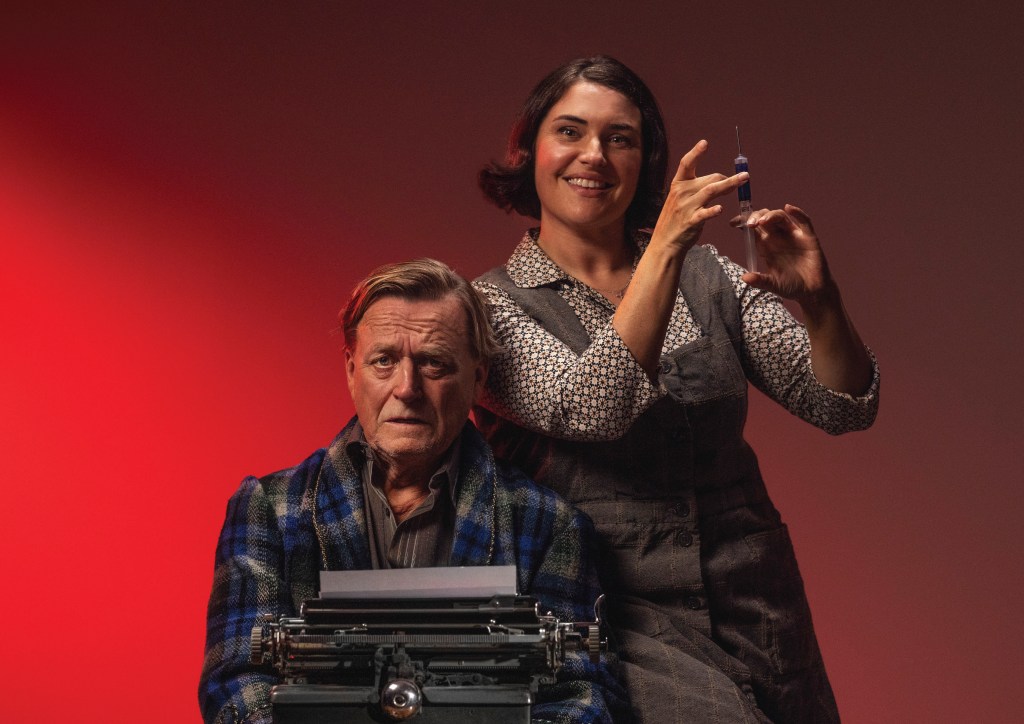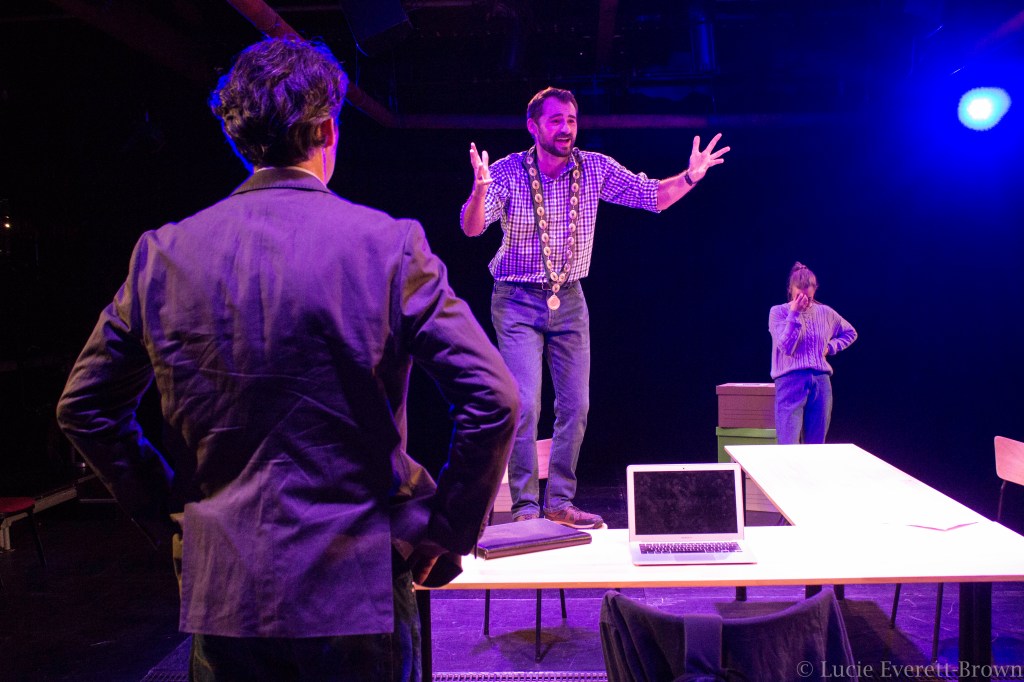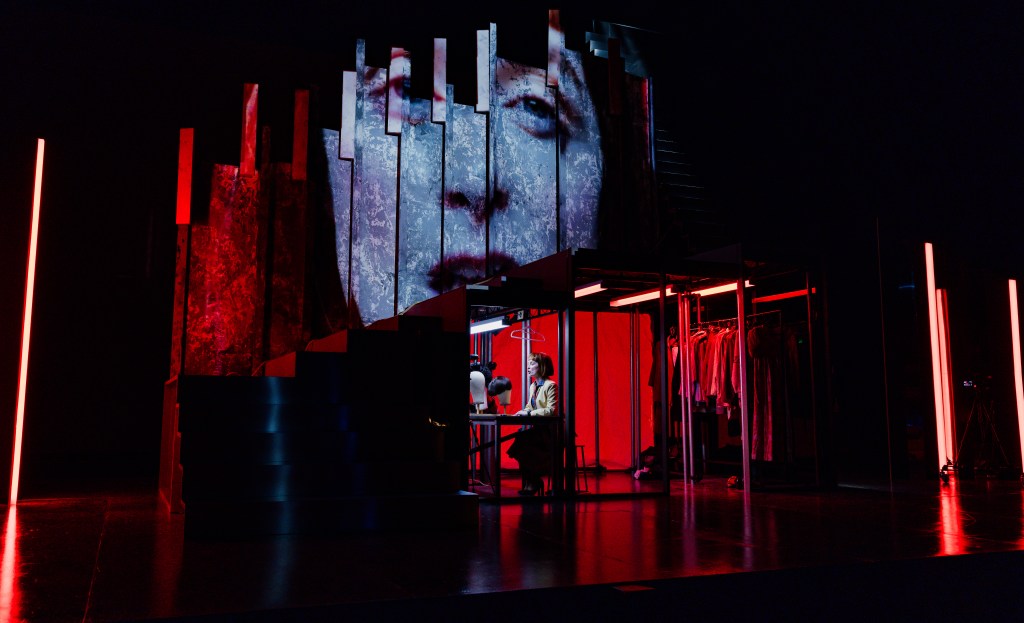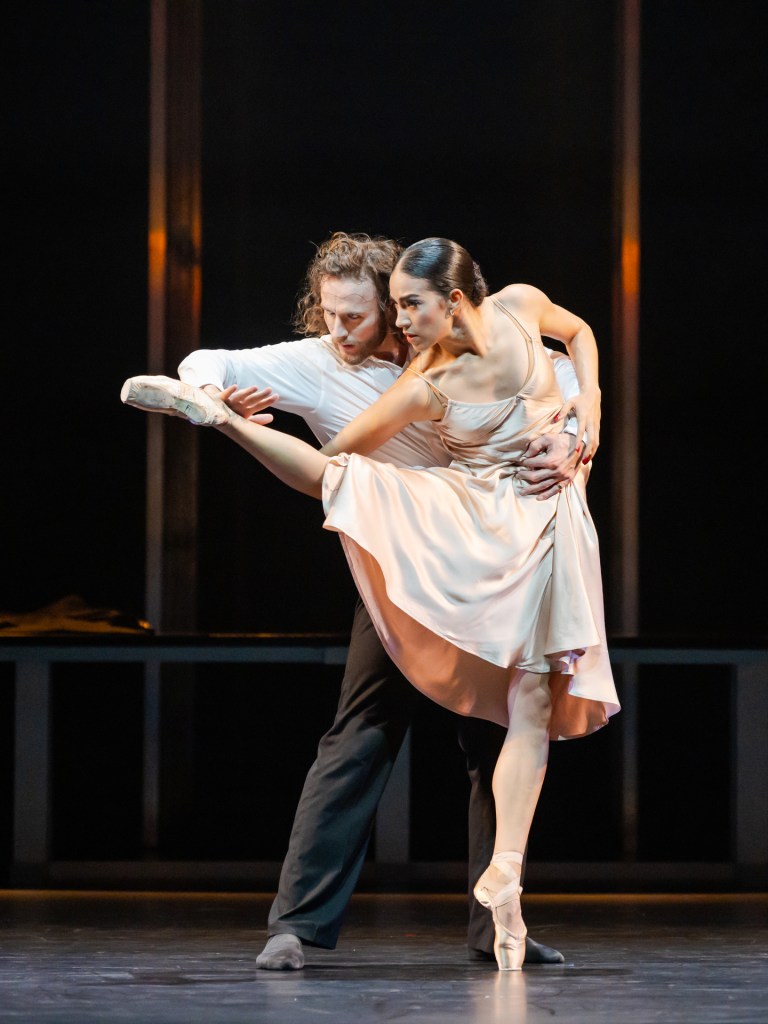
Peter Stockmann (Sam Bunkall), Thomas Stockmaan !Fraser Hofmann. and Katherine !Grace Cullen) Image: Lucie Everett-Brown
An Enemy of the People
By Henrik Ibsen
Flyleaf Theatre Production
Q Theatre
Until 22nd August
Reviewed by John Daly-Peoples
In this new version of Ibsen’s “An Enemy of the People” adapted by Aaron Richardson, Dr Thomas Stockmann (Fraser Hoffman) has discovered that the local spa, Te Wai Puia is poisoned from rural runoff and industry. He attempts to inform the local residents and civic leaders through the local newspaper and its sympathetic editor.
Initially he has some support but then there are attempts to cover it up, and the local people turn against him. However, Stockmann still pursues the truth which leads to him being discredited, losing his job and wife. He is also faced with an interfamily drama as his brother Peter (Sam Bunkall) who is also the mayor is opposed to his comments and opinions.
This modern reimagining relocates the story from nineteenth-century Norway to present-day Aotearoa and our own water crisis. This emphasis on water, the commercial and rural use as well as the concern for safe drinking water becomes a real issue. This is emphasised by the large water pipes surrounding the roof of the stage with water dripping into buckets and a small flood in the final act.
As the sole beacon of truth Fraser Hoffman gives a great performance with speeches which are filled with crusading zeal and inspirational lines – “You can’t ignore the truth” and “the public has to hear the truth even if they don’t believe it”.
While he is the hero of the play, he ultimately becomes the lone voice crying in the wilderness. His standing for truth and his zeal is not sufficient to convince everybody, so even his wife Katherine (Grace Cullen) who gives a fine performance as the conflicted wife is forced to leave him.
There is also a well-judged performance from Sam Bunkall who plays Peter Stockmann the brother of Dr Stockmann. Sam Bunkall and Hoffman complement each other wonderfully as they argue on what is best for the town and their onstage physical fight was wonderfully orchestrated.
Joseph Wycoff as Hobson the editor of the local newspaper gave a polished performance as did Matt Chamberlain as Martin whose Everyman approach to was convincing.
Director Grace Augustine has created nuanced production where the characters take on the subtly of real-life politicians as they take up their positions in their investigations of the truth / facts / opinions. Even the audience is left with conflicting views on who is best at protecting the town and the environment.
The minimal set (also Aaron Richardson) works well especially the final scene where the audience becomes the onlookers at a Town Hall meeting, and we feel we are part of the cast.
The ambient sound designed by Laika Rountree initially seems to add to the plays emotional impact but used throughout becomes something of an irritation, detracting from the emotional power of the play.
The Queen’s Nanny By Melanie Tait Tadpole Theatre Productions Director Simon Prast Set John Parker Lighting & Sound Gareth Evans and Geoff Evans Costume Robyn Fleming With Anna Julienne, Laura Hill, Jack Buchanan
Pumphouse Theatre, Takapuna Ends 24 May
Reviewer Malcolm Calder 15 May 2026
I had a lovely little evening out at The Queen’s Nanny last night.
But first a very brief history lesson.
Elizabeth Angela Marguerite Bowes-Lyon, initially Duchess of York, became King’s Consort in 1936 when her husband the Duke of York – known as ‘Bertie’ to intimates – ascended to the British throne as King George VI.
Throughout her life, she became an increasingly popular figure with the British – she and Bertie cutting a dashing swathe through English society when younger, Elizabeth devising outrageous cocktails and an impeccable dress sense, while her husband did his best to keep up as he somewhat trepidatiously stuttered his way to the throne. Elizabeth’s seemingly indomitable spirit provided moral support to the British public during WW2 and took on a life of its own afterwards. Privileged, eccentric and outrageous on occasion, she somehow connected with the people. I have never quite worked out why – but she did. No question.
Australian playwright Melanie Tait spans much of this period with The Queen’s Nanny, a tale of young Scots child psychologist Marion Crawford who became a governess to the royal couple’s then young two daughters initially for six months and eventually in a tenure that was to last seventeen years.
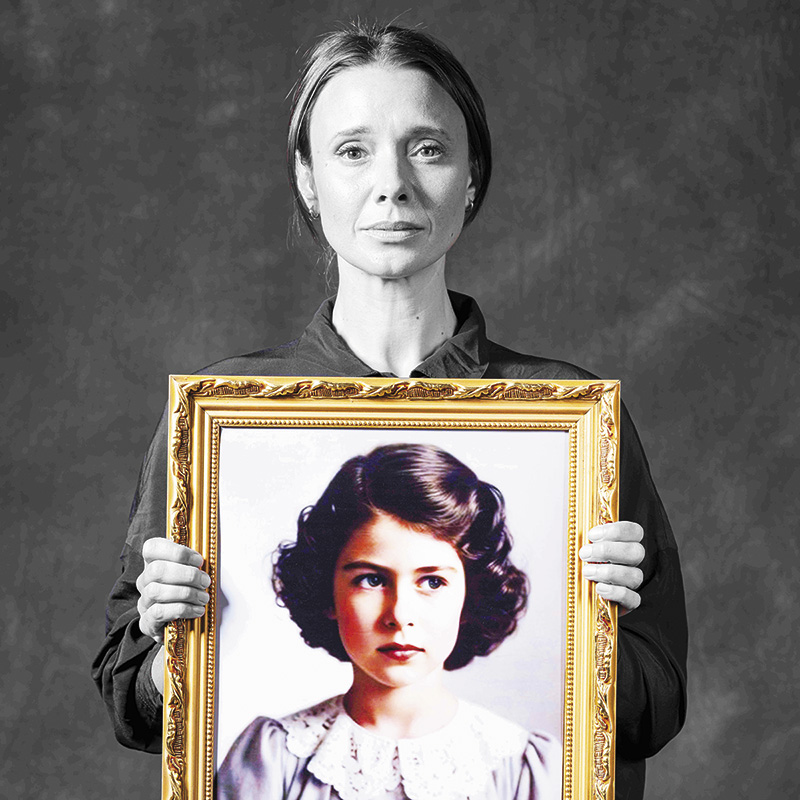
Crawford, or ‘Crawfie’ as both knew her, became the intimate companion of the princesses Elizabeth and Margaret. She become a trusted servant of the family and her service continued until Princess Elizabeth’s marriage in 1947, two months after Crawford’s own wedding that she had postponed for 16 years to serve the family.
So she then wrote a book about bringing up the two royal princesses, used her own name and was rather well paid. The Great British Reading Public loved her words and they sold rather well. Extremely well in fact. So did American readers who lapped them up like hot cakes. I mean to say … sensational revelations, how could they not!
But Crawfie had made something of a colossal blunder. She had omitted to ask permission from the now Elizabeth Queen Mother to do so. Who took exception to them. And that sets the scene for Tait’s play.
Crawfie was cast aside. Ignored and ostracised by the royals and treated like some kind of highly contagious, self-seeking, colonial leper. Y’know, the kind that feature in tabloids or in social media everywhere these days. How outrageous. How dreadful. How could she !
These events are explored with impressive economy by playwright, Melanie Tait, with a cast of only 3. Or maybe 15 or so if you include all the characters played by Jack Buchanan. He slides easily and quite believably through them : everything from an Australian journo (‘you’re assigned to the royals desk, son’), to a butler, to Crawfie’s husband and even to a 7-y-o Princess Eizabeth. Importantly, his characters provide an essential element in the structure of the play – giving the two prime protagonists something to bounce their lines off and providing both context and location. He does so admirably.
However the true strength of the play lies in what is not said. And Simon Prast once again handles this with subtlety and nuance. Backed up with John Parker’s simple set that uses projected moving visuals to convey location, time, space and movement. Quite effective on the small Pumphouse stage I thought.
Anna Julienne gives us an entirely believable Crawfie. Humble, dedicated and loving although childless herself, living a life that has been shaped by the family she has spent so many years tending and caring for. Selfless one might say. She aged the character remarkably well and her and her command of accents matched the say she aged the character.
I think I was looking for a little more bitterness in her Crawfie towards the end but perhaps her ritualised daily preparation of the afternoon tea and then waiting by the window on the road to Balmoral sure in her own mind that the young Queen would stop her landrover and partake of the scones said that far more poignantly.
Many years later my own father used to describe the time he met a somewhat bewildered older woman on an upper floor of a New Zealand hotel, asking in a stentorian voice when the lift was going to be fixed, where the stairs were located and was the bar open. Yes, slightly bumptious he said, with a definite presence and sense of entitlement, but he was more concerned she had addressed him as ‘boy’. That recollection probably coloured my view of Laura Hill’s Queen Mother (Elizabeth if you will).
She was exactly the Queen Mother I have always imagined, with an inimitable on-stage presence, an impish sense of humour and a superior view of the rest of the world with never a hint that she was anything but right in everything she did, thought and said.
For a time I wondered what Melanie Tait was trying to say with this play. Was she having a go at those with a worldview that is one hundred percent insensitive to others? Was she endeavouring to comment on the entrenched (to this day) British class system? Or that wealth speaks (perhaps one might substitute contemporary American attitudes and behaviours today)? Or maybe that there are social iniquities and we should simply accept them? Or personal loyalty? Or maybe the vastly changed mores of contemporary society? Or was Crawfie actually the saint many apparently believed ?
Perhaps all of these and a few more tossed in as well.
The Queen’s Nanny is not a world-shattering play, but this production is definitely a lovely little evening out.
One of the almost unrecognised literary / artistic areas of New Zealand culture has been the zine.
Zines, a corruption of magazines or fanzines are non-commercial, self-published, small-circulation booklets, often produced by hand or photocopied in limited editions of often only a few hundred copies. They are derived from anti-establishment, punk-rock music, and other activist cultures, providing a platform for personal expression, niche topics, and marginalized voices.
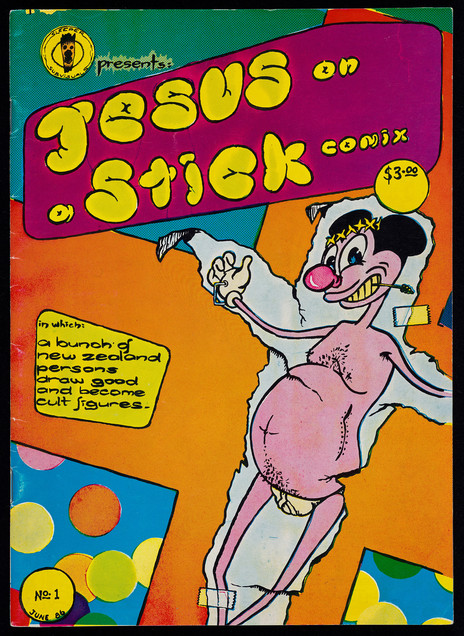
Chris Knox, Jesus on a stick
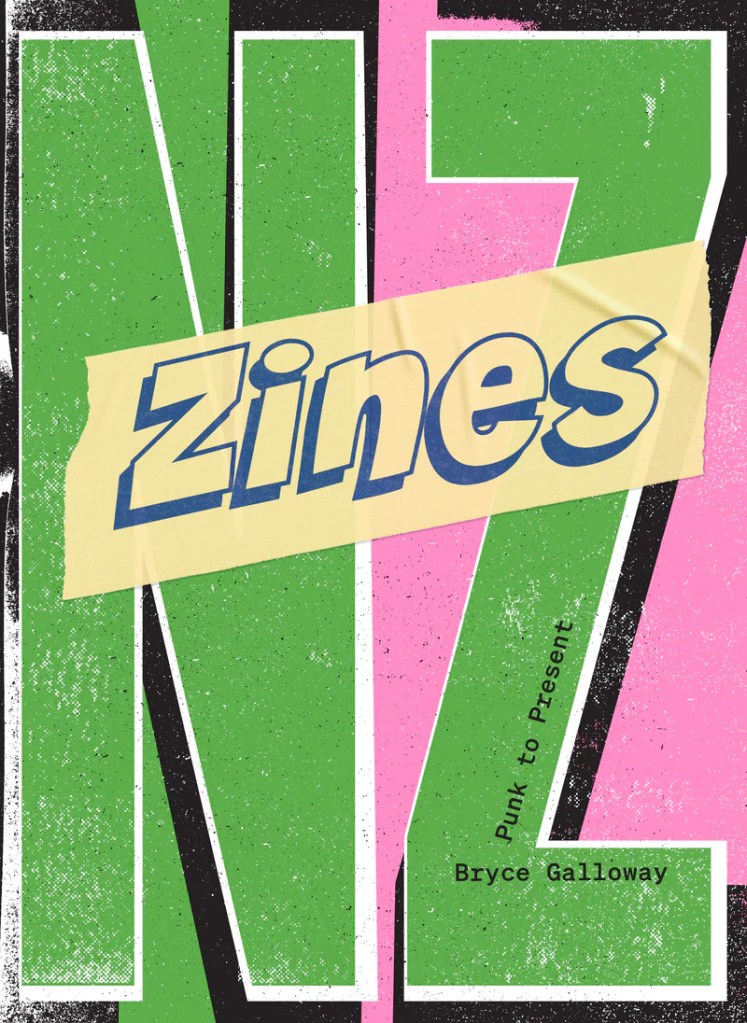
Even though the zine in New Zealand has been widespread there has been no serious writing about the form. Until now. Bryce Galloway’s “Zines NZ: Punk to present” is written by a zine devotee and is packed with hundreds of images of zine covers and spreads, most of which charm with lopsided collaged energy and all of which possess a singular vision. Zines are so often ephemeral and elusive, and this book’s tribute to so many rich and distinctive voices ensures that their history is not lost.
Some of the early names like Barry Linton and Dylan Horrocks who were major forces early on are mentioned along with others who helped establish the numerous outlets which has seen a plethora of voices over the past forty years.
Galloway says the impetus for the book was largely personal, having been a zine creator himself
“I was interested in finding the thread from today’s plethora of zinefests back to the punk rock zines of early 80s Aotearoa. In 2015 I wrote a rather subjective history of 21st century zines in Aotearoa. I released this as issue 56 of Incredibly Hot Sex with Hideous People, also presenting it at pop culture and bibliographic conferences. I was thinking, who’s qualified, who could I commission to research and write the earlier part of Aotearoa’s zine history? Eventually I decided I should just take the job on myself.”
He acknowledges that the zine has been side-lined by the art/ publishing/ library world. “I’m sure they’ve been looked down upon, but many in the zine scene wouldn’t have it any other way. For all those who celebrate the growth in this media, there’s others who see the shift from scrappy punk zines and zinefests in community halls to zinefests in major galleries and the like as evidence that zines have lost their edge. I don’t think that’s true but there’s something to be said for the aesthetic challenge made by your scrappy punk zines versus your well-crafted Risograph-printed chapbook for example.”
While Galloway has written this history of the zine, he has also included extensive quotes from around fifty other zine creators who expand the history with all the various personal motivations behind the various concepts and designs.
The book is packed with information along with dozens of illustrations from the zines produced by authors / designers who are well-known such as Chris Knox and David Tulloch to lesser known, but prolific names like Sarah Laing and Indira Neville.
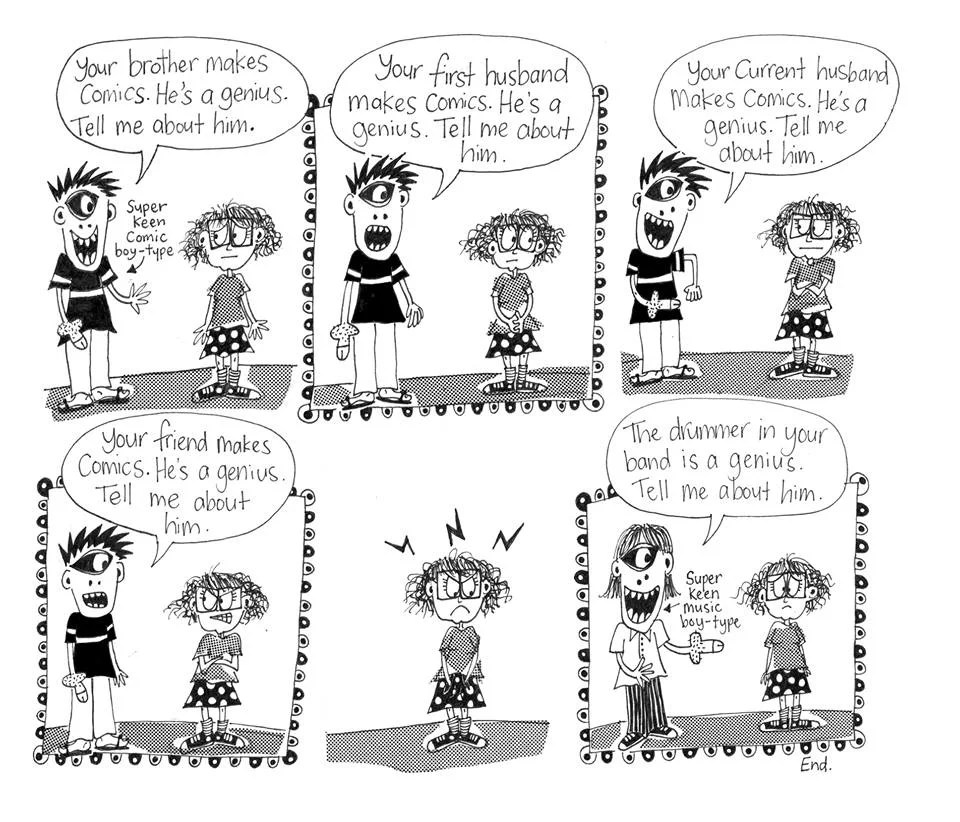
Indira Neville, An Incompetent Girl
Along with being a history of the zine in New Zealand Galloway has provided a personal political and social history of New Zealand featuring significant events and individuals who have helped create change in New Zealand over the last forty years.
Helen Clark in Six Outfits uses the notion of tracking Helen Clark’s career through reference to the clothing she wore at various stages of her life. It is a concept which even the stage version of Clark rejects going on a rant about how she has always been judged by appearance – her hair, her teeth, her voice and her marriage. All those notions which are rarely used to demean male parliamentarians.
The play traces the life of Helen Clark from school kid through to the present as she climbs both the academic and the parliamentary ladders to her unsuccessful bid at becoming the Secretary General of the UN.
Along the way we/she remember the fluctuating fortunes of National and Labour governments as well as encountering the major political figures of the time – Phil Goff, Jim Anderton, David Lange, Jonathan Hunt, Jenny Shipley, Judith Tizard and even Winston Peters -is he still alive.
We also hear the voice of Brian Edwards who acts as a voice-over Narrator and was one of her early media advisors / image consultants. We also get to encounter her more recent media consultant, Maggie Eyre.
Studded though her career we get the major achievements of her and her governments – paid parental leave, free early childcare, the New Zealand Superannuation Fund. legalized prostitution and civil unions for same-sex couples.
Loooming over the stage is a clever set designed by Dan Williams which features a mountain-side which Clark ascends from time to time. It acts a a metaphor for her ascent to power as well as her physical/ mental / political struggles to reach the summit of her career.
As the older Clark Jennifer Te Atamira Ward-Lealand gives an impressive account of the politician, at time managing to capture the sound and intonation of her voice as well as her stare. Lauren Gibson as the younger Clark while not quite getting the voice manges to give an astute sense of the earlier Clark with her aspirations and self belief.
Ward Lealand also does a reasonable job of some walk-on parts such as Clark’s father a farmer who was at the other end of the political spectrum but still supported his daughter.
While this play is about serous stuff of politics Fiona Samuel takes a comic approach to the material which had the audience appreciating the political and personal witticisms such as the reference to Clark’s early page boy haircut – her “Joan of Arc” look
The play concluded with Ward-Lealand delivering a Clark speech. I couldn’t remember it all, but it went somewhere along the lines of –
“Let me note now the great importance of empowering women, including through education, to be part of leadership at every level. Equality between women and men at decision-making tables ensures that the perspectives of both get full consideration. As women, we are fully justified in asserting that there should be no decisions made about us without us.
When women are at those decision-making tables, they have the power to change priorities to what matters for the health and well-being of families and communities.
Empowered women become the architects of better health and well-being, making informed decisions for themselves and their communities.”
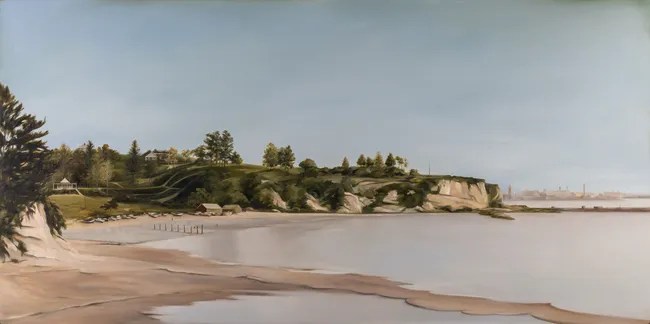
Shane Foley’s “Tide and Tide” exhibition is based of archival images of Auckland‘s waterfront from the nineteenth and early twentieth century. They are of images of foreshores, beaches and building, most of the which have disappeared,
Several of the works make reference to Auckland’s history so “Campbells Point at Judges Bay” ($7500) includes `Kilbryd’, the large Italianate home of Sir John Logan Campbell. In this painting the artist has shaped much of the view making the foreshore beach a series of flat planes while the cliffs below the house have been sculpted with gentle curves of lawn.
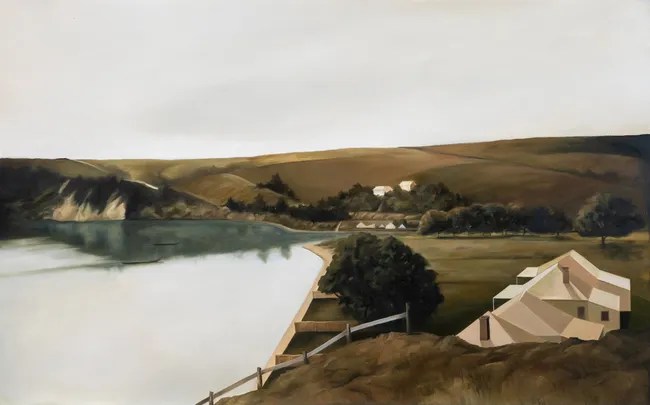
Shane Foley Heaphy’s View, St Georges Bay, early 1860’s
In her “Heaphy’s View, St Georges Bay, early 1860’s” she has carefully constructed two houses in the foreground while two background houses owe much to Braque’s “Houses at L’estaque”.
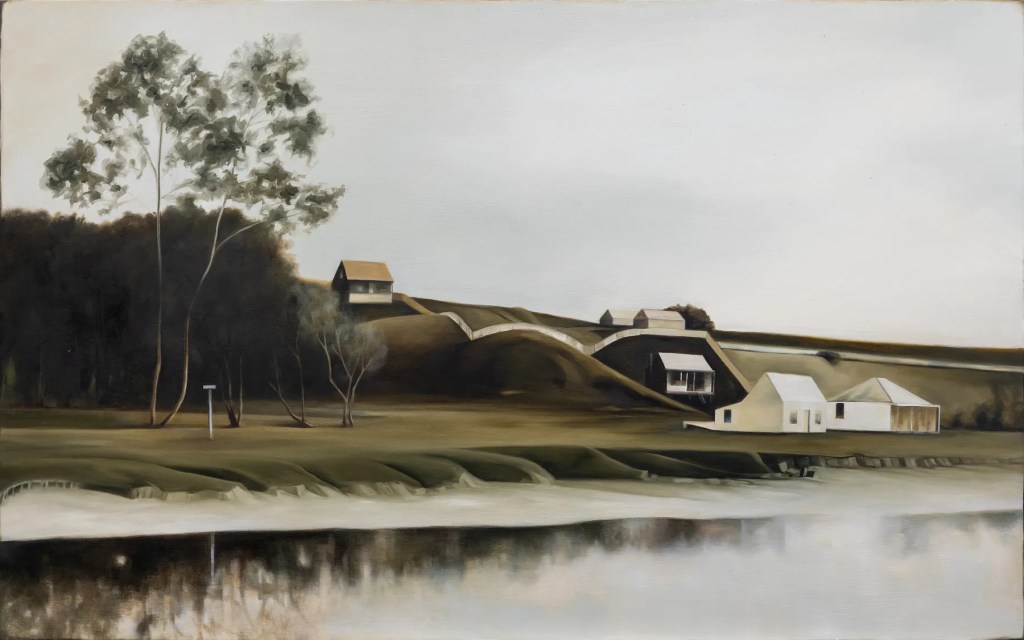
Shane Foley Settlement, St Georges Bay 1867
With “Settlement, St Georges Bay 1867” ($3800) the houses seem like surreal addition, the boxlike shapes placed in the carefully formed landscape consisting of folded landforms, where the fence lines are made from abstract curves.
With “Trees at Shelly Beach, Pt Erin 1914” ($1900) she has depicted one of the now forgotten buildings which could be found on Auckland’s waterfront. This was the salt water, tidal baths at Pt Erin which were demolished for the Auckland Harbour Bridge.
Other buildings from the period include “West End Rowing Club at St Mary’s Bay 1914” ($4800) and ‘The Jetty, St Mary’s Bay. 1950’s’ ($4800) where the eerie white buildings stand out from the background.
There is a slight tension in viewing these works, as the past and present merge and the abstraction the artist uses distances our view, giving them a dream-like aspect.
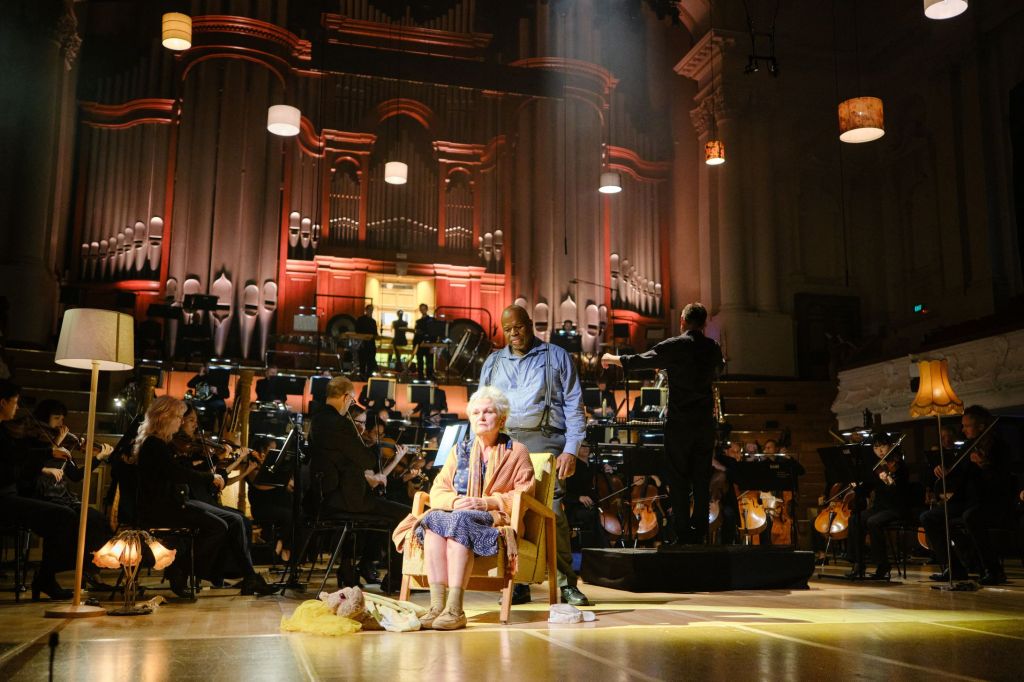
Judith (Susan Bullock) and Bluebeards (Lester Lynch) Image: Thomas Hamill
Bluebeards Castle
By Bela Bartok
NZ Opera & Auckland Arts Festival
Aotea Centre
March 13th & 14th
Reviewed by John Daly-Peoples
In Bela Bartok’s original staging of Bluebeards Castle, the newlywed Judith enters her husband’s dark, foreboding castle where she is faced with seven locked doors that she is forbidden to open. In this version by Daisy Evans, it is a single trunk which holds the memories of the couples past lives which Bluebeard remembers while Judith herself seems to become lost to him.
For this production director Daisy Evens created a new Judith who is somewhere between an older woman with dementia and a woman facing her own psychological breakdown and who along with her husband can be seen as displaying the Freudian concepts of sexual trauma.
The castle can be seen as symbolic of Bluebeard’s soul; a dark mind filled with secrets that threaten to reveal his true nature. The opera itself can be seen as an allegory for the loneliness of the human soul, the impossibility of truly knowing another person, or the conflict between rational and emotional.
Bartok was writing the opera at the same time that Freud was engaged in studies into psychoanalysis and elements of this have seeped into Bartok’s thinking which aligns with Freud’s theories of exploring the unconscious mind, hidden sexual desires, and psychological trauma.
Bluebeards Castle like other Symbolist art works, replaced traditional dramatic narratives with dark, subjective internal journeys, mirroring the Freudian focus on repressed emotions and dreams.
Despite Bluebeards protests she removes the symbolic items from the chest and in doing so she discovers events from Bluebeards past, events she needs to recognise if she is to fully understand him. He also needs to acknowledge these events if they are to be a truly understanding, loving couple.
In opening the chest for the seventh time she discovers the three women of his past, one found in the morning, one at noon and one at sunset, Then with Judith, his fourth, the bride he found at night, having fully understood her husband she joins the women leaving Bluebeard in perpetual darkness.
The seven memories in the trunk contain the relics of the couples past that Lester Lynch’s Bluebeard remembers with joy and anguish, while Susan Bullock’s Judith emotionally engages with her former self, as lover, bride and mother.
References are made throughout the opera about the power of light to overcome darkness and symbolic of this the stage was studded with two dozen domestic lamps which flickered on and off at various points.
Like the story of Bluebeards Castle, the music is mysterious and riveting, providing a background soundscape which seems to continually shift as the various events of the opera are revealed.
Throughout the work there were sequences where the music provided particularly unsettling sounds, while there were other times when the orchestra was able to symbolise the idea of light flooding into the darkness of the castle. There were some exquisite passages particularly the blaring drama of the organ which was like a palpable force and the swelling of the strumming harps.
It was the emotional richness provided by the two singers which helped maintain the tension along with their creation of character though their acting. Bullock displayed a voice of amazing power while Lynch plumbed great depths as he revealed his inner thoughts.
This production was a stunning display of acting and singing along with an inspiring performance by the Auckland Philharmonia under the direction of conductor Brad Cohen.
Brandon Reiners and Ana Gallardo Bobainaw Photo credit: Stephen A’Court.
Macbeth
Auckland Arts Festival
Royal New Zealand Ballet
Co-production with West Australian Ballet
Kiri Te Kanawa Theatre, Aotea Centre
4-7 March
CREATIVE TEAM:
Choreography – Alice Topp Set & Lighting Design – Jon Buswell
Costume Design – Aleisa Jelbart
Dramaturgy – Ruth Little
Music – Christopher Gordon
Conductor – Hamish McKeich
String Ensemble – Musicians of the New Zealand Symphony Orchestra
Then
Dunedin, The Regent, 13-14 March
Christchurch, Isaac Theatre Royal, 18-21 March
Reviewed by John Daly-Peoples
The Royal New Zealand Ballet ‘s new Macbeth, is a contemporary interpretation of one of Shakespeare’s most ruthless tragedies which is as relevant now as it was four hundred years ago. As in many of his plays Shakespeare explores the intense, often tragic tension between the individual and the state, showcasing how personal identity, ambition, and morality clash with political power and societal duty. In his plays state authority and sovereignty, demand conformity, yet individuals seek autonomy or challenge the status quo, navigating complex power structures.
He explores the Machiavellian rise to power and the devastation that two individuals can inflict on the state.
This is all achieved in this production through the choreography, the sets and the music.
The sets designed by Jon Buswell are essentially minimalist while the lighting, also by Buswell is more complex. At some points the lighting is focused on the main characters, at other times shadows and darkness dominate.
Created by internationally director / choreographer Alice Topp the ballet unfolds in a ruthless modern world shaped by political ambition, media manipulation and the fatal seduction of power.
She says, “Macbeth is one of Shakespeare’s great tragedies, exploring themes as current today as they were when first written,” says Alice Topp. “An epic story fuelled by political ambition, passion, desire for power and the burden of guilt, its potency endures. Our Macbeth is set in a hierarchy-hungry, high-society city, where political storms, media frenzy and personal ambition collide.”
The music for the work has been composed by Christopher Gordon and features both recorded and live music. One hundred and twenty-nine musicians contributed to the recorded music while an octet of strings from the New Zealand Symphony Orchestra provide live music. The musical landscape provides full orchestral sound with driving, unrelenting tempo that echoes the character’s anxieties.
Gordon created a series of musical themes designed to reflect the characters as well as the mood of the various sequences of the ballet. His complex music consisted of big band music, electric dance music, funk, film music and references to composers such as Phillip Glass.
At the centre of the ballet are the two malevolent Macbeths (Brandon Reiners and Ana Gallardo Bobainaw) who dance their solos, pas de deux with moves which indicate corruption and self-centeredness.
The visceral language of the choreography is used to explore the characters psychological pursuit of power and duplicity.
The classical poses and movements which are normally used to display romantic connections were subverted so that these movements create a disquiet which reflects their own inner turmoil. When the two of them dance their elaborate almost ritualistic dances they seem to be abusing each other in erotic displays.
While the sets are minimal, they are often dominated by tables surrounded by protagonists who engage in discussion and planning. These balletic movements around the table recall Canadian choreographer Crystal Pite’s “The Scenario”, her witty take on a boardroom meeting,
As the three witches / influencers Kirby Selchow, Ruby Ryburn, and Shaun James Kelly are an excellent melding of the comic, the supernatural and the intruding media with the endless writhing, gesturing and guttural sounds.
Laurynas Vėjalis as Duncan, Dane Head as Malcolm, and Kihiro Kusukami as Banquo gave strong displays which contrasted with the spikey dancing of Reiners and Bobainaw.
There were a few occasions when the audience was given some indication of the story with texts projected onto screens, including a few lines form the play itself but there were other times when the audience could have been given more useful indications of location and event.
We are surrounded by music every day, in our houses, in the public space in shopping malls and with our audio devices and through this soundscape to our lives which we build up a huge sound bank of songs and music. Often, we are not aware of how this music is created but we are conscious of its components such as melody, harmony, rhythm, tempo, dynamics, timbre, texture, and form, which work together to create a piece of music. But we rarely investigate them, they are magically and mysteriously assembled, providing enjoyment and diversion There are many though who become obsessed by what a composer, band or singer have created and how these creators have seemingly produced something which touches on our psyche, our emotions and our way of seeing the world. There are some writers, composers and philosophers who try and understand this fascination with what music is and what it does.
Roger Horrocksm is deeply interested in this world of music and his new book “Music Without End; A book of listening” which follows on from his 2022 book “A book of Seeing” delves into areas of music which will resonate with readers as well as offering new perspectives and insights.
As the author says in his preface “I take a very broad approach … since I am interested in popular music, jazz, classical music contemporary classical sounds and music form non-Western traditions (including, Indian, African and Māori).
This very catholic approach has resulted in a book which covers the musical landscapes which most readers will be aware of but also presents new landscapes which will be new, novel and intriguing sending readers off in a quest for these often unknown composers, musicians and compositions.
The four chapters of the book are Music and Listening: A personal History, On Listening, Interviews and Music without End: A History of Western Classical Music
The opening chapter reads very much like the account many music lovers would write- early encounters with music which stimulated great interest in listening and collecting music. For Horrocks this has led to a very wide interest in both classical and popular music. He recounts his exploration of music with its various interwoven strands such as hearing Vivaldi’s “Four Season as the soundtrack to Kenneth Angers 1953 short film “Eaux d’Artifice” filmed at the Villa d’Este.
His music education really developed when he spent time in the1960’s is the US One encounter meant that he saw the Merce Cunningham dance groups performing to music by John Cage and David Tudor and also got to talk with John Cage. An encounter with Arab / Andalusian music in a taxi in Paris as well as exposure to the experimental jazz of the of the 1960’s hearing musicians such as Ornette Coleman and archie Shepp
He also includes miscellany of musical events such as a performance of Handel’s “Messiah” at Crystal Palace in 1857 which had an orchestra of 500 and 2000 singers. Providing a New Zealand context, he notes that two years before the concert the infant Auckland Choral Society had performed the work in Auckland.
For the third chapter the author interviewed ten contemporary musicians who offer different perspectives on the Importance of listening, inspiration and process in the creation of music. These include contemporary composers Eve De Castro Robinson and Annea Lockwood, conductor / composer /performer, Petere Scholes and singer Caitlin Smith,
“Music Without End: A history of Western Classical Music”, is the final chapter in the book takes a broad approach to the history of Western Music. As the author notes, ‘What interests me is the constant evolution of styles and genres, along with development of instruments, venues and technologies.
Here he follows the course of the Western music over 800 years looking at the major periods – Baroque, Romanticism, Late Romanticism, Modernism, as well Atonal Music Serialism and Minimalism, He also devotes space to many of the Russian composers. including Sofia Gubaidulina, Alfred Schnittke and Valentin Silvestrov.
As well as looking at various aspects of music he devotes much of the book in tracing out the historical threads of Western Music he interested is in trying to understand how the music got to be written and the changes in approaches to composition.
In his exploration of the nature of listening he broadens out his enquiry, looking (and listening) at music from various perspectives such as the compositions of John Cage where the music is close to a theoretical or philosophical model.
This exceptional book not only introduces readers to many specialist areas of music, but it does so using an accessible language, providing interesting anecdotes and providing readers with a way of understanding their own approaches to music.
The “Follow button” at the bottom right will appear and clicking on that button will allow you to follow that blog and all future posts will arrive on your email.
The Collector; Thomas Cheesemen and the making of the Auckland Museum
Andrew McKay and Richard Wolfe
Massey University Press
RRP $65.00
Reviewed by John Daly-Peoples
Museums have had a lot of critical press over the past few years, viewed as agents of the colonizers because their collections often contain artifacts taken from colonized countries, and their early practices reinforced colonial ideologies by presenting the colonizer as superior. They functioned as a means of control, where European museums collected objects from voyages of exploration and colonies to showcase their dominance and justify the imperial project. But a major thrust of museums has also been to preserve, interpret, and exhibit the local cultural and scientific heritage serving as a bridge between the past and present by collecting objects, telling stories, and providing a space for people to learn, reflect, and connect with history, art, and science.
That has certainly been the aim of the Auckland Museum and the individuals who initiated it, guided it and developed it. A new book “The Collector; Thomas Cheeseman and the making of the Auckland Museum” tells how the Auckland Museum, like man y other museums in the nineteenth century were guided by visionary individuals.
The newly opened Auckland and Institute in 1876 Thomas Cheeseman stands in the doorway
Authors Andrew McKay and Richard Wolfe write about the establishment of the museum’s first custom-built building in 1876 at the northern end of Princes Street. When it opened the director was Thomas Cheesman who had been in the post since 1874, remaining in the post remained in that post until his death in 1923.
They write about the original building which was unfavourably compared to the more ambitious Christchurch Museum. It was “plain, improvised and almost invisible … It was housed in an old public building, with little funding and few staff. But that’s what makes the story compelling. The contrast between the buildings isn’t just architectural — it reflects differing levels of civic support, cultural ambition and access to resources. Auckland’s museum didn’t look like much, but it had people with vision, especially Thomas Cheeseman. Over time, he took that underwhelming space and turned it into a serious scientific institution.”
Under his visionary guidance the Museum and its collections flourished, necessitating a further move and the commissioning of a world-wide architectural competition to design a new Museum for Auckland which would be combined with a war memorial to commemorate soldiers lost in World War I. That new museum opened on its current site in 1929.
Not only did Cheesman manage to the institution for nearly fifty years but as a self-taught botanist he travelled the length and breadth of New Zealand, collecting and recording plants, and observing the geography of the country. During his career, Cheeseman also published numerous important papers on a range of flora, described three plant genera, and numerous plant species from New Zealand and the Cook Islands. At the request of the New Zealand government, Cheeseman began his magnum opus, Manual of the New Zealand flora, which was first published in 1906and in 1914 he edited the two-volume work Illustrations of the New Zealand flora.
Thomas Cheeseman
Cheeseman met or corresponded with many of the scientists in New Zealand as well as extensive professional relationships with local and international colleagues, including the German-born geologist and director of the Canterbury Museum, Julius von Haast, the geologist James Hector of the the Colonial Museum, the geologist, zoologist and museum director Frederick Hutton as well as Sir Joseph Hooker at the Royal Botanic Gardens in Kew, England.
Early on in his career he even corresponded with Charles Darwin as the authors write. “Charles Darwin was arguably the most famous scientist in the world and also one of the most controversial. And it wasn’t just a lucky moment. Cheeseman’s note was careful, respectful and scientifically rigorous. It showed that he wasn’t just some amateur with an opinion — he was a careful observer who took the work seriously. Darwin saw that. For Cheeseman, it must have been thrilling and validating. It also helped open doors — that exchange helped establish his credibility in the scientific world, and it reinforced the idea that valuable knowledge didn’t just come from Oxford or London, it could come from a young man on the edge of empire, with a sharp mind and a notebook. That Cheeseman dared to write at all — and so confidently — speaks volumes about both his scientific maturity and his quiet self-assurance.”
The book highlights Cheeseman’s efforts to develop the taonga Māori component of the museum and also touches on the ethically sensitive area of collecting the art and culture of Māori noting ‘While Thomas Cheeseman was largely guided by the norms of nineteenth-century science, some of his actions — particularly around the acquisition and display of taonga Māori — now fall into ethically ambiguous, if not outright troubling, territory. His drive to build the Auckland museum’s collections sometimes led him to treat cultural objects as specimens, detached from the communities that made and valued them.
His acquisition methods could also be problematic. In several cases, taonga were obtained through missionary networks, collectors or private sales, often with little documentation about provenance or permission. Cheeseman rarely questioned the ethics of these transactions… These actions were not driven by malice, but rather by an unshakeable belief in the civilising power of museums and the primacy of scientific classification.”
The book tells the history and development of the Auckland Museum and its progress over more than fifty years to the triumph of the building on the present site in Auckland Doman. It also tells of the journey of Thomas Cheeseman who become a great person of influence not just in Auckland but nationally. The book also gives an account of the changing scientific and cultural landscape of the latter part of the nineteenth century and the early part of the twentieth century.
It is a well-researched and written book, thoughtfully designed with numerous images which help tell the entwined stories of Cheeseman, the development of scientific inquiry, the museum and museum’s collections.
Andrew McKay holds a PhD in art history from the University of Auckland and was a Professional Teaching Fellow in the university’s art history department.
Richard Wolfe is an Associate Emeritus of the Auckland War Memorial Museum and from 1978 to 1997 was Curator of Display. He has written numerous books on New Zealand art, history and popular culture.
The “Follow button” at the bottom right will appear and clicking on that button will allow you to follow that blog and all future posts will arrive on your email.
Based on the book by Trent Dalton Additional Writing and Story: Trent Dalton and Fiona Franzmann Adaptor: Tim McGarry Choreographer & Movement Director Nerida Matthaei Associate Director Ngoc Phan Set & Costume Design Renee Mulder Lighting Design Ben Hughes Video Design and Cinematographer Craig Wilkinson Composition & Sound Design Stephen Francis
Civic Theatre
October 17
Reviewed by John Daly-Peoples
Before heading off to see Trent Daltons “Love Stories” a quick survey of what love is was in order. First stop would be Shakespeare, and he almost nails it with
“Love looks not with the eyes, but with the mind” from a Midsummers Night Dream
The audience filled the Civic Theatre and on stage all we see is a panorama of the audience looking back at ourselves. All of those people who know about their own encounters with love. They are the mass of humanity who are hoping to find out the truth / answer to the eternal question. – What is love?. And each one of them knows what it is. Each one can tell their own story
And then scrolling across the screen are the answers we could give, all provided by previous audience members
LOVE IS
Lasting the distance. Even when you think you can’t do it.
The perfect coffee with crema on Sunday morning
Saying sorry and meaning it
Being confident in the silent moment
Magical; poetic, sometimes messy
And dozens more some profound, some very personal, some cliched
Trent Dalton spent two months in 2021 gathering stories on his 1960’s blue Olivetti typewriter, on a prominent street corner in Brisbane’s CBD. He had sign which read “Sentimental writer collecting love stories. Do you have one to share” Speaking with Australians from all walks of life, he received hundreds of them.
The show opened with Jean- Benoit and his drumming as he introduced the show and it closes with his taking us backstage through to a simple doorway which led us back out of the theatrical world of make believe into the real world.
The dozen actors who swarmed the stage enacting the stories, some lasting a few minutes, other only a few brief moments created a topography of love with its range of, stories, anecdotes and remembrances.
Some of the stories are profound, some of them flippant, some of them might have been written by the writers at Hallmark Cards. Other could have been written by your partner, boyfriend, girlfriend.
Director Sam Shepheard wove the various stories together, the actors changing guises as they connected and parted. Sometimes cameras made their faces balloon up large on the screen as they addressed the audience. Many of the stories are moving, rich in compassion, witty, and full of allegories.
The entire cast created impressive range of characters and encounters and there were some clever sequences – a bit of a Juliet speech, a quote from Emily Dickinson, a scientist explaining about technical aspects of dopamine
Holding much of the performance together was Jason Klarwein (the Writer / Husband) and Anna McGahan (The Wife) where the actual world of the couple seems at odds with his accounts of the people from the street with their passionate, flawed and intermingled lives.
And there are several life stories all woven together such as a film segment delivered by Joshua Creamer, a barrister and human rights activist who not only tells his personal story but also the story of land rights, family, and his identity as an Aboriginal man.
There is also the Asian woman Sakuri Tomi whose story is trapped inside a nightmare is told in several vignettes.
The video montages combined with live video feed help create a dynamic flow and the choreography of Nerida Matthaei adds to this dynamism which works brilliantly in sequences like the State of Origin game.
While it’s not in the play they could have used Marilyn Munroe phlegmatic quote about love – “If you can make a woman laugh, you can make her do anything.