John Daly-Peoples
Peter Boggs
Peter Boggs who was born in New Zealand is one of the leading contemporary painters in Australia, with a career spanning over 50 years and 70 solo exhibitions. He trained at the Elam School of Fine Arts where one of his tutors was Colin McCahon. He taught at Mt Albert Grammar and had several exhibitions in New Zealand before moving to Australia.
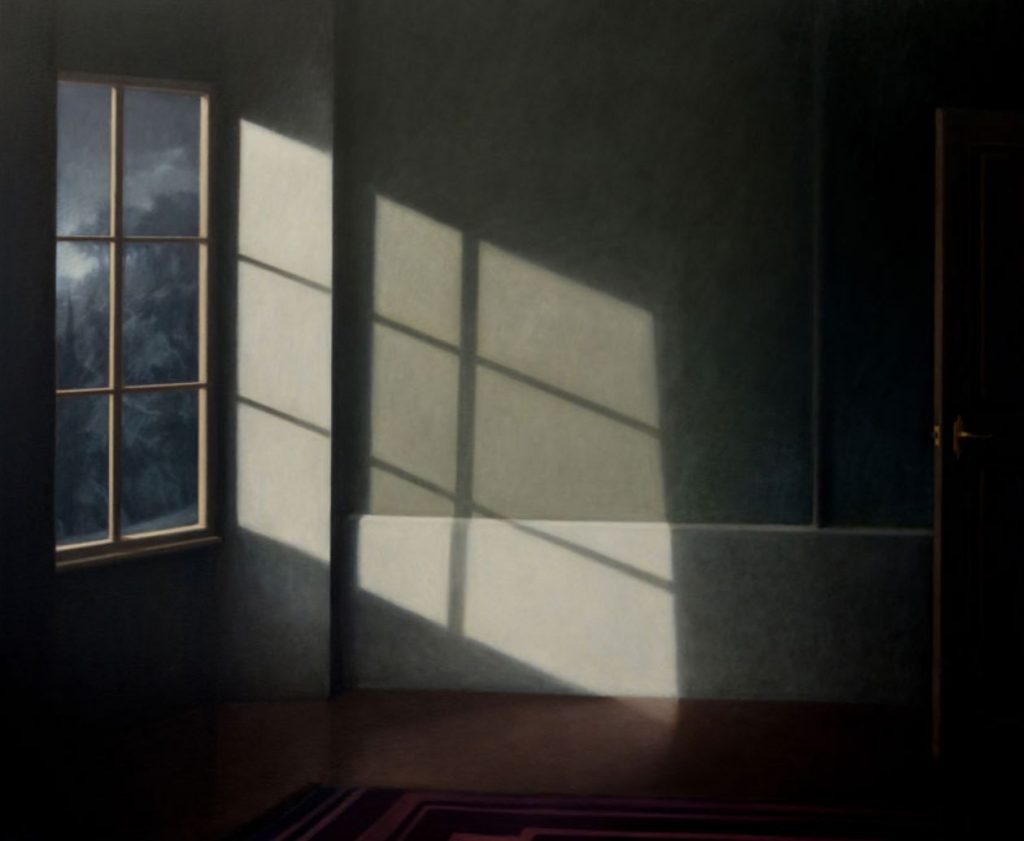
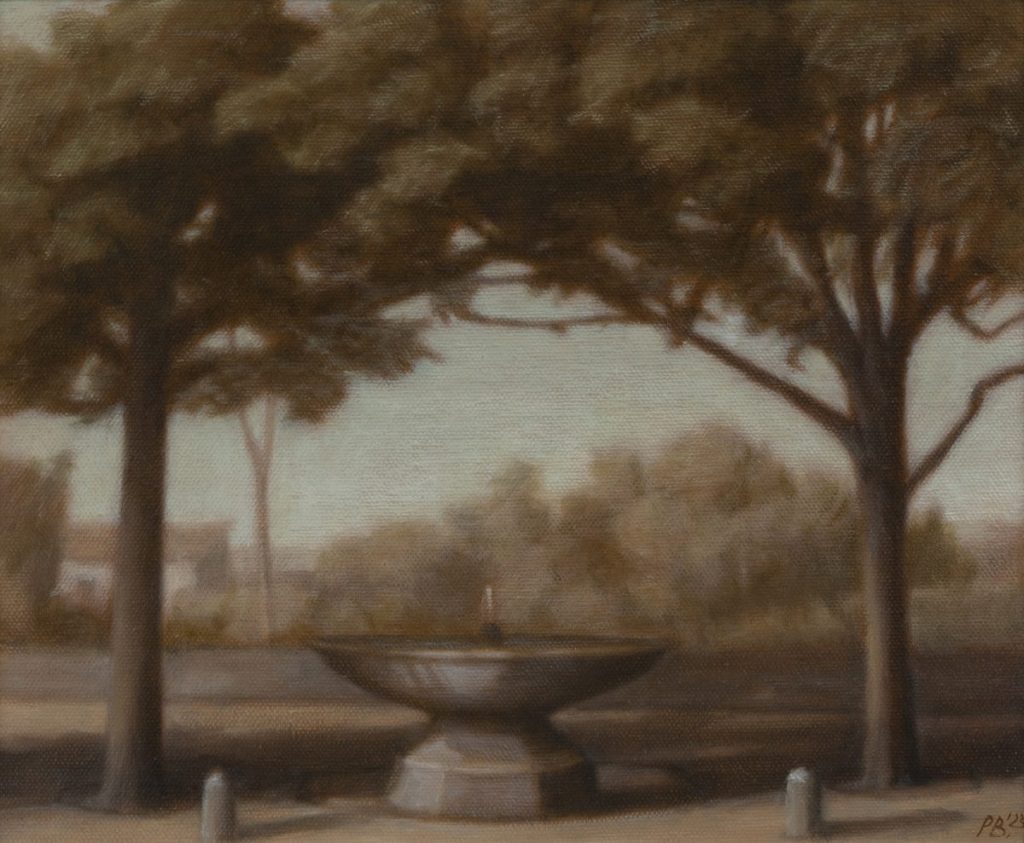
He has been an award-winning painter and is at home painting the mysteries of Italian Renaissance Gardens – most notably the Boboli Gardens in Florence, as well exploring the secret and forgotten aspects of the rural and urban landscapes. After coming across a strange empty room in a building in Italy in 2013, interiors began to dominate his interest – continuing to the present. Dreamscapes of remembered interior settings often only briefly seen and experienced, have become transfigured and re- imagined enigmatic spaces of stillness and silence
His paintings have been referred to as quiet works with a restrained magic and are subtle and dreamlike evoking deep moods, sensations, and atmospheres without relying on explicit storytelling or literal narratives. Rather than demand attention like some expressionist art, his pieces are described as quiet and seductive, drawing the viewer into a personal, deeply felt experience.
The spaces he paints seem entirely real yet slightly out of reach, forcing the viewer to engage intuitively rather than just visually. It is this bitter-sweet quality, where the known and that which is slightly eerie and edgy meet, that characterises many of Boggs’s paintings. Boggs can be an exquisite literal draughts man who can capture precise likenesses and surface textures, yet in his paintings he creates ‘memoryscapes’. All of the locations that he has painted he has visited, frequently on numerous occasions, and he knows them well, yet he recreates them from memory and reimagined.
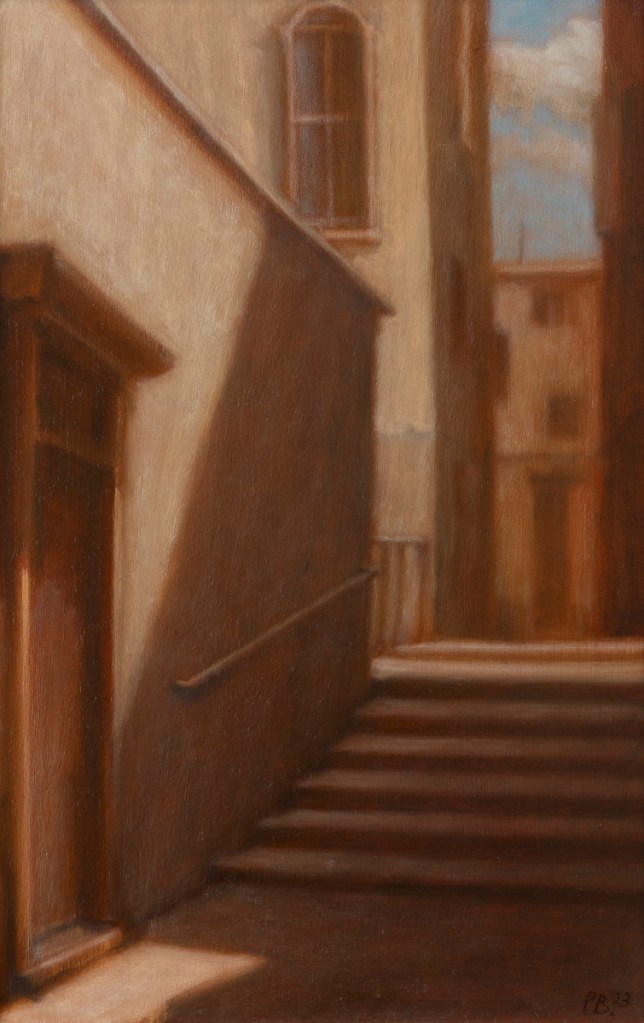
In the Boboli Gardens views and the alleys and streetscapes of Venice there is a quiet reverence for the painters Walter Sickert and John Singer Sargent. Paintings, including Shadowed walkway (Venice), is an examples of his strangely transfigured spaces, rich in their spiritual associations. All of his scenes are depopulated, rather than deserted. It is as if the human presence has been removed, perhaps only temporarily, although signs of habitation are omnipresent. It seems that at any moment, someone will appear from around the corner or walk down the alleyway, but for the moment all is still, tranquil and caught within a dream-like reality. The light is filtered, subdued and the tonal harmonies are beautifully balanced.
In a review of his interior paintings the reviewer Sasha Grishin wrote, “Many of his paintings deal with gardens, deserted landscapes and cityscapes and earlier were preoccupied with still life compositions. He had already been hinting at facades of buildings and looking into windows and open doorways. In this new body of work the focus is entirely on interiors of usually unspecified structures. They seem European, quite grand, possibly museums, but seen from odd angles with open curtains, windows and doorways exposing glimpses of the outside world.
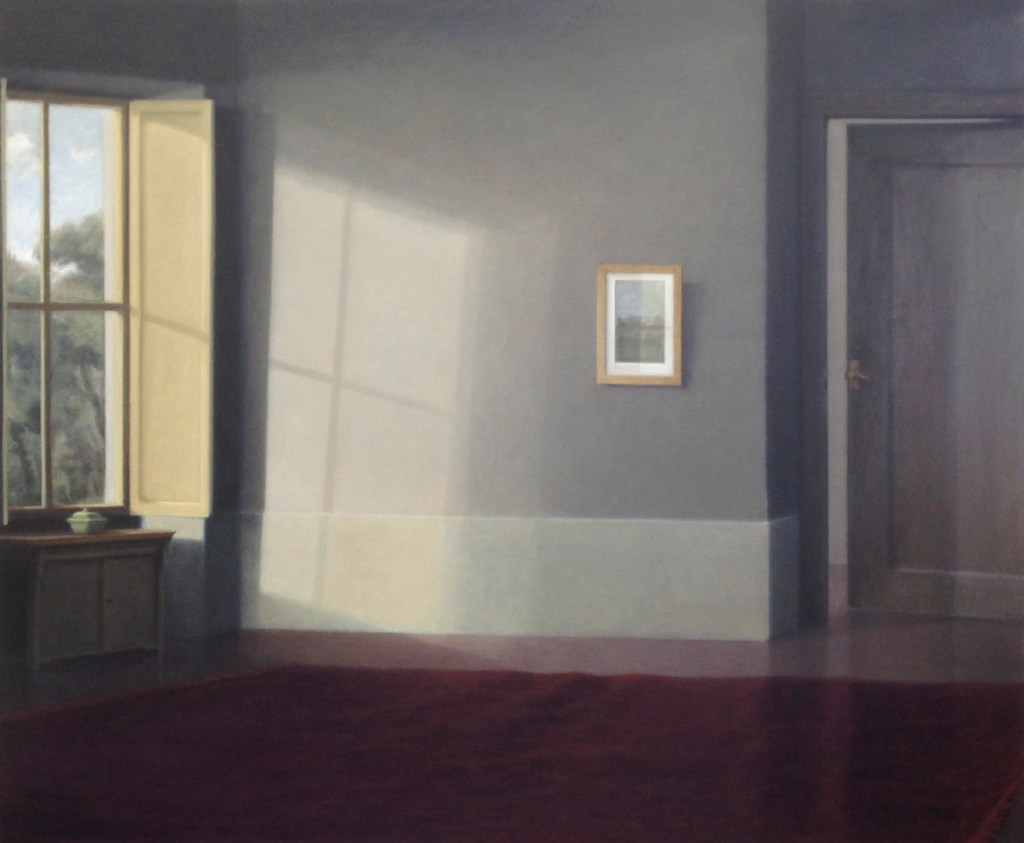
In his paintings nothing much happens, there is no dramatic narrative for us to engage with, but everything is charged with an inner tension where the anticipation is immense. There is so much that can happen, but nothing actually does. The viewer is provided with privileged access to these scenes, but there are relatively few clues provided as to what we are actually witnessing. We are invited to contemplate a passage of sunlight in the hallway, a painting hanging on the wall as a silent witness, a glimpse of a street through an open doorway or the play of shadows on the floor.
Boggs exploits two very deliberate artistic strategies in his work. The first is the use of a very subdued tonal palette, there are no screaming bright colours or sudden contrasts. The second is the total depopulation of the settings and the general sparseness. There is no movement and although there are signs of human habitation, there is no one present at the moment, and we are invited into the spaces in the manner of voyeurs. When there is no human presence, we tend to populate the space within our imagination, we invent narratives.”