One of the almost unrecognised literary / artistic areas of New Zealand culture has been the zine.
Zines, a corruption of magazines or fanzines are non-commercial, self-published, small-circulation booklets, often produced by hand or photocopied in limited editions of often only a few hundred copies. They are derived from anti-establishment, punk-rock music, and other activist cultures, providing a platform for personal expression, niche topics, and marginalized voices.
Chris Knox, Jesus on a stick
Even though the zine in New Zealand has been widespread there has been no serious writing about the form. Until now. Bryce Galloway’s “Zines NZ: Punk to present” is written by a zine devotee and is packed with hundreds of images of zine covers and spreads, most of which charm with lopsided collaged energy and all of which possess a singular vision. Zines are so often ephemeral and elusive, and this book’s tribute to so many rich and distinctive voices ensures that their history is not lost.
Some of the early names like Barry Linton and Dylan Horrocks who were major forces early on are mentioned along with others who helped establish the numerous outlets which has seen a plethora of voices over the past forty years.
Galloway says the impetus for the book was largely personal, having been a zine creator himself
“I was interested in finding the thread from today’s plethora of zinefests back to the punk rock zines of early 80s Aotearoa. In 2015 I wrote a rather subjective history of 21st century zines in Aotearoa. I released this as issue 56 of Incredibly Hot Sex with Hideous People, also presenting it at pop culture and bibliographic conferences. I was thinking, who’s qualified, who could I commission to research and write the earlier part of Aotearoa’s zine history? Eventually I decided I should just take the job on myself.”
He acknowledges that the zine has been side-lined by the art/ publishing/ library world. “I’m sure they’ve been looked down upon, but many in the zine scene wouldn’t have it any other way. For all those who celebrate the growth in this media, there’s others who see the shift from scrappy punk zines and zinefests in community halls to zinefests in major galleries and the like as evidence that zines have lost their edge. I don’t think that’s true but there’s something to be said for the aesthetic challenge made by your scrappy punk zines versus your well-crafted Risograph-printed chapbook for example.”
While Galloway has written this history of the zine, he has also included extensive quotes from around fifty other zine creators who expand the history with all the various personal motivations behind the various concepts and designs.
The book is packed with information along with dozens of illustrations from the zines produced by authors / designers who are well-known such as Chris Knox and David Tulloch to lesser known, but prolific names like Sarah Laing and Indira Neville.
Indira Neville, An Incompetent Girl
Along with being a history of the zine in New Zealand Galloway has provided a personal political and social history of New Zealand featuring significant events and individuals who have helped create change in New Zealand over the last forty years.
Opening the Auckland Philharmonia new series of 6.30 Sessions were two works from Wagners opera “Tristan and Isolde” the Prelude and Liebestod (love-death).
In the opera this music is used to convey the culmination of the lovers, uniting them in death, the merging of love and mortality. Several of the thematic passages were used in Lars von Trier’s film “Melancholia” which had similar themes of love and destruction.
Much of the music expressed a deep yearning which contrasted with an unsettling anxiety initially expressed by the woodwinds and strings who engaged in a tortuous conversation.
This deep yearning slowly built to an ecstatic onslaught before returning to an earnestness expressing the depth of love and despair.
In the final monuments the orchestra sought a resolution as Isolde comforted the dying Tristan with some explosive music conveying a sense of pent-up energy before the final apotheosis.
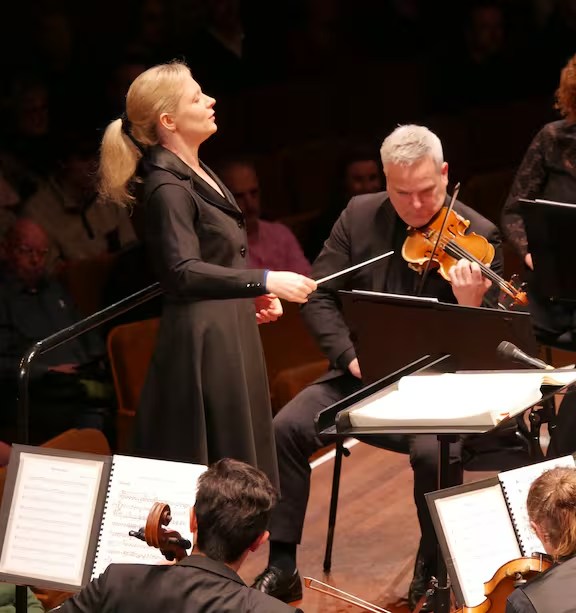
The conductor Pierre Bleuse seemed to respond to the music, his body creating sinuous shapes, crouching, arms spread wide and his exuberant hand gestures and dramatic flourishes added to the intensity of the piece.
There are a number of autobiographical symphonies where composers directly use elements of their personal lives, emotions, psychological struggles, and life narratives into the music. These works often act as musical depictions, blending personal experience with thematic development, exemplified by composers like Mahler, Shostakovich and Tchaikovsky.
Tchaikovsky’s Symphony No 4 like much of his music is deeply autobiographical, often channelling his intense depressions, secret homosexuality, and personal anxieties into his compositions. His most personal works, particularly his later symphonies, served as an emotional outlet for his inner torment, reflecting themes of fate, longing, and despair.
His Symphony No 4 of 1878 was written during a period of severe crisis following his failed marriage. In it he deals directly with the theme of “Fate” and his inability to escape his circumstance. His opera Eugene Onegin finished a year later also has semi-autobiographical elements, with the emotional dilemmas of the characters reflecting the composer’s own experiences with love and social pressures.
However, Tchaikovsky often used his ballet scores, such as Swan Lake as an escape into a “fantasy world” of beauty, contrasting with his intense melancholy.
The work opened with a strident form the brass and woodwinds, its joyful sounds tinged with a sense of desolation which hint at the composer depicting his elation at his renewed love of life but aware of his previous despondency. And the turbulent life around him. He seemed to wallow in his previous despair but looking forward to a new resolution.
The bleakness of the movement was punctuated by signs of light and hope provided by the sounds of the flutes which displayed touches of the composer’s ballet like melodies.
The music built to a crescendo of exaltation and release with the blaring brass which was followed by sequences of truly Romantic sounds lovingly crafted by the conductor.
The second movement opened with the woodwinds producing a Romantic yearning sound with some delightful sequences which the conductor insisted on extracting from the orchestra. In the third movement the strings engaged in a relentless pizzicato which was the composers display of musical showmanship.
The relentless strings wer3e interspersed with various instruments, notably the woodwinds and brass taking on a ballet-like momentum. Then, with e addition of the percussion instruments the orchestra created some exuberant sounds reminiscent of the composers “1812 Overture”.
The conductor Pierre Bleuse seemed inspired by the music his body swaying with intricate movements mirroring the rhythms of the music, with a dramatic display of timpani and cymbals.
After some menacing outbursts the orchestra began a joyous conclusion in an exploration of the composer’s minds and his turbulent past.
Bleuse carefully lowered the volume of the orchestra at times so that when he demanded more intensity, they were able to create a particularly dramatic sound.
The next Auckland Philharmonia 6.30 session will be Sheku & Elgar on August 12th and will feature Sheku Kanneh-Mason , described as a “Global phenomenon”. The British cellist is one of the worlds young classical stars in the world right now. His impressive resume includes winning BBC’s Young Musician of the Year, Artist-in-Residence at the New York Philharmonic and performing at the wedding of Prince Harry and Meghan Markle. Following his Carnegie Hall performance in April, this August he makes his New Zealand debut, performing Elgar’s Cello Concerto.
In introducing Shostakovich’s Symphony No 8 conductor André de Ridder mentioned a young Ukrainian conductor who had reservations about playing any Russian music during the present conflict. De Ridder acknowledged the complex issue of politics and music but insisted that with a work such as the Shostakovich which is considered to be an antiwar composition that there was a reason for it to be included in contemporary concerts.
De Ridder said he considered the work to be a requiem for all people and the most profound and honest of works which dealt with the outcome of the Second World War.
The work which was written in 1943 in the midst of the war was not well received. It was written after the Battle of Stalingrad and while the composer wrote that it was an optimistic work the Soviet authorities banned it for being pessimistic and “anti-Soviet”.
Ther work opened with huge sounds of dark strings similar to the composers Symphony No 5 written six years before. Some whispering violins could be heard trying to rise above the sounds of the darker strings like voices crying out in a dark and barren landscape.
Even the few rays of light which were suggested seemed to be infused with a darker element, light which seemed to be continually repressed, the darker strings overwhelming the lighter.
There was sense of relentless night and fog which only got darker and more overpowering and then a snare drum heralded a ferocious dance of death followed by a parody of a marching army leading to a fateful conclusion full of pessimism and an eerie solo woodwind sounding like a lone voice or birdcall on the battlefield.
The second movement opened with sounds of glorious martial celebration or like those of a fairground but these sounds were all brash, discordant and false. It is a section which ends with a plaintiff tin whistle which accompanying the mocking sounds of a parade which become increasing more hectic as the instruments took us on a crazed march of fools.
The final three movements were full of contrasts. There were the pulsing mechanical sounds of war interspersed with moments of light along with the screams of individuals.
Great onslaughts of sound were followed by whispering violins offering a bleak contrast. These contrasts between fragility and power, between darkness and light between triumph and defeat were central to the work and the composer’s choice of instruments.
This ambivalence reached its conclusion in the fifth movement where the intense light of the violin’s heralds not so much a triumph but a time of reflection and prayer as the orchestra faded to silence leaving the audience to reflect on a deeply tragic event.
The opening work on the programme was Ravel’s “Pavane pour une infante défunte”, is a work somewhere between a tribute and farewell to a long departed princess. Ravel indicated that the piece depicted a pavane as it would be danced by an Infanta such as the one found in Las Meninas the painting by Velazques. He seemed to have imagined the young princess depicted in the painting as preparing to attend a dance or engaged in one. This was not a requiem but a remembrance of a past time, a past elegance and a past princess.
The sweet melodies of the work provided a sensation of fleeting clouds or the passing of frothy dancing gowns and gave the work a sense of meandering either through the ballroom or the corridors of the palace.
The trill of the harp provided images of sunlight on a river or highlighting the dancing figures. The movements of the dance are beautifully realised, the colours and sounds of dance as well as the elegance of the event.
There was change of programme for the trombone work which meant the audience heard a special work composed by Bryce Dessner who had written the music for the film The Revenant. It was played by David Bremner the Principal trombonist of the NZSO.
The work certainly exploited the sounds of the instrument resulting in an intriguing and satisfying work. From the opening we were confronted with an onslaught of notes which worked well with the pizzicato of the orchestra when they combined to give a sense of momentum.
The brass instruments provided a subtle layering of sounds underneath the blaring trombone while the strings created a hovering mysterious sound.
Bremner exploited the sounds and tones of the trombone from its blaring sounds to its eerie breath-like eruptions.
From second movement the orchestra created a changing sonic field as though it was tuning up and the trombone provided a series of short sequences whish seemed designed to test the instruments percussive sounds…
There was also an elaborate conversation between the trombone and the other brass instruments providing some very original sounds and a clever display of the trombones range and tonal textures.
Helen Clark in Six Outfits uses the notion of tracking Helen Clark’s career through reference to the clothing she wore at various stages of her life. It is a concept which even the stage version of Clark rejects going on a rant about how she has always been judged by appearance – her hair, her teeth, her voice and her marriage. All those notions which are rarely used to demean male parliamentarians.
The play traces the life of Helen Clark from school kid through to the present as she climbs both the academic and the parliamentary ladders to her unsuccessful bid at becoming the Secretary General of the UN.
Along the way we/she remember the fluctuating fortunes of National and Labour governments as well as encountering the major political figures of the time – Phil Goff, Jim Anderton, David Lange, Jonathan Hunt, Jenny Shipley, Judith Tizard and even Winston Peters -is he still alive.
We also hear the voice of Brian Edwards who acts as a voice-over Narrator and was one of her early media advisors / image consultants. We also get to encounter her more recent media consultant, Maggie Eyre.
Studded though her career we get the major achievements of her and her governments – paid parental leave, free early childcare, the New Zealand Superannuation Fund. legalized prostitution and civil unions for same-sex couples.
Loooming over the stage is a clever set designed by Dan Williams which features a mountain-side which Clark ascends from time to time. It acts a a metaphor for her ascent to power as well as her physical/ mental / political struggles to reach the summit of her career.
As the older Clark Jennifer Te Atamira Ward-Lealand gives an impressive account of the politician, at time managing to capture the sound and intonation of her voice as well as her stare. Lauren Gibson as the younger Clark while not quite getting the voice manges to give an astute sense of the earlier Clark with her aspirations and self belief.
Ward Lealand also does a reasonable job of some walk-on parts such as Clark’s father a farmer who was at the other end of the political spectrum but still supported his daughter.
While this play is about serous stuff of politics Fiona Samuel takes a comic approach to the material which had the audience appreciating the political and personal witticisms such as the reference to Clark’s early page boy haircut – her “Joan of Arc” look
The play concluded with Ward-Lealand delivering a Clark speech. I couldn’t remember it all, but it went somewhere along the lines of –
“Let me note now the great importance of empowering women, including through education, to be part of leadership at every level. Equality between women and men at decision-making tables ensures that the perspectives of both get full consideration. As women, we are fully justified in asserting that there should be no decisions made about us without us.
When women are at those decision-making tables, they have the power to change priorities to what matters for the health and well-being of families and communities.
Empowered women become the architects of better health and well-being, making informed decisions for themselves and their communities.”
The highlights of this year’s Auckland Arts Festival were the two concerts presented by the Shanghai Symphony Orchestra, the oldest symphony in Asia which has a formidable history of touring.
The seventy strong orchestra under the direction of conductor Long Yu, opened their first concert with a relatively new work by Elliot Leung – “Chinese Kitchen: A feat of Flavors”. Leung has made a name for himself both as a composer who spans Eastern and Western music but also as a composer for Hollywood films.
His background as compose of film music showed throughout his four movement Chinese Kitchen, the opening movement “Deep Fried River Prawns” displaying an inventive use of a dozen percussion instruments. The collection of instruments including maracas, cymbals, bells, clappers and xylophone created a syncopated sound which recreated the noise, colour and hectic movement of a Chinese kitchen.
This movement and the others showed the composers ability to create musical equivalents of the taste, texture and colours of Chinese dishes. In the second movement “Buddha Jumps on the Wall” the woodwinds created a luxurious sequence with the melodies taken up by the piano and harp. The music flowed effortlessly between moments of savage attack and sequences of little more than whispers. While this was a Western style music it was flecked through with clever traditional Chinese elements. The Western style music could be detected in some Copland style passage as well as a nod to the music of “The Wizard of Oz”.
With “Vegetable in Soup” there was a sense of vegetables bubbling away in a pot, the tempo of the music becoming more animated as the piece evolved and in “Deep Fried Sesame Balls” there was again adventurous percussion playing which could have come from an Indiana Jones film provided an electrifying display.
Conductor Long Yu used his hands and body to great effect with his generous movements and careful directions which adding to the sense of a watery, misty environment with surprises erupting from the music, seemingly at his command.
Playing Tchaikovsky’s “Variations on a Rococo Theme” cellist Jian Wang glided effortlessly through the work, revelling in the interplay with the orchestra in a tantalising display which emphasised aspects of the sophisticated composition. He made use of the various solo sections to show an understanding of the work as well displaying his extraordinary technical skills.
He was able to combine, as did Tchaikovsky, an understanding of the romanticism of the Rococo theme as well as debt to Mozart which gives the work its spectacle in the way that cello and orchestra intertwine. The theme was dissected and re-formed in different guises with Wang seemingly finding new opportunities in the melodies as well as exploring its tones, and textures.
Serena Wang Image : Leilei Cai
Tchaikovsky’s Piano Concerto No.1 is one of the top ten piano concertos and is the last great Romantic piano concerto of the nineteenth century, full of lyricism as well as many dramatic moments. The pianist has to be capable of producing the most poignant of sounds as well as the most intense.
Pianist Serena Wang was able to deliver both these qualities of the work as she ranged from the pensive to the flamboyant.
From the opening moments where she responded to the brash horns and sharp flourishes of the orchestra Wang dominated the stage with some dazzling displays.
Her expression when playing changed continuously and she took on various poses from rapture to steely focus. At times there was a tenderness to her playing while at others a brutal rawness and then at other times she seemed to be cajoling herself into discovering new depths to the music
Her rapport with the orchestra was constantly changing as well. Battling with the orchestra, chasing the dramatic themes conjured up by the orchestra and then the dynamics would change, and the orchestra would attempt to match her feverish playing. There were also several moments of musical poetry when Wang had interchanges with the flutes, and clarinets.
After the frenetic finale the audience responded with a huge ovation, but this was matched by even great applause when she and the orchestra played a stunning version of Pokarekare Ana.
The second concert was bookended by two pieces which had featured ih their first concert Elliot Leung’s – “Chinese Kitchen: A feast of Flavors” and the orchestra playing of Pokarekare Ana with Serena Wang.
The major work on the programme was Rachmaninoff’s Symphony No 2 which was written ten years after his first symphony’s disastrous reception 1897. It is a masterpiece of late-Romanticism, combining a deep Russian melodic yearning with an intense symphonic structure, combining lush harmonies, with an emotional depth.
There were passages of great delicacy in the first movement which reflected his love of the Russian landscape and Russian history. However, he was unhappy with the political climate in Russia at the time and moved to Dresden, Germany, where he wrote the symphony in 1906. This aspect shows in the work as he seems to be looking forward to a new dawn both politically and musically, the music full of positive aspirations.
The soaring strings and blaring passages owe much to his early friendship with Thaikovsky and the earlier composer’s sounds recur throughout this symphony, notably the 1812 Overture.
In the second movement there were wistful, dreamy sequences as well as urgent, action filled sections while the romantic third movement was carried along by some delightful flutes, filled with intense yearning, giving voice to a modern Russia, a feeling which was being expressed by many Russian writers and dramatists at the time.
Also on the programme was Gigang Chen’s “Er Huang, for Piano and Orchestra” which had been commissioned by Carnegie Hall in 2009 and is based on the composer’s interest in Peking Opera.
Serena Wang’s playing developed with slow tentative sounds, providing a sense of a hazy, limpid environment. The pianist’s crisp sounds trembling above the subdued sounds of the orchestra were like an Impressionist work with each individual note and section clearly articulated.
They were like the images of raindrops on water, or the descriptions of flowers and landscapes. The moods expressed seemed simultaneously to be like Impressionist paintings of the late nineteenth century as well as a depictions of classical Chinese paintings where the aim was to capture not only the outer appearance of a subject but its inner energy and life force.
Wang seemed captivated by the music, being drawn deeper and deeper into its complexity. At times she expressed a celebratory approach to her discoveries, raising her arms in triumph.
Wang’s expression of triumph could be applied to the success of the orchestra’s success in providing Auckland with two outstanding concerts along with two exceptional soloists in Serena Wang and Jian Wang.
Judith (Susan Bullock) and Bluebeards (Lester Lynch) Image: Thomas Hamill
Bluebeards Castle
By Bela Bartok
NZ Opera & Auckland Arts Festival
Aotea Centre
March 13th & 14th
Reviewed by John Daly-Peoples
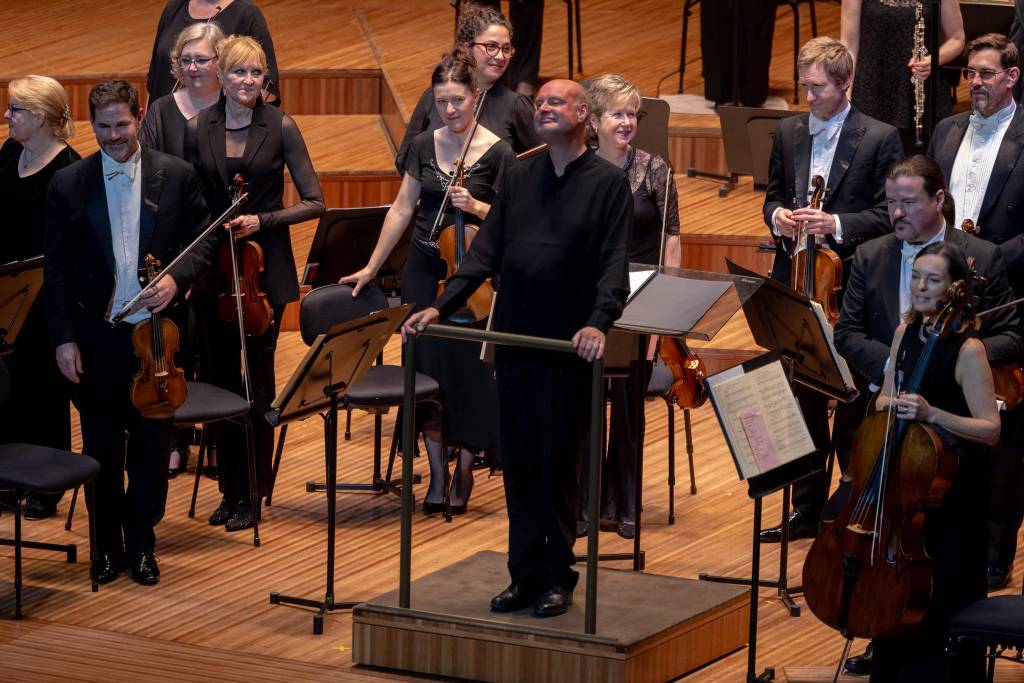
In Bela Bartok’s original staging of Bluebeards Castle, the newlywed Judith enters her husband’s dark, foreboding castle where she is faced with seven locked doors that she is forbidden to open. In this version by Daisy Evans, it is a single trunk which holds the memories of the couples past lives which Bluebeard remembers while Judith herself seems to become lost to him.
For this production director Daisy Evens created a new Judith who is somewhere between an older woman with dementia and a woman facing her own psychological breakdown and who along with her husband can be seen as displaying the Freudian concepts of sexual trauma.
The castle can be seen as symbolic of Bluebeard’s soul; a dark mind filled with secrets that threaten to reveal his true nature. The opera itself can be seen as an allegory for the loneliness of the human soul, the impossibility of truly knowing another person, or the conflict between rational and emotional.
Bartok was writing the opera at the same time that Freud was engaged in studies into psychoanalysis and elements of this have seeped into Bartok’s thinking which aligns with Freud’s theories of exploring the unconscious mind, hidden sexual desires, and psychological trauma.
Bluebeards Castle like other Symbolist art works, replaced traditional dramatic narratives with dark, subjective internal journeys, mirroring the Freudian focus on repressed emotions and dreams.
Despite Bluebeards protests she removes the symbolic items from the chest and in doing so she discovers events from Bluebeards past, events she needs to recognise if she is to fully understand him. He also needs to acknowledge these events if they are to be a truly understanding, loving couple.
In opening the chest for the seventh time she discovers the three women of his past, one found in the morning, one at noon and one at sunset, Then with Judith, his fourth, the bride he found at night, having fully understood her husband she joins the women leaving Bluebeard in perpetual darkness.
The seven memories in the trunk contain the relics of the couples past that Lester Lynch’s Bluebeard remembers with joy and anguish, while Susan Bullock’s Judith emotionally engages with her former self, as lover, bride and mother.
References are made throughout the opera about the power of light to overcome darkness and symbolic of this the stage was studded with two dozen domestic lamps which flickered on and off at various points.
Like the story of Bluebeards Castle, the music is mysterious and riveting, providing a background soundscape which seems to continually shift as the various events of the opera are revealed.
Throughout the work there were sequences where the music provided particularly unsettling sounds, while there were other times when the orchestra was able to symbolise the idea of light flooding into the darkness of the castle. There were some exquisite passages particularly the blaring drama of the organ which was like a palpable force and the swelling of the strumming harps.
It was the emotional richness provided by the two singers which helped maintain the tension along with their creation of character though their acting. Bullock displayed a voice of amazing power while Lynch plumbed great depths as he revealed his inner thoughts.
This production was a stunning display of acting and singing along with an inspiring performance by the Auckland Philharmonia under the direction of conductor Brad Cohen.
In her recent concert at the Auckland Town Hall Julia Bullock sang a group of songs which she considered as having an “American” sound. These included George Gershwin, Leonard Bernstein and Margaret Bonds. Bonds is a pianist / composer who Bullock has championed for several years a major black composer who was overlooked for many years primarily due to systemic racism and sexism in the classical music industry, exacerbated by the loss of her manuscripts and a lack of publication.
Bullock included three settings of poems by Langston Hughes – “The Negro speaks of Rivers”, “Winter Moon” and “Poeme D’Automne” which gave voice to black aspirations in the 1920’s. With Bullocks singing of “The Negro speaks of Rivers” she provided a fine sense of the Negro spiritual, the softness of her delivery veiling a strong, insistent voice and a slowly developing dramatic force. Her voice delivered an emotional and haunting tone capturing the essence of heritage and endurance.
“Poeme D’Automne” was an astonishing song in which images of falling leaves and the colours of autumn were linked to the human body. She sang this with a surging operatic voice providing and intense and emotional sound.
“Winter Moon” was a short piece, but it showed that Bond was not just writing music to accompany the words of the poem, she had the ability to write dramatic meaningful music.
She sang Stephen Sonfheim’s “Somewhere” as though it was an anthem for the displaced and disadvantaged – a piece very relevant today’s America. There was also the poem “To Julia de Burgos” by Bernstein, a vibrant piece of music which spoke of an angry revolutionary adventure in which she projected the words as though a personal statement.
She also sang a couple of George Gerswin songs, “Somebody from Somewhere” and “Summertime “from “Porgy and Bess”.
She also sang “La Conga Blicoti” a vibrant, Afro-Cuban jazz-influenced song performed by Josephine Baker with the Lecuona Cuban Boys, which features a distinctive conga rhythm.
She also sang Billy Taylor’s “I wish I knew how it feels to be free” like a requiem or funeral lament, very appropriate as a song for freedom.
There was also “I have Two Cities” by the French composer Henri Varna and lyricist Geo Koegar with lines such as
Manhattan is beautiful,
But why deny it.
What enchants me is Paris,
All of Paris
Which she sang as a hymn to Josephine Baker.
The concert opened with the Auckland Philharmonia playing Erich Korngolds “Theme and Variations” and closed with them playing Kurt Weill’s “Symphony No 2”.
Bullock has an affinity for the outsider artist which has led to her interest in Josephine Baker who made the journey from the US to Europe where she made her name while the two composers became outsiders under the Nazis and were forced to move from Europe to the US.
Korngold who was a major composer in Austria influenced the style of composition and singing in the 1920’s and 30’s with operas such as “Die Tote Stadt” while Weill was influential in bringing Bertolt Brecht’s work to the public with works including “The Threepenny Opera”.
In 1926 the iconic red telephone box which was designed by British architect Sir Giles Gilbert Scott first appeared in the UK making communication between individuals easier.
Now 100 years later as part of the Auckland Arts Festival telephone users can enter a modern telephone booth as participants in an art event which breaks down the boundary between artist and audience.
For the next three days on Level 3 of the Aotea Centre, you can be part of an art event where you become the actor in scenarios which you create.
Pick up your phone and you are connected to another random audience member or friend. You are confronted with a teleprompter which provides you a collection of scripts, including one by New Zealand playwright Victor Rodger.
You become part of an evolving dialogue which is part theatre and part social intervention. You become both performer and spectator, creating unique dialogues which will surprise, embarrass and entertain you.
Jay Dodge, one of the creators of Red Phone“When this project started, we had five or six local writers, and now we have representation from dozens of countries.
“We asked writers to connect and think about what they love about performance but in a creative way where they can be free and not obliged to reflect what is happening right now,” said Sherry Yoon another creator. “There is so much now going on right now, that we will see artists being both reflective and relevant to now, but also to engage in work that can continue on past our global pandemic. What really resonated with us and the presenters and artists we have engaged is to give audiences a work that isn’t here to replace theatre but is in essence of what we love about live performance — the emotional ride, the intimacy, etc.”
This free installation by Canadian interdisciplinary theatre company Boca del Lupo has toured Canada, Norway, and Latin America to critical acclaim. Now it is presented in Auckland for a strictly limited season.
Julia Bullock, Bluebeards Castle, Sincere Apologies
The New York Classic review last year featured a review of Julia Bullock by Rick Perdian
“It would have once been almost impossible to imagine a vocal recital by a major artist with songs by Alban Berg, Bob Dylan, and Rodgers & Hammerstein on the program. These are different times, however, and what once would have been dubious box-office is now perfectly attuned to the times.
Bullock opened the recital with songs by Samuel Barber, whose embrace of Romanticism put him at odds with the more progressive elements of the musical establishment in mid-twentieth-century America. The three songs which she sang—“My Lizard (Wish for a Young Love),” “Nuvoletta,” and “The Daisies”—outlined the wistful nostalgia, zaniness, and embrace of the bizarre that would course through the recital.
As with the Barber songs, Bullock performed songs by Kurt Weill which spanned the composer’s career from his collaboration with Bertolt Brecht in Germany to his Broadway hit, Lady in the Dark.
The outlier was the first, “Complainte de la Seine,” which Weill composed in Paris after fleeing Nazi Germany. This setting, like earlier songs dating from Weill’s collaboration with Brecht, “Ballade vom ertrunkenden Mädchen” and “Song of the Hard Nut,” show the composer at his most hard-edged and bleak. With crystalline tone, perfect pitch, and a delivery void of sentiment, Bullock sang of cadavers resting at the bottom of the Seine, the Marxist revolutionary Rosa Luxemburg’s decaying corpse in a Berlin canal, and the calculated transactions that fuel capitalism. With “The “Princess of Pure Delight,” Bullock switched gears, projecting a cool sophistication that evoked the era.
Bullock’s most sublime singing came with Berg’s Altenberg Lieder. Viennese audience’s greeted the songs with such derision in 1913 that Berg never permitted them to be performed during his lifetime. The five songs are settings of enigmatic verses by the poet Peter Altenberg which he sent to friends on postcards.
A substantial portion of the second half of the recital was devoted to songs by Richard Rodger and Oscar Hammerstein. Bullock told the audience that their music had been a part of her life from her earliest years growing up in St. Louis. “Dites-Mois” from South Pacific was the first song that she ever sang in public at the age of ten before an audience of thousands.
The audience was enthralled as Bullock sang some of the greatest hits from The Sound of Music and South Pacific. For the most part, these were straightforward renditions of beloved songs, but Bullock and Brown could be provocative, such as in “You’ve Got to Be Carefully Taught” from South Pacific. Bullock delivered the song’s message with a matter-of-fact directness which was intensified by Brown’s punctuation from the piano.
There were also songs linked to Odetta Holmes,who was known as the voice of the American civil rights movement in the Sixties. Bullock sang Bob Dylan’s “Masters of War” with a penetrating, unflinching directness. Odetta’s arrangement of “Going Home” and Elizabeth’s Cotten’s “Freight Train” followed.
Bullock ended the recital with Converse’s poignant ballad “How Sad, How Lovely,” a meditation on the loveliness and sadness of life.”
Bluebeards Castle
This version of Bluebeards Castel was previously performed in Wellington and Christchurch in 2023. Elizabeth Kerr reviewed the work in Five Lines.
“The dramatic trajectory of this contemporary production of Bluebeard’s Castle is vivid and deeply moving from its opening bars till the passionate conclusion. ..For me, its greatest wonder is the faithful use of the original text and music to tell a tragic story of today, a superb creative reimagining of Bartók ‘s only opera.
Bartók wrote Bluebeard’s Castle in 1911. He was 30 years old. The Gothic work, with a libretto by the composer’s friend, poet Béla Balázs, was based on the French folk tale published in the 17th century by Charles Perrault.
The opera has a singing cast of two with a full orchestra. The role of Bluebeard is sung in this New Zealand performance by US baritone Lester Lynch, and his wife Judith by UK soprano Susan Bullock. As the semi-staged production opens, the strings of the NZSO set a rather creepy mood. The couple arrive onstage, Judith appearing confused and troubled. “If you left me, I’d be lost and all alone here,” she sings.
In the original, Judith was Bluebeard’s very young wife, brought to his cold, dark castle and confronted by seven locked doors, which open in turn throughout the opera, revealing their disturbing contents. The locked doors are replaced by a suitcase, and from it are drawn contents representing memories of Judith’s life and their relationship.
Bluebeard’s Castle is often described as a Symbolist opera and symbolism remains strong in this production. ..This is the writing of a young Bartók, strongly influenced by Romantic composers and Debussy, and his score, including the challenging and chromatic vocal lines, is beautiful, colourful and lush. It is also highly dramatic and alongside the theatrical symbolism are meaningful musical motives, most noticeable the “blood” motive of a minor second, a semitone, appearing whenever Judith, remembering past losses and fears, refers to blood.
A final “door” brings the impassioned denouement. “When this door is opened, Judith, you will find my wife there waiting”, sings Bluebeard, handing her a mirror from the suitcase. The poetry in the libretto really blooms here, as Bluebeard sings of his former wives, the young lover, wife of the dawn, the young wife of his “noontime”, the mother, wife of his evening.
The younger wives return, also holding mirrors, and as Bluebeard sings of each, Judith offers a repetitive and sad little refrain from her chair. “Ah, compared to her, I am nothing.” But she is, he tells her, his wife of the night. Musically, Bartók brings the opera to its big romantic climax. “Eternal beauty!” sings Bluebeard. “Now, all turns to darkness.”
The mood in music and staging fades quietly. Tenderly, Bluebeard brings Judith a cup of tea. The lights also fade to blackness.”
Sincere Apologies
“Sincere Apologies” is an Australian production with relevance to New Zealand with a recent review of the production in “My Melbourne Arts” praising the low key, audience based play.
“Sincere Apologies” begins unassumingly: an envelope is handed to an audience member and it is passed from hand to hand. No words are exchanged, no introduction is made, no actors are present. It’s just a low-key game of “pass the parcel” that opens the door to a chorus of voices and a world of regret.
Fifty real apologies are sealed inside fifty envelopes that are distributed to the audience. These span from 1990 all the way into the future, each one factual and collected from documented expressions of remorse by public figures, private correspondence, and personal moments by the shows three creators, Dan Koop, Jamie Lewis and David Williams. One by one, in numerical order, audience members step up to a microphone and read them aloud.
Some are weighty and political – a Prime Minister’s apology to the Stolen Generation or BP’s statement following an oil spill. Others tap into pop culture’s hall of infamy – like Kanye West and Taylor Swift. Then, there are the apologies from the creators themselves, adding a deeper intimate layer to the mix. There are no actors in Sincere Apologies. No one introduces the show or welcomes the audience. Even at the end, when we clap, it’s not for performers on stage, but for each other, and the three tech staff quietly stationed in the corner. The audience is the cast, and in that shared vulnerability something almost communal forms. Strangers stumble over words, laugh nervously, or surprisingly choke up. You start to listen differently, not as a spectator, but as part of a temporary community bound by confession.
As the reading unfolds, you find yourself unexpectedly drawn in, paying attention not only to the words themselves, but to the way they are spoken. Stripped of power, fame, and PR polish, these words take on new meanings. When random people speak them, they can come across as absurd, hollow, or even heartbreaking and genuine. The performance asks: what happens when we remove status from an apology? Can tone, delivery, and intent make any acknowledgment register as authentic – or insincere?
A carefully crafted score heightens the work, as subtle sound effects and rhythmic pulses heighten particular instances, building a hypnotic rhythm that pulls the audience into this collective act of reckoning.
By the end, this experience is strangely moving. There’s humour and absurdity, yes, but there is a weight to hearing the people in the room attempt to make things right. It’s exhausting and cathartic, and a reminder that “sorry” is both universal and endlessly complicated.”
We are surrounded by music every day, in our houses, in the public space in shopping malls and with our audio devices and through this soundscape to our lives which we build up a huge sound bank of songs and music. Often, we are not aware of how this music is created but we are conscious of its components such as melody, harmony, rhythm, tempo, dynamics, timbre, texture, and form, which work together to create a piece of music. But we rarely investigate them, they are magically and mysteriously assembled, providing enjoyment and diversion There are many though who become obsessed by what a composer, band or singer have created and how these creators have seemingly produced something which touches on our psyche, our emotions and our way of seeing the world. There are some writers, composers and philosophers who try and understand this fascination with what music is and what it does.
Roger Horrocksm is deeply interested in this world of music and his new book “Music Without End; A book of listening” which follows on from his 2022 book “A book of Seeing” delves into areas of music which will resonate with readers as well as offering new perspectives and insights.
As the author says in his preface “I take a very broad approach … since I am interested in popular music, jazz, classical music contemporary classical sounds and music form non-Western traditions (including, Indian, African and Māori).
This very catholic approach has resulted in a book which covers the musical landscapes which most readers will be aware of but also presents new landscapes which will be new, novel and intriguing sending readers off in a quest for these often unknown composers, musicians and compositions.
The four chapters of the book are Music and Listening: A personal History, On Listening, Interviews and Music without End: A History of Western Classical Music
The opening chapter reads very much like the account many music lovers would write- early encounters with music which stimulated great interest in listening and collecting music. For Horrocks this has led to a very wide interest in both classical and popular music. He recounts his exploration of music with its various interwoven strands such as hearing Vivaldi’s “Four Season as the soundtrack to Kenneth Angers 1953 short film “Eaux d’Artifice” filmed at the Villa d’Este.
His music education really developed when he spent time in the1960’s is the US One encounter meant that he saw the Merce Cunningham dance groups performing to music by John Cage and David Tudor and also got to talk with John Cage. An encounter with Arab / Andalusian music in a taxi in Paris as well as exposure to the experimental jazz of the of the 1960’s hearing musicians such as Ornette Coleman and archie Shepp
He also includes miscellany of musical events such as a performance of Handel’s “Messiah” at Crystal Palace in 1857 which had an orchestra of 500 and 2000 singers. Providing a New Zealand context, he notes that two years before the concert the infant Auckland Choral Society had performed the work in Auckland.
For the third chapter the author interviewed ten contemporary musicians who offer different perspectives on the Importance of listening, inspiration and process in the creation of music. These include contemporary composers Eve De Castro Robinson and Annea Lockwood, conductor / composer /performer, Petere Scholes and singer Caitlin Smith,
“Music Without End: A history of Western Classical Music”, is the final chapter in the book takes a broad approach to the history of Western Music. As the author notes, ‘What interests me is the constant evolution of styles and genres, along with development of instruments, venues and technologies.
Here he follows the course of the Western music over 800 years looking at the major periods – Baroque, Romanticism, Late Romanticism, Modernism, as well Atonal Music Serialism and Minimalism, He also devotes space to many of the Russian composers. including Sofia Gubaidulina, Alfred Schnittke and Valentin Silvestrov.
As well as looking at various aspects of music he devotes much of the book in tracing out the historical threads of Western Music he interested is in trying to understand how the music got to be written and the changes in approaches to composition.
In his exploration of the nature of listening he broadens out his enquiry, looking (and listening) at music from various perspectives such as the compositions of John Cage where the music is close to a theoretical or philosophical model.
This exceptional book not only introduces readers to many specialist areas of music, but it does so using an accessible language, providing interesting anecdotes and providing readers with a way of understanding their own approaches to music.
The “Follow button” at the bottom right will appear and clicking on that button will allow you to follow that blog and all future posts will arrive on your email.