Categories
Reviews, News and Commentary

Shakespearean Disappointment

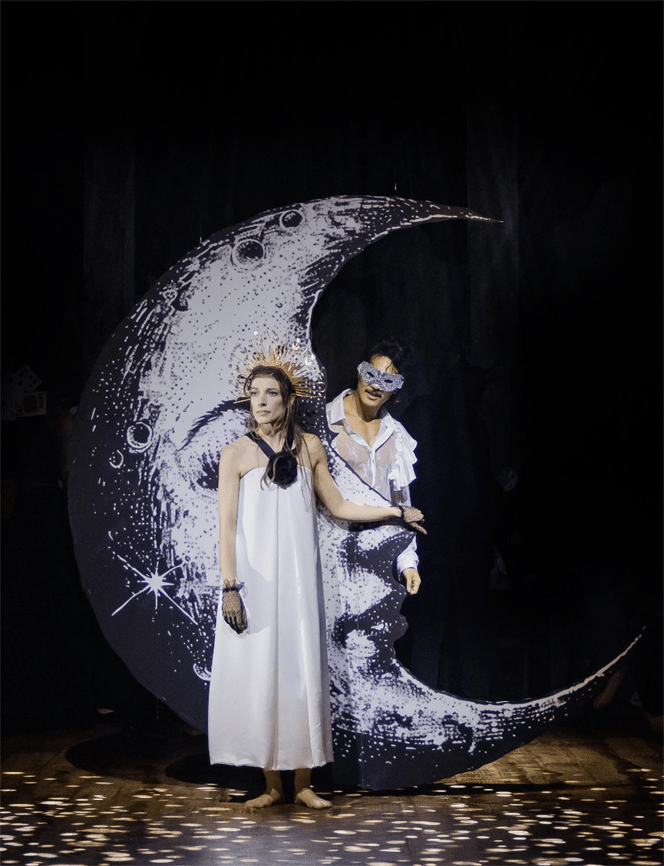
Phoebe McKellar (Juliet) and Theo Dāvid (Romeo) Photo: Andi Crown

Review by Malcolm Calder

Romeo and Juliet

By William Shakespeare

Auckland Theatre Company

Director – Benjamin Kilby-Henson

Design – Dan Williams

Lighting – Filament Eleven 11

Costumes – Daniella Salazar

Sound – Robin Kelly

With Ryan Carter, Liam Coleman, Theo Dāvid, Courteney Eggleton, Jesme Faa’auuga, Isla Mayo, Miriama McDowell, Phoebe McKellar, Jordan Mooney, Meramanji Odedra, Beatriz Romilly and Amanda Tito

Waterfront Theatre – until 9 August

Review by Malcolm Calder

This is a brave attempt by ATC to broaden its audience base and provide a path for younger performers.  And when you’re doing that, a good Shakespeare is a fairly safe bet as it can probably do quite well with younger audiences, meet the needs of traditional adherents and will no doubt fare well with a schools audience.  And ATC is to be acknowledged for that.

Unfortunately, when one looks at the larger theatrical picture, this Romeo and Juliet doesn’t really fare very well.  Especially as a major production by one of this country’s more significant professional companies.  However ATC’s production standards remain fairly high and are arguably this production’s saving grace. 

This Romeo and Juliet is set in a 1960s Verona and I get that – not such a silly idea.  The the overall design is consistent and sometimes works very well indeed with the themes Director Benjamin Kilby-Henson is articulating – youth, love and lyricism.  Chapeaus are due to the entire creative team and his production looks and feels quite stunning.

Dan Williams has generated a well-executed, three-dimensional set, largely articulated with reductive arches, derived some mobility from a well-used billiard table and unusually introduced what looks like a painter’s scaffold that trucks about a Veronian ballroom that is ‘under renovation’ and elsewhere too.  It makes for a splendidly unusual balcony scene.

I wasn’t in Verona in the 1960s, however I did own a pair of vertically-striped trousers a decade later, so I give costumier Daniella Salazar’s costumes a big thumbs up too.  Her use of colour is at times subtle and nuanced and the differences she has drawn between Montague and Capulet families are finely drawn.  Of particular note is the ballroom scene.

But it was the lighting and the soundscape that were the standouts for me.   The Filament 11 designers have introduced some dramatic and highly effective lighting that echoes the sentiments of Shakespeare’s words and the emotions highlighted by the director.  It is also pleasing to see ATC using effective sound reinforcement for actors who often spend more time in front of cameras and on more intimate venues these days than on the comparatively largish Waterfront’s stage.

However, Miriama McDowell aside, the cast struggled with Shakepeare’s words, couplet-ridden though they are

In fact, the whole casting process seemed somehow –  odd.  Generational differences were blurred, there was a rather strange mix of accents, some characters seemed to fit the context while others didn’t, and I’m still trying to work out why there were so many varied approaches.

Music may be the food of love but, as the director has noted, poetic verse is its very life force. Romeo only addresses Juliet in verse and she does likewise.  But sustaining this is very difficult indeed.

Apart from occasional flashes, especially with some of the longer speeches, the net result was one where authority and credibility were just – missing.   At one point it seemed like I was watching a youth company of younger kiwis imagining a Verona they had never visited.   

Miriama McDowell (Whaea Lawrence), however, was very much the exception, actually speaking Shakespeare’s words rather than matching the prevalent declamations of others. Theo Dāvid (Romeo) matched her to some extent leading one to wonder whether their work with the now-long-gone Popup Globe had anything to do with this.

There were a number of unanswered quibbles too: why, for example, did Friar Lawrence became a ‘Whaea’ in this production.  If this really were set in 1960s Tauranga and there two gangs at war with each other it could make sense.  But it is a term never uttered in in Verona in the 1960s.  And perhaps a bit of undersheet nudity was a way of  the simpering unreality of Paris, but that didn’t work for me either.

So thanks for the effort ATC.  But Romeo and Juliet was a disappointment for me.

Categories
Reviews, News and Commentary

Grace Wright, Grand Illusions

Reviewed by John Daly-Peoples

Grace Wright, The Truth Is In The Depths

Grace Wright

Grand Illusions

Gow Langsford, Onehunga

Until July 19

Reviewed by John Daly-Peoples

“In the beginning how the heavens and earth

Rose out of Chaos:”

John Milton “Paradise Lost”

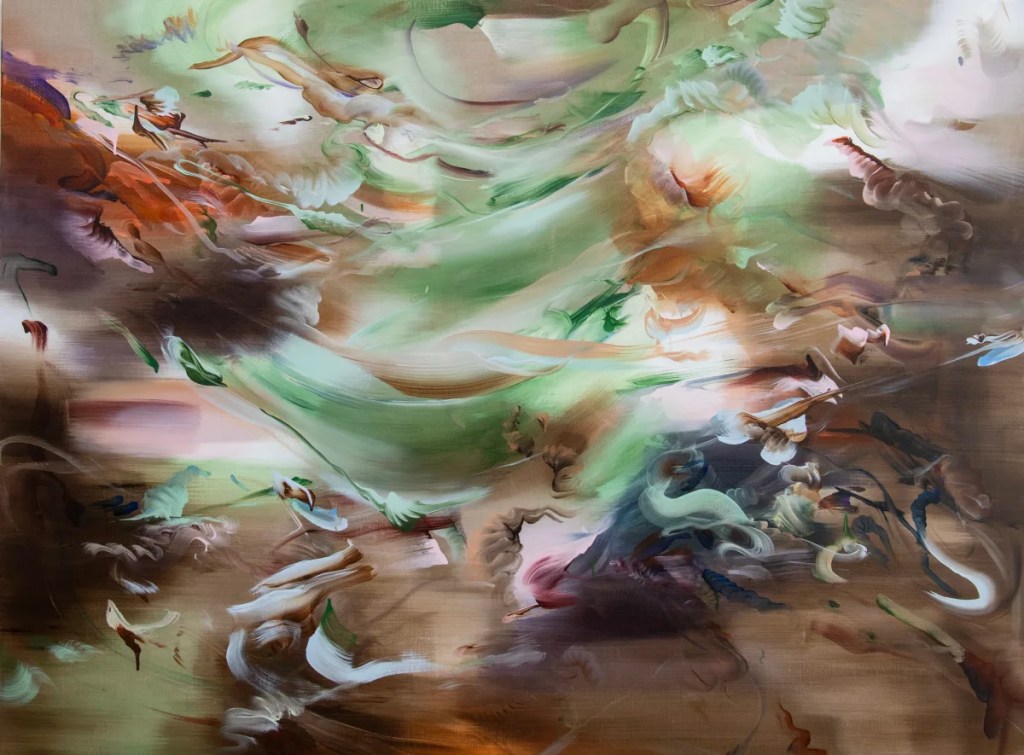
John Miltons lines at the beginning of Paradise Lost provide a succinct description of Grace Wrights suite of paintings in her show Grand Illusions. Equally the description of Charles Albury’s who was an observer of the effects of the atomic bomb at Hiroshima are also applicable – “We watched that cloud rise. It had every colour of the world up there, beautiful colours. To me it looked like salmon colours, blues, greens.”

Theses impressions  of shape, design and colour are something we also see in  the  images of the heavens taken by NASA revealing what appears to be chaos in the Milky Way and other galaxies.

Grace Wright, The Causes of Seeds, Plants and Fruit

Wright’s paintings conjure up a range of associations, from the of cosmic to the microscopic with some of her images  linked to brain scans and the flares of neurological synapses as in her “The Causes of Seeds Plants and Fruit”.

As with her previous work the artist explores the confluence between abstraction, symbolism and realism with a colour palette echoing the renaissance masters as well as the great Impressionist.

Grace Wright, On the Disposition which Characterizes the Wise

With a lot of her work she appears to have a contemporary take on the Baroque with images such as  “On the Disposition which Characterise the Wise)” with its drama and exuberance. Here the brush strokes suggesting the writhing bodies of baroque paintings in the paintings of Giovanni Battista Gaulli, at the Il Gesu church in Rome.

With “Cosmology” there is a sense of floating diaphanous fabrics in pastel colours while works like “The Causes of Atmospheric Phenomena provide a sense of dramatic skies after a storm .

Grace Wright, Cosmology

The small lively brushstrokes in several of the works suggest small birds in flight (On the Beauty of Song” or carefully described shell forms (Projections). These lively brushstrokes also make the viewer aware of following the mark making of the artist, both the small tentative marks as well as the grand gestures.

To subscribe or follow New Zealand Arts Review site – www.nzartsreview.org.

The “Follow button” at the bottom right will appear and clicking on that button  will allow you to follow that blog and all future posts will arrive on your email.

Or go to https://nzartsreview.org/blog/, Scroll down and click “Subscribe”

Categories
Reviews, News and Commentary

Ruth Cleland’s exploration of the enigmatic quality of concrete

Reviewed by John Daly-Peoples

Ruth Cleland Concrete 3

Ruth Cleland, Concrete

Sumer Fine Art

Until July 22

Reviewed by John Daly-Peoples

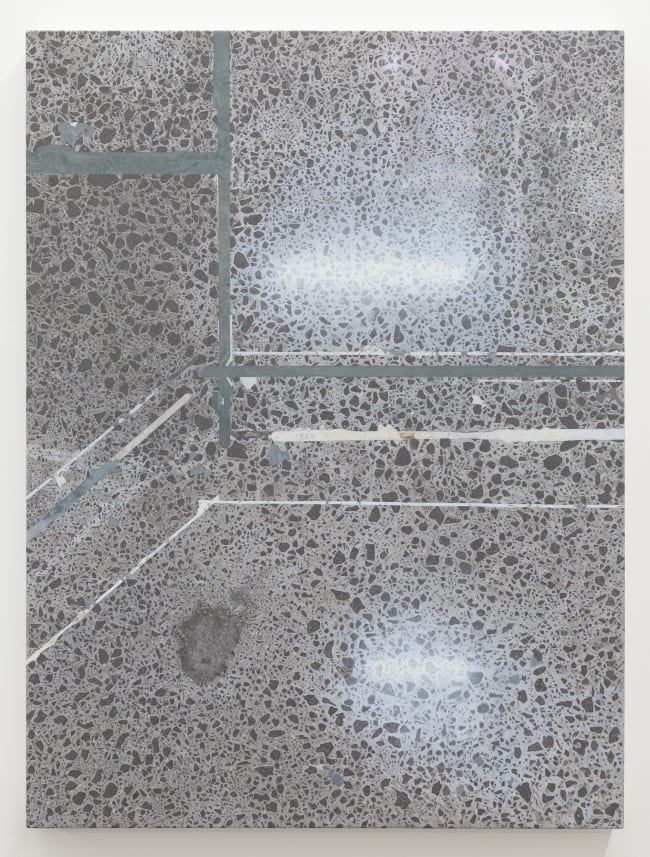
In her latest exhibition ”Concrete” Ruth Cleland continues her interest in the accurate depiction of her environment along with the use of the grid.

Gridding is a technique that has been used by many artists throughout history using horizontal and vertical lines over drawings or photographs for enlargement and transfer purposes.

Cleland uses a grid to transfer images of concrete floors onto board using either graphite pencil or acrylic. These images such as “Concrete Floor 3” ($12,8000) show the polished concrete surface with imbedded scoria along with signs of previous uses and marks.

The works are akin to the work of the Boyle Family who randomly chose sites or parts of the body which they then recreated, the completed work offering new interpretations of the environment or body.

These images of concrete floors could be of the floor of the gallery with its various  sections of ground and polished concrete laid over the years. They are in fact of a supermarket floor that the artist has previously used as subject matter. One image, “Concrete Path” ($12,800) has a more personal connection being the concrete path outside the artist’s home.

These images of concrete are meticulous in their accuracy but the artist shows her skill in the depiction of both ambient light sources as well as overhead lights.

Ruth Cleland, Concrete Floor 1
Ruth Cleland Gris (Concrete Floor 1)

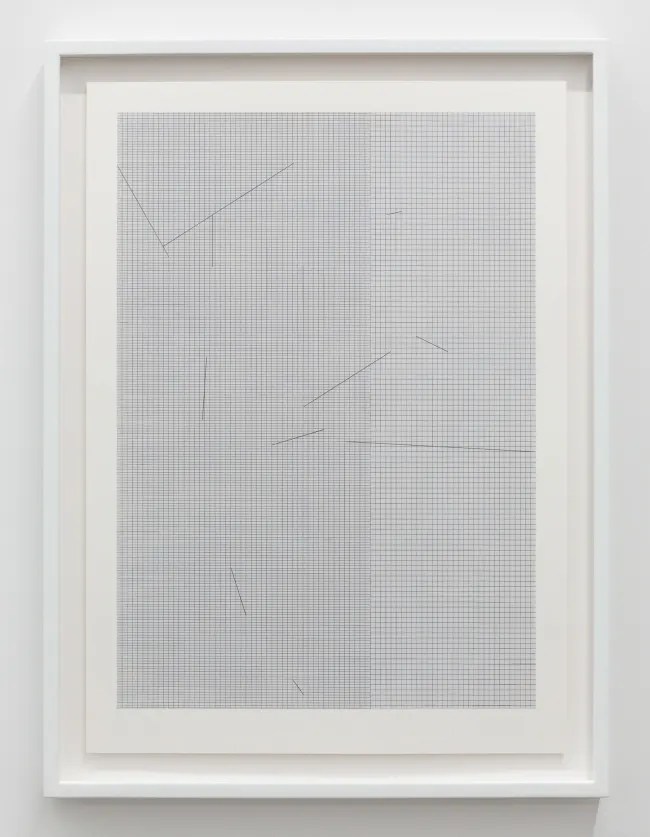
In some cases there is a companion piece to the photorealistic image as with “Concrete Floor 1” and “Grid / Concrete Floor 1” ($12,800 pair). The lines drawn on the grid have been used here to indicate the striations seen in the drawing as well as light intensity. This recording adds to the enigmatic nature of the work suggesting there is an underlying plan or logic inherent in the image itself which the artist has revealed.

To subscribe or follow New Zealand Arts Review site – www.nzartsreview.org.

The “Follow button” at the bottom right will appear and clicking on that button  will allow you to follow that blog and all future posts will arrive on your email.

Or go to https://nzartsreview.org/blog/, Scroll down and click “Subscribe”

Categories
Reviews, News and Commentary

La Clique: A magical and adventurous show

Reviewed by John Daly-Peoples

Tara Boon Image Liam Newth /Auckland Live

La Clique

Cabaret Festival

Civic Theatre

June 3 – 15

Reviewed by John Daly-Peoples

Headlining Auckland’s Cabaret Festival starting this week is La Clique featuring a range of performers with some of them presenting at a press preview.

La Clique has been performing for many years with their performers changing over the years. It was here at the Auckland Arts Festival in 2007 and while some of the performers have changed the class, innovation  and magic is still there.

Performing in the Civic, the show is particularly magical, not just being in the Civic but being on the Civic’s stage. The lights, curtains and apparatus that we never see takes the audience into a very different space and looming over us are the seats of the stalls and balcony  and above them the ceiling of the Civic with its twinkling stars of the solar system.

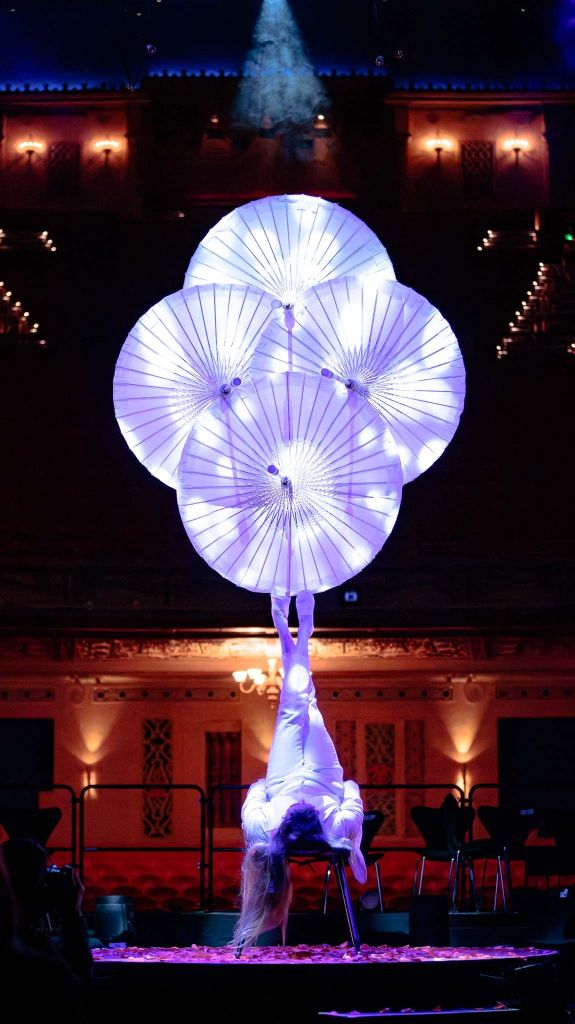
Tara Boon is a foot juggler which sounds like a pretty easy trick to take to the beach  later in the year,  that is,  until you realise that some people can’t even get their shoes on without becoming a contortionist.  Boon is as dexterous with her feet as ordinary people are with their hands. Resting on her reclining chair, she initially upends an umbrella which showers the stage with red petals and with her act she is able to manipulate up to four oriental umbrellas – on the handle or on their edges.

It’s a simple  slick stylish  act performed to the song “Umbrella” by Mechanical Bride and you keep forgetting how difficult it is to manipulate an umbrella, let alone four of them.

Byron Hutton is a juggler who is as clever with his hands as Boon is with her feet. He manages to juggle with his hands as well as other parts of his body, the  clubs dancing  and cavorting around him in fluid  movements.

He showed his consummate skill a couple of times when he lost a club and instantly caught another from his offsider before moving on to the next routine.

Heather Holliday Image: Liam Newth / Auckland LIve

The act which attracted thy most gasps was the fire eating Queen, Heather Holliday. I’ve seen a few fire eaters before but never up close, so close I could feel the heat of the flames. I know they use low combustion fuels which are less dangerous than things like alcohol and petrol but even so it all looks a bit scary, especially when she takes her flaming batons and drags them across her skin

At the end of her performance, her offsider came on with a flute  full of what I thought was a celebratory glass of champagne. But no. This was a glass full of her flame throwing fluid. She drank the flute and then spouted out a flaming jet like a flamethrower which had all the audience recoiling .

We saw just three acts but on the night, there will be a dozen. It will be a night full of the  sexy, the funny and the dangerous

Categories
Reviews, News and Commentary

The Play That Goes Wrong: skillfully executed chaos

Reviewed by Malcolm Calder

The Mischief Theatre Production of 
THE PLAY THAT GOES WRONG  

By Henry Lewis, Jonathan Sayer and Henry Shields

GMG Productions & Stoddart Entertainment Group
Associate director – Anna Marshall
Resident director – Nick Purdie
With Olivia Charalambous, Edmund Eramiha, Tom Hayward, Stephanie Astrid John, Joe Kosky, Jonathan Martin, Jack Buchanan, Anthony Craig and Kira Josephson

ASB Waterfront Theatre, Auckland

Until 1 June

Reviewer Malcolm Calder

The crew were frantically seeking a missing dog called Winston (I thought that was pretty funny from the outset), couldn’t find a missing CD, contending with a tricky door that wouldn’t latch, dealing with a floorboard that seemed have a mind of its own and contending with a mantlepiece wouldn’t mantle.  All this before the show had even started.

Their crew’s efforts were entirely unsuccessful of course and the litany of woes continued once things got underway.  But the teddibly English lads and lasses of the fictitious Cornley Polytechnic Drama Society struggled on in their efforts to ensure their eminently forgettable murder-mystery actually took place, with nowhere near understanding their own characters or, it seemed at times, even the plot.  Not to mention a set that seemed intent on total disintegration.  Their efforts certainly did go wrong and they eventually staggered to a dis-assembled conclusion.

However that’s not what The Play That Went Wrong is all about.  Rather, it uses the context of an amateur theatre production to very quickly hit the spot demonstrating both subtle and in-your-face comic writing, exquisite nuance and a mature command of the farce-wrapped-in-slapstick idiom whilst totally demolishing the fourth wall.

Lewis, Sayer and Shields, formed Mischief Theatre in 2008 and created The Play That Went Wrong while still studying at the London Academy of Music and Dramatic Art.  Originally titled The Murder Before Christmas, their production opened initially on the Edinburgh Fringe, enjoyed enormous success, moved to a pub on London and then quickly transferred to the West End.  It has been winning accolades around the world ever sinceand has even spawned a range of not unrelated television spinoffs.

This cast is very much an ensemble.  In performance they consummately demonstrate a broad-ranging set of physical theatre skills, demonstrate the importance of timing in making these work and do pretty well in convincing the audience that this is a collection of loosely-linked, impromptu standup snatches despite being a meticulously scripted work.

On Oening Night in Auckland I noticed a couple of rather precious looking luvvies in deep discussion during interval but they appeared to have missed the point entirely.   Deep, thought-provoking, question-raising theatre this is not.  Technique – yes!  But, rather, if set in the context of a funeral parlour, not dissimilar gags, techniques and characters these writers could probably transmogrify it quite readily into The Funeral That Goes Wrong.

After any number of productions that occasionally take themselves a little too seriously, we seem to be on something of a comedy roll of late.  Down at the water-side anyway.  The Play That Goes Wrong is the second bout of hilarity in a row with another soon to follow.

Categories
Reviews, News and Commentary

Peter Cleverly: The artist revealed

Reviewed by John Daly-Peoples

Peter Cleverly: Between Transience and Eternity

Alistair Fox

Quentin Wilson Publishing

RRP $60

Reviewed by  John Daly-Peoples

Peter Cleverly has rarely shown his work in Auckland galleries apart from a few times the early 1990’s, so for many his work is unknown apart from images in publications.

However, a new book, “Peter Cleverly: Between Transience and Eternity” by Alistair Fox will correct this.

The heavily illustrated book traces the artists career from the 1980’s to the present with images of his work across more than four decades.

These four decades of art practice have seen him developing a personal style partly influenced by other New Zealand artists as well as his personal, response to his environment –  physical, social and political.

His early work was predominantly figurative but from the 1990’s these were replaced with landscapes, often with texts and then. more recently the  inclusion of figurative elements again.

His work, particularly early on was influenced in different ways by Toss Woollaston, and McCahon.

McCahon probably influenced his palette and his use of text but he may have also gained an understanding of McCahon’s approach. Unlike many artists influenced by McCahon he referenced A C Cotton’s book “Geomorphology” which was a prime source for both artists and Cleverly uses Cottons illustrations and shapes. He also used objects such as the pitcher as symbols in his work.

Other influences include New Zealand artists Bill Sutton and Tony Fomison while the importance of several international artists  such as George Baselitz, Mimmo Paladino and David Salle and appears to  have adapted their thinking about art.

His early landscapes owe much to McCahon shapes in “Six Days in Nelson and Canterbury while interiors such as “Still life kitchen Oamaru” are Post Impressionist distilled though Woollaston.

Peter Cleverly, All twenty-nine

His figurative work often dwells on mortality and death. “All Twenty-nine” his response to the death of 29 miners at Pike River. Here and in many other works the artist has a personal and visceral approach to his subject.

This is also seen in “Couriers” featuring two distorted hanging figures – is reaction to the incarceration of drug couriers Lorraine and Aaron Cohen. Often his figures are something  between flayed corpses and angels.

Peter Cleverly, Seadog

Cleverly has developed his own distinctive iconography including a dog shape/face which serves a range of emotional and symbolic purposes as in “Seadog”. 

The book is a very readable account of the artists varied life which has had an impact on the way he sees the world and the influences on his practice as well as an understanding of the artists thoughts and motivations.

Categories
Reviews, News and Commentary

Auckland Philharmonia’s Enigma

Reviewed by John Daly-Peoples

Enigma

Auckland Philharmonia

Auckland Town Hall

March 27

Conductor Karl-Heinz Steffens

Grieg, Norwegian Dances
James MacMillan, Concerto for Orchestra ‘Ghosts’ (NZ premiere)
Elgar, Enigma Variations

On the programme for the Auckland Philharmonia’ s “Enigma” concert was a newly commissioned  work by the Scottish composer James MacMillan. His “Concerto for Orchestra” was subtitled “Ghosts” and had an enigmatic quality to it.

As the composer says of the work, “The music seems to be haunted by other, earlier musical spirits and memories,” These musical memories which creep into the composition can be seen in the reference to Beethoven’s “Ghost”  trio along with other musical references – Debussy, Scottish traditional music and an eastern musical hymn.

These musical references emerge from the composition like ghostly figures, sometimes gradually appearing, sometimes unexpectedly while some of the themes overlap.  The music is full of juxtapositions and surprises as various instruments and combinations of instruments introduce new themes and spiritedly amplify them.

The lively spirits of the opening were created by dramatic percussion and piercing brass which led to a great chattering of sounds with some eerie conversations between the strings and brass.

Throughout the work there is a sense of the instruments floating around, trying to discover and capture themes which have been lost. This floating, colliding and capturing of elusive themes creates a tension within the piece. The dramatic flourishes of percussion, the sinuous sounds of the strings as well as some jazzy sequences all add to the works restlessness and urgency.

The sounds all helped create a dreamscape of remembered, and reimagined sounds and like some ghostly figures were continually slipping and finally the wispy sounds disappear.

The piece recalls the Shakespeare line from the Tempest

The isle is full of noises,
Sounds, and sweet airs, that give delight and hurt not.
Sometimes a thousand twangling instruments
Will hum about mine ears, and sometime voices

Many of the same musical ideas appear in Elgars “Enigma Variations” where various musical instruments are used to convey impression of people that were close to the composer. The one theme that is probably never heard is the one that represents the composer himself. The variations feature the composer’s own ideas about his friends and close contacts conveying their physical, psychological and spiritual personalities.

The variations with their delightful impressions include variation I said to be of his wife, has a wistful quality and  an anthem overflowing with joy but also with s hint of sadness, Variation IX Nimrod with its heavenly sounds and the violas solo in Variation VI – Ysobel

Conductor Karl-Heinz Steffens was able to ensure that each of the portraits was interpreted with the appropriate mood, pace and colour and he seemed to relish both the music and the narratives of the work and his sharp, sensitive gestures had him performing like some grand puppet master manipulating the  dozen characters of Elgar’s world.

The opening work on the programme was Grieg’s “Norwegian Dances” and Steffens was able to lead the orchestra through the spirited dances with its changing portraits of the people, the history  and landscape effortlessly, taking the orchestra from lethargic to happy and ebullient.

Categories
Reviews, News and Commentary

Animal: The great little show in the farmyard

Reviewed by John Daly-Peoples

Animal

Cirque Alfonse

Q Theatre

March 19 – 23

Reviewed by John Daly-Peoples

It was not much of an act, chucking an egg in the air, have it land on your back and keep it there while you jiggle around. Anyone could do it , except one of the performers in the Quebec based group “Animal” had to have three goes at it. One of the eggs splatting on his back and head and two more landing on the stage. He got more applause for the broken eggs than did his two fellow perfomers for their safely caught eggs.

It’s always great to see performers achieving pulling off acts , but it’s more amusing when they fail – fail, recover and get on with the show. It often reveals the skill and dexterity of the performer and shows up our own lack of skill. In another of their acts one of the females spins a bucket full of seeds which is supposed to keep the seeds inside  . She misjudges and we get a stage strewn with seeds and she doesn’t miss a beat – it almost seems as if she meant that to happen. I think the little children may have learned one of their basic science lessons about centripetal force.

Theres a lot of basic science in” Animal” along with basic acrobatics as the group perform basic balancing, juggling and springboard work. They take the audience on a slightly surreal  journey through their weird farm of outlandish animal  and wacky activities – tossing pitch forks, balancing on milk churns, riding bucking cows.

As well as being skilled acrobats and contortionists the group are also skilled musicians playing guitar, trumpets, a range of percussion instruments, flute and keyboard – and they can sing too, belting out their own French compositions which are probably very witty if you are up on your French.

The Canadian Cirque Du Soliel group has shown us  how to put on a high-powered performance with cool moves and dazzling costumes but “Animal” is more down to earth, using all the contraptions from the farm, – wheelbarrows. milk churns and  hay forks, along with a jumble of clothes and hats which they must have found around the barn. Their routines are all clever and entertaining, bringing together circus, song, dance and theatre with some  quirky live music.

It may be designed for children but it has a universal appeal  with their displays of strength  agility and balance in their boutique version of the grander Cirque displays.

To subscribe or follow New Zealand Arts Review site – www.nzartsreview.org.

The “Follow button” at the bottom right will appear and clicking on that button  will allow you to follow that blog and all future posts will arrive on your email.

Or go to https://nzartsreview.org/blog/, Scroll down and click “Subscribe”
Categories
Reviews, News and Commentary

HEDY! The Life & Inventions of Hedy Lamar

Reviewed by John Daly-Peoples

HEDY! The Life & Inventions of Hedy Lamar

Written and performed by Heather Massie

Q Theatre

March 13- 16

Reviewed by John Daly-Peoples

While she never got an Oscar, Hedy Lamarr was considered the most beautiful woman in the world and was one of the great movie stars of the mid twentieth century. She starred in many films including “Samsom and Delilah and the Czech film “Ecstasy” which featured a controversial orgasm scene which was banned in many countries.

She was divorced six times, making her one of the most divorced women of the twentieth century, a distinction beaten only by Elizabeth Taylor with seven.

But, in many ways, her greatest distinction was her invention (along with George Antheil} of  a “Secret Communication System,” which was a radio-guided device with anti-jamming frequencies which would have had the capacity to interfere with torpedo guidance systems during WWI. The US Navy declined to make use of it.

This device is a component of present-day satellite technology and cellular phone technology.

Her work as an inventor was eventually recognized in 1997 with the Sixth Annual Pioneer Award bestowed on her by the Electronic Frontier Foundation.

These are some of the highlights of her career which were revealed in Heather Massie’s one-woman autobiographical show, “Hedy Lamarr”.

Lamarr reminisces about her life, her father, her time in Vienna and later her career in Hollywood. There are her relationships with the various men in her life – an armaments producer, a count, Louis B Meyer and various director and actors.

Many of them were presented by Heather Massie using a of range voices to create to give depth to her performance, although she gave most of the men pretty much the same clichéd accent. Her account of Jimmy Stewart, however, was a delightfully, breathless portrait of the actor.

The various events and activities referred to showed the range of Lamarr’s interests and encounters with her quotes indicating a shrewd mind and a keen observer of life.

Massie managed to turn Lamarr into a remarkable complicated but simple figure who seems to know a lot about life, men and the workings of the world as well as making shrewd observation about her life and her inventions.

However, Massie galloped through her “tutorial” about her guidance system with not much time to appreciate just how important the invention could have been to the war effort.

Massie’s presentation has Lamarr engage the various people in her life over the phone or in having on stage conversations so effectively that in retrospect it seems they were with there on stage.

She also engaged with the audience as a whole and in many cases with individual audience members, a technique which worked as a means of creating Lamarr as well as providing a classy example of how to create a character.

To subscribe or follow New Zealand Arts Review site – www.nzartsreview.org.

The “Follow button” at the bottom right will appear and clicking on that button  will allow you to follow that blog and all future posts will arrive on your email.

Or go to https://nzartsreview.org/blog/, Scroll down and click “Subscribe”

Categories
Reviews, News and Commentary

You are Here: linking language, memories and landscape

Reviewed by John Daly-Peoples

You Are Here

Whiti Hereaka and Peata Larkin

Massey University Press

RRP $45.00

Reviewed by John Daly-Peoples

Most stories have a beginning, a middle  and an end. Most stories have a central idea, a kernel from which the tale expands like a sinuous river which follows a plot or a life. Other books can have a very different structure as with the new book “You Are Here”.

“You Are Here” which is the  sixth book in the “kōrero series”, edited by Lloyd Jones, features Jann Medlicott Acorn Fiction Prize winner Whiti Hereaka and artist Peata Larkin, cousins who share the same whakapapa. in a collaboration. Unlike the previous stories in the collection Larkin’s images are not merely illustrations of the text but rather complementary representations of similar ideas.

Here the story line is cyclical, expanding and contracting. Like James Joyce’s  “Finnegans Wake” the work begins and ends at the same point but with an elaborate structure in between  

The poem  starts with the line “You are here” and ends with the line – “Return to where you belong”, seemingly following the mathematical notions of the Fibonacci number sequence.

In tracing out the narrative the  narrator recalls their youth and their experiences of life. Threaded through this personal journey are images of water and the stones of a lake as well as  images of birds and journeys. like the  symbolic use of the Piwakawaka by Colin McCahon.

Language, memories and landscape are seen as linked in the development of the narrator, their memories of school and the shaping of the person through language and experiences. the physical and the metaphorically linked in this journey.

Parallel to Hereaka’s storyline are Peata Larkin’s multi-layered visual images in which ideas inherent in the structure of the story are the linked to her exploration of the DNA structure as well as images of Māori design. Drawings of tāniko and whakairo on gridded shapes are linked to European notions of embroidery and mathematical structures.

Peata Larkin says of the work “Working on this project has been very special to me …Being cut from the same cloth enables the threads of the fabric to shine through and hopefully we achieved that.

Hereaka says. ‘It is my hope that by the time you have walked that path that you are now a different reader and will read those words in a new way,’

To subscribe or follow New Zealand Arts Review site – www.nzartsreview.org.

The “Follow button” at the bottom right will appear and clicking on that button  will allow you to follow that blog and all future posts will arrive on your email.

Or go to https://nzartsreview.org/blog/, Scroll down and click “Subscribe”