Reviewed by John Daly-Peoples
Jeffrey Harris
Suite Gallery
April 28 – May 30
Reviewed by John Daly-Peoples
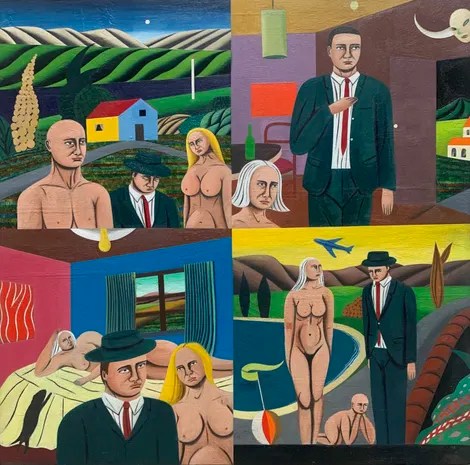
Jeffrey Harris creates surreal environments and portraits where Christian iconography and the mundane create richly textured imagery. Scenes which may derive from personal experience become images of universal importance reflecting on sexuality, personal and spiritual relationships.
In his latest exhibition of new paintings at Suite Gallery Harris draws on a range of sources including artists of the Trecento such as Giotto and Colin McCahon. His cartoon-like approach to his subjects and the Christian imagery create a unique view of the social, psychological, and spiritual dilemmas of society.
His use of Christian symbolism, is similar to the way McCahon had approached religion and its iconography, imagining the life of Christ in a contemporary world, in a contemporary setting.
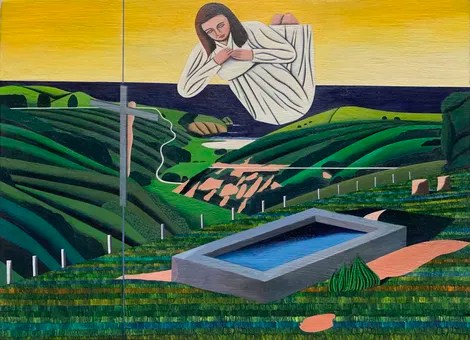
This mix of landscape, symbolism and religious iconography is seen at its most obvious in “Hovering Angel over Stony Bay” ($75,000) where the angel represents spiritual presence, protection, and the intersection of heaven and earth. There is also a swimming pool / cattle water trough referencing Christs baptism, the baptismal font and the water of life.
A crucifixion scene set in the centre of the painting appears to be located at a precise position, indicated by a precise line bisecting the image.
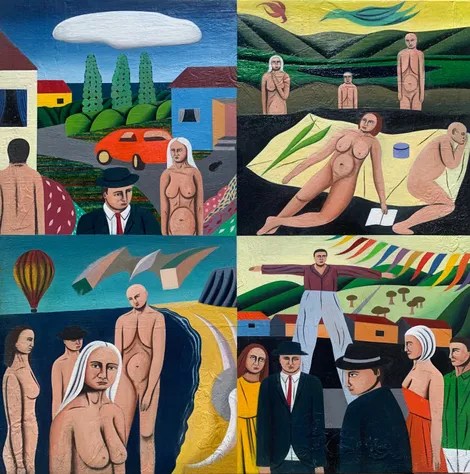
The four vignettes in his “Journeys 1975 – 2026” ($95,000) owe much to surrealist artists such as de Chirico and Magritte. Each of the images composed of simple figures and objects which have populated much of the artist’s work. The elongated nude figures which allude the nude figure if Christ can probably also be read as a disenchanted, disillusioned Harris while many of the other figures – men with hats can be seen as bureaucrats or individual searching for the truth.
In these views of Harris’s world we are confronted figures who look back at us, questioning and querying. The objects in these paintings are at once recognisable and mysterious. The cloud in one can be linked to the early Christian mystical book “The Cloud of Unknowing” with its obscure attempts to the link the attaining of spiritual through mediation on the world rather than through enquiry.
In other works there are also strange symbols or sections of the Cross floating the air as well as a lone figure exhorting a group of people. These figures often found in his work confront the viewer but offer no lesson or reaction.
Throughout his works he depicts small objects, some instantly recognisable, other slightly obscure. They are like those images found in Renaissance painting, ordinary objects which have been chosen to convey the sitter’s wealth, status, piety, or intellect, functioning as a symbolic language rather than mere decoration. These symbols – an airplane, a book, various birds, black cats, a hot air balloon and a human head with horns give the paintings a sense of density and depth as well as the enigmatic.
The plane could be a reference to a series of McCahon works “Jet over Muriwai” which are a clever image connecting Māori and Christian / European notions of afterlife and isolation while the images of birds convey the idea of a free spirit as well as highlighting the balance between nature and divine narratives.
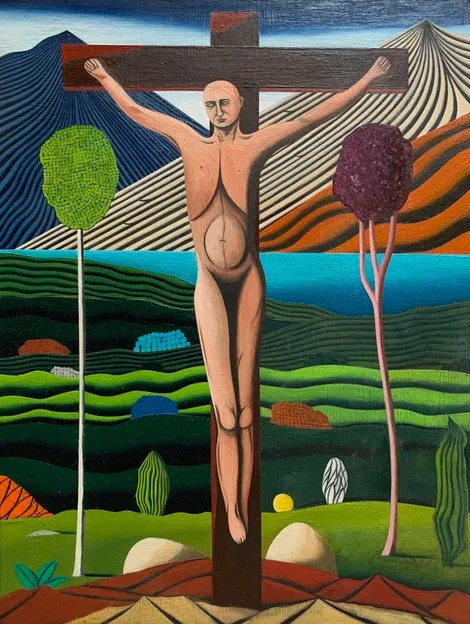
With “Crucifixion and Landscape” ($70,000) the artist places the event in an undefined location, although the hills could refer to the Southern Alps. The work like many artists of the last 100 years tries to place the Christian narrative in contemporary settings with the Christ figure symbolising the suffering and pain of individuals in contemporary society. In using Christian imagery Harris creates ambivalent narratives. While the Bible stories are about God/Christ, Harris uses them as symbols of human suffering, addressing issues of personal spirituality and angst.
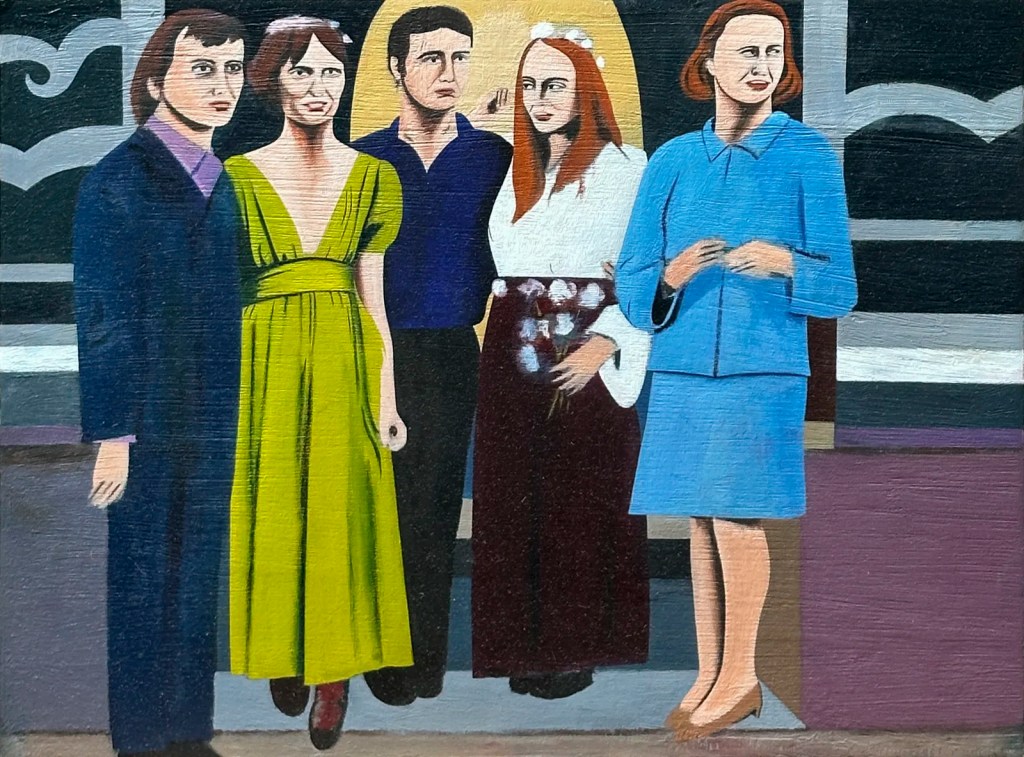
With “Wedding 1975 – 2026” ($70,000) the artist has depicted a wedding party, but as with all his “secular” images there is a tension and unease with the wedding group most of whom are looking to the right beyond the picture frame. Knowing Harris’s liking of religion subjects this could well be a depiction of the wedding at Cana, and the group are watching Christ performing his miracle of turning water into wine.
With these painting the artist endeavours to create narratives combining biblical tales, recreated myths, dream sequences and psychological insights.