Shane Foley’s “Tide and Tide” exhibition is based of archival images of Auckland‘s waterfront from the nineteenth and early twentieth century. They are of images of foreshores, beaches and building, most of the which have disappeared,
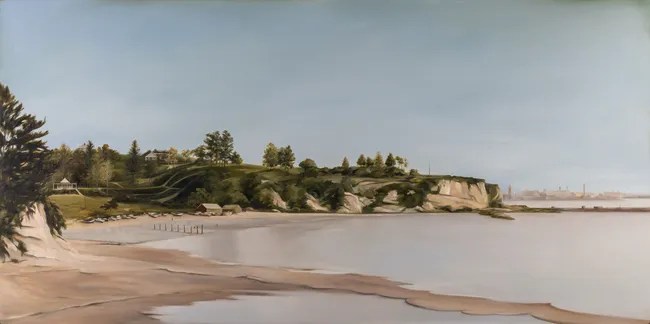
Several of the works make reference to Auckland’s history so “Campbells Point at Judges Bay” ($7500) includes `Kilbryd’, the large Italianate home of Sir John Logan Campbell. In this painting the artist has shaped much of the view making the foreshore beach a series of flat planes while the cliffs below the house have been sculpted with gentle curves of lawn.
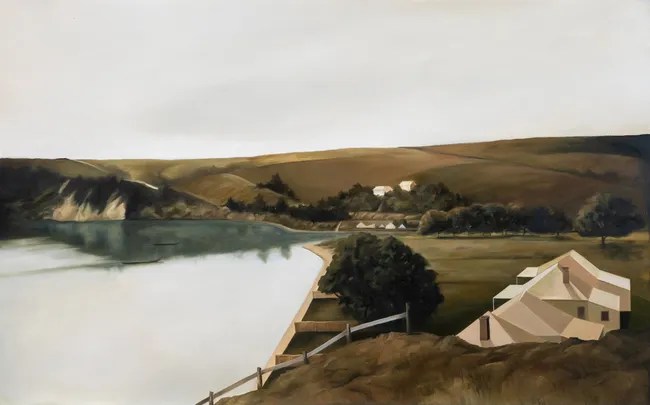
Shane Foley Heaphy’s View, St Georges Bay, early 1860’s
In her “Heaphy’s View, St Georges Bay, early 1860’s” she has carefully constructed two houses in the foreground while two background houses owe much to Braque’s “Houses at L’estaque”.
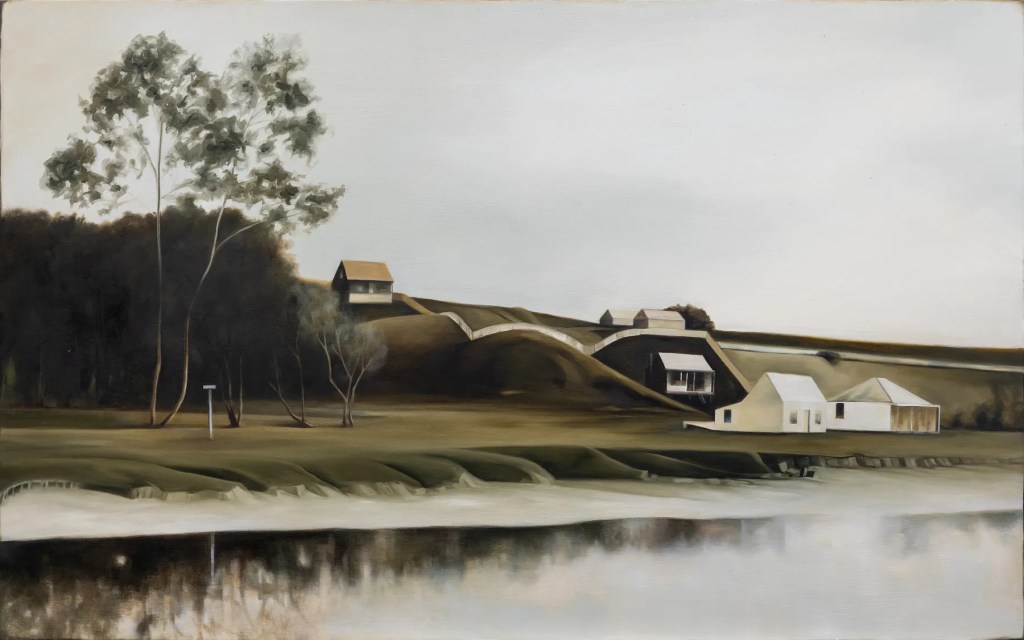
Shane Foley Settlement, St Georges Bay 1867
With “Settlement, St Georges Bay 1867” ($3800) the houses seem like surreal addition, the boxlike shapes placed in the carefully formed landscape consisting of folded landforms, where the fence lines are made from abstract curves.
With “Trees at Shelly Beach, Pt Erin 1914” ($1900) she has depicted one of the now forgotten buildings which could be found on Auckland’s waterfront. This was the salt water, tidal baths at Pt Erin which were demolished for the Auckland Harbour Bridge.
Other buildings from the period include “West End Rowing Club at St Mary’s Bay 1914” ($4800) and ‘The Jetty, St Mary’s Bay. 1950’s’ ($4800) where the eerie white buildings stand out from the background.
There is a slight tension in viewing these works, as the past and present merge and the abstraction the artist uses distances our view, giving them a dream-like aspect.
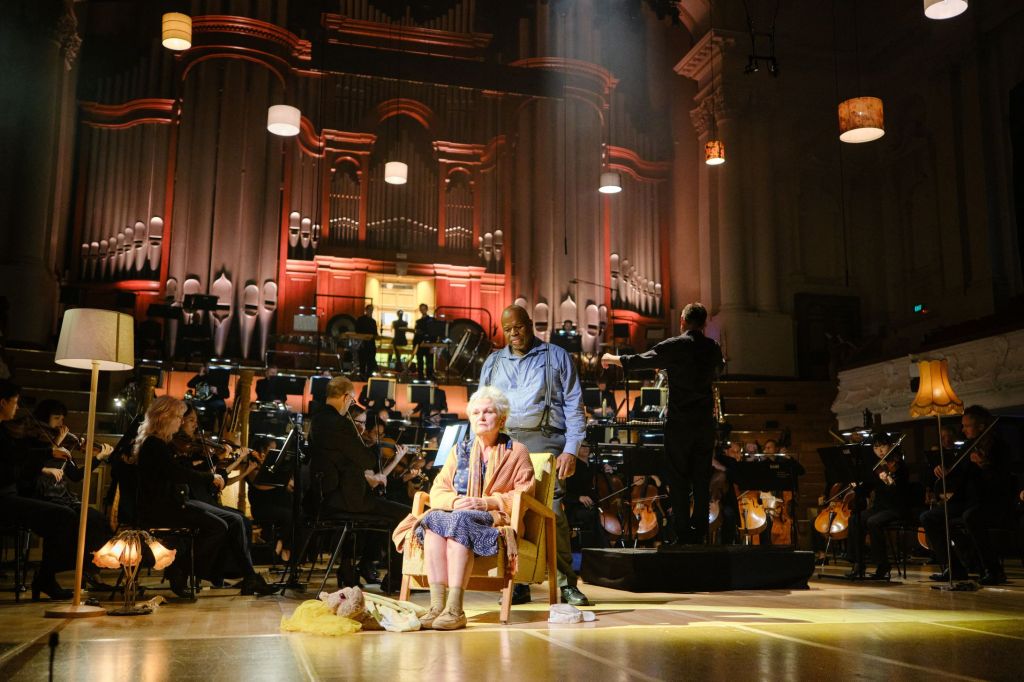
Judith (Susan Bullock) and Bluebeards (Lester Lynch) Image: Thomas Hamill
Bluebeards Castle
By Bela Bartok
NZ Opera & Auckland Arts Festival
Aotea Centre
March 13th & 14th
Reviewed by John Daly-Peoples
In Bela Bartok’s original staging of Bluebeards Castle, the newlywed Judith enters her husband’s dark, foreboding castle where she is faced with seven locked doors that she is forbidden to open. In this version by Daisy Evans, it is a single trunk which holds the memories of the couples past lives which Bluebeard remembers while Judith herself seems to become lost to him.
For this production director Daisy Evens created a new Judith who is somewhere between an older woman with dementia and a woman facing her own psychological breakdown and who along with her husband can be seen as displaying the Freudian concepts of sexual trauma.
The castle can be seen as symbolic of Bluebeard’s soul; a dark mind filled with secrets that threaten to reveal his true nature. The opera itself can be seen as an allegory for the loneliness of the human soul, the impossibility of truly knowing another person, or the conflict between rational and emotional.
Bartok was writing the opera at the same time that Freud was engaged in studies into psychoanalysis and elements of this have seeped into Bartok’s thinking which aligns with Freud’s theories of exploring the unconscious mind, hidden sexual desires, and psychological trauma.
Bluebeards Castle like other Symbolist art works, replaced traditional dramatic narratives with dark, subjective internal journeys, mirroring the Freudian focus on repressed emotions and dreams.
Despite Bluebeards protests she removes the symbolic items from the chest and in doing so she discovers events from Bluebeards past, events she needs to recognise if she is to fully understand him. He also needs to acknowledge these events if they are to be a truly understanding, loving couple.
In opening the chest for the seventh time she discovers the three women of his past, one found in the morning, one at noon and one at sunset, Then with Judith, his fourth, the bride he found at night, having fully understood her husband she joins the women leaving Bluebeard in perpetual darkness.
The seven memories in the trunk contain the relics of the couples past that Lester Lynch’s Bluebeard remembers with joy and anguish, while Susan Bullock’s Judith emotionally engages with her former self, as lover, bride and mother.
References are made throughout the opera about the power of light to overcome darkness and symbolic of this the stage was studded with two dozen domestic lamps which flickered on and off at various points.
Like the story of Bluebeards Castle, the music is mysterious and riveting, providing a background soundscape which seems to continually shift as the various events of the opera are revealed.
Throughout the work there were sequences where the music provided particularly unsettling sounds, while there were other times when the orchestra was able to symbolise the idea of light flooding into the darkness of the castle. There were some exquisite passages particularly the blaring drama of the organ which was like a palpable force and the swelling of the strumming harps.
It was the emotional richness provided by the two singers which helped maintain the tension along with their creation of character though their acting. Bullock displayed a voice of amazing power while Lynch plumbed great depths as he revealed his inner thoughts.
This production was a stunning display of acting and singing along with an inspiring performance by the Auckland Philharmonia under the direction of conductor Brad Cohen.
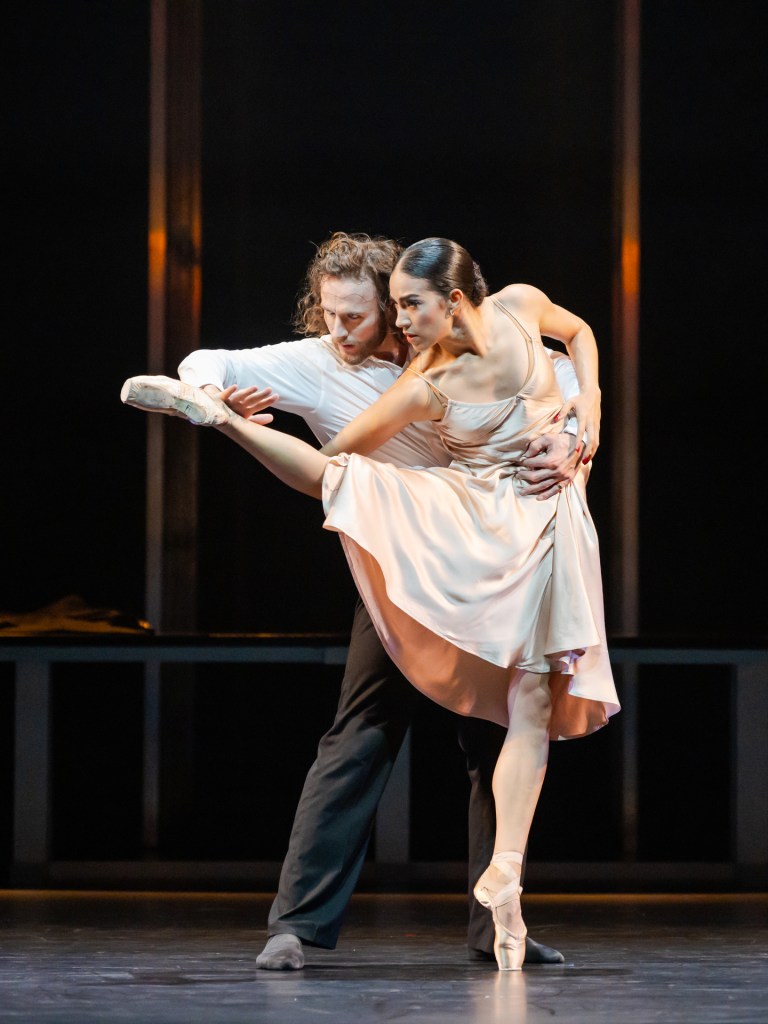
Brandon Reiners and Ana Gallardo Bobainaw Photo credit: Stephen A’Court.
Macbeth
Auckland Arts Festival
Royal New Zealand Ballet
Co-production with West Australian Ballet
Kiri Te Kanawa Theatre, Aotea Centre
4-7 March
CREATIVE TEAM:
Choreography – Alice Topp Set & Lighting Design – Jon Buswell
Costume Design – Aleisa Jelbart
Dramaturgy – Ruth Little
Music – Christopher Gordon
Conductor – Hamish McKeich
String Ensemble – Musicians of the New Zealand Symphony Orchestra
Then
Dunedin, The Regent, 13-14 March
Christchurch, Isaac Theatre Royal, 18-21 March
Reviewed by John Daly-Peoples
The Royal New Zealand Ballet ‘s new Macbeth, is a contemporary interpretation of one of Shakespeare’s most ruthless tragedies which is as relevant now as it was four hundred years ago. As in many of his plays Shakespeare explores the intense, often tragic tension between the individual and the state, showcasing how personal identity, ambition, and morality clash with political power and societal duty. In his plays state authority and sovereignty, demand conformity, yet individuals seek autonomy or challenge the status quo, navigating complex power structures.
He explores the Machiavellian rise to power and the devastation that two individuals can inflict on the state.
This is all achieved in this production through the choreography, the sets and the music.
The sets designed by Jon Buswell are essentially minimalist while the lighting, also by Buswell is more complex. At some points the lighting is focused on the main characters, at other times shadows and darkness dominate.
Created by internationally director / choreographer Alice Topp the ballet unfolds in a ruthless modern world shaped by political ambition, media manipulation and the fatal seduction of power.
She says, “Macbeth is one of Shakespeare’s great tragedies, exploring themes as current today as they were when first written,” says Alice Topp. “An epic story fuelled by political ambition, passion, desire for power and the burden of guilt, its potency endures. Our Macbeth is set in a hierarchy-hungry, high-society city, where political storms, media frenzy and personal ambition collide.”
The music for the work has been composed by Christopher Gordon and features both recorded and live music. One hundred and twenty-nine musicians contributed to the recorded music while an octet of strings from the New Zealand Symphony Orchestra provide live music. The musical landscape provides full orchestral sound with driving, unrelenting tempo that echoes the character’s anxieties.
Gordon created a series of musical themes designed to reflect the characters as well as the mood of the various sequences of the ballet. His complex music consisted of big band music, electric dance music, funk, film music and references to composers such as Phillip Glass.
At the centre of the ballet are the two malevolent Macbeths (Brandon Reiners and Ana Gallardo Bobainaw) who dance their solos, pas de deux with moves which indicate corruption and self-centeredness.
The visceral language of the choreography is used to explore the characters psychological pursuit of power and duplicity.
The classical poses and movements which are normally used to display romantic connections were subverted so that these movements create a disquiet which reflects their own inner turmoil. When the two of them dance their elaborate almost ritualistic dances they seem to be abusing each other in erotic displays.
While the sets are minimal, they are often dominated by tables surrounded by protagonists who engage in discussion and planning. These balletic movements around the table recall Canadian choreographer Crystal Pite’s “The Scenario”, her witty take on a boardroom meeting,
As the three witches / influencers Kirby Selchow, Ruby Ryburn, and Shaun James Kelly are an excellent melding of the comic, the supernatural and the intruding media with the endless writhing, gesturing and guttural sounds.
Laurynas Vėjalis as Duncan, Dane Head as Malcolm, and Kihiro Kusukami as Banquo gave strong displays which contrasted with the spikey dancing of Reiners and Bobainaw.
There were a few occasions when the audience was given some indication of the story with texts projected onto screens, including a few lines form the play itself but there were other times when the audience could have been given more useful indications of location and event.
We are surrounded by music every day, in our houses, in the public space in shopping malls and with our audio devices and through this soundscape to our lives which we build up a huge sound bank of songs and music. Often, we are not aware of how this music is created but we are conscious of its components such as melody, harmony, rhythm, tempo, dynamics, timbre, texture, and form, which work together to create a piece of music. But we rarely investigate them, they are magically and mysteriously assembled, providing enjoyment and diversion There are many though who become obsessed by what a composer, band or singer have created and how these creators have seemingly produced something which touches on our psyche, our emotions and our way of seeing the world. There are some writers, composers and philosophers who try and understand this fascination with what music is and what it does.
Roger Horrocksm is deeply interested in this world of music and his new book “Music Without End; A book of listening” which follows on from his 2022 book “A book of Seeing” delves into areas of music which will resonate with readers as well as offering new perspectives and insights.
As the author says in his preface “I take a very broad approach … since I am interested in popular music, jazz, classical music contemporary classical sounds and music form non-Western traditions (including, Indian, African and Māori).
This very catholic approach has resulted in a book which covers the musical landscapes which most readers will be aware of but also presents new landscapes which will be new, novel and intriguing sending readers off in a quest for these often unknown composers, musicians and compositions.
The four chapters of the book are Music and Listening: A personal History, On Listening, Interviews and Music without End: A History of Western Classical Music
The opening chapter reads very much like the account many music lovers would write- early encounters with music which stimulated great interest in listening and collecting music. For Horrocks this has led to a very wide interest in both classical and popular music. He recounts his exploration of music with its various interwoven strands such as hearing Vivaldi’s “Four Season as the soundtrack to Kenneth Angers 1953 short film “Eaux d’Artifice” filmed at the Villa d’Este.
His music education really developed when he spent time in the1960’s is the US One encounter meant that he saw the Merce Cunningham dance groups performing to music by John Cage and David Tudor and also got to talk with John Cage. An encounter with Arab / Andalusian music in a taxi in Paris as well as exposure to the experimental jazz of the of the 1960’s hearing musicians such as Ornette Coleman and archie Shepp
He also includes miscellany of musical events such as a performance of Handel’s “Messiah” at Crystal Palace in 1857 which had an orchestra of 500 and 2000 singers. Providing a New Zealand context, he notes that two years before the concert the infant Auckland Choral Society had performed the work in Auckland.
For the third chapter the author interviewed ten contemporary musicians who offer different perspectives on the Importance of listening, inspiration and process in the creation of music. These include contemporary composers Eve De Castro Robinson and Annea Lockwood, conductor / composer /performer, Petere Scholes and singer Caitlin Smith,
“Music Without End: A history of Western Classical Music”, is the final chapter in the book takes a broad approach to the history of Western Music. As the author notes, ‘What interests me is the constant evolution of styles and genres, along with development of instruments, venues and technologies.
Here he follows the course of the Western music over 800 years looking at the major periods – Baroque, Romanticism, Late Romanticism, Modernism, as well Atonal Music Serialism and Minimalism, He also devotes space to many of the Russian composers. including Sofia Gubaidulina, Alfred Schnittke and Valentin Silvestrov.
As well as looking at various aspects of music he devotes much of the book in tracing out the historical threads of Western Music he interested is in trying to understand how the music got to be written and the changes in approaches to composition.
In his exploration of the nature of listening he broadens out his enquiry, looking (and listening) at music from various perspectives such as the compositions of John Cage where the music is close to a theoretical or philosophical model.
This exceptional book not only introduces readers to many specialist areas of music, but it does so using an accessible language, providing interesting anecdotes and providing readers with a way of understanding their own approaches to music.
The “Follow button” at the bottom right will appear and clicking on that button will allow you to follow that blog and all future posts will arrive on your email.
The Collector; Thomas Cheesemen and the making of the Auckland Museum
Andrew McKay and Richard Wolfe
Massey University Press
RRP $65.00
Reviewed by John Daly-Peoples
Museums have had a lot of critical press over the past few years, viewed as agents of the colonizers because their collections often contain artifacts taken from colonized countries, and their early practices reinforced colonial ideologies by presenting the colonizer as superior. They functioned as a means of control, where European museums collected objects from voyages of exploration and colonies to showcase their dominance and justify the imperial project. But a major thrust of museums has also been to preserve, interpret, and exhibit the local cultural and scientific heritage serving as a bridge between the past and present by collecting objects, telling stories, and providing a space for people to learn, reflect, and connect with history, art, and science.
That has certainly been the aim of the Auckland Museum and the individuals who initiated it, guided it and developed it. A new book “The Collector; Thomas Cheeseman and the making of the Auckland Museum” tells how the Auckland Museum, like man y other museums in the nineteenth century were guided by visionary individuals.
The newly opened Auckland and Institute in 1876 Thomas Cheeseman stands in the doorway
Authors Andrew McKay and Richard Wolfe write about the establishment of the museum’s first custom-built building in 1876 at the northern end of Princes Street. When it opened the director was Thomas Cheesman who had been in the post since 1874, remaining in the post remained in that post until his death in 1923.
They write about the original building which was unfavourably compared to the more ambitious Christchurch Museum. It was “plain, improvised and almost invisible … It was housed in an old public building, with little funding and few staff. But that’s what makes the story compelling. The contrast between the buildings isn’t just architectural — it reflects differing levels of civic support, cultural ambition and access to resources. Auckland’s museum didn’t look like much, but it had people with vision, especially Thomas Cheeseman. Over time, he took that underwhelming space and turned it into a serious scientific institution.”
Under his visionary guidance the Museum and its collections flourished, necessitating a further move and the commissioning of a world-wide architectural competition to design a new Museum for Auckland which would be combined with a war memorial to commemorate soldiers lost in World War I. That new museum opened on its current site in 1929.
Not only did Cheesman manage to the institution for nearly fifty years but as a self-taught botanist he travelled the length and breadth of New Zealand, collecting and recording plants, and observing the geography of the country. During his career, Cheeseman also published numerous important papers on a range of flora, described three plant genera, and numerous plant species from New Zealand and the Cook Islands. At the request of the New Zealand government, Cheeseman began his magnum opus, Manual of the New Zealand flora, which was first published in 1906and in 1914 he edited the two-volume work Illustrations of the New Zealand flora.
Thomas Cheeseman
Cheeseman met or corresponded with many of the scientists in New Zealand as well as extensive professional relationships with local and international colleagues, including the German-born geologist and director of the Canterbury Museum, Julius von Haast, the geologist James Hector of the the Colonial Museum, the geologist, zoologist and museum director Frederick Hutton as well as Sir Joseph Hooker at the Royal Botanic Gardens in Kew, England.
Early on in his career he even corresponded with Charles Darwin as the authors write. “Charles Darwin was arguably the most famous scientist in the world and also one of the most controversial. And it wasn’t just a lucky moment. Cheeseman’s note was careful, respectful and scientifically rigorous. It showed that he wasn’t just some amateur with an opinion — he was a careful observer who took the work seriously. Darwin saw that. For Cheeseman, it must have been thrilling and validating. It also helped open doors — that exchange helped establish his credibility in the scientific world, and it reinforced the idea that valuable knowledge didn’t just come from Oxford or London, it could come from a young man on the edge of empire, with a sharp mind and a notebook. That Cheeseman dared to write at all — and so confidently — speaks volumes about both his scientific maturity and his quiet self-assurance.”
The book highlights Cheeseman’s efforts to develop the taonga Māori component of the museum and also touches on the ethically sensitive area of collecting the art and culture of Māori noting ‘While Thomas Cheeseman was largely guided by the norms of nineteenth-century science, some of his actions — particularly around the acquisition and display of taonga Māori — now fall into ethically ambiguous, if not outright troubling, territory. His drive to build the Auckland museum’s collections sometimes led him to treat cultural objects as specimens, detached from the communities that made and valued them.
His acquisition methods could also be problematic. In several cases, taonga were obtained through missionary networks, collectors or private sales, often with little documentation about provenance or permission. Cheeseman rarely questioned the ethics of these transactions… These actions were not driven by malice, but rather by an unshakeable belief in the civilising power of museums and the primacy of scientific classification.”
The book tells the history and development of the Auckland Museum and its progress over more than fifty years to the triumph of the building on the present site in Auckland Doman. It also tells of the journey of Thomas Cheeseman who become a great person of influence not just in Auckland but nationally. The book also gives an account of the changing scientific and cultural landscape of the latter part of the nineteenth century and the early part of the twentieth century.
It is a well-researched and written book, thoughtfully designed with numerous images which help tell the entwined stories of Cheeseman, the development of scientific inquiry, the museum and museum’s collections.
Andrew McKay holds a PhD in art history from the University of Auckland and was a Professional Teaching Fellow in the university’s art history department.
Richard Wolfe is an Associate Emeritus of the Auckland War Memorial Museum and from 1978 to 1997 was Curator of Display. He has written numerous books on New Zealand art, history and popular culture.
The “Follow button” at the bottom right will appear and clicking on that button will allow you to follow that blog and all future posts will arrive on your email.
Based on the book by Trent Dalton Additional Writing and Story: Trent Dalton and Fiona Franzmann Adaptor: Tim McGarry Choreographer & Movement Director Nerida Matthaei Associate Director Ngoc Phan Set & Costume Design Renee Mulder Lighting Design Ben Hughes Video Design and Cinematographer Craig Wilkinson Composition & Sound Design Stephen Francis
Civic Theatre
October 17
Reviewed by John Daly-Peoples
Before heading off to see Trent Daltons “Love Stories” a quick survey of what love is was in order. First stop would be Shakespeare, and he almost nails it with
“Love looks not with the eyes, but with the mind” from a Midsummers Night Dream
The audience filled the Civic Theatre and on stage all we see is a panorama of the audience looking back at ourselves. All of those people who know about their own encounters with love. They are the mass of humanity who are hoping to find out the truth / answer to the eternal question. – What is love?. And each one of them knows what it is. Each one can tell their own story
And then scrolling across the screen are the answers we could give, all provided by previous audience members
LOVE IS
Lasting the distance. Even when you think you can’t do it.
The perfect coffee with crema on Sunday morning
Saying sorry and meaning it
Being confident in the silent moment
Magical; poetic, sometimes messy
And dozens more some profound, some very personal, some cliched
Trent Dalton spent two months in 2021 gathering stories on his 1960’s blue Olivetti typewriter, on a prominent street corner in Brisbane’s CBD. He had sign which read “Sentimental writer collecting love stories. Do you have one to share” Speaking with Australians from all walks of life, he received hundreds of them.
The show opened with Jean- Benoit and his drumming as he introduced the show and it closes with his taking us backstage through to a simple doorway which led us back out of the theatrical world of make believe into the real world.
The dozen actors who swarmed the stage enacting the stories, some lasting a few minutes, other only a few brief moments created a topography of love with its range of, stories, anecdotes and remembrances.
Some of the stories are profound, some of them flippant, some of them might have been written by the writers at Hallmark Cards. Other could have been written by your partner, boyfriend, girlfriend.
Director Sam Shepheard wove the various stories together, the actors changing guises as they connected and parted. Sometimes cameras made their faces balloon up large on the screen as they addressed the audience. Many of the stories are moving, rich in compassion, witty, and full of allegories.
The entire cast created impressive range of characters and encounters and there were some clever sequences – a bit of a Juliet speech, a quote from Emily Dickinson, a scientist explaining about technical aspects of dopamine
Holding much of the performance together was Jason Klarwein (the Writer / Husband) and Anna McGahan (The Wife) where the actual world of the couple seems at odds with his accounts of the people from the street with their passionate, flawed and intermingled lives.
And there are several life stories all woven together such as a film segment delivered by Joshua Creamer, a barrister and human rights activist who not only tells his personal story but also the story of land rights, family, and his identity as an Aboriginal man.
There is also the Asian woman Sakuri Tomi whose story is trapped inside a nightmare is told in several vignettes.
The video montages combined with live video feed help create a dynamic flow and the choreography of Nerida Matthaei adds to this dynamism which works brilliantly in sequences like the State of Origin game.
While it’s not in the play they could have used Marilyn Munroe phlegmatic quote about love – “If you can make a woman laugh, you can make her do anything.
The NZSO latest concert “Stabat Mater featured two works based on the image of the Virgin Mary standing at the site of Christ’s crucifixion which had led to numerous compositions and art works has which has added to the church’s iconography and rituals.
Rossini’s Stabat Mater complete in 1841 was based on the medieval Latin poem describing the Virgin Mary’s grief at the crucifixion of her son while Victoria Kelly’s Stabat Mater was a response to both Rossini’s work and the medieval text. Kelly’s work was less of a sorrowful meditation on to the event but rather a reflection on the misogynistic nature of the text.
Rossini’s Stabat Mater featured three New Zealand singers: soprano Madison Nonoa, mezzo-soprano Anna Pierard, tenor Filipe Manu along with Australian bass-baritone Jeremy Kleeman.
The singers were joined by Voices New Zealand Chamber Choir, which also performed during Kelly’s new work.
The orchestral opening of Rossini’s Stabat Mater was very operatic contrasting with the low, soft sounds of the choir, as though angelic voices were descending.
The Air that followed had a rather breezy tone and Filipe Manu finely nuance delivery was rich in emotion as he sang about the sword that pierced the Virgins heart. Jeremy Kleeman in a later Air displayed a fine tightly controlled voice with a luxurious sound.
The duet revealed the colourful voice of Madison Nonoa along with the more fulsome sounds of Anna Pierard. Together they were able to convey the torment and grief of the Virgen.
The Quartet which saw the four soloists elegantly interpreted the text, their voices complementing g each other. Their singing did highlight one of the problems with Rossini’s major failing with the work in not assigning characters at the crucifixion to the individual singer – The Virgin, Mary Magdalen, John, the two thieves.
In the Cavatina section Anna Pierard showed drama in her voice along with some terse vibrato and in her Air Madison Nono started off with barely a whisper which was take up by the choir which turned inti a thunderous sound, her light, piercing voice seeming to be the Virgin overwhelmed by the choir
In the final quartet the four soloists emphasised their individua voices, seemingly disconnected unfocussed somehow replicating the discord and cacophony which would have occurred during the time of the crucifixion. All this was brought to a conclusion with the chorus and their transcendental Amen.
Victoria Kelly’s response to the medieval text and Rossini use of it “provoked an overwhelming sense of rase and sorrow in me” she has written. Rather than see the texts and the event form a religious perspective she has seen the misogynistic and religious oppression which is tied to much of the church’s teachings. She has taken a revisionist approach and her text for the work is full of critical lines such as
“She wants no choirs castrated,
No congregation tithed,
no people bound and silenced.
no false priests fellated.
The work opening with a low electronic sound leading to the murmuring strings which created a sense of travel or /transition as though we were being transported back to an earlier time.
Much of the time the work sounded like a lament, the sombre singing of the choir and the music interwoven, the text reinforced by the tension and intensity of the choir.
The choir displayed a nice balance between singing and choral speaking their quality, pitch, power, tempo, effective in conveying the meaning and emotion of the work.
The phrase” She does not mourn” occurred several times through the work and was repeated at the conclusion as the words slowly and softly disappeared.
The dark brooding sounds of the final moments of the music contrasted with the angelic voices of the choir and rather than end with a b ang something triumphant like the Rossini it ended with a whimper.
Making her New Zealand debut was Italian conductor Valentina Peleggi whose lively conducting, sweeping gestures and close attention to the soloists and choir ensured an impressive performance.
The “Follow button” at the bottom right will appear and clicking on that button will allow you to follow that blog and all future posts will arrive on your email.
Royal New Zealand Ballet & The New Zealand Dance Company
Kiri te Kanwa Theatre, Aotea Centre, Auckland
July 31
Reviewed by John Daly-Peoples
Choreography: Stephen Baynes, Shaun James Kelly, Moss Te Ururangi Patterson Music: Pyotr Ilyich Tchaikovsky, Philip Glass, Shayne P. Carter Set Design: Jon Buswell (Home, Land and Sea) Costume Design: Stephen Baynes with RNZB Costume Department, Rory William Docherty, Moss Te Ururangi Patterson with RNZB Costume Department Lighting Design: Jon Buswell, Daniel Wilson
“Home, Land and Sea”, The Royal New Zealand Ballet’s Triple Bill featured three very different works each with a distinctive mood and choreography, all had links to the land with styles ranging from the abstract to the deeply connected.
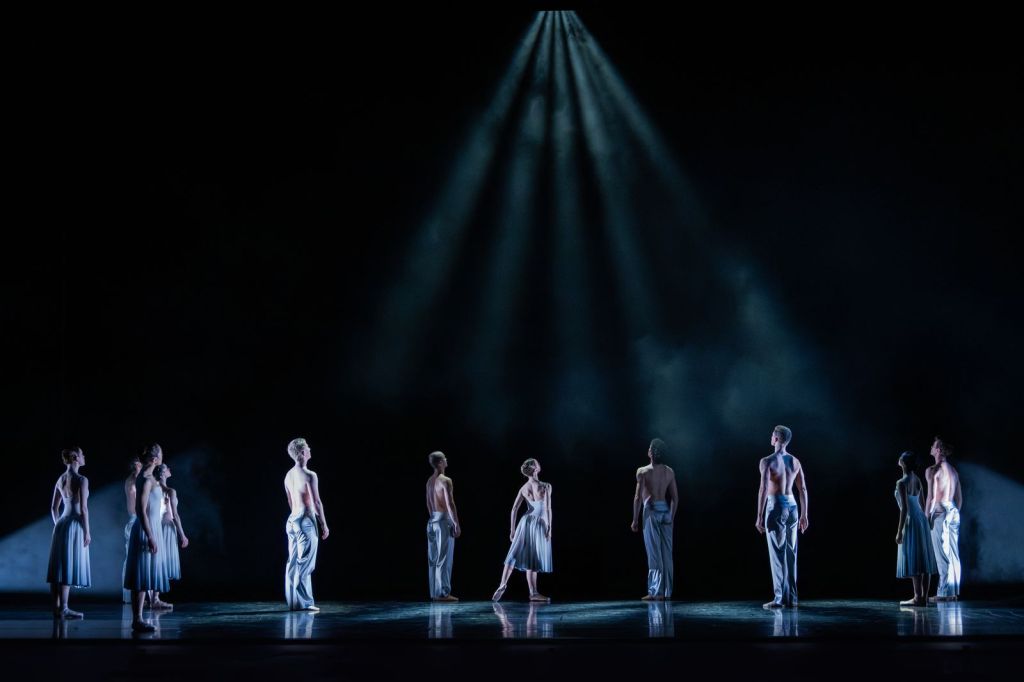
The opening work, Stephen Baynes’ “The Way Alone” was originally performed in Hong Kong in 2008 for a Tchaikovsky programme and is a response to some of the composers lesser-known music included some of his choral works. Firmly in the classical tradition the dancing was a direct response to the textures and rhythms of the music. the choreography emphasising the qualities of weightiness, graceful movements and subtle gestures as well as accentuating the dancer’s integration with aspects of light and shadow.
The work owed much to concepts of ritual with an elegance and refinement to the dancing which featured some beautifully articulated pas de deux and pas de trios.
The only problem with this sequence was that the recorded sound lacked the refinement of the dancing and created a disconnection between audio and visual. It was an issue that did not affect the other two works.
Chrysalis, Kate Kadow and Calum Gray Photo credit: Stephen A’Court.
After the first interval was the premiere of Shaun James Kelly’s “Chrysalis” set to the Phillip Glass music “Metamorphosis” which was inspired by the Franz Kafka short story of a man who wakes up to find his body has been changed to that of a large insect or chrysalis.
The setting for the dance also gave a nod to Kafka’s other work “The Trial” with various figures, some in trench coats roaming the stage, divesting themselves of items of clothing , an act which provided a clever metaphor for transformation – the shedding of skin and the emergence of the butterfly from the chrysalis.
The music features Glass at his minimalist best with repeated phrases and eerie looping sequences. There were also long, enigmatic silences which were as expressive as the music and emphasised the notions of the dream, the surreal and the transformation.
The musical landscape with its abrupt, stark sounds was echoed by the dancers with their carefully choreographed movements, rapid changes and tense interactions.
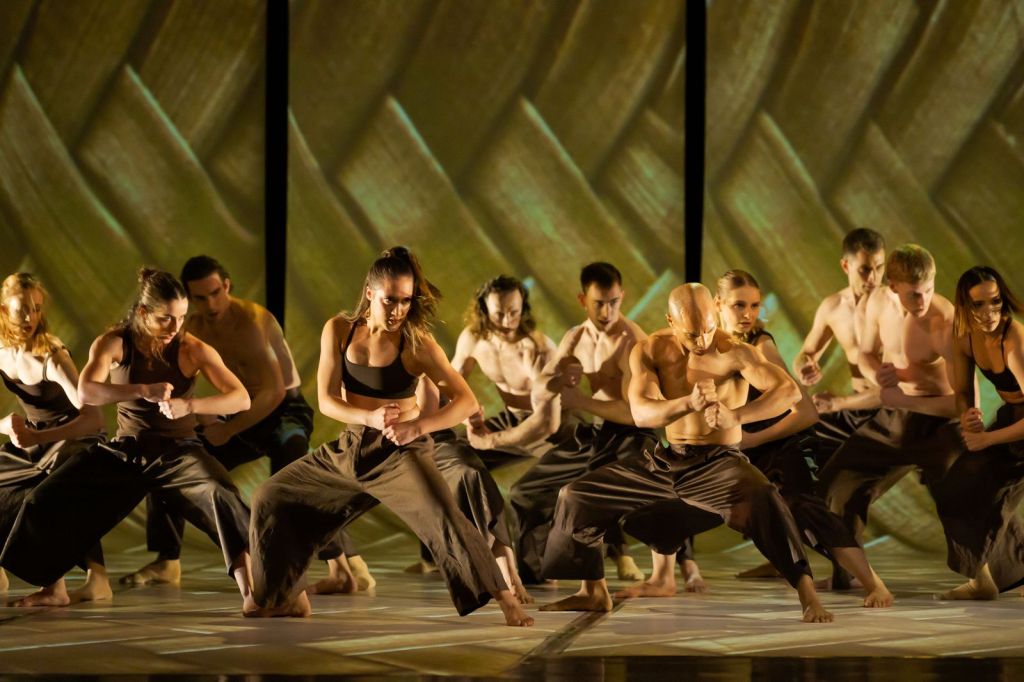
Home, Land and Sea Photo credit: Stephen A’Court
The third work on the programme was “Home, Land and Sea” choreographed by Moss Te Ururangi Patterson’s (Ngāti Tūwharetoa), the Artistic Director of The New Zealand Dance Company. This was the first the Royal New Zealand Ballet has partnered with The New Zealand Dance Company with members from both companies performing.
The stage featured five panels on which were projected images linked to the dance – tāniko, vegetation, clouds and sea.
The work combined contemporary dance and kapa haka suggesting elements of journey, history and tradition.
The music for the work composed by Shayne P. Carter had a harsh quality to it which was emphasised by the dancing where there was much angularity in the gestures and movements, combining the sinuous quality of contemporary dance with the intensity and athleticism of kapa haka.
The element of sound often associated with kapa hake -was also much in evidence – slapping, stamping and breathing, all adding to the physicality of the work.
In the latter part of the dance when the dancers became more dynamic and the music more aggressive, the roiling mass of dancers seemed to become a force of nature transcending their human condition to become god-like in their expression.
Phoebe McKellar (Juliet) and Theo Dāvid (Romeo) Photo: Andi Crown
Review by Malcolm Calder
Romeo and Juliet
By William Shakespeare
Auckland Theatre Company
Director – Benjamin Kilby-Henson
Design – Dan Williams
Lighting – Filament Eleven 11
Costumes – Daniella Salazar
Sound – Robin Kelly
With Ryan Carter, Liam Coleman, Theo Dāvid, Courteney Eggleton, Jesme Faa’auuga, Isla Mayo, Miriama McDowell, Phoebe McKellar, Jordan Mooney, Meramanji Odedra, Beatriz Romilly and Amanda Tito
Waterfront Theatre – until 9 August
Review by Malcolm Calder
This is a brave attempt by ATC to broaden its audience base and provide a path for younger performers. And when you’re doing that, a good Shakespeare is a fairly safe bet as it can probably do quite well with younger audiences, meet the needs of traditional adherents and will no doubt fare well with a schools audience. And ATC is to be acknowledged for that.
Unfortunately, when one looks at the larger theatrical picture, this Romeo and Juliet doesn’t really fare very well. Especially as a major production by one of this country’s more significant professional companies. However ATC’s production standards remain fairly high and are arguably this production’s saving grace.
This Romeo and Juliet is set in a 1960s Verona and I get that – not such a silly idea. The the overall design is consistent and sometimes works very well indeed with the themes Director Benjamin Kilby-Henson is articulating – youth, love and lyricism. Chapeaus are due to the entire creative team and his production looks and feels quite stunning.
Dan Williams has generated a well-executed, three-dimensional set, largely articulated with reductive arches, derived some mobility from a well-used billiard table and unusually introduced what looks like a painter’s scaffold that trucks about a Veronian ballroom that is ‘under renovation’ and elsewhere too. It makes for a splendidly unusual balcony scene.
I wasn’t in Verona in the 1960s, however I did own a pair of vertically-striped trousers a decade later, so I give costumier Daniella Salazar’s costumes a big thumbs up too. Her use of colour is at times subtle and nuanced and the differences she has drawn between Montague and Capulet families are finely drawn. Of particular note is the ballroom scene.
But it was the lighting and the soundscape that were the standouts for me. The Filament 11 designers have introduced some dramatic and highly effective lighting that echoes the sentiments of Shakespeare’s words and the emotions highlighted by the director. It is also pleasing to see ATC using effective sound reinforcement for actors who often spend more time in front of cameras and on more intimate venues these days than on the comparatively largish Waterfront’s stage.
However, Miriama McDowell aside, the cast struggled with Shakepeare’s words, couplet-ridden though they are
In fact, the whole casting process seemed somehow – odd. Generational differences were blurred, there was a rather strange mix of accents, some characters seemed to fit the context while others didn’t, and I’m still trying to work out why there were so many varied approaches.
Music may be the food of love but, as the director has noted, poetic verse is its very life force. Romeo only addresses Juliet in verse and she does likewise. But sustaining this is very difficult indeed.
Apart from occasional flashes, especially with some of the longer speeches, the net result was one where authority and credibility were just – missing. At one point it seemed like I was watching a youth company of younger kiwis imagining a Verona they had never visited.
Miriama McDowell (Whaea Lawrence), however, was very much the exception, actually speaking Shakespeare’s words rather than matching the prevalent declamations of others. Theo Dāvid (Romeo) matched her to some extent leading one to wonder whether their work with the now-long-gone Popup Globe had anything to do with this.
There were a number of unanswered quibbles too: why, for example, did Friar Lawrence became a ‘Whaea’ in this production. If this really were set in 1960s Tauranga and there two gangs at war with each other it could make sense. But it is a term never uttered in in Verona in the 1960s. And perhaps a bit of undersheet nudity was a way of the simpering unreality of Paris, but that didn’t work for me either.
So thanks for the effort ATC. But Romeo and Juliet was a disappointment for me.
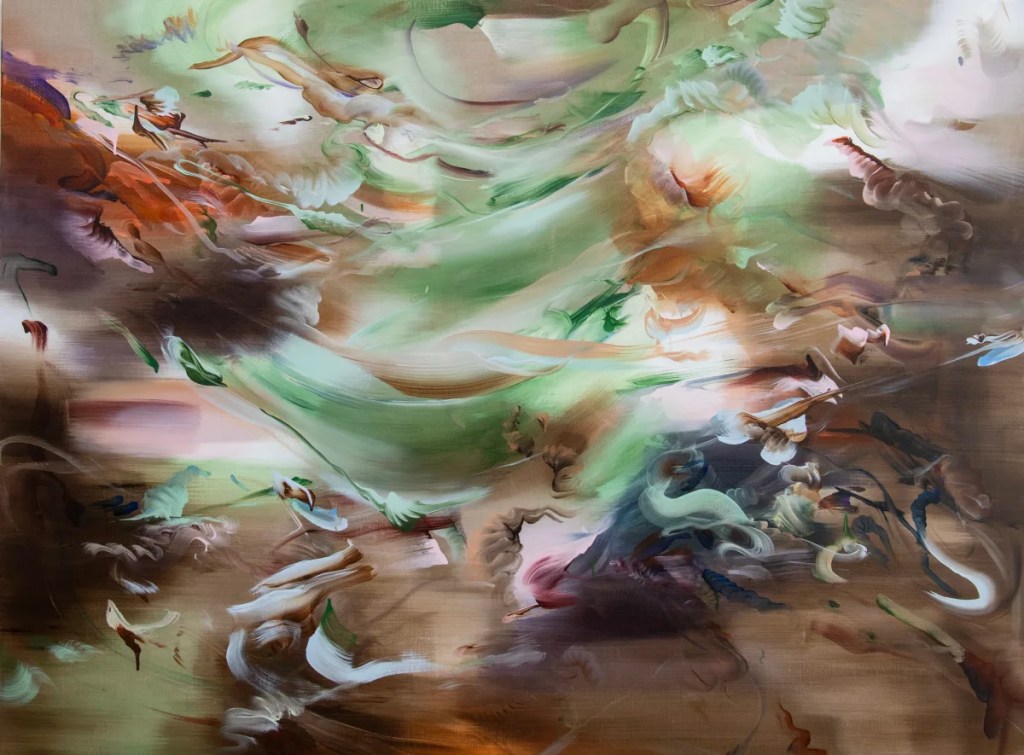
John Miltons lines at the beginning of Paradise Lost provide a succinct description of Grace Wrights suite of paintings in her show Grand Illusions. Equally the description of Charles Albury’s who was an observer of the effects of the atomic bomb at Hiroshima are also applicable – “We watched that cloud rise. It had every colour of the world up there, beautiful colours. To me it looked like salmon colours, blues, greens.”
Theses impressions of shape, design and colour are something we also see in the images of the heavens taken by NASA revealing what appears to be chaos in the Milky Way and other galaxies.
Grace Wright, The Causes of Seeds, Plants and Fruit
Wright’s paintings conjure up a range of associations, from the of cosmic to the microscopic with some of her images linked to brain scans and the flares of neurological synapses as in her “The Causes of Seeds Plants and Fruit”.
As with her previous work the artist explores the confluence between abstraction, symbolism and realism with a colour palette echoing the renaissance masters as well as the great Impressionist.
Grace Wright, On the Disposition which Characterizes the Wise
With a lot of her work she appears to have a contemporary take on the Baroque with images such as “On the Disposition which Characterise the Wise)” with its drama and exuberance. Here the brush strokes suggesting the writhing bodies of baroque paintings in the paintings of Giovanni Battista Gaulli, at the Il Gesu church in Rome.
With “Cosmology” there is a sense of floating diaphanous fabrics in pastel colours while works like “The Causes of Atmospheric Phenomena provide a sense of dramatic skies after a storm .
Grace Wright, Cosmology
The small lively brushstrokes in several of the works suggest small birds in flight (On the Beauty of Song” or carefully described shell forms (Projections). These lively brushstrokes also make the viewer aware of following the mark making of the artist, both the small tentative marks as well as the grand gestures.
The “Follow button” at the bottom right will appear and clicking on that button will allow you to follow that blog and all future posts will arrive on your email.






 New Zealand Arts Review