Categories
Reviews, News and Commentary

Three exhibitions K Rd – Palmer, Creed, Parekōwhai.

Reviewed by John Daly-Peoples
Martin Creed, Work No 3769, Work No 3764, Work No 2053

Three exhibitions K Rd – Palmer, Creed, Parekōwhai.

Stanley Palmer, New Work

Melanie Roger Gallery

Until February 22

Martin Creed, Like Favourite Socks in a Drawer

Michael Lett

Until March 1

Michael Parekōwhai, The Indefinite Article

Artspace Aotearoa

Until April 17

Reviewed by John Daly-Peoples

Current exhibitions along Karangahape Rd offers a range of art works from the  realist depictions of the landscape to abstract paintings and conceptual construction.

With his latest exhibition at Melanie Roger Gallery Stanley Palmer continues  his depictions of the New Zealand landscape. Like many of his previous exhibition he has painted views of the New Zealand coastline featuring dramatic vistas of headlands and offshore islands.

With this new series of works he has revisited many of his previous subjects including depictions of Karamea, Great Barrier Island, Chathams, Great Mercury Island and Matauiri. While these are mainly landscape there are a few which also feature other element in the landscape which add a visual drama as in “Akiaki – Chathams” ($30,000) where he has included windswept  trees and grazing sheep.

Stanley Palmer, “Akiaki – Chathams”

These paintings seem to be less detailed than some of his previous work and there is a simplicity which gives these works an added drama. Part of this drama comes from the artists shrewd use of paint, so that in “Awana- Aotea Great Barrier” ($22,000) the eroded cliffs are highlighted by the gash of earthy colours and in “Mataurui” ($28,000) the red line of a track is like an abstract slash through the landscape.

Stanley Palmer “Mataurui”

In most of the works the background of sea meeting sky shows a clever juxtaposition of shimmering abstract blues with subtle variations between each of the paintings

Also included in the exhibition are some of the artist’s earlier bamboo prints of the early 1970’s including “Hillside Town Kohukohu” ($2250).

Stanley Palmer “Hillside Town Kohukohu”

Martin Creed’s minimalist works have always played with the definition of art and art making starting with his Turner winning installation “Work No. 227: The lights going on and off: an empty room” in which the gallery lights switched on and off at 5-second intervals.

His work is  a mixture of the witty, poetic and philosophical, making use of a range of everyday materials and approaches which challenge traditional views of art.

His current show “Like Favourite Socks in a Drawer” brings together elements of chance, time and structure with a series of ziggurat shaped works. The works  started with his decision to buy an ordinary multi pack of commercial paint brushes.

Martin Creed, Work No 3764

With these he applied paint in different colours  with the varying brush sizes, stacking the colours one above the other to create stepped, random bands of colour.

The paintings/designs can be seen as referencing the ziggurat forms of ancient Mesopotamia and Mexico as well as more recent brutalist constructions and has connections with Rewi Thompson’s block-like house in Kohimarama. There are also hints of Frank Stella, Donald Judd and Cuisenaire rods.

Creed says of the works “A step pyramid is solid and easy to understand. It is a safe structure that is not going to fall down. It is trustworthy. You can see how it is built. The steps are hopefully leading to the top, and you can enjoy the colours on the way up. In a blobby, soupy, ill-defined world it can be helpful to put your ducks in a row.”

The works have a sense of the structure to them with their build-up of coloured shapes and in works such as  “Work No 3764” (USD $22,000 plus GST) there is sense of the artist gestural involvement  where the striations of the brown / sepia are visible as a single calligraphic stroke. With others there is the notion of time with the various strokes of colour measuring out the time taken to complete each work

Martin Creed, Work No 3766

Some of the work display additions to the quick gesture with Creed scumbling the yellow band in “Work No 3766” (USD $22,000 plus GST). This work like some other has a humorous element with the painting looking like a celebratory, multi-layered birthday cake.

The works all convey  Creed’s minimalism of means, notions of time along with the structuring and ordering of objects shapes and colours.

Michael Parekōwhai, The Indefinite Article

Artspace is exhibiting Michael Parekōwhai’s sculptural object, “The Indefinite Article (1990) which had previously been shown at Artspace in 1990 in the show “Choice” curated by George Hubbard

The large letters based on McCahon’s cubist stylised letters  constructed of MDF spell out the words “I AM HE”. Which references some of the McCahon paintings featuring the words “I Am”.

While borrowing from McCahon the work can also be seen as creating a bilingual pun linking the words to te reo where “HE” can be read  as the indefinite article where the word can be  defined as -a, an, some – or it can  also  mean something is  wrong, mistaken or incorrect.

Other linguistic variations can be identified with the words. During the ”Cultural Safety” exhibition in Frankfort in 1995 where the work was shown this reviewer noted at the time – “His large word sculpture using the words of the Colin McCahon painting I AM HE was quickly identified by one perceptive German journalist as coming from the pen of John Lennon in “I Am the Walrus” [I am he as you are he, as you are me and we are all together] rather than the Bible or McCahon.

To subscribe or follow New Zealand Arts Review site – www.nzartsreview.org.

The “Follow button” at the bottom right will appear and clicking on that button  will allow you to follow that blog and all future posts will arrive on your email.

Or go to https://nzartsreview.org/blog/, Scroll down and click “Subscribe”

Categories
Reviews, News and Commentary

“Stop, Look Both Ways” provides new ways of seeing

Reviewed by John Daly-Peoples

Murray Savidan, Cinque Terra

Stop. Look Both Ways

Murray Savidan

Ugly Hill Press / Bateman Books

RRP $70.00

Reviewed by John Daly-Peoples

Murray Savidan’s new photographic book “Stop. Look Both Ways” is something of a travel diary, a record of his journeys through Aotearoa/New Zealand and around the globe to diverse locations in Europe, Africa, Asia and the Americas. There are images of his time in Vietnam and Nepal, Egypt and Zanzibar, Italy and Spain, Japan and Vietnam.

But as well as a travel diary documenting the places he has been the images are also a record of the people of these places, seeing the aspects of other people’s lives which make them distinct but also seeing the similarities between us – partly ethnographic and partly the photographers own quirky approach to life.

Each of the individual photographs are the result of a keen eye, often capturing a moment, a contrast, a reflection or a facial expression which offers more than a simple photograph.

With many of the photographs Savidan has paired them in a way which emphasises their stories and creates new narratives. These often-subtle connections  are an indication that he has reflected on the images and his way of contemplating the world around him.

There are spreads where he has contrasted the physical world a such as pairing the architectural shapes of the Guggenheim Gallery in Bilbao with those of a shrine in Bhaktapur – two different temples to culture.

The clash of cultures is seen is several of the works such as the linking of a beach on the Cinque Terra filled with sunbathing figures with a horde of burqa clad woman on a beach in Zanzibar.

Murray Savidan, Zanzibar

With some of the works there isa nod to other photographers such as his image of a crocodile in Madagascar which owes much to a similar work by Peter Peryer and his image of a woman contemplating a painting by Christian Schad at the Pompidou Centre is reminiscent of the similar gallery photographs of Thomas Struth.

He manages to find quirky connections as well. So, his view of the Anish Kapoor Dismemberment, Site 1 at Gibbs Farm is contrasted with horn shapes in an atrium in South Africa.

Then there are the landscapes such his pairing of a forlorn, misty landscape at Meola Reef with a desert landscape in Namibia. There are also some individual landscapes such  as the drama view of a climber scaling a mountain in Fiordland.

Murray Savidan, Namibia

He contrasts a street scene in Kathmandu with one in Madagascar and a simple church in Northland with one in Madagascar as well as  the contrasting portraits  of a father and his child in Nepal and Egypt

While these paired images are serious reflections on culture and society there are many in which Savidan is making witty, or  ironic comments.in one spread he pairs a gaudy jukebox with a church organ  and in another he has juxtaposed the various parts of fish at a fish market in Vietnam with a figure lazing on a beach during a fishing competition on the East Cape., an image which itself is a droll comment on recreational fishing.

Murray Savidan, East Cape, New Zealand

He uses these images to create drama, explore history, culture and sexuality which become meditations on society and the individual, but in all of them he captures humanity.

Categories
Reviews, News and Commentary

Olafur Eliasson: The Leonardo da Vinci of our time

Reviewed by John Daly-Peoples

Olafur Eliasson. The glacier melts series

Reviewed by John Daly-Peoples

Olafur Eliasson, Your Curious Journey

Auckland Art  Gallery

Until March 23, 2025

Reviewed  by John Daly-Peoples

Much of the work of the Danish / Icelandic artist Olafur Eliasson focusses on issues around the impact of changing climate on our lives and our impacts on the environment. In his current exhibition “Your Curious Journey” at the Auckland Art Gallery the most obvious of his works which address these issues is “The Glacier Melt series 1999/2019”. In this series of 15 paired  photographs the artist shows several; glaciers in Iceland ten years apart showing the extent of the glacier melt. The works are a clear visual documentation of the way in which warming temperatures are changing the nature of the environment. While they provide physical evidence of climate change they are also a metaphor for the issue and many of his other works are metaphorical or medications on the nature of the issues.

Eliasson is the Leonardo da Vinci of our times combining art and science with each of the disciplines informing the other providing observations and insights.

The title of the exhibition “Your Curious Journey” could be applied to the set of photographs as we witness the glaciers journeys of expansion and retraction, alerting us to the fact that climate change is part of the evolutionary journey of our past and future.

Linked to that work is  one of the newer pieces, The Last Seven Days of Glacial Ice “(2024) where the progression of  a melting block of ice over seven days has been rendered in bronze. The melted water has been captured in seven glass globes which are exhibited alongside the bronzes, The original block of ice is condensed to a shard of bronze and a globe of water but in reality the ice has disappeared, like some magic trick

While these and other works have a polemic quality to them, all his works are concerned with aspects of aesthetics -and scientific enquiry – light, structure, colour and movement. This mix  of science and art can also be seen in “Double Spiral” where a long steel tube   coils around itself creating a double helix in reference to the structure of DNA

One of the works which encapsulated all of these  aspects is “Movement Microscope” (2011), a  16-minute video set in the artists studio / office in Berlin where the everyday activities of the staff become an elaborate dance routine and simple movements are elaborately observed.  All the movements and interchanges are heighten by the inclusion of a group of “performers who move at a reduced pace, seemingly moving as though their recorded movements have been filmed at a slower speed.

We observe his designers and artists communicating ideas,  working on designs, constructing works, sharing meals, their constructed works now on display in the gallery.

His largest work :”Under the Weather” hangs above the gallery atrium and appears to flicker and change as the observer moves beneath it. The images created are like weather patterns or brain scanner. The illusion of movement is created by an optical effect of two patterns similar to the auditory intersection of the Doppler Effect. Similar effects  can be seen “Multiple Shadow House”.

Olafur Eliasson. Yellow Corridor

One of the more impressive works is at the  entrance to the show. “Yellow Corridor “is an version of a  work the artist has created in m any locations, flooding an  area with yellow light which effects our perceptions of colour and form. The almost blinding light of the lit corridor recalls the quote of Robert Oppenheimer who described the Atom Bomb as brighter than a thousand – which also links to Eliasson’s  “The Weather Project”  which featured a massive  sun located in the Tate’s Turbine Hall.

Eliasson also plays with water and in “Beauty (1993), films of  misty water, illuminated by projected light create a mini Aurora Australis and  with “Object defined by activity (then) a fountain of water is rendered as an almost solid figure by the use of stroboscopic light.

“Still River” brings the issue of climate change down to a local level with three large cubes of ices, slowly melting in the gallery. The ice is frozen water taken form the Waikato River at Lake Whakamaru. We witness the ice melting, see the drops of water falling into the collection tray and hear the sound of the ice cracking and the water melting. We can also see in the water the residue contained in the water – the chemical, effluent and soil and other contaminants.

It provides a physical reminder of the process of the natural world and the ways they can be disrupted.

To subscribe or follow New Zealand Arts Review site – www.nzartsreview.org.

The “Follow button” at the bottom right will appear and clicking on that button  will allow you to follow that blog and all future posts will arrive on your email.

Or go to https://nzartsreview.org/blog/, Scroll down and click “Subscribe”

Categories
Reviews, News and Commentary

Te Whare o Rehua Sarjeant Gallery

Reviewed by John Daly-Peoples

Te Whare o Rehua Sarjeant Gallery

A Whanganui biography

By Martin Edmond

Massey University Press

RRP $65.00

Reviewed by John Daly-Peoples

Whanganui’s Serjeant Gallery has just reopened after having been closed for ten years with  an opening season entitled “Nō Konei | From Here” (Until 11 May 2025). The exhibition features over 200 artworks, spanning four centuries of European and New Zealand art history. Filling the gallery’s newly expanded exhibition spaces, works range from traditional gilt-framed paintings to contemporary practice in a variety of media.

Coinciding with the opening is the publication of “Te Whare o Rehua Sarjeant Gallery” which tells the gallery’s 100-year history.

Written by Martin Edmond the book charts the Sarjeant Gallery’s early years and its development as a collecting and exhibiting institution that is now recognised as one of the major New Zealand’s art galleries.

The gallery  which is one of the most elegant and imposing buildings in the country is located at a central point in the city and has been of significance to the development of the city.

Henry Sarjeant whom the gallery is named after had lived in the area since the 1860’s and had  a lifelong interest in the arts, visiting the major galleries of Europe during a number of trips abroad. When he died in 1912, aged 82, he left property valued at £30,000 in trust to the Wanganui Borough Council for the purpose of building and maintaining an art gallery. The design of the gallery was won by Dunedin architect Edmund Anscombe and the building was constructed in the shape of a Greek Cross and  faced with Oamaru stone.

The Governor General, the earl of Liverpool, laid the foundation stone on 20 September 1917, and on 6 September 1919 the Prime Minister, W. F. Massey, officially opened the gallery.

Frank Denton, The Sarjeant Gallery, 1926. Collection of Te Whare o Rehua Sarjeant Gallery.

While the gallery was the dream of Henry Serjeant Martin Edmond notes that it was Sergeant’s wife, Ellen who was the driving force after his death.

“Ellen Sarjeant was a remarkable woman and without her we probably wouldn’t have the gallery we do today. She was almost 40 years younger than her first husband, Henry Sarjeant, the benefactor of the gallery; the eldest daughter of one of his close friends. It would be interesting to have some insight into the dynamics of their marriage but they were very discreet. It’s possible that he had the money and she had everything else: the drive and enthusiasm, the artistic insight, the business sense and the administrative skills. He would have seen this and I suspect their partnership was intended to transform the city the way the Sarjeant has. Ellen was among those who oversaw the building of the gallery; she was, with her second husband, John Neame, the initiator of its first acquisitions, both in New Zealand and overseas.”

The importance of Bill Millbank (Director 1978 – 2006) in developing the galleries status in his time at the gallery was a period when the institution became an important institution in developing a major programme as well as curating exhibition of national importance.

Edmond notes that the while Millbank initially had no real interest in the arts this changed with his travels overseas.

“crisscrossing Europe in a Kombi van, visiting galleries and churches, looking at art ‘all the time’. There was a revelation in Toledo, in front of an El Greco, when Milbank understood a hitherto obscure (to him) connection between these works and a painting he had admired on his weekly visits to the Sarjeant. He wondered, naively, if the Sarjeant painting was in fact by El Greco. It turned out to be the aforementioned Gethsemane by New Zealand artist Lois White.

Among the significant exhibitions that Millbank was responsible for was the first exhibition of “The Given as an Art-Political Statement” by Billy Apple in 1979. The exhibition included a controversial intervention by Apple, where he removed the sculpture “The Wrestlers” (Raffaello Romanelli) from its prominent position and replaced it with photographs of the sculpture on the surrounding walls.

He also initiated Te Ao Marama: Seven Māori Artists which showcased contemporary Māori art and travelled to Sydney.

Millbank was also responsible for the development of the Tylee Cottage residency which has seen over sixty artists make use of the programme including Laurence Aberhart, Mervyn Williams, Bronwynne Cornish, Adrian Jackman, Anne Noble  and Jade Townsend

Edmond also writes of the pivotal role of Gordon Brown  who was the first full time director between 1974 and  1977).

The book has the subtitle of “A Whanganui biography” and Edmond rounds out both history of the gallery and its place in the city’s history as well as the directors of the institution. He includes many incidental aspects of the city’s history both of artistic as well as general interest.

He includes the D’Arcy Cresswell drama where the poet was shot and injured  by  the  Mayor Charles Mackay who had made homosexual advances towards him in the mayoral office. The incident brought Mackay’s 11-year career as mayor of Whanganui and as a major supporter of the gallery to a shocking end.

While the galleries new extension has been many years in planning and execution it was hampered early on by the mayor Michale Laws. He had Goebbels-like approach to culture, seeing the “arts community consisting mainly as bludgers and elitists”. His attempts to stop the building was a low point in the city’ s artistic history.

Threaded through the gallery’s history are accounts of the developing collection including donations, European buying sprees and local acquisitions. Over its 100 year the  gallery has acquired a number of important works as well as establishing a fine collection of local artists including Edith Collier.

It is a compelling read full of lively, far sighted and dubious characters along with interesting accounts of the development of a public institution.

The book is generously illustrated with many works from the Sarjeant’s rich, varied and important collection. It also provides a full list of all the staff since the gallery’ inception as well as all the artists who have been Tylee Cottage residents.

Categories
Reviews, News and Commentary

Shane Cotton. New Paintings and new directions

Reviewed by John Daly-Peoples

Shane Cotton, Super Radiance

Shane Cotton

New Paintings

Gow Langsford, Onehunga

Until November 16

Reviewed by John Daly-Peoples

Shane Cotton has progressively mined the history and myth of Māori along with its intersection with European colonisation, featuring images which recall stories, along with references to historical and mythical figures and locations.

With his latest exhibition of “New Paintings” the artist  could be seen as entering his  Fauvist period with many of the paintings having the features of the Fauves. Those painters of the early part of the twentieth century employed simplified shapes along with intense and juxtaposed colours.

The “He Waka Karaka” ($9000) featuring a small  Pacific craft with a sail exemplifies this aspect with intense blues, purples and green while the large, colourful “Super Radiance” ($90,000) is an example of one of the new directions of Cottons painting – more traditional landscape painting. Even though his previous works have featured landscape forms these were generally refined and abstracted.

There are several works of Cotton’s Toi Moko works where the  tattooed and preserved ‘shrunken’ Māori heads reference conflict, trade, and repatriations. In works such as “The Great Attractors” ($55,000) the tattoo lines tracing out genealogy are linked to the notion of neural connections, knowledge links and computer networks.

Shane Cotton, The Great Attractors

Apart from the shrunken heads Cotton has rarely included figures in his work but in this show, there are several which connect with his living in Northland and revisiting some of his earlier work and the notions of colonialism and cultural exchange.

Shane Cotton, The Walker

In “The Walker” ($8500) he has replicated the self portrait of the early explorer/artist Augustus Earle taken from Earle ‘s painting “Distant view of the Bay of Island”. Cotton has also appropriated another figure from the work , A Māori with a taiaha who is leading Earle . This figure is also present in “Super Radiance”, “Sunset Gate” ($48,000) and “He tangata hikoi” ($8500) acting as a guide through the landscapes of the North.

Augustus Earle, Distant view of the Bay of Island

Cotton has also used an image of missionary and publisher of Māori works Thomas Kendall taken from the painting “Hongi Hika and Waikato” with Thomas Kendall in England in 1820” by James Barry.

James Barry, Hongi Hika and Waikato” with Thomas Kendall in England in 1820

This image is used in the small portrait “Internal Visions” ($8750) and “The Visitation” ($8500) where Cotton has depicted him contemplating a colourful, modernist manaia form where in the original painting he is looking at Hongi Hika and Waikato.

Shane Cotton, The Visitation

There are also a few of the artists flower painting such as “Insert” ($12,500) which have developed over the years for his early  plant paintings.

There are a number of the artist’s three panel works most of which feature a manaia figure flanked by delicate foliage while others have landscape/vegetation  panels or in the case of ”Ahuaiti’s Cave” ($130,000) images of the sea. This work refers to the Ahuaiti who was rejected by her husband, forcing her to live in a cave on the Northland coast with her son Uenuku Kuare who is depicted at the base of the painting as a tiny figure, the same image as Earle’s guide  in “Distant view of the Bay of Island”.

Shane Cotton, Ahuaiti’s Cave

This linking of mythic figure to historical figure to an  invented guide inhabiting some the paintings is an example of Cottons ability to transition across myth, history, time and location.

To subscribe or follow New Zealand Arts Review site – www.nzartsreview.org.

The “Follow button” at the bottom right will appear and clicking on that button  will allow you to follow that blog and all future posts will arrive on your email.

Or go to https://nzartsreview.org/blog/, Scroll down and click “Subscribe”

Categories
Reviews, News and Commentary

Some Neo Impressionists: Gary McMillan and Elizabeth Rees

Reviewed by John Daly-Peoples

Gary McMillan, Scene 60 (detail)
Elizabeth Rees, Low Tide

Gary McMillan, City in Progress

Fox Jensen McCrory Gallery

September/October

Elizabeth Rees, The Bay

ARTIS Gallery

Until October 7

Reviewed by John Daly-Peoples

Two recent exhibitions see artists responding to the to the light, colours and textures of the environment just as artists of 150 years ago did with some variations on Impressionism.

In his latest exhibition “City in Progress” Gary McMillan has continued his depiction of views of the inner city, the motorways and industrial buildings.

These are nearly all seen from the interior of a car, capturing the often-fleeting images we have when driving. He also captures light in its various forms –sunlight at dawn and dusk, reflected light, refracted light, motorway lamps, industrial lights and traffic lights.

Each of the images has the simple title of “Scene” plus a number, an indication of the artist’s referencing photography and film which gives many of the works a slightly surreal quality.

As well as the connections to film and photography his work connects with traditional realist painting, pointillism and neo-Impressionism.

Many of the works capture the flash of recognition, of half seeing objects seen from a moving car as Scene 52 ($9500) – the rain speckled windscreen, parts of the car, overhead road signs, lamp standards and a blinding sun. They are the impressions  the brain takes in as it makes the journey.

Gary McMillan, Scene 63

Scene 63 ($9500) provides a complex view – light blooming on the car’s window screen, light shining through obscuring foliage, another view reflected in the cars side mirror. It becomes an image composed of different elements of light. But these various elements of light are all painted illusions created by the artist.

In these works, he investigates the way in which paint creates the illusion of the photographic pixel as well as the painterly impressionist dot.

At a distant his works look like photographs but as the viewer gets closer to the work one is more aware of the Seurat-like pointillism or the pixilation of low-resolution photographs.

With “Scene 57” ($5500) the pointillism is far more apparent with the sky and clouds stippled with the small dots of colour. The artist has added a sense of structure to the work with parallel power lines and one of his ever-present lamp posts.

Gary McMillan Scene 60

This focus on sky and cloud is also seen in “Scene 60”($8000) where the billowing cloud looks like a massive explosion saturated  with colour.

Where Gary McMillans exhibition looks at the urban environment Elizabeth Rees’s work is focussed on an isolated area of Northland. As she notes in the catalogue – “”The Bay” is a response to my new small-town life in the Bay of Islands where light ever changes the sea and bushclad land. My recent acquisition of a boatshed in a small tidal bay has now become my full-time studio. Being surrounded by water, this change has offered me yet another perspective – being able so closely connected to the natural environment.”

Her paintings owe much to the style of the Impressionists with a sense of the artist painting in the open air surrounded by her subject.

In responding to an environment she feels some connection with these paintings are a record of the various times of day, moods and qualities of light she has observed

Many of her previous works featured figures in a landscape, their presence providing a sense of isolation. In these newer works it is the landscape itself which provides that sense of isolation.

Elizabeth Rees, A High Tide

Here there are brooding landscapes such as  “Summer Shade” ($10,000) where the touches of colour seep through the dark foliage.

With works like “A High Tide” ($8000)) the  colours are almost bleached out with light swirling around the shapes of trees.

Elizabeth Rees, On the Beach

A similar work “On the Beach” ($8000 where the foliage is almost shattered by light, could have been used as the cover illustration for  the Nevil Shute novel “On the Beach” which tells of impending nuclear pollution in the South Pacific

A further connection could also see the work in reference to the origins of the title in the lines from T S Eliots “The Wasteland”

In this last of meeting places
We grope together
And avoid speech
Gathered on this beach of the tumid river. connection

Two of the works features figures as in   “Low Tide” ($8000) where the small figures contribute to the sense of isolation and drama. “Last Light” ($10,500) feels less successful as the two figures contemplating the vista do not contribute to the  sense of remoteness.

With “The Bay” ($10,500) there is  more colour contrast with the blue of the water and the sky more dominant and the colours of the foliage picked out by light.

Elizabeth Rees, The Bay

“Nestled in the Bay” ($13,500) also alludes to the human presence with several low buildings or boathouses which merge with the light colours of the sand and sea.

The merging of sands and sea is also apparent in “Dunes Beyond” ($10,500) where the dunes seem to be the foam of crashing waves.

With nearly all these works it is light which is the dominant aspect with the artist endeavouring to create an ethereal presence of cloud and sky .The hills and foliage created with scumbled paint give a sense of seeing through a darkened or fogged glass.

Categories
Reviews, News and Commentary

Resetting the Coordinates of Performance art in NZ

Reviewed by John Daly-Peoples

Resetting the Coordinates

An anthology of performance art in Aotearoa New Zealand

Edited by Christopher Braddock, Ioana Gordon-Smith, Layne Waerea and Victoria Wynne-Jones

Massey University Press

Published September 2024

RRP $65.00

Reviewed by John Daly-Peoples

In 2014 The Walters Prize  included a work by Kalisolaite ‘Uhila where the artist inhabited the Auckland Art Gallery precinct for several months, living as a homeless person – eating sleeping and communicating with visitors, staff and other destitute  people. The work  was intended to draw attention to the plight of the homeless.

However, going to the gallery to find the ”art” and the artist necessitated searching the art gallery, the nearby park and streets until I found him wedged into an overhang on the gallery’s roof.

This search seemed more like a game of hide and seek rather than being immersed in a social /political experience /experiment. At the time It seemed to only involve me and the artist, reflecting on an encounter.

That encounter is what can loosely be called an example of  post-object art or performance art which has been evolving in New Zealand since the 1970’s.

With that encounter and many others one can see that performance  art requires an audience as well as documentation as many of the events are transient.

Now an  anthology/reader of performance art in New Zealand, ”Resetting the Coordinateshas been published,providing an in-depth survey of the artists and artworks in the  performance area which have happened over the past fifty years.

At the core of performance art  is the audience and the performer/artist,  the works having a theatrical element to them in which artist often draw attention to time, space, and body,

The  goal of these actions is to generate a reaction with themes which are commonly linked to life experiences of the artist themselves along with social and political criticism.

Darcell Apelu:, New Zealand Axemens Association: Womens subcommittee president
2 August 2014, documentation of performance.
Courtesy Artspace, Auckland. Photo by Peter Jennings

The book records a number of the activities which occurred as described in the introduction by editor Christiopher Braddock,

“If, on 2 April 1971, you had journeyed out across the unsealed metal roads to the west coast of the Tāmaki Makaurau Auckland region of the North Island of Aotearoa New Zealand, venturing as far as the remote Karekare Beach, to the north of Whatipu Beach and the great Manukau Harbour and south of Piha Beach, you would have come across the mystifying scene of ten people arduously sweeping the beach with long-handled yard brooms. “

Organised by Phil Dadson and colleagues this was the first in a series of purposeless works of which Dadson said : ‘This was work for the sake of the work, no particular purpose, no rewards’ across a ‘pointless-to-sweep stretch of beach’ in ‘communion with the elements and the place’.

These activities often existed outside the confines of the mainstream contemporary art scene  and were often undocumented. Many of the names included in the anthology will be recognisable because of their wide-ranging practice, others however have had lower profiles.

Central figures have been Phil Dadson, Jim Allen, Annea Lockwood, Peter Roche & Linda Buis, Andrew Drummond, Daniel Malone, Shannon Te Ao and Lonnie Hutchinson. There have also been numerous other practitioners who are included in the book.

Christopher Braddock, one of the editors says “Mainstream art history tends to prioritise static forms of art that are more commodifiable and saleable such as painting and sculpture. Anthologies often prioritise these artforms, such as Michael Dunn’s “New Zealand Painting: A Concise History| published in 2004. Furthermore, large-scale anthologies can cement these institutional prejudices, such as Hamish Keith’s The Big Picture: The History of New Zealand Art from 1642 (2007) which largely ignores performance art.”

The book underlines the fact that performance art is a distinctive part of recent art history, with its activities presenting  social and political  approaches which  emphasises the  connections between artist, audience and art critic /  historian.

These events often combined elements of anarchy,  humour, spirituality, repetition, the unplanned and unexpected.

There are a several chapters which examine the  history and development of performance art, some which look at the aspects of woman’s art practice, the development of Māori and Pacific based works, queer performance art and performance art in post -quake Christchurch.

There are numerous photographs and records of the activities which only give a limited appreciation of the performances such as Annae Lockwood piano burning while the multiple images of Andrew Drummond’s projects give some sense of the scale of his work.

CardboardConfessional_
Audrey Baldwin, Oscar Bannan, Bridget Harris, NeilMacLeod, Annemieke Montagne, Pat Parkin, Jennifer. Katherine Shield
2016, documentation of performance for the Centre of Contemporary Art Toi Moroki programme,Ōtautahi Christchurch.
Courtesy Centre of Contemporary Art Toi Moroki. Photo by Janneth Gi

Among the other projects included are the documentation project of the Christchurch “Cardboard Confessional” (2016) developed by Audrey Baldwin et al, Louise Potiki Bryant’s dance work “Te Taki o te Ua / The Sound of Rain” (2001), Jeremy Leatinu’u’s Queen Victoria (2013) where the artist contemplated statues of the queen,  Juliet Batten’s Women’s Project of 1985 at Te Henga Beach and Bruce Barber’s “Mt Eden Crater Performance  (1973) which was a collaboration with Solar Plexus as part of the drumming event initiated by Phil Dadson..

It is a fascinating book with lots of performances which have been rarely written about, seemingly lost to history but which tell us much about the social, political and spiritual examinations and soundings which artists have made.

The writers include  Natasha Conland, Gregory Burke, Ioana Gordon-Smith, Khye Hitchcock, Audrey Baldwin, Bruce E Phillips and Heather Galbraith

To subscribe or follow New Zealand Arts Review site – www.nzartsreview.org.

The “Follow button” at the bottom right will appear and clicking on that button  will allow you to follow that blog and all future posts will arrive on your email.

Or go to https://nzartsreview.org/blog/, Scroll down and click “Subscribe”
Categories
Reviews, News and Commentary

Ka Mua Ka Muri: Backwards to the Future

Reviewed by Malcolm Calder

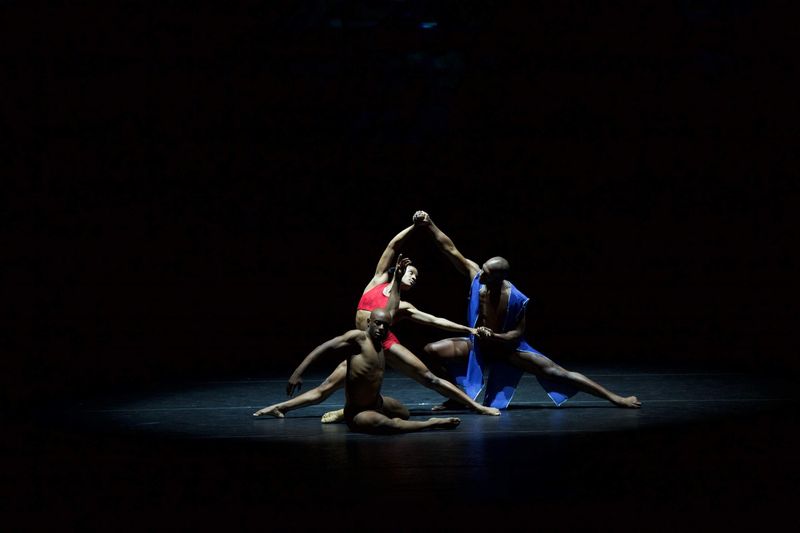
Ka Mua Ka Muri Image, Andi Crown

Ka Mua Ka Muri

Choreographers: Bianca Hyslop and Eddie Elliott

Sound composition: Eden Mulholland

Set and costume design: Rona Ngahuia Osborne

Lighting design: Owen McCarthy

Projection Design: Owen McCarthy (Remain), Dan Mace (Whakamaheahea)

With Abbie Rogers, Caleb Heke, Madi Tumataroa, Matiu Hamuera, Oli Mathiesen, Tai Taranui Hemana, Toalei Roycroft,

An Atamira Dance Company production

Q Theatre, Rangitira

Until 27 July

Then Clarence Street Theatre, Hamilton 29 July.

Review by Malcolm Calder

25 July 2024

This significant work comprises two collaborative creations without an interval – Eddie Elliott’s Remain followed by Bianca Hyslop’s Whakamaheahea.  Although each could easily stand alone, they are not really a double bill.  There is no interval, simply a pause, or perhaps a lengthy segue between the two, and each reflects the other.  Hence the title which loosely translates into Before and After.

Elliott’s Remain does far more than simply relate the past and provide a context for today however.  It helps to explain that past and how the intertwining of traditions with their origins, social practice and evolution delivers a whakapapa that is as rich with meaning and significance in contemporary Aotearoa as it has been since Ranginui and Papatūānuku.

Elliott has mined the humour and playfulness of everyday life, pride in achievement and evolutionary contributions to making Aotearoa what it is today.  And, no, it is far from a sugar-coating.  There are brief flashes of anger, resentment and disagreement and, after all, that’s life.

Conversely, Hyslop’s Whakamaheahea takes all this as a given or starting point and looks to the world we live in today while providing a basis for navigating the path ahead.  A future that shimmers one moment and then cowers the next.  As Hyslop has noted, cultural identity is a continuum and the place of māoritanga is clearly identified and deeplyembedded in the social context of our country.

The dancers provide a strong ensemble quality with individual characters allowed to emerge and some of the solo work is of a high quality indeed.

Of special mention is the creative team who handled the production aspects of this work admirably.  It is slick, extremely contemporary and entirely captivating.

Importantly, this work acknowledges and further develops the legacy that is Altamira Dance Company.  Yes, there may be some ‘fooling about’ along the way but there is also a strong sense of empowerment, transformation, and resilience that underpins Ka Mua Ka Muri.  It has the potential to inspire a bright collective future.

Categories
Reviews, News and Commentary

Sight Lines: Women and Art in Aotearoa

Reviewed by John Daly-Peoples

Sight Lines: Women and Art in Aotearoa

By Kirsty Baker

Auckalnd University Press

RRP $69.99

Reviewed by John Daly-Peoples

Sight Lines: Women and Art in Aotearoa is a bold and timely book exploring various threads of women’s  art  of the past as well as those creating art for our times. Editor and writer Kirst Baker acknowledges the complexity of bringing together writings for  such a book in her introduction  where she notes “It should come as no surprise that this book does not attempt to offer a complete history of women’s artmaking in this country. Such a project is doomed to fail… Instead, the book winds its way along a path that is both fragmented and politicised”.

Within that winding journey it is the through the fragments that we see ideas and revelations and make connections. It is through the practice of many of these artists and their working within a social and political context that we see the importance and ramifications of art.

Lisa Reihana, in Pursuit of Venus [infected], Auckland Art Gallery. single channel UHD video

The dozen chapters in the book have been written by Kirsty Baker along with  Chloe Cull, Ngarino Ellis, Ioana Gordon-Smith, Rangimarie Sophie Jolley, Lana Lopesi, Hanahiva Rose, Huhana Smith and Megan Tamati-Quennell.

The essays are all thought-provoking with a mix of biography, narrative, interviews, observations and reflections. These offer new ways at looking at the art created by women but also the nature of art and art institutions.

Baker notes that there are a number of themes running through the book which are indicative of the often different world in which many female artists exist and work.

There is the way that women artists have interrogated their relationship with the land and place and the way they have pushed against gendered limitations.

There is also the way that artists have used their practice to comment on art history and arts institutions and the way that art making plays a role in the care and transmission of knowledge.

In not being a contiguous history of women’s art, the gaps and exclusions are often apparent. These gaps mean at times the book is less satisfying without the linkages of history and context.

While not a history the book covers over two hundred years of art making in New Zealand and includes painters, photographers, performers, sculptors,  textile artists and writers. The work of these artists spans whatu kākahu through to the recent work of the Mataaho Collective. Along the away there are chapters on a diverse range of artists –  Frances Hodgkins, Rita Angus, Rangimārie Hetet, Pauline Rhodes, Teuane Tibbo, Yuki Kihara and Ruth Buchanan.

With over 150 illustrations the books also provide a visual history of women’s art which is well integrated with the texts.

Julia Morison, Quiddities 1-10. Auckland Art Gallery, Cibachrome transparencies

The essay on Frances Hodgkins provides a succinct overview of her life and work while highlighting the issues which impacted on women artists of the early part of the twentieth century.

The essay on Kura Te Waru-Rewiri reveals the way in which Māori artists have addressed issues of mythology. history  and land using abstraction as a means of conveying ideas.

Many of the chapters focus on the issues around the land, whānau and wāhine which is seen in the work of artists such as Robyn  Kahukiwa so it is surprising that  Robin White, Sylvia Siddell and Jaqueline Fahey who have documented the family and domesticity for several decades are not mentioned.

The other area of exclusion is around abstraction for while the work  of Vivian Lynn, Kura Te Waru-Rewiri and Imogen Taylor is included artists such as Phillipa Blair and Gretchen Albrecht are omitted.

Maureen Lander, Ko nga puna waiora o Maunga Taranaki (detail), Govett-Brewster Gallery, mixed media

The final chapter in the book concerns the  work by the Mataaho Collective, a group which has recently won the prestigious Golden Lion Award at the Venice Biennale. The chapter predates the win but much of what is written is relevant to the work which has generated more column  inches than any previous New Zealand exhibition at the Venice event.

Here there seems to be a disconnection because of the six previous New Zealand female artists to exhibit at the Biennale. only Lisa Reihana and Yuki Kihara are mentioned. That the four other women selected over a twenty yar period to represent New Zealand at the world’s most high-profile event seems puzzling.

Despite this oversight and others, the book is still one which offers much in understanding the developing history of women’s art in New Zealand as well as way that they have been impacted  by  social acceptance and cultural institutions.

To subscribe or follow New Zealand Arts Review site – www.nzartsreview.org.

The “Follow button” at the bottom right will appear and clicking on that button  will allow you to follow that blog and all future posts will arrive on your email.

Or go to https://nzartsreview.org/blog/, Scroll down and click “Subscribe”
Categories
Reviews, News and Commentary

Aotearoa Contemporary to open at the Auckland Art Gallery in July

John Daly-Peoples

Maungarongo Te Kawa, Celestial Stargate for Invisible People, 2024 (detail). Photo by Jemma Mitchell

Aotearoa Contemporary

Auckland Art Gallery

July 6 – October 20

 The Auckland Art Gallery Toi o Tāmaki and Ngāti Whātua Orākei have announced a new contemporary art triennial at Auckland Art Gallery which will celebration of the breadth of contemporary art in New Zealand.

“The Gallery is thrilled to partner with Ngāti Whātua Ōrākei to present a new generation of talented artists and showcase Aotearoa New Zealand’s diverse artistic environment.”

“Set to occur every three years, the exhibition provides ongoing representation and pathways for new artistic voices, bolstering the future resilience of New Zealand art. Aotearoa needs a contemporary art triennial and it now has one.” adds Lacy.

Ngāti Whātua Ōrākei Trust Deputy Chair Ngarimu Blair says, “Our tupuna Apihai Te Kawau gifted 3000 acres of land on the Waitematā on 18th September in 1840 to become a city which welcomed people, cultures and ideas from afar. Our relationship with Auckland Art Gallery is founded in the shared goal to foster the arts reflective of our multi-cultural community in Aotearoa.”

With an emphasis on artists not previously exhibited at the Gallery, the exhibition presents 27 artists and 22 compelling new projects in a range of media including painting, textiles, sculpture, ceramics, photography, and performance.

Senior Curator, Contemporary Art, Natasha Conland says, “Aotearoa Contemporary reveals a new cluster of artists who work afresh with ritual and storytelling, mythology, rhythm, indigenous space and materials. There is also a special emphasis on art’s relationship with choreography through the commission of four dance works.”

Curator, Pacific Art, Cameron Ah Loo-Matamua adds, “From Ruth Ige’s enigmatic blue paintings of anonymous figures, to the art collective The Killing’s installation of supersized soft-toys in a state of play, there is something for everyone in this exhibition. Amongst the ambitious new commissions is a three-channel video by Qianye and Qianhe Lin featuring mythology set in Hailing Island off the coast of China and Aotearoa.”

Aotearoa Contemporary is proudly supported by Ngāti Whātua Ōrākei, Auckland Art Gallery Foundation and the Chartwell Trust.

Aotearoa Contemporary has been scheduled to coincide with New Zealand’s leading contemporary art award, The Walters Prize 2024, to provide a broad overview of contemporary art in New Zealand in the Gallery’s winter programme.

The exhibition has been curated by Cameron Ah Loo-Matamua, Natasha Conland and Ane Tonga with support from Ruth Ha.

Artists featured in Aotearoa Contemporary

Emerita Baik, Leo Baldwin-Ramult, Heidi Brickell, Pelenakeke Brown, Jack Hadley, Ruth Ige, Hannah Ireland, Xin Ji, Reece King, Qianye Lin and Qianhe Lin, Te Ara Minhinnick, Ammon Ngakuru, Amit Noy, Sung Hwan Bobby Park, Meg Porteous, Maungarongo (Ron) Te Kawa, Tyrone Te Waa, The Killing (collective), Anh Trân, Manuha’apai Vaeatangitau, Jahra Wasasala and George Watson.

Jahra ‘Rager’ Wasasala by Jocelyn Janon

Jahra ‘Rager’ Wasasala is an award-winning cross-disciplinary artist of Fijian/NZ European descent. As an artist, Jahra investigates her ancestral connections through the art mediums of performance activation, contemporary dance and poetry, and has extensively toured her performance works both nationally and internationally.

As a child of the Pasifika diaspora, Jahra is invested in translating her shared internal conflict into an accessible, yet confrontational, physicalised language. Her most recent performance work titled “a world, with your wound in it” focuses on the complex relationship between the earth and a woman’s body, a theme Jahra continues to investigate in her developing work.

Maungarongo Te Kawa is a takatāpui fabric artist, educator, and storyteller. His practice makes old pūrākau newly relevant using brilliant colour, fluid design, and infectious good humour. Following a career in costume design and fashion, Te Kawa dedicated himself to full-time art-making and teaching. In addition to producing his own elaborate whakapapa quilts, he runs sewing workshops, guiding participants to express their creativity and genealogy through fabric.

Ruth Ige is a Nigerian New Zealand-based painter whose intimate, evocative compositions oscillate between bodily forms and painterly abstractions. While some resemble traditional portraiture, others consist of colour fields that capture a more mysterious, ethereal effect. Hands, shoulders, and faces emerge from a watery facture. “I am interested in creating images that are not easily understood,” says Ige. She considers her unique figuration, which renders her subjects featureless and inscrutable, to be a form of “veiling.”

Performances

The commissioned performances in Aotearoa Contemporary include Pelenakeke Brown, Is this a performance 1+2, Xin Ji, Doco Dance, Amit Noy, Errant and Jahra Wasasala, DRA.

To subscribe or follow New Zealand Arts Review site – www.nzartsreview.org.

The “Follow button” at the bottom right will appear and clicking on that button  will allow you to follow that blog and all future posts will arrive on your email.

Or go to https://nzartsreview.org/blog/, Scroll down and click “Subscribe”