Categories
Reviews, News and Commentary

“La Mer”, the impressionist sounds of the National Youth Orchestra

Reviewed by John Daly-Peoples
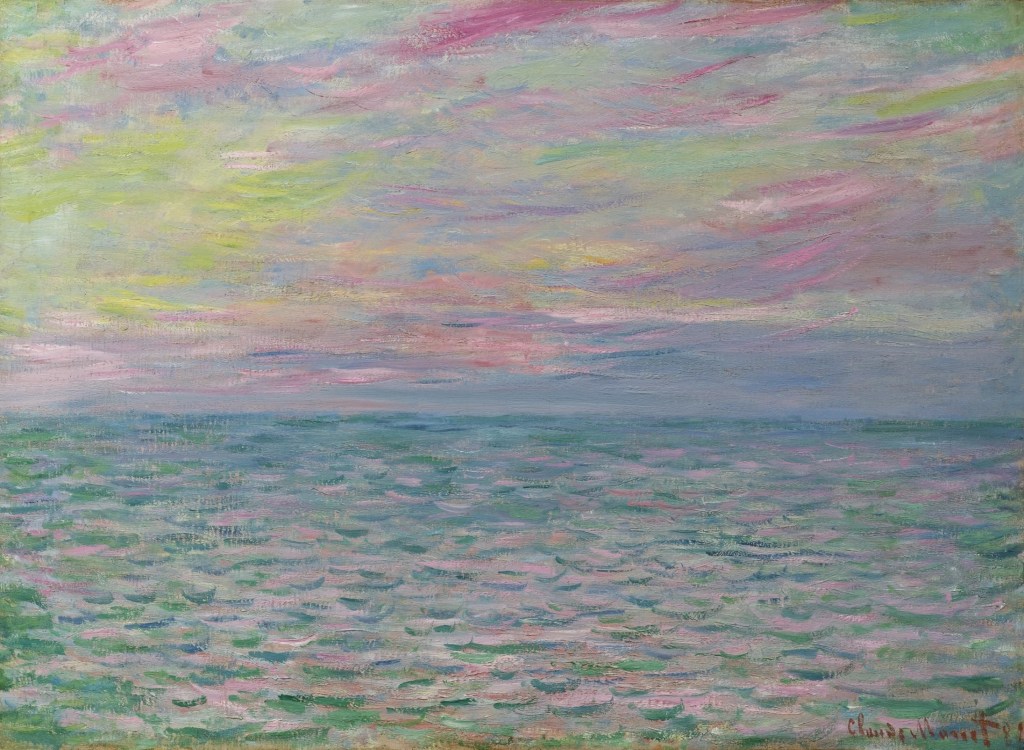
Coucher de soleil à Pourville, pleine mer (1882) Claude Monet

National Youth Orchestra

NYO La Mer

Conductor, Dane Lam

Auckland Town Hall

July 4

Reviewed by John Daly-Peoples

The NZSO National Youth Orchestra’s concert “La Mer” was a celebration of the sea with four works, spanning two centuries exploring various aspects of the sea – descriptive, psychological and historical

The orchestra was led by the Australian-Chinese conductor Dane Lam the recently appointed Music Director of the Hawai’i Symphony Orchestra and Artistic Director of State Opera South Australia.

As Lam noted in his introduction to the concert these young musicians were the future of New Zealand music playing music of our time including music of New Zealand itself

They opened the concert with a new New Zealand work which spoke of the sea and the country’s connection with it.

Jack Bewley’s “Pray for the wanderer” is, as the composer says, “an ode to the courage it takes to … travel vast distances to our country”.

The opening drum roll which heralded thunder was followed by some glorious music from the orchestra reflecting the wonder and mystery of the sea voyage. The blare of the brass and the hectic percussion with some great surging sounds explored the movement of the sea as well as the movement of those who journeyed across the oceans.

The second work on the programme was one of the great atmospheric works – Four Sea Interludes by Benjamin Britten from his opera “Peter Grinmes” written in 1945. Grimes, afisherman in a small coastal town, is accused of mistreating his apprentice, who has died under mysterious circumstances at sea. He is a temperamental outcast, alienated from the local people with the moody music reflecting his character. Britten also depicts the nature of the weather and the sea as active elements in the story leading to the death of Grimes.

The opening section “Dawn”consisting of a high-pitched, desolate sound which is threaded though the swells of the sea as well as the early morning calm provided a sinister quality to the work. This was followed by “Sunday Morning” where the orchestra produced glittering sounds which described the sunshine and the sounds of sea birds.  We also heard the cacophony of church bells, referencing happier times of the village which also contrasts with the darker sounds of the work.  

The impressionist “Moonlight” movementhad some pulsating sounds which were both sounds of the sea and the heavy breathing of Grimes suggested an unease beneath the swell of the sea and the surface of the village

The final movement “Storm featured aggressive percussion and brass describing the mummering and heaving of the sea which became more thunderous, eventually exploding in raging storm sequence which hints at the fury of both the weather and the fury of the villagers.

After the interval they played Michael-Thomas Foumai’s Kealaikahiki Suite which recounts the 1976 maiden voyage of Hōkūleʻa, a replica of an ancient Polynesian voyaging canoe to Tahiti as well as honouring the master navigator Mau Piailug. 

The work was cinematic in scale in which the sea and activities merge, occasionally recalling the music of Douglas Lilburn’s “Landfall in Unknown Seas”.

The rousing music suggested the thrill of the sea and voyaging and the sense of adventure and the activities of the seafarers. There were other sequences which conveyed the majesty and breadth of the sea with some superb musicianship.

The final robust sequence sounded like a theme from an Indianna Jones movie leading to another energetic depiction of the sea

Much of Debussy’s music can be considered impressionist because it reflects the same goals of Impressionist artists such as Claude Monet and Paul Cezanne. Rather than using the structural elements of traditional classical music, he focused on evoking mood and atmosphere.

He avoided calling “La Mer” a symphony but rather giving it the subtitle of Three Symphonic Sketches. These three sketches are impressions of the sea in its various mood and colours in much the same way that the Impressionist painters conveyed their reactions to nature and its landscapes or seascapes

One of Debussy’s favourite artists apart from the Impressionist was the English artist J.M.W. Turner whom he admired for the way in which he dealt with light and hazy landscape depictions as well as the drama of light and shade.

With the first movement, “De l’aube à midi sur la mer” the orchestra conveyedthe sense of the seas awakening with voluptuous waves of sound. The various sections of the orchestra took on the variety of colours and textures of the sea, swelling and receding. The music captured the physicality of the sea, much as the way the artists used dashes and strokes of paint, Debussy used short, jazzy-like sequences of sound.

This was followed by “Jeux de vagues” with lively playing producing a wide range of loosely connected sounds, like a myriad of splashes depicting the changeable motion and moods of the sea

With the final “Dialogue du vent et de la mer” the orchestra created a   dialogue between the wind and the turbulent sea with dramatic contrasts between the surging orchestral sounds. Here the orchestra had a sequence of meditation followed by a final surge of muscular sounds.

The orchestra showed in this concert that it has the musical talent and a depth of understanding of the music which will see a great future for some individual musicians as well as New Zealand orchestras.
Categories
Reviews, News and Commentary

Rarely seen American and European art at the Auckland Art Gallery

Reviewed by John Daly-Peoples

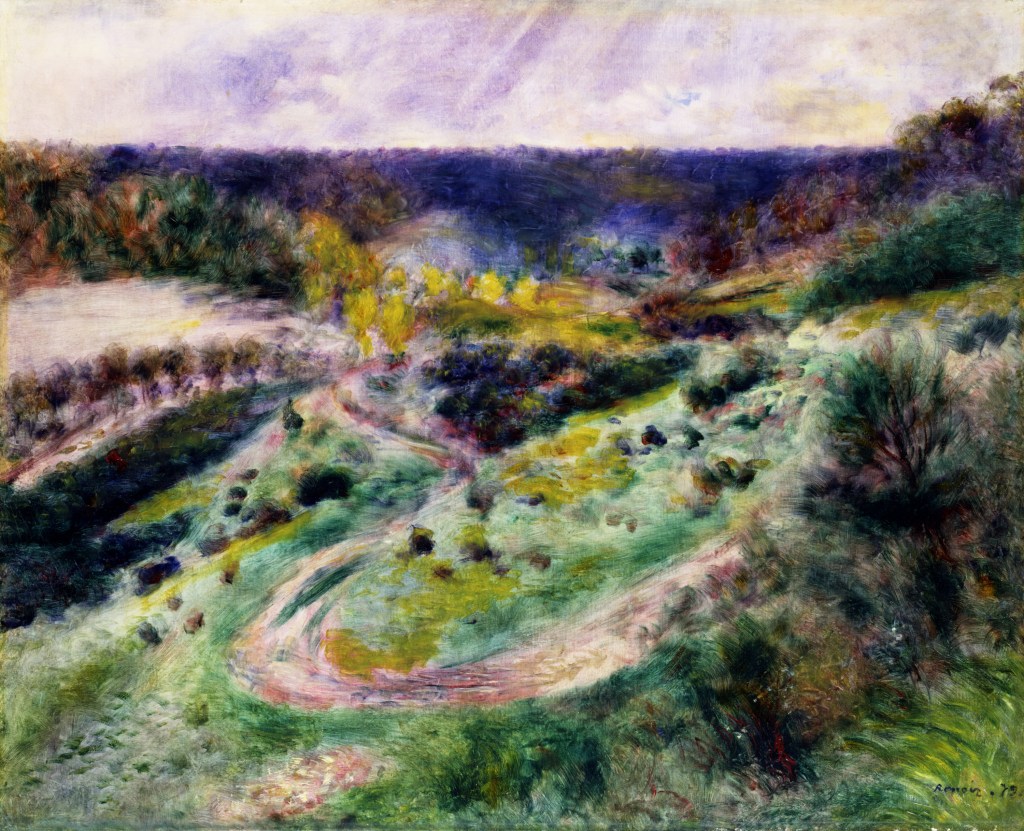
Auguste Renoir, Road at Wargemont, 1879, Toledo Museum of Art, Purchased with funds from the Libbey Endowment, Gift of Edward Drummond Libbey

A Century of Modern Art

Auckland Art Gallery  

June 7 – September 28

John Daly-Peoples

A Century of Modern Art which has just opened at the Auckland Art Gallery is one of the most significant exhibitions mounted by the gallery in the last few years. It is on loan from the Toledo Museum of Art, Ohio, and provides  a survey of the major artists who transformed modern art  from the mid nineteenth century to the mid twentieth century.

The exhibition features 57 works by 53 artists, including Paul Cezanne, Edgar Degas, Helen Frankenthaler, Édouard Manet, William Merritt Chase, Amedeo Modigliani, Berthe Morisot, Claude Monet, Pablo Picasso, Camille Pissarro, Robert Rauschenberg, Pierre-Auguste Renoir, Vincent van Gogh, James McNeill Whistler, among others.

The Toledo Art Museum was established and funded by Edward Drummond Libby and still has a substantial Endowment Trust in his name . The endowment has some $330 million and a budget of more than $20 million a year,. Many of the works in the exhibition were gifted by Libby or acquired through the Libbey Endowment.

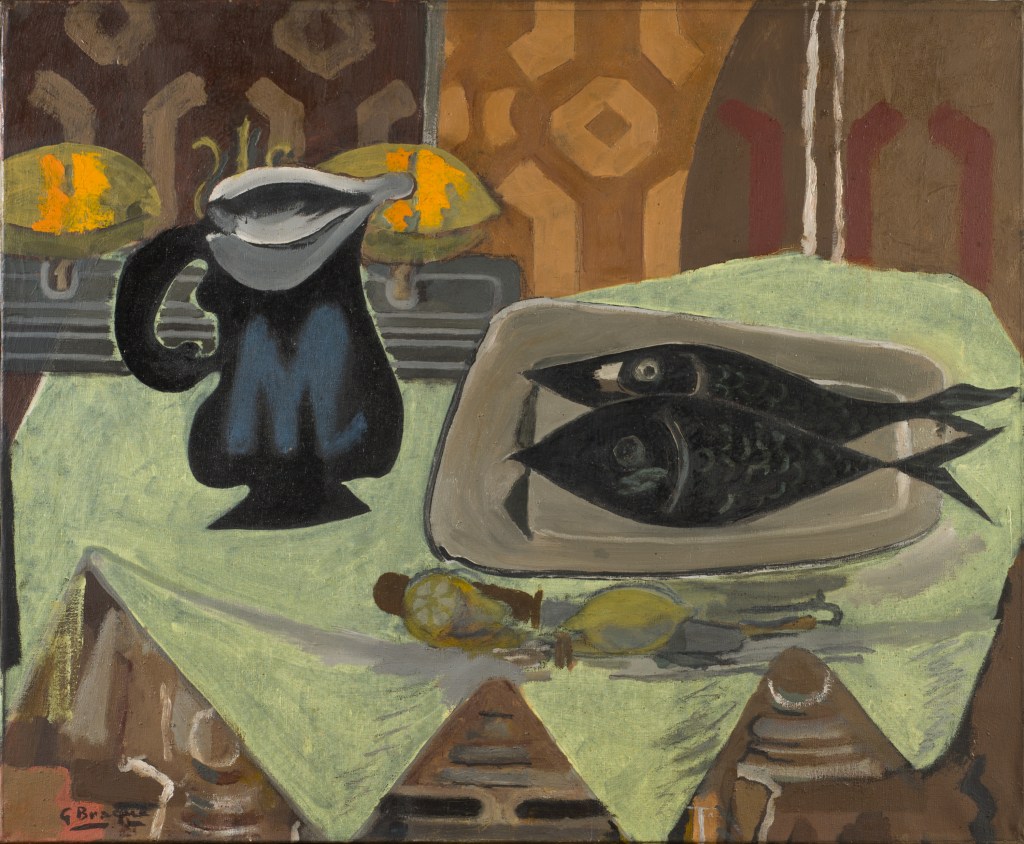
Georges Braque, Still Life with Fish, 1941, Toledo Museum of Art, Purchased with funds from the Libbey Endowment, Gift of Edward Drummond Libbey

Some of the Impressionist / Post Impressionist works by artists such as Renoir, van Gogh, Morisot and Gauguin are major works whle some of them are of unfamiliar subjects such as Renoir’s ”Road at Wargemont”

Several of the works are excellent examples of their work such as van Gogh’s “Wheat Fields with Reaper, Auvers” and Monet’s Water Lilies of 1922, one of the many images of the flower he created in his later years.

The show also features some unfamiliar names of American artists such as Luther Emerson van Gorder whose “Flower Market, Paris” (late 19ht century) could be mistaken for a Pissarro.

Flower Market, PLuther Emerson, Van Gorder, Flower Market, Paris, late 19th century- early 20th century. Toledo Museum of Art, Gift of the artist

The small Whistler work ”Crepuscule in Opal, Trouville” of 1865 is an interesting inclusion in the show, the landscape with its slash of colour is an almost abstract work

Among the more contemporary work is Helen Frankenthaler “Blue Jay” painted at a transition time between paintings of organic forms and colour field paintings. There is also a Morris Louis whose work has not been seen in Auckland since his large exhibition at the gallery in 1971

Helen Frankenthaler, Blue Jay, 1963, Toledo Museum of Art, Gift of The Woodward Foundation

There are also works by artists who we rarely see but whose work shows high level of sophistication such as Piet Mondrian’s Composition with Red, Blue, Yellow, Black, and Gray”, László Moholy-Nagy’s ”Am2”, and Max Beckmann’s “The Trapeze”.

Max Beckmann, German, 1884-1950; The Trapeze; 1923; oil on canvas;H: 77 3/8 in. (196.5 cm); W: 33 1/8 in. (84 cm);Toledo Museum of Art; 1983.20;

There are a few important American artists  as Stanton Macdonald-Wright who was one of the early American abstract artists and his  “Synchromy, Blue-Green”, of  1916 is  an example of the abstraction which developed in America in the early twentieth century.

Other American artists in the show include Gertrude Glass Green  who was an important constructivist artist and Grace Hartigan who was a  member of the New York School in the 1950’s and 60’s.

To subscribe or follow New Zealand Arts Review site – www.nzartsreview.org.

The “Follow button” at the bottom right will appear and clicking on that button  will allow you to follow that blog and all future posts will arrive on your email.

Or go to https://nzartsreview.org/blog/, Scroll down and click “Subscribe”

Categories
Reviews, News and Commentary

A Century of Modern Art coming to the Auckland Art Gallery in June

John Daly-Peoples

Claude Monet, French, 1840-1926; Water Lilies ; about 1922;oil on canvas Toledo Museum of Art, purchased with funds from the Libbey Endowment, Gift of Edward Drummond Libbey

A Century of Modern Art

Auckland Art Gallery  

June 7 – September 28

John Daly-Peoples

Auckland Art Gallery has announced that the exhibition “A Century of Modern Art” will be  its special winter exhibition this year, running from  June & through till September 28th.

The exhibition will be on loan from the Toledo Museum of Art, Ohio, and will provide  a survey of the major artists who transformed modern art.

The exhibition will consist of 57 works by 53 artists, including Paul Cezanne, Edgar Degas, Helen Frankenthaler, Édouard Manet, William Merritt Chase, Amedeo Modigliani, Berthe Morisot, Claude Monet, Pablo Picasso, Camille Pissarro, Robert Rauschenberg, Pierre-Auguste Renoir, Vincent van Gogh, James McNeill Whistler, among others.

Director of Auckland Art Gallery Toi o Tāmaki, Kirsten Lacy says the calibre of works and artists in this collection is exceptional and not to be missed.  “A Century of Modern Art showcases the diversity and innovation that defined modern art movements,” says Lacy. “From the emotive brushstrokes of Van Gogh to the evocative landscapes of Monet and Rauschenberg’s bold abstractions, these works not only revolutionised Western art history but continue to inspire new generations.”

“The exhibition includes works by legendary art figures, including Vincent van Gogh, whose work hasn’t been publicly displayed here in Aotearoa in over a decade. It is made available to us due to renovations that are taking place at Toledo Museum of Art, and we are honoured to be working with the Museum to make the most of this rare opportunity.”

The centrepiece of the show will be Claude Monet’s  “Water Lilies” Purchased with funds from the Libbey Endowment, Gift of Edward Drummond Libbey    Plants, water, and sky seem to merge in Claude Monet’s evocative painting of his lily pond at Giverny. The disorienting reflections, bold brushstrokes, and lack of horizon line or spatial depth make Water Lilies appear almost abstract. Painted about 1922, it belongs to a grand project that Monet had conceived as far back as 1897:

“Imagine a circular room whose wall . . . would be entirely filled by a horizon of water spotted with [water lilies]… the calm and silence of the still water reflecting the flowering display; the tones are vague, deliciously nuanced, as delicate as a dream.”

Monet began this ambitious project in 1914, finally completing it shortly before his death in 1926. Over those years he executed more than 60 paintings of his water garden, capturing the light conditions at different times of day and in different weather. Twenty-two of these large panels were installed in the Orangerie in the Tuileries Gardens, Paris, as a gift to France. The  Toledo’s work was is possibly a study for one of the three panels of the Orangerie composition” Morning”.

Berthe Morisot, In the Garden at Maurecourt. (Purchased with funds from the Libbey Endowment, Gift of Edward Drummond Libbey)

Included in the exhibition is a work by artists Berthe Morisot one of the few female Impressionist artists. Her work “In the Garden at Maurecourt” (Purchased with funds from the Libbey Endowment, Gift of Edward Drummond Libbey) is set in Morisot’s sister Edma country house outside Paris and probably shows Morisot’s daughter, Julie, and one of Edma’s daughters.

She was born to an upper-middle class family and was the great-niece of Rococo artist Jean-Honoré Fragonard. Morisot rejected the social expectations of her class and gender by pursuing a professional career as an artist. In 1868 she met and became close friends with artist Édouard Manet, marrying his younger brother Eugène in 1874, the same year she participated in the first Impressionist group exhibition.

Paul Gauguin, French, 1848-1903; Street in Tahiti; 1891;oil on canvas (Purchased with funds from the Libbey Endowment, Gift of Edward Drummond Libbey)


There is also a work by the recently deemed “controversial” Paul Gauguin. His work “Street in Tahiti” (Purchased with funds from the Libbey Endowment, Gift of Edward Drummond Libbey) which predates his Tahitian figurative works was among the first group of paintings Gauguin produced in Tahiti during his initial two-year stay. He conveyed something of the special character of the place—the limpid light, rich colour, lush vegetation, and lofty mountains—through his use of strong contours, flattened shapes, repeated curving rhythms, and tautly patterned brushstrokes. However, minor notes of strain, such as the brooding woman and heavy clouds pressing down from above, introduce undertones of sadness and disquiet.

A Century of Modern Art will make use of its current major exhibition “The Robertson Gift: Paths through Modernity” which includes works by. Georges Braque, Paul Cezanne, Fernand Léger, Henri Matisse, Piet Mondrian and Pablo Picasso.

Together the two exhibitions will trace out the birth of modern painting, beginning with the Impressionists in the 1860s, and follows its evolution through key movements such as Post- Impressionism, Symbolism, Cubism, Surrealism, Constructivism, German Expressionism, Bauhaus, De Stijl, Precisionism, and Colour Field Painting and Abstract Expressionism.

Adam Levine, the Edward Drummond and Florence Scott Libbey President, Director and CEO of the Toledo Museum of Art, says, “The Toledo Museum of Art is distinguished by the quality of its collection. Each acquisition in our institution’s history has been oriented to acquiring artworks of superlative aesthetic merit. Never have so many of our masterworks travelled together, and we could not be more excited for them to debut in Auckland.”

A Century of Modern Art is organised by the Toledo Museum of Art, Ohio and has been supported by HSBC and Auckland Art Gallery Foundation. Co-ordinating curator of the exhibition is Dr Sophie Matthiesson

To subscribe or follow New Zealand Arts Review site – www.nzartsreview.org.

The “Follow button” at the bottom right will appear and clicking on that button  will allow you to follow that blog and all future posts will arrive on your email.

Or go to https://nzartsreview.org/blog/, Scroll down and click “Subscribe”

Categories
Reviews, News and Commentary

Some Neo Impressionists: Gary McMillan and Elizabeth Rees

Reviewed by John Daly-Peoples

Gary McMillan, Scene 60 (detail)
Elizabeth Rees, Low Tide

Gary McMillan, City in Progress

Fox Jensen McCrory Gallery

September/October

Elizabeth Rees, The Bay

ARTIS Gallery

Until October 7

Reviewed by John Daly-Peoples

Two recent exhibitions see artists responding to the to the light, colours and textures of the environment just as artists of 150 years ago did with some variations on Impressionism.

In his latest exhibition “City in Progress” Gary McMillan has continued his depiction of views of the inner city, the motorways and industrial buildings.

These are nearly all seen from the interior of a car, capturing the often-fleeting images we have when driving. He also captures light in its various forms –sunlight at dawn and dusk, reflected light, refracted light, motorway lamps, industrial lights and traffic lights.

Each of the images has the simple title of “Scene” plus a number, an indication of the artist’s referencing photography and film which gives many of the works a slightly surreal quality.

As well as the connections to film and photography his work connects with traditional realist painting, pointillism and neo-Impressionism.

Many of the works capture the flash of recognition, of half seeing objects seen from a moving car as Scene 52 ($9500) – the rain speckled windscreen, parts of the car, overhead road signs, lamp standards and a blinding sun. They are the impressions  the brain takes in as it makes the journey.

Gary McMillan, Scene 63

Scene 63 ($9500) provides a complex view – light blooming on the car’s window screen, light shining through obscuring foliage, another view reflected in the cars side mirror. It becomes an image composed of different elements of light. But these various elements of light are all painted illusions created by the artist.

In these works, he investigates the way in which paint creates the illusion of the photographic pixel as well as the painterly impressionist dot.

At a distant his works look like photographs but as the viewer gets closer to the work one is more aware of the Seurat-like pointillism or the pixilation of low-resolution photographs.

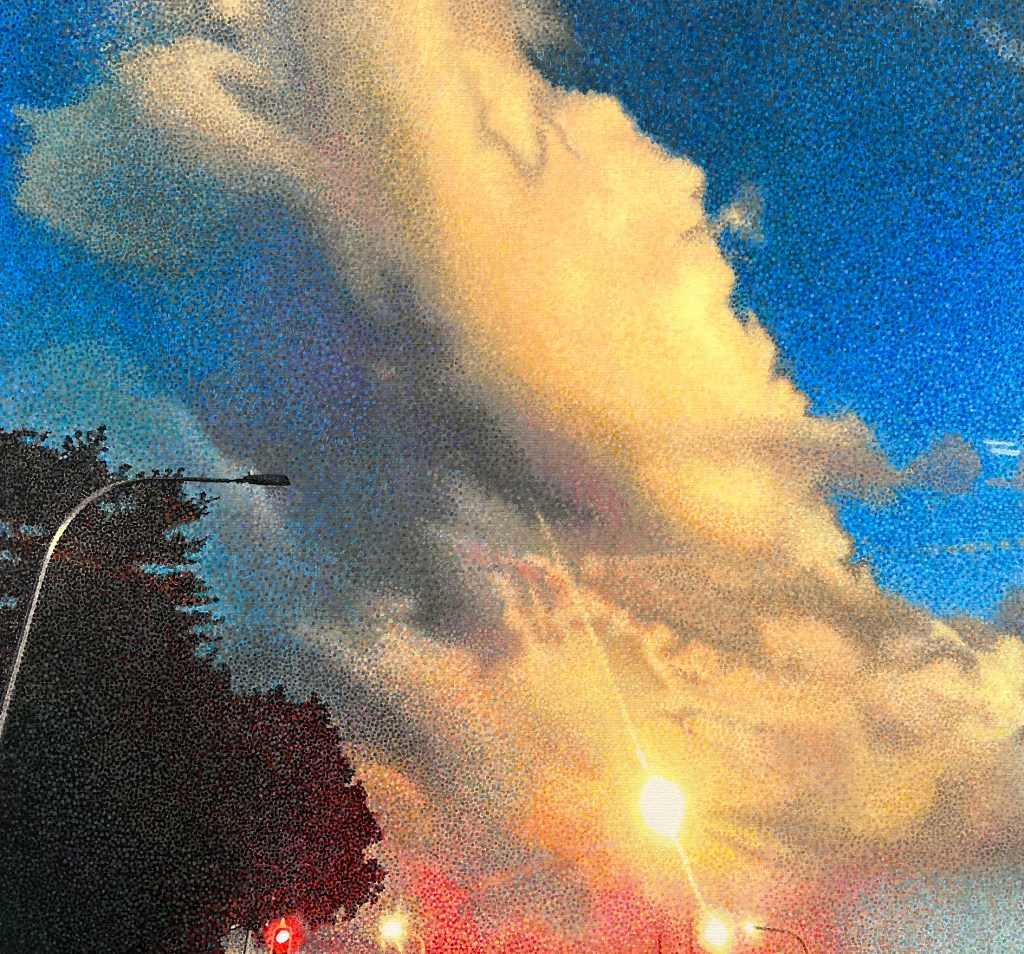
With “Scene 57” ($5500) the pointillism is far more apparent with the sky and clouds stippled with the small dots of colour. The artist has added a sense of structure to the work with parallel power lines and one of his ever-present lamp posts.

Gary McMillan Scene 60

This focus on sky and cloud is also seen in “Scene 60”($8000) where the billowing cloud looks like a massive explosion saturated  with colour.

Where Gary McMillans exhibition looks at the urban environment Elizabeth Rees’s work is focussed on an isolated area of Northland. As she notes in the catalogue – “”The Bay” is a response to my new small-town life in the Bay of Islands where light ever changes the sea and bushclad land. My recent acquisition of a boatshed in a small tidal bay has now become my full-time studio. Being surrounded by water, this change has offered me yet another perspective – being able so closely connected to the natural environment.”

Her paintings owe much to the style of the Impressionists with a sense of the artist painting in the open air surrounded by her subject.

In responding to an environment she feels some connection with these paintings are a record of the various times of day, moods and qualities of light she has observed

Many of her previous works featured figures in a landscape, their presence providing a sense of isolation. In these newer works it is the landscape itself which provides that sense of isolation.

Elizabeth Rees, A High Tide

Here there are brooding landscapes such as  “Summer Shade” ($10,000) where the touches of colour seep through the dark foliage.

With works like “A High Tide” ($8000)) the  colours are almost bleached out with light swirling around the shapes of trees.

Elizabeth Rees, On the Beach

A similar work “On the Beach” ($8000 where the foliage is almost shattered by light, could have been used as the cover illustration for  the Nevil Shute novel “On the Beach” which tells of impending nuclear pollution in the South Pacific

A further connection could also see the work in reference to the origins of the title in the lines from T S Eliots “The Wasteland”

In this last of meeting places
We grope together
And avoid speech
Gathered on this beach of the tumid river. connection

Two of the works features figures as in   “Low Tide” ($8000) where the small figures contribute to the sense of isolation and drama. “Last Light” ($10,500) feels less successful as the two figures contemplating the vista do not contribute to the  sense of remoteness.

With “The Bay” ($10,500) there is  more colour contrast with the blue of the water and the sky more dominant and the colours of the foliage picked out by light.

Elizabeth Rees, The Bay

“Nestled in the Bay” ($13,500) also alludes to the human presence with several low buildings or boathouses which merge with the light colours of the sand and sea.

The merging of sands and sea is also apparent in “Dunes Beyond” ($10,500) where the dunes seem to be the foam of crashing waves.

With nearly all these works it is light which is the dominant aspect with the artist endeavouring to create an ethereal presence of cloud and sky .The hills and foliage created with scumbled paint give a sense of seeing through a darkened or fogged glass.