Reviewed by John Daly-Peoples
National Youth Orchestra
NYO La Mer
Conductor, Dane Lam
Auckland Town Hall
July 4
Reviewed by John Daly-Peoples
The NZSO National Youth Orchestra’s concert “La Mer” was a celebration of the sea with four works, spanning two centuries exploring various aspects of the sea – descriptive, psychological and historical
The orchestra was led by the Australian-Chinese conductor Dane Lam the recently appointed Music Director of the Hawai’i Symphony Orchestra and Artistic Director of State Opera South Australia.
As Lam noted in his introduction to the concert these young musicians were the future of New Zealand music playing music of our time including music of New Zealand itself
They opened the concert with a new New Zealand work which spoke of the sea and the country’s connection with it.
Jack Bewley’s “Pray for the wanderer” is, as the composer says, “an ode to the courage it takes to … travel vast distances to our country”.
The opening drum roll which heralded thunder was followed by some glorious music from the orchestra reflecting the wonder and mystery of the sea voyage. The blare of the brass and the hectic percussion with some great surging sounds explored the movement of the sea as well as the movement of those who journeyed across the oceans.
The second work on the programme was one of the great atmospheric works – Four Sea Interludes by Benjamin Britten from his opera “Peter Grinmes” written in 1945. Grimes, afisherman in a small coastal town, is accused of mistreating his apprentice, who has died under mysterious circumstances at sea. He is a temperamental outcast, alienated from the local people with the moody music reflecting his character. Britten also depicts the nature of the weather and the sea as active elements in the story leading to the death of Grimes.
The opening section “Dawn”consisting of a high-pitched, desolate sound which is threaded though the swells of the sea as well as the early morning calm provided a sinister quality to the work. This was followed by “Sunday Morning” where the orchestra produced glittering sounds which described the sunshine and the sounds of sea birds. We also heard the cacophony of church bells, referencing happier times of the village which also contrasts with the darker sounds of the work.
The impressionist “Moonlight” movementhad some pulsating sounds which were both sounds of the sea and the heavy breathing of Grimes suggested an unease beneath the swell of the sea and the surface of the village
The final movement “Storm” featured aggressive percussion and brass describing the mummering and heaving of the sea which became more thunderous, eventually exploding in raging storm sequence which hints at the fury of both the weather and the fury of the villagers.
After the interval they played Michael-Thomas Foumai’s Kealaikahiki Suite which recounts the 1976 maiden voyage of Hōkūleʻa, a replica of an ancient Polynesian voyaging canoe to Tahiti as well as honouring the master navigator Mau Piailug.
The work was cinematic in scale in which the sea and activities merge, occasionally recalling the music of Douglas Lilburn’s “Landfall in Unknown Seas”.
The rousing music suggested the thrill of the sea and voyaging and the sense of adventure and the activities of the seafarers. There were other sequences which conveyed the majesty and breadth of the sea with some superb musicianship.
The final robust sequence sounded like a theme from an Indianna Jones movie leading to another energetic depiction of the sea
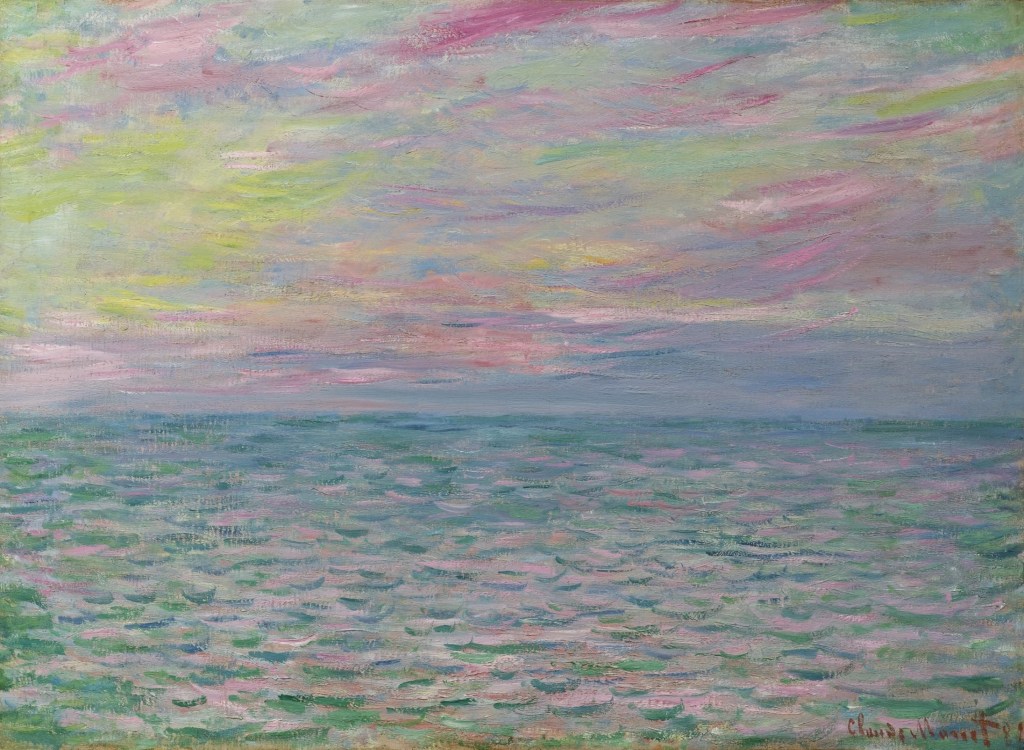
Much of Debussy’s music can be considered impressionist because it reflects the same goals of Impressionist artists such as Claude Monet and Paul Cezanne. Rather than using the structural elements of traditional classical music, he focused on evoking mood and atmosphere.
He avoided calling “La Mer” a symphony but rather giving it the subtitle of Three Symphonic Sketches. These three sketches are impressions of the sea in its various mood and colours in much the same way that the Impressionist painters conveyed their reactions to nature and its landscapes or seascapes
One of Debussy’s favourite artists apart from the Impressionist was the English artist J.M.W. Turner whom he admired for the way in which he dealt with light and hazy landscape depictions as well as the drama of light and shade.
With the first movement, “De l’aube à midi sur la mer” the orchestra conveyedthe sense of the seas awakening with voluptuous waves of sound. The various sections of the orchestra took on the variety of colours and textures of the sea, swelling and receding. The music captured the physicality of the sea, much as the way the artists used dashes and strokes of paint, Debussy used short, jazzy-like sequences of sound.
This was followed by “Jeux de vagues” with lively playing producing a wide range of loosely connected sounds, like a myriad of splashes depicting the changeable motion and moods of the sea
With the final “Dialogue du vent et de la mer” the orchestra created a dialogue between the wind and the turbulent sea with dramatic contrasts between the surging orchestral sounds. Here the orchestra had a sequence of meditation followed by a final surge of muscular sounds.
The orchestra showed in this concert that it has the musical talent and a depth of understanding of the music which will see a great future for some individual musicians as well as New Zealand orchestras.


