John Daly-Peoples
Mt Eden Chamber Music Festival
Eden Arts
Mt Eden Village Centre Church
July 2 – 5
Reviewed by John Daly-Peoples
Now in its tenth year the Mt Eden Chamber Music Festival organised by the local community arts group, Eden Arts has presented high quality performances by some of the country’ s leading musical groups and major talent including NZ Trio and NZ Barok.
These concerts have been programmed by Simeon Broom, the Festival’s Artistic Director who is a violinist with the New Zealand Symphony Orchestra and Cathy Manning of Eden Arts.
CONCERT 1 – THURSDAY 2 JULY 7pm
Dedicated to Mary O’Brien
Boccherini – Cello Quintet in D minor Op.25 & Schubert – Cello Quintet D.956
Featuring violinists Simeon Broom and Jessica Oddie
The Boccherini Cello Quintet in D minor, Op. 25, No. 1 is a supreme example of the galante classical style. It opens with an expressive slow opening with a stately, almost operatic feel and some virtuosic play.
There is also a graceful minuet that embodies the courtly elegance of the era, paired with a contrasting trio section. And finishes with a spirited, dance-like conclusion.
The Schubert – Cello Quintet is regarded as one of the absolute pinnacles of chamber music. Completed in 1828 just two months before the composer’s death. It is the composers only full-fledged string quintet and has been called “sublime” and “extraordinary” been said to possess “bottomless pathos”, and is generally regarded as Schubert’s finest chamber work as well as one of the greatest compositions in all chamber music.
CONCERT 2 – FRIDAY 3 JULY 7pm
Alyssa Morris – The Big Questions (2024)
Charles Loeffler – Deux Rhapsodies (1901)
Janet Jennings – Five Emotional States (2025)
TRIO OBSCURA
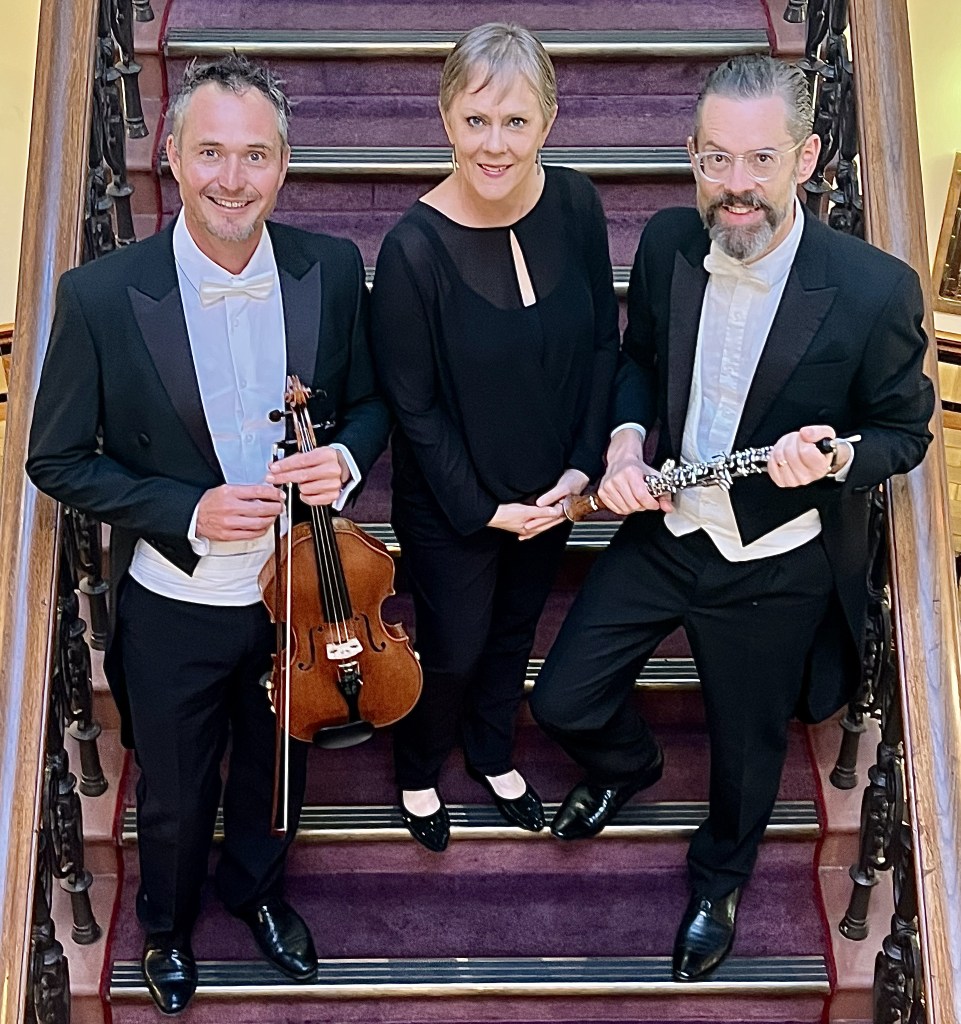

Bede Hanley, Robert Ashworth and Sarah Walkins
TRIO OBSCURA’s name was inspired by the somewhat unusual combination of instruments that comprise the ensemble: as it turns out, very little has been written for oboe, viola, and piano. Five Emotional States was written especially for TRIO OBSCURA’s 2026 In Partnership Series tour for Chamber Music New Zealand.
Alyssa Morris’s “The Big Questions” is a poignant reflection on the uncertainties of our time. Morris’s virtuosic writing and characteristic wit are ever-present, yet at its heart lies a search for peace and understanding.
Written a century earlier, Charles Loeffler’s “Deux Rhapsodies” are richly coloured and dramatic tone poems that capture the atmosphere and imagination of French Impressionism.
Janet Jennings’ “Five Emotional States” is intended to be fun to play and entertaining for audiences, with its quixotic changes of mood, and journeys between atonality and downright tunefulness.
CONCERT 3 – SATURDAY 4 JULY 5pm
Remembering Katherine Austin
Bach – E major Partita for solo violin
Schumann – Fantasiestücke Opus 73 for cello and piano
Prokofiev – Piano Sonata No.3 in A minor, Opus 28
Rachmaninov – Vocalise Opus 34 No.14
Dvorak – Piano Quintet No. 2 in A major, Opus 81 (1st mvmt)
A Garland for Katherine (2025)
(KATHERINE AUSTIN)
Andrew Leithwick – a little bit a bit
Helen Bowater – Ludwig, Katherine and me
Janet Jennings – Expressivo
Michael Williams – Effervescence
Peter Scholes – A Shining Star
Gillian Whitehead – S
Known for its joyful character Johann Sebastian Bach’s Partita No. 3 in E major for Solo Violin, composed in 1720, is the final work in his famous Sei Solo collection.
Robert Schumann’s Fantasiestücke originally composed in 1849 for clarinet and piano, is a staple of the cello repertoire. This three-movement cycle—highly lyrical, contrasting, and continuous in spirit—is widely celebrated for its warm, intimate dialogue between the two instruments.
Prokofiev’s Piano Sonata No. 3 in A minor of 1917 was composed for solo piano, using sketches dating from 1907. It is one of the shortest but most technically demanding pieces in the piano repertoire. Written in a single, continuous movement, the work is a compressed tour de force that flawlessly balances aggressive, mechanical rhythms with profoundly lyrical and romantic interludes.
Rachmaninov’s “Vocalise” is a song written for high voice and piano accompaniment. It contains no words, being sung using only one vowel of the singer’s choosing but is performed in various instrumental arrangements more frequently than in the original vocal version.
Antonín Dvořák’s Piano Quintet No. 2 in A major, Op. 81 (1887) is a pillar of the chamber music repertoire. The first movement (Allegro, ma non tanto) is celebrated for its warm, lyrical melodies and expressive shifts between melancholic folk influences and bright, romantic passion.
CONCERT 4 – SUNDAY 5 JULY 3pm
Ravel – Sonata for Violin & Cello
Beethoven – Eyeglass Duo for Viola & Cello
Dohnányi – String Trio Op.10
Maurice Ravel’s Sonata for Violin and Cello (1920–1922) is a lean, masterfully challenging chamber piece dedicated to the memory of Claude Debussy. Spanning four movements, the work strips away harmonic padding to pit the two instruments against one another in a brilliant, virtuosic, and contrapuntal display
Beethoven – Eyeglass Duo for Viola & Cello refers to two performers who wear glasses. It is unclear who else the short-sighted violist Beethoven might have been referring to other besides himself. Perhaps it is his friend Zmeskall. In any case, it must have been an accomplished musician, as the cello part is demanding throughout.
Serenade for String Trio in C major, Op. 10 (1902) by Hungarian composer Ernő Dohnányi is a masterpiece of the chamber music repertoire. Celebrated for its rich textures, virtuosic demands, and lyrical warmth, the five-movement suite beautifully balances late-Romantic spirit with dynamic, modern twists.
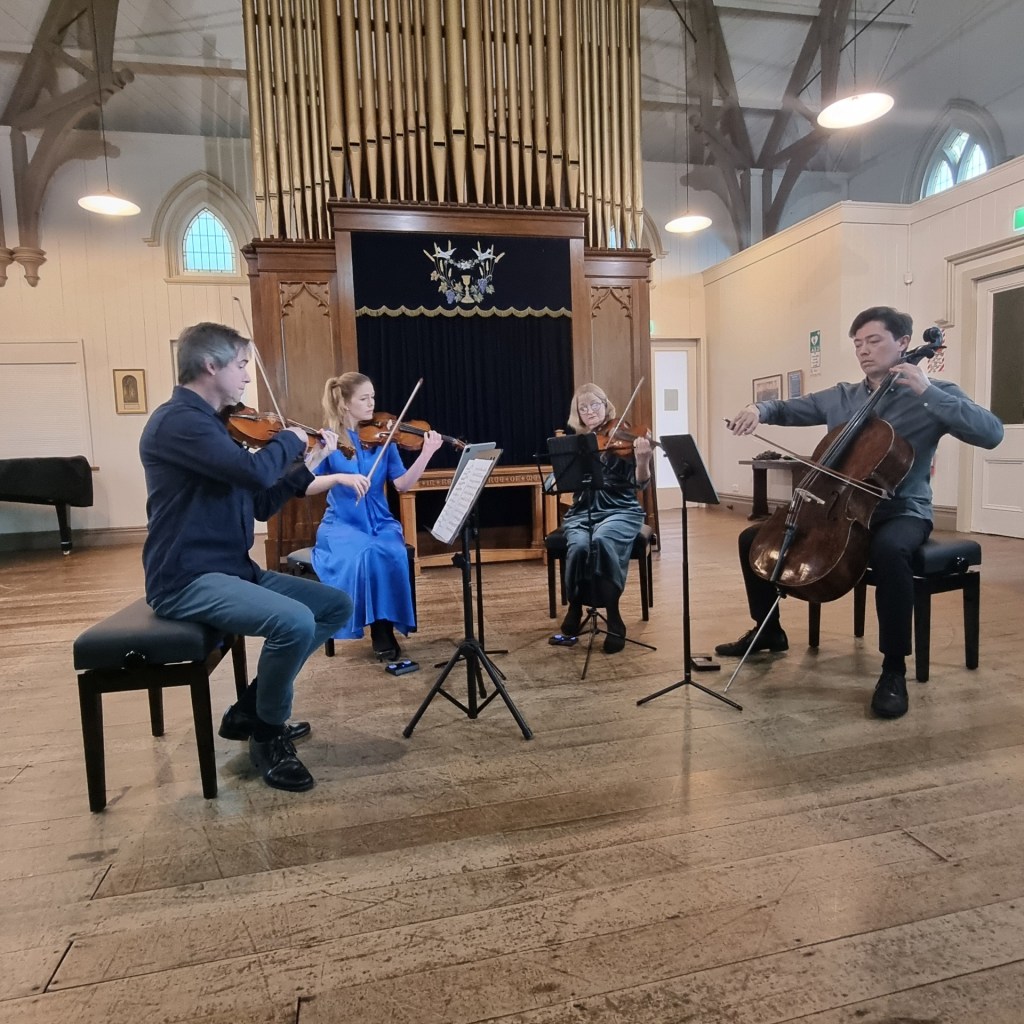
2025 Beethoven quartet – Simeon Broom, Jessica Oddie, Gillian Ansell, Ken Ichinose
Trio Obscura – Bede Hanley, Robert Ashworth, Sarah Watkins (trio so-named because very little has been written for oboe, viola and piano).


