Reviewed by John Daly-Peoples
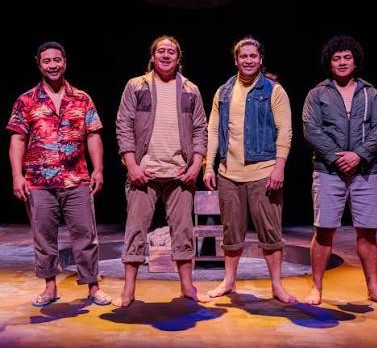
Sons of Vao by Vela Manusaute
Director, Anapela Polata’ivao
Auckland Theatre Company
ASB Waterfront Theatre
Until July 5th
Reviewed by John Daly-Peoples
Whenever I see that a play is about families I am reminded of Leo Tolstoy’s quote about families from the opening of his 1877 novel, Anna Karenina: “All happy families are alike; each unhappy family is unhappy in its own way.”
With his new play Sons of Vao, Vela Manusaute has created a brilliantly crafted tour de force about an unhappy family plagued an endless variety of unique conflicts, flaws, and dysfunctions.
The play follows of the family of Vao and his three sons and is essentially an autobiographical account of the playwright’s own relationship with his father. As he says in notes to the play,” My relationship with my father was fraught with difficulty. Through a child’s eyes, I perceived only struggle and pain, unable to comprehend the love of the man who brought me into this world.
The play revolves around Vao, the Samoan patriarch of a Niuean / Samoan family living on Niue. He takes his child rearing seriously, every misdemeanour is punished and each recipient of the punishment learns that they must never cry or show signs of weakness. This family violence is intended to create masculinity and strength; it actually leads to lifelong trauma.
In many ways this isn’t just about the family of Vao but an exploration of the survival mechanisms that many Pasifika people, both individually and collectively have had to resort to – accepting the word of the father, agreeing to the conservative notions of the village and following the dictates of the missionaries. The ambivalence that has been created has led to dysfunctional individuals and groups.
Director Anapela Polata’ivao explores the psychological and physical trauma and its impact on the individual with a mixture of bleakness and humour.
The all-male Pacific cast of Beulah Koale (as Vao), Haanz Fa’avae-Jackson (To), Epine Bob Savea (Seki), and Brett Taefu (Sau) initially seemed unconfirmable in their roles but quickly inhabited their characters with a distinctive Pacific quality.
Leading the cast Haanz Fa’avae-Jackson as To gave an emotional account of the son filled with hatred for his father who tentatively negotiates his way through life, ultimately striving for forgiveness.
Brett Taefu as the youngest son Sau plays an almost innocent young man whose world is dominated by the Roman legionnaires and cowboys he sees at the local cinema while Epine Bob Savea as Seki expresses the struggle between the traditional and the new.
As Vao, Beulah Koale gives a superb account of a true patriarch, completely sure of his beliefs and his approach to family but without reflection on his impact on the lives of others.
The interplay between the actors results in witty and insightful dialogue, some carefully staged action as well as clever song and dance moves.
For a play dealing with the dark side of life and the pain of growing up in an oppressive family and society writer and director have created an environment which uses an astute balance of angst and humour to negotiate the issues.
The play starts in the1970’s with the birth of the sons and traces their lives over the next forty years along with their arrival in New Zealand, their journey paralleling the journey that many Pasifika families make as well as their adaptation to life in a new country.
The father / son relationship is one which will resonate with many, not just the in addressing issues around family violence but also the clash of ideas and attitudes.
The minimal set design dominated by a constellation of stars is a nice metaphor for negotiating the distance travelled by Manusaute and all those who have travelled to New Zealand.
The opening and closing vignettes of the play feature a large white sheet which is passed over the stage is a clever way of framing the play as the revealing and capturing the memories of a family’s history.


