Categories
Reviews, News and Commentary

Picasso: Designed by Paul Smith

Reviewed by John Daly-Peoples
Picasso: Designed by Paul Smith

Curated by Joanne Snrech. Virginie Perdrisot-Cassan and François Dareau (Musée National Picasso–Paris) and Sophie Matthiesson (Auckland Art Gallery)

Auckland Art Gallery

10 Oct 2026 – 1 Feb 2027

Reviewed by John Daly-Peoples

With the new “Picasso: Designed by Paul Smith” exhibition at the Auckland Art Gallery we actually get two shows – a survey of Picasso’s works spanning seventy years as well as an introduction to Paul Smith’s approach to design and his own take on the work of Picasso.

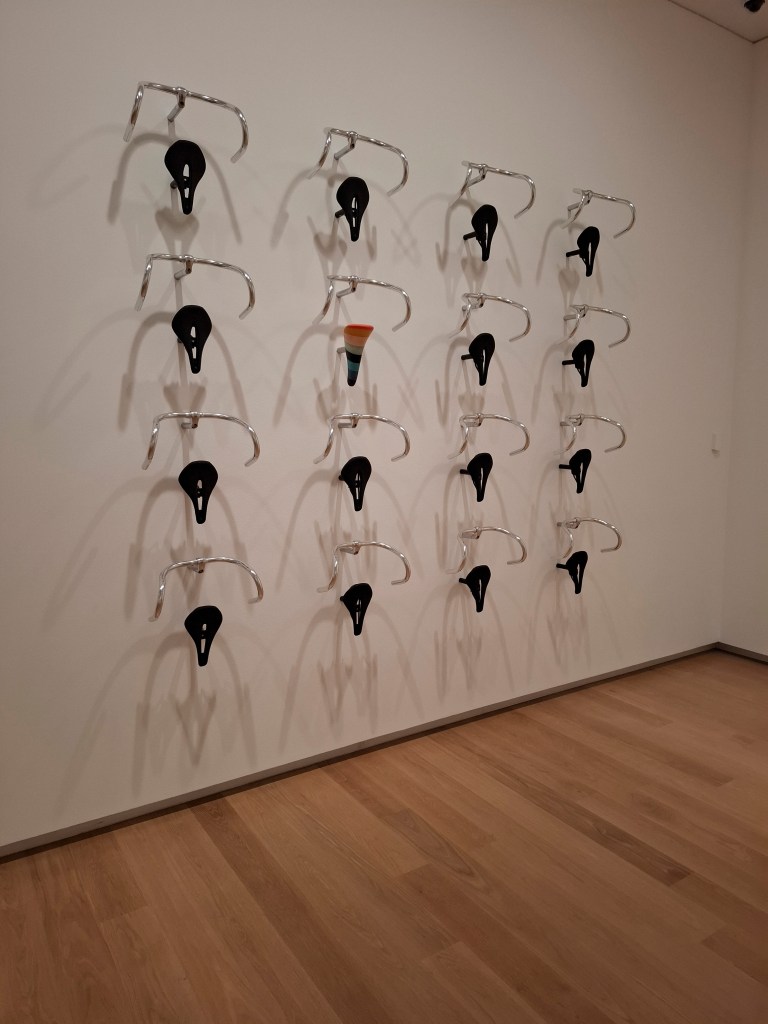
We encounter the crossover between the two artists in the first room of the show where Picasso’s “Head of a Bull” confronts Paul Smith’s sixteen deconstructed bulls head made of handlebars and bicycle seats. Whether this is an homage or just a witty response will colour your appreciation of Smith’s design interventions throughout the show.

His painted walls and others contrived aspects of the show have divided opinions similar to the divided response to the Tate’s “Theatre Picasso” exhibition which has just ended in London. Staged by the contemporary artist Wu Tsang and curator Enrique Fuenteblanca, they transformed the exhibition space into a theatre for displaying over 45 works by Picasso.

But as one commentator in the Arts Dispatch said of the show, “Still, this is Picasso and the works remain impressive, standing on their own merit without the failed framing”. It’s a comment which applies to Paul Smith’s design as well. The works do not really need someone else’s interpretation, in fact, the additions of Paul Smith can often detract from Picassos intent.

This is the first solo exhibition of Picasso’s work in New Zealand in more than 30 years with over 80 paintings, sculptures, drawings, prints and ceramics from the Musée national Picasso–Paris.

Sir Paul’s designs for the gallery spaces take inspiration from the colours, shapes, patterns and textures of Picasso’s artwork. His designs transform the gallery spaces, creating environments which add or detract from the viewers experience.
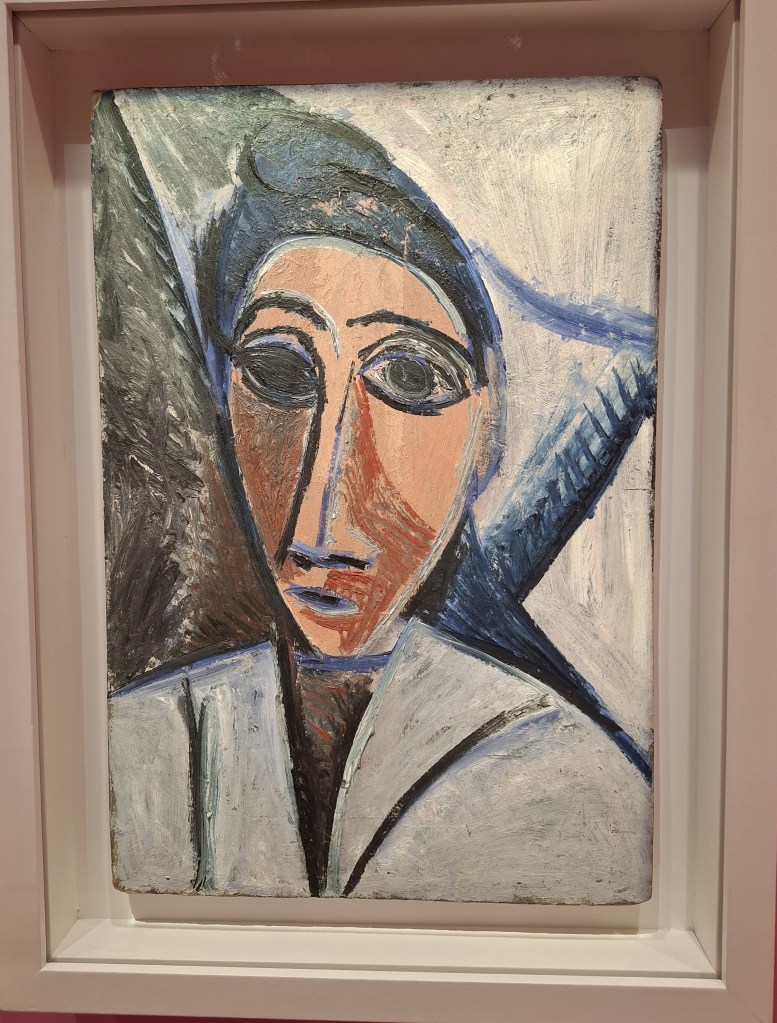
Pablo Picasso, Bust of a woman or sailor (study for “Les Demoiselles d’Avignon”) Musée national Picasso-Paris

There are many of the spaces where we get a sense of the artist developing his art such as in the Pink Ladies section where “Buste de femme ou de marin” can be seen as a study for” Les Demoiselles d’Avignion” where he has broken down the face into shapes, so the nose, eyes, cheeks and background become geometric splinters.

Then in The Cubist Laboratory room there are several examples of how he and Georges Braque created Cubist abstraction and collage.

There is Picasso’s “Le Sacre-Couer,” the Paris church he lived near to. This is an early example of analytical cubism, where Picasso used sharp geometric shapes, fractured planes, and broken semi-circles to deconstruct the three-dimensional landscape of the hill and church into a flat, abstract composition.
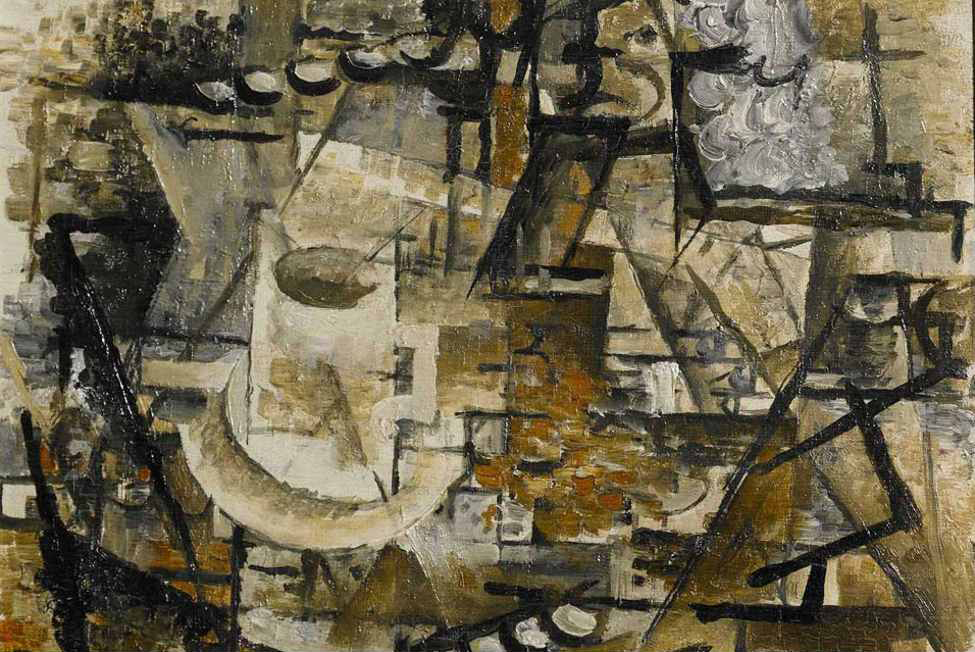
Georges Braque, La Tasse Auckland Art Gallery, Julien and Rosie Robertson Collection

Then there is the more interesting Georges Braque “La Tasse” where the artist has deconstructed a simple cup into a web of intersecting vertical, horizontal, and diagonal lines. Rather than rendering a realistic object, the artwork focuses heavily on spatial relationships, shifting perspectives, and the compression of light and shadow.

This work comes from the gallery’s own collection having been gifted by Julien and Rosie Robertson and bought by the Robertsons in 2006 for $2,872,000 USD.  This work and two Picasso’s from the collection are the most impressive works in the exhibition and are fine examples of the artist’s use of colour and makes a real impact.

Many of the works reflect Picasso’s biographical approach to his art. As he says ‘I paint the way some people write an autobiography. The paintings, finished or not, are the pages from my diary.’ So, sometimes these diary entries are fulsome while at other times they are like brief notes.

In the Bullfighting Room there are several images of the horse and in “Bullfighting: The Death of the Bullfighter” we see the image of the distressed horse, a subject he had previously used and which would be a major element in his Guernica of 1937.
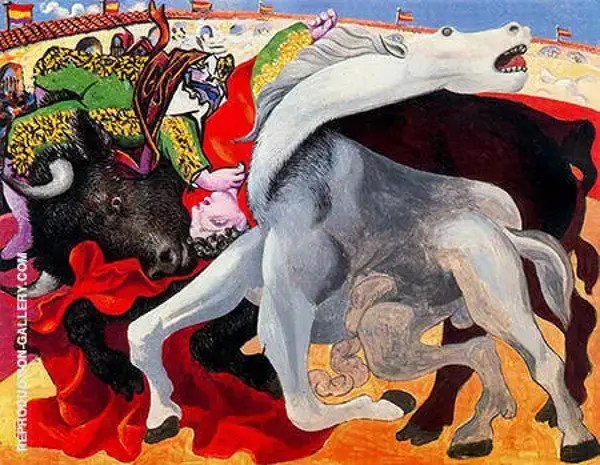
Pablo Picasso, Bullfighting: Death of the Toreador Musée national Picasso-Paris (Paris, France)

In the “Stripes” Room we encounter several of his portraits where the backgrounds are of stripes. The motif may have derived from the Breton striped shirt which was the standard navy and white stripes, of the French Navy uniform. It was adopted by Picasso while living in the South of France. The striped background in several of his paintings used both as a wallpaper and as a motif which connects many of his works.
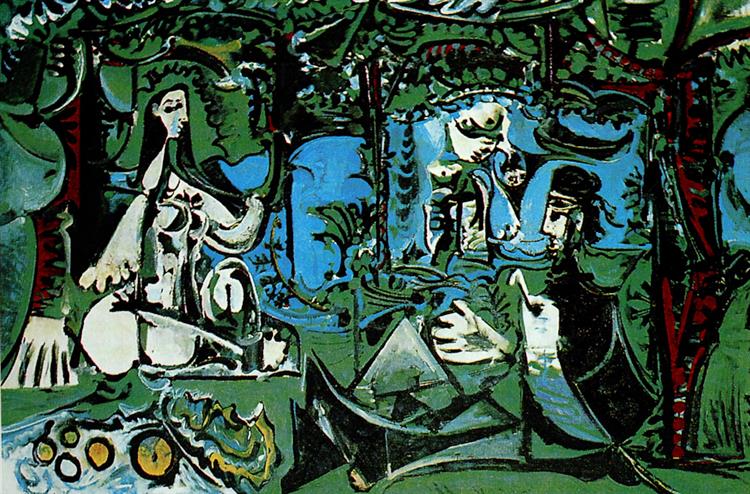
Pablo Picasso Le Déjeuner Sur L’herbe après Manet, Musée national Picasso-Paris

One of the most impressive rooms is one devoted to his interpretations of “Le Déjeuner Sur L’herbe” by Manet. Picasso had long shown a great interest in the theme of the nude, and “Le Déjeuner sur l’herbe” relates in part to the theme of the artist and his model which figures often in his work.

In adapting” Le déjeuner sur l’herbe” to his own purposes, Picasso was playing with the history of art, with Manet’s legacy and that of the Italian Renaissance with the images of the Renaissance artists Marcantonio Raimondi and Raphael whose work had inspired the Manet work.

Picasso likes the image which fitted in with his many depictions of the artist and his nude model. He produced close to 150 paintings and numerous other works featuring the artist and his model. With many of these works Picasso cast himself as a passionate, flawed creator or beast observing or interacting with female figures.

Categories
Reviews, News and Commentary

A Century of Modern Art coming to the Auckland Art Gallery in June

John Daly-Peoples

Claude Monet, French, 1840-1926; Water Lilies ; about 1922;oil on canvas Toledo Museum of Art, purchased with funds from the Libbey Endowment, Gift of Edward Drummond Libbey

A Century of Modern Art

Auckland Art Gallery  

June 7 – September 28

John Daly-Peoples

Auckland Art Gallery has announced that the exhibition “A Century of Modern Art” will be  its special winter exhibition this year, running from  June & through till September 28th.

The exhibition will be on loan from the Toledo Museum of Art, Ohio, and will provide  a survey of the major artists who transformed modern art.

The exhibition will consist of 57 works by 53 artists, including Paul Cezanne, Edgar Degas, Helen Frankenthaler, Édouard Manet, William Merritt Chase, Amedeo Modigliani, Berthe Morisot, Claude Monet, Pablo Picasso, Camille Pissarro, Robert Rauschenberg, Pierre-Auguste Renoir, Vincent van Gogh, James McNeill Whistler, among others.

Director of Auckland Art Gallery Toi o Tāmaki, Kirsten Lacy says the calibre of works and artists in this collection is exceptional and not to be missed.  “A Century of Modern Art showcases the diversity and innovation that defined modern art movements,” says Lacy. “From the emotive brushstrokes of Van Gogh to the evocative landscapes of Monet and Rauschenberg’s bold abstractions, these works not only revolutionised Western art history but continue to inspire new generations.”

“The exhibition includes works by legendary art figures, including Vincent van Gogh, whose work hasn’t been publicly displayed here in Aotearoa in over a decade. It is made available to us due to renovations that are taking place at Toledo Museum of Art, and we are honoured to be working with the Museum to make the most of this rare opportunity.”

The centrepiece of the show will be Claude Monet’s  “Water Lilies” Purchased with funds from the Libbey Endowment, Gift of Edward Drummond Libbey    Plants, water, and sky seem to merge in Claude Monet’s evocative painting of his lily pond at Giverny. The disorienting reflections, bold brushstrokes, and lack of horizon line or spatial depth make Water Lilies appear almost abstract. Painted about 1922, it belongs to a grand project that Monet had conceived as far back as 1897:

“Imagine a circular room whose wall . . . would be entirely filled by a horizon of water spotted with [water lilies]… the calm and silence of the still water reflecting the flowering display; the tones are vague, deliciously nuanced, as delicate as a dream.”

Monet began this ambitious project in 1914, finally completing it shortly before his death in 1926. Over those years he executed more than 60 paintings of his water garden, capturing the light conditions at different times of day and in different weather. Twenty-two of these large panels were installed in the Orangerie in the Tuileries Gardens, Paris, as a gift to France. The  Toledo’s work was is possibly a study for one of the three panels of the Orangerie composition” Morning”.

Berthe Morisot, In the Garden at Maurecourt. (Purchased with funds from the Libbey Endowment, Gift of Edward Drummond Libbey)

Included in the exhibition is a work by artists Berthe Morisot one of the few female Impressionist artists. Her work “In the Garden at Maurecourt” (Purchased with funds from the Libbey Endowment, Gift of Edward Drummond Libbey) is set in Morisot’s sister Edma country house outside Paris and probably shows Morisot’s daughter, Julie, and one of Edma’s daughters.

She was born to an upper-middle class family and was the great-niece of Rococo artist Jean-Honoré Fragonard. Morisot rejected the social expectations of her class and gender by pursuing a professional career as an artist. In 1868 she met and became close friends with artist Édouard Manet, marrying his younger brother Eugène in 1874, the same year she participated in the first Impressionist group exhibition.

Paul Gauguin, French, 1848-1903; Street in Tahiti; 1891;oil on canvas (Purchased with funds from the Libbey Endowment, Gift of Edward Drummond Libbey)


There is also a work by the recently deemed “controversial” Paul Gauguin. His work “Street in Tahiti” (Purchased with funds from the Libbey Endowment, Gift of Edward Drummond Libbey) which predates his Tahitian figurative works was among the first group of paintings Gauguin produced in Tahiti during his initial two-year stay. He conveyed something of the special character of the place—the limpid light, rich colour, lush vegetation, and lofty mountains—through his use of strong contours, flattened shapes, repeated curving rhythms, and tautly patterned brushstrokes. However, minor notes of strain, such as the brooding woman and heavy clouds pressing down from above, introduce undertones of sadness and disquiet.

A Century of Modern Art will make use of its current major exhibition “The Robertson Gift: Paths through Modernity” which includes works by. Georges Braque, Paul Cezanne, Fernand Léger, Henri Matisse, Piet Mondrian and Pablo Picasso.

Together the two exhibitions will trace out the birth of modern painting, beginning with the Impressionists in the 1860s, and follows its evolution through key movements such as Post- Impressionism, Symbolism, Cubism, Surrealism, Constructivism, German Expressionism, Bauhaus, De Stijl, Precisionism, and Colour Field Painting and Abstract Expressionism.

Adam Levine, the Edward Drummond and Florence Scott Libbey President, Director and CEO of the Toledo Museum of Art, says, “The Toledo Museum of Art is distinguished by the quality of its collection. Each acquisition in our institution’s history has been oriented to acquiring artworks of superlative aesthetic merit. Never have so many of our masterworks travelled together, and we could not be more excited for them to debut in Auckland.”

A Century of Modern Art is organised by the Toledo Museum of Art, Ohio and has been supported by HSBC and Auckland Art Gallery Foundation. Co-ordinating curator of the exhibition is Dr Sophie Matthiesson

To subscribe or follow New Zealand Arts Review site – www.nzartsreview.org.

The “Follow button” at the bottom right will appear and clicking on that button  will allow you to follow that blog and all future posts will arrive on your email.

Or go to https://nzartsreview.org/blog/, Scroll down and click “Subscribe”