Reviewed by John Daly-Peoples
Picasso: Designed by Paul Smith
Curated by Joanne Snrech. Virginie Perdrisot-Cassan and François Dareau (Musée National Picasso–Paris) and Sophie Matthiesson (Auckland Art Gallery)
Auckland Art Gallery
10 Oct 2026 – 1 Feb 2027
Reviewed by John Daly-Peoples
With the new “Picasso: Designed by Paul Smith” exhibition at the Auckland Art Gallery we actually get two shows – a survey of Picasso’s works spanning seventy years as well as an introduction to Paul Smith’s approach to design and his own take on the work of Picasso.
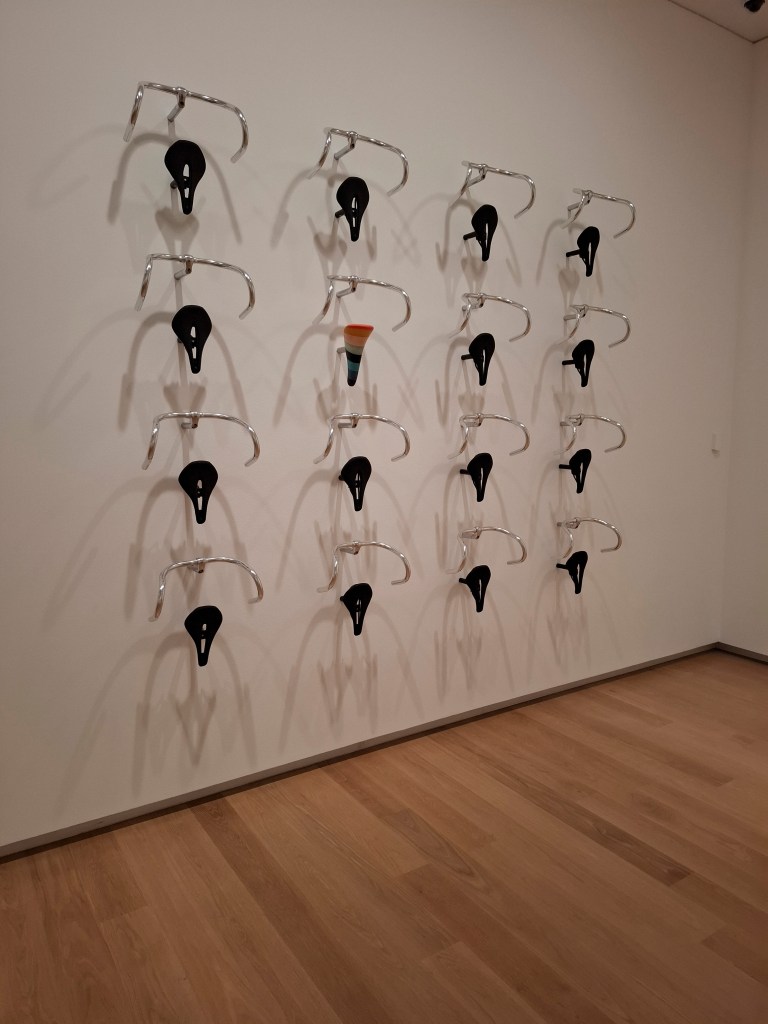
We encounter the crossover between the two artists in the first room of the show where Picasso’s “Head of a Bull” confronts Paul Smith’s sixteen deconstructed bulls head made of handlebars and bicycle seats. Whether this is an homage or just a witty response will colour your appreciation of Smith’s design interventions throughout the show.
His painted walls and others contrived aspects of the show have divided opinions similar to the divided response to the Tate’s “Theatre Picasso” exhibition which has just ended in London. Staged by the contemporary artist Wu Tsang and curator Enrique Fuenteblanca, they transformed the exhibition space into a theatre for displaying over 45 works by Picasso.
But as one commentator in the Arts Dispatch said of the show, “Still, this is Picasso and the works remain impressive, standing on their own merit without the failed framing”. It’s a comment which applies to Paul Smith’s design as well. The works do not really need someone else’s interpretation, in fact, the additions of Paul Smith can often detract from Picassos intent.
This is the first solo exhibition of Picasso’s work in New Zealand in more than 30 years with over 80 paintings, sculptures, drawings, prints and ceramics from the Musée national Picasso–Paris.
Sir Paul’s designs for the gallery spaces take inspiration from the colours, shapes, patterns and textures of Picasso’s artwork. His designs transform the gallery spaces, creating environments which add or detract from the viewers experience.
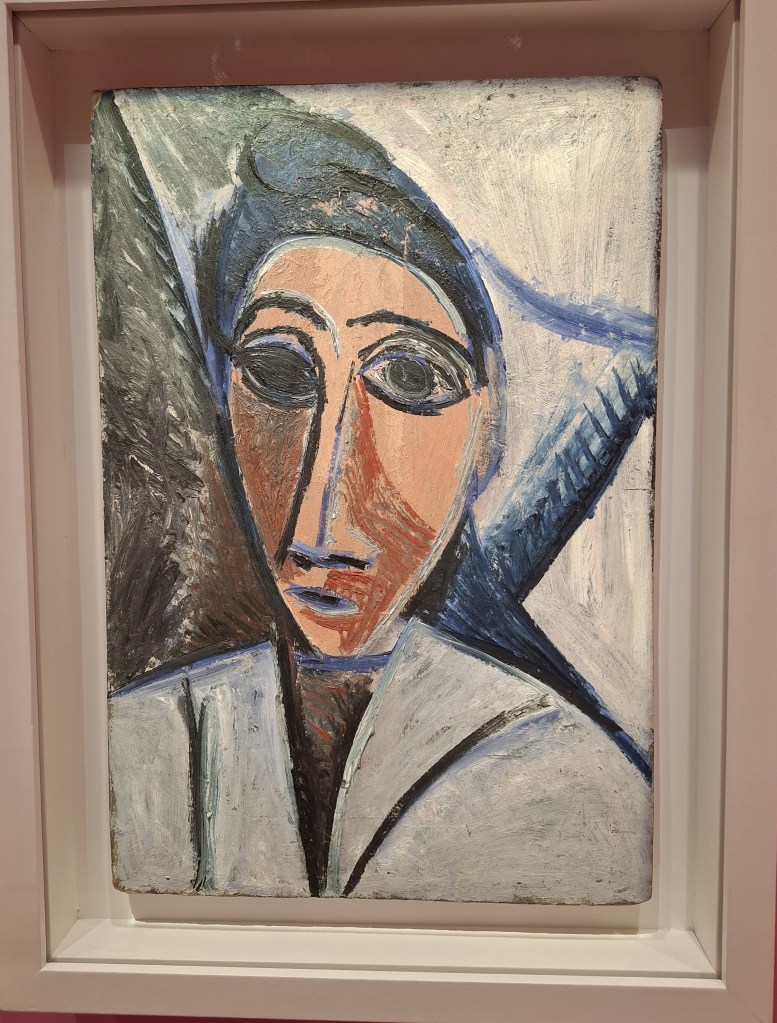
There are many of the spaces where we get a sense of the artist developing his art such as in the Pink Ladies section where “Buste de femme ou de marin” can be seen as a study for” Les Demoiselles d’Avignion” where he has broken down the face into shapes, so the nose, eyes, cheeks and background become geometric splinters.
Then in The Cubist Laboratory room there are several examples of how he and Georges Braque created Cubist abstraction and collage.
There is Picasso’s “Le Sacre-Couer,” the Paris church he lived near to. This is an early example of analytical cubism, where Picasso used sharp geometric shapes, fractured planes, and broken semi-circles to deconstruct the three-dimensional landscape of the hill and church into a flat, abstract composition.
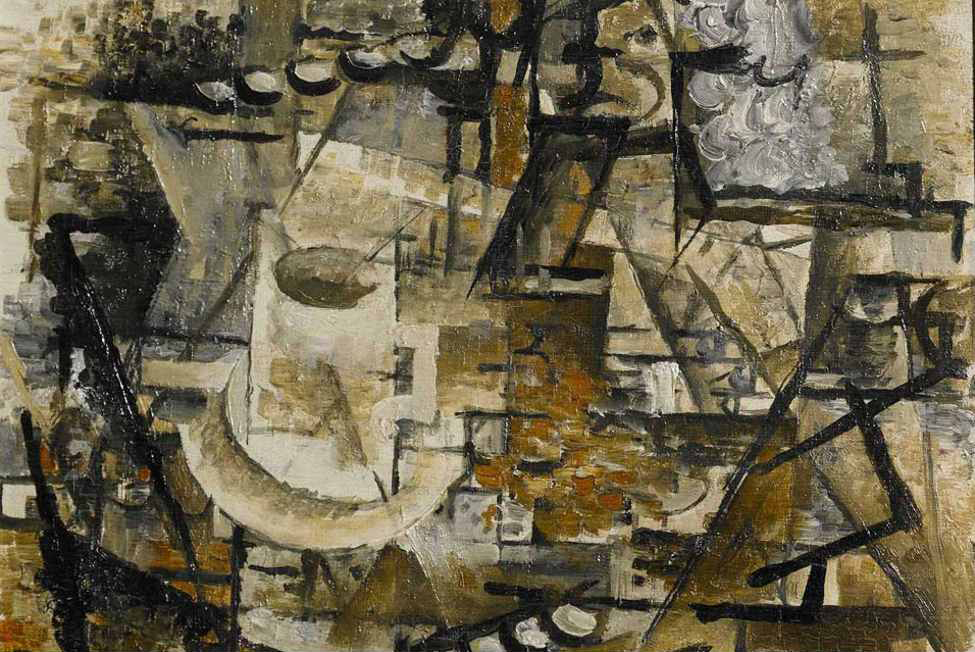
Then there is the more interesting Georges Braque “La Tasse” where the artist has deconstructed a simple cup into a web of intersecting vertical, horizontal, and diagonal lines. Rather than rendering a realistic object, the artwork focuses heavily on spatial relationships, shifting perspectives, and the compression of light and shadow.
This work comes from the gallery’s own collection having been gifted by Julien and Rosie Robertson and bought by the Robertsons in 2006 for $2,872,000 USD. This work and two Picasso’s from the collection are the most impressive works in the exhibition and are fine examples of the artist’s use of colour and makes a real impact.
Many of the works reflect Picasso’s biographical approach to his art. As he says ‘I paint the way some people write an autobiography. The paintings, finished or not, are the pages from my diary.’ So, sometimes these diary entries are fulsome while at other times they are like brief notes.
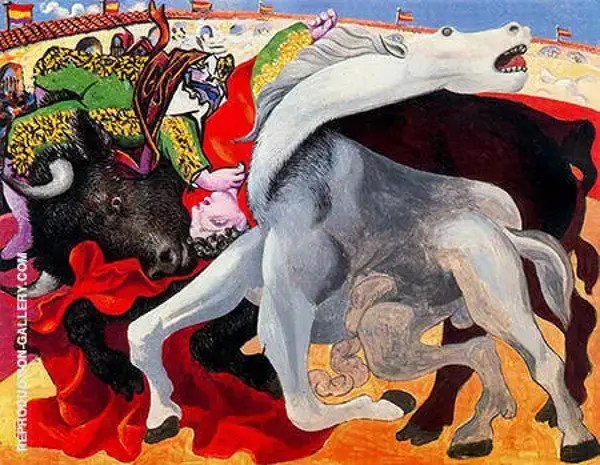
In the Bullfighting Room there are several images of the horse and in “Bullfighting: The Death of the Bullfighter” we see the image of the distressed horse, a subject he had previously used and which would be a major element in his Guernica of 1937.
In the “Stripes” Room we encounter several of his portraits where the backgrounds are of stripes. The motif may have derived from the Breton striped shirt which was the standard navy and white stripes, of the French Navy uniform. It was adopted by Picasso while living in the South of France. The striped background in several of his paintings used both as a wallpaper and as a motif which connects many of his works.
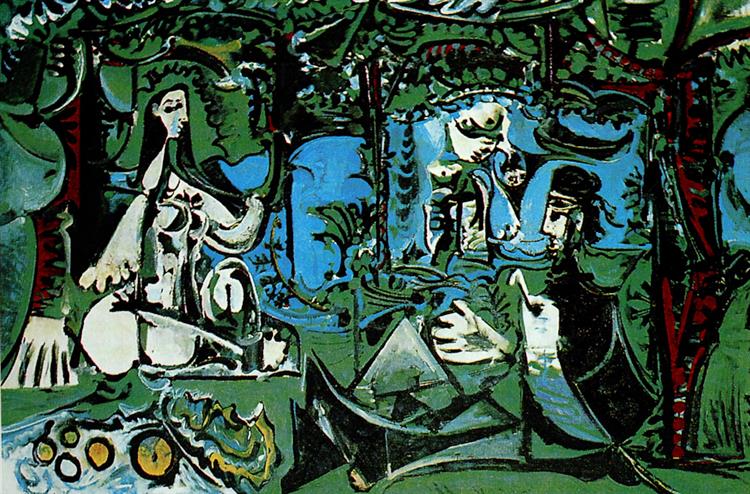
One of the most impressive rooms is one devoted to his interpretations of “Le Déjeuner Sur L’herbe” by Manet. Picasso had long shown a great interest in the theme of the nude, and “Le Déjeuner sur l’herbe” relates in part to the theme of the artist and his model which figures often in his work.
In adapting” Le déjeuner sur l’herbe” to his own purposes, Picasso was playing with the history of art, with Manet’s legacy and that of the Italian Renaissance with the images of the Renaissance artists Marcantonio Raimondi and Raphael whose work had inspired the Manet work.
Picasso likes the image which fitted in with his many depictions of the artist and his nude model. He produced close to 150 paintings and numerous other works featuring the artist and his model. With many of these works Picasso cast himself as a passionate, flawed creator or beast observing or interacting with female figures.


