Categories
Reviews, News and Commentary

Shakespearean Disappointment

Phoebe McKellar (Juliet) and Theo Dāvid (Romeo) Photo: Andi Crown

Review by Malcolm Calder

Romeo and Juliet

By William Shakespeare

Auckland Theatre Company

Director – Benjamin Kilby-Henson

Design – Dan Williams

Lighting – Filament Eleven 11

Costumes – Daniella Salazar

Sound – Robin Kelly

With Ryan Carter, Liam Coleman, Theo Dāvid, Courteney Eggleton, Jesme Faa’auuga, Isla Mayo, Miriama McDowell, Phoebe McKellar, Jordan Mooney, Meramanji Odedra, Beatriz Romilly and Amanda Tito

Waterfront Theatre – until 9 August

Review by Malcolm Calder

This is a brave attempt by ATC to broaden its audience base and provide a path for younger performers.  And when you’re doing that, a good Shakespeare is a fairly safe bet as it can probably do quite well with younger audiences, meet the needs of traditional adherents and will no doubt fare well with a schools audience.  And ATC is to be acknowledged for that.

Unfortunately, when one looks at the larger theatrical picture, this Romeo and Juliet doesn’t really fare very well.  Especially as a major production by one of this country’s more significant professional companies.  However ATC’s production standards remain fairly high and are arguably this production’s saving grace. 

This Romeo and Juliet is set in a 1960s Verona and I get that – not such a silly idea.  The the overall design is consistent and sometimes works very well indeed with the themes Director Benjamin Kilby-Henson is articulating – youth, love and lyricism.  Chapeaus are due to the entire creative team and his production looks and feels quite stunning.

Dan Williams has generated a well-executed, three-dimensional set, largely articulated with reductive arches, derived some mobility from a well-used billiard table and unusually introduced what looks like a painter’s scaffold that trucks about a Veronian ballroom that is ‘under renovation’ and elsewhere too.  It makes for a splendidly unusual balcony scene.

I wasn’t in Verona in the 1960s, however I did own a pair of vertically-striped trousers a decade later, so I give costumier Daniella Salazar’s costumes a big thumbs up too.  Her use of colour is at times subtle and nuanced and the differences she has drawn between Montague and Capulet families are finely drawn.  Of particular note is the ballroom scene.

But it was the lighting and the soundscape that were the standouts for me.   The Filament 11 designers have introduced some dramatic and highly effective lighting that echoes the sentiments of Shakespeare’s words and the emotions highlighted by the director.  It is also pleasing to see ATC using effective sound reinforcement for actors who often spend more time in front of cameras and on more intimate venues these days than on the comparatively largish Waterfront’s stage.

However, Miriama McDowell aside, the cast struggled with Shakepeare’s words, couplet-ridden though they are

In fact, the whole casting process seemed somehow –  odd.  Generational differences were blurred, there was a rather strange mix of accents, some characters seemed to fit the context while others didn’t, and I’m still trying to work out why there were so many varied approaches.

Music may be the food of love but, as the director has noted, poetic verse is its very life force. Romeo only addresses Juliet in verse and she does likewise.  But sustaining this is very difficult indeed.

Apart from occasional flashes, especially with some of the longer speeches, the net result was one where authority and credibility were just – missing.   At one point it seemed like I was watching a youth company of younger kiwis imagining a Verona they had never visited.   

Miriama McDowell (Whaea Lawrence), however, was very much the exception, actually speaking Shakespeare’s words rather than matching the prevalent declamations of others. Theo Dāvid (Romeo) matched her to some extent leading one to wonder whether their work with the now-long-gone Popup Globe had anything to do with this.

There were a number of unanswered quibbles too: why, for example, did Friar Lawrence became a ‘Whaea’ in this production.  If this really were set in 1960s Tauranga and there two gangs at war with each other it could make sense.  But it is a term never uttered in in Verona in the 1960s.  And perhaps a bit of undersheet nudity was a way of  the simpering unreality of Paris, but that didn’t work for me either.

So thanks for the effort ATC.  But Romeo and Juliet was a disappointment for me.

Categories
Reviews, News and Commentary

The Monster in the Maze: a new community opera opera from N Z Opera

John Daly-Peoples

The Monster in the Maze

Composer Jonathan Dove

Libretto by Alasdair Middleton

N Z Opera and The Freemasons Foundation NZ Opera Chorus

Christchurch, Isaac Theatre Royal, September 5 /6

Wellington, St James Theatre, September 12/13

Auckland Kiri te Kanawa Theatre, September 19/20

John Daly-Peoples
Following its highly successful production of  La Boheme N Z Operas next production will be the Monster in the Maze, a contemporary community opera written by the British composer Jonathan Dove (Mansfield Park, Flight, Marx in London) with libretto by Alasdair Middleton that earned a British Composer Award in 2016.
Celebrated as one of the most successful contemporary operas of its kind globally, it was originally perforemed by the Berlin Philharmonic, the London Symphony Orchestra, and the Festival d’Art Lyrique d’Aix-en-Provence.
 When the legendary King Minos defeats the Athenians, he metes out his punishment in the cruellest way possible: by destroying their hope for the future. Every year, the king compels the conquered Athenians to send him their youth, to be fed to the terrible beast at the centre of his island’s maze: the Minotaur.


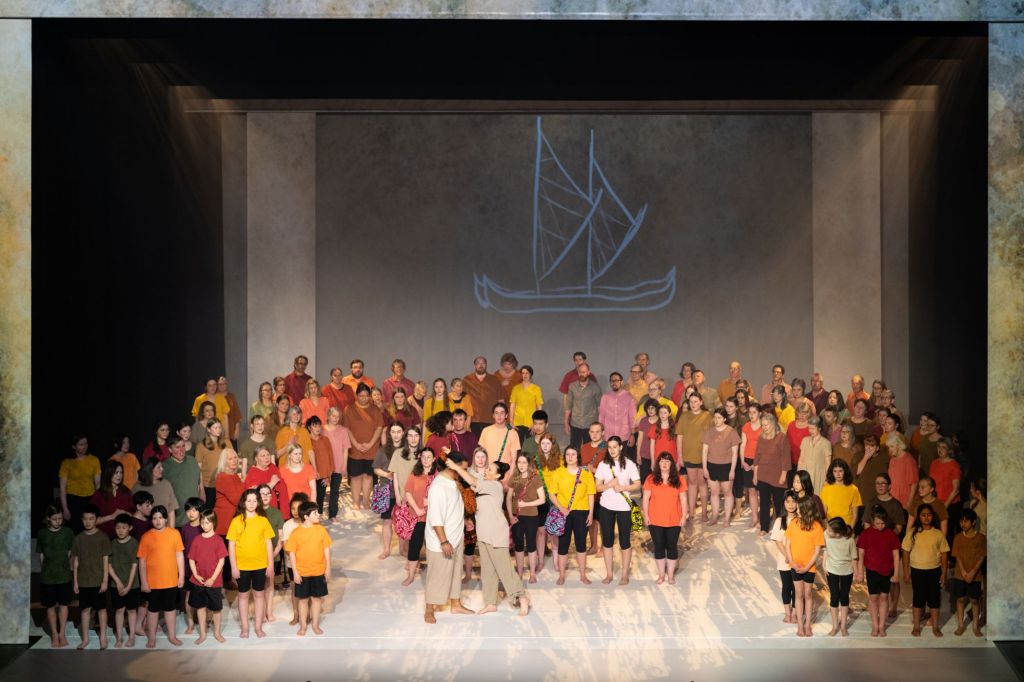
As the vindictive king will soon learn, however, these youth will not accept their fate without a fierce challenge. The Monster in the Maze is a story about resistance; about justice; about finding power not in oppression, but in collectivism. Fittingly, then, it’s also a groundbreaking work in its form: a community-focused and community-driven opera in which young and community singers and players stand proudly shoulder-to-shoulder with their professional counterparts, and in which both are integral.
The production marks the significant NZ Opera directorial debut for Anapela Polata’ivao. Reflecting on what drew her to The Monster in the Maze she explains: “What attracted me was the community aspect. This is an incredible opportunity for our local choirs and community members to participate in a high-level, professional performance. This collaborative involvement not only enriches the storytelling but also fosters a sense of connection to the production’s cultural themes and to each other, making it an inclusive and empowering experience for all participants and audiences.”
This new production pays homage to the rich Pasifika heritage that profoundly shapes New Zealand’s cultural tapestry, highlighting themes of displacement and resilience. The Athenian youth’s journey from a warmer homeland to the cold, unforgiving land of Crete powerfully echoes the migration experiences of many Pacific peoples. In this Aotearoa-specific interpretation, Athens symbolises the warmth and familiarity of the islands, while Crete metaphorically becomes contemporary urban New Zealand, embodying the challenges and opportunities of arriving in a new land.
An exceptional, all-New Zealand cast star in the principal roles. Acclaimed UK-based mezzo-soprano Sarah Castle (Andrea Chénier, Semele, La Cenerentola) brings her powerful presence to the role of Mother. Popular baritone and 2018 Lexus Song Quest winner Joel Amosa (La Traviata, Mansfield Park, Rigoletto) steps into the role of maze architect Daedalus. Rising operatic talent Ipu Laga’aia, recently named NZ Opera Freemasons Foundation Company Artist for 2025, makes his professional operatic role debut as the hero Theseus. Completing the principal cast, versatile entertainer and actor Maaka Pohatu (Ngai Tāmanihiri, Tūwharetoa), known for The Modern Māori Quartet and screen roles in Happiness, Far North, and Wellington Paranormal, makes his NZ Opera debut as the vindictive King Minos.
Joining Anapela Polata’ivao and Stacey Leilua in the creative team, conductor Brad Cohen leads the Christchurch Symphony Orchestra in Ōtautahi, Christchurch, and Brent Stewart conducts the New Zealand Symphony Orchestra and the Auckland Philharmonia in Te Whanganui-a-Tara, Wellington and Tāmaki Makaurau, Auckland respectively. The Freemasons Foundation NZ Opera Chorus, child, youth and adult community performers join the production in each city.
A highly innovative set, costume, and lighting design by Filament Eleven 11 (Rachel Marlow and Brad Gledhill) vividly transforms the worlds of Athens and Crete into a compelling contemporary setting. The design skilfully weaves local narratives into the production elements, showcasing Aotearoa’s unique identity and its ongoing dialogue between traditional heritage and contemporary realities.   One of the operas first review, ten years ago in the Financial Times  gave it high praise

“First seen in Berlin last month, and now on its way to Aix-en-Provence, The Monster in the Maze is an exhilarating, visceral take on the ancient Greek myth of the Minotaur. Every aspect of Dove’s score, from the rhythmic game-play to the lower-brass Minotaur roars, stokes the imagination, leaving stage director Thomas Guthrie only to supply some subtle image projection and artful choreography. Alasdair Middleton’s libretto is less successful, thanks to some inane rhymes (“Theseus can box/ His arrows are unerring;/ And he works out with rocks”). But when sung with the do-or-die conviction of the LSO Discovery Choirs and LSO Community Choir, the overall product is a beast to be reckoned with.”

Categories
Reviews, News and Commentary

The Art of Banksy

Reviewed by John Daly-Peoples

Banksy, Girl with a balloon

The Art of Banksy

Hunua Rooms, Aotea Centre

Until  3 Aug.

Reviewed by John Daly-Peoples

The Art of Banksy, is a  major exhibition of the artist’s work which has now been seen by 1.5 million visitors in 18 cities around  the world.

The collection of 150 original and authenticated works features more than 150 pieces, including prints, canvases, unique works, and ephemera.

There are several versions of his well-known pieces such as the “Girl with a balloon” and “Flower Thrower,” also known as “Love is in the Air,”

As with many of his works Banky borrows from other sources, changing the original intention, subverting the original meaning as well as trawling the world for the symbols and highlights in other artworks.

So, there are references, adaptations and reworkings of Christian iconography, news photographs, Disney images along with the work of Andy Warhol, Keith Harring and even Degas.

Banksy, Ballerina with Action Man parts

It is the clever borrowing of images which appeals to adult audiences as well as well as children and his images which undermine capitalism will bring a smile to both to the conservative as well as the revolutionary.

The exhibition spans his output from the 1990’s to the present-day showing examples of his satirical and subversive output  often appearing in public places around the world.

His iconic artwork depicting a masked figure or rioter, about to throw a bunch of flowers is taken for a newspaper image of a rioter throwing a projectile. This substitution is an obvious message advocating for love and peace over conflict and war.

Banksy, Trolley Hunters

There are other works like “Trolley Hunters” that satirize consumerism by depicting cavemen hunting shopping trolleys instead of wild animals. As well as being a clever juxtaposition of elements it is also a commentary on how modern society has become overly reliant on mass-produced goods and detached from nature.

Banksy, Souvenirs

Some of his work has more immediacy such as the several works related to his Walledoff Hotel in Bethlehem including some hand painted souvenirs. There are also images of his “Dismaland”, his take on Disney World ,creating a dystopian “bemusement park” located at the Tropicana in Weston-Super-Mare in 2015.

The exhibition also helps expand our understanding of the artist with numerous quotes by the artist about his history and approach to his work along with commentary by some of his collaboratives.

While here are many of his famous work there are also some of his original pencil sketches for the finished works

The works in the exhibition show that Banksy can be viewed  from various perspectives – a cartoonist, a comic, a satirist, an agent provocateur or an  advertising guru,

Categories
Reviews, News and Commentary

The Auckland Philharmonia’s Nightscapes

Reviewed by John Dally-Peoples

Bede Hanley, Ingrid Hagan and Gabrielle Pho, Jonathan Cohen Image Sav Schulman

NIGHTSCAPES

Auckland Philharmonia

Auckland Town Hall

July 19

Reviewed by John Daly-Peoples

The Auckland Philharmonia’s latest concert “Nightscapes”  went someway into describing  aspects of the night, the night sky and activities occurring at night, so the opening work, a  Strauss waltz was very appropriate.

For a Viennese at the end of the nineteenth century a nighttime’s entertainment would almost certainly involve dancing to one of the composer’s works.

The Emperor Waltz was originally called “Hand in Hand” and intended as a toast  made by the Emperor of |Austria to the German Emperor on the occasion of his visit to Germany and at the time, seen as a toast of friendship.

Strauss’ publisher suggested the title Kaiser-Walzer, as the title could allude to either monarch.

The work created a night under the twinkling stars or the sparkling chandeliers of the ballroom. Filled with gay, celebratory music its swirling music suggests whirling dancers and conjures up images of a night filled with gaiety, romance and pleasure.

The second work on the program didn’t seem to have much of a connection to the theme of night or nightscape but was one of the highlights of the orchestra’s recent concerts.

Mozart’s “Sinfonia Concertante for Four Winds “featured Bede Hanley (oboe), Ingrid Hagan (bassoon), Gabrielle Pho (Horn) and Jonathan Cohen (clarinet).

The work provided the audience with the pleasure of a quartet as well as the impact of a full orchestral concerto in which the various soloists responded to passages from the orchestra , building on themes to create and elaborate musical work.

Each of the soloists played short sequences but generally combined with each other, notably the clarinet and oboe.

The low burnished sounds of the bassoon  and the warm tone of the horn created some fulsome sequences while the sharper sound of the  clarinet and velvety sounds of the oboe were in marked contrast. The four instruments showed the full range of the wind instruments – jaunty, reflective and dramatic all bound together with Mozart’s showmanship.

When the soloists played, they showed considerable skill both with their individual playing as well as their ability to integrate with each other  and the orchestra.

For their encore they performed an arrangement of Libertango by Astor Piazzola where the jazzy Latin American sounds  they produced were dazzling  and inventive.

With the second half of the concert the two works on the program explored the notion of the nightmare and secret love.

First there was Richard Wagner’s Traume (Dream) featuring Andrew Beer as soloist.

Wagner composed settings of poems written by his lover Mathilde Wessendonck which eventualy appear as part pf his musical drama “Tristan and Isolde”. The Wesendonck Lieder portray an angel yearning for sublime bliss and eternity, escaping  the sorrows of the world through death. This desire is linked to the eroticism and longing that encapsulate Wagner’s bond with Mathilde.

The music  initially conjured up images of dusk and fading light followed by an ever-developing harmonies with moments of passion and stillness which are never quite resolved. Throughout the work Andrew Beer’s violin became an insistent voice in this melancholic tale.

Rather than end the dream summoned up by Wagner before beginning the final work Conductor Guiordano Bellincampi chose to seamlessly move the orchestra into the brooding final work, Schoenberg’s “Verklarte Nacht (Transfigured Night).

The work depicts a man and a woman  walking through a darkening forest. She tells of having conceived a child by another man and he declares his love of both the woman and the child.

The music reflected the physical journey through the forest – the moon moving above the trees and the scudding  cloud as well as the couples  emotional connection with each other while the notion of the  child’s transfiguration parallels the story of the birth of Christ.

The orchestra’s strings depicted the encroaching darkness and bleakness in which the couple walk. While these darker strings dominated there were also interventions  by lighter strings which helped create this psychological tone poem. There was both the description of the physical environment as well as the  psychological condition of the young woman who feels she has transgressed as well as offering some form of redemption, relief and spiritual calm.

The music presented a bleakness filled with sadness and anxiety but in the latter part of the work it became more joyous and lyrical with some ethereal bowing.

To subscribe or follow New Zealand Arts Review site – www.nzartsreview.org.

The “Follow button” at the bottom right will appear and clicking on that button  will allow you to follow that blog and all future posts will arrive on your email.

Or go to https://nzartsreview.org/blog/, Scroll down and click “Subscribe”

Categories
Reviews, News and Commentary

La traviata: exceptional voices, intelligent direction and a superb conductor

Reviewed by John Daly-Peoples

La traviata Image Sav Schulman

La traviata by Giuseppe Verdi

Pub Charity, Opera in Concert

Auckland Philharmonia and the Freemasons Foundation  NZ Opera Chorus

Aotea Centre, Auckland

June 7

Violetta Valéry Luiza Fatyol

Alfredo Germont Oliver Sewell

Giorgio Germont Phillip Rhodes

Annina Felicity Tomkins

Flora Bervoix Katie Trigg

Doctor Grenvil Joel Amosa

Baron Douphol Pelham Andrews

Marquis D’Obigny James Ioelu

Gastone de Letorières Andrew Goodwin

Reviewed by John Daly-Peoples

“La traviata” or  “The Fallen Woman” centres on the life of Violetta Valéry, a courtesan living in Paris, and her struggle to find love and escape her past. It deals with the societal and familial  judgments faced by her due to her profession and choices, highlighting the opera’s themes of love, sacrifice, and social hypocrisy.

The opera is more intimate than much of Verdi’s output, focussing on contemporary social issues and has autobiographical elements paralleling his relationship with the singer Giuseppina Strepponi with whom he had a scandalous relationship in the 1840’s  It is also the only one of Verdi’s operas to specifically take place in his own time,

At the centre of the various themes of the opera is the nature of love in all its forms – romantic love, lust, the love of family and the love of individual freedoms.

Being a work about love any production succeeds or fails on the way in which these notions of love are conveyed and emphasised. Without sets which can often add to the drama and symbolism it means it is the voices which have to convey the emotional nature of the story and relationships.

This production succeeded by having exceptional voices, intelligent direction and a superb conductor.

In the first half of the opera we were treated to some impressive singing by Luiza Fatyol dressed in red, standing out from the black costumers of the chorus.

Oliver Sewell (Alfredo) and Luiza Fatyol (Violetta) Image Sav Schulman)

Almost immediately the two lovers, Violetta and Alfredo (Oliver Sewell) sing “Un di, felicé, eterea” in which they speak of the torments and delights of love, succinctly capturing the nature of their love and love generally.

Luiza Fatyol provided some touching moments with her singing notably with the aria “Sempre Libera” at the beginning of the opera, after Alfredo confesses his love. Here she  is torn between wanting to be free to live her life and reflecting on her possible future with her lover.

That division between the two lovers was emphasised by Alfredo singing in a  distant voice from offstage.

At times she seemed to be singing directly to the audience, baring her soul as in her singing of “Un di, felicé, eterea”. Where she lamented her fate “alone in the desert of Paris”

There were times when she used her calm recitative voice to convey secrecy and at other times her voice was not much more than a whisper. Then, in her meeting with Giorgio Germont she engaged in a raging vocal duel and in her final minutes her voice sounded as though sung from a failing body, robbed of sensation.

Later in the opera she produced some stunning singing as with her “Alfredo, di queste core”  (If you know how much I loved you), which she sang with a forlorn pathos flecked with anguish and despair. Her final death scene was heart wrenching as her voice gasped and quavered with a real sense of loss, love and sadness.

Oliver Sewell as Alfredo was impeccable . He presented as a simple down-to-earth male whose life is suddenly filled with an  urgent passion and the realization of his mature love.

He gave the role a realism and authenticity expressing his love, anger and turmoil

with genuine emotion .

Oliver Sewell (Alfredo) and Phillip Rhodes (Giorgio Germont) Image Sav Schulman

Phillip Rhodes was impressive as Giorgio Germont, Alfredo’s father. He provided a strong emotional character with his furious and exciting singing, which was genuinely powerful and unsettling. He brilliantly conveyed, with gesture demeanour and voice a man using his superior moral station to impose his will.

All the main characters as well as having great voices also displayed great acting talent conveying personalities through well-judged voice action and facial expression.

The Freemasons Foundation  NZ Opera Chorus, as ever sang gloriously and inhabited the upper levels of the Auckland Town Hall stage in a relaxed and realistic way. Although the “dance sequence” featuring Gypsies and Matadors could have been better performed with only a few of the cast.

The Auckland Philharmonia was guided by conductor Giordano Bellincampi  who followed the singers intently and ensured that the music added to the emotional drama of the opera, never dominating the singers, creating  a rich soundscape which enveloped cast and audience making for a moving and inspiring evening.

To subscribe or follow New Zealand Arts Review site – www.nzartsreview.org.

The “Follow button” at the bottom right will appear and clicking on that button  will allow you to follow that blog and all future posts will arrive on your email.

Or go to https://nzartsreview.org/blog/, Scroll down and click “Subscribe”

Categories
Reviews, News and Commentary

Grace Wright, Grand Illusions

Reviewed by John Daly-Peoples

Grace Wright, The Truth Is In The Depths

Grace Wright

Grand Illusions

Gow Langsford, Onehunga

Until July 19

Reviewed by John Daly-Peoples

“In the beginning how the heavens and earth

Rose out of Chaos:”

John Milton “Paradise Lost”

John Miltons lines at the beginning of Paradise Lost provide a succinct description of Grace Wrights suite of paintings in her show Grand Illusions. Equally the description of Charles Albury’s who was an observer of the effects of the atomic bomb at Hiroshima are also applicable – “We watched that cloud rise. It had every colour of the world up there, beautiful colours. To me it looked like salmon colours, blues, greens.”

Theses impressions  of shape, design and colour are something we also see in  the  images of the heavens taken by NASA revealing what appears to be chaos in the Milky Way and other galaxies.

Grace Wright, The Causes of Seeds, Plants and Fruit

Wright’s paintings conjure up a range of associations, from the of cosmic to the microscopic with some of her images  linked to brain scans and the flares of neurological synapses as in her “The Causes of Seeds Plants and Fruit”.

As with her previous work the artist explores the confluence between abstraction, symbolism and realism with a colour palette echoing the renaissance masters as well as the great Impressionist.

Grace Wright, On the Disposition which Characterizes the Wise

With a lot of her work she appears to have a contemporary take on the Baroque with images such as  “On the Disposition which Characterise the Wise)” with its drama and exuberance. Here the brush strokes suggesting the writhing bodies of baroque paintings in the paintings of Giovanni Battista Gaulli, at the Il Gesu church in Rome.

With “Cosmology” there is a sense of floating diaphanous fabrics in pastel colours while works like “The Causes of Atmospheric Phenomena provide a sense of dramatic skies after a storm .

Grace Wright, Cosmology

The small lively brushstrokes in several of the works suggest small birds in flight (On the Beauty of Song” or carefully described shell forms (Projections). These lively brushstrokes also make the viewer aware of following the mark making of the artist, both the small tentative marks as well as the grand gestures.

To subscribe or follow New Zealand Arts Review site – www.nzartsreview.org.

The “Follow button” at the bottom right will appear and clicking on that button  will allow you to follow that blog and all future posts will arrive on your email.

Or go to https://nzartsreview.org/blog/, Scroll down and click “Subscribe”
Categories
Reviews, News and Commentary

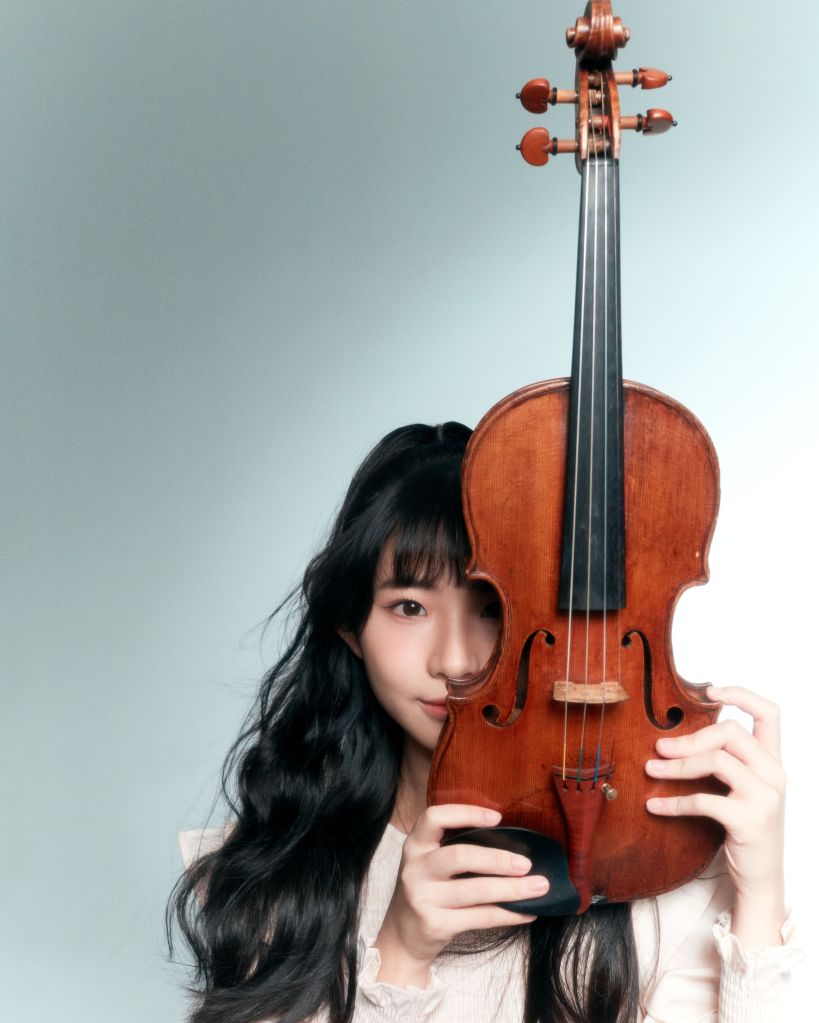
Violinist Arabella Steinbacher shines in Auckland Philharmonia’s “Beethoven 5” concert

Reviewed by John Daly-Peoples

Arabella Steinbacher image: Sav Schulman

Beethoven 5

Auckland Philharmonia

June 26

Reviewed by John Daly-Peoples

It is rare for a New Zealand orchestra to perform the  same concert twice  in a week, something which is common with European orchestras and even Australian ones. However, this week the Auckland Philharmonia performed its Beethoven programme on a Wednesday and Thursday, both to sold out audiences.

The orchestra’s “Beethoven 5” concert opened and closed with two very different compositions composed within ten years of each other. The first, Rossini’s Overture to La Cenerentola, composed in 1817 is an effervescent work based on a fairy / folk story while Beethoven’s Symphony No 5 of 1808 is a dramatic work reflecting the composers view of the political climate of the time as well as a growing awareness of his own fate.

Between those two pieces was an elegant display of violin playing by Arabella Steinbacher

The Rossini opened with an engaging display by the woodwinds and brass evolving into a dance-like piece.

The woodwinds held much of this musical adventure together which captures the essence of the opera, its comedy and convoluted storyline.

The Auckland Philharmonia manages to attract some of the world’s great soloists and with the Japanese / German violinist Arabella Steinbacher the audience was treated to a stunning performance of Mozart’s “Violon Concerto No 5”.

She opened the work with some silky playing, slowly revealing the intricacies of the work. At times her playing flowed along with the orchestra while at other times she appeared to add new musical themes to which the orchestra responded.

With the cadenza she showed a skill and insistence which gave the work a very contemporary and adventurous sound.

Throughout the piece she seemed to be perfectly in control of her playing, never trying to outdo the orchestra preferring to let her exquisite, often restrained  playing  shine. In the second movement some of her playing was almost ethereal while at other times her deft and refined.

In the third movement as the orchestra became more dynamic, she seemed to revel in their playing adding an urgency to her own playing.

Having heard Beethoven’s “Symphony No 5” several times it is still rewarding to hear another orchestral performance. The drama, the nuance, the intensity of the conductor and the players, all add the spectacle. As well as appreciating the music there is also a sense of the composer himself grasping for musical ideas, responding to the momentous events of his  times and seeing his own political and spiritual condition connected to those events.

No section of the work is irrelevant or unnecessary, it can can be loud and dramatic with rousing sequences but also gentle, soothing. delicate and  sprightly. Beethoven certainly knew how to create drama, mystery and atmosphere.

Apart from the symphony’s well-known dynamic opening and other dramatic sequence the symphony also has superb moments provided by individual instruments  such as the clarinet and flutes in the opening minutes or the mass pizzicato of the strings.

Conductor  Bellincampi guided the orchestra  brilliantly showing his ability to reveal the drama, tension, and revolution within the work. He also highlighted the nuances of the work, emphasising the  contrasts and  moods of the piece.

To subscribe or follow New Zealand Arts Review site – www.nzartsreview.org.

The “Follow button” at the bottom right will appear and clicking on that button  will allow you to follow that blog and all future posts will arrive on your email.

Or go to https://nzartsreview.org/blog/, Scroll down and click “Subscribe”

Categories
Reviews, News and Commentary

End of Summer Time: Unexpected Ode to Auckland

Andrew Grainger as Dickie Hart Image Andi Crown

END OF SUMMER TIME 

By Roger Hall

Auckland Theatre Company

Director – Alison Quigan

Set/Costume – John Parker

Lighting – Phillip Dexter

Sound – Sean Lynch

With Andrew Grainger as Dickie Hart

ASB Waterfront Theatre, Auckland

Until 5 July

Reviewer Malcolm Calder

Andrew Grainger as Dickie Hart     Photo Andi Crown

Gidday Dickie,

Great to see you last night.  I think we last met when you’d just moved up to Wellington and I was still milking in the ‘naki after our African adventure.  Then you moved again.  Up north.  

After Glenda pretty neatly convinced you both to take that Takapuna joint with a sea view, you never stopped grumbling and grouching about the place.  For years.  Y’know – its humidity, traffic, its prices, its pretentious people and so on.  Not to mention its upsy-downsy football team of course.  As for natural disasters, lockdowns, etc … I won’t go on.

But, bluddy hell mate, since then it’s almost like you’ve had what that Ayckbourne mate of yours would call a car-thar-sis.  Family disruptions aside, it seems that you’ve stopped moaning and fallen in love with the place.  Auckland!  Never thought I’d see the day. 

Blow me down, you seem to have become an advocate for just about everything and everyone.  From Auckland’s buses to its ferries, from its oddball characters to its libraries.  To lots of its bits too – from Riverhead to Moolfud even if the grandkids are your excuse to explore lots of Maccas and KFCs. 

Quite honestly, mate, it seems like you’ve discovered some sort of extra-special non-energetic energy in your post-Covid life.   Part of me thinks you have somehow grown an extra leg.  Or at least grown up.  And good on ‘yer. 

Never even dreamed I’d see such a contented, reflective and accepting Dickie.  I can see you now sitting on that playwright feller’s beach gazing contentedly at Rangitoto.

Nice looking apartment too and that ever-helpful sheila deserved the flowers as well.

Probably a few lessons in there for me.  Perhaps, after 50 years – yes FIFTY years – it’s time for me to stop getting irate about suss hotel food, Mendela, Pienaar and 747s.

Yes it was pretty definitely good to see you again.  Might even visit sometime.

Cheers mate

Jock

To subscribe or follow New Zealand Arts Review site – www.nzartsreview.org.

The “Follow button” at the bottom right will appear and clicking on that button  will allow you to follow that blog and all future posts will arrive on your email.

Or go to https://nzartsreview.org/blog/, Scroll down and click “Subscribe”
Categories
Reviews, News and Commentary

Roger Hall’s “End of Summer Time”: sparkling dialogue and consummate acting

Reviewed by John Daly-Peoples

Andrew Grainger as Dickie Hart Image Andi Crown

End of Summer Time by Sir Roger Hall

Auckland Theatre Company

ASB Waterfront Theatre

Until July 5

Reviewed by John Daly-Peoples

What are we going to do without Roger Hall? Is this really the end of a theatrical era? Will regional theatre companies  collapse?

These are some of the questions which theatre lovers, theatre companies and Creative New Zealand will be addressing over the next few years.

With the retirement  of Roger Hall from playwriting New Zealand theatre scene will be dealt something of a body blow.

But those questions and their answers are for next week, next year. In the meantime, we have another Roger Hall play, probably his last  production with “End of Summer Time.”

With his latest play Hall gives a nod to one of the important milestones in New Zealand theatre history, Bruce Mason “End of the Golden Weather”. Even the publicity material features images of Rangitoto and Takapuna Beach which was the site of Masons play.

The play charts the problems of older people thrust into a new social  environment as well as discovering the joys and drawbacks of living in a new town.

We have met Dickie Hart before in two of Halls plays “C’mon Black” and “You Gotta be Joking”. Hart has moved to the big smoke from Wellington, moving into an apartment on the North Shore.

Dickie (Andrew Grainger) is confronted by a lot of problems in his transition to Auckland and apartment living and Hall has exploited all these situations. Dickie has to manage his wife Glenda’s new interests in the library and yoga  and he has to deal with issues around the body corporate and the South African block manager.

He also has to manage more personal issues such as getting a health check from the doctor for his driving license, particularly the cognitive test as well as trying to fill in the census form and its questions on gender. identity

There is a scary account of the Dickie’s-first time visit to inner Auckland, navigating the motorway system, the bridge and the netherworld of the Aotea Centre carpark.

Dickie has moved to Auckland partly to spend time with his grandkids – a task that is which is not all that simple but he manages educational outings to Auckland volcanic cones brilliantly by combining these trips with visits to Auckland’s great dining establishments – MacDonalds, KFC and Subway.

The play is essentially in two halves– pre and post Covid , the second half being a bit more reflective.

Hall has developed a clever approach to his characters and their comments on life politics and relationship, a style  somewhere between the misogynistic and woke, it’s a tenuous area but Hall negotiates it skilfully and Andrew Grainger pulls it off with a breezy, nonchalant style.

Hall is able to assemble his string of one-liners into a coherent, monologue which acts as political and social commentary of issues of the present day as well as providing a compelling portrait of a typical New Zealand character.

The play is a brilliant and sustained piece of comedy throughout, But at one point play turns  into tragedy with a few lines and some convincing acting which demonstrates Halls consummate writing, Quigan’s directorial skill and Grainger’s intelligent acting.

Much of Dickie’s identity is linked to rugby and throughout the play there are mentions of the Rugby world Cup as well as images of Rugby games on the TV which dominated the apartment. The local library also gets a favourable mention as Dickie manages to find a copy of Brian Turners book on  Colin Meads

Grainger  takes on Roger Halls monologue with an energetic enthusiasm, the conservative cow cocky only just managing to adjust to a new life as he prowls  the pared back apartment-cum-prison set designed by John Parker.

As with all Hall’s work this is an engaging play with sparkling dialogue and consummate acting.

To subscribe or follow New Zealand Arts Review site – www.nzartsreview.org.

The “Follow button” at the bottom right will appear and clicking on that button  will allow you to follow that blog and all future posts will arrive on your email.

Or go to https://nzartsreview.org/blog/, Scroll down and click “Subscribe”
Categories
Reviews, News and Commentary

Ruth Cleland’s exploration of the enigmatic quality of concrete

Reviewed by John Daly-Peoples

Ruth Cleland Concrete 3

Ruth Cleland, Concrete

Sumer Fine Art

Until July 22

Reviewed by John Daly-Peoples

In her latest exhibition ”Concrete” Ruth Cleland continues her interest in the accurate depiction of her environment along with the use of the grid.

Gridding is a technique that has been used by many artists throughout history using horizontal and vertical lines over drawings or photographs for enlargement and transfer purposes.

Cleland uses a grid to transfer images of concrete floors onto board using either graphite pencil or acrylic. These images such as “Concrete Floor 3” ($12,8000) show the polished concrete surface with imbedded scoria along with signs of previous uses and marks.

The works are akin to the work of the Boyle Family who randomly chose sites or parts of the body which they then recreated, the completed work offering new interpretations of the environment or body.

These images of concrete floors could be of the floor of the gallery with its various  sections of ground and polished concrete laid over the years. They are in fact of a supermarket floor that the artist has previously used as subject matter. One image, “Concrete Path” ($12,800) has a more personal connection being the concrete path outside the artist’s home.

These images of concrete are meticulous in their accuracy but the artist shows her skill in the depiction of both ambient light sources as well as overhead lights.

Ruth Cleland, Concrete Floor 1
Ruth Cleland Gris (Concrete Floor 1)

In some cases there is a companion piece to the photorealistic image as with “Concrete Floor 1” and “Grid / Concrete Floor 1” ($12,800 pair). The lines drawn on the grid have been used here to indicate the striations seen in the drawing as well as light intensity. This recording adds to the enigmatic nature of the work suggesting there is an underlying plan or logic inherent in the image itself which the artist has revealed.

To subscribe or follow New Zealand Arts Review site – www.nzartsreview.org.

The “Follow button” at the bottom right will appear and clicking on that button  will allow you to follow that blog and all future posts will arrive on your email.

Or go to https://nzartsreview.org/blog/, Scroll down and click “Subscribe”