Categories
Reviews, News and Commentary

A Century of Modern Art coming to the Auckland Art Gallery in June

John Daly-Peoples

Claude Monet, French, 1840-1926; Water Lilies ; about 1922;oil on canvas Toledo Museum of Art, purchased with funds from the Libbey Endowment, Gift of Edward Drummond Libbey

A Century of Modern Art

Auckland Art Gallery  

June 7 – September 28

John Daly-Peoples

Auckland Art Gallery has announced that the exhibition “A Century of Modern Art” will be  its special winter exhibition this year, running from  June & through till September 28th.

The exhibition will be on loan from the Toledo Museum of Art, Ohio, and will provide  a survey of the major artists who transformed modern art.

The exhibition will consist of 57 works by 53 artists, including Paul Cezanne, Edgar Degas, Helen Frankenthaler, Édouard Manet, William Merritt Chase, Amedeo Modigliani, Berthe Morisot, Claude Monet, Pablo Picasso, Camille Pissarro, Robert Rauschenberg, Pierre-Auguste Renoir, Vincent van Gogh, James McNeill Whistler, among others.

Director of Auckland Art Gallery Toi o Tāmaki, Kirsten Lacy says the calibre of works and artists in this collection is exceptional and not to be missed.  “A Century of Modern Art showcases the diversity and innovation that defined modern art movements,” says Lacy. “From the emotive brushstrokes of Van Gogh to the evocative landscapes of Monet and Rauschenberg’s bold abstractions, these works not only revolutionised Western art history but continue to inspire new generations.”

“The exhibition includes works by legendary art figures, including Vincent van Gogh, whose work hasn’t been publicly displayed here in Aotearoa in over a decade. It is made available to us due to renovations that are taking place at Toledo Museum of Art, and we are honoured to be working with the Museum to make the most of this rare opportunity.”

The centrepiece of the show will be Claude Monet’s  “Water Lilies” Purchased with funds from the Libbey Endowment, Gift of Edward Drummond Libbey    Plants, water, and sky seem to merge in Claude Monet’s evocative painting of his lily pond at Giverny. The disorienting reflections, bold brushstrokes, and lack of horizon line or spatial depth make Water Lilies appear almost abstract. Painted about 1922, it belongs to a grand project that Monet had conceived as far back as 1897:

“Imagine a circular room whose wall . . . would be entirely filled by a horizon of water spotted with [water lilies]… the calm and silence of the still water reflecting the flowering display; the tones are vague, deliciously nuanced, as delicate as a dream.”

Monet began this ambitious project in 1914, finally completing it shortly before his death in 1926. Over those years he executed more than 60 paintings of his water garden, capturing the light conditions at different times of day and in different weather. Twenty-two of these large panels were installed in the Orangerie in the Tuileries Gardens, Paris, as a gift to France. The  Toledo’s work was is possibly a study for one of the three panels of the Orangerie composition” Morning”.

Berthe Morisot, In the Garden at Maurecourt. (Purchased with funds from the Libbey Endowment, Gift of Edward Drummond Libbey)

Included in the exhibition is a work by artists Berthe Morisot one of the few female Impressionist artists. Her work “In the Garden at Maurecourt” (Purchased with funds from the Libbey Endowment, Gift of Edward Drummond Libbey) is set in Morisot’s sister Edma country house outside Paris and probably shows Morisot’s daughter, Julie, and one of Edma’s daughters.

She was born to an upper-middle class family and was the great-niece of Rococo artist Jean-Honoré Fragonard. Morisot rejected the social expectations of her class and gender by pursuing a professional career as an artist. In 1868 she met and became close friends with artist Édouard Manet, marrying his younger brother Eugène in 1874, the same year she participated in the first Impressionist group exhibition.

Paul Gauguin, French, 1848-1903; Street in Tahiti; 1891;oil on canvas (Purchased with funds from the Libbey Endowment, Gift of Edward Drummond Libbey)


There is also a work by the recently deemed “controversial” Paul Gauguin. His work “Street in Tahiti” (Purchased with funds from the Libbey Endowment, Gift of Edward Drummond Libbey) which predates his Tahitian figurative works was among the first group of paintings Gauguin produced in Tahiti during his initial two-year stay. He conveyed something of the special character of the place—the limpid light, rich colour, lush vegetation, and lofty mountains—through his use of strong contours, flattened shapes, repeated curving rhythms, and tautly patterned brushstrokes. However, minor notes of strain, such as the brooding woman and heavy clouds pressing down from above, introduce undertones of sadness and disquiet.

A Century of Modern Art will make use of its current major exhibition “The Robertson Gift: Paths through Modernity” which includes works by. Georges Braque, Paul Cezanne, Fernand Léger, Henri Matisse, Piet Mondrian and Pablo Picasso.

Together the two exhibitions will trace out the birth of modern painting, beginning with the Impressionists in the 1860s, and follows its evolution through key movements such as Post- Impressionism, Symbolism, Cubism, Surrealism, Constructivism, German Expressionism, Bauhaus, De Stijl, Precisionism, and Colour Field Painting and Abstract Expressionism.

Adam Levine, the Edward Drummond and Florence Scott Libbey President, Director and CEO of the Toledo Museum of Art, says, “The Toledo Museum of Art is distinguished by the quality of its collection. Each acquisition in our institution’s history has been oriented to acquiring artworks of superlative aesthetic merit. Never have so many of our masterworks travelled together, and we could not be more excited for them to debut in Auckland.”

A Century of Modern Art is organised by the Toledo Museum of Art, Ohio and has been supported by HSBC and Auckland Art Gallery Foundation. Co-ordinating curator of the exhibition is Dr Sophie Matthiesson

To subscribe or follow New Zealand Arts Review site – www.nzartsreview.org.

The “Follow button” at the bottom right will appear and clicking on that button  will allow you to follow that blog and all future posts will arrive on your email.

Or go to https://nzartsreview.org/blog/, Scroll down and click “Subscribe”

Categories
Reviews, News and Commentary

Three exhibitions K Rd – Palmer, Creed, Parekōwhai.

Reviewed by John Daly-Peoples
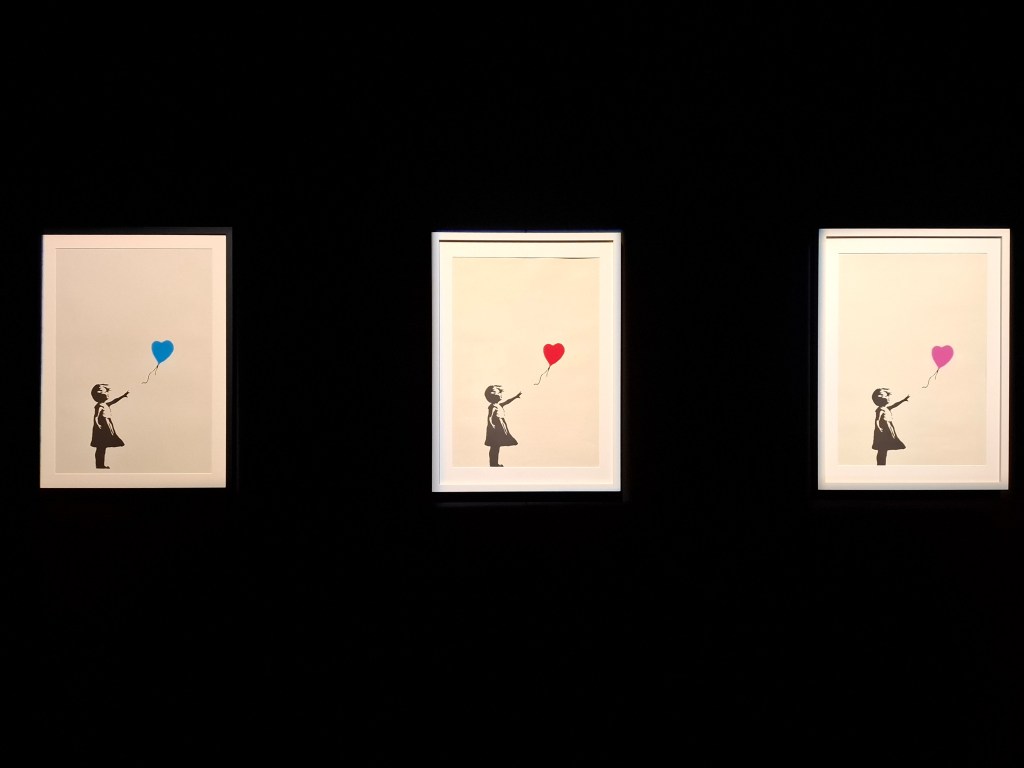
Martin Creed, Work No 3769, Work No 3764, Work No 2053

Three exhibitions K Rd – Palmer, Creed, Parekōwhai.

Stanley Palmer, New Work

Melanie Roger Gallery

Until February 22

Martin Creed, Like Favourite Socks in a Drawer

Michael Lett

Until March 1

Michael Parekōwhai, The Indefinite Article

Artspace Aotearoa

Until April 17

Reviewed by John Daly-Peoples

Current exhibitions along Karangahape Rd offers a range of art works from the  realist depictions of the landscape to abstract paintings and conceptual construction.

With his latest exhibition at Melanie Roger Gallery Stanley Palmer continues  his depictions of the New Zealand landscape. Like many of his previous exhibition he has painted views of the New Zealand coastline featuring dramatic vistas of headlands and offshore islands.

With this new series of works he has revisited many of his previous subjects including depictions of Karamea, Great Barrier Island, Chathams, Great Mercury Island and Matauiri. While these are mainly landscape there are a few which also feature other element in the landscape which add a visual drama as in “Akiaki – Chathams” ($30,000) where he has included windswept  trees and grazing sheep.

Stanley Palmer, “Akiaki – Chathams”

These paintings seem to be less detailed than some of his previous work and there is a simplicity which gives these works an added drama. Part of this drama comes from the artists shrewd use of paint, so that in “Awana- Aotea Great Barrier” ($22,000) the eroded cliffs are highlighted by the gash of earthy colours and in “Mataurui” ($28,000) the red line of a track is like an abstract slash through the landscape.

Stanley Palmer “Mataurui”

In most of the works the background of sea meeting sky shows a clever juxtaposition of shimmering abstract blues with subtle variations between each of the paintings

Also included in the exhibition are some of the artist’s earlier bamboo prints of the early 1970’s including “Hillside Town Kohukohu” ($2250).

Stanley Palmer “Hillside Town Kohukohu”

Martin Creed’s minimalist works have always played with the definition of art and art making starting with his Turner winning installation “Work No. 227: The lights going on and off: an empty room” in which the gallery lights switched on and off at 5-second intervals.

His work is  a mixture of the witty, poetic and philosophical, making use of a range of everyday materials and approaches which challenge traditional views of art.

His current show “Like Favourite Socks in a Drawer” brings together elements of chance, time and structure with a series of ziggurat shaped works. The works  started with his decision to buy an ordinary multi pack of commercial paint brushes.

Martin Creed, Work No 3764

With these he applied paint in different colours  with the varying brush sizes, stacking the colours one above the other to create stepped, random bands of colour.

The paintings/designs can be seen as referencing the ziggurat forms of ancient Mesopotamia and Mexico as well as more recent brutalist constructions and has connections with Rewi Thompson’s block-like house in Kohimarama. There are also hints of Frank Stella, Donald Judd and Cuisenaire rods.

Creed says of the works “A step pyramid is solid and easy to understand. It is a safe structure that is not going to fall down. It is trustworthy. You can see how it is built. The steps are hopefully leading to the top, and you can enjoy the colours on the way up. In a blobby, soupy, ill-defined world it can be helpful to put your ducks in a row.”

The works have a sense of the structure to them with their build-up of coloured shapes and in works such as  “Work No 3764” (USD $22,000 plus GST) there is sense of the artist gestural involvement  where the striations of the brown / sepia are visible as a single calligraphic stroke. With others there is the notion of time with the various strokes of colour measuring out the time taken to complete each work

Martin Creed, Work No 3766

Some of the work display additions to the quick gesture with Creed scumbling the yellow band in “Work No 3766” (USD $22,000 plus GST). This work like some other has a humorous element with the painting looking like a celebratory, multi-layered birthday cake.

The works all convey  Creed’s minimalism of means, notions of time along with the structuring and ordering of objects shapes and colours.

Michael Parekōwhai, The Indefinite Article

Artspace is exhibiting Michael Parekōwhai’s sculptural object, “The Indefinite Article (1990) which had previously been shown at Artspace in 1990 in the show “Choice” curated by George Hubbard

The large letters based on McCahon’s cubist stylised letters  constructed of MDF spell out the words “I AM HE”. Which references some of the McCahon paintings featuring the words “I Am”.

While borrowing from McCahon the work can also be seen as creating a bilingual pun linking the words to te reo where “HE” can be read  as the indefinite article where the word can be  defined as -a, an, some – or it can  also  mean something is  wrong, mistaken or incorrect.

Other linguistic variations can be identified with the words. During the ”Cultural Safety” exhibition in Frankfort in 1995 where the work was shown this reviewer noted at the time – “His large word sculpture using the words of the Colin McCahon painting I AM HE was quickly identified by one perceptive German journalist as coming from the pen of John Lennon in “I Am the Walrus” [I am he as you are he, as you are me and we are all together] rather than the Bible or McCahon.

To subscribe or follow New Zealand Arts Review site – www.nzartsreview.org.

The “Follow button” at the bottom right will appear and clicking on that button  will allow you to follow that blog and all future posts will arrive on your email.

Or go to https://nzartsreview.org/blog/, Scroll down and click “Subscribe”

Categories
Reviews, News and Commentary

Shakespeare in the Park: A cold blooded tragedy and a highly promising comedy

Auckland Shakespeare in the Park 2025

A Shoreside Theatre production

Pumphouse Amphitheatre

(if wet – Pumphouse Theatre)

Richard III

By William Shakespeare

Dir Catherine Boniface

Jan 22, 23, 24, 28, 31, Feb 1, 5, 6, 9, 11, 13, 15

The Taming of the Shrew

By William Shakespeare

Dir Mags Delaney-Moffat

Jan 23, 29, 30, Feb 4, 7, 8, 10, 12, 14

Review by Malcolm Calder

22 January 2024

Richard, Duke of Gloucester (Chris Raven) surrounded by his friends, perceived rivals
and even some who survived his ascension to the throne

Tragedy is a commonly used euphemism in theatre for when lots of people die.  Richard III doesn’t quite reach Titus proportions, but it has to be up there and this particular production is in good company.

It is part of Shoreside Theatre’s annual Shakespeare in the Park series, now in its 29th iteration, and staged at the delightful, terraced, outdoor amphitheatre adjacent to Lake Pupuke at Takapuna’s Pumphouse theatre.

Rather than try and recreate Shakespeare’s historical setting and fail, Director Catherine Boniface has chosen to locate her Richard III in a seedy but sartorially splendid 1930s London.  Her program notes suggest the setting is reminiscent of Peaky Blinders – and, yes, there were some artfully angled flat caps on display.  Gangland in a word.  It works too, largely because it is analogously appropriate to the dastardly deeds that Richard, Duke of Gloucester got up to towards the end of the the English Civil Wars.

I won’t even begin to list all the deaths he generates.  Suffice to say it’s a lot – one might even suggest he ‘eliminated’ his way to the top.  And misogynistically too because, as far as I recall, all those who died were males.  Something to do with lineage in those dastardly days when York’s rose challenged that of Lancaster and the distaff lines were those who suffered the pain and of loss.

Richard, of course, received his final comeuppance and the reference to Leicester reminded me that his remains were eventually discovered under a carpark there only 15 years ago.

Chris Rather played Richard with a suavely cool and assured arrogance, his ambition plainly on display, and even his disintegrating final days were well handled.  He was a standout for me in 2024’s Measure for Measure and it was good to see him progress to the Richard role.  The supporting roles more than served to enhance and focus attention on Richard’s dominance but the standout for me this time was Suzie Sampson as Lady Margaret – subtle, nuanced and very, very professional.

The period setting on a simple stage is fairly stark but allowed the inclusion of some delightful props – the wooden Lancaster bomber, the pistols and, of course, the costumes.  I could swear the ghoulishly severed head with spectacles intact was still dripping blood.  Although I did wonder if the prominently held and waved cigarettes may have in fact been vapes.

On balance, another competent and highly entertaining part of the Shakespeare in the Park series.

Conversely the comedic Taming of the Shrew is the very antithesis of Richard.  Its content, gender-neutral casting and the fact that it is performed by what is effectively Shoreside’s youth company mean it would be facetious to compare the two.

Katerina (Matilda Chua) and Petrucio (Heather Warne) in The Taming of the Shrew

The plot itself of Shrew is well-known.  In overly-simple words, Lucentio loves Bianca but cannot court her until her shrewish older sister Katerina marries. The eccentric Petrucio marries the reluctant Katerina and uses guile and trickery to render her an obedient wife.  Lucentio marries Bianca and, in a contest at the end, Katerina proves to be a most obedient wife.  The end !

There is probably a moral in there somewhere but the play is almost like a minefield for actors with cross-cuts of double entendre, split-second timing and that all important factor – suspension of disbelief. Shrew calls for a closer understanding of, and appreciation of the nuance in Shakespeare’s words coupled with the timing that is essential to pull this off revealing the farce beneath.  Without them the humour just doesn’t work.

And that is where director Mags Delaney-Moffat is to be congratulated on clearly focussing her youthful and highly-promising cast.  They work as an ensemble, there are laughs aplenty and the work that has gone into achieving them is clearly on display.  

It would seem churlish to single out anyone but the work of Heather Warne (Petrucio) is almost upstaged at times by the wit, humour and general antics, and indeed the timing and presence, of Lizzie Morris as her ‘man’-servant Grumio.  And, despite a demure start, Matilda Chua (Katerina) grows in confidence as true love with Petrucio eventually blossoms.

But there are many highlights and both director and cast are to be congratulated.

The annual two-play Shoreside season is now firmly established on the Auckland theatrical calendar in this, its 29th season.

Note: If wet, transfers indoors.

To subscribe or follow New Zealand Arts Review site – www.nzartsreview.org.

The “Follow button” at the bottom right will appear and clicking on that button  will allow you to follow that blog and all future posts will arrive on your email.

Or go to https://nzartsreview.org/blog/, Scroll down and click “Subscribe”

Categories
Reviews, News and Commentary

A Complete Unknown: How Bob Dylan became known

Reviewed by John Daly-Peoples

A Complete Unknown

Director, James Mangold

Screenplay, James Mangold and Jay Cocks

Reviewed by John Daly-Peoples

A Complete Unknown, the new biopic about Bob Dylan takes its title from the refrain to his “Like a Rolling Stone”


How does it feel
To be on your own
With no direction home
Like a complete unknown
Like a rolling stone

The song articulates his ambivalence about success and failure, about the loss of innocence and the realities of the music world.

The film is based on the 2015 book Dylan Goes Electric! written by Elijah Wald, and follows Dylan from his early folk music success through to the his controversial use of electrically amplified instrumentation at the 1965 Newport Folk Festival

We first encounter Dylan Timothée Chalamet in 1961 when he moves from Minnesota to New York City, to see the recently hospitalized Woody Guthrie (Scoot McNairy) where he also meets Pete Seeger (Edward Norton) who becomes a close friend

Dylan impresses both the singers with a song he has written for Guthrie and he ends up staying with Seeger’s family who introduce him to the New York folk music scene.

Dylan meets Sylvie Russo (Elle Fanning), his first girl friend  at a concert, charming her with his approach to music and life while she introduces him to politics and the Civil Rights movement The two begin a relationship and move in together.

At an open mic session Dylan follows on from a performance by Joan Baez (Monica Barbaro) starting a relationship which would last many years. Also at the session is Albert Grossman who signs Dylan up and becomes his manager. However, the record company won’t use any of Dylan’s original work, only interested in covers. The poor sales and reception are the first of the singer’s frustrations with the music industry

Dylan’s career takes off and he goes to several of the folk music festivals including Newport where he sings with Joan Baez and where in 1965 he alienates many of the crowd as well as his fellow folk musicians for embracing the more dynamic and challenging rock sounds that the electric guitar offers.

Timothée Chalamet isn’t going to convince a Dylan purist but he comes close to capturing the playing, the raspy voice, the subtle gestures and movements along with his ambivalent and unpredictable reactions to people and events.

We get a sense of how his musical ideas developed, mixing personal, political and musical elements to create songs which look at the heart of American society. All his encounters and relationships become the grist to his creative mind as he become one of the great voices of his generation

The film is full of his music as well as the music and musicians who had an impact on the singer – street musicians, The Kinks, Johny Cash, Woody Guthrie and Pete Seeger. There are also glimpses of important events of the time  which shaped his view of the world – The Vietnam War, the Cuban Missile Crisis and the death of J. F. Kennedy.

Monica Barbaro (Joan Baez) and Timothée Chalamet Bob Dylan

Throughout the film we see the differences between  Dylan’s style and many of the other musicians of the time. In his duo “All Day and All of the Night” with Joan Baez at the Newport Folk Festival Baez’s sweet singing contrasts with Dylan’s sharper, more cynical sound, a sound which sets him apart for the next fifty years.

To subscribe or follow New Zealand Arts Review site – www.nzartsreview.org.

The “Follow button” at the bottom right will appear and clicking on that button  will allow you to follow that blog and all future posts will arrive on your email.

Or go to https://nzartsreview.org/blog/, Scroll down and click “Subscribe”

Categories
Reviews, News and Commentary

“Stop, Look Both Ways” provides new ways of seeing

Reviewed by John Daly-Peoples

Murray Savidan, Cinque Terra

Stop. Look Both Ways

Murray Savidan

Ugly Hill Press / Bateman Books

RRP $70.00

Reviewed by John Daly-Peoples

Murray Savidan’s new photographic book “Stop. Look Both Ways” is something of a travel diary, a record of his journeys through Aotearoa/New Zealand and around the globe to diverse locations in Europe, Africa, Asia and the Americas. There are images of his time in Vietnam and Nepal, Egypt and Zanzibar, Italy and Spain, Japan and Vietnam.

But as well as a travel diary documenting the places he has been the images are also a record of the people of these places, seeing the aspects of other people’s lives which make them distinct but also seeing the similarities between us – partly ethnographic and partly the photographers own quirky approach to life.

Each of the individual photographs are the result of a keen eye, often capturing a moment, a contrast, a reflection or a facial expression which offers more than a simple photograph.

With many of the photographs Savidan has paired them in a way which emphasises their stories and creates new narratives. These often-subtle connections  are an indication that he has reflected on the images and his way of contemplating the world around him.

There are spreads where he has contrasted the physical world a such as pairing the architectural shapes of the Guggenheim Gallery in Bilbao with those of a shrine in Bhaktapur – two different temples to culture.

The clash of cultures is seen is several of the works such as the linking of a beach on the Cinque Terra filled with sunbathing figures with a horde of burqa clad woman on a beach in Zanzibar.

Murray Savidan, Zanzibar

With some of the works there isa nod to other photographers such as his image of a crocodile in Madagascar which owes much to a similar work by Peter Peryer and his image of a woman contemplating a painting by Christian Schad at the Pompidou Centre is reminiscent of the similar gallery photographs of Thomas Struth.

He manages to find quirky connections as well. So, his view of the Anish Kapoor Dismemberment, Site 1 at Gibbs Farm is contrasted with horn shapes in an atrium in South Africa.

Then there are the landscapes such his pairing of a forlorn, misty landscape at Meola Reef with a desert landscape in Namibia. There are also some individual landscapes such  as the drama view of a climber scaling a mountain in Fiordland.

Murray Savidan, Namibia

He contrasts a street scene in Kathmandu with one in Madagascar and a simple church in Northland with one in Madagascar as well as  the contrasting portraits  of a father and his child in Nepal and Egypt

While these paired images are serious reflections on culture and society there are many in which Savidan is making witty, or  ironic comments.in one spread he pairs a gaudy jukebox with a church organ  and in another he has juxtaposed the various parts of fish at a fish market in Vietnam with a figure lazing on a beach during a fishing competition on the East Cape., an image which itself is a droll comment on recreational fishing.

Murray Savidan, East Cape, New Zealand

He uses these images to create drama, explore history, culture and sexuality which become meditations on society and the individual, but in all of them he captures humanity.

Categories
Reviews, News and Commentary

Olafur Eliasson: The Leonardo da Vinci of our time

Reviewed by John Daly-Peoples

Olafur Eliasson. The glacier melts series

Reviewed by John Daly-Peoples

Olafur Eliasson, Your Curious Journey

Auckland Art  Gallery

Until March 23, 2025

Reviewed  by John Daly-Peoples

Much of the work of the Danish / Icelandic artist Olafur Eliasson focusses on issues around the impact of changing climate on our lives and our impacts on the environment. In his current exhibition “Your Curious Journey” at the Auckland Art Gallery the most obvious of his works which address these issues is “The Glacier Melt series 1999/2019”. In this series of 15 paired  photographs the artist shows several; glaciers in Iceland ten years apart showing the extent of the glacier melt. The works are a clear visual documentation of the way in which warming temperatures are changing the nature of the environment. While they provide physical evidence of climate change they are also a metaphor for the issue and many of his other works are metaphorical or medications on the nature of the issues.

Eliasson is the Leonardo da Vinci of our times combining art and science with each of the disciplines informing the other providing observations and insights.

The title of the exhibition “Your Curious Journey” could be applied to the set of photographs as we witness the glaciers journeys of expansion and retraction, alerting us to the fact that climate change is part of the evolutionary journey of our past and future.

Linked to that work is  one of the newer pieces, The Last Seven Days of Glacial Ice “(2024) where the progression of  a melting block of ice over seven days has been rendered in bronze. The melted water has been captured in seven glass globes which are exhibited alongside the bronzes, The original block of ice is condensed to a shard of bronze and a globe of water but in reality the ice has disappeared, like some magic trick

While these and other works have a polemic quality to them, all his works are concerned with aspects of aesthetics -and scientific enquiry – light, structure, colour and movement. This mix  of science and art can also be seen in “Double Spiral” where a long steel tube   coils around itself creating a double helix in reference to the structure of DNA

One of the works which encapsulated all of these  aspects is “Movement Microscope” (2011), a  16-minute video set in the artists studio / office in Berlin where the everyday activities of the staff become an elaborate dance routine and simple movements are elaborately observed.  All the movements and interchanges are heighten by the inclusion of a group of “performers who move at a reduced pace, seemingly moving as though their recorded movements have been filmed at a slower speed.

We observe his designers and artists communicating ideas,  working on designs, constructing works, sharing meals, their constructed works now on display in the gallery.

His largest work :”Under the Weather” hangs above the gallery atrium and appears to flicker and change as the observer moves beneath it. The images created are like weather patterns or brain scanner. The illusion of movement is created by an optical effect of two patterns similar to the auditory intersection of the Doppler Effect. Similar effects  can be seen “Multiple Shadow House”.

Olafur Eliasson. Yellow Corridor

One of the more impressive works is at the  entrance to the show. “Yellow Corridor “is an version of a  work the artist has created in m any locations, flooding an  area with yellow light which effects our perceptions of colour and form. The almost blinding light of the lit corridor recalls the quote of Robert Oppenheimer who described the Atom Bomb as brighter than a thousand – which also links to Eliasson’s  “The Weather Project”  which featured a massive  sun located in the Tate’s Turbine Hall.

Eliasson also plays with water and in “Beauty (1993), films of  misty water, illuminated by projected light create a mini Aurora Australis and  with “Object defined by activity (then) a fountain of water is rendered as an almost solid figure by the use of stroboscopic light.

“Still River” brings the issue of climate change down to a local level with three large cubes of ices, slowly melting in the gallery. The ice is frozen water taken form the Waikato River at Lake Whakamaru. We witness the ice melting, see the drops of water falling into the collection tray and hear the sound of the ice cracking and the water melting. We can also see in the water the residue contained in the water – the chemical, effluent and soil and other contaminants.

It provides a physical reminder of the process of the natural world and the ways they can be disrupted.

To subscribe or follow New Zealand Arts Review site – www.nzartsreview.org.

The “Follow button” at the bottom right will appear and clicking on that button  will allow you to follow that blog and all future posts will arrive on your email.

Or go to https://nzartsreview.org/blog/, Scroll down and click “Subscribe”

Categories
Reviews, News and Commentary

A Midsummer Night’s Dream: A Triumph Returns

Image. Stephen ACourt

Reviewed by Malcolm Calder

A Midsummer Night’s Dream

Royal New Zealand Ballet

Choreography – Liam Scarlett

Music – Felix Mendelssohn

Music Arranger – Nigel Gaynor

Set & Costume Design – Tracy Grant Lord

Lighting Design – Kendall Smith

Conductor – Hamish McKeich

Orchestra – Auckland Philharmonia

Kiri Te Kanawa Theatre, Aotea Centre (until Dec 8)

Then Bruce Mason Theatre, Takapuna

OK, Shakespeare started all this theatrical fantasy stuff more than 4 centuries back when he developed some of the Greeks’ allegorical reflections on love and its mythical interpretations by writing A Midsummer Night’s.

It has a convoluted and fantastical plot that epitomises the suspension of disbelief and is perfectly suited to the meandering minds of creatives.   So they did.

A young Felix Mendelssohn had an initial stab at expressing it musically before King William Frederick IV convinced him to enhance his music further as accompaniment to a theatrical staging where it became a favourite of the Prussian court.

I have no idea what William Blake was on when he expressed Shakespeare’s work visually a century later, nor the mindset of various theatre and even movie directors as the original was variously interpreted until eventually becoming a stock in trade for theatre over a couple of centuries.   Little wonder then that it would evolve much later into a significant full-length ballet that is commonly attributed to Georges Ballanchine – apparently a fairly tame interpretation by contemporary standards.  Eventually The Royal New Zealand Ballet was to be congratulated on collaborating in 2015 with the fairly progressive Queensland Ballet in a completely new interpretation devised by the even more weirdly wonderful and progressive mind of the late Liam Scarlett. 

Mendelssohn’s original incidental music was skillfully re-arranged and expanded by former RNZB Music Director Nigel Gaynor and, with an innovative set and a costume design by the distinguishd Tracy Grant Lord, the result was a full-length two-act contemporary ballet that audiences greeted with joyous rapture.

A subsequent 2021 season was rudely interrupted by Covid and this Dream only played in Wellington.   However it has finally toured nationally and reached Auckland where those earlier plaudits can ring even more true today.  This Midsummer Night’s Dream is something that makes one wallow in pure enjoyment.

Yes, of course the threads of serious Greek allegory on humankind are not lost, but it is the telling of the tale that makes this production so outstanding and to marvel at what Liam Scarlett, and the team he headed, has produced.

Firstly, lets look at Tracy Grant Lord’s set.  This combines colour and texture that, when coupled with Kendall Smith’s lighting, results almost as if an additional dimension has somehow been added to the stage. There is a depth and a height and a breadth that I could swear somehow exceed the theatre’s stage dimensions.  This dimensionality is exploited to the fullest in the choreography and the costumes that somehow reinforce the set rather than the other way around.  It is night.  It is a woodland.  It is ethereal.  It is enchanted.  It is a place where subtlety, confusion and a comedy of errors are rife.  It is actually the inside of someone’s mind.

That is largely achieved and certainly enhanced by Nigel Gaynor’s sympathetic musical arrangement of Mendelsson’s sumptuous score and which itself defies traditional convention.  Off-stage voices are introduced under Hamish McKeich’s baton and I could swear I heard someone humming along during the triumphal Wedding March.

The ballet opens with an imperious Oberon (Joshua Guillemot-Rodgerson) and his compellingly superior Queen Titania (Ana Gallardo Lobaina), assisted by his energetic and whimsical sprite Puck (Shaun James Kelly) who attempt to influence and even thwart the course of true love via the use of a supposedly magical pixie dust.  When sprinkled this confuses things a bit and just about everyone on stage loses track of who is love with whom.  There is whimsy and humour around each and every corner and the characterisations are superb – none more so than Bottom (Calum Gray) who magically develops a donkey’s head and tail.

The characterisations are superb, the detail in the dancing shows real connections and Liam Scarlett’s stunning choreography is built around fluidity and motion that blurs fantasy with reality and gives us something unexpected at each turn.  Just as one is starting to relax after a particular marvellous pas de deux, for example, this Dream slides effortlessly into something equally ethereal albeit several feet in the air serving only to amplify, elevate and unify the whole.

Plotwise … no, I won’t bother you with the complexities … suffice to say it all becomes totally confusing but love wins out in the end.  Of course.  And the donkey is human underneath it all – a message for all of us.

This Midsummer Night’s Dream is indeed a sparkling, spectacular ballet of sheer theatrical magic that is a Christmas treat for audiences everywhere

Categories
Reviews, News and Commentary

Dorothy’s trip to the Wonderful land of Oz

John Daly-Peoples

John Daly-Peoples

Destination Sydney recently manged a unique  promotion which has highlighted Sydney as a cultural destination and the arts and architecture on offer.

Dorothy Smith  a 102-year-old from San Francisco visited Sydney  completing her bucket list dream of visiting all seven continents.

Two young men, Ammar Kandil and Staffan Taylor who produce Yes Theory, a YouTube channel with almost 9.3 million subscribers, met Dorothy in October 2024 while filming a story at The Redwoods Retirement Village in Mill Valley, California.

They discovered Smith had always dreamed of visiting all seven continents. She had been to Asia, South America  North America, Antarctica, and Europe but never made it to Australia.

Kandil and Taylor partnered with destination NSW and Qantas  to make her dream come true and organised a flight to Sydney .

“It’s never too late for an adventure, just try and see and I think you will be surprised how well you do.” she said in a video Yes Theory shared about her trip yesterday. “You either rust out or wear out. I chose to wear out.”

Smith’s visit involved a Sydney Harbour cruise, a koala and kangaroo encounter at Sydney Zoo, touring Sydney Opera House and Bondi Beach, the Botanic Gardens and the Museum of Contemporary Art.

The video of her visit which has had 500,000 views online highlights the opportunities for older travellers and their ability to have art experiences over walking tours, ski slopes and surf beaches.

Julia Mehretu, Haka and Riot

The MCA currently has a major exhibition of works by Julie Mehretu an Ethiopian artist now living in the US. She is one of today’s most acclaimed living painters and the exhibition which blurs distinctions between abstraction and figuration. One of her works, Haka and Riot which evolved from photographs of children held in US detention centres refers to exorcism or a dancer performing the haka.

They also have New Zealander Kate Newby’s installation “Hours in Wind” in the Sculpture Terrace on the top floor of the gallery.

The other major exhibition on in Sydney during  her visit was “Magritte” which features one hundred works by the artist – paintings of clouds, hats, pipes and apples among the most recognisable images of surrealism. Renowned for his deadpan, realist style, the Belgian artist depicted ordinary objects and everyday settings, revealing them to be mysterious and enchanting.

Rene Magritte

“Magritte”  journeys from the artist’s first avant-garde explorations and commercial works in the 1920s, to his groundbreaking contributions to surrealism, his surprising provocations of the 1940s, and the renowned paintings of his final years, before his death in 1967.

With her stop at the Sydney Opera House Smith could have seen the current production of Tchaikovsky’s “The Nutcracker” or even a concert by the New Zealand band Crowded House.

Smith said she loved visiting Sydney, saying the city was beautiful and the people were so friendly.

“The people are charming, the food is good, the scenery is just wonderful, and even the weather is nice,” she said. Although she didn’t expect the city to be quite so developed.

The Sydney Opera House was a particularly special place to visit, with Smith being more than twice as old as the iconic building.

For Dorothy’s Sydney experience watch it here.

Categories
Reviews, News and Commentary

A thrilling “The Planets” from the NZSO

Reviewed by John Daly-Peoples

The Planets

New Zealand Symphony Orchestra

Auckland Town Hall

November 23

Reviewed by John Daly-Peoples

One of the disappointing aspects of the NZSO’s recent “The Planets” concert was the short duration of the first work on the programme.

The Finnish composer Kaije Saariaho’s  “Asteroid 4179: Toutatis” was performed for four minutes, but many in the audience would have been delighted if it had run for twice or three times that length.

“Asteroid 4179: Toutatis”, is named for an actual asteroid, a two-kilometre rock fragment which moves between Mars and Jupiter. The work is a confluence of science and art with the music sounding like music many composers have used for the soundtracks of science fiction movies or to create otherworldly sounds Her ethereal sounds which represent the movement of the asteroid were mysterious and saw her turning scientific notations into music.

The composer was trying to describe the pattern of Toutati’s movements, its chaotic orbit, its unfixed north pole and its complex pattern of rotation so we had music which described the various ellipses, parabolas and  cosmic curves tracing out celestial journeys.

The work contained  multiple combinations, of strings and huge sounds from the full orchestra . Many of the sounds were unusual with shimmering strings, eerie sounds  from  the wind instruments  and even fleeting sounds from the harp.

Christian Tetzlaff

Christian Tetzlaff gave an electrifying performance with his playing of Elgar’s Violin Concerto and he seemed to become one with the violin, It was not just his bowing arm but his whole body which appeared to be affected by the music.

He opened with some  ferocious bowing but this soon morphed into playing which was not much more than a whisper with Tetzlaff gently rocking as though playing a lullaby, taking him into a state of reverie.

There were times when the bow met the strings with a piercing sound,  while there were other passages when the bow barely touched the strings.

Several times his feverish playing was matched by Gemma New’s demonstrative conducting where she conducted with her body and not just baton and hands. Then there were times when violinist and conductor appeared to be linked in a dance, their bodies  swaying in harmony.

There were many passages in the work which were extremely taxing for the violinist but Tetzlaff handled these with style and self-assurance. At times he was sharply focused with some aggressive playing, as though he was trying  to outrun the orchestra  before changing to a more serene mode, melding with the orchestra.

With the slower second movement he was like a different violinist, the torments of the first movement replaced by an  engaging romanticism  Before the spirited finale he effortlessly dashed off a spirited theme with some grand gestures.

That Gustav Holst composed his The Planets suite early on in the twentieth century saved a lot of problems later on. Pluto was not discovered until 1930 so was not one of the planets which the composer included in his work. So, with Pluto now being dropped as one of the planets his work doesn’t have to be seen as an oddity just one of the great British musical works of the early twentieth century.

Under the brilliant direction of Gemma New the orchestra managed to give each of the sequences a thrilling interpretation, exploring their emotional and narrative themes. At times New seemed carried away by the music performing little dances and jigs, her hands and arms tracing out the music as though replicating planetary arcs.

From the relentless marching sounds of Mars, The Bringer of War through to the almost spiritual Neptune there was an urgency and  drama from the orchestra.

Jupiter featured an onslaught from the full strings along with an array of percussion including bells and triangle which added to the intense atmosphere.

Emotional and expressive playing by the violins, cellos, and double basses introduced Venus along with percussion instruments – gongs, triangles, bells, timpani, celesta and drums, which provided a serene and imposing atmosphere.

Saturn gave us the sombre sounds of the double basses  and  plucked cellos and  this then changed with a nice contrast to harps and double bass.

The opening harps and organ of Neptune, created an enigmatic sound with the  orchestra joined by Voice New Zealand Chamber Choir which was beautifully expressive, becoming another instrument  to finish the work in style,

Categories
Reviews, News and Commentary

APO’s Romantic Journeys

Reviewed by John Daly-Peoples

Johannes Moser

Auckland Philharmonia

Romantic Journeys

Auckland Town Hall

November 21

Reviewed by John Daly-Peoples

The opening and closing works on the APO’s Romantic Journeys programme featured travelogues from Tchaikovsky and Schumann. Tchaikovsky Capriccio Italien is a record of one of his  trips to Italy whileSchumann’s Symphony No.3 ‘Rhenish’ was written in response to a journey along the Rhine and a visit to Cologne.

Tchaikovsky travelled many times to Italy, partly to escape the Russian winter and it was on one of these trips that he was inspired to compose his Capriccio Italien partly inspired by Carnivale, of which he wrote – “seeing the public raging on the Corso, you are convinced that no matter how strangely the joy of the local crowd manifests itself, it is nevertheless sincere and unconstrained,”

A  blaze of horns opens the work,like a curtain being lifted to reveal a colourful panorama of landscape, cities and spectacle. There are some slow and precise passages before we hear traces of folk music which introduce a sense of Italian life with lively  and charming dance melodies and bugle calls.

This was followed by a fast-paced tarantella-like sequence with the lively strings and woodwinds allowing the composer to capture the ebullient moods of the people as they danced through Carnivale  from dawn to dusk.

Throughout the work with its changing, colours and tempos there is a sense of the composer delighting in parading these sounds which would be new to a Northern European  audience

Schumann’s Symphony No 3 (Rhenish) is a portrait of the Rhine but it can be seen as part of the nationalist ethos which had been developing since the end of the Napoleonic  Wars and was particularly strong in the Rhineland.

From the opening fanfare, there is a sense of celebration of the land, the buildings and the people. The Rhine is central to this depiction and the music paints a picture of the flowing river indicated by the sinuous sounds and overlapping melodies of the orchestra.

The work is like a musical diary depicting the changing landscape as the composer passes through towns and villages capturing his changing impressions.

The voluptuous second movement also has landscape images – clouds, fields and activity, all highlighted with bursts of dramatic brass while the third continues with descriptive passages which are increasingly jaunty.

The fourth movement is  full of majestic sounds and is a description of the composers visit to Cologne Cathedral, the largest in Germany. The building was still in its unfinished state, surrounded by scaffolding, the two massive spires yet to be installed. It would still have provided an impressive scene and the music conveys that sense of size and grandeur, with traces of liturgical and choral music. The full range of the brass instruments provided  the orchestral texture and the movement climaxed in a massive, repeated fanfare for brass and winds.

With the finale, the vibrancy of the first movement was revisited emphasising the rhythms, giving the music a headlong movement that drove the Symphony to its thrilling, conclusion.

Between the two descriptive works the orchestra played Tchaikovsky’s Variations on a Rococo Theme with German / Canadian cellist Johannes Moser who replaced Edgar Moreau.

Moser glided  effortlessly through the work revelling in the interplay with the orchestra in a tantalising display which emphasised aspects of the sophisticated composition. He made use of the various solo sections  to show an understanding of the work as well  displaying his extraordinary technical skills.

He was able to combine, as did Tchaikovsky, an understanding of the romanticism of the Rococo theme as well as debt to Mozart which gives the work its spectacle in the way that cello and orchestra intertwine. The theme was dissected and re-formed in different guises with Moser seemingly finding new opportunities in the melodies as well as exploring its tones, and textures.