Following a brief run in Wellington, Stephen Papps’ one-man show Social Animal graces the upstairs room at Q for the next week or so.
I lost track of how many and didn’t count anyway, but Social Animal enables Papps to reveal a panoply of characterisations that amply display his skills as a character-actor of some standing. These are the people in and around Joe’s rather narrow world which is that of a fading and insecure
mediocrity. Some are colleagues, some wield power and others don’t. But all are his friends – albeit in different ways and at different times. But only occasionally so. It is the world of theatre after all.
Almost incidentally the central character Joe Quigley – the fading actor – deals with his own realities by finding another reality. A dog. And not just any dog, but a former racing greyhound. And getting there enables Papps to reveal a further panoply of dog characterisations. That’s it a nutshell.
For me, the dogs were the highlight of this one-man performance. I was never in doubt about which dog was which and what they were up to. Pretty much doggie things really.
Before we got to the dogs though, many characters were introduced from the top of the show – some only fleetingly – and I must admit to being a little confused a couple of times. The standout character of course never exists at all … although this only serves to heighten the final denoument.
There are some great comedy lines, many bitter-sweet moments, some hilarious schlapstick and a heap of pace changes. All of which lead to an up, then down, then up again finale.
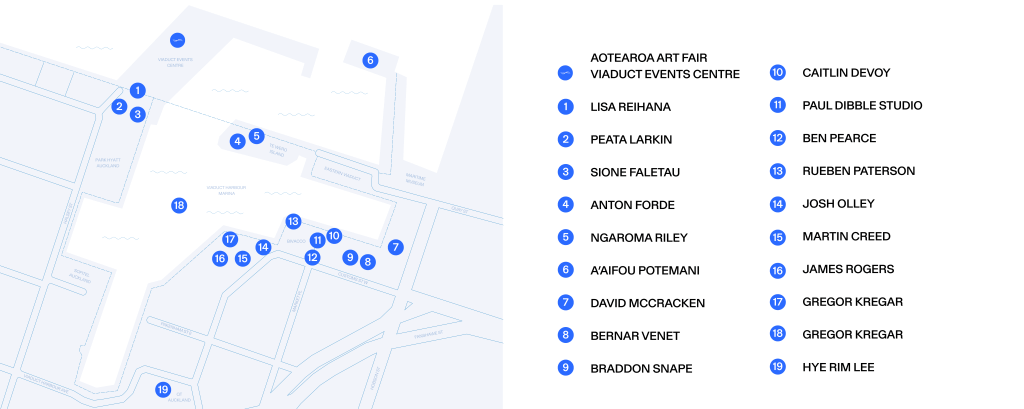
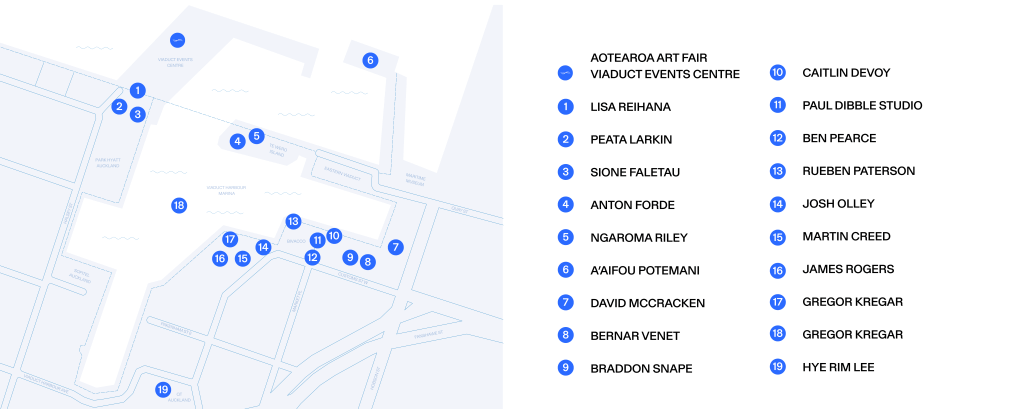
The sculpture on show at the Auckland Art Fair is always one of the highlights of the show as it is often difficult to access and view large scale sculpture. This year the works on show have been expanding significantly with 24 large-scale works by 18 artists installed across the Art Fair precinct, which extends from the area outside the Events Centre to locations around the Viaduct Basin.
The trail will feature leading Aotearoa artists and major international names, along with strong Māori and Pacific representatives.
The artists include Bernar Venet, Braddon Snape, James Rodgers, Hye Rim Lee, Reuben Paterson, Paul Dibble, Caitlen Devoy, Peata Larkin, Martin Creed, a floating work by Gregor Kregar, and a shimmering installation by Lisa Reihana.
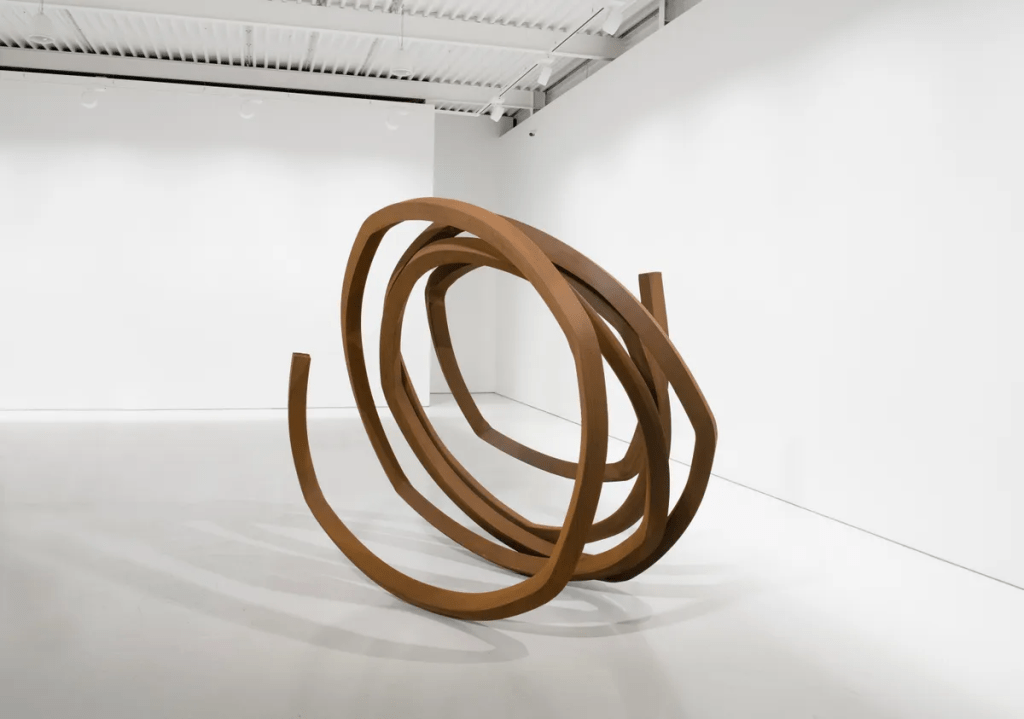
Bernar Venet’s Indeterminate Line is a steel form where bending and twisting are balanced with chance. Loops coil and unravel, reflecting the artists decades-long exploration of lines, geometry, and the interplay of order, chaos, and material presence.
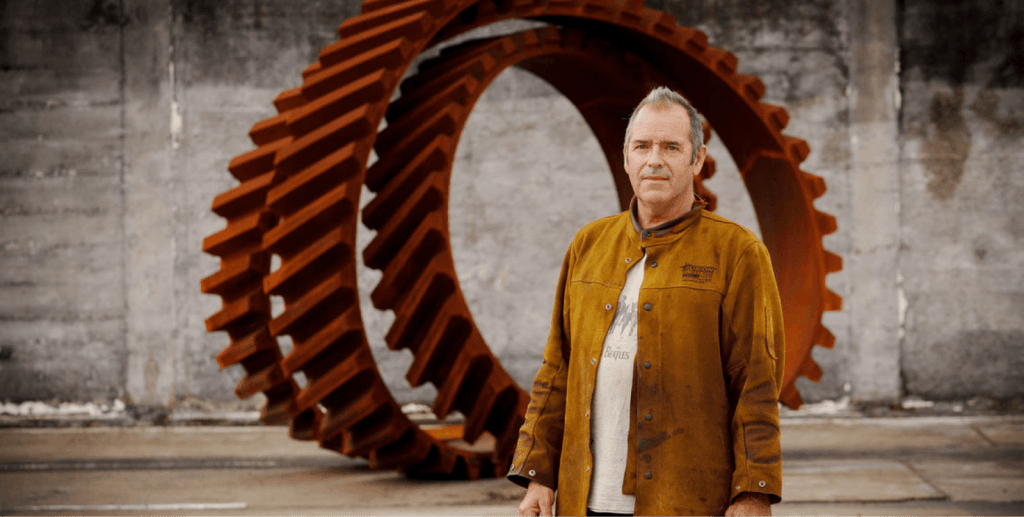
David McCracken
In his 2026 work, the weathered corten steel operates as both object and aperture reflecting David McCracken’s enduring interest in balance, repetition, and the tension between solidity and illusion.
He creates forms that appear to extend beyond their physical limits, drawing the viewer into a quiet contemplation of the processes involved.
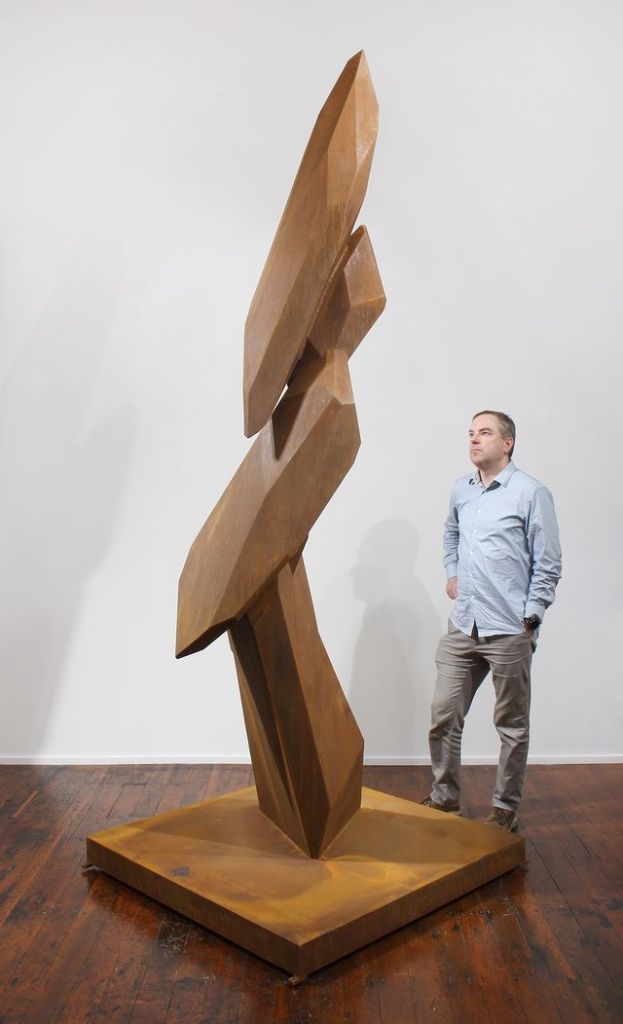
Ben Pearce
ARLOS, silk & RYOS, Ben Pearce’s large-scale sculpture celebrates nature, its strength, and its delicate balance. The boulder-like sections of his towering forms seem tethered to the firmament yet soar into the air like the supports of some natural colonnade. figurative aspects and character emerge giving them a sense of animated presence. Shapes and concepts emerge and disappear as the forms interact with the space around them.
Paul Dibble
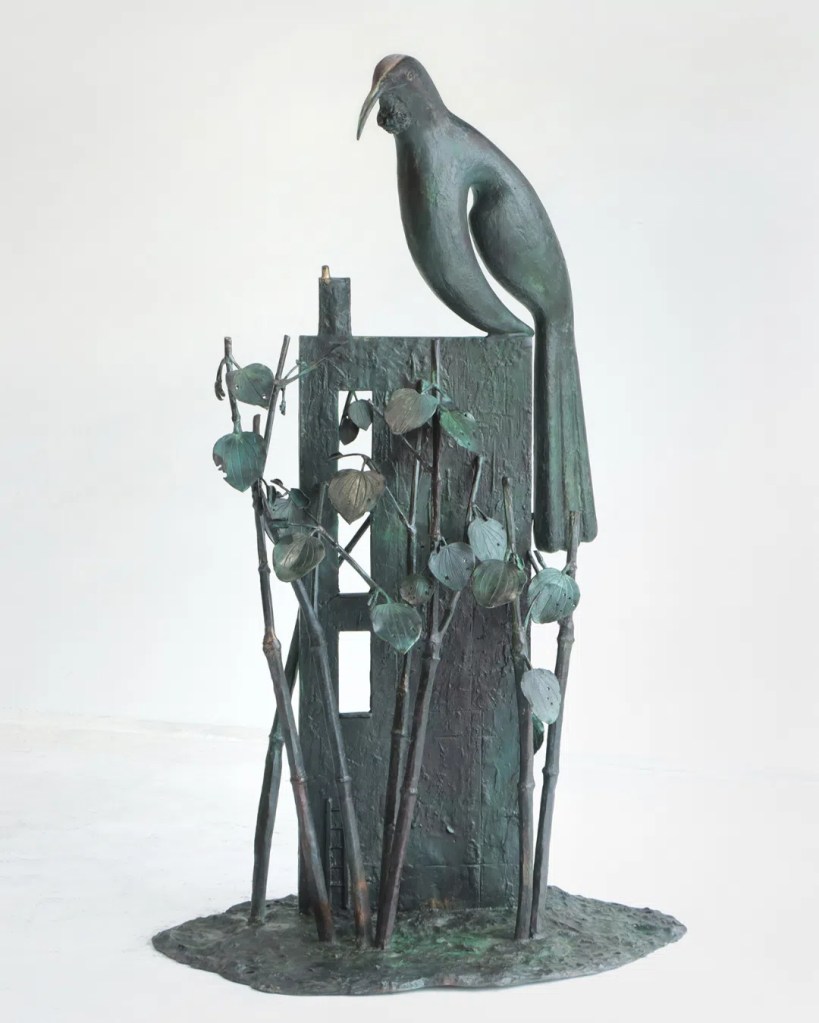
Paul Dibble’s Healing a Busy World acknowledges the return of native birds into the built environments of our cities. His flattened volume, references to building outlines and modern architecture interspersed by rectangular windows filled with light and hope. We also see for the first time a new rich green patina and the emblematic, symbolic sticks of healing kawakawa reclaiming the city.
Reuben Paterson
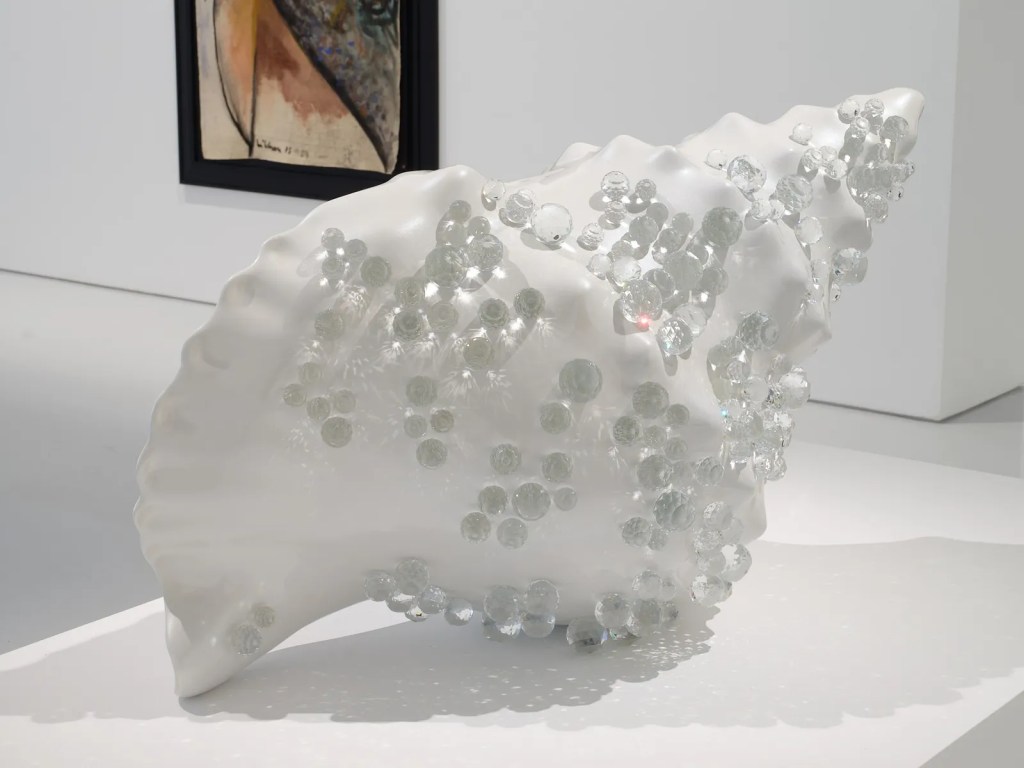
Reuben Paterson’s Koro is a sculptural work from 2023. Crafted from cast aluminium, painted with automotive lacquer, and encrusted with glass crystals, it showcases Paterson’s ability to create works across a diverse range of media.
Through a diverse range of media he creates works which are visually hypnotic and conceptually nuanced.
Hye Rim Lee
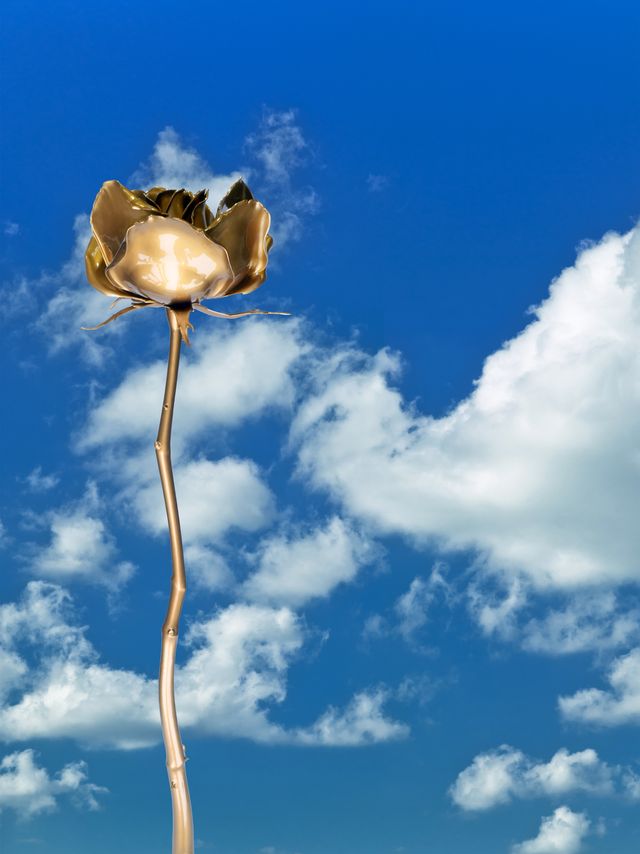
Hye Rim Lee’s artistic practice navigates the fluid threshold between the real and the virtual, translating digital imagination into tangible form. Gold Rose emerges from her iconic 3D animation series White Rose, where virtual fantasies are reborn through material transformation. In this sculptural work, Lee transforms glass — a medium rooted in her digital world — to explore its dual nature: hard yet fragile, liquid yet solid, transparent yet opaque, in her cast Gold Rose.
Ngaroma Riley
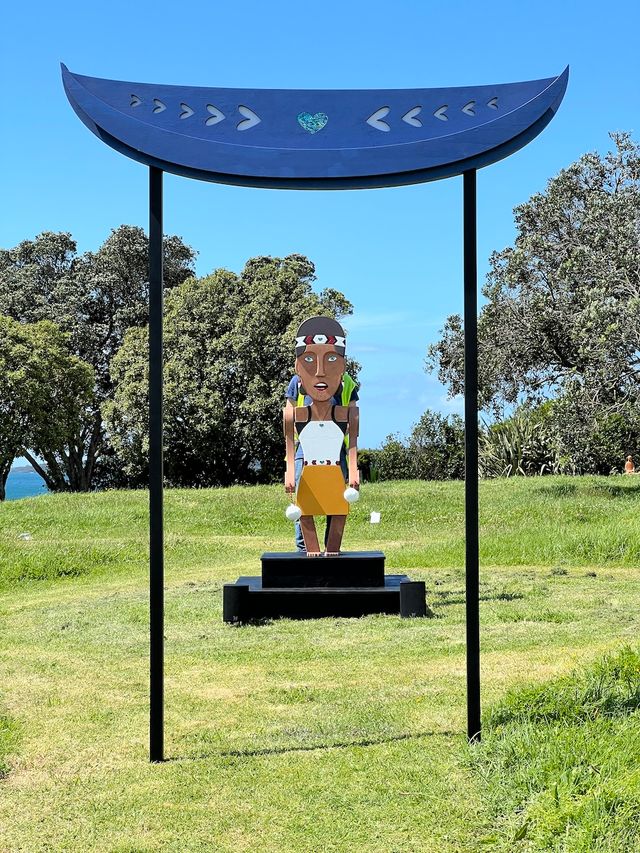
Ngaroma Riley is an artist of Te Rarawa, Te Aupōuri, and Pākehā descent. She began her carving journey making Buddhist statues while working in Japan. Her work centres on Māori narratives, with a focus on retelling whānau, hapū and iwi stories through a wahine Māori lens.
Her work Kapahaka Queens is a shout out to all the aspiring performers — the ones who live and breathe haka, who learn their words on the bus, sing their waiata in the shower, practise their pukana in the mirror and who give their heart and soul to every performance.
Sione Faletau
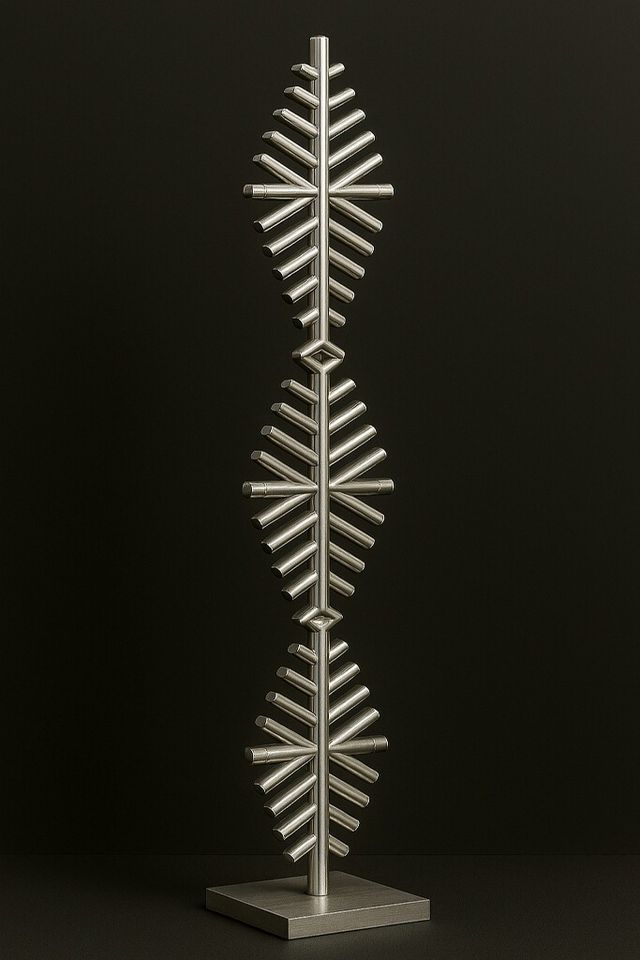
Inspired by the Waitematā Harbour, Sione Faletau recorded its sounds and translated their frequencies into kupesi patterns. Lalava ke he Uho – Connected to the Essence is formed through intersecting lines, the sculpture speaks to the DNA strand, symbolising the harbour’s life-giving essence. Lalava – meaning to bind – connects sound, place and identity into a site-specific expression of the harbour’s mauri. This is the first time Faletau has worked on a large-scale sculpture with his earlier works focused on digital and video works.
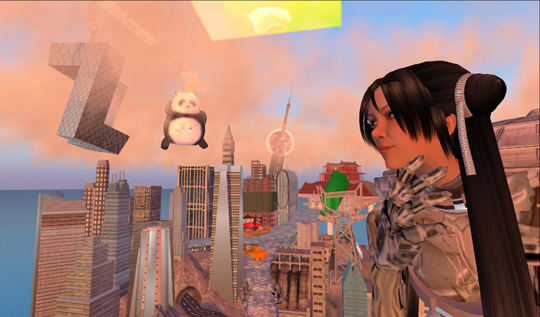
Cao Fei (SL avatar: China Tracy), i.Mirror, 2007, still from RMB City
Auckland Art Gallery Toi o Tāmaki
Forever Tomorrow: Chinese Art Now
Auckland Art Gallery Toi o Tāmaki
Sat 2 May–Sun 23 Aug 2026
John Daly-Peoples
Next month the Auckland Art Gallery will be opening a major survey of Chinese contemporary art.
“Forever Tomorrow” showcases how Chinese artists have grappled with China’s transformation since the late 1970’s, producing work that remains visionary and influential today. The exhibition features 67 works by 42 artists and spans performance, photography, sculpture, installation, moving image and new media.
Two years ago the gallery featured a stunning collection of garments by Guo Pei which included a gown that Rihanna made famous. The dozens of designs by the Chinese couturier highlighted Guo’s prolific work, with its references to fashion of the past and the present. The exhibition showed how Chinese designers had explored new aesthetic ideas.
“Forever Tomorrow” will demonstrate how Chinese artists have explored, reimagines and reworked art practices, making commentary about important ideas – political, social and artistic.
Dr Zara Stanhope, Tātaki Auckland Unlimited Director of Auckland Art Gallery, says, “Forever Tomorrow” brings to Tāmaki Makaurau a wide range of works that reveal how Chinese artists reflected the seismic shifts that have recently taken place in China and in its relationships with the world. This exhibition resonates in Aotearoa and in Tāmaki Makaurau as we grow in cultural diversity and understanding, and in the dynamic cultural experiences it offers that touch us all.”
The exhibition has been curated by Hutch Wilco of Auckland Art Gallery Toi o Tāmaki, with support from Feng Boyi. Feng is a prominent curator and critic who previously served as director of the He Xiangning Art Museum and Suzhou Jinji Lake Art Museum. He is currently a researcher at the Institute of Art Sociology at the Sichuan Fine Arts institute based in China.
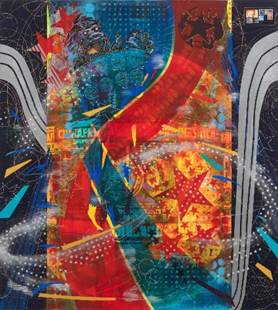
Pu Yingwei, Purple King Kong: Red and Blue Entangled in Space, 2022.
Hutch Wilco says: “Forever Tomorrow” brings together powerful works that register lived experience — labour, migration, family, intimacy, and technology. Spanning generations, the exhibition reveals how artists have given form to the emotional and psychological dimensions of everyday life. Together, these works offer a compelling portrait of contemporary experience, inviting audiences to reflect on how these changes continue to shape individual lives and shared futures.”
“Forever Tomorrow” features work by Ai Weiwei, Xu Zhen, Xiao Lu and Cao Fei, alongside artists exhibiting in Aotearoa New Zealand for the first time including Lu Pingyuan, Pu Yingwei, Xiyadie, Lu Yang and 2023 Sigg Prize winner Wang Tuo. The exhibition draws extensively on the White Rabbit Collection from Sydney and the M+ Sigg Collection in Hong Kong, with other works coming directly from artists and their representative galleries. Key works include Xiao Lu’s Dialogue, 1989, first presented at Beijing’s landmark China/Avant-Garde exhibition, made infamous when she fired two shots into her installation — a gesture entwining the personal with the politics of the time; Ai Weiwei’s Dropping a Han Dynasty Urn, 1995, a photographic series documenting deliberate destruction that questions history and cultural memory; and Zhang Huan’s To Raise the Water Level in a Fishpond: Beijing, China 1997, a defining performance binding personal memory with collective spirit through an impossible task.
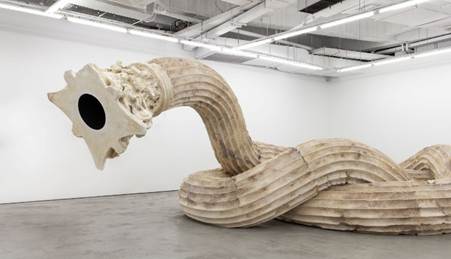
XU ZHEN®’s “Hello”, 2018–19
Highlights include XU ZHEN®’s “Hello”, 2018–19, a robotic Corinthian column that turns a symbol of Western civilisation into an unsettling presence; Cao Fei’s RMB City: A Second Life Urban Planning, 2007, envisions a virtual metropolis in Second Life, while Lu Pingyuan’s Semi-Auto Wandering Gods series, 2024–ongoing, imagines new folk rituals in collaboration with artificial intelligence. XU ZHEN®’s “Hello”, 2018–19 revisits the legacy of the 1989 China/Avant-Garde exhibition, examining the enduring logic of censorship and self[1]criticism in the cultural sphere.
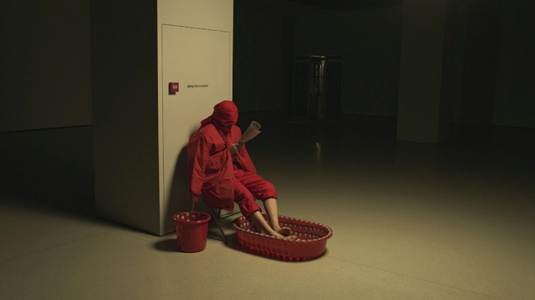
Wang Tuo, The Second Interrogation (film still), 2023
From Thursday 2 April, a major sculptural work by XU ZHEN® will be on display: Eternity–Tianlongshan Grottoes Bodhisattva, Winged Victory of Samothrace, 2014. The large-scale sculpture combines a Buddhist figure representative of China’s Tianlongshan grottoes with the form of the Greek sculpture Winged Victory of Samothrace, and will be freely accessible to view ahead of the full exhibition’s opening.
“Forever Tomorrow” will be accompanied by an illustrated catalogue featuring essays and artist profiles, available exclusively from the Gallery’s Shop.
The exhibition is proudly supported by the Auckland Art Gallery Foundation and the New Zealand Government’s Events Boost Fund.
Ensemble: Jacob Randell, Alyssa Moore, Kevin Beverley, Lachlan Harper, Annalise Moore, Andre Augustus, Axl Osborne, Shani Stephens
The ten thousand hours rule refers to the concept that it takes that many hours of focussed practice to achieve expertise in a complex field. I suppose that’s why I have never become a contortionist or acrobat even though I did practice for three weekend in a row.
Image : Simon McClure
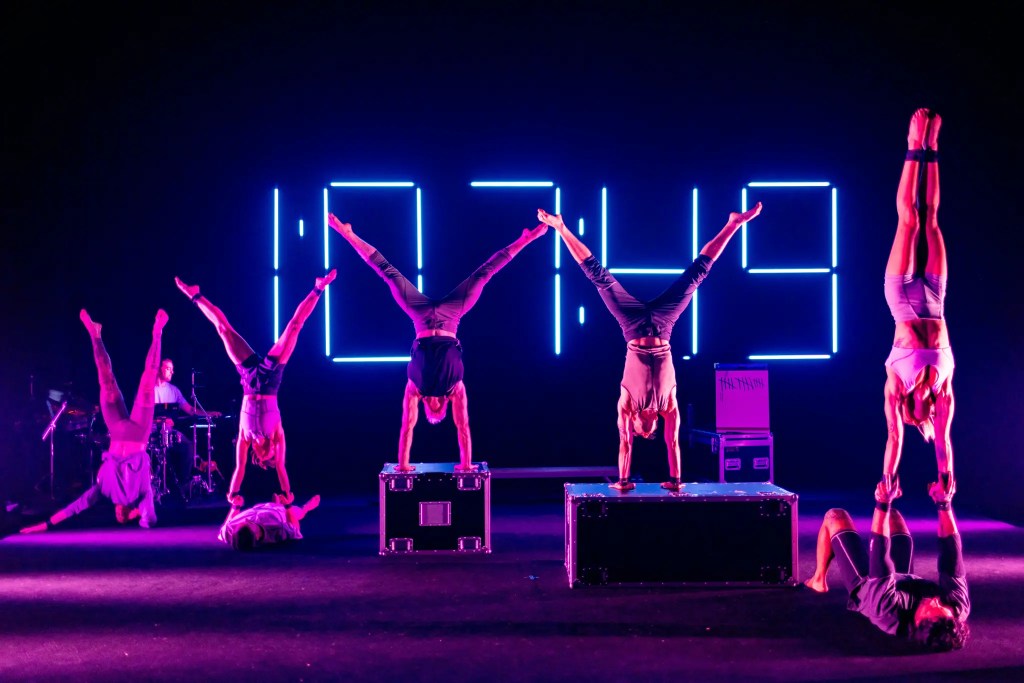
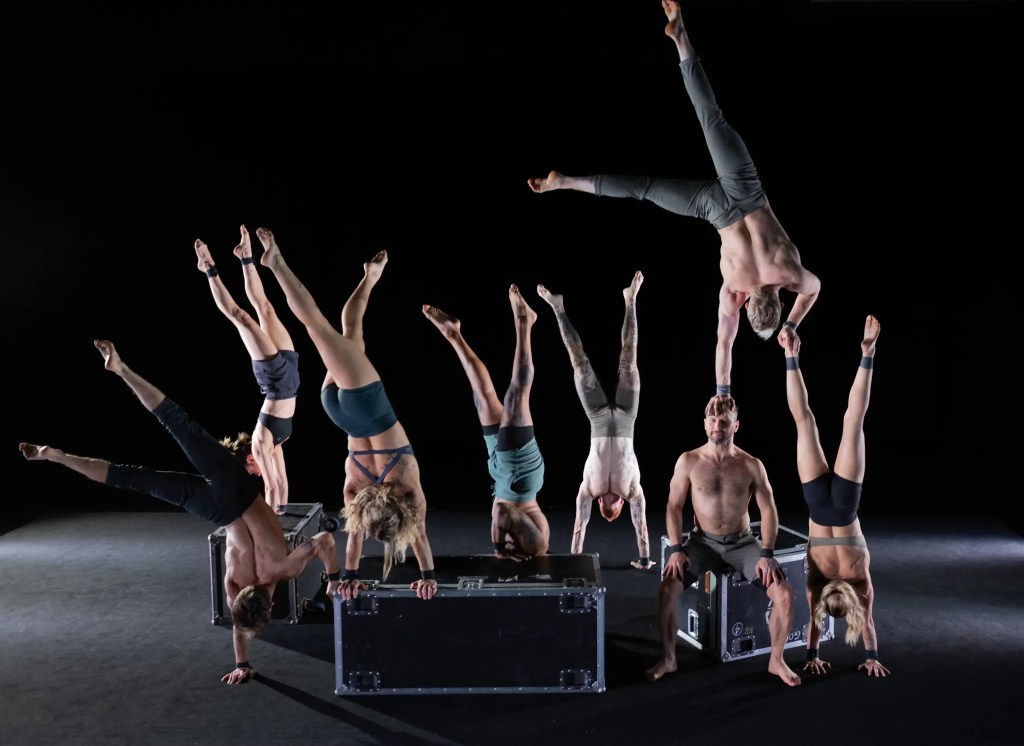
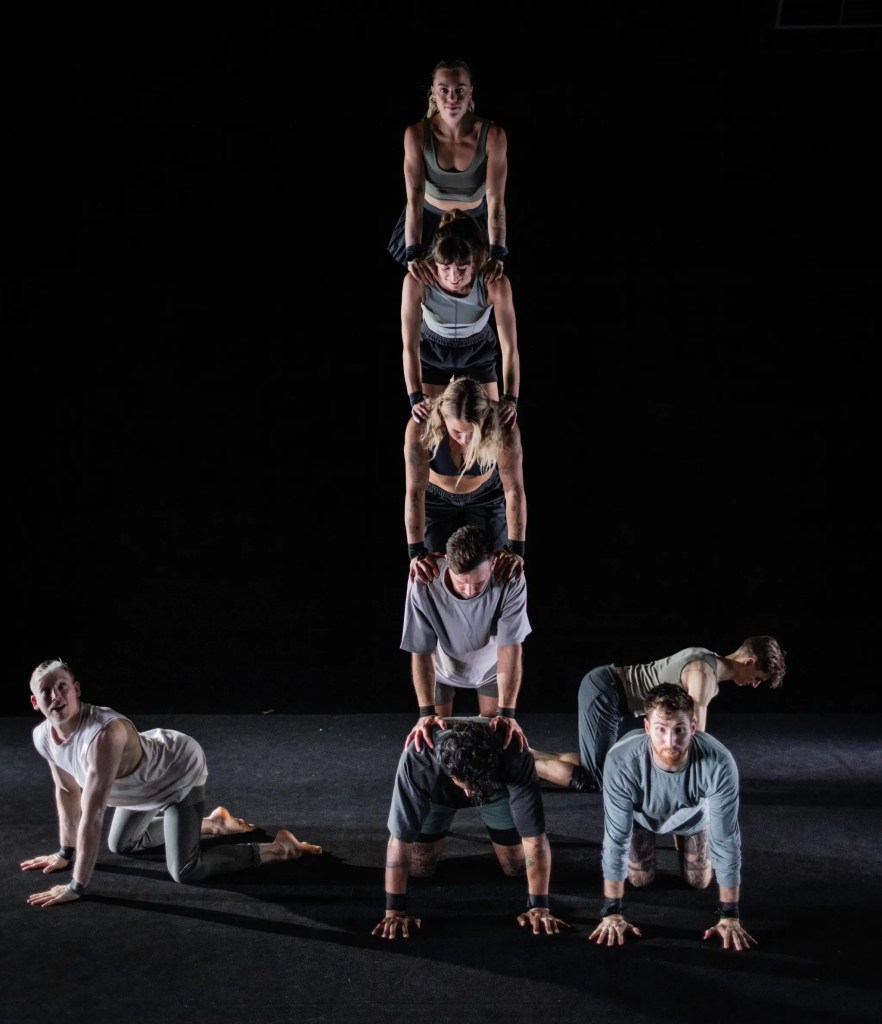
Seeing the eight highly skilled members of Gravity & Other Myths going through their routines is to enter another realm of physical prowess. They manage to do things that most humans would not only find impossible, they would also never even contemplate them. I the reckon the Gravity team probably put in way more than ten thousand hours of practice .
The show starts off simply enough, a few simple lifts, jumps and handstands, all very clever, and the audience was very appreciative but no clapping. But then the troupe ramp up the action with the performers taking on more elaborate and risky moves and the audience erupts with, lots of ohhs, and ahh’s and tremendous rounds of applause.
From then on the audience kept a constant steam of applause, whistles and gasps.
The trick that the team seem to have mastered is that of working together, understanding their colleagues’ intentions, working with the team collectively to achieve incredible outcomes.
Image : Simon McClure
Some of the inspiration for their work probably comes from the Spanish human towers which are a spectacular Catalan tradition and can be up to ten stories high with up to one hundred people.
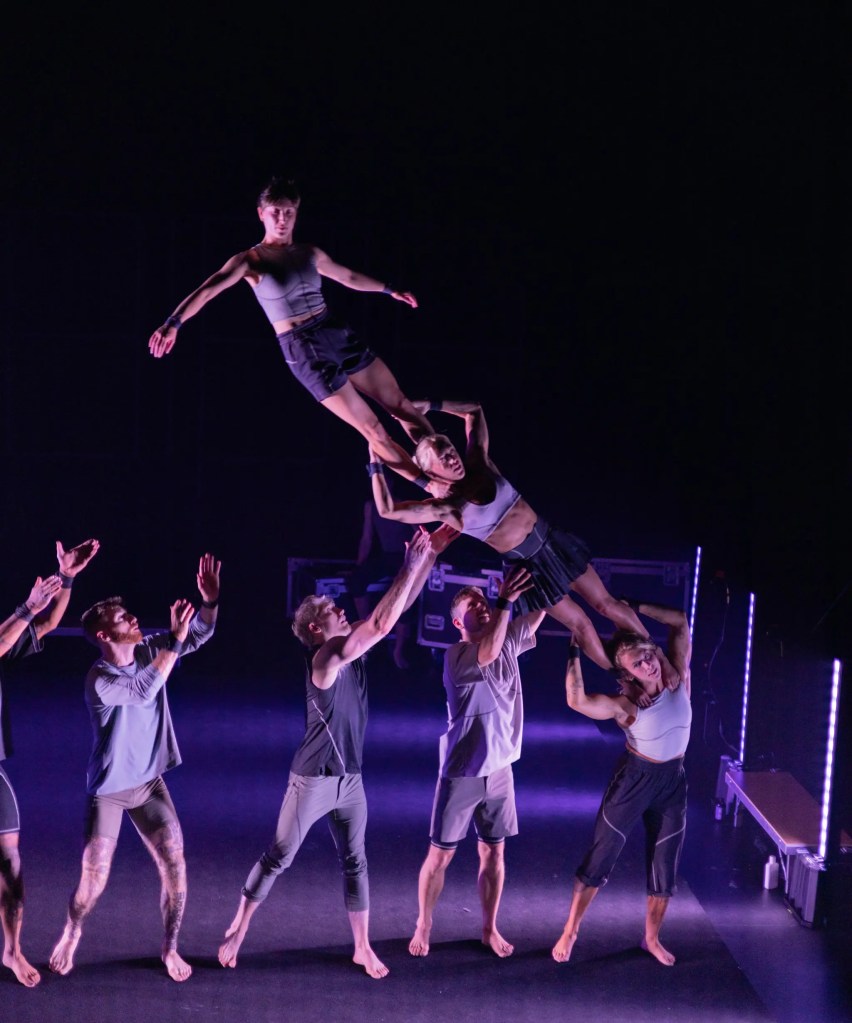
The towers of this troupe are only three storied but are pretty spectacular for the ease with which they construct them, the way they can link them and the way they effortlessly deconstruct them.
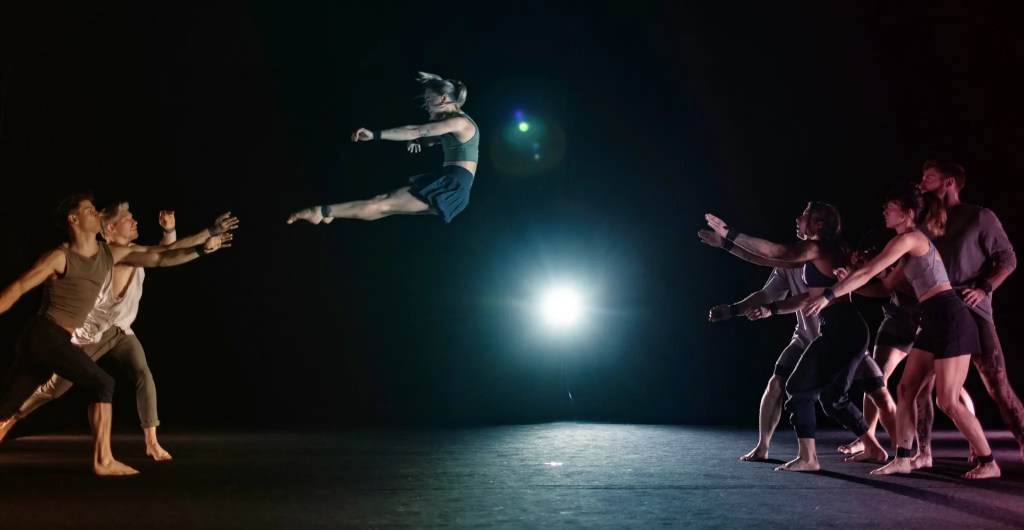
The group is also very good at throwing each other around. A lot of the time they are like trapeze artists but without the trapeze, hurling each of the across the stage as though they were rag dolls.
There were number of individual acts which start off seeming easy. Possibly a few people could leap, hands first ,across two people lying on the stage but diving across four people would be virtually impossible. So, when one of them manages to dive across six people there was an initial gasp of disbelief followed by massive round of applause.
Image : Simon McClure
It is small acts like this which captivate the audience, the attempts by ordinary performers to take on impossible stunts and impossible acrobatic moves. The audiences were always right behind these almost superhuman performers, even when they failed in their attempts, they still got rounds of applause.
In a bit of audience participation one (un)lucky person was cajoled onto the stage where she was quickly instructed in the art of stick figure drawing. After a bit of instruction, she was able to produce a series of composite portraits of stick figures which the group then formed themselves into human versions of her sketchs.
All this tumbling, climbing, throwing and weird acrobatics are supported by Nick Martyn an onstage drummer who interacts with the performers, adding moments of comic relief and hectic drumming solos between the extraordinary acts.
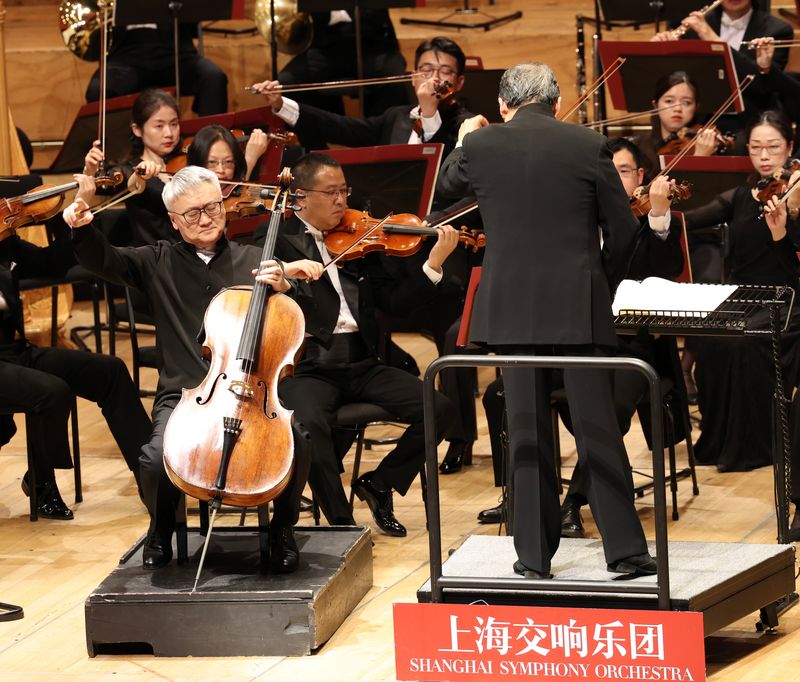
The highlights of this year’s Auckland Arts Festival were the two concerts presented by the Shanghai Symphony Orchestra, the oldest symphony in Asia which has a formidable history of touring.
The seventy strong orchestra under the direction of conductor Long Yu, opened their first concert with a relatively new work by Elliot Leung – “Chinese Kitchen: A feat of Flavors”. Leung has made a name for himself both as a composer who spans Eastern and Western music but also as a composer for Hollywood films.
His background as compose of film music showed throughout his four movement Chinese Kitchen, the opening movement “Deep Fried River Prawns” displaying an inventive use of a dozen percussion instruments. The collection of instruments including maracas, cymbals, bells, clappers and xylophone created a syncopated sound which recreated the noise, colour and hectic movement of a Chinese kitchen.
This movement and the others showed the composers ability to create musical equivalents of the taste, texture and colours of Chinese dishes. In the second movement “Buddha Jumps on the Wall” the woodwinds created a luxurious sequence with the melodies taken up by the piano and harp. The music flowed effortlessly between moments of savage attack and sequences of little more than whispers. While this was a Western style music it was flecked through with clever traditional Chinese elements. The Western style music could be detected in some Copland style passage as well as a nod to the music of “The Wizard of Oz”.
With “Vegetable in Soup” there was a sense of vegetables bubbling away in a pot, the tempo of the music becoming more animated as the piece evolved and in “Deep Fried Sesame Balls” there was again adventurous percussion playing which could have come from an Indiana Jones film provided an electrifying display.
Conductor Long Yu used his hands and body to great effect with his generous movements and careful directions which adding to the sense of a watery, misty environment with surprises erupting from the music, seemingly at his command.
Playing Tchaikovsky’s “Variations on a Rococo Theme” cellist Jian Wang glided effortlessly through the work, revelling in the interplay with the orchestra in a tantalising display which emphasised aspects of the sophisticated composition. He made use of the various solo sections to show an understanding of the work as well displaying his extraordinary technical skills.
He was able to combine, as did Tchaikovsky, an understanding of the romanticism of the Rococo theme as well as debt to Mozart which gives the work its spectacle in the way that cello and orchestra intertwine. The theme was dissected and re-formed in different guises with Wang seemingly finding new opportunities in the melodies as well as exploring its tones, and textures.
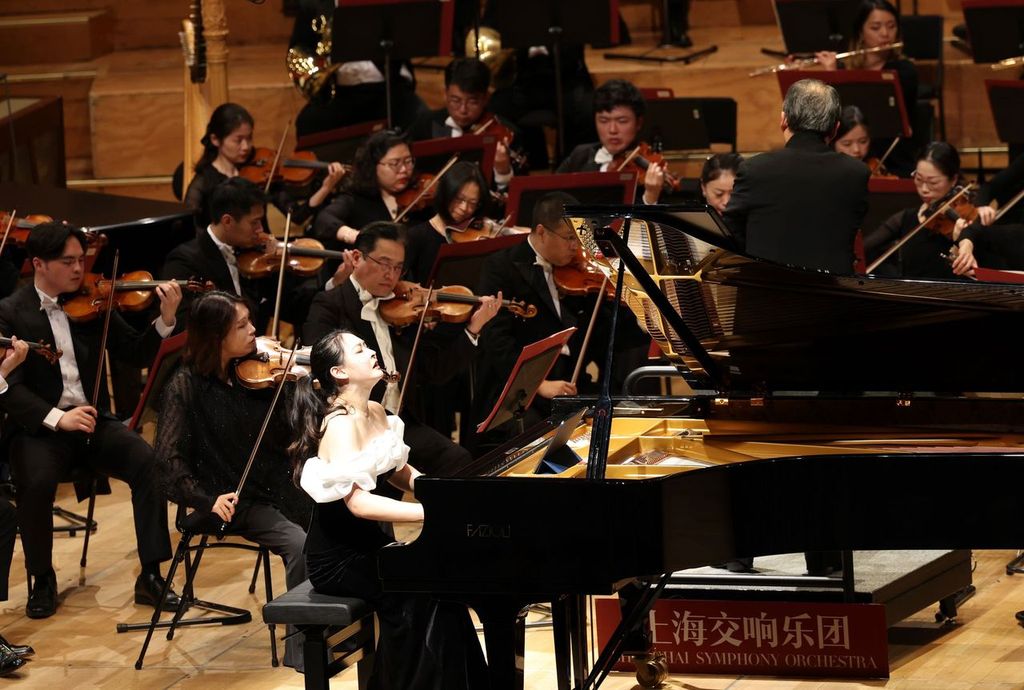
Serena Wang Image : Leilei Cai
Tchaikovsky’s Piano Concerto No.1 is one of the top ten piano concertos and is the last great Romantic piano concerto of the nineteenth century, full of lyricism as well as many dramatic moments. The pianist has to be capable of producing the most poignant of sounds as well as the most intense.
Pianist Serena Wang was able to deliver both these qualities of the work as she ranged from the pensive to the flamboyant.
From the opening moments where she responded to the brash horns and sharp flourishes of the orchestra Wang dominated the stage with some dazzling displays.
Her expression when playing changed continuously and she took on various poses from rapture to steely focus. At times there was a tenderness to her playing while at others a brutal rawness and then at other times she seemed to be cajoling herself into discovering new depths to the music
Her rapport with the orchestra was constantly changing as well. Battling with the orchestra, chasing the dramatic themes conjured up by the orchestra and then the dynamics would change, and the orchestra would attempt to match her feverish playing. There were also several moments of musical poetry when Wang had interchanges with the flutes, and clarinets.
After the frenetic finale the audience responded with a huge ovation, but this was matched by even great applause when she and the orchestra played a stunning version of Pokarekare Ana.
The second concert was bookended by two pieces which had featured ih their first concert Elliot Leung’s – “Chinese Kitchen: A feast of Flavors” and the orchestra playing of Pokarekare Ana with Serena Wang.
The major work on the programme was Rachmaninoff’s Symphony No 2 which was written ten years after his first symphony’s disastrous reception 1897. It is a masterpiece of late-Romanticism, combining a deep Russian melodic yearning with an intense symphonic structure, combining lush harmonies, with an emotional depth.
There were passages of great delicacy in the first movement which reflected his love of the Russian landscape and Russian history. However, he was unhappy with the political climate in Russia at the time and moved to Dresden, Germany, where he wrote the symphony in 1906. This aspect shows in the work as he seems to be looking forward to a new dawn both politically and musically, the music full of positive aspirations.
The soaring strings and blaring passages owe much to his early friendship with Thaikovsky and the earlier composer’s sounds recur throughout this symphony, notably the 1812 Overture.
In the second movement there were wistful, dreamy sequences as well as urgent, action filled sections while the romantic third movement was carried along by some delightful flutes, filled with intense yearning, giving voice to a modern Russia, a feeling which was being expressed by many Russian writers and dramatists at the time.
Also on the programme was Gigang Chen’s “Er Huang, for Piano and Orchestra” which had been commissioned by Carnegie Hall in 2009 and is based on the composer’s interest in Peking Opera.
Serena Wang’s playing developed with slow tentative sounds, providing a sense of a hazy, limpid environment. The pianist’s crisp sounds trembling above the subdued sounds of the orchestra were like an Impressionist work with each individual note and section clearly articulated.
They were like the images of raindrops on water, or the descriptions of flowers and landscapes. The moods expressed seemed simultaneously to be like Impressionist paintings of the late nineteenth century as well as a depictions of classical Chinese paintings where the aim was to capture not only the outer appearance of a subject but its inner energy and life force.
Wang seemed captivated by the music, being drawn deeper and deeper into its complexity. At times she expressed a celebratory approach to her discoveries, raising her arms in triumph.
Wang’s expression of triumph could be applied to the success of the orchestra’s success in providing Auckland with two outstanding concerts along with two exceptional soloists in Serena Wang and Jian Wang.
It’s opening night of Sincere Apologies but there are only twenty-five people in the Loft at Q with seating for more than one hundred. Maybe people have read about the show already and have found out that they may have to speak. That’s a big no-no for some New Zealanders. Public speaking – that’s when you make a complete idiot of yourself with the wedding speech, or the farewell speech at the office. No wonder only twenty-five turned up.
[I attended the opening night and some adjustments have been made based on feedback from this preview]
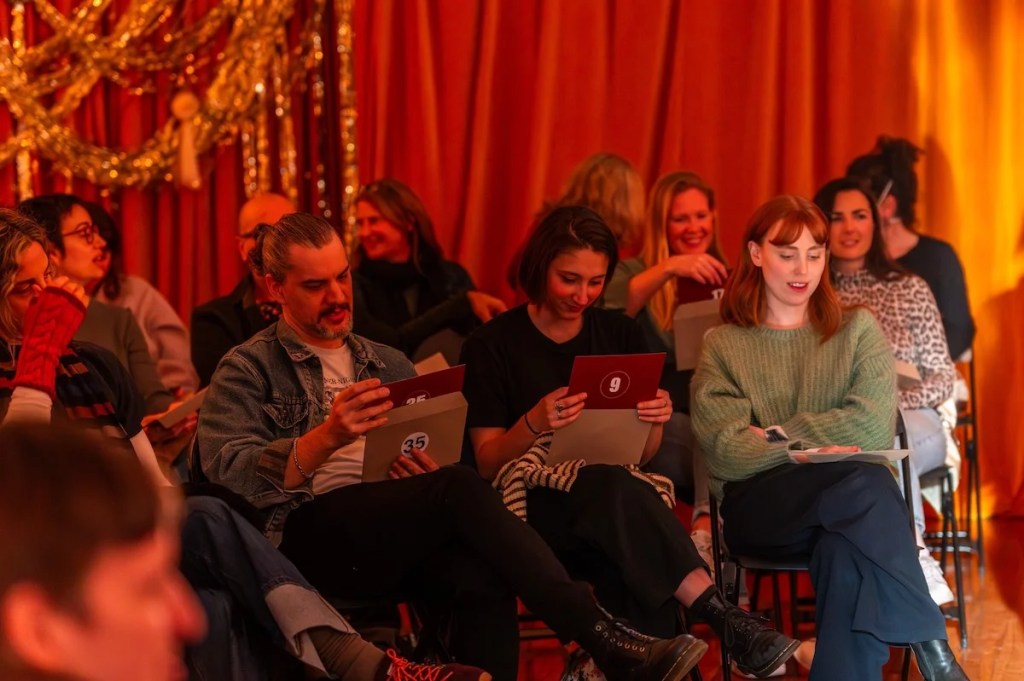
It all starts simply enough. An envelope is handed round the group with instructions to keep it moving until the music runs out. Just a version of pass the parcel, and then the lucky person gets to read out the instructions and hand out fifty envelopes.
These are fifty real apologies that are distributed to the audience. They are mainly from the last fifty years, all of them factual, collected by the three creators, Dan Koop, Jamie Lewis and David Williams. There are apologies from government ministers, public figures as well as private individuals, all expressing remorse for things they have said or done or their governments have done. One by one, the audience members step up to the microphone and read them out aloud.
There are some important apologies. New Zealand government ministers apologizing for the government actions during the Land Wars, an on-air apology by Paul Henry to the Governor General Anand Satyanand for dumb things he said on radio and there is also Kanya West apologising to Taylor Swift and Beyonce for dumb things he has said about them.
I got to read out two apologies. One by the chairman of the Fukushima Power Board apologizing for the trouble and harm caused by the explosion and release of radioactive materials into the sea and air.
The other was by Geroge Bush apologising for the treatment of Japanese /American citizens during the Second World War.
There were lots of other apologies for the harm done by war with some private individuals apologising for what their German and Japanese parents may have done during the Second World War.
There was a range of apologies from all walks of life and for all sorts of reasons. There was Tiger Woods apologizing for his infidelity and an apology for the harm caused by the Dawn raids.
There were also a couple of apologies to theatre goers who had made complaints to Q Theatre for unstated reasons.
One apology was very succinct – “Fuck”.
There are no actors in this mix of ordinary people but some of them were as assured as if they were. Others displayed a bit of hesitancy, but all seem to relate to the apology they were reading. Some of the apologies from government ministers were a bit formulaic and those apologies were buried under the same set of words. When these statements are stripped of power, position, and spin they seem hollow, lacking real meaning. Other apologies like Jacinda Ardern’s apology for the Christchurch Mosque murders were filled with meaning and history seemed particularly relevant.
Hearing these apologies, one is made aware of the power of language and sometimes because of the way in which people read them the readings were given an added emotional tone.
There are couple of made-up apologies with dates set in the future – an apology in 2065 to Kiribati and other island nations for the inundations of 2050 and one from the Australian government acknowledging the death of the last koala in existence. The one disappointment was that there was no discussion at the end of the session, only applause by the audience for their own collective performance.
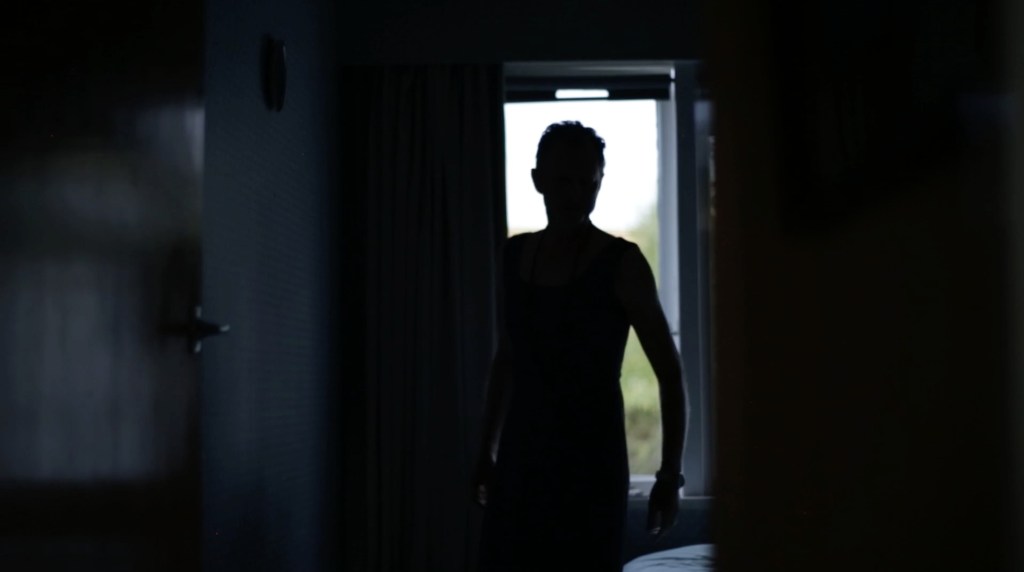
Image credit: Edith Amituanai, Vaimoe (video still), 2024. Digital video, sound. Cinematographer: Ralph Brown. Photo credit: Ralph Brown
Held every three years, the Walters Prize is widely regarded as Aotearoa New Zealand’s most prestigious award for contemporary art. Over its 24-year history, the prize has helped elevate contemporary New Zealand art, both nationally and internationally. Conceived as a platform to showcase excellence in the visual arts, it has bolstered careers, stimulated critical debate and enriched the cultural life of Tāmaki Makaurau and wider New Zealand.
Four artists have been selected by an independent jury for works exhibited between February 2023 and February 2026.
In making their selection, the jury made the following comments: “These artists have made an outstanding contribution to contemporary art in Aotearoa over the last three years, a period marked by political unrest, escalating conflicts, and environmental devastation. Rather than amplifying this turbulence through spectacle, they each respond to the disorientation of our times by turning an acute attention toward local and personal narratives, while expanding the material and conceptual possibilities of their practices.”
Edith Amituanai (born 1980, Tāmaki Makaurau Auckland) is a New Zealand-born Samoan lens-based artist based in Tāmaki Makaurau Auckland. Amituanai was nominated for Vaimoe, 2024, first exhibited in Edith Amituanai and Sione Tuívailala Monū: Toloa Tales, Christchurch Art Gallery Te Puna Waiwhetū, 2024, which demonstrates the artist’s recent shift into moving image while maintaining the gracious, lucid enquiry that has defined her practice over the last two decades. Vaimoe gently pushes against conventional ideals of home and belonging, exploring the ways relationships are upheld and maintained through proximity and distance, while acknowledging the challenges of change, disconnection, and communication.
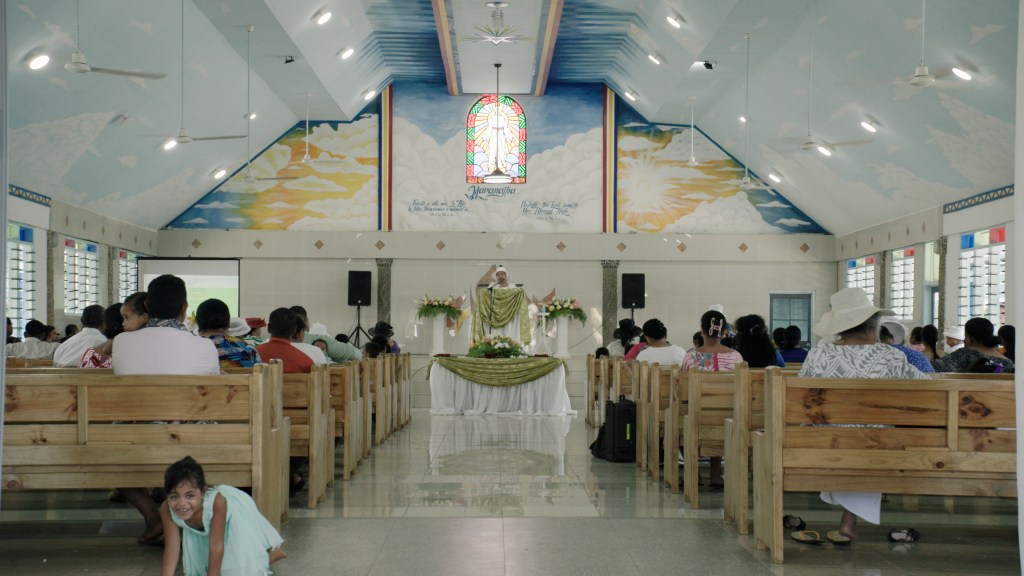
Image credit: Richard Frater, Nicky’s conversion (video still), 2025. HD video, colour, sound. Lett Thomas, Auckland. Image supplied by the artist
Richard Frater (born 1984, Te Whanganui-a-Tara Wellington) lives and works in Berlin. Frater was nominated for Nicky’s conversion, 2024, first exhibited at Klosterruine Berlin, 2024 and Lett Thomas, Auckland, 2025, a work that tenderly records the rehearsal of a sermon by an Anglican priest, articulating the challenges of reconciling the interior self with the structures through which we have come to understand the exterior world. With dignity and grace, the work describes a changing gender identity and offers a path through the Anglican tradition towards acceptance and love of ourselves and others.
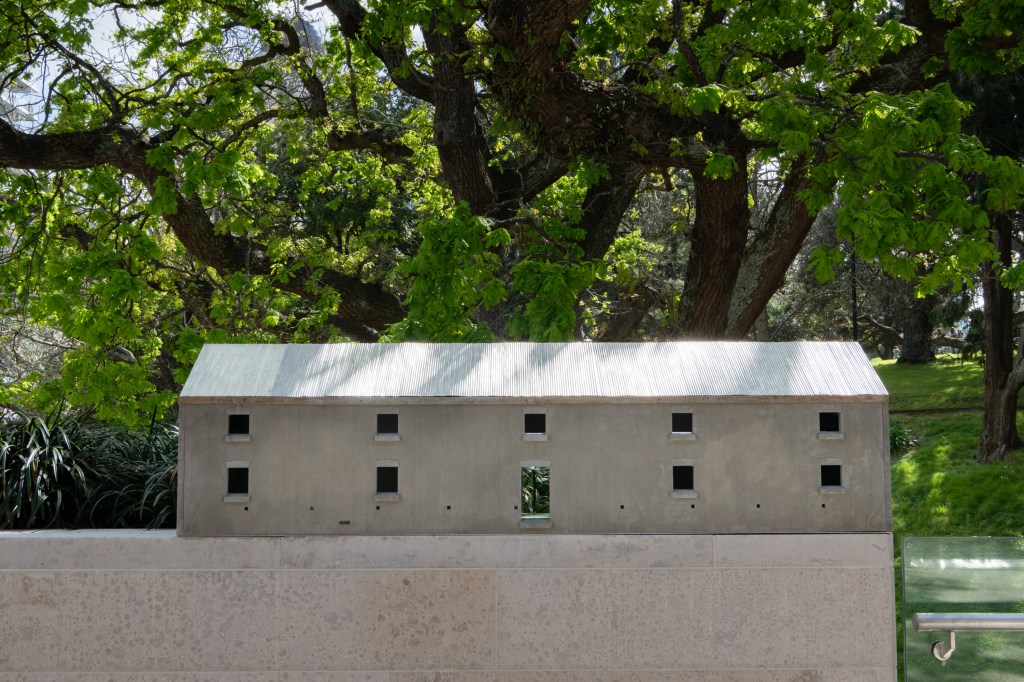
Image credit: Ammon Ngakuru, Three Scenes (installation detail), 2025. Mixed media sculptural installation. Commissioned by Auckland Art Gallery Toi o Tāmaki, with support from the Chartwell Trust and the Contemporary Benefactors of the Auckland Art Gallery, 2025.
Ammon Ngakuru (born 1993, Tāmaki Makaurau Auckland) lives and works in Tāmaki Makaurau Auckland. Ngakuru was nominated for Three Scenes, commissioned for Auckland Art Gallery Toi o Tāmaki in 2025, a work that responds to the Gallery’s outdoor terrace and its site on Albert Park with an elegant restraint characteristic of his practice. Implicating the audience in its field of sculptural references, the work establishes a stage on which uncertain interpretation is acted out.
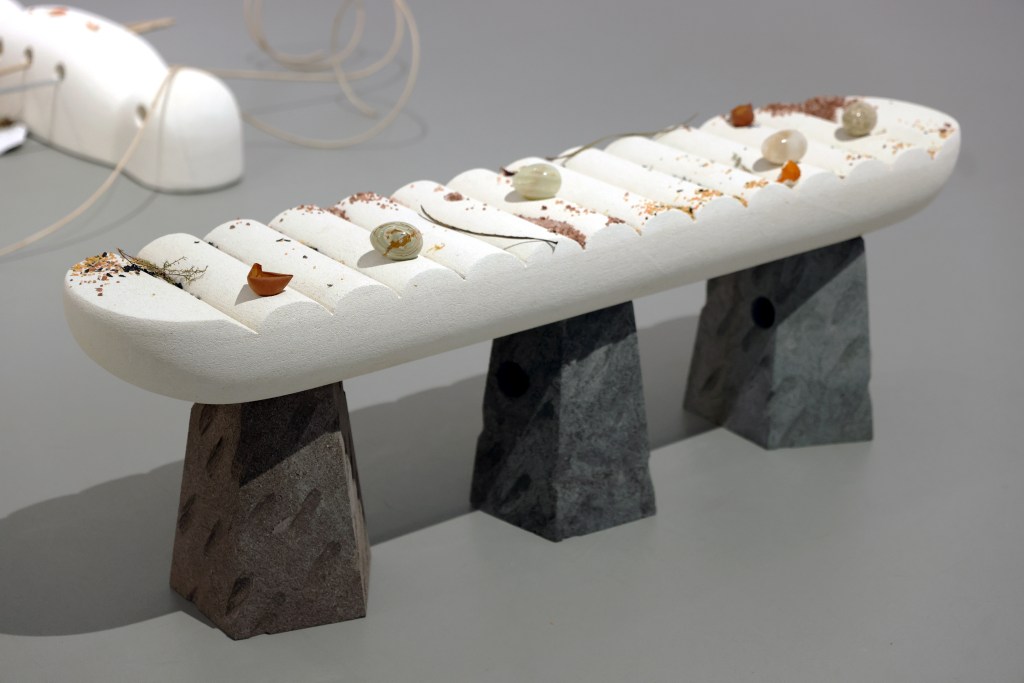
Image credit: Sorawit Songsataya, Ranad detail from the exhibition Fibrous Soul, 2024. Taranaki andesite, Ōamaru limestone, onyx, dried plant. Taranaki andesite carving by Donald Buglass. Photo courtesy of the artist and Govett- Brewster Art Gallery
Sorawit Songsataya (born 1986, Chiang Mai, Thailand) is a Thai-New Zealand artist currently based in Bangkok. Songsataya was nominated for the exhibition Fibrous Soul, presented at Govett-Brewster Art Gallery, 2024, for its exploration of processes of accumulation, regeneration and transformation. Across moving image and sculpture, and including work made by the late weaver and kaitiaki of Te Niho o Te Ātiawa Maata Wharehoka, Fibrous Soul draws together organic and artificial materials, and customary and contemporary practices, to elucidate slippages between human and more-than-human worlds and the possibility of communication across them.
Tātaki Auckland Unlimited Director of Auckland Art Gallery Toi o Tāmaki Dr Zara Stanhope says, “It has been a privilege to begin my term as Director of the Gallery welcoming in the jurors and artists for the 2027 Walters Prize. Their selection is a poignant reminder of the breadth and range of art across Aotearoa New Zealand and of the activity currently shaping the visual arts as a healthy and vital part of the cultural sector.”
The finalists are invited to present new work or their nominated work at the Gallery in a public exhibition, scheduled to open in March 2027.
Auckland Art Gallery’s Senior Curator, Global Contemporary Art, Natasha Conland, who works closely with the artists to realise the prize exhibition and says, “These finalists express materially rich works with unique, often humorous and intellectually rewarding content. It’s not surprising that they each carry a large following of supporters who are looking to ask new questions of art, and to explore its potential,” says Conland.
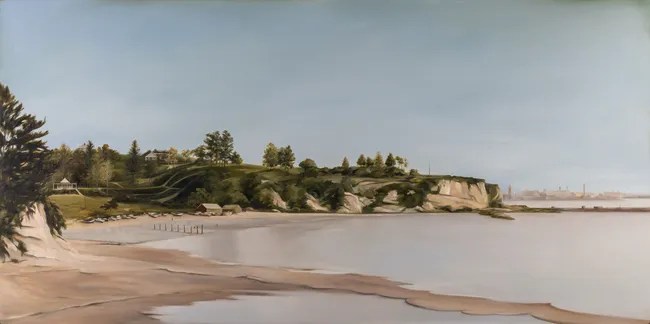
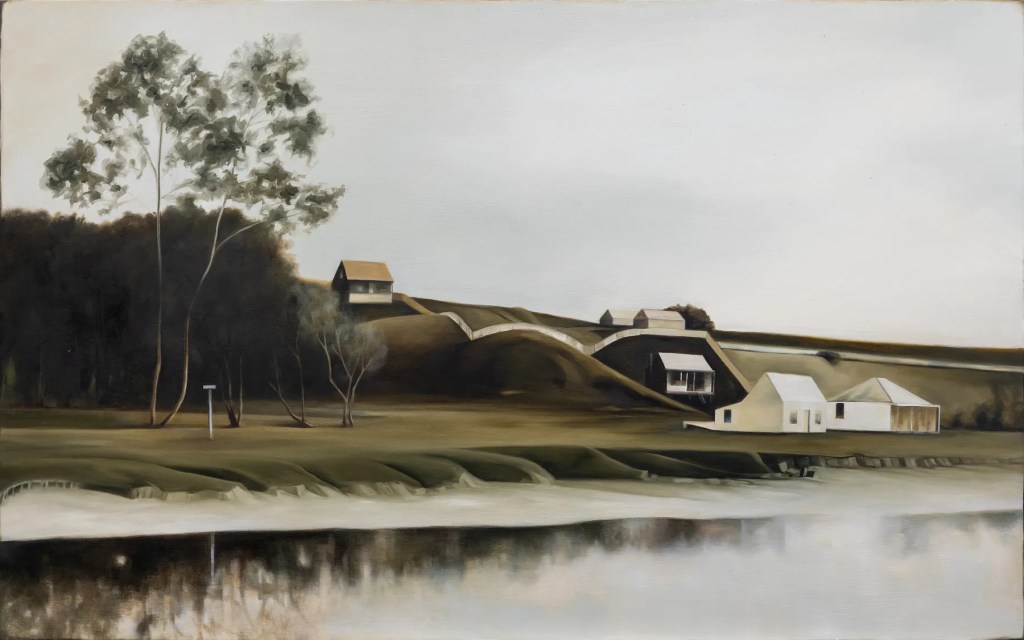
Shane Foley’s “Tide and Tide” exhibition is based of archival images of Auckland‘s waterfront from the nineteenth and early twentieth century. They are of images of foreshores, beaches and building, most of the which have disappeared,
Several of the works make reference to Auckland’s history so “Campbells Point at Judges Bay” ($7500) includes `Kilbryd’, the large Italianate home of Sir John Logan Campbell. In this painting the artist has shaped much of the view making the foreshore beach a series of flat planes while the cliffs below the house have been sculpted with gentle curves of lawn.
Shane Foley Heaphy’s View, St Georges Bay, early 1860’s
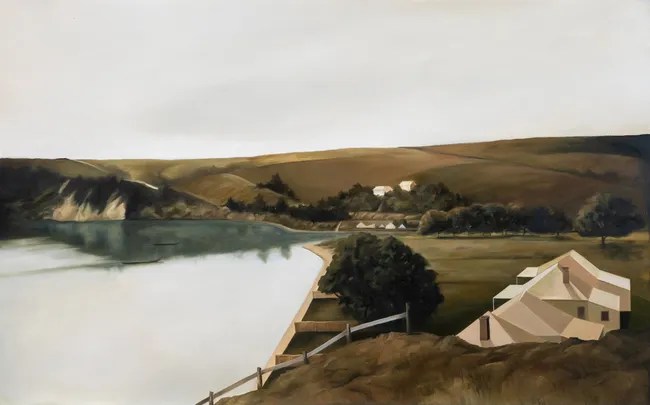
In her “Heaphy’s View, St Georges Bay, early 1860’s” she has carefully constructed two houses in the foreground while two background houses owe much to Braque’s “Houses at L’estaque”.
Shane Foley Settlement, St Georges Bay 1867
With “Settlement, St Georges Bay 1867” ($3800) the houses seem like surreal addition, the boxlike shapes placed in the carefully formed landscape consisting of folded landforms, where the fence lines are made from abstract curves.
With “Trees at Shelly Beach, Pt Erin 1914” ($1900) she has depicted one of the now forgotten buildings which could be found on Auckland’s waterfront. This was the salt water, tidal baths at Pt Erin which were demolished for the Auckland Harbour Bridge.
Other buildings from the period include “West End Rowing Club at St Mary’s Bay 1914” ($4800) and ‘The Jetty, St Mary’s Bay. 1950’s’ ($4800) where the eerie white buildings stand out from the background.
There is a slight tension in viewing these works, as the past and present merge and the abstraction the artist uses distances our view, giving them a dream-like aspect.
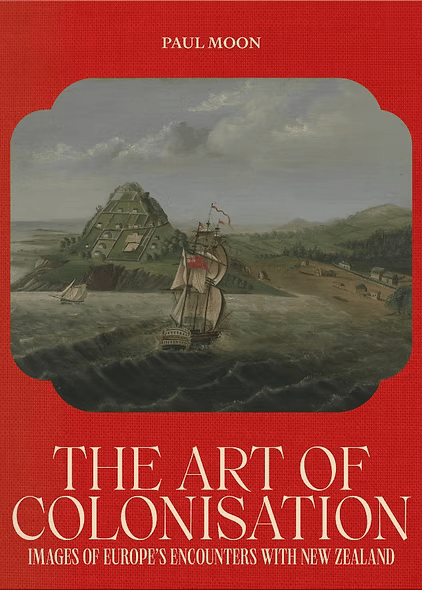
Paul Moon, The Art of Colonisation: Images of Europe’s encounters with New Zealand, by
Ugly Hill Press
RRP $55.00
Reviewed by John Daly-Peoples
Paul Moon’s “The Art of Colonisation” is the latest in a number of books which have looked at New Zealand art from a political and social perspective. This reinterpretation of the history of art involves re-examining, challenging, and recontextualizing traditional art narratives through a modern, often critical lens.
He has chosen twenty works, mainly well-known, which record the development of New Zealand and the intersection of explorers and colonists with the indigenous people.
The works range from Isaac Gilseman’s “A View of Murderers Bay (1643) though to Marcus King’s “The Signing of the Treaty of Waitangi” (1938). The years between the dates of these works has produced a substantial amount of written and visual material which records the colonization and development of New Zealand.
Part of that material is the art which was produced at the time. Some of it is personal records, simple sketches and paintings, other works are commissioned works for specific purposes. Moon and other writers have noted that the art of this period is inherently political, serving as a reflection of power, identity, and social values of the time regardless of the artist’s intent.
Moon notes of this period of art production “This was the realm of art, where images of imperial activity and its consequences ranged from disturbing to calming, scientific to whimsical, superficial to intimate and paternalistic to outright injurious”.
By choosing what to create, who sees it, and how it is displayed, much of the art of this early period in New Zealand’s history gives a colonisers viewpoint rather than that of the indigenous.
The first artwork Moon refers to is Isaac Gilseman’s “A view of Murderers Bay” which is a record of the first fateful encounter of European explorer with Māori. Gilseman’s view as Moon recounts was “an image of European cultural and racial narcissism in this period.
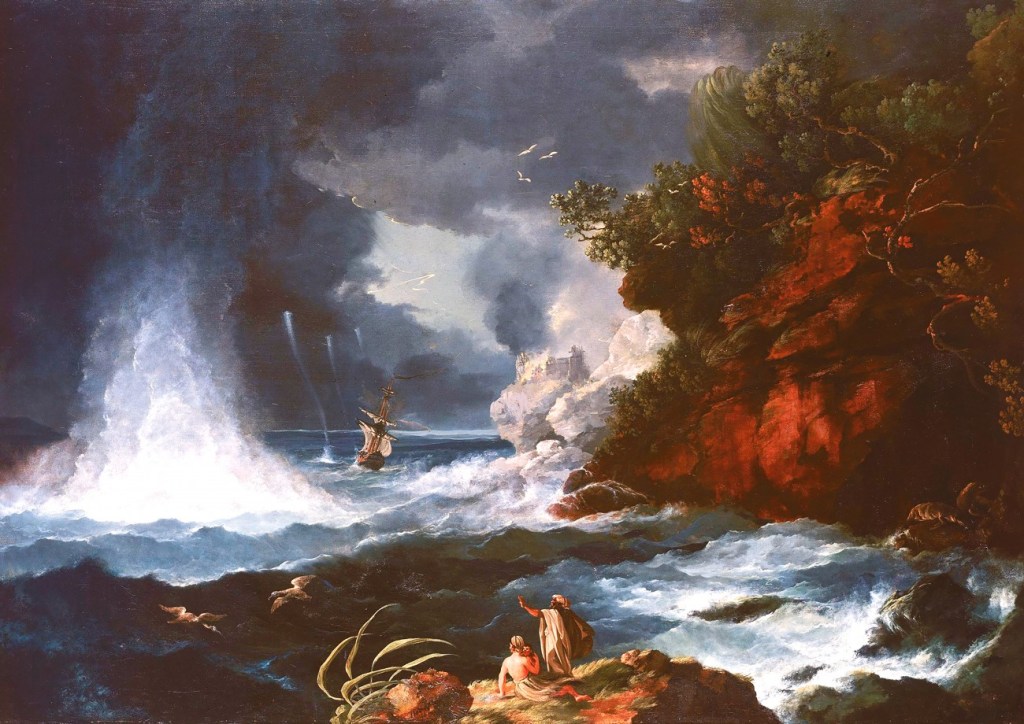
William Hodges ‘A view of Cape Stephens in Cook Strait with Waterspout”
Subsequent images Moon refers to include a mixture of landscape, images of indigenous and European constructions and portraits. These include Herman Diedrich Sporing “A fortified village” (1773) and William Hodges ‘A view of Cape Stephens in Cook Strait with Waterspout” (1776)
Even art that seems apolitical, like portraits or landscapes can be seen as political acts because it is produced in a specific social context, reflecting the established, mainstream standards.
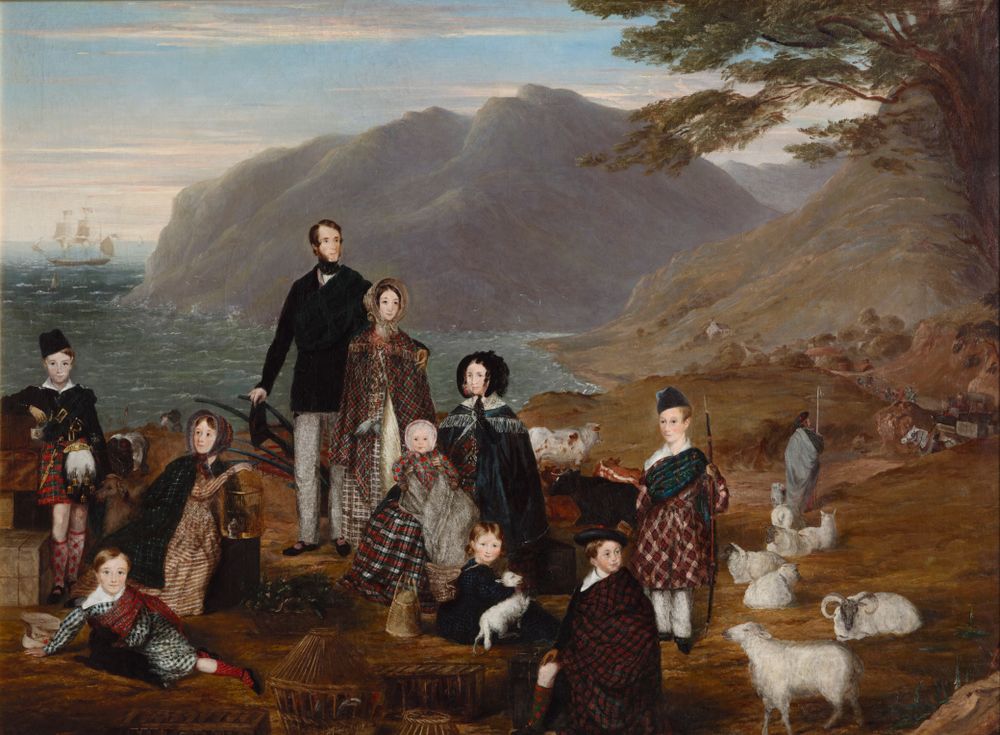
William Ashworth “The Emigrants
So even the relatively innocuous portrait of the Mackay family which was commissioned from the artist William Allsworth is shown after Moon’s research, to display the artists or at least the patriarchs attempt to provide a better pedigree for the family . The tartan which many of the family are wearing is red, white and black whereas the tartan of Clan Mackay is actually blue, black and orange. Moon points out other inaccuracies in the painting as well.
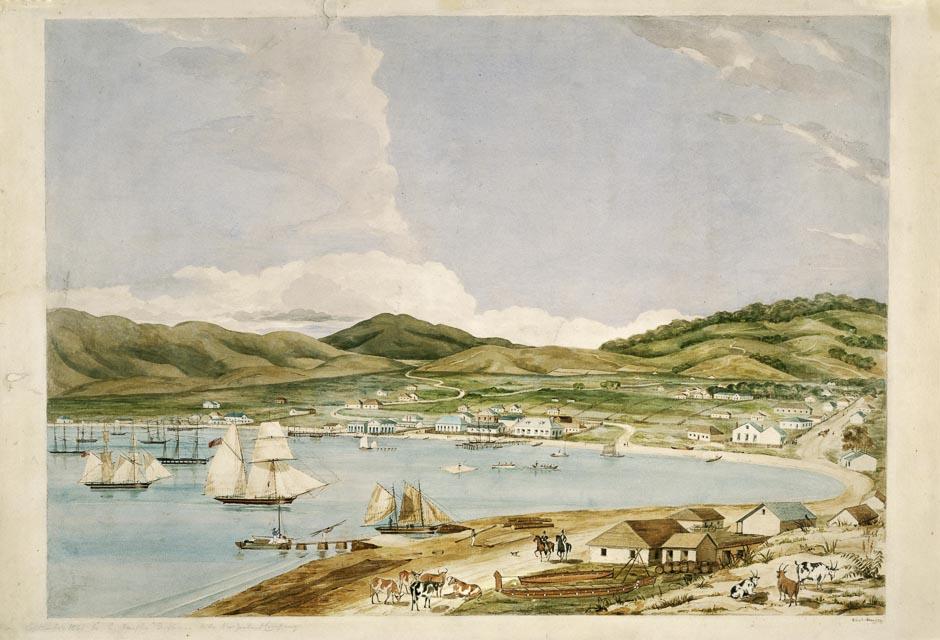
Charles Heaphy “View of a part of the town of Wellington
Such minor matters seem to take on greater importance when rather than details related to family they relate to a town. In referring to Heaphy’s “View of a part of the town of Wellington (1841) Moon quotes the Presbyterian Minister John Lang writing about the town at the same time – “it consist of the verist of refuse of civilized society… their usual articles of barter are either muskets and gunpowder or tobacco and rum.. most of them live in open concubinage or adultery with native women”.
Heaphy’s view of Wellington, one of many he produced for the New Zealand Land Company however shows a relatively ordered settlement with stock grazing and well tended pastures.
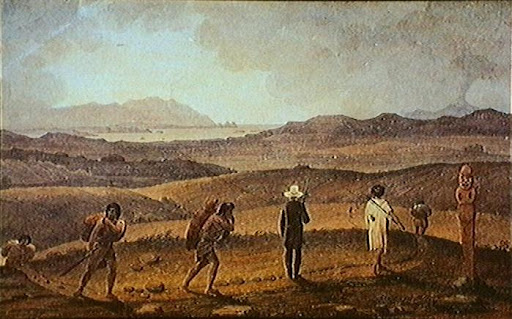
Augustus Earle’s “Distant View of the Bay of Islands”
Augustus Earle’s “Distant View of the Bay of Islands” (1827) provides Moon with an image which “represents a common view at the time that Europe was at the centre of the world’s values and development” with the artist placing himself at the centre of the image, surveying his domain.
There are several paintings Moon refers to which were painted around the turn of the century which were part of the nation building images which of the time. Among them is Kennett Watkins “The Death of von Tempsky at Te Ngutu o te Manu” which depicts soldier in dramatic pose yet hides the Māori figures in shadow.
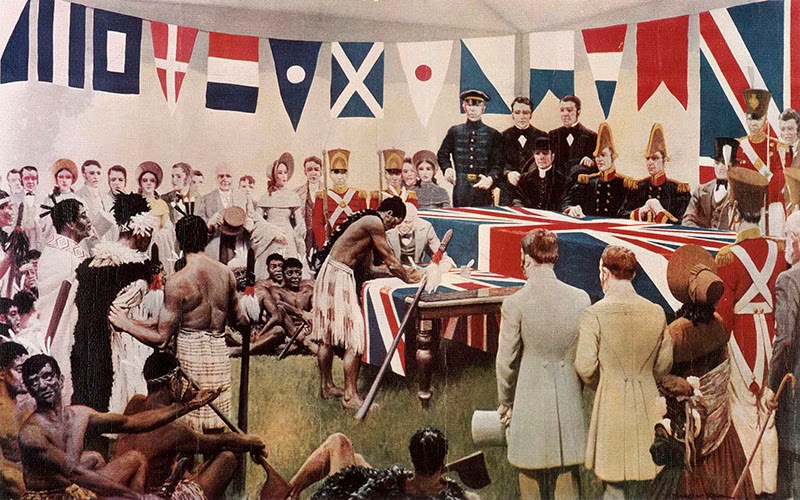
Marcus King “The signing of the Treaty of Waitangi”
The final image in the book is Marcus Kings “The signing of the Treaty of Waitangi”, painted to celebrate the centenary of New Zealand. Here the image is filled with symbols and flags of the British Empire with little representing Māori.
In the lower left hand, the artist has included a figure turned to the viewer who seems perplexed or appalled at the scene.
In his introduction Moon writes about the “bumpy marriage between art and colonisation…the offspring of this relationship was visual portfolio of imperialism – part record, part propaganda and part prescription …tracing the progression of art’s intricate allegiance with Europe’s colonisation of New Zealand. It is a visual portfolio which still needs to be clarified, reflected on and understood.
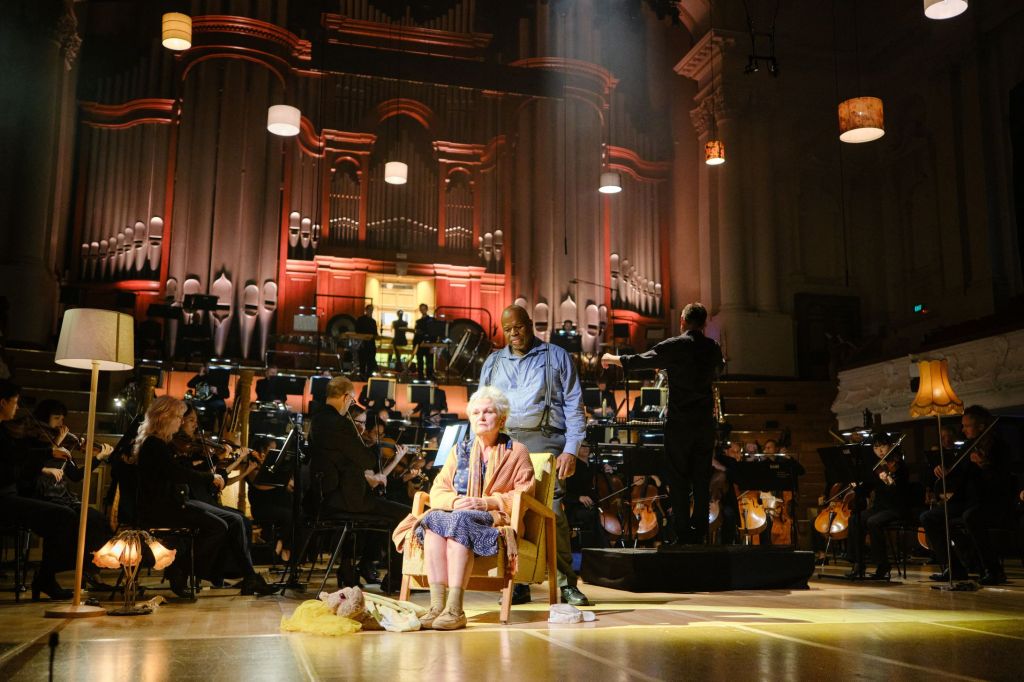
Judith (Susan Bullock) and Bluebeards (Lester Lynch) Image: Thomas Hamill
Bluebeards Castle
By Bela Bartok
NZ Opera & Auckland Arts Festival
Aotea Centre
March 13th & 14th
Reviewed by John Daly-Peoples
In Bela Bartok’s original staging of Bluebeards Castle, the newlywed Judith enters her husband’s dark, foreboding castle where she is faced with seven locked doors that she is forbidden to open. In this version by Daisy Evans, it is a single trunk which holds the memories of the couples past lives which Bluebeard remembers while Judith herself seems to become lost to him.
For this production director Daisy Evens created a new Judith who is somewhere between an older woman with dementia and a woman facing her own psychological breakdown and who along with her husband can be seen as displaying the Freudian concepts of sexual trauma.
The castle can be seen as symbolic of Bluebeard’s soul; a dark mind filled with secrets that threaten to reveal his true nature. The opera itself can be seen as an allegory for the loneliness of the human soul, the impossibility of truly knowing another person, or the conflict between rational and emotional.
Bartok was writing the opera at the same time that Freud was engaged in studies into psychoanalysis and elements of this have seeped into Bartok’s thinking which aligns with Freud’s theories of exploring the unconscious mind, hidden sexual desires, and psychological trauma.
Bluebeards Castle like other Symbolist art works, replaced traditional dramatic narratives with dark, subjective internal journeys, mirroring the Freudian focus on repressed emotions and dreams.
Despite Bluebeards protests she removes the symbolic items from the chest and in doing so she discovers events from Bluebeards past, events she needs to recognise if she is to fully understand him. He also needs to acknowledge these events if they are to be a truly understanding, loving couple.
In opening the chest for the seventh time she discovers the three women of his past, one found in the morning, one at noon and one at sunset, Then with Judith, his fourth, the bride he found at night, having fully understood her husband she joins the women leaving Bluebeard in perpetual darkness.
The seven memories in the trunk contain the relics of the couples past that Lester Lynch’s Bluebeard remembers with joy and anguish, while Susan Bullock’s Judith emotionally engages with her former self, as lover, bride and mother.
References are made throughout the opera about the power of light to overcome darkness and symbolic of this the stage was studded with two dozen domestic lamps which flickered on and off at various points.
Like the story of Bluebeards Castle, the music is mysterious and riveting, providing a background soundscape which seems to continually shift as the various events of the opera are revealed.
Throughout the work there were sequences where the music provided particularly unsettling sounds, while there were other times when the orchestra was able to symbolise the idea of light flooding into the darkness of the castle. There were some exquisite passages particularly the blaring drama of the organ which was like a palpable force and the swelling of the strumming harps.
It was the emotional richness provided by the two singers which helped maintain the tension along with their creation of character though their acting. Bullock displayed a voice of amazing power while Lynch plumbed great depths as he revealed his inner thoughts.
This production was a stunning display of acting and singing along with an inspiring performance by the Auckland Philharmonia under the direction of conductor Brad Cohen.

 New Zealand Arts Review