Categories
Reviews, News and Commentary

The Art of Banksy coming to Auckland

John Daly-Peoples

Girl With Balloon
The Art of Banksy – the major exhibition which has brought Banksy’s era defining works to over 1.5 million visitors in 19 cities across the globe will visit Auckland for a final and strictly limited New Zealand season. The exhibition will be hosted at Tāmaki Makaurau Auckland’s Aotea Centre (Hunua Rooms) from Monday 7 July through Sunday 3 August 2025.

The Art of Banksy is the world’s largest collection of original and authenticated Banksy art showcasing more than 150 pieces including prints, canvases and unique works. The collection wowed thousands of Wellingtonians in 2024 and now it’s Auckland’s turn.

Michel Boersma, curator and producer of the exhibition says: “Following a hugely successful 19 city global tour and 2 years in London, UK, we’re very excited to bring this larger-than-ever collection to Auckland, bigger and better! The last 9 years we have been working with collectors in expanding the collection which we are able to display, from 70 in Auckland in 2018 to over 150 authenticated and genuine works, no replicas – the real deal. I am particularly proud that trusted associates of Banksy, for example Ben Eine, have been willing to contribute to the exhibit with their privately held works, gifts and hand drawn sketches and video testimonials. This way The Art of Banksy is able to lift the veil on how some of the iconic Banksy works were created and reveals some of the secret stunts they got up to.” 

Daniel Clarke, Tātaki Auckland Unlimited Director of Performing Arts, leading Auckland Live adds: “We’re delighted to be working with GTP Exhibitions to bring The Art of Banksy to Tāmaki Makaurau Auckland. As one of the world’s most successful contemporary artists Banksy’s work consistently captures the public’s attention and imagination – over a million people worldwide have seen the exhibition – so to have this number of works on show is a hugely exciting addition to our winter events season.”

Visitors at The Art of Banksy can expect to see the seminal artworks that brought the infamously anonymous artist international notoriety such as Girl With Balloon in four different colour variations, including the rare Gold Edition. Banksy fans can also see unique personalised gift prints created for friends, associates and lovers. The exhibition also focuses on Banksy’s Dismaland and recent artworks acknowledging the ongoing war in Ukraine.


Many of Banksy’s iconic works are also featured in the exhibition including a very rare collection of ‘thank you prints which Banksy created as gifts to staff and team members who worked with him at Dismaland and other Banksy stunts. The exhibition also features a series of unique hand drawn sketches by Banksy. The fragile pieces of paper are one-of-a-kind depicting Banksy’s working on versions of his famous rat images.

The Art of Banksy is an unmissable show for anyone who wants to learn more about one of the world’s most important current artists and what their work reveals today; the power of art to affect social change, inspire the public and lay bare the undercurrents of social issues.

The Art of Banksy is not curated or authorised by the artist and only displays authenticated art sold or gifted by the Artist, no replicas or art removed from the street.
Banksy’s Dismaland
ART OF BANKSY
 
Monday 7 July – Sunday 3 August 2025
Mon – Wed: 10am – 6pm
Thu – Sun: 10am – 9pm
 
Tickets start from $39.50. Service fees apply
 
Tickets on sale from Wednesday 7 May
Categories
Reviews, News and Commentary

A Century of Modern Art coming to the Auckland Art Gallery in June

John Daly-Peoples

Claude Monet, French, 1840-1926; Water Lilies ; about 1922;oil on canvas Toledo Museum of Art, purchased with funds from the Libbey Endowment, Gift of Edward Drummond Libbey

A Century of Modern Art

Auckland Art Gallery  

June 7 – September 28

John Daly-Peoples

Auckland Art Gallery has announced that the exhibition “A Century of Modern Art” will be  its special winter exhibition this year, running from  June & through till September 28th.

The exhibition will be on loan from the Toledo Museum of Art, Ohio, and will provide  a survey of the major artists who transformed modern art.

The exhibition will consist of 57 works by 53 artists, including Paul Cezanne, Edgar Degas, Helen Frankenthaler, Édouard Manet, William Merritt Chase, Amedeo Modigliani, Berthe Morisot, Claude Monet, Pablo Picasso, Camille Pissarro, Robert Rauschenberg, Pierre-Auguste Renoir, Vincent van Gogh, James McNeill Whistler, among others.

Director of Auckland Art Gallery Toi o Tāmaki, Kirsten Lacy says the calibre of works and artists in this collection is exceptional and not to be missed.  “A Century of Modern Art showcases the diversity and innovation that defined modern art movements,” says Lacy. “From the emotive brushstrokes of Van Gogh to the evocative landscapes of Monet and Rauschenberg’s bold abstractions, these works not only revolutionised Western art history but continue to inspire new generations.”

“The exhibition includes works by legendary art figures, including Vincent van Gogh, whose work hasn’t been publicly displayed here in Aotearoa in over a decade. It is made available to us due to renovations that are taking place at Toledo Museum of Art, and we are honoured to be working with the Museum to make the most of this rare opportunity.”

The centrepiece of the show will be Claude Monet’s  “Water Lilies” Purchased with funds from the Libbey Endowment, Gift of Edward Drummond Libbey    Plants, water, and sky seem to merge in Claude Monet’s evocative painting of his lily pond at Giverny. The disorienting reflections, bold brushstrokes, and lack of horizon line or spatial depth make Water Lilies appear almost abstract. Painted about 1922, it belongs to a grand project that Monet had conceived as far back as 1897:

“Imagine a circular room whose wall . . . would be entirely filled by a horizon of water spotted with [water lilies]… the calm and silence of the still water reflecting the flowering display; the tones are vague, deliciously nuanced, as delicate as a dream.”

Monet began this ambitious project in 1914, finally completing it shortly before his death in 1926. Over those years he executed more than 60 paintings of his water garden, capturing the light conditions at different times of day and in different weather. Twenty-two of these large panels were installed in the Orangerie in the Tuileries Gardens, Paris, as a gift to France. The  Toledo’s work was is possibly a study for one of the three panels of the Orangerie composition” Morning”.

Berthe Morisot, In the Garden at Maurecourt. (Purchased with funds from the Libbey Endowment, Gift of Edward Drummond Libbey)

Included in the exhibition is a work by artists Berthe Morisot one of the few female Impressionist artists. Her work “In the Garden at Maurecourt” (Purchased with funds from the Libbey Endowment, Gift of Edward Drummond Libbey) is set in Morisot’s sister Edma country house outside Paris and probably shows Morisot’s daughter, Julie, and one of Edma’s daughters.

She was born to an upper-middle class family and was the great-niece of Rococo artist Jean-Honoré Fragonard. Morisot rejected the social expectations of her class and gender by pursuing a professional career as an artist. In 1868 she met and became close friends with artist Édouard Manet, marrying his younger brother Eugène in 1874, the same year she participated in the first Impressionist group exhibition.

Paul Gauguin, French, 1848-1903; Street in Tahiti; 1891;oil on canvas (Purchased with funds from the Libbey Endowment, Gift of Edward Drummond Libbey)


There is also a work by the recently deemed “controversial” Paul Gauguin. His work “Street in Tahiti” (Purchased with funds from the Libbey Endowment, Gift of Edward Drummond Libbey) which predates his Tahitian figurative works was among the first group of paintings Gauguin produced in Tahiti during his initial two-year stay. He conveyed something of the special character of the place—the limpid light, rich colour, lush vegetation, and lofty mountains—through his use of strong contours, flattened shapes, repeated curving rhythms, and tautly patterned brushstrokes. However, minor notes of strain, such as the brooding woman and heavy clouds pressing down from above, introduce undertones of sadness and disquiet.

A Century of Modern Art will make use of its current major exhibition “The Robertson Gift: Paths through Modernity” which includes works by. Georges Braque, Paul Cezanne, Fernand Léger, Henri Matisse, Piet Mondrian and Pablo Picasso.

Together the two exhibitions will trace out the birth of modern painting, beginning with the Impressionists in the 1860s, and follows its evolution through key movements such as Post- Impressionism, Symbolism, Cubism, Surrealism, Constructivism, German Expressionism, Bauhaus, De Stijl, Precisionism, and Colour Field Painting and Abstract Expressionism.

Adam Levine, the Edward Drummond and Florence Scott Libbey President, Director and CEO of the Toledo Museum of Art, says, “The Toledo Museum of Art is distinguished by the quality of its collection. Each acquisition in our institution’s history has been oriented to acquiring artworks of superlative aesthetic merit. Never have so many of our masterworks travelled together, and we could not be more excited for them to debut in Auckland.”

A Century of Modern Art is organised by the Toledo Museum of Art, Ohio and has been supported by HSBC and Auckland Art Gallery Foundation. Co-ordinating curator of the exhibition is Dr Sophie Matthiesson

To subscribe or follow New Zealand Arts Review site – www.nzartsreview.org.

The “Follow button” at the bottom right will appear and clicking on that button  will allow you to follow that blog and all future posts will arrive on your email.

Or go to https://nzartsreview.org/blog/, Scroll down and click “Subscribe”

Categories
Reviews, News and Commentary

“Stop, Look Both Ways” provides new ways of seeing

Reviewed by John Daly-Peoples

Murray Savidan, Cinque Terra

Stop. Look Both Ways

Murray Savidan

Ugly Hill Press / Bateman Books

RRP $70.00

Reviewed by John Daly-Peoples

Murray Savidan’s new photographic book “Stop. Look Both Ways” is something of a travel diary, a record of his journeys through Aotearoa/New Zealand and around the globe to diverse locations in Europe, Africa, Asia and the Americas. There are images of his time in Vietnam and Nepal, Egypt and Zanzibar, Italy and Spain, Japan and Vietnam.

But as well as a travel diary documenting the places he has been the images are also a record of the people of these places, seeing the aspects of other people’s lives which make them distinct but also seeing the similarities between us – partly ethnographic and partly the photographers own quirky approach to life.

Each of the individual photographs are the result of a keen eye, often capturing a moment, a contrast, a reflection or a facial expression which offers more than a simple photograph.

With many of the photographs Savidan has paired them in a way which emphasises their stories and creates new narratives. These often-subtle connections  are an indication that he has reflected on the images and his way of contemplating the world around him.

There are spreads where he has contrasted the physical world a such as pairing the architectural shapes of the Guggenheim Gallery in Bilbao with those of a shrine in Bhaktapur – two different temples to culture.

The clash of cultures is seen is several of the works such as the linking of a beach on the Cinque Terra filled with sunbathing figures with a horde of burqa clad woman on a beach in Zanzibar.

Murray Savidan, Zanzibar

With some of the works there isa nod to other photographers such as his image of a crocodile in Madagascar which owes much to a similar work by Peter Peryer and his image of a woman contemplating a painting by Christian Schad at the Pompidou Centre is reminiscent of the similar gallery photographs of Thomas Struth.

He manages to find quirky connections as well. So, his view of the Anish Kapoor Dismemberment, Site 1 at Gibbs Farm is contrasted with horn shapes in an atrium in South Africa.

Then there are the landscapes such his pairing of a forlorn, misty landscape at Meola Reef with a desert landscape in Namibia. There are also some individual landscapes such  as the drama view of a climber scaling a mountain in Fiordland.

Murray Savidan, Namibia

He contrasts a street scene in Kathmandu with one in Madagascar and a simple church in Northland with one in Madagascar as well as  the contrasting portraits  of a father and his child in Nepal and Egypt

While these paired images are serious reflections on culture and society there are many in which Savidan is making witty, or  ironic comments.in one spread he pairs a gaudy jukebox with a church organ  and in another he has juxtaposed the various parts of fish at a fish market in Vietnam with a figure lazing on a beach during a fishing competition on the East Cape., an image which itself is a droll comment on recreational fishing.

Murray Savidan, East Cape, New Zealand

He uses these images to create drama, explore history, culture and sexuality which become meditations on society and the individual, but in all of them he captures humanity.

Categories
Reviews, News and Commentary

Dorothy’s trip to the Wonderful land of Oz

John Daly-Peoples

John Daly-Peoples

Destination Sydney recently manged a unique  promotion which has highlighted Sydney as a cultural destination and the arts and architecture on offer.

Dorothy Smith  a 102-year-old from San Francisco visited Sydney  completing her bucket list dream of visiting all seven continents.

Two young men, Ammar Kandil and Staffan Taylor who produce Yes Theory, a YouTube channel with almost 9.3 million subscribers, met Dorothy in October 2024 while filming a story at The Redwoods Retirement Village in Mill Valley, California.

They discovered Smith had always dreamed of visiting all seven continents. She had been to Asia, South America  North America, Antarctica, and Europe but never made it to Australia.

Kandil and Taylor partnered with destination NSW and Qantas  to make her dream come true and organised a flight to Sydney .

“It’s never too late for an adventure, just try and see and I think you will be surprised how well you do.” she said in a video Yes Theory shared about her trip yesterday. “You either rust out or wear out. I chose to wear out.”

Smith’s visit involved a Sydney Harbour cruise, a koala and kangaroo encounter at Sydney Zoo, touring Sydney Opera House and Bondi Beach, the Botanic Gardens and the Museum of Contemporary Art.

The video of her visit which has had 500,000 views online highlights the opportunities for older travellers and their ability to have art experiences over walking tours, ski slopes and surf beaches.

Julia Mehretu, Haka and Riot

The MCA currently has a major exhibition of works by Julie Mehretu an Ethiopian artist now living in the US. She is one of today’s most acclaimed living painters and the exhibition which blurs distinctions between abstraction and figuration. One of her works, Haka and Riot which evolved from photographs of children held in US detention centres refers to exorcism or a dancer performing the haka.

They also have New Zealander Kate Newby’s installation “Hours in Wind” in the Sculpture Terrace on the top floor of the gallery.

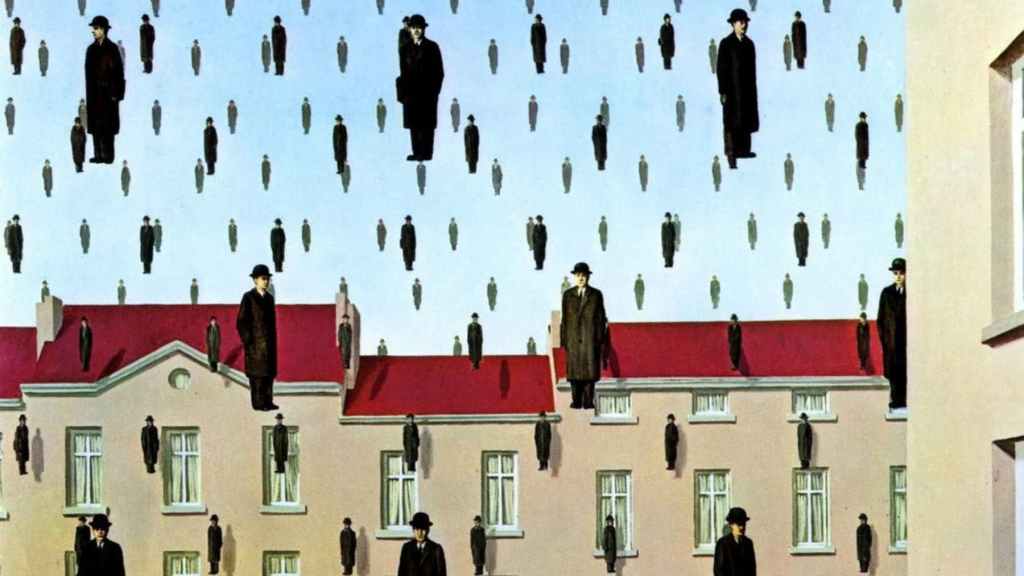
The other major exhibition on in Sydney during  her visit was “Magritte” which features one hundred works by the artist – paintings of clouds, hats, pipes and apples among the most recognisable images of surrealism. Renowned for his deadpan, realist style, the Belgian artist depicted ordinary objects and everyday settings, revealing them to be mysterious and enchanting.

Rene Magritte

“Magritte”  journeys from the artist’s first avant-garde explorations and commercial works in the 1920s, to his groundbreaking contributions to surrealism, his surprising provocations of the 1940s, and the renowned paintings of his final years, before his death in 1967.

With her stop at the Sydney Opera House Smith could have seen the current production of Tchaikovsky’s “The Nutcracker” or even a concert by the New Zealand band Crowded House.

Smith said she loved visiting Sydney, saying the city was beautiful and the people were so friendly.

“The people are charming, the food is good, the scenery is just wonderful, and even the weather is nice,” she said. Although she didn’t expect the city to be quite so developed.

The Sydney Opera House was a particularly special place to visit, with Smith being more than twice as old as the iconic building.

For Dorothy’s Sydney experience watch it here.

Categories
Reviews, News and Commentary

Luise Fong’s “Nexus” examines the body and the cosmos

Reviewed by John Daly-Peoples

Luise Fong, Pathology

Luise Fong, Nexus

Bergman Gallery, Auckland

Until November 30

Reviewed by John Daly-Peoples

When I reviewed the work of Luise Fong in the “Cultural Safety” exhibition at the Frankfurter Kunstverein in 1996 I noted that her surfaces had much in common with an exhibition in the adjacent Jewish Museum which was displaying lampshades made from human skin.

Works from that time such as Pathology Sample ($5200) which refers to the examination of tissue and the wider aspects of death and mutability are central to Fong’s work. These images allude to the body and the forces—physical, psychological and social which affect it.

Luise Fong, Omni

While there is a focus on the body in her works there are wider connections which  encompass the nature of the cosmos as well as with works such as Small Orbit  8 ($6800). This contradiction or ambivalence between the microscopic and macroscopic infuses much of her work. This other worldliness is also suggested in the two photogram works included in the show where objects are transformed into strange shapes as in the UFO Series X ($3000).

There is also a sense of this ambiguity in the ethereal sounds of the Icelandic musical group Sigur Ross which have inspired the artist.

With many of the images such as the sperm-like streaks of paint in Omni ($9800) , the cellulear forms  in Pool ($7700) or the planetary shapes in Orbit ($6800) we are aware of the artists manipulating the painted surface, creating other surfaces and changing our perceptions.

Luise Fong, Twilight III

Some of her more recent work extends the notion of skin with work which look more like fabric, reflecting her Chinese/Malaysian heritage and her interest in textile design. With work such as Twilight III  ($3200) with its vibrant reds and oranges as well as other with dramatic blues, colour plays an important role. These images which can be seen as displaying planetary shapes, and solar flares are also suggestive of MRI s scans of the body, returning her work to its origins of thirty years ago.

Categories
Reviews, News and Commentary

Shane Cotton. New Paintings and new directions

Reviewed by John Daly-Peoples

Shane Cotton, Super Radiance

Shane Cotton

New Paintings

Gow Langsford, Onehunga

Until November 16

Reviewed by John Daly-Peoples

Shane Cotton has progressively mined the history and myth of Māori along with its intersection with European colonisation, featuring images which recall stories, along with references to historical and mythical figures and locations.

With his latest exhibition of “New Paintings” the artist  could be seen as entering his  Fauvist period with many of the paintings having the features of the Fauves. Those painters of the early part of the twentieth century employed simplified shapes along with intense and juxtaposed colours.

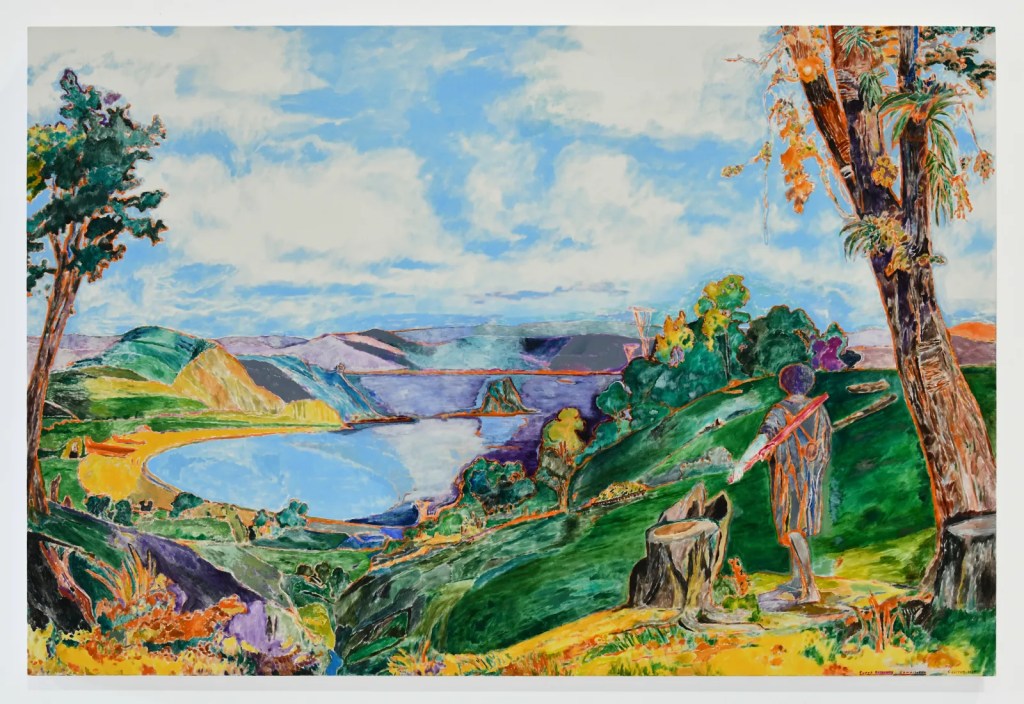
The “He Waka Karaka” ($9000) featuring a small  Pacific craft with a sail exemplifies this aspect with intense blues, purples and green while the large, colourful “Super Radiance” ($90,000) is an example of one of the new directions of Cottons painting – more traditional landscape painting. Even though his previous works have featured landscape forms these were generally refined and abstracted.

There are several works of Cotton’s Toi Moko works where the  tattooed and preserved ‘shrunken’ Māori heads reference conflict, trade, and repatriations. In works such as “The Great Attractors” ($55,000) the tattoo lines tracing out genealogy are linked to the notion of neural connections, knowledge links and computer networks.

Shane Cotton, The Great Attractors

Apart from the shrunken heads Cotton has rarely included figures in his work but in this show, there are several which connect with his living in Northland and revisiting some of his earlier work and the notions of colonialism and cultural exchange.

Shane Cotton, The Walker

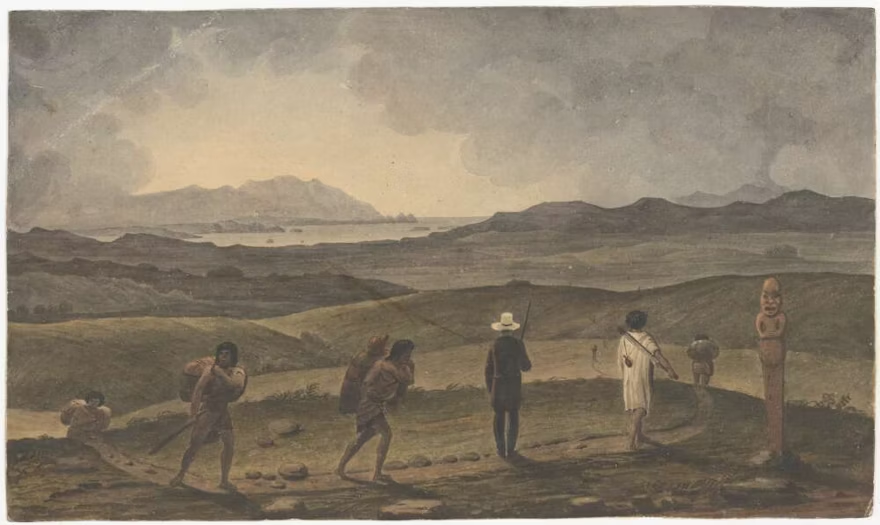
In “The Walker” ($8500) he has replicated the self portrait of the early explorer/artist Augustus Earle taken from Earle ‘s painting “Distant view of the Bay of Island”. Cotton has also appropriated another figure from the work , A Māori with a taiaha who is leading Earle . This figure is also present in “Super Radiance”, “Sunset Gate” ($48,000) and “He tangata hikoi” ($8500) acting as a guide through the landscapes of the North.

Augustus Earle, Distant view of the Bay of Island

Cotton has also used an image of missionary and publisher of Māori works Thomas Kendall taken from the painting “Hongi Hika and Waikato” with Thomas Kendall in England in 1820” by James Barry.

James Barry, Hongi Hika and Waikato” with Thomas Kendall in England in 1820

This image is used in the small portrait “Internal Visions” ($8750) and “The Visitation” ($8500) where Cotton has depicted him contemplating a colourful, modernist manaia form where in the original painting he is looking at Hongi Hika and Waikato.

Shane Cotton, The Visitation

There are also a few of the artists flower painting such as “Insert” ($12,500) which have developed over the years for his early  plant paintings.

There are a number of the artist’s three panel works most of which feature a manaia figure flanked by delicate foliage while others have landscape/vegetation  panels or in the case of ”Ahuaiti’s Cave” ($130,000) images of the sea. This work refers to the Ahuaiti who was rejected by her husband, forcing her to live in a cave on the Northland coast with her son Uenuku Kuare who is depicted at the base of the painting as a tiny figure, the same image as Earle’s guide  in “Distant view of the Bay of Island”.

Shane Cotton, Ahuaiti’s Cave

This linking of mythic figure to historical figure to an  invented guide inhabiting some the paintings is an example of Cottons ability to transition across myth, history, time and location.

To subscribe or follow New Zealand Arts Review site – www.nzartsreview.org.

The “Follow button” at the bottom right will appear and clicking on that button  will allow you to follow that blog and all future posts will arrive on your email.

Or go to https://nzartsreview.org/blog/, Scroll down and click “Subscribe”
Categories
Reviews, News and Commentary

Ray Ching: the huia & our tears

reviewed by John Daly-Peoples

Ray Ching

the huia & our tears

ARTIS Gallery

RRP $80.00

Reviewed by John Daly-Peoples

With his latest book “the huia & our tears” Ray Ching has shown once again that he is not just a great painter, he is also a clever storyteller and an expert ornithologist.

The large format book like all his previous publications is impressive with full colour reproduction, Illustrations spread over two pages, great typography and well researched text. It adds greatly to our understanding and appreciation of the huia which disappeared in the early years of the twentieth century.

The book is a remarkable collection of memories, observations, research and reflections on the huia and its place in New Zealand ornithological and national history.

Ching has had an interest bordering on obsession with the huia from an early age noting that he had always had the bird with him, connected by its image on the old New Zealand sixpence.

Included in the book are the artist’s encounters with taxidermists, ornithologists, writers artists and major figures in New Zealand’s history who provide fascinating insights into the history of the huia.

The Kite and the huia (detail)

In many of his previous books notably his Aesop’s Kiwi Fables  he has included moral tales featuring figures from the animal kingdom. In this  book he has included several examples of these including  “The huia and our tears as well as “The kite and the huia”

He includes early reports of the huia by Charles Heaphy, Edward Jerningham Wakefield and Ernest Dieffenbach as well as Walter Buller’s description of the huia where he wrote:

“The Huia never leaves the shade of the forest. It moves along the ground, or from tree to tree, with surprising celerity by a series of bounds or jumps. In its flight it never rises, like other birds, above the tree tops”.

There are a number of other mentions about the bird such as the poem “The Huia” included in Eileen Duggan’ s 1929 publication “New Zealand Bird Songs”  The final verse of this poem reads:

Where is it now that once was high?

Where is it now, where is its wing?

Where is the Prince of the leaves and sky?

Where is the King?

Ching notes that many of the illustrations of the huia are from examples held in museums but only few from recently killed birds which accounts for the lack of dramatic colouring as the plumage has faded.

Ray Ching, Huia (detail)

In this respect he notes that the work of Keulemans who produced the illustrations for Walter Bullers books on New Zealand birds may be the most accurate as he normally received his birds sent by Buller to Europe within a few weeks of their death.

There is a series of portraits of  Māori by Lindauer and Goldie in which the sitters have worn huia feathers in their hair with Ching referencing the use of the bird’s feathers by high-ranking Māori. Included in these portraits are images Pane Watene (Ngati Maru) and Tawhiao Matutaera Te Wherewhere (Ngāti Mahuta).

Gottfried Lindauer, Pane Watene (Ngati Maru)

As well as Chings account of his sixty-year interest in the huia he includes another important text.

The now out of print publication “The Book of the Huia” written by W.J. Phillipps and published in 1963 is reproduced in full providing additional information . In it the author included conversations and correspondence of early settlers and the place of the huia in the lives of Māori.

He also provides details of the bird’s life from birth through its use as a food and its feathers for decoration both for Māori and later Europeans and its wholesale slaughter in the late nineteenth century and inclusion in museums across the globe.

Ching also includes  details of all the huia held in the many New Zealand locations as well as the UK, America Germany

Categories
Reviews, News and Commentary

Some Neo Impressionists: Gary McMillan and Elizabeth Rees

Reviewed by John Daly-Peoples

Gary McMillan, Scene 60 (detail)
Elizabeth Rees, Low Tide

Gary McMillan, City in Progress

Fox Jensen McCrory Gallery

September/October

Elizabeth Rees, The Bay

ARTIS Gallery

Until October 7

Reviewed by John Daly-Peoples

Two recent exhibitions see artists responding to the to the light, colours and textures of the environment just as artists of 150 years ago did with some variations on Impressionism.

In his latest exhibition “City in Progress” Gary McMillan has continued his depiction of views of the inner city, the motorways and industrial buildings.

These are nearly all seen from the interior of a car, capturing the often-fleeting images we have when driving. He also captures light in its various forms –sunlight at dawn and dusk, reflected light, refracted light, motorway lamps, industrial lights and traffic lights.

Each of the images has the simple title of “Scene” plus a number, an indication of the artist’s referencing photography and film which gives many of the works a slightly surreal quality.

As well as the connections to film and photography his work connects with traditional realist painting, pointillism and neo-Impressionism.

Many of the works capture the flash of recognition, of half seeing objects seen from a moving car as Scene 52 ($9500) – the rain speckled windscreen, parts of the car, overhead road signs, lamp standards and a blinding sun. They are the impressions  the brain takes in as it makes the journey.

Gary McMillan, Scene 63

Scene 63 ($9500) provides a complex view – light blooming on the car’s window screen, light shining through obscuring foliage, another view reflected in the cars side mirror. It becomes an image composed of different elements of light. But these various elements of light are all painted illusions created by the artist.

In these works, he investigates the way in which paint creates the illusion of the photographic pixel as well as the painterly impressionist dot.

At a distant his works look like photographs but as the viewer gets closer to the work one is more aware of the Seurat-like pointillism or the pixilation of low-resolution photographs.

With “Scene 57” ($5500) the pointillism is far more apparent with the sky and clouds stippled with the small dots of colour. The artist has added a sense of structure to the work with parallel power lines and one of his ever-present lamp posts.

Gary McMillan Scene 60

This focus on sky and cloud is also seen in “Scene 60”($8000) where the billowing cloud looks like a massive explosion saturated  with colour.

Where Gary McMillans exhibition looks at the urban environment Elizabeth Rees’s work is focussed on an isolated area of Northland. As she notes in the catalogue – “”The Bay” is a response to my new small-town life in the Bay of Islands where light ever changes the sea and bushclad land. My recent acquisition of a boatshed in a small tidal bay has now become my full-time studio. Being surrounded by water, this change has offered me yet another perspective – being able so closely connected to the natural environment.”

Her paintings owe much to the style of the Impressionists with a sense of the artist painting in the open air surrounded by her subject.

In responding to an environment she feels some connection with these paintings are a record of the various times of day, moods and qualities of light she has observed

Many of her previous works featured figures in a landscape, their presence providing a sense of isolation. In these newer works it is the landscape itself which provides that sense of isolation.

Elizabeth Rees, A High Tide

Here there are brooding landscapes such as  “Summer Shade” ($10,000) where the touches of colour seep through the dark foliage.

With works like “A High Tide” ($8000)) the  colours are almost bleached out with light swirling around the shapes of trees.

Elizabeth Rees, On the Beach

A similar work “On the Beach” ($8000 where the foliage is almost shattered by light, could have been used as the cover illustration for  the Nevil Shute novel “On the Beach” which tells of impending nuclear pollution in the South Pacific

A further connection could also see the work in reference to the origins of the title in the lines from T S Eliots “The Wasteland”

In this last of meeting places
We grope together
And avoid speech
Gathered on this beach of the tumid river. connection

Two of the works features figures as in   “Low Tide” ($8000) where the small figures contribute to the sense of isolation and drama. “Last Light” ($10,500) feels less successful as the two figures contemplating the vista do not contribute to the  sense of remoteness.

With “The Bay” ($10,500) there is  more colour contrast with the blue of the water and the sky more dominant and the colours of the foliage picked out by light.

Elizabeth Rees, The Bay

“Nestled in the Bay” ($13,500) also alludes to the human presence with several low buildings or boathouses which merge with the light colours of the sand and sea.

The merging of sands and sea is also apparent in “Dunes Beyond” ($10,500) where the dunes seem to be the foam of crashing waves.

With nearly all these works it is light which is the dominant aspect with the artist endeavouring to create an ethereal presence of cloud and sky .The hills and foliage created with scumbled paint give a sense of seeing through a darkened or fogged glass.

Categories
Reviews, News and Commentary

Aotearoa Contemporary to open at the Auckland Art Gallery in July

John Daly-Peoples

Maungarongo Te Kawa, Celestial Stargate for Invisible People, 2024 (detail). Photo by Jemma Mitchell

Aotearoa Contemporary

Auckland Art Gallery

July 6 – October 20

 The Auckland Art Gallery Toi o Tāmaki and Ngāti Whātua Orākei have announced a new contemporary art triennial at Auckland Art Gallery which will celebration of the breadth of contemporary art in New Zealand.

“The Gallery is thrilled to partner with Ngāti Whātua Ōrākei to present a new generation of talented artists and showcase Aotearoa New Zealand’s diverse artistic environment.”

“Set to occur every three years, the exhibition provides ongoing representation and pathways for new artistic voices, bolstering the future resilience of New Zealand art. Aotearoa needs a contemporary art triennial and it now has one.” adds Lacy.

Ngāti Whātua Ōrākei Trust Deputy Chair Ngarimu Blair says, “Our tupuna Apihai Te Kawau gifted 3000 acres of land on the Waitematā on 18th September in 1840 to become a city which welcomed people, cultures and ideas from afar. Our relationship with Auckland Art Gallery is founded in the shared goal to foster the arts reflective of our multi-cultural community in Aotearoa.”

With an emphasis on artists not previously exhibited at the Gallery, the exhibition presents 27 artists and 22 compelling new projects in a range of media including painting, textiles, sculpture, ceramics, photography, and performance.

Senior Curator, Contemporary Art, Natasha Conland says, “Aotearoa Contemporary reveals a new cluster of artists who work afresh with ritual and storytelling, mythology, rhythm, indigenous space and materials. There is also a special emphasis on art’s relationship with choreography through the commission of four dance works.”

Curator, Pacific Art, Cameron Ah Loo-Matamua adds, “From Ruth Ige’s enigmatic blue paintings of anonymous figures, to the art collective The Killing’s installation of supersized soft-toys in a state of play, there is something for everyone in this exhibition. Amongst the ambitious new commissions is a three-channel video by Qianye and Qianhe Lin featuring mythology set in Hailing Island off the coast of China and Aotearoa.”

Aotearoa Contemporary is proudly supported by Ngāti Whātua Ōrākei, Auckland Art Gallery Foundation and the Chartwell Trust.

Aotearoa Contemporary has been scheduled to coincide with New Zealand’s leading contemporary art award, The Walters Prize 2024, to provide a broad overview of contemporary art in New Zealand in the Gallery’s winter programme.

The exhibition has been curated by Cameron Ah Loo-Matamua, Natasha Conland and Ane Tonga with support from Ruth Ha.

Artists featured in Aotearoa Contemporary

Emerita Baik, Leo Baldwin-Ramult, Heidi Brickell, Pelenakeke Brown, Jack Hadley, Ruth Ige, Hannah Ireland, Xin Ji, Reece King, Qianye Lin and Qianhe Lin, Te Ara Minhinnick, Ammon Ngakuru, Amit Noy, Sung Hwan Bobby Park, Meg Porteous, Maungarongo (Ron) Te Kawa, Tyrone Te Waa, The Killing (collective), Anh Trân, Manuha’apai Vaeatangitau, Jahra Wasasala and George Watson.

Jahra ‘Rager’ Wasasala by Jocelyn Janon

Jahra ‘Rager’ Wasasala is an award-winning cross-disciplinary artist of Fijian/NZ European descent. As an artist, Jahra investigates her ancestral connections through the art mediums of performance activation, contemporary dance and poetry, and has extensively toured her performance works both nationally and internationally.

As a child of the Pasifika diaspora, Jahra is invested in translating her shared internal conflict into an accessible, yet confrontational, physicalised language. Her most recent performance work titled “a world, with your wound in it” focuses on the complex relationship between the earth and a woman’s body, a theme Jahra continues to investigate in her developing work.

Maungarongo Te Kawa is a takatāpui fabric artist, educator, and storyteller. His practice makes old pūrākau newly relevant using brilliant colour, fluid design, and infectious good humour. Following a career in costume design and fashion, Te Kawa dedicated himself to full-time art-making and teaching. In addition to producing his own elaborate whakapapa quilts, he runs sewing workshops, guiding participants to express their creativity and genealogy through fabric.

Ruth Ige is a Nigerian New Zealand-based painter whose intimate, evocative compositions oscillate between bodily forms and painterly abstractions. While some resemble traditional portraiture, others consist of colour fields that capture a more mysterious, ethereal effect. Hands, shoulders, and faces emerge from a watery facture. “I am interested in creating images that are not easily understood,” says Ige. She considers her unique figuration, which renders her subjects featureless and inscrutable, to be a form of “veiling.”

Performances

The commissioned performances in Aotearoa Contemporary include Pelenakeke Brown, Is this a performance 1+2, Xin Ji, Doco Dance, Amit Noy, Errant and Jahra Wasasala, DRA.

To subscribe or follow New Zealand Arts Review site – www.nzartsreview.org.

The “Follow button” at the bottom right will appear and clicking on that button  will allow you to follow that blog and all future posts will arrive on your email.

Or go to https://nzartsreview.org/blog/, Scroll down and click “Subscribe”

Categories
Reviews, News and Commentary

The APO’s captivating musical tour of Rome

Reviewed by John Daly-Peoples

The Trevi Fountain

The Eternal City

Auckland Philharmonia Orchestra

Auckland Town Hall

June 13

Reviewed by John Daly-Peoples

Respighi’s Roman Trilogy takes the listener on a musical tour of Rome with three tone poems which celebrate the city’s fountains, pines and festivals. Along  the way we encounter the architecture, landscape and history  of the city with vibrant music which capture its moods, sounds and spectacles.

The three works were composed over a twelve-year period 1916 – 1928 and the APO presented the three works under the title of The Eternal City.

The programme opened with  Fountains of Rome, the purpose of which the composer said was “to give expression to the sentiments and visions suggested . . . by four of Rome’s fountains, contemplated at the hour in which their character is most in harmony with the surrounding landscape, or in which their beauty appears most impressive to the observer.”

In this work we encounter some of the smaller fountains like the one by the Villa Medici as well as the extravagant Trevi Fountain.

The first part of the work, inspired by the Fountain of Valle Giulia, depicted a pastoral landscape and  captured the early Romas  dawn with the strings and woodwinds.

This was followed by a sudden loud blast of the brass and percussion above the shrill tones of the orchestra, introducing the Triton who raises a conch to his lips and we also hear the sounds of activity around the fountain.


Next, he depicts The Trevi Fountain at midday, the theme, passing from the woodwind to the brass instruments, with the trumpets depicting the dramatic figure of  Neptune,  seahorses and another Triton blowing a conch shell, the sounds of which were depicted by the orchestra’s horns.


The fourth section depicting the Villa Medici Fountain at sunset captures the fading grandeur of the city with is a nostalgic theme and we hear the tolling of bells above the whispering strings of birds twittering.

The work which features much brass and percussion shows us a panoramic Rome filled with a sensory overload of excitement and activity.

The music captures the flow of water from a trickle to torrents with instruments providing flecks of light intermingled in the sprays of water.

The Pines of Rome

The second work, The Pines of Rome had an animated opening with a depiction of the trees around the Villa Borghese mixed  with the sounds of the city. The depiction then moves to the outer areas of the  city with a  melancholic mood in the area of  the catacombs highlighted with hints of the Latin mass .

The pines on the Janiculum Hill were introduced with timpani and gongs, giving a spacious vision, the trees picked out by the piano and clarinet. As though taking its cue from the clarinet comes a recording of a nightingale seeping into the hall only to disappear with the coming of night and the brooding sounds of the ghosts of centurions returning on the Appian Way. These sounds initially seem distant but then as the orchestra’s voice increases a sextet of brass instrument up by the organ let loose some triumphal sounds conveying the drama of Roman pomp and power.

A Roman Carnival

The third of the works “Roman Festivals” opens with  the same dramatic sounds which featured in the depiction of the Appian way. Here the triumphal sounds become the sounds of gladiatorial combat. After this overexcited opening there were some lovely, lethargic orchestral sounds with echoing strings. In the middle sections the music conveys all the excitement, colours and movement of the community festivals. Here conductor Bellincampi was agile in stressing both  the  clamorous sounds as well as the gentler ones.

The final movement featured a strong, slightly discordant section which morphed into  a folksy romanticism which included a mandolin-like sequence, before moving onto  some circus sounds which recall the cinematic compositions of  Nino Rota and his music for Fellini’s 8½ .The final movement ended with some thunderous sounds from the massed orchestra and  percussion, bringing to an end to a  entertaining journey.

The concert featured a number of musicians from the Australian National Academy of Music , as part of an ongoing collaboration with the APO. 

To subscribe or follow New Zealand Arts Review site – www.nzartsreview.org.

The “Follow button” at the bottom right will appear and clicking on that button  will allow you to follow that blog and all future posts will arrive on your email.

Or go to https://nzartsreview.org/blog/, Scroll down and click “Subscribe”