Categories
Reviews, News and Commentary

Auckland Arts Festival Previews – Visitors, Sultans Kitchen and Duck Pond

John Daly-Peoples

Visitors

Visitors

A Theatre Times review by Bronwyn Carlson.

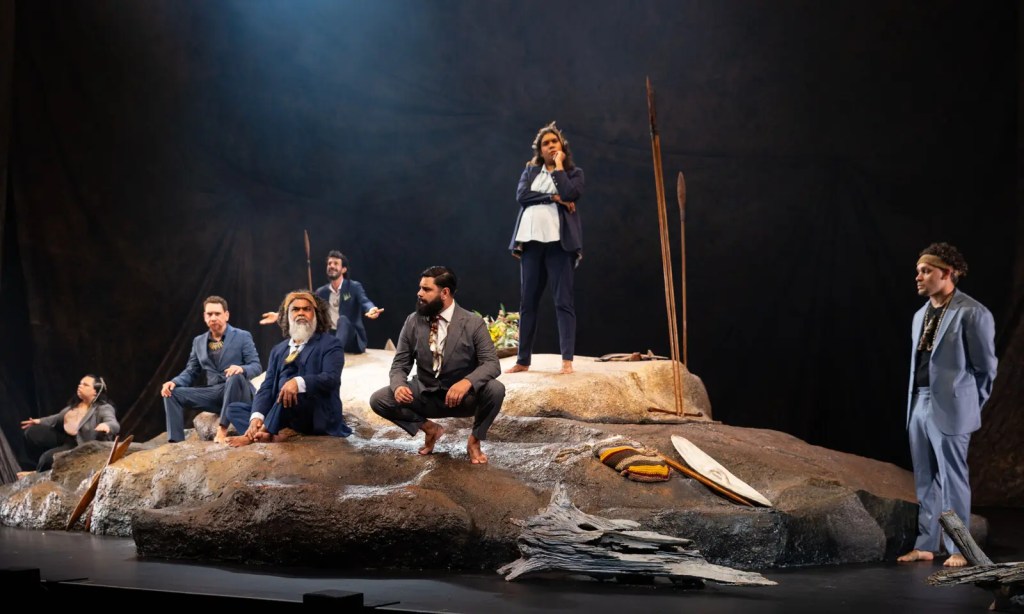
“It is 1788, and six senior lawmen (with one young man sent as a representative) witness the arrival of the First Fleet. The play features a talented cast: John Blair, Damion Hunter, Colin Kinchela, Nathan Leslie, Leroy Parsons, Glenn Shea, Kerri Simpson. As we approach the 250th anniversary of Cook’s arrival, this play is timely and fresh given the paucity of publicly available sources that document first encounters from an Indigenous perspective. Visitors had come and gone for many years and the play includes reference to Cook’s visit 18 Summers prior. But previous visitors always left.

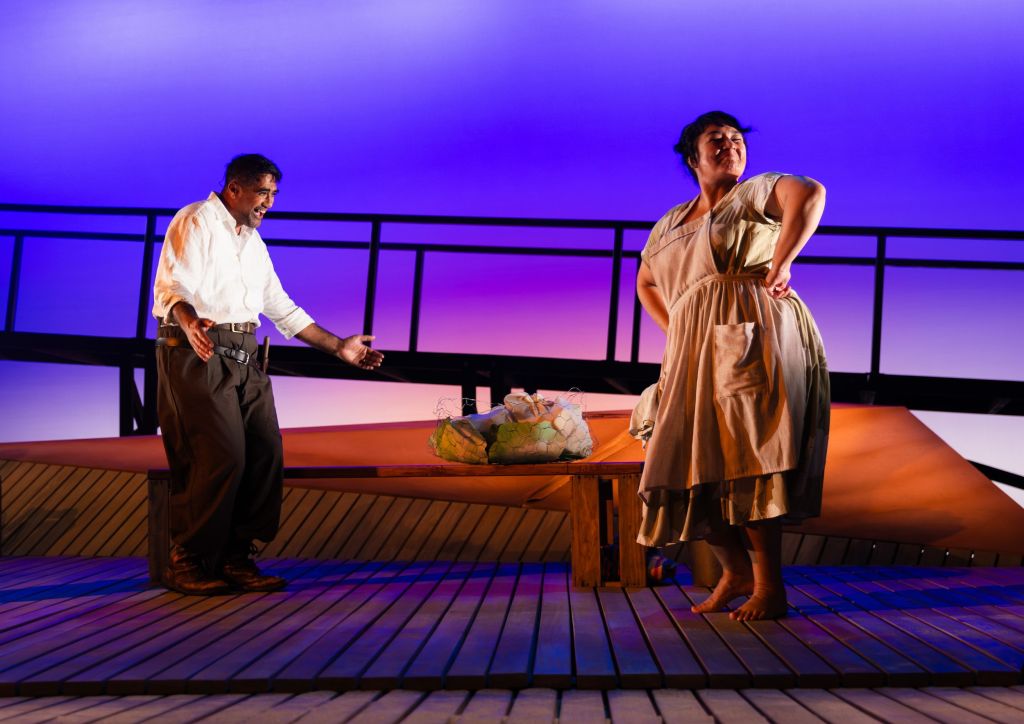
Humour provides relief to this intensely imagined moment in history. The Visitors is written by Jane Harrison. Dir. Frederick Copperwaite. Carriageworks Theatre, 2020. Photo: Jamie James.

The script involves much discussion about whether to engage in war or allow the visitors to come ashore. After lengthy debates, the men notice that the visitors are landing. They make the fatal decision to welcome them. The Visitors’ dialogue is witty and satirical. The men at its center describe the visitors in derogatory ways that mirror the way colonizers described us – “wretched people” with nothing to offer.

The Design

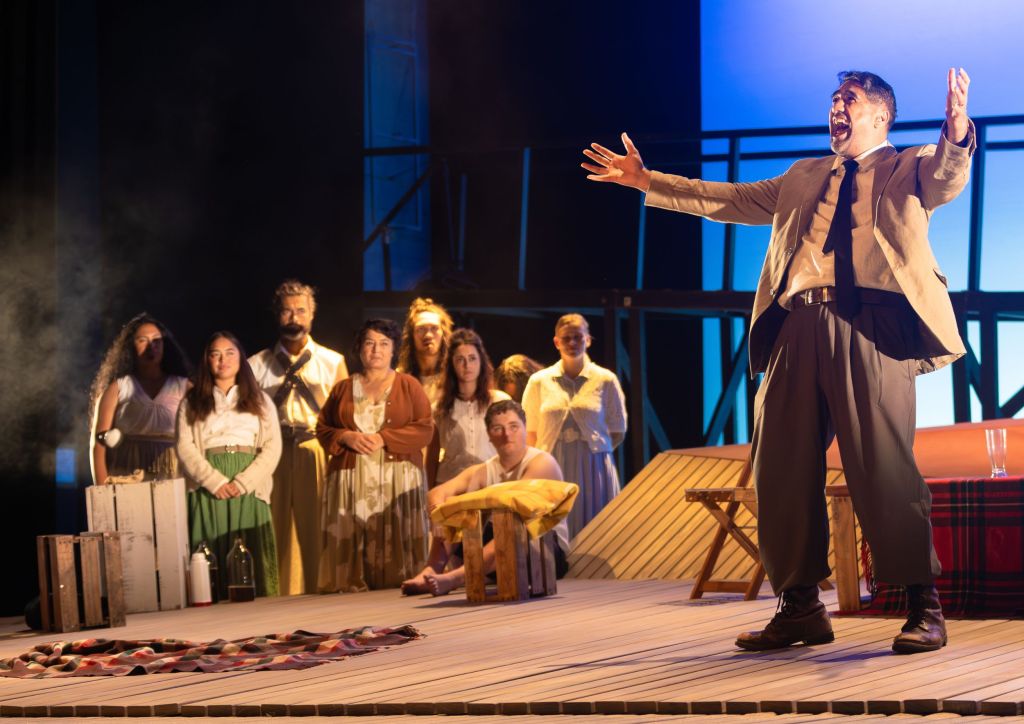
The set is beautifully designed with large trees framing the meeting place. Fog drifts in, allowing the audience to imagine a time long ago by the ocean. The sound of the sea and birds amplifies the experience.

The men are dressed in suits symbolizing their status in contemporary terms. They are given clan names that relate to Countries such as Eel clan or Bay people. This avoids any contest around traditional boundaries and clan names.

Personalities, But Where Are The Women?

Aboriginal protocols are clear – the men pay respect to the Country as they each arrive. Formal proceedings begin with being welcomed onto the Country, just like what the audience experienced before the performance.

Formalities aside, there is also a lot of humour in this play. Fun is made of one of the men who has complained he can’t connect with his new wife. Grandfather Elder examines him and concludes that his new wife probably just doesn’t like him. Personalities are clear – something that is often missed in the colonial writing of Indigenous peoples. We are human, we laugh, we disagree and we engage in combat, revenge, grudges, and all manner of human frailty.

The experience could have only been improved by the inclusion of Aboriginal women in the cast. The women, we are told, are away on Women’s business  and although they are often referred to, are missing from the decision making process. In one scene one of the men refers to women as “spoils” of battle and in another, after hearing the younger man simulate the mooing of a cow, a comment is made that it sounds like his wife. Perhaps this is just banter between men, however, historically a range of tropes have been used to typecast Aboriginal women into roles imagined by the colonizers.

The women’s absence suggests there was — or is — a lack of senior Aboriginal women knowledge holders. The truth is far from this assumption. There is ample evidence Aboriginal women were involved in early interactions, amicable and otherwise, with early settlers. For example, it is believed local fisherwoman Barrangaroo — noted for her presence and authority — was present at the first meeting between settlers and her Cammeraygal people at Manly in 1788, and also participated in warfare with settlers at North Harbour in November 1788. She is remembered in early colonial documents as having a commanding presence, inciting respect and fear in those around her. Likewise across the country, there are stories of Aboriginal women emerging including their heroic efforts to defend Country.

A Place in the Sultan’s Kitchen

A review of A Place in the Sultan’s Kitchen (or How to Make the Perfect One-Pot Chicken Curry) by Nance Haxton in Brisbane’s Indaily

“There aren’t many shows where you emerge and say the play was as good as the food, but A Place in the Sultan’s Kitchen (or How to Make the Perfect One-Pot Chicken Curry) certainly passed the taste test.

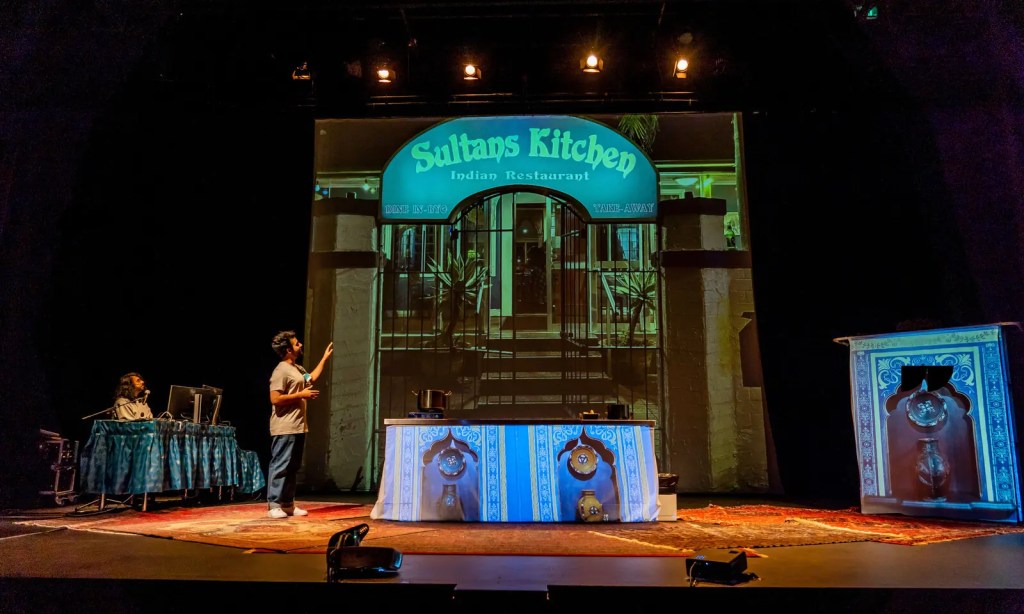
Telling the multi-layered story of his family’s past while cooking his grandmother Mehmeh’s chicken curry, Joshua Hinton recalls his heritage, sprinkled with a message so needed right now – that we are all not as far apart culturally as we think. And that food unites us all.

The Australian singer-songwriter unpicks his origins going back generations by skilfully weaving into his conversation audio interviews with his grandmother while the aromas of turmeric, garam masala, cinnamon, chilli, tomato and chicken float over the audience like a spell.

The spice bottles from his onstage kitchen become integral parts of the story, with photos of his family emerging from the spice rack to become characters in his grandmother’s recollections. Kitchen utensils magically becoming war planes in war stories.

Joshua’s brother Dominic is also on stage throughout, on guitar and supporting his brother by controlling multi-media shots from a range of angles around the kitchen to highlight crucial elements in the evolution of the curry. This all reveals aspects of Joshua’s identity, living between cultures.

For Brisbane lovers and appreciators of Sultans Kitchen, a staple of the Paddington foodie scene for more than 40 years, this is somewhat compulsory viewing to see the incredible challenges that the founders of this Brisbane institution overcame to build this restaurant.

Hinton is a skilled storyteller as well as musician, wrapping up his culinary journey around the world with an original song sung with his brother, satisfying all the senses before the audience steps outside to partake of the chicken curry that formed the backbone of the tale. It was a beguilingly simple device executed perfectly, and a night to remember.”

Duck Pond

A review of Duck Pond in The Guardian by Lindsey Winship
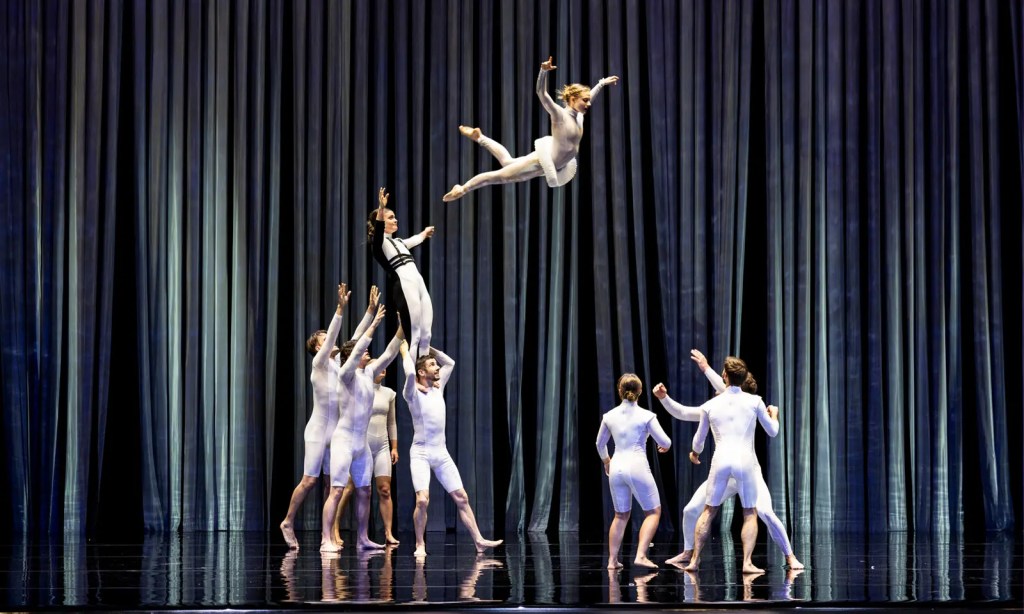
“Australian company Circa are masters of modern circus, often eschewing obvious exhibitionism, and instead weaving acrobatic skills with a dance and theatre sensibility to make mood pieces. Previous works have considered the plight of refugees (The Return), tragic tales of Orpheus and Eurydice or Dido and Aeneas, and have taken on music from Stravinsky’s Rite of Spring to Beethoven’s Ninth – all serious business.

Duck Pond is, on the surface, a less serious proposition. The name is a parody of Swan Lake and it borrows from the famous ballet – shards of Tchaikovsky’s score feed into Jethro Woodward’s soundtrack – and also from another fairytale, the Ugly Duckling. So we get a love triangle of sorts between a prince, an ugly duck and a vivacious black swan. The conceit might seem to promise a more conventional narrative, but it delivers something a little different. The mood is understated, classy, colours of black and gold, a clan of performers in shimmering velvet catsuits. The music is a constant underscore rather than a game of set-ups and climaxes.

There is a lot of beautiful skill on show. Acrobats climb up human towers; flyers somersault between bases. Their formations of three are especially inventive: ornate arrangements of bodies in fine-tuned equilibrium, toes anchored on hips, lower backs, shoulders, anywhere they can get a foothold. There are some lovely moments of flow between couples who lift and fling, curl and unfurl, balance and counterbalance. Bodies tie themselves in knots on the trapeze; others soar on the silks. The ugly duck is revealed to be a swooping swan; the black swan has a dominatrix moment walking over a man’s bare back in red stilettos. But there are lulls too, such as a pillow fight that turns into an anticlimax.

Story-wise, director Yaron Lifschitz puts a couple of nice twists on the Swan Lake narrative but it lacks a big emotional payoff. Low-key lyricism, rather than transactional tricks for applause is Circa’s way and Duck Pond is a lovely show, with warmth, skill and some wow moments, but you can’t help feel it could do with a dash more pizzazz.”

Categories
Reviews, News and Commentary

Niue’s Hikulagi Sculpture Park

John Daly-Peoples

Niue’s Hikulagi Sculpture Park: A Global Microcosm

Sited in the middle of the natural rainforest of the Pacific Island of Niue is a physically small but conceptually monumental installation / treatise on global environment concerns, the Hikulagi Sculpture Park.

The Hikulagi Park was established in 1996 by members of the then Tahiono Arts Collective, a small group of artists including Mark Cross. Many had returned to their Pacific home, countering the trend of urban drift that has devastated many rural and island populations in the Pacific.

Several acres of land south of the eastern village of Liku were at the artists’ disposal and, while being ideal for the purpose of the artists’ environmental concerns, it was also ironically surrounded by the pristine rainforest which once covered the now degraded land.

The park’s concept embraces the sentiment that an island is analogous to Planet Earth in microcosm, and so is intended to encourage discussion on issues such as, pollution, climate change and human co-existence. It is a place where the intrinsic and unique qualities of Niuean Culture and environment can be shared with the world while attracting attention to Niue through the medium of contemporary sculpture, a medium seen nowhere else in the Pacific Islands.

Its intention is to do this through audience participation and the predominant utilisation of the found object; that is to say, the artists and community make sculpture from the inorganic waste created by contemporary consumer society.

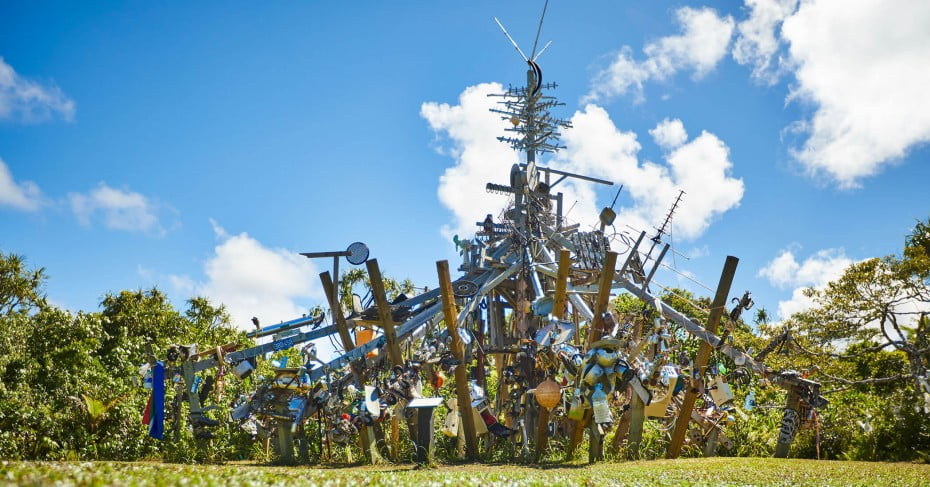
With this in mind, the centrepiece of the park is the monumental sculpture called ‘Protean Habitat’ which epitomises the ideals behind the Hikulagi Sculpture Space. On-going and interactive, it is an art project that does not have any perception of a finite conclusion. Based on a wooden substructure, it is an assemblage sculpture fundamentally constructivist in its utilisation of the found object that can easily be attached with the most basic of tools, enabling passers-by to add their own input.

In its state of ever-changing growth the sculpture reflects the state of the world and the refuse that humanity is accumulating in its juggernaut consumerist path to who-knows-where. This vagueness of direction and final outcome of humanity are then reflected in the unexpected directions the sculpture will take during its growth and the fact that it will grow ad infinitum.

The first sculpture to be erected at the park in 1996 was by Niuean returnee Mikoyan Vekula, who grew up in Wellington. His ‘Odesyk’ is a six-metre semicircle of six totem poles of native Kafika hardwood decorated intricately with cut and inverted beer cans. The circle is completed by limestone rocks known as Makatea throughout Polynesia. Resisting the Polynesian artist trend of introspection in his imagery, Vekula draws from a number of indigenous cultures including Australian, American and Celtic .The totems in this esoterically titled sculpture depict a family, with the guardians on each end of the semicircle and the four children in the middle. At the centre of the circle is a bench intended for the viewer’s contemplation and meditation.

Several more ephemeral artworks have been created by artists who just happen to be passing through Niue. A good example is ‘Web’, a sculpture created by environmental artist Meri Heitala from Helsinki which has been made by stringing telephone wire, spider-web-like, between two coconut trees while attaching drink can tear tabs, which suggests captured insects. In this way, such ephemeral sculptures are encouraged to enlist the input from visiting artists who may not have the time to create something more permanent.

A recent project that is more of an enclosure than a sculpture is ‘Sale’s Fale’, an ongoing project in memory of the Niue High School art teacher and sculpture park co-founder Charles Jessop who passed away in 2012. The sculpture is in the form of a monumental montage constructed by the Niue community through the biennial competition ‘The Charles Jessop Memorial Sculpture Prize’

The Hikulagi Sculpture space to date is being created through the voluntary labour of various individuals and businesses on Niue. Initial funding at its inception was provided by the Pacific Development and Conservation Trust as well as the then Aus-Aid Cultural Fund. The space has been supported by Reef Shipping, The New Zealand High Commission to Niue and Niue Tourism has helped with some construction and on-going maintenance.


Protean Habitat is an ongoing monumental assemblage in an ever-changing state of growth and decay, not unlike all life on the planet Earth. It has an interactive element whereby the public are invited to add their own sub-sculptures to the substructure leaving their small indelible mark on the growth of the main construction.

Mark Cross who has had over 40 years of association with the Island of Niue says “I have been alert to the layers upon layers of humanity that has come and gone leaving small elements of their lives making a small community into a living protean organism. In such an isolated community this awareness becomes more acute and then you realize what you are experiencing is a microcosm of the whole world. So, in its state of ever-changing growth, the sculpture reflects the state of the world and the refuse that humanity is accumulating in its juggernaut consumerist path to who knows where. This vagueness of direction and the final outcome of humanity is then reflected in the unpredictable directions the sculpture will take during its growth and the fact that it may or may not grow ad infinitum.”

The concept behind the Hikulagi Sculpture Park has links to the Watts Towers in Los Angles and Palais Ideal in Hauterives, France.

The Watts Towers are a collection of 17 interconnected sculptural, structures, built by Simon Rodia over a period of 33 years from 1921 to 1954. The Palais Ideal is a series of constructions built by postman. Ferdinand Cheval over 33 years 1879–1912 in Hauterives, France.

A new project will involve the internationally recognised sculptor Chris Booth who has produced more than twenty large scale sculptures around the world. The sculptor travelled to Niue in 2023 when he ascertained the potential sculptural medium of rocks and stones as well as meeting with potential collaborators such as the leading weavers in the village of Liku,

As weaving is the most dynamic artform existing in Niue today Chris has identified with it and master weavers Enele Kaiuha and Ahi Makaea-Cross have agreed to collaborate and transfuse ideas that may influence the design of the sculpture. This collaboration will in turn enable the project managers to interest the wider community in becoming involved both in a practical way (the collection of rocks and stones) and as an audience in the construction of the sculpture and the finished work. We also anticipate that the schools both primary and secondary to be involved from the outset to the completion, the project being a unique opportunity for the children to be exposed to contemporary art practice if not being more closely involved in its construction.

In 2024 he again travelled to Niue in September to try to decide on a more definite concept for the sculpture. Prior to his arrival the Broadcasting Corporation of Niue (BCN) offered the project a cyclone damaged, 8 metre diameter, aluminium satellite dish which could be inverted to form a dome structure. This would support around 1700 150mm rocks from the quarry while another 500 or so weathered beach rocks would provide a contrast to the more jagged quarry stone which would be employed to create the patterns used in the “tia” coil weaving technique (placemats, bowls etc). The use of the satellite dish also fits within the strong Hikulagi ethos of the re and upcycling of obsolete consumer and industrial materials as an environmental statement.

https://www.markcross.nu/

Categories
Reviews, News and Commentary

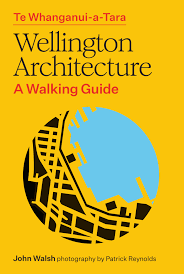
Wellington Architecture: A Walking Guide

Reviewed by John Daly-Peoples

Wellington Architecture: A Walking Guide

John Walsh and Patrick Reynolds

Massey University Press

RRP $37.00

Reviewed by John Daly-Peoples

John Walsh and photographer Patrick Reynolds have just launched “Wellington Architecture, A Walking Guide” their third book in the series of architectural walking tours following on from their books on Auckland and Christchurch. It is a great addition to books which explore and explain our built environment.

 John Walsh in the introduction notes that he was born in Wellington which was as “compact and confined as a medieval city-state, intensely impressed itself on me, in the most impressionable part of my life. My mother had moved to Wellington where she met my father, and they were married in the church at St Gerard’s Monastery. I remember the Freyberg Pool, where I learned to swim; the summer lights strung on the Norfolk pines along Oriental Parade; and the council yard where my father worked, next to the Herd Street Post and Telegraph Building. My high school was near the old National Art Gallery and Dominion Museum; we’d be sent to mass at St Mary of the Angels and, in blazers and ties, despatched from Wellington Railway Station on rugby expeditions into the hinterlands of the Hutt Valley.”

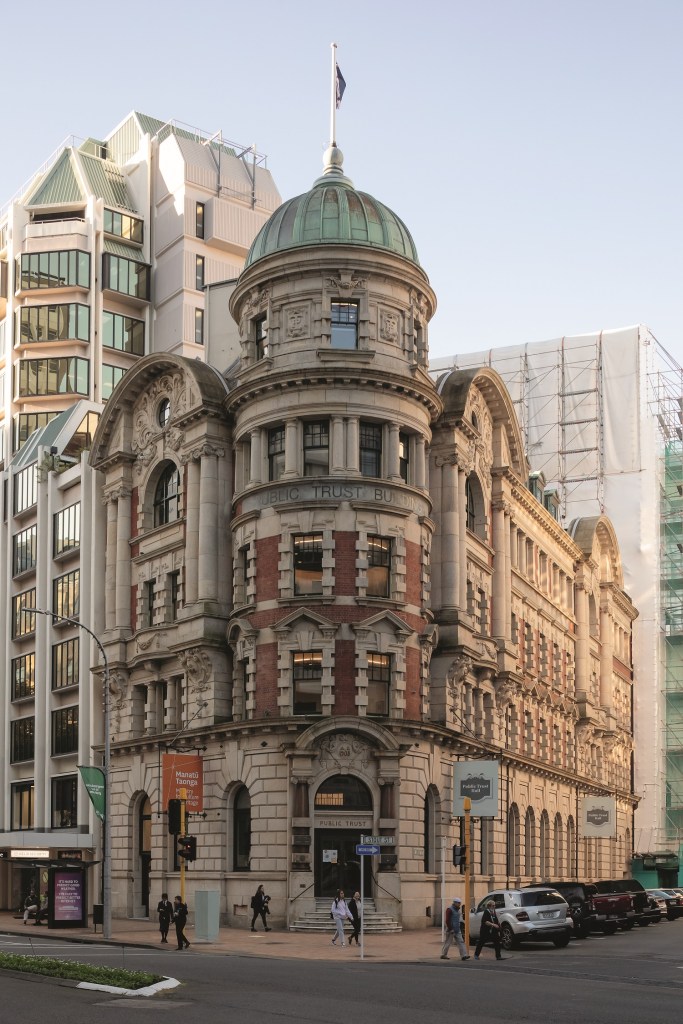
Public Trust Building

This reviewer also grew up in  Wellington, living in the National Hotel  across from  the corner of Stout St and  Lambton Quay. From our front room we had an impressive architectural vista including The Public Trust Building The Government Departmental Building and The State Insurance Building. Further down the street was the Wellington Railway Station  and the Seamans Mission Building.

On my way to school I passed  Ernst Plischke’s Massey House, The Old Supreme Court, The Old Government Building, The Beehive, Parliament building, the General Assembly Library, Turnbull House and the rather unfortunate Cathedral of St Paul. These were the background to my life at the time and it was only when I moved to suburban Karori that I noticed the difference in my daily environment.

Shed 7, Wellington Harbour Board

The place of architecture in our environment and in our personal and social history is important often more noticeable when we are in foreign cities. A city’s buildings are important in defining the nature of a place. When visiting a place for the first time the visitor will map a city through its buildings. The materials, the orientation, the colours, the decoration and the forms all help create the language of the way the city is perceived.

The buildings of Auckland Wellington and Christchurch have many similarities but the accumulation of the various periods of construction and styles in each of those places has created very individual environments.

“Wellington Architecture, A Walking Guide” features more than 120 significant buildings describing their purpose and history as well as  providing a background on  the architects who designed them. The buildings are grouped into five self-guided walking routes, each with a map together with itineraries which collectively create a portrait of the  city.

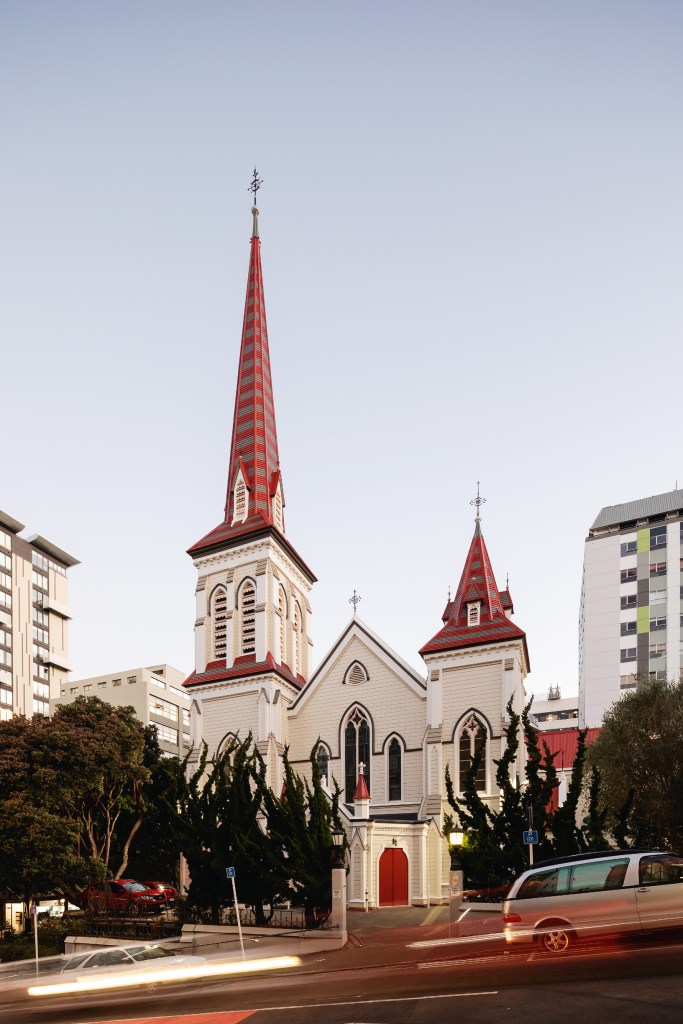
St John’s

The building are  a mix of colonial, nineteenth century Gothic, mid-century modernism and buildings of the last fifty years illustrating the changing nature of the architecture along with the changing nature of New Zealand and the city. The buildings are banks, businesses, government departments, churches, apartment buildings libraries, hotels, apartments, and a few  private houses.

One of the tours features several of the government institutions surrounding Parliament including the Old Government Building (now the Victoria University Law School) and one on the largest wooden buildings in the world, all those other buildings I passed on the way to school along with the more recent  brutalist National Library and the modernist Freyberg Building.

Several architects feature with a number of buildings such as Gummer & Ford, Thomas Turnbull and Ian Athfield who is represented by the Wellington Library (soon to be reopened) and his Oriental Parade flats as well as a few, often controversial,  additions he made to existing buildings

DeLoitte, 20 Customhouse Quay

While all the buildings are significant there are a number  scattered through the  walk which have importance beyond their architectural qualities. There are the Dixon Street Flats which were the first multi-story modernist block of flats created under the First Labour Government which show the influence of overseas trends introduced to New Zealand by Plischke.

There is also the remarkable Futuna Chapel designed by John Scott the Māori architect who managed to combine aspects of Māori and mainstream architecture. Walsh notes that Futuna is  one of the few buildings one could refer to as “iconic”.

Asked which building he regarded as the most interesting new building in Wellington he has stated that it is Heke Rua the new building for New Zealand’s Archive beside the National library, both for its architecture as well its signaling a commitment to preserving the nations documentary heritage.

Walsh writes in an informative style, providing wide ranging information to provide a context for the buildings so that while the book is an ideal complement to a walking tour of the city it is also provides a potted history of the social, political and aesthetics development over 150 years in the city as seen through the buildings.

The photography of Patrick Reynolds enhances the text with many of them showing an appreciation of the design elements of the buildings, 

Anscombe Flats
Categories
Reviews, News and Commentary

Wellington Architecture: a Walking Guide

Wellington Architecture: A Walking Guide

John Walsh and Patrick Reynolds

Massey University Press

RRP $37.00

Reviewed by John Daly-Peoples

John Walsh and photographer Patrick Reynolds have just launched “Wellington Architecture, A Walking Guide”  a revised edition of the book first published in 2022. This is their third book in the series of architectural walking tours following on from their books on Auckland and Christchurch. It is a great addition to books which explore and explain our built environment.

 John Walsh in the introduction notes that he was born in Wellington which was as “compact and confined as a medieval city-state, intensely impressed itself on me, in the most impressionable part of my life. I remember the Freyberg Pool, where I learned to swim; the summer lights strung on the Norfolk pines along Oriental Parade; and the council yard where my father worked, next to the Herd Street Post and Telegraph Building. My high school was near the old National Art Gallery and Dominion Museum; we’d be sent to mass at St Mary of the Angels and, in blazers and ties, despatched from Wellington Railway Station on rugby expeditions into the hinterlands of the Hutt Valley.”

A building with a dome on the top

AI-generated content may be incorrect.Public Trust Building

This reviewer also grew up in Wellington, living in the National Hotel across from the corner of Stout St and Lambton Quay. From our front room we had an impressive architectural vista including The Public Trust Building, The Government Departmental Building and The State Insurance Building. Further down the street was the Wellington Railway Station.

On my way to school I passed Ernst Plischke’s Massey House, The Old Supreme Court, The Old Government Building, The Beehive, Parliament building, the General Assembly Library, Turnbull House and the rather unfortunate Cathedral of St Paul. These were the background to my life at the time and it was only when I moved to suburban Karori that I noticed the difference in my daily environment.

A building with a dome top

AI-generated content may be incorrect.Shed 7, Wellington Harbour Board

The place of architecture in our environment and in our personal and social history is important often more noticeable when we are in foreign cities. A city’s buildings are important in defining the nature of a place. When visiting a place for the first time the visitor will map a city through its buildings. The materials, the orientation, the colours, the decoration and the forms all help create the language of the way the city is perceived.

The buildings of Auckland Wellington and Christchurch have many similarities but the accumulation of the various periods of construction and styles in each of those places has created very individual environments.

“Wellington Architecture, A Walking Guide” features more than 126 significant buildings describing their purpose and history as well as providing a background on the architects who designed them. The buildings are grouped into five self-guided walking routes, each with a map together with itineraries which collectively create a portrait of the city.

A church with a tall steeple

AI-generated content may be incorrect.St John’s

The building are a mix of colonial, nineteenth century Gothic, mid-century modernism and buildings of the last fifty years illustrating the changing nature of the architecture along with the changing nature of New Zealand and the city. The buildings are banks, businesses, government departments, churches, apartment buildings libraries, hotels, apartments, and a few private houses.

One of the tours features several of the government institutions surrounding Parliament including the Old Government Building (now the Victoria University Law School) and one on the largest wooden buildings in the world, all those other buildings I passed on the way to school along with the more recent  brutalist National Library and the modernist Freyberg Building.

Several architects feature with a number of buildings such as Gummer & Ford, Thomas Turnbull and Ian Athfield who is represented by the Wellington Library (soon to be reopened) and his Oriental Parade flats as well as a few, often controversial,  additions he made to existing buildings.

Asked which building he regarded as the most interesting nee building in Wellington he has stated that it is Heke Rua the new building for New Zealand’s Archive beside the National library, both for its architecture as well its signaling a commitment to preserving the nations documentary heritage.

Categories
Reviews, News and Commentary

Wellington Architecture: A Walking Guide

Reviewed by John Daly-Peoples

Wellington Architecture: A Walking Guide

John Walsh and Patrick Reynolds

Massey University Press

RRP $37.00

Reviewed by John Daly-Peoples

John Walsh and photographer Patrick Reynolds have just launched “Wellington Architecture, A Walking Guide”  a revised edition of the book first published in 2022. This is their third book in the series of architectural walking tours following on from their books on Auckland and Christchurch. It is a great addition to books which explore and explain our built environment.

 John Walsh in the introduction notes that he was born in Wellington which was as “compact and confined as a medieval city-state, intensely impressed itself on me, in the most impressionable part of my life. I remember the Freyberg Pool, where I learned to swim; the summer lights strung on the Norfolk pines along Oriental Parade; and the council yard where my father worked, next to the Herd Street Post and Telegraph Building. My high school was near the old National Art Gallery and Dominion Museum; we’d be sent to mass at St Mary of the Angels and, in blazers and ties, despatched from Wellington Railway Station on rugby expeditions into the hinterlands of the Hutt Valley.”

A building with a dome on the top

AI-generated content may be incorrect.Public Trust Building

This reviewer also grew up in Wellington, living in the National Hotel across from the corner of Stout St and Lambton Quay. From our front room we had an impressive architectural vista including The Public Trust Building, The Government Departmental Building and The State Insurance Building. Further down the street was the Wellington Railway Station.

On my way to school I passed Ernst Plischke’s Massey House, The Old Supreme Court, The Old Government Building, The Beehive, Parliament building, the General Assembly Library, Turnbull House and the rather unfortunate Cathedral of St Paul. These were the background to my life at the time and it was only when I moved to suburban Karori that I noticed the difference in my daily environment.

A building with a dome top

AI-generated content may be incorrect.Shed 7, Wellington Harbour Board

The place of architecture in our environment and in our personal and social history is important often more noticeable when we are in foreign cities. A city’s buildings are important in defining the nature of a place. When visiting a place for the first time the visitor will map a city through its buildings. The materials, the orientation, the colours, the decoration and the forms all help create the language of the way the city is perceived.

The buildings of Auckland Wellington and Christchurch have many similarities but the accumulation of the various periods of construction and styles in each of those places has created very individual environments.

“Wellington Architecture, A Walking Guide” features more than 126 significant buildings describing their purpose and history as well as providing a background on the architects who designed them. The buildings are grouped into five self-guided walking routes, each with a map together with itineraries which collectively create a portrait of the city.

A church with a tall steeple

AI-generated content may be incorrect.St John’s

The building are a mix of colonial, nineteenth century Gothic, mid-century modernism and buildings of the last fifty years illustrating the changing nature of the architecture along with the changing nature of New Zealand and the city. The buildings are banks, businesses, government departments, churches, apartment buildings libraries, hotels, apartments, and a few private houses.

One of the tours features several of the government institutions surrounding Parliament including the Old Government Building (now the Victoria University Law School) and one on the largest wooden buildings in the world, all those other buildings I passed on the way to school along with the more recent  brutalist National Library and the modernist Freyberg Building.

Several architects feature with a number of buildings such as Gummer & Ford, Thomas Turnbull and Ian Athfield who is represented by the Wellington Library (soon to be reopened) and his Oriental Parade flats as well as a few, often controversial,  additions he made to existing buildings.

Asked which building he regarded as the most interesting nee building in Wellington he has stated that it is Heke Rua the new building for New Zealand’s Archive beside the National library, both for its architecture as well its signaling a commitment to preserving the nations documentary heritage..

Categories
Reviews, News and Commentary

The Collector: Thomas Cheeseman and the making of the Auckland Museum

Reviewed by John Daly-Peoples

The Collector; Thomas Cheesemen and the making of the Auckland Museum

Andrew McKay and Richard Wolfe

Massey University Press

RRP $65.00

Reviewed by John Daly-Peoples

Museums have had a lot of critical press over the past few years, viewed as agents of the colonizers because their collections often contain artifacts taken from colonized countries, and their early practices reinforced colonial ideologies by presenting the colonizer as superior. They functioned as a means of control, where European museums collected objects from voyages of exploration and colonies to showcase their dominance and justify the imperial project. But a major thrust of museums has also been to preserve, interpret, and exhibit the local cultural and scientific heritage serving as a bridge between the past and present by collecting objects, telling stories, and providing a space for people to learn, reflect, and connect with history, art, and science.

That has certainly been the aim of the Auckland Museum and the individuals who initiated it, guided it and developed it. A new book “The Collector; Thomas Cheeseman and the making of the Auckland Museum” tells how the Auckland Museum, like man y other museums in the nineteenth century were guided by visionary individuals.

The newly opened Auckland and Institute in 1876 Thomas Cheeseman stands in the doorway

Authors Andrew McKay and Richard Wolfe write about the establishment of the museum’s first custom-built building in 1876 at the northern end of Princes Street.  When it opened the director was Thomas Cheesman who had been in the post since 1874, remaining in the post remained in that post until his death in 1923.

They write about the original building which was unfavourably compared to the more ambitious Christchurch Museum. It was “plain, improvised and almost invisible … It was housed in an old public building, with little funding and few staff. But that’s what makes the story compelling. The contrast between the buildings isn’t just architectural — it reflects differing levels of civic support, cultural ambition and access to resources. Auckland’s museum didn’t look like much, but it had people with vision, especially Thomas Cheeseman. Over time, he took that underwhelming space and turned it into a serious scientific institution.”

Under his visionary guidance the Museum and its collections flourished, necessitating a further move and the commissioning of a world-wide architectural competition to design a new Museum for Auckland which would be combined with a war memorial to commemorate soldiers lost in World War I. That new museum opened on its current site in 1929.

Not only did Cheesman manage to the institution for nearly fifty years but as a self-taught botanist he travelled the length and breadth of New Zealand, collecting and recording plants, and observing the geography of the country. During his career, Cheeseman also published numerous important papers on a range of flora, described three plant genera, and numerous plant species from New Zealand and the Cook Islands. At the request of the New Zealand government, Cheeseman began his magnum opus, Manual of the New Zealand flora, which was first published in 1906and in 1914 he edited the two-volume work Illustrations of the New Zealand flora.

Thomas Cheeseman

Cheeseman met or corresponded with many of the scientists in New Zealand as well as extensive professional relationships with local and international colleagues, including  the German-born geologist and director of the Canterbury Museum, Julius von Haast, the geologist James Hector of the the Colonial Museum, the geologist, zoologist and museum director Frederick Hutton as well as  Sir Joseph Hooker at the Royal Botanic Gardens in Kew, England. 

Early on in his career he even corresponded with Charles Darwin as the authors write. “Charles Darwin was arguably the most famous scientist in the world and also one of the most controversial. And it wasn’t just a lucky moment. Cheeseman’s note was careful, respectful and scientifically rigorous. It showed that he wasn’t just some amateur with an opinion — he was a careful observer who took the work seriously. Darwin saw that. For Cheeseman, it must have been thrilling and validating. It also helped open doors — that exchange helped establish his credibility in the scientific world, and it reinforced the idea that valuable knowledge didn’t just come from Oxford or London, it could come from a young man on the edge of empire, with a sharp mind and a notebook. That Cheeseman dared to write at all — and so confidently — speaks volumes about both his scientific maturity and his quiet self-assurance.”

The book highlights Cheeseman’s efforts to develop the taonga Māori component of the museum and also touches on the ethically sensitive area of collecting the art and culture of Māori noting ‘While Thomas Cheeseman was largely guided by the norms of nineteenth-century science, some of his actions — particularly around the acquisition and display of taonga Māori — now fall into ethically ambiguous, if not outright troubling, territory. His drive to build the Auckland museum’s collections sometimes led him to treat cultural objects as specimens, detached from the communities that made and valued them.

His acquisition methods could also be problematic. In several cases, taonga were obtained through missionary networks, collectors or private sales, often with little documentation about provenance or permission. Cheeseman rarely questioned the ethics of these transactions… These actions were not driven by malice, but rather by an unshakeable belief in the civilising power of museums and the primacy of scientific classification.”

The book tells the history and development of the Auckland Museum and its progress over more than fifty years to the triumph of the building on the present site in Auckland Doman. It also tells of the journey of Thomas Cheeseman who become a great person of influence not just in Auckland but nationally.  The book also gives an account of the changing scientific and cultural landscape of the latter part of the nineteenth century and the early part of the twentieth century.

It is a well-researched and written book, thoughtfully designed with numerous images which help tell the entwined stories of Cheeseman, the development  of scientific inquiry, the museum and museum’s collections.

Andrew McKay holds a PhD in art history from the University of Auckland and was a Professional Teaching Fellow in the university’s art history department.

Richard Wolfe is an Associate Emeritus of the Auckland War Memorial Museum and from 1978 to 1997 was Curator of Display. He has written numerous books on New Zealand art, history and popular culture.

To subscribe or follow New Zealand Arts Review site – www.nzartsreview.org.

The “Follow button” at the bottom right will appear and clicking on that button  will allow you to follow that blog and all future posts will arrive on your email.

Or go to https://nzartsreview.org/blog/, Scroll down and click “Subscribe”

Categories
Reviews, News and Commentary

The Hanly House Residency. Preserving the legacy of Gil and Pat Hanly

John Daly-Peoples

The Hanly House Residency

A visionary plan to preserve, establish and maintain the home of Gil and Pat Hanly as an artist’s residency and museum at 7 Walters Road, Mt Eden was recently announced at the artist’s former home.

The house and extensive tropical garden located in the heart of Mt Eden, would operate as a social hub, gallery and museum as well as an education and research space for New Zealand art history, and a unique supported urban artists’ residency and studio for emerging contemporary artists locally and from across the world.

Iconic New Zealand artists Pat, a painter and Gil, a documentary photographer, contributed significantly to the social, political and cultural landscape of Aotearoa. Through the Hanly House project the family wish to celebrate Pat and Gil’s contributions to the cultural landscape of Aotearoa, and for visitors and researchers to enjoy and be inspired by it.

The Artist Residency Programme would support artist at a critical point in their career development by providing the house rent free for up to five years.

The residency would work with key stakeholders including Te Papa, AAG, ELAM and ILAM to achieve that goal.

Initial aims of the Hanly House would be to raise capital to purchase the house and garden from the Family. Once established it is intended that house would host regular arts focused functions and support public access to events at the house, support public access to the  garden and raise operational funds through events, endowment fund, and edition sales.

ARTIST RESIDENCY DETAILS

  • Long term (3 -5-year residency programme)
  • Open to national and international artists through an arts partner organisation.
  • Selection Process and Programme in Partnership with Te Papa, AAG, ELAM, ILAM
    • Artist to be between 30 and 40 years old
    • Artist’s family welcome to reside with artist
    • On acceptance of the residency, The Artist will be expected to reside and work at the address for the duration of the period, with standard holiday breaks.
    • The residing Artist participation and outcome expectations would include
      • Attend the Annual Garden Party Functions at the house.
      • Speak at quarterly In Conversation programmes at the house or another arts organisation.
      • Deliver a body of work or installation that responses to the region.
      • Produce and gift to the Trust a series of limited edition to the value of $20,000 for fundraising purposes.

The Hanly Family Trust is currently supporting the development of the Hanly House proposal and is calling on individuals for support. Supporters can make immediate donations of $5 or more and can pledge donations which will help offset the establishment costs and enable the commissioning of further development plans.

Supporters can register at various tiers:

  • Heart 1M+
  • Kowhai 500K+
  • Dove 100K+
  • Hope 5K+
  • Activist 1K+
  • Benefactors will be acknowledged, onsite, in print material and at functions.

To subscribe or follow New Zealand Arts Review site – www.nzartsreview.org.

The “Follow button” at the bottom right will appear and clicking on that button  will allow you to follow that blog and all future posts will arrive on your email.

Or go to https://nzartsreview.org/blog/, Scroll down and click “Subscribe”

For more information – hanlyhouse.nz

Contact diane.blomfield@icloud.com to discuss your pledge.

To subscribe or follow New Zealand Arts Review site – www.nzartsreview.org.

The “Follow button” at the bottom right will appear and clicking on that button  will allow you to follow that blog and all future posts will arrive on your email.

Or go to https://nzartsreview.org/blog/, Scroll down and click “Subscribe”

Categories
Reviews, News and Commentary

PĀ – Te Huarahi ki te Kāinga  Hiria Anderson-Mita’s continuing journey

Reviewed by John Daly-Peoples

Hiria Anderson-Mita

PĀ – Te Huarahi ki te Kāinga Finding my way Home’

Tim Melville Gallery

Until November 15

Reviewed by John Daly-Peoples

Writing about Hiria Anderson-Mita a couple of years ago I noted that she “has never had to look far for subject matter. She only has to look around the room, out the window or down the road. Her paintings are essentially documentation of her daily life, painting what she sees, the people she encounters and her immediate experiences.”

Her domestic interiors or local views of her local environment were both mundane and intriguing.

This incongruity in many of her works give the images both a simplicity and sophistication. One could compare her paintings to the simple French Impressionist paintings as well as the recent landscape paintings of David Hockney, in creating timeless views.

In her latest exhibition the  paintings and view points have been extended, broadening out from the local to the wider area of hers and her ancestors land  so the exhibition becomes for her “a return to the ancestral landscapes that have shaped who I am.”

In the catalogue notes she writes “The tracts of farmland in these artworks hold the DNA and stories of my ancestors. Their ridges and valleys are layered with the pā sites of my tūpuna; connections that survey pegs and ownership papers can never sever.
 
In fact those pegs and papers are reference points for rediscovery.  

Through researching Māori Land Court records and field books made by 19th Century Government Surveyor William Cussen – alongside maps, archaeological files, photographs, oral histories and the living landscape itself – I am tracing the footprints of my tūpuna.

Each painting in this exhibition describes and locates a site of history and connection within the rohe of Ōtewa, Rangitoto Tuhua and the surrounding pā of Ngāti Maniapoto and Rereahu.

The pā tuna, the kohatu, the maunga, and the awa I paint were once sources of sustenance  for entire communities. I want to make them visible once more; to bring them into the light. And to reinsert our knowledge and our presence into the whenua from which we have been separated by pen and politics.

I have been guided by ancestors who still reside within me. My paintings are my journey home.”

Central to the works is the large “Ōtuaoroa” ($11,500) which is the original name for the area. The artist calls the painting “A map”, so the image is like the chart of a mythical land or a treasure map found in a children’s book with each road, farm, bend in the river all bearing a history. Many of these places are then seen in a larger format in other paintings such as “Puketarata Rd No2” ($3500) which is the view from her childhood home or “Hikurangi Pa” ($3250) a  bend in the river where her ancestors had been born and which sustained the local population with food.

There are also links to the geomorphological qualities of the land which had intrigued Colin McCahon and his study of the landforms and their history.

Puketarata

This idea of discovering the history and formation of the land is seen in Puketarata ($7500) where the landscape is inscribed with other information such a pre-European name, survey number, the indication of tracks or landforms as well as the Google Earth Coordinates.

Turamoe Pa Otuaoroa (Te Kooti’s Lookout)

Most of the works have personal connection to the artist and their importance and significance is made clear from their titles of the catalogue notes. So, there is the obvious “Otewa – My Mothers Ancestral Home ($3500) as well as “Turamoe Pa Otuaoroa (Te Kooti’s Lookout)” ($3250) featuring the hill site where Te Kooti spent the last years of the Land Wars.

Otwea Pa – Into the Future

Most of the works in the exhibition are landscapes but there are a few are more emblematic. One “Otewa Pa – Into the Future ($5750), a portrait of a niece where the artist envisions the future and  there is the more abstract “Hinaki a Rautawhiri / Te Awa a Tane Pa Tuns” ($4750) which looks to the past with a design  featuring netting used to trap fish and fowl.

The paintings in the exhibition paintings along with a poem she has written, “her return Home” as well as many of her previous paintings build a visual biography of her personal connections with the land, a history which is both personal, tribal and mythological.

Categories
Reviews, News and Commentary

Exhibition of Michelangelo’s Sistine Chapel coming to Wellington for Christmas

Reviewed by John Daly-Peoples

Michelangelo Creation of Adam

MICHELANGELO – A Different View 

Tākina, 50 Cable Street

December 22 – February 8

Reviewed by John Daly-Peoples

The Sistine Chapel at the Vatican is home to one of the greatest artistic accomplishments in history. It was there in the early 16th century that Michelangelo created the brilliant religious frescoes on the ceiling telling the stories from Genesis. He also painted The Last Judgement on the altar wall, depicting the Second Coming and the Final Judgement.

While millions of viewers have visited the chapel in Rome each year it is not always the most pleasurable experience with the room  crowded with hundreds of people and a constant babble of voices. Having to crane one’s neck to see the ceiling surrounded by milling people is not the ideal way to see the work.

Now a new photographic exhibition attempts to replicate the experience with large reproduction of the Michelangelo’s ceiling and   The Last Judgement. The exhibition was shown in Auckland three years ago, attracting large numbers interested in the religious, art and historical significance of the works..

The exhibition has used state-of-the-art technology to reproduce photographs taken of the artworks following recent restorations

The printing techniques used have been able to  reproduce the colours, the details and  brushstrokes, even compensating for the curved nature of some of the paintings

The reproduction 4.6 metres by 20 metres –  about half the size of the actual ceiling but up close the images provide a new experience.

The image of the ceiling is laid out on the floor and adjacent to it is a viewing platform which provides a view which in many ways is better than the original. Even if you have seen the original this is a different experience as you can see the detail of the work and appreciate the overall design as well the juxtaposition of figures and colours.

Many of the smaller elements of the work which are hardly visible when standing in the chapel such as the small bronze-coloured medallions but these are clear now and add another level of complexity and  understanding to the work.

For many the work will be a religious experience seeing the stories from the Bible brought to life on a grand scale. For others it will be an admiration of the originality and skill displayed by the artist along with an appreciation of the working conditions he faced in creating the works.

Michelangelo, The Last Judgement

On the Sistine Chapel ceiling he painted his complex telling the story of the Creation according to Genesis, the beginning of the world. Then in the Last Judgment he presents the end of the world when the godly are separated from the ungodly. Here the scene is presided over, not by the old, bearded god of the ceiling but by a youthful dynamic figure. Michelangelo also included a self-portrait – a flayed skin  which is something of a metaphor of the artist who considered himself to have been eviscerated by the whole painterly journey.

The ceiling painting is a stunning example of trompe l’oeil with the painter creating an illusory architecture with marble putti supporting a cornice on whose regularly placed outcrops are stone seats on which, nude figures are seated along with images of major Prophets and Sibyls seated on monumental thrones .

Michelangelo, Delphic Sibyl

Michelangelo had a difficult task in reconciling the ideas of Renaissance Humanism with the theology of 16th century Christianity. This was because the Church emphasized Man as essentially sinful and flawed, while Michelangelo was focused on Man’s beauty and nobility. The  two views were irreconcilable and led to later problems such as the nudes of the Last Judgment having drapery painted over their testicles after the artists death.

For Michelangelo it was the creation  of the  human body which was paramount. In his depiction of the creation of Adam it is not so much the creation of a man but the creation of a body and this awe in the beauty of the human body is repeated in many of the figures both naked and clothed

Prior to the Renaissance images of God were rare and generally symbolic. In the early Renaissance such image depicted a patriarchal God the Father as an old man, usually with a long beard. Michelangelo’s image of God saw him with almost human qualities. In the second scene, the Creator is fully defined and heroic and we even see a rear view of him with his buttocks visible through purple drapery.

Also included in the exhibition are images of   the lower frescoes in the chapel. Often given less prominence these wall paintings by several artists including Botticelli, Perugino, Ghirlandio and Matteo da Lecce depict the Life of Moses and the Life of Christ. They were all  completed in twenty-five years before Michelangelo began work on the ceiling.

They are impressive  paintings but do not have the same power as those of the Michelangelo works Rather than just tell stories he attempted to create emotional responses through the power of gesture.

Many of these artists were showing off their draughting and painterly skills using the relatively new ideas of perspective with Perugino’s Christ Giving the Keys to St. Peter being a fine example. Michelangelo does not use these techniques instead using his knowledge of anatomy to create tactile human figure in three dimensions.

When one compares the naked torsos in The Disputation over Moses’ Body by Matteo da Lecce. with those of Michelangelo’s one can see his consummate understanding of the human figure.

Important to an understanding of the paingtings is the role that the Pope Julius II played in commissioning the works. He was a warrior pope and he chose his papal name not in honour of Pope Julius I but in emulation of Julius Caesar. He was one of the great pre reformation humanists seeing links between the Ancient Greeks and this can be seen in other works he commissioned by Raphael  such as  The School of Athens (also in the Vatican) being painted at the same time as Michelangelo was working on the  Sistine ceiling

Like Julius the individuals faces portrayed are bold and dramatic and filled with energy. Compared to the figures in the lower frescoes these are strong personalities which speak of the need for militant Christians, not the softer versions of the lower frescoes.

Michelangelo’s inventiveness can be seen  in the figures he creates. He has used the faces of ordinary people. He probably used the faces of people he saw in the streets or in the church not the stereotypes normally used. These figures are men and women who walked the streets of the sixteenth century Rome.

Michelangelo’s masterpiece combines the worlds of art, religion, science, and faith in a provocative and awe-inspiring work of art.

Categories
Reviews, News and Commentary

Victoria Kelly and Rossini take different approaches to Stabat Mater

Reviewed by John Daly-Peoples

Stabat Mater

NZSO
Auckland Town Hall

September 3

Reviewed by John Daly-Peoples

The NZSO latest concert “Stabat Mater featured two works based on the image of the Virgin Mary standing at the site of Christ’s crucifixion which had led to numerous compositions and art works has which has added to the church’s iconography and rituals.

Rossini’s Stabat Mater complete in 1841 was based on the medieval Latin poem describing the Virgin Mary’s grief at the crucifixion of her son while Victoria Kelly’s Stabat Mater was a response to both Rossini’s work and the medieval text. Kelly’s work was less of a sorrowful meditation on to the event but rather a reflection on the misogynistic nature of the text.

Rossini’s Stabat Mater featured three New Zealand singers: soprano Madison Nonoa, mezzo-soprano Anna Pierard, tenor Filipe Manu along with Australian bass-baritone Jeremy Kleeman.

The singers were joined by Voices New Zealand Chamber Choir, which also performed during Kelly’s new work.

The orchestral opening of Rossini’s Stabat Mater was very operatic contrasting with the low, soft sounds of the choir, as though angelic voices were descending.

The Air that followed had a rather breezy tone and Filipe Manu finely nuance delivery was rich in emotion as he sang about the sword that pierced the Virgins heart. Jeremy Kleeman in a later Air displayed a fine tightly controlled voice with a luxurious sound.

The duet revealed the colourful voice of Madison Nonoa along with the more fulsome sounds of Anna Pierard. Together they were able to convey the torment and grief of the Virgen.

The Quartet which saw the four soloists elegantly interpreted the text, their voices complementing g each other. Their singing did highlight one of the problems with Rossini’s major failing with the work in not assigning characters at the crucifixion to the individual singer – The Virgin, Mary Magdalen, John, the two thieves.

In the Cavatina section Anna Pierard showed drama in her voice along with some terse vibrato and in her Air  Madison Nono started off with barely a whisper which was take up by the choir which turned inti a thunderous sound, her light, piercing  voice seeming to be the Virgin overwhelmed by the choir

In the final quartet the four soloists emphasised their individua voices, seemingly disconnected unfocussed somehow replicating the discord and cacophony which would have occurred during the time of the crucifixion. All this was brought to a conclusion with the chorus and their transcendental Amen.

Victoria Kelly’s response to the medieval text and Rossini use of it “provoked an overwhelming sense of rase and sorrow in me” she has written. Rather than see the texts and the event form a religious perspective she has seen the misogynistic and religious oppression which is tied to much of the church’s teachings. She has taken a revisionist approach and her text for the work is full of critical lines such as

“She wants no choirs castrated,

No congregation tithed,

no people bound and silenced.

no false priests fellated.

The work opening with a low electronic sound leading to the murmuring strings which created a sense of travel or /transition as though we were being transported back to an earlier time.

Much of the time the work sounded like a lament, the sombre singing of the choir and the music interwoven, the text reinforced by the tension and intensity of the choir.

The choir displayed a nice balance between singing and choral speaking their quality, pitch, power, tempo, effective in conveying the meaning and emotion of the work.

The phrase” She does not mourn” occurred several times through the work and was repeated at the conclusion as the words slowly and softly disappeared.

The dark brooding sounds of the final moments of the music contrasted with the angelic voices of the choir and rather than end with a b ang something triumphant like the Rossini it ended with a whimper.

Making her New Zealand debut was Italian conductor Valentina Peleggi whose lively conducting, sweeping gestures and close attention to the soloists and choir ensured an impressive performance.

To subscribe or follow New Zealand Arts Review site – www.nzartsreview.org.

The “Follow button” at the bottom right will appear and clicking on that button  will allow you to follow that blog and all future posts will arrive on your email.

Or go to https://nzartsreview.org/blog/, Scroll down and click “Subscribe”