Categories
Reviews, News and Commentary

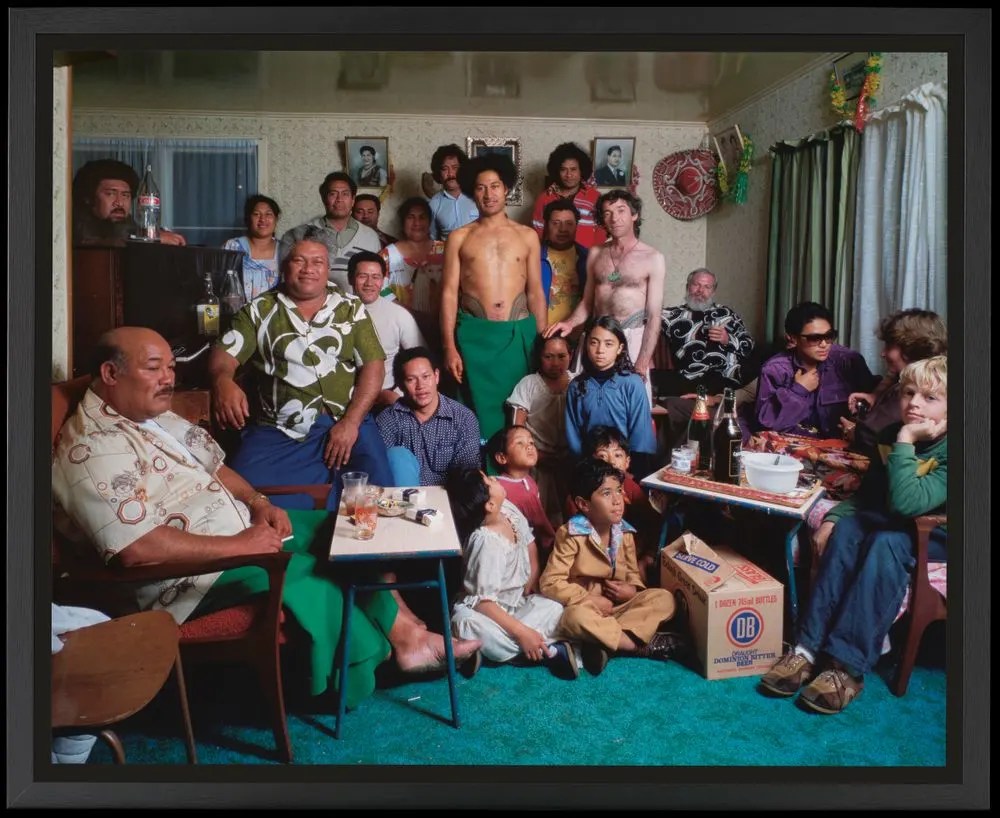
BLACK GRACE TURNS 30

John Daly-Peoples

John Daly-Peoples

‘THIS IS NOT A RETROSPECTIVE’

Auckland Town Hall

Saturday March 22,  7.30

Neil Ieremia is one of Aotearoa’s most astonishing and prolific home-based creatives. His ever-growing body of work has easily and unselfconsciously graced stages in many parts of the world and he is rapidly becoming a one-man export machine. In part this is because of his perfectionism that never forgets the past, stands firmly rooted in the present and yet finds time to seriously address the future – sometimes simultaneously.

His works combine different personal histories, different body shapes and abilities, and different musical and dance backgrounds.

May of his works have a strong musical underpinning that ranges from pop to hip hop, traditional to church, coupled with soundscapes that underscore the everyday concerns of young people today. It leaps from recollections of things past to things that might have been and things that are very much of the present, uses the simplest of props and creates some beautiful moments.

His latest work celebrates the company’s 30th year milestone with ‘THIS IS NOT A RETROSPECTIVE’, the ultimate interactive dance party at the Auckland Town Hall, Saturday March 22

Joining Blackl Grace will be CHE FU and THA FEELSTYLE along with the many amazing friends of Black Grace already down to party including; DJ Manuel Bundy, drag queen diva Buckwheat and the NZ Trio, working alongside a stellar production team, with Artistic Direction by Neil Ieremia, ONZM, sound designer Faiumu Matthew Salapu aka Anonymouz, internationally respected NYC-based lighting designer JAX Messenger, along with the incredible Black Grace Dancers.

But the fun doesn’t stop there, Black Grace has a number of special events planned throughout their birthday year. To be in the know join them at blackgrace.co.nz

Main event 1hr 10min, followed by a party which  will continue after main event until late

Categories
Reviews, News and Commentary

Luise Fong’s “Nexus” examines the body and the cosmos

Reviewed by John Daly-Peoples
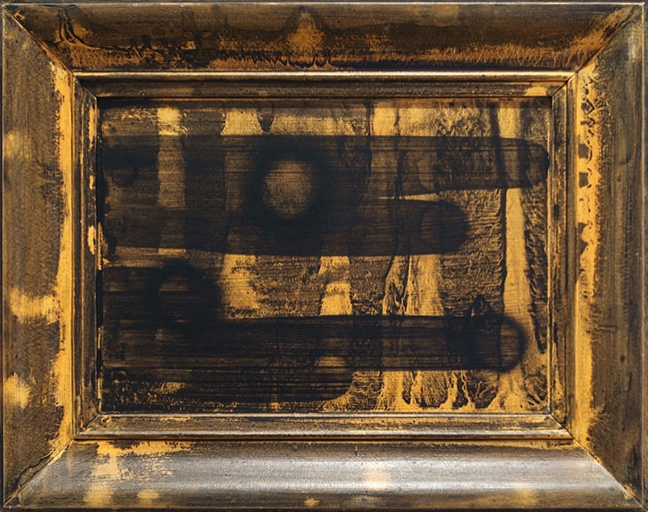
Luise Fong, Pathology

Luise Fong, Nexus

Bergman Gallery, Auckland

Until November 30

Reviewed by John Daly-Peoples

When I reviewed the work of Luise Fong in the “Cultural Safety” exhibition at the Frankfurter Kunstverein in 1996 I noted that her surfaces had much in common with an exhibition in the adjacent Jewish Museum which was displaying lampshades made from human skin.

Works from that time such as Pathology Sample ($5200) which refers to the examination of tissue and the wider aspects of death and mutability are central to Fong’s work. These images allude to the body and the forces—physical, psychological and social which affect it.

Luise Fong, Omni

While there is a focus on the body in her works there are wider connections which  encompass the nature of the cosmos as well as with works such as Small Orbit  8 ($6800). This contradiction or ambivalence between the microscopic and macroscopic infuses much of her work. This other worldliness is also suggested in the two photogram works included in the show where objects are transformed into strange shapes as in the UFO Series X ($3000).

There is also a sense of this ambiguity in the ethereal sounds of the Icelandic musical group Sigur Ross which have inspired the artist.

With many of the images such as the sperm-like streaks of paint in Omni ($9800) , the cellulear forms  in Pool ($7700) or the planetary shapes in Orbit ($6800) we are aware of the artists manipulating the painted surface, creating other surfaces and changing our perceptions.

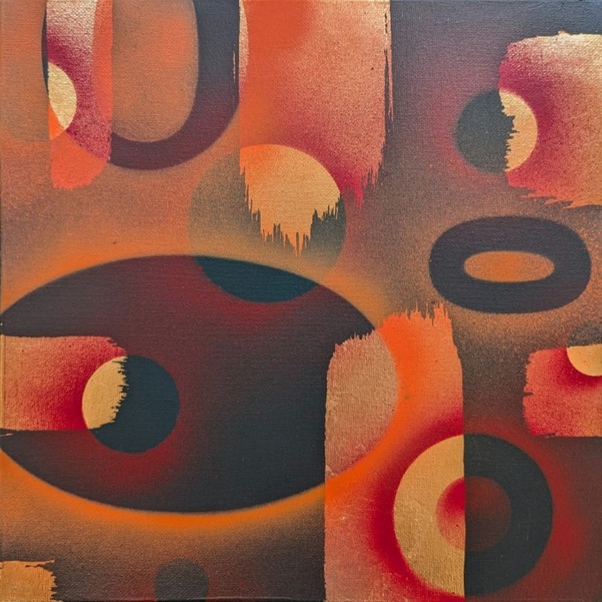
Luise Fong, Twilight III

Some of her more recent work extends the notion of skin with work which look more like fabric, reflecting her Chinese/Malaysian heritage and her interest in textile design. With work such as Twilight III  ($3200) with its vibrant reds and oranges as well as other with dramatic blues, colour plays an important role. These images which can be seen as displaying planetary shapes, and solar flares are also suggestive of MRI s scans of the body, returning her work to its origins of thirty years ago.

Categories
Reviews, News and Commentary

Shane Cotton. New Paintings and new directions

Reviewed by John Daly-Peoples

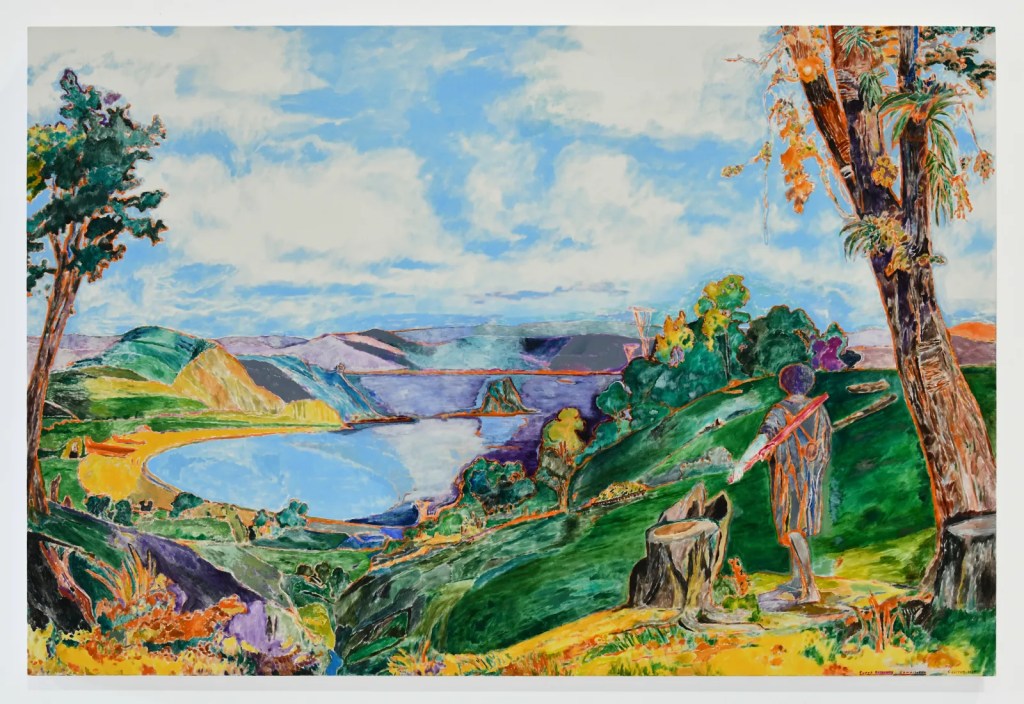
Shane Cotton, Super Radiance

Shane Cotton

New Paintings

Gow Langsford, Onehunga

Until November 16

Reviewed by John Daly-Peoples

Shane Cotton has progressively mined the history and myth of Māori along with its intersection with European colonisation, featuring images which recall stories, along with references to historical and mythical figures and locations.

With his latest exhibition of “New Paintings” the artist  could be seen as entering his  Fauvist period with many of the paintings having the features of the Fauves. Those painters of the early part of the twentieth century employed simplified shapes along with intense and juxtaposed colours.

The “He Waka Karaka” ($9000) featuring a small  Pacific craft with a sail exemplifies this aspect with intense blues, purples and green while the large, colourful “Super Radiance” ($90,000) is an example of one of the new directions of Cottons painting – more traditional landscape painting. Even though his previous works have featured landscape forms these were generally refined and abstracted.

There are several works of Cotton’s Toi Moko works where the  tattooed and preserved ‘shrunken’ Māori heads reference conflict, trade, and repatriations. In works such as “The Great Attractors” ($55,000) the tattoo lines tracing out genealogy are linked to the notion of neural connections, knowledge links and computer networks.

Shane Cotton, The Great Attractors

Apart from the shrunken heads Cotton has rarely included figures in his work but in this show, there are several which connect with his living in Northland and revisiting some of his earlier work and the notions of colonialism and cultural exchange.

Shane Cotton, The Walker

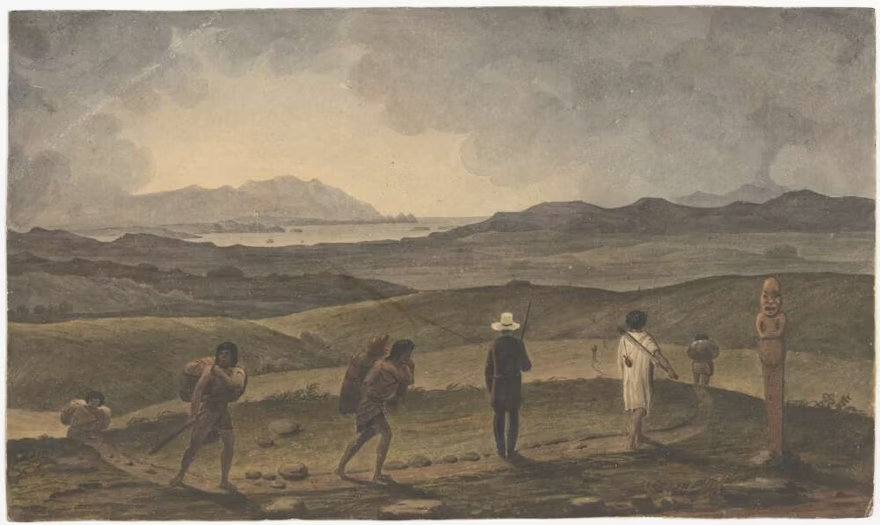
In “The Walker” ($8500) he has replicated the self portrait of the early explorer/artist Augustus Earle taken from Earle ‘s painting “Distant view of the Bay of Island”. Cotton has also appropriated another figure from the work , A Māori with a taiaha who is leading Earle . This figure is also present in “Super Radiance”, “Sunset Gate” ($48,000) and “He tangata hikoi” ($8500) acting as a guide through the landscapes of the North.

Augustus Earle, Distant view of the Bay of Island

Cotton has also used an image of missionary and publisher of Māori works Thomas Kendall taken from the painting “Hongi Hika and Waikato” with Thomas Kendall in England in 1820” by James Barry.

James Barry, Hongi Hika and Waikato” with Thomas Kendall in England in 1820

This image is used in the small portrait “Internal Visions” ($8750) and “The Visitation” ($8500) where Cotton has depicted him contemplating a colourful, modernist manaia form where in the original painting he is looking at Hongi Hika and Waikato.

Shane Cotton, The Visitation

There are also a few of the artists flower painting such as “Insert” ($12,500) which have developed over the years for his early  plant paintings.

There are a number of the artist’s three panel works most of which feature a manaia figure flanked by delicate foliage while others have landscape/vegetation  panels or in the case of ”Ahuaiti’s Cave” ($130,000) images of the sea. This work refers to the Ahuaiti who was rejected by her husband, forcing her to live in a cave on the Northland coast with her son Uenuku Kuare who is depicted at the base of the painting as a tiny figure, the same image as Earle’s guide  in “Distant view of the Bay of Island”.

Shane Cotton, Ahuaiti’s Cave

This linking of mythic figure to historical figure to an  invented guide inhabiting some the paintings is an example of Cottons ability to transition across myth, history, time and location.

To subscribe or follow New Zealand Arts Review site – www.nzartsreview.org.

The “Follow button” at the bottom right will appear and clicking on that button  will allow you to follow that blog and all future posts will arrive on your email.

Or go to https://nzartsreview.org/blog/, Scroll down and click “Subscribe”

Categories
Reviews, News and Commentary

Ray Ching: the huia & our tears

reviewed by John Daly-Peoples

Ray Ching

the huia & our tears

ARTIS Gallery

RRP $80.00

Reviewed by John Daly-Peoples

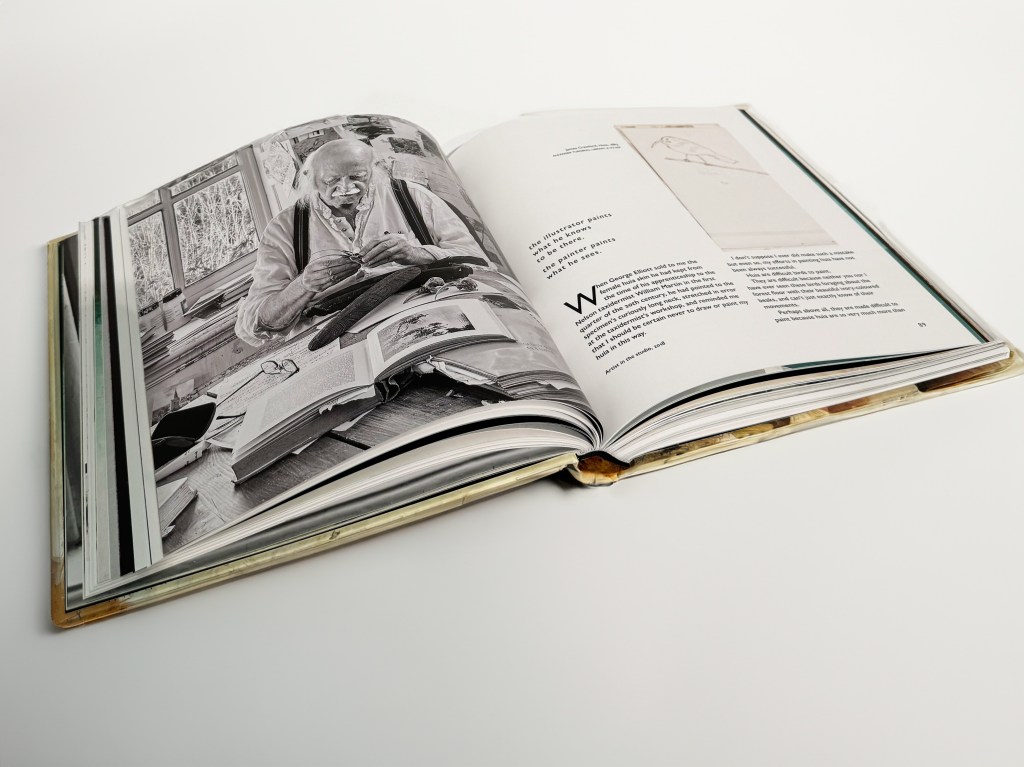
With his latest book “the huia & our tears” Ray Ching has shown once again that he is not just a great painter, he is also a clever storyteller and an expert ornithologist.

The large format book like all his previous publications is impressive with full colour reproduction, Illustrations spread over two pages, great typography and well researched text. It adds greatly to our understanding and appreciation of the huia which disappeared in the early years of the twentieth century.

The book is a remarkable collection of memories, observations, research and reflections on the huia and its place in New Zealand ornithological and national history.

Ching has had an interest bordering on obsession with the huia from an early age noting that he had always had the bird with him, connected by its image on the old New Zealand sixpence.

Included in the book are the artist’s encounters with taxidermists, ornithologists, writers artists and major figures in New Zealand’s history who provide fascinating insights into the history of the huia.

The Kite and the huia (detail)

In many of his previous books notably his Aesop’s Kiwi Fables  he has included moral tales featuring figures from the animal kingdom. In this  book he has included several examples of these including  “The huia and our tears as well as “The kite and the huia”

He includes early reports of the huia by Charles Heaphy, Edward Jerningham Wakefield and Ernest Dieffenbach as well as Walter Buller’s description of the huia where he wrote:

“The Huia never leaves the shade of the forest. It moves along the ground, or from tree to tree, with surprising celerity by a series of bounds or jumps. In its flight it never rises, like other birds, above the tree tops”.

There are a number of other mentions about the bird such as the poem “The Huia” included in Eileen Duggan’ s 1929 publication “New Zealand Bird Songs”  The final verse of this poem reads:

Where is it now that once was high?

Where is it now, where is its wing?

Where is the Prince of the leaves and sky?

Where is the King?

Ching notes that many of the illustrations of the huia are from examples held in museums but only few from recently killed birds which accounts for the lack of dramatic colouring as the plumage has faded.

Ray Ching, Huia (detail)

In this respect he notes that the work of Keulemans who produced the illustrations for Walter Bullers books on New Zealand birds may be the most accurate as he normally received his birds sent by Buller to Europe within a few weeks of their death.

There is a series of portraits of  Māori by Lindauer and Goldie in which the sitters have worn huia feathers in their hair with Ching referencing the use of the bird’s feathers by high-ranking Māori. Included in these portraits are images Pane Watene (Ngati Maru) and Tawhiao Matutaera Te Wherewhere (Ngāti Mahuta).

Gottfried Lindauer, Pane Watene (Ngati Maru)

As well as Chings account of his sixty-year interest in the huia he includes another important text.

The now out of print publication “The Book of the Huia” written by W.J. Phillipps and published in 1963 is reproduced in full providing additional information . In it the author included conversations and correspondence of early settlers and the place of the huia in the lives of Māori.

He also provides details of the bird’s life from birth through its use as a food and its feathers for decoration both for Māori and later Europeans and its wholesale slaughter in the late nineteenth century and inclusion in museums across the globe.

Ching also includes  details of all the huia held in the many New Zealand locations as well as the UK, America Germany

Categories
Reviews, News and Commentary

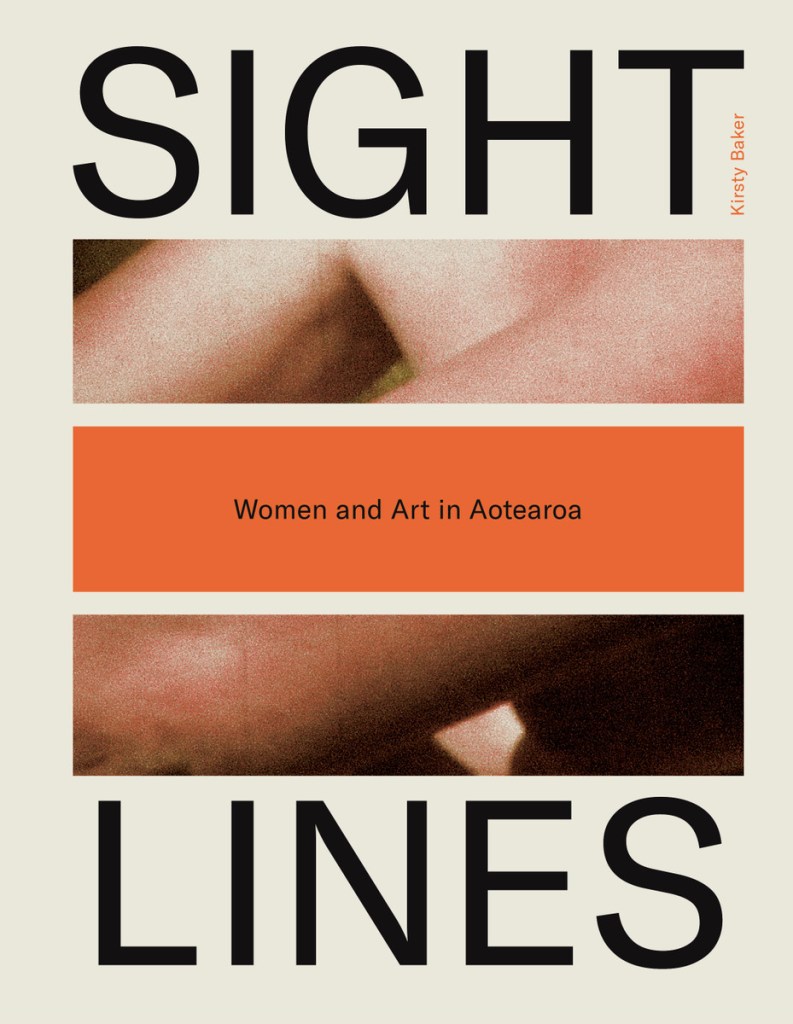
Sight Lines: Women and Art in Aotearoa

Reviewed by John Daly-Peoples

Sight Lines: Women and Art in Aotearoa

By Kirsty Baker

Auckalnd University Press

RRP $69.99

Reviewed by John Daly-Peoples

Sight Lines: Women and Art in Aotearoa is a bold and timely book exploring various threads of women’s  art  of the past as well as those creating art for our times. Editor and writer Kirst Baker acknowledges the complexity of bringing together writings for  such a book in her introduction  where she notes “It should come as no surprise that this book does not attempt to offer a complete history of women’s artmaking in this country. Such a project is doomed to fail… Instead, the book winds its way along a path that is both fragmented and politicised”.

Within that winding journey it is the through the fragments that we see ideas and revelations and make connections. It is through the practice of many of these artists and their working within a social and political context that we see the importance and ramifications of art.

Lisa Reihana, in Pursuit of Venus [infected], Auckland Art Gallery. single channel UHD video

The dozen chapters in the book have been written by Kirsty Baker along with  Chloe Cull, Ngarino Ellis, Ioana Gordon-Smith, Rangimarie Sophie Jolley, Lana Lopesi, Hanahiva Rose, Huhana Smith and Megan Tamati-Quennell.

The essays are all thought-provoking with a mix of biography, narrative, interviews, observations and reflections. These offer new ways at looking at the art created by women but also the nature of art and art institutions.

Baker notes that there are a number of themes running through the book which are indicative of the often different world in which many female artists exist and work.

There is the way that women artists have interrogated their relationship with the land and place and the way they have pushed against gendered limitations.

There is also the way that artists have used their practice to comment on art history and arts institutions and the way that art making plays a role in the care and transmission of knowledge.

In not being a contiguous history of women’s art, the gaps and exclusions are often apparent. These gaps mean at times the book is less satisfying without the linkages of history and context.

While not a history the book covers over two hundred years of art making in New Zealand and includes painters, photographers, performers, sculptors,  textile artists and writers. The work of these artists spans whatu kākahu through to the recent work of the Mataaho Collective. Along the away there are chapters on a diverse range of artists –  Frances Hodgkins, Rita Angus, Rangimārie Hetet, Pauline Rhodes, Teuane Tibbo, Yuki Kihara and Ruth Buchanan.

With over 150 illustrations the books also provide a visual history of women’s art which is well integrated with the texts.

Julia Morison, Quiddities 1-10. Auckland Art Gallery, Cibachrome transparencies

The essay on Frances Hodgkins provides a succinct overview of her life and work while highlighting the issues which impacted on women artists of the early part of the twentieth century.

The essay on Kura Te Waru-Rewiri reveals the way in which Māori artists have addressed issues of mythology. history  and land using abstraction as a means of conveying ideas.

Many of the chapters focus on the issues around the land, whānau and wāhine which is seen in the work of artists such as Robyn  Kahukiwa so it is surprising that  Robin White, Sylvia Siddell and Jaqueline Fahey who have documented the family and domesticity for several decades are not mentioned.

The other area of exclusion is around abstraction for while the work  of Vivian Lynn, Kura Te Waru-Rewiri and Imogen Taylor is included artists such as Phillipa Blair and Gretchen Albrecht are omitted.

Maureen Lander, Ko nga puna waiora o Maunga Taranaki (detail), Govett-Brewster Gallery, mixed media

The final chapter in the book concerns the  work by the Mataaho Collective, a group which has recently won the prestigious Golden Lion Award at the Venice Biennale. The chapter predates the win but much of what is written is relevant to the work which has generated more column  inches than any previous New Zealand exhibition at the Venice event.

Here there seems to be a disconnection because of the six previous New Zealand female artists to exhibit at the Biennale. only Lisa Reihana and Yuki Kihara are mentioned. That the four other women selected over a twenty yar period to represent New Zealand at the world’s most high-profile event seems puzzling.

Despite this oversight and others, the book is still one which offers much in understanding the developing history of women’s art in New Zealand as well as way that they have been impacted  by  social acceptance and cultural institutions.

To subscribe or follow New Zealand Arts Review site – www.nzartsreview.org.

The “Follow button” at the bottom right will appear and clicking on that button  will allow you to follow that blog and all future posts will arrive on your email.

Or go to https://nzartsreview.org/blog/, Scroll down and click “Subscribe”

Categories
Reviews, News and Commentary

New exhibitions by John Pule and Fatu Feu’u

Reviewed by John Daly-Peoples

John Pule. As we stood one misty morning near the ocean the desire the solitude gone gone forever

Haia

John Pule

Gow Langsford, Onehunga

Until June 8

Vai Manino

Fatu Feu’u

Artis Gallery

Until June 9

Reviewed by John Daly-Peoples

Two recent exhibition by Pacific artists focus on the ways in which artists draw on the physical and topographic  and historic , merging them, with social, political and personal insight and visions.

John Pule’s latest exhibition “Haia” was  the result of a nine-month residency in Niue provided by the government in 2023. The work contains much of the artist previous iconography but have a greater immediacy given the artists response to in his ancestral land.

The works are in a sense both a discovery and rediscovery  of the land and its mythologies as well as the artists own journeys.

As he says in his notes to the exhibition

“For nine months I rode my bike each day through the canopy forest from Liku to Alofi [around 15 kilometres]. Through rain or shine, winds, storm, or calm. The road is bordered with plantations, forests, tracks into the interior. Big blue skies and clouds, shadows of trees stretch across the makatea (limestone) road. Returning to Liku every evening, the sun is warm on my back.  These paintings and drawings are about that particular time.”

His works have often dealt with his growing up in New Zealand, his discovery of traditional Niuean art, the islands history, flora and fauna and developing his own iconography. This had led to him dealing with wider issues of colonialism, the impact of Christianity as well as  the mythology and spirituality of Niue.

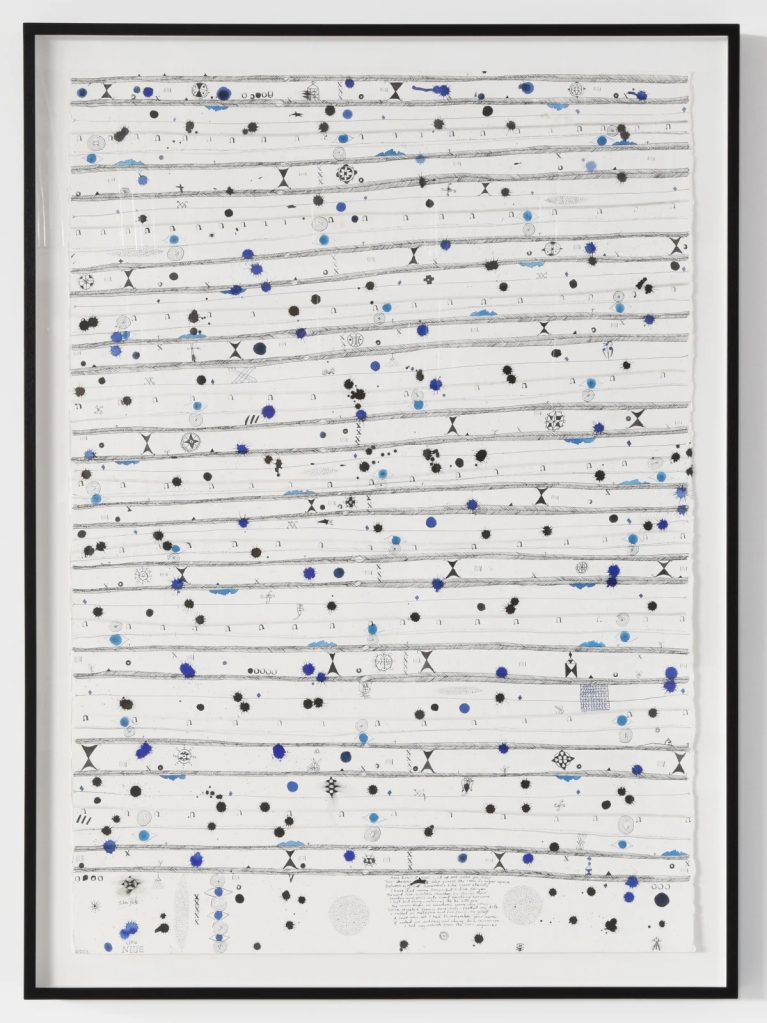
John Pule. Many times at night I sit up and watch you sleep

Works such a “Many times at night I sit up and watch you sleep” with their strips of images – symbols, shapes and figures are like the trails that that the artist has ridden on his bike but also the pathways which reach back in time. They are analogous to the songlines of aboriginal art as well as the lines of musical compositions, imagining the way the sounds evolve, carrying a narrative expressing joy. sorrow and wonderment.

In the more dramatic paintings  such as “As we stood one misty morning near the ocean the desire the solitude gone gone forever” a road snakes into the distance and there are several figures  depicted recalling tales of the Bible and other mythological histories. 

The foliage depicted is at once colourful and local as well as surreal and mythological – a portrays of Pule’s Niue as well as an imagined paradise.

The pathways and journeys depicted in his paintings are metaphors for the artist’s own physical, spiritual and aesthetic journeys.

John Pule. Foulua Pukenamo Tau Misi

Other works such as “Foulua Pukenamo Tau Misi” feature plans,  grids and designs – locating islands, stars, measuring winds and sea currents, all ways of comprehending the environment

Fatu Feu’u. The Golden Age

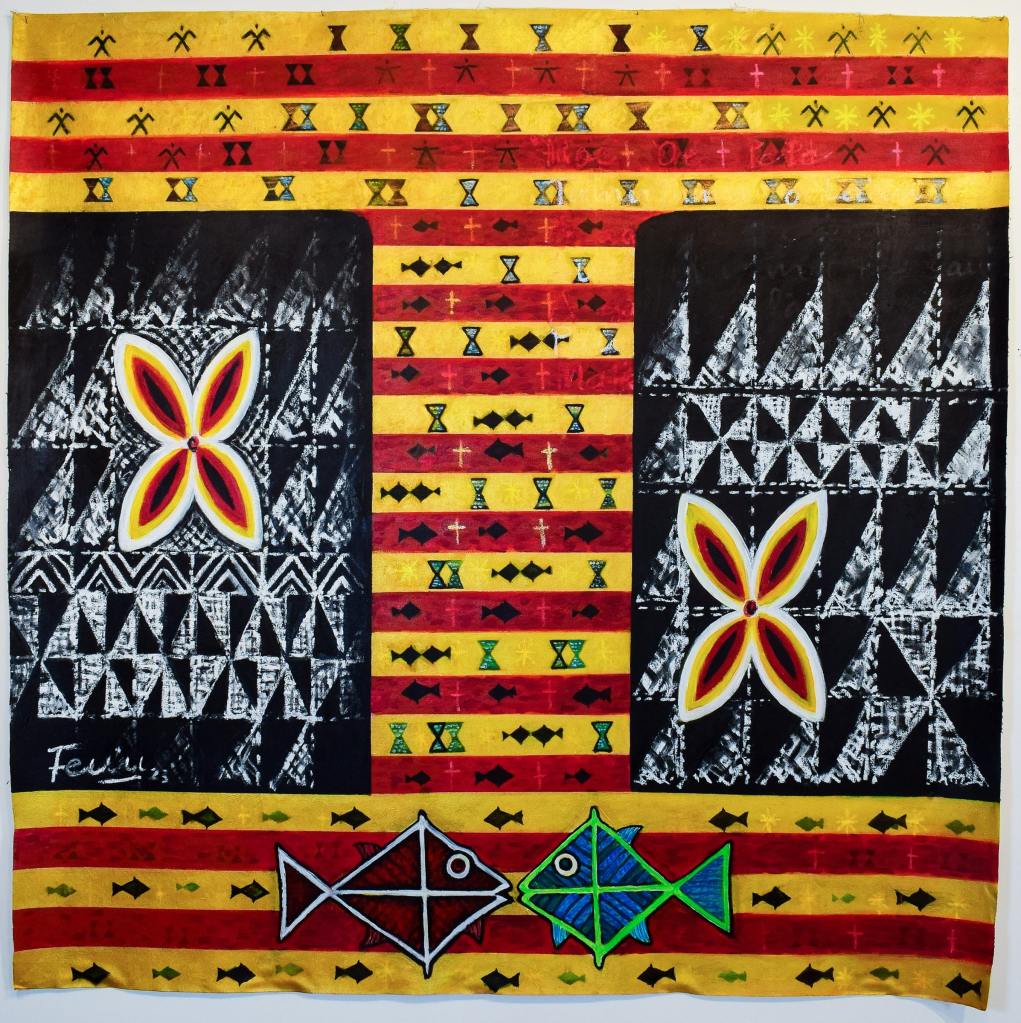
In his latest exhibition “Vai Manino” (Clear Water) Fatu Feu’u focusses on the social political and historical aspects of Samoan fisheries with works that follow on from his previous exhibitions which have  addressed social, political and environmental issues which are confronting Samoan society. Several are  based on the Samoan tradition of ‘ifoga’ or reconciliation/rebuilding with the dominating  central letter ‘I’ as a motif captures this, with different colours coalescing. The large “I” which he has used many times before also references Colin McCahons use of the letter / symbol.

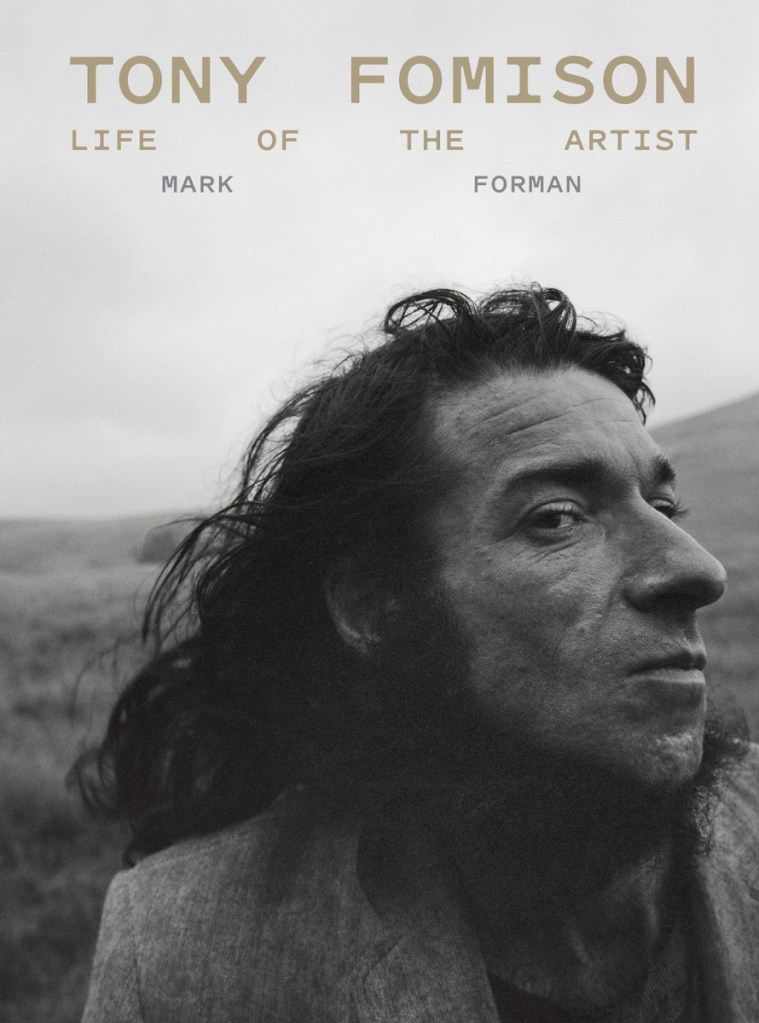
His work draws inspiration from ancient designs and patterns – from tapa cloth. siapo, lapita pottery and tattoo along with contemporary Samoan design. There are also the influences of abstract art and that of other artists such as Colin McCahon and Tony Fomison.  The artist has employed shapes and symbols that he has developed over many years – masks, fish, birds and sails along with hints of human figures and landscape. Many of the siapo patterns themselves are derived from insects, leaves, shells, animals and fish.

Fatu Feu’u First Ritual

In many of the works such as “First Ritual” there are swirls of colours which seem to reference shoals of fish and  the ocean currents along with curving lines which can indicate the trawling nets used by fisherman.

Works such as “Pacific Conference II” have more complex structures with reference to the historical and mythological past pf the Pacific with an Easter Island monolith. The swarms of fish which morph into humans and birds refence journeys, distance and the dependence on the sea.

Fatu Feu’u. “Pacific Conference II”

Like the works of John Pule several of the paintings feature bands of colour representing journeys and histories. And with both artists there are gridded area which are related to cartography, structure and measurement

To subscribe or follow New Zealand Arts Review site – www.nzartsreview.org.

The “Follow button” at the bottom right will appear and clicking on that button  will allow you to follow that blog and all future posts will arrive on your email.

Or go to https://nzartsreview.org/blog/, Scroll down and click “Subscribe”.