Brazilian born Roberta Queiroga’s training as an architect appears to inform her art practice, bringing a nuanced understanding of space, rhythm, and materiality. Her architectural sensibility links gesture, energy, and spatial awareness.
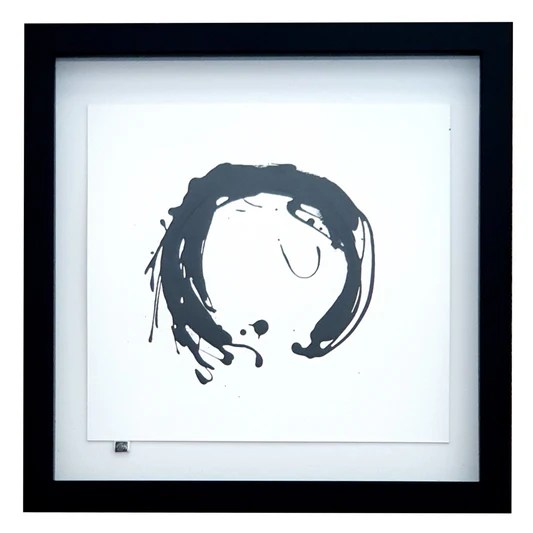
Her works are connected to Eastern artists such as Sengai Gibon the nineteenth Japanese Zen artist known for his simple, and profound ink paintings which employed minimal brushstrokes to convey deep spiritual truths. There are a couple of Queiroga’s small gestural work on paper such as “Today 1” ($480) which are reminiscent of the Japanese artist.
Roberta Queiroga. Today 1
The paintings also connect with the work of Max Gimblett, entwining Eastern spirituality and modernism. Like Gimblett’s work Queiroga’s has a sense of capturing the instant, when emotion is realised and intuition is revealed.
“Tidal Composition – Ripple” ($4800) is a simple gestural work with a single sweeping stroke with small ink splatters, capturing the instance of creation. Like the title of the work several of the paintings are derived from the tides, their motion, their drama, their moments of calm and their intricate patterns of movement.
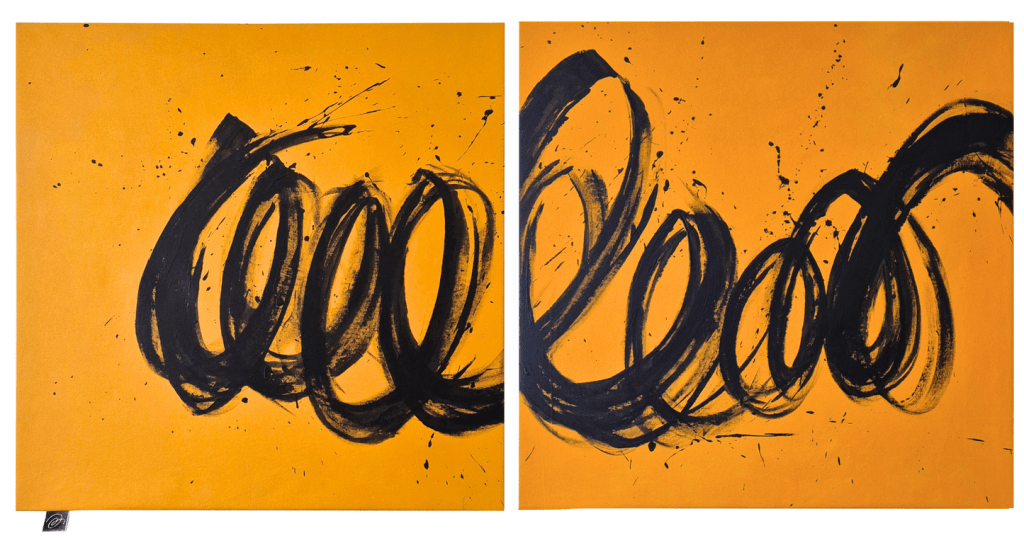
The two panel “Tidal Composition – Pulse” ($8000) extends the notion of surf and tides with a suggestion of curling breakers, the energy of the waves pulsing along a shoreline.
Roberta Queiroga. Tidal Composition: Pulse
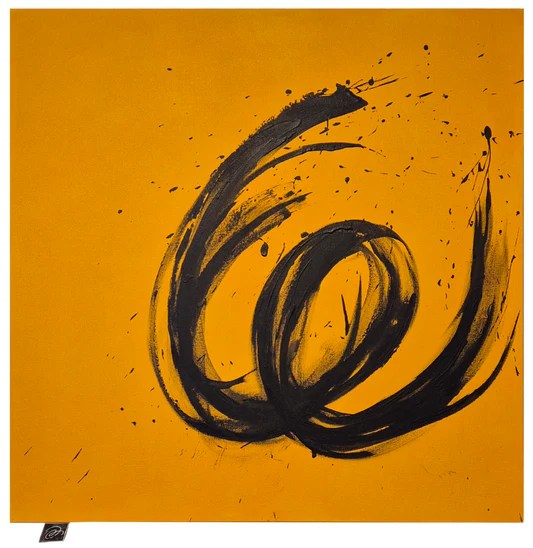
Some of the works have titles related to another energy, that of fire with some titled ”Brasa” which is Portuguese for embers while others are titled “Charcoal and Fire” and “Glow of Embers”. In “Charcoal and Fire” a small slash of red enlivens the work like a bloody mark.
The predominant colour for these works is a bold orange which provides a sense of energy, heat and light. With “Charcoal and Fire” ($3800) there are also traces of red which adds a sense of danger. With the “Glow of Embers” ($3800) where black encroaches on the orange it is like the colours of a dying fire.
Roberta Queiroga, Glow of Embers 1
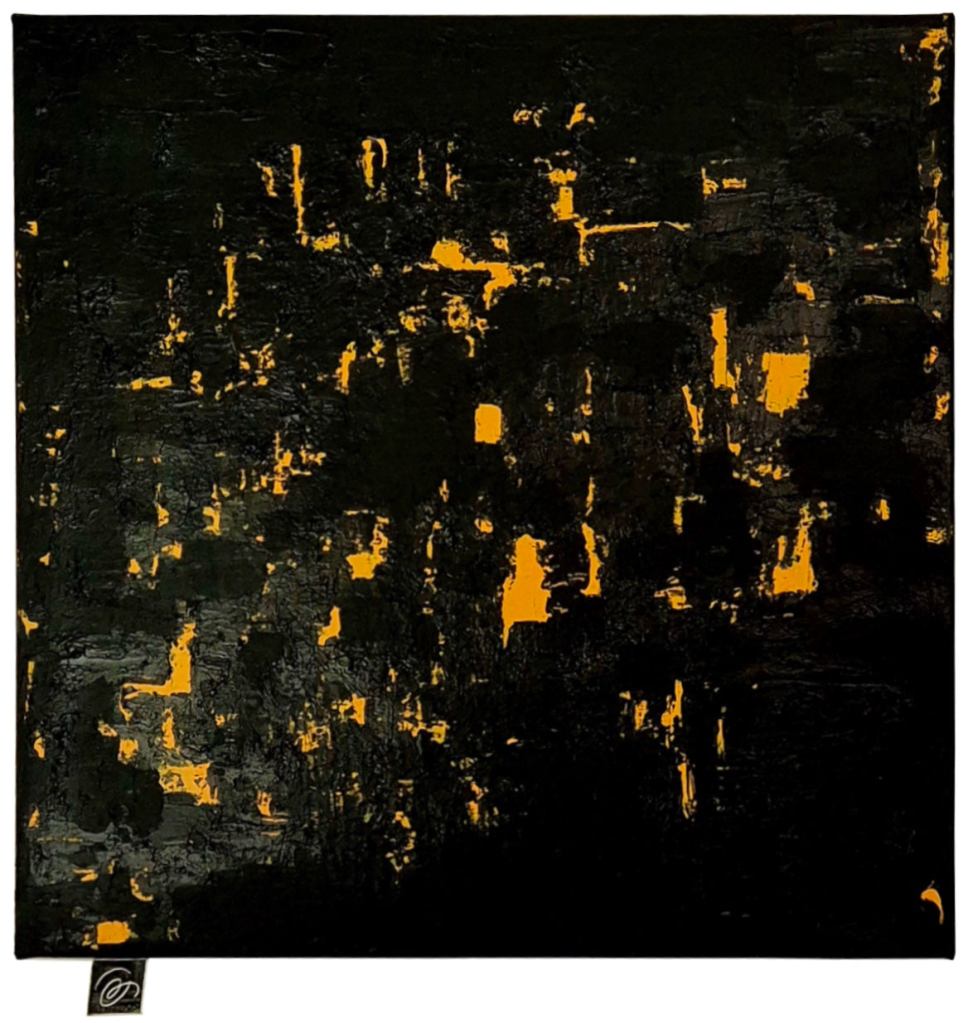
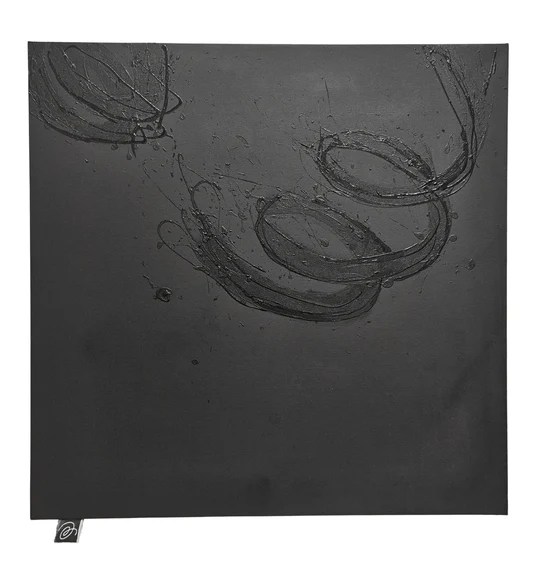
There are some more subtle, gestural works in the show among them “Midnight” ($4800) where the black gestural strokes are laid over a black background giving a sense of the shapes emerging from the velvety darkness of the night.
Roberta Queiroga, Midnight
There is also a display of her” Kaleidoscope Series”, twelve small panels ($150 each, 3 for $300) where black painterly gestures are made on a black background, the various marks seeming like a secret form of calligraphy.
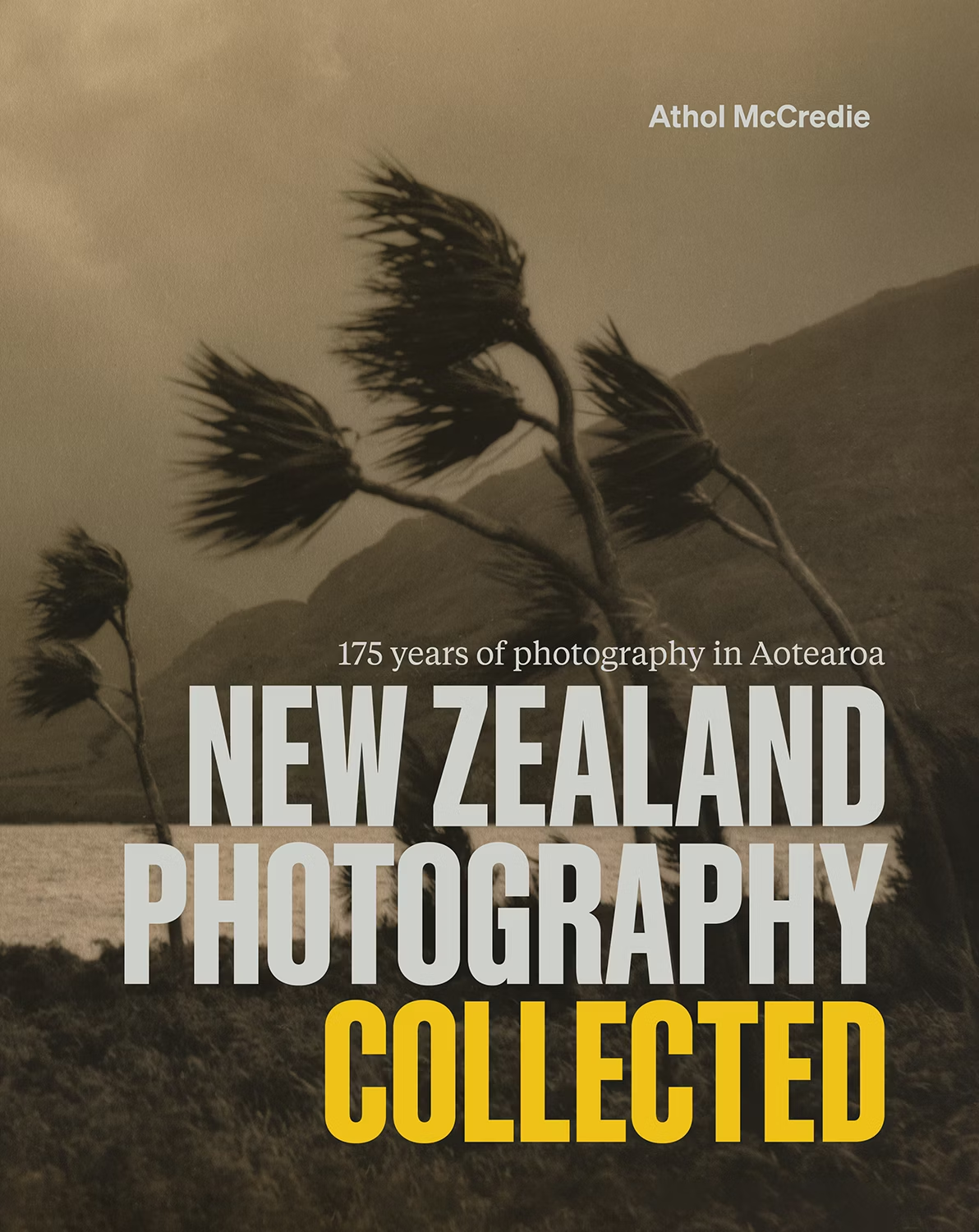
Cover image, George Chance – The Storm, Wanaka (c1940)
New Zealand Photography Collected
175 Years of Photography in Aotearoa
Te Papa Press
Written by Athol McCredie
RRP $90.00
Reviewed by John Daly-Peoples
New Zealand Photography Collected illuminates New Zealand’s photographic history, from the earliest nineteenth-century portraits of Māori and local ‘scenic views’ to the latest contemporary art photography. The previous edition of the book published in 2015 went into two editions and this expanded version featuring 400 images from Te Papa’s collection of 400,000 works.
From the iconic to the previously unpublished, the selection includes outstanding photographs by the Burton Brothers, Leslie Adkin, Spencer Digby, John Pascoe, Brian Brake, Frank Hofmann, Ans Westra, Eric Lee-Johnson, Marti Friedlander, Laurence Aberhart, Ann Shelton, Glenn Jowitt, Anne Noble, Yvonne Todd – and many more.
The book not only provides a wide selection of images, it also introduces the reader to the photographic artists who have used photography to explore our history and environment. The photographs of the nineteenth century makes us realise that these images are often our only reference point for how the country, its people and events looked in the past.
Author and curator Athol McCredie provides a wide-ranging selection of images across portraiture, landscape, science, documentary photography and art with informative notes.
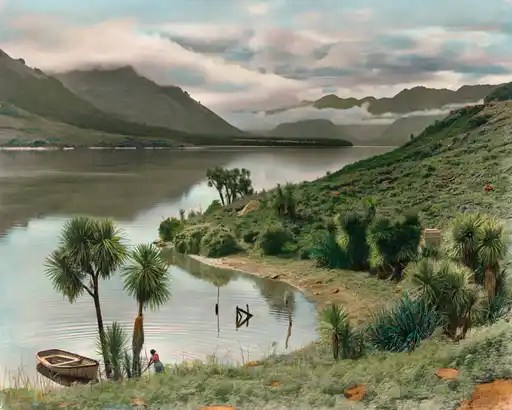
Ellis Dudgeon Lake Hawea, c.1947 Hand-coloured gelatin silver print, coloured by Elaine Watson, 1962, 404 × 500 mm Purchased 2023, O.051365 It is almost unknown for a hand-colourist to be identified on a photograph, but this one has a handwritten label on the back reading ‘Hand painted photograph by Elaine Watson, July 1962.’ This records that Watson hand-coloured it, not that she took it, for we know from a 1947 book in which it was reproduced in black and white that it was taken by Ellis Dudgeon, a photographer who ran a studio in Nelson from 1930 to 1970. Dudgeon’s scenic hand-coloured photographs were widely seen. Indeed, this image appears in colour on the cover of the upmarket magazine Mirror: New Zealand’s national home journal in 1955. In that version, the colouring is quite different: there is much more yellow in the tī kouka (cabbage trees), there are red flowers on the bushes by the lakeside, and it is much brighter and sunnier throughout. It is a more upbeat, holiday image than Watson’s subdued and uniformly toned version, showing just how much interpretive room there was for colourists, who were rarely present when the photograph was taken.
Together these photographs tell stories about life in this country from almost the earliest days of European colonisation and about how the practice of photography has evolved here, reflecting the dynamic and increasingly diverse nature of the collection, allowing for previously unseen treasures, and enabling familiar works to be recontextualised with fresh insights.
In making the selection, McCredie, says “I looked for photographs that were evocative, resonant, ambiguous, entertaining, and most especially, that might say something about the nature of photography itself.”
Whie no collection of photographs can be comprehensive the book offers many threads which weave together a sense of the nation’s history and culture. It is more than a history of photography tracing out our responses to the landscape, the built environment, events and people.
Through the book we see the taming and changing of the landscape, the changing domestic and commercial architecture, the way we dress and there are images of the citizens we valued for their contribution to our civic and cultural life.
There are portraits of Māori such as Tomika Te Mutu, as well as other history makers such as Peter Fraser, Ed Hillary and Mike Moore along with artists such as Kiri Te Kanawa, Tony Fomison and Yuki Kihara.
We also can see the way in which the photograph has changed from the need to simply record the landscape and people through to experimentation as well as viewing photography as a means of social and political change.
While there no comparative before and after images the book does have images of the changing face of the land as well as images of the major cities and the built environment from the nineteenth century and the twentieth which show the development of the urban areas. We are also able to see the changing nature of clothes, particularly those worn by females.
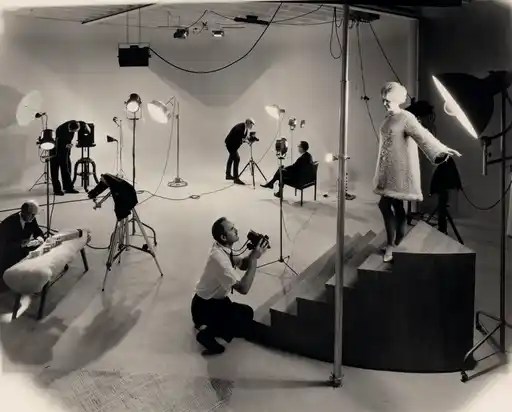
The inclusion of Frank Hofmann, one of the major modernist photographers is an example of the multi-talented artist who worked across the media providing many of the important modernist photographs as well as portraits. A photograph of the Christopher Bede Studio, which he founded also shows his ability to work across the commercial as well as experimental genres.
Frank Hofmann Christopher Bede Studios, 1967 Gelatin silver print, 418 × 578 mm Purchased 2016, O.044647 Christopher Bede Studios was formed by Frank Hofmann and Bill Doherty around 1950. It focused on home portraiture but also operated a studio, and this photograph was probably taken to promote its new premises being opened in Auckland in 1967. The image clearly sets out to demonstrate the varieties of photography the studio could undertake, from fashion and product photography to portraiture. It is pure advertising though, for it would be fanciful to imagine four photographers actually working simultaneously in the same studio space. The studio had branches in other centres, and in 1970 it claimed to be New Zealand’s largest photographic organisation. In 1975 it became Bede Photography.
There are number of images of individual Māori and Māori society which changes over the course of time from initially being of an ethnographic nature with images by John Nicol Crombuie and Alfred Burton through to seeing Māori as an integral part of society with photos by Ans Westra as well as seeing the inclusion of Māori photographers such as Tia Ranginui and Fiona Pardinton.
There are several small suites of work such as Eric Lee-Johnson images of Opo taken at Opononi in 1956, Gordon Burt’s commercial works mainly of automobiles and the Burton Brothers for their extensive images of the country.
Then there are individual images such as Frede Brockett’s dramatic image of the wreck of La Bella, Theo Schoon’s Geothermal studies or Eric Lee Johnson’s image of a bike wheel and shadow which predate similar work by Bill Culbert who, surprisingly, has no images in the book.
The landscape work in the book range from the nineteenth century images of the Burton Brothers through the NZ Tourism images, the myth-like work “Peter Pan on Mt Eden” by J. W. Chapman-Taylor through to the revisionist work of Mark Adams.
Les Wallace Napier after Hawke’s Bay earthquake, 1931 Gelatin silver print, 158 × 386 mm Gift of Holden New Zealand Limited, 1998, O.005635 The Hawke’s Bay earthquake of 3 February 1931 remains New Zealand’s deadliest natural disaster: 256 lost their lives, and the region was devastated. With limited water to fight the fires that ignited after the quake, eleven blocks of central Napier were completely gutted. According to an eyewitness, by evening the town ‘looked as if it had been subjected to a severe bombardment’: The centre of it for over a mile was a mass of flames. Every concrete and brick building had collapsed. It was like an upheaval and there was a terrible number of deaths . . . A number of people were lying in the streets and buried under the debris. Some were terribly injured and some were dead. The town was all in darkness and that added to the horror of the situation.
While there are not a lot of photographs of dramatic historical events like Les Wallace’s “Napier after the earthquake” there are a few, like Paul Simei Barton’s images of the demonstrations about the Springbok 1982 tour as well as the Covid 19 demonstration in Wellington by Adrian Lambert.
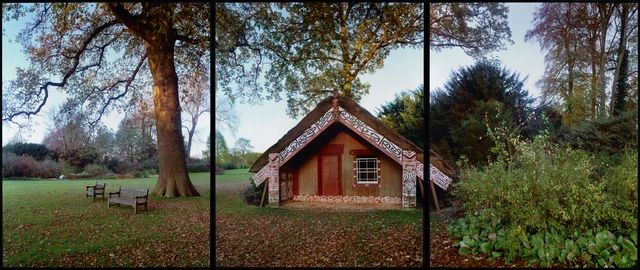
Mark Adams 13.11.2000 Hinemihi, ClandonPark, Surrey, England. Nga Tohunga:Wero Taroi, Tene Waitere, 2000 Chromogenic prints, 1200 × 3200 mm Purchased 2020, O.049055/A-C to C-C Mark Adams has often highlighted cultural incongruities in his photographs, and nowhere more so than in this triptych of the meeting house Hinemihi o te Ao Tawhito standing in a corner of an English country estate. The 1881 house was originally situated at Te Wairoa, the gateway village to the Pink and White Terraces. When Mount Tarawera erupted in 1886, the house was partially buried and subsequently abandoned. In 1891, the Earl of Onslow and Governor of New Zealand purchased Hinemihi and had it dismantled and reinstalled on his English estate as a sort of folly — something he probably didn’t see as incongruous himself, as he bought it as a reminder of his affection for New Zealand. Adams took another equally dissonant triptych that pairs with this photograph. It shows the site where Hinemihi originally stood — now just a forlorn patch of empty land covered in long grass and thistles. Hinemihi will be returned to New Zealand (though probably not to this site), placing Adams’s photograph in dialogue with the future as well as the past.
The “Follow button” at the bottom right will appear and clicking on that button will allow you to follow that blog and all future posts will arrive on your email.
Dick Frizzell’s latest show “Weight of the World,” at Gow Langsford could well be a reference to Ringo Starr’s 1998 comeback single of the same name which uses the phrase to describe the struggle of letting go of the past and embracing the future.
The exhibition is ambivalent in terms of the artist’s own life and work, linking the past with his history of breaking new ground. At times his work has seemed to be conservative, borrowing art of the past and outdated advertising images. But this reworking or appropriating images of the past can also be a way of charting new directions for his art.
The exhibition also alludes to his recently published autobiography “Hastings” with its references to growing up in small town New Zealand and the rural landscapes of Central North Island in which the young Frizzell’s encounters with the world of Hastings provide an almost heroic account of his life.
As the artist says “My landscapes occupy a special place in my affections because they define, more than any other of my endeavours, the most solid manifestation of my philosophy. Both the subjects and their manner of representation are chosen to emphasise my eternally optimistic faith in the physical universe that I believe we are ultimately destined to define. I hope… through my piles of hills, stumps, trees and land… to literally convey ‘the gravity of the situation’.”
While his paintings can be seen as simple descriptive works there is a complexity to their construction as well as their context and history. creating dense works about observation, contemplation and significance.
Dick Frizzell, Dirt Road
Several of the landscape images from the exhibition could have been illustrations to his autobiography such as “Dirt Road” ($27,500) and “Backtrack” ($45,000), images that are quintessential New Zealand scenes which link past and present with images which are both descriptive and metaphoric.
There is one work with the same title of the exhibition, “The Weight of the World” ($163,000). It depicts a large tree stump, a reference both to his own tree stump works of the 1980’s as well as those by artists such as Mervyn Taylor and Eric Lee-Johnson. These dead trees were both a symbol of modernism and change as well as an emblematic of the past and loss of identity.
Much of the artist’s work is imbued with this sense of nostalgia and Frizzell has regularly depicted aspects of New Zealand – a series of local businesses, the huts at Scott base and the controversial series of hei tiki works which all helped define the nature of New Zealand culture.
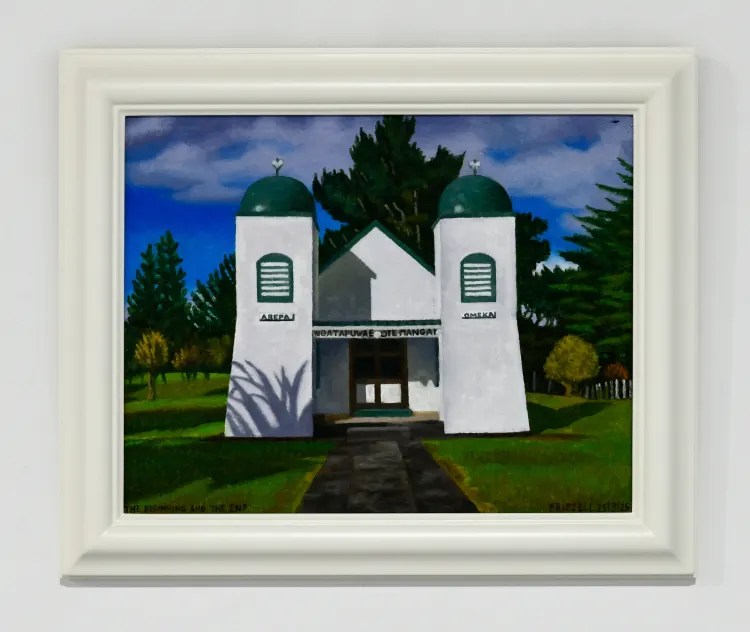
There are a few signs of habitation or figures in his works mainly small insignificant buildings, “Whitebaiter’s Huts” ($27,500) and “Leaning Toilet” ($27,500) but there is also a painting of a Ratana Chapel “The Beginning and the End” $27,500) displaying the words ārepa (alpha) ōmeka (omega), and the large panoramic “Autumn Morning Alexandra” $185,000).
Dick Frizzell, The Beginning and the End
The only paintings of a settlement in the exhibition are “Autumn Morning Alexandra, 2023 “($185,000) and “Alexandra Morning 2019” ($65,000) where the emphasis is on the natural aspects of the view, the distant hills, the colours of the sky and Autumn leaves as well as the surrounding vegetation. The largest work in the exhibition is “Milling Whakaangiangi” ($225,000), a celebration and recognition of the ever-changing face of the land.
As well as taking inspiration from the New Zealand artists of the early twentieth century there are acknowledgment of other artists – such as his Monet-like “Winter, Earnscleugh Road” ($55,000) and a nod to Winslow Homer’s lighthouse with his “Castlepoint”.
Dick Frizzell, Winter, Earnscleugh Road
As with much of the artist’s work there is a wry humour in many of the paintings both in terms of the subject and the titles. A small painting of a pie is titled 27/3/2025” where English and mathematics merge, similar to his Greek / English word play in “The Beginning and the End”.
The exhibition reveals an artist addressing conflicted personal and national histories around land, seeing the land as both a record of our history and a metaphor for our changing identity, seeing the future looming out of the past.
The paintings in Aroha Gossage’s new exhibition “Into the Light” are grounded in her connection to the whenua of Pakiri, north of Auckland where she lives.
They continue Gossage’s exploration of land, light, and ancestry, the paintings serving as links between observation of her environment and reflections on her connections to the land and to her ancestors.
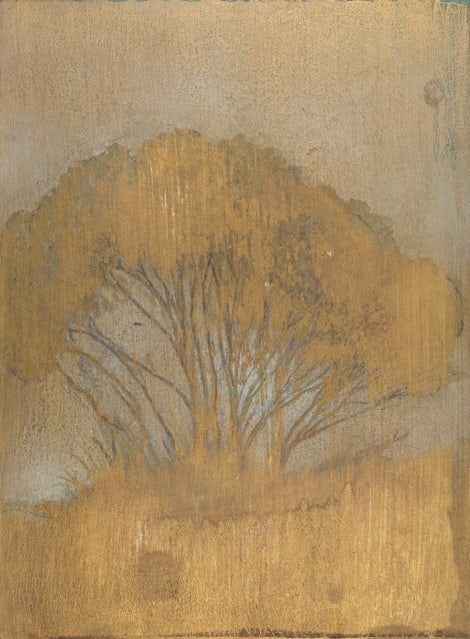
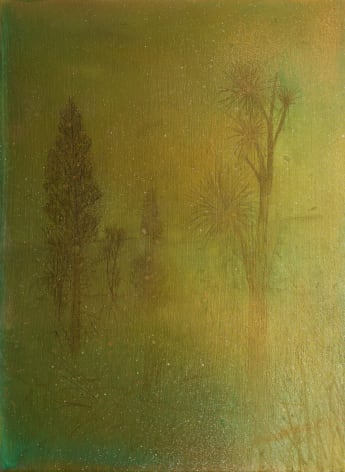
Several of the works are titled after their subject matter, simple renderings of native trees – Nikau, Macrocarpa and Manuka. These works follow in the tradition of botanical artists such as Sir Joseph Banks who identified Manuka in 1769 during his time with Captain Cook on his first voyage aboard the Endeavour and many artists have depicted trees and their flowers since then notably Emily Cumming Harris and Shane Cotton.
Aroha Gossage, Manuka
Gossage’s “Manuka” ($2700) is painted in golden tones giving it an enigmatic quality where earth and foliage are connected, creating an image which transcends the physical. ”Manuka” is part of group of four small works which have distinctive colouring, due to the earth pigments the artist has collected from sites around her local environment.
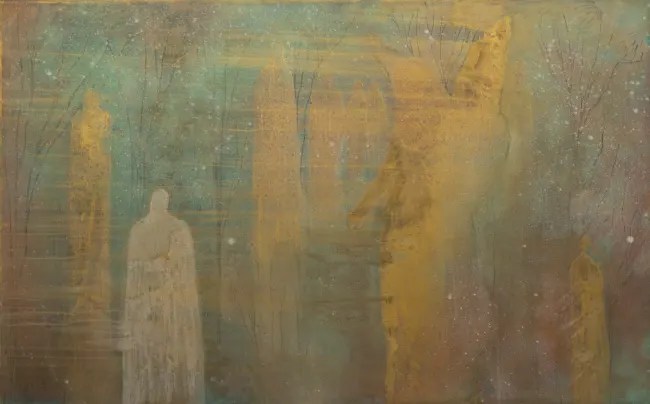
While most of her works are of botanical subjects there are a few which include figures, or at least the spirits or manifestations of figures. Rather than earthly figures they suggest ancestral presence. As the title of the show suggest these figures are journeying towards the light of a new place or a new understanding.
In the large ”Anahera” ($9800) a caped / shrouded figure inhabits an abstract environment with traces of foligare snaking through the work. There is a sense of another world in which ancestors dwell, the paintings connecting the physicality of this world with the spirituality of the other-world .
Aroha Gossage, Light
This can also be seen in “Light” ($2700) with one indistinct form and “Tupuna” ($9800) with several shapes inhabiting a forest of trees. With the works that include figures it is noticeable that while the trees are painted with distinctive realism the figures are indistinct and ethereal.
Some of her works such as “Witi” ($4750) have a quiet drama to them like Rita Angus’ “Tree”. ”Witi” is also impressive because of its deep red earth pigment which seems to it refer to bush fires, destruction and renewal.
Works such as “Hine” ($2700) and “Macrocarpa” with their dark tones seem to be ghost-like images of the trees rather than mere depictions, as though inhabiting another dimension.
The suggestion of another world is created in many of these painting by veils of overlapping colour where the air around the foliage and figures in infused with earthy tones.
There are a couple of works which are pure landscape “Pakiri Dunes” ($9800) and “Kaitaki” ($9800).These do not have the same density or richness as the others works being descriptive with fewer allusions to another dimension.
The Art of Banksy – the major exhibition which has brought Banksy’s era defining works to over 1.5 million visitors in 19 cities across the globe will visit Auckland for a final and strictly limited New Zealand season. The exhibition will be hosted at Tāmaki Makaurau Auckland’s Aotea Centre (Hunua Rooms) from Monday 7 July through Sunday 3 August 2025.
The Art of Banksy is the world’s largest collection of original and authenticated Banksy art showcasing more than 150 pieces including prints, canvases and unique works. The collection wowed thousands of Wellingtonians in 2024 and now it’s Auckland’s turn.
Michel Boersma, curator and producer of the exhibition says: “Following a hugely successful 19 city global tour and 2 years in London, UK, we’re very excited to bring this larger-than-ever collection to Auckland, bigger and better! The last 9 years we have been working with collectors in expanding the collection which we are able to display, from 70 in Auckland in 2018 to over 150 authenticated and genuine works, no replicas – the real deal. I am particularly proud that trusted associates of Banksy, for example Ben Eine, have been willing to contribute to the exhibit with their privately held works, gifts and hand drawn sketches and video testimonials. This way The Art of Banksy is able to lift the veil on how some of the iconic Banksy works were created and reveals some of the secret stunts they got up to.”
Daniel Clarke, Tātaki Auckland Unlimited Director of Performing Arts, leading Auckland Live adds: “We’re delighted to be working with GTP Exhibitions to bring The Art of Banksy to Tāmaki Makaurau Auckland. As one of the world’s most successful contemporary artists Banksy’s work consistently captures the public’s attention and imagination – over a million people worldwide have seen the exhibition – so to have this number of works on show is a hugely exciting addition to our winter events season.”
Visitors at The Art of Banksy can expect to see the seminal artworks that brought the infamously anonymous artist international notoriety such as Girl With Balloon in four different colour variations, including the rare Gold Edition. Banksy fans can also see unique personalised gift prints created for friends, associates and lovers. The exhibition also focuses on Banksy’s Dismaland and recent artworks acknowledging the ongoing war in Ukraine.
Many of Banksy’s iconic works are also featured in the exhibition including a very rare collection of ‘thank you prints which Banksy created as gifts to staff and team members who worked with him at Dismaland and other Banksy stunts. The exhibition also features a series of unique hand drawn sketches by Banksy. The fragile pieces of paper are one-of-a-kind depicting Banksy’s working on versions of his famous rat images.
The Art of Banksy is an unmissable show for anyone who wants to learn more about one of the world’s most important current artists and what their work reveals today; the power of art to affect social change, inspire the public and lay bare the undercurrents of social issues.
The Art of Banksy is not curated or authorised by the artist and only displays authenticated art sold or gifted by the Artist, no replicas or art removed from the street.
Banksy’s Dismaland
ART OF BANKSY
Monday 7 July – Sunday 3 August 2025 Mon – Wed: 10am – 6pm Thu – Sun: 10am – 9pm
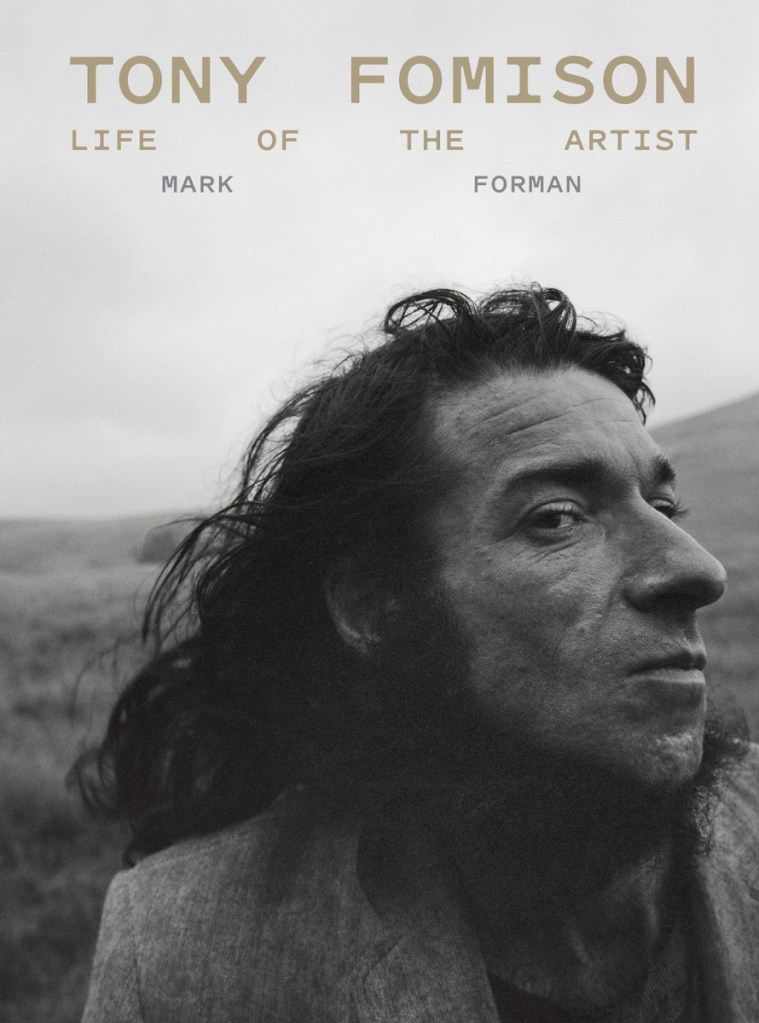
Mark Forman’s new book on Tony Fomison is a superb piece of scholarship which adds to our understanding of the life of one of the great New Zealand artists of the late twentieth century. His writing is particularly informative as there are no images of Fomison’s work in the book. The trustees of his estate, his three daughters, withheld permission to use his work because of assumptions and inaccuracies.
Forman has made up for this with perceptive descriptions of many of the artists important works as well as providing an understanding of the artist and the environment in which he developed his work
Forman’s detailed research, obvious from his bibliography along with the numerous interviews he had with other artists, family members and friends enabled him to give the reader insights into Fomison life and thoughts. He has also included a number of quotes from newspapers and magazines of reviews of the artist’s work and there are also accounts of Fomison irritation at unfavourable reviews.
Fomison had been to Ilam Art School at Canterbury University where he had met a number of artists who he would be friends for the rest of his life including Quentin McFarlane and Des Helmore, Later he would meet Philip Clairmont, Allen Maddox and Colin McCahon. He was also influenced by some of the tutors at Ilam notably Bill Sutton and Rudi Gopas.
In the chapters covering his later life Forman has accounts of his involvement with his various gallerists including Elva Bett, Tina and Kees Hos, Peter McLeavey as well as John Gow and Gary Langsford. There were also other important figures who helped and supported him such as Charles Brasch and Jim and Mary Barr
In the 1960s, Fomison began painting and exhibiting portraits that were, even then very different from many of the other portraits by his peers. His were often distorted, maniacal and tapped into his own troubled life.
Also in the 1960’s as well as pursuing an art career he studied and recorded a number of the Māori rock drawings in Canterbury which became part of his art references
The 1970s was a particularly troubled period in Fomison’s life after he had returned from Europe which had included a spell in a mental institution.
He was down and out, grappling with drug addiction, and he began producing work which was contemptuous and cynical about society.
Many of these artists he identified with were ‘outsider artists’ which Fomison identified with and his dark figures and landscape began to emerge in his paintings. His monsters, misfits, and medical deformities challenged polite society, and explored what it means to be an outsider. Fomison began to paint people on the edges of society, such as prisoners and the disfigured.
Tony Fomison Grotto Road, Onehunga, Auckland. Image Mark Adams
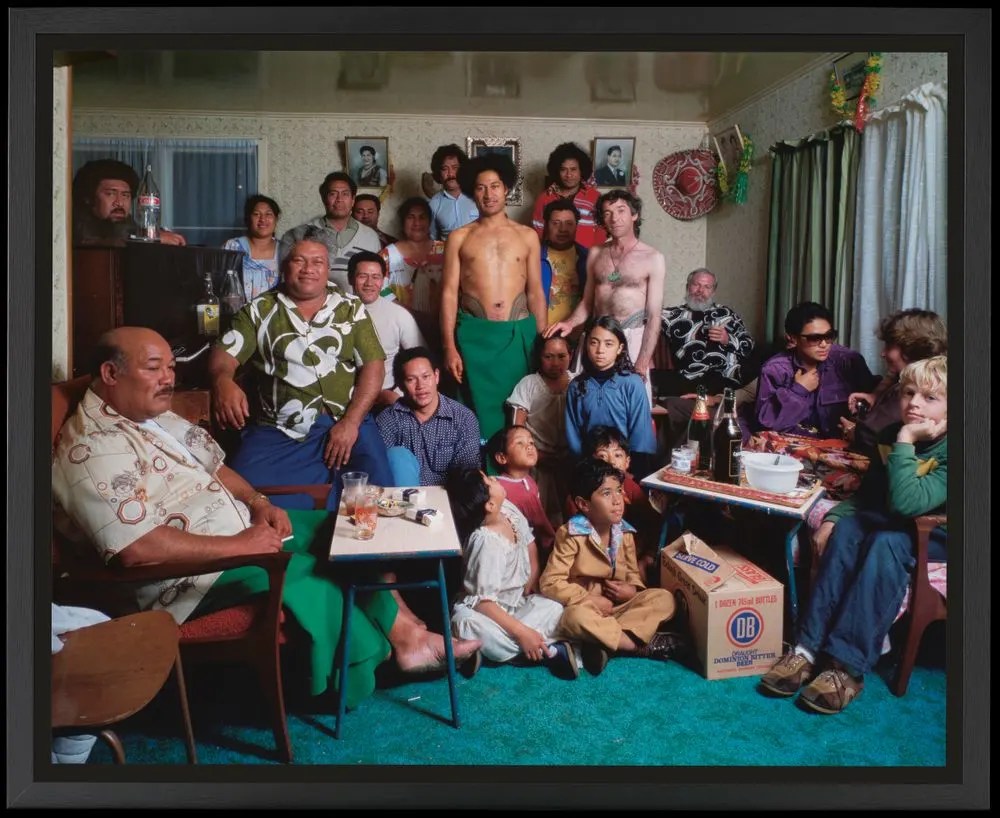
Living in Auckland for much of his life, he had a strong connection to the local Samoan community and in 1980 made the decision to be tattooed with a Samoan pe’a. This and his response to the Springbok tour of 1981was part of the artists unconventional or subversive approach to social and political issues
Forman includes numerous quotes from friends and fellow artists along with reviews which allude to Fomison’ s art as being related to distant periods rather than addressing contemporary issues so that Francis Pound said of his work that it was “akin to that of a seventeenth century primitive” while Hamish Keith wrote that his figures were “sinister and unpleasant… giving of an Old Master complex” and Peter Simpson said he “has something of the impoverished yet eloquent beauty of late Michelangelo”
Fomison led a challenging personal life, which often could be seen in his paintings. As Ian Wedde says, ‘Fomison persisted with thinking and with making art out of his thoughts.’ Following a trip to Europe in the mid 1960s, and a short stint in institutions, Fomison began to paint people on the edges of society, such as prisoners and the disfigured. He would repeatedly return to the theme of the ‘outsider’. Fomison’s work was also often ‘socially committed’, protest the state of the world.
In his career spanning three decades, Fomison produced some of New Zealand’s most significant paintings and drawings, which seemed to incorporate elements of his own physical journey as well as the spiritual and aesthetic journey, linking ideas that he developed along with his whimsical and dark attitude to life.
The “Follow button” at the bottom right will appear and clicking on that button will allow you to follow that blog and all future posts will arrive on your email.
Martin Creed, Work No 3769, Work No 3764, Work No 2053
Three exhibitions K Rd – Palmer, Creed, Parekōwhai.
Stanley Palmer, New Work
Melanie Roger Gallery
Until February 22
Martin Creed, Like Favourite Socks in a Drawer
Michael Lett
Until March 1
Michael Parekōwhai, The Indefinite Article
Artspace Aotearoa
Until April 17
Reviewed by John Daly-Peoples
Current exhibitions along Karangahape Rd offers a range of art works from the realist depictions of the landscape to abstract paintings and conceptual construction.
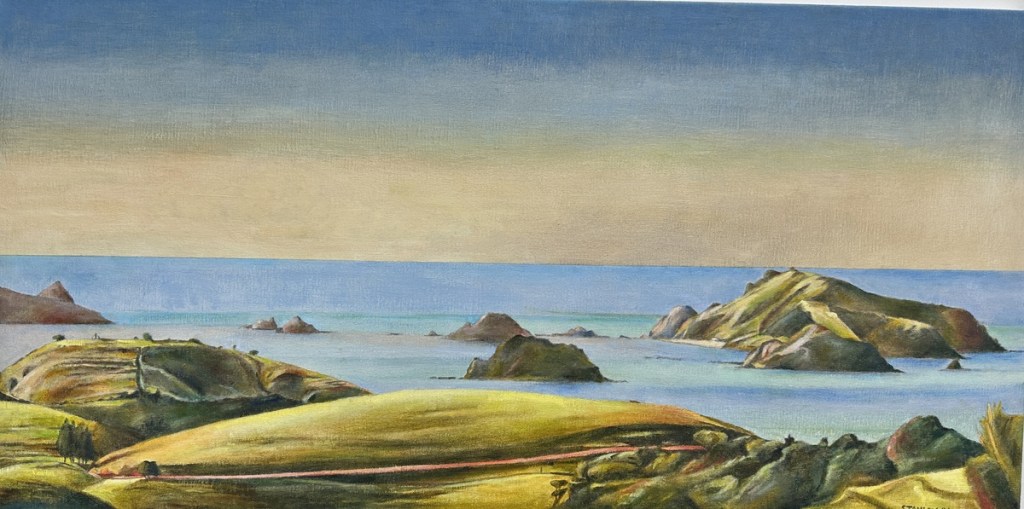
With his latest exhibition at Melanie Roger Gallery Stanley Palmer continues his depictions of the New Zealand landscape. Like many of his previous exhibition he has painted views of the New Zealand coastline featuring dramatic vistas of headlands and offshore islands.
With this new series of works he has revisited many of his previous subjects including depictions of Karamea, Great Barrier Island, Chathams, Great Mercury Island and Matauiri. While these are mainly landscape there are a few which also feature other element in the landscape which add a visual drama as in “Akiaki – Chathams” ($30,000) where he has included windswept trees and grazing sheep.
Stanley Palmer, “Akiaki – Chathams”
These paintings seem to be less detailed than some of his previous work and there is a simplicity which gives these works an added drama. Part of this drama comes from the artists shrewd use of paint, so that in “Awana- Aotea Great Barrier” ($22,000) the eroded cliffs are highlighted by the gash of earthy colours and in “Mataurui” ($28,000) the red line of a track is like an abstract slash through the landscape.
Stanley Palmer “Mataurui”
In most of the works the background of sea meeting sky shows a clever juxtaposition of shimmering abstract blues with subtle variations between each of the paintings
Also included in the exhibition are some of the artist’s earlier bamboo prints of the early 1970’s including “Hillside Town Kohukohu” ($2250).
Stanley Palmer “Hillside Town Kohukohu”
Martin Creed’s minimalist works have always played with the definition of art and art making starting with his Turner winning installation “Work No. 227: The lights going on and off: an empty room” in which the gallery lights switched on and off at 5-second intervals.
His work is a mixture of the witty, poetic and philosophical, making use of a range of everyday materials and approaches which challenge traditional views of art.
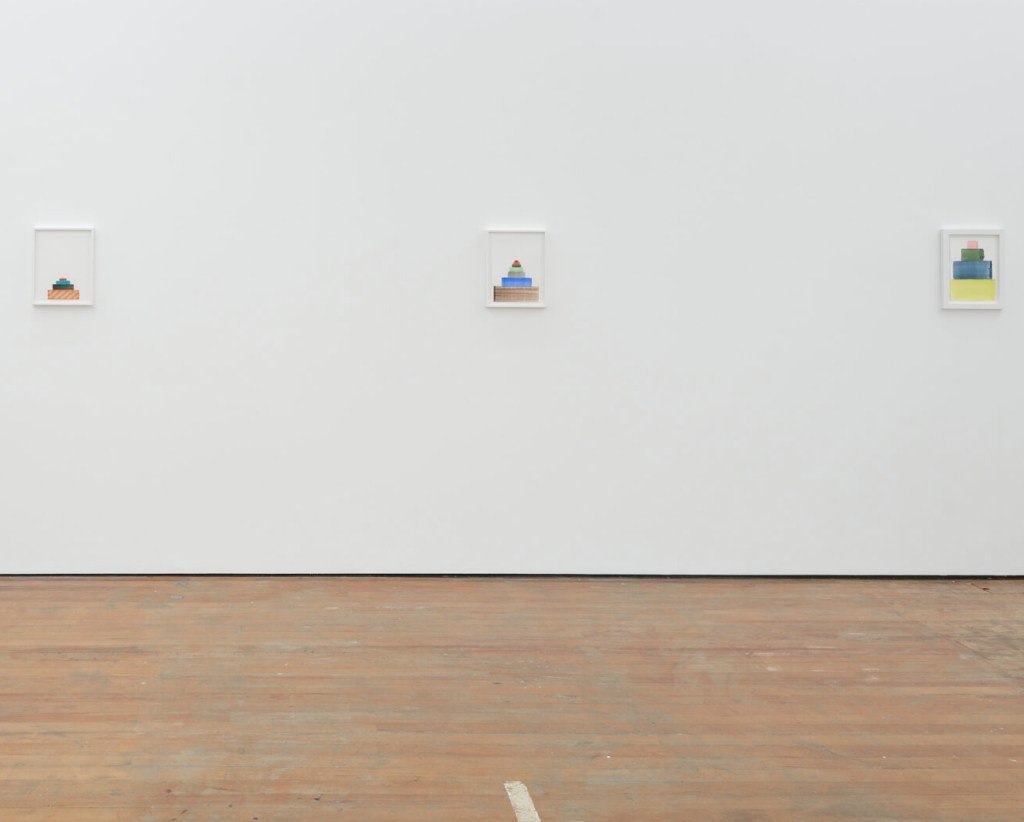
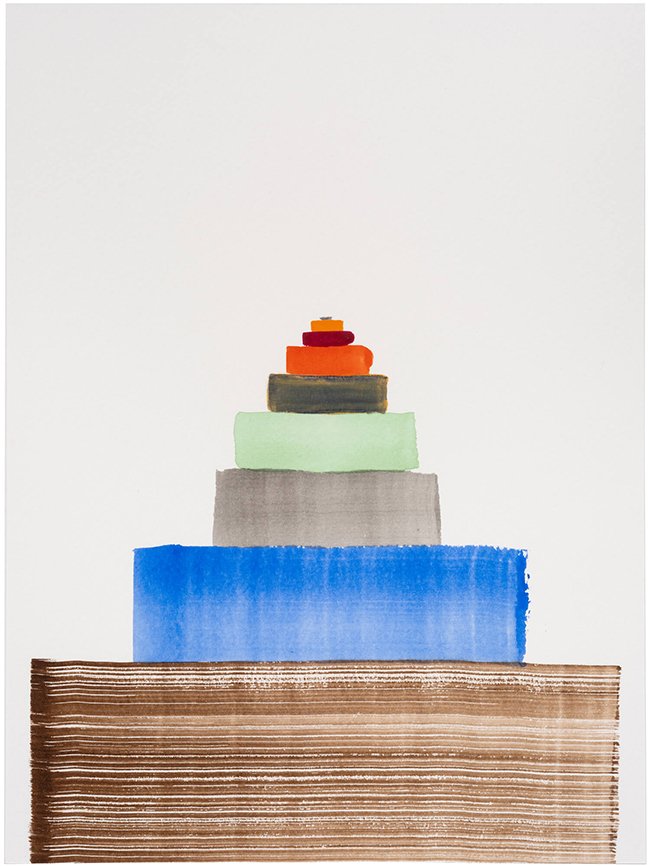
His current show “Like Favourite Socks in a Drawer” brings together elements of chance, time and structure with a series of ziggurat shaped works. The works started with his decision to buy an ordinary multi pack of commercial paint brushes.
Martin Creed, Work No 3764
With these he applied paint in different colours with the varying brush sizes, stacking the colours one above the other to create stepped, random bands of colour.
The paintings/designs can be seen as referencing the ziggurat forms of ancient Mesopotamia and Mexico as well as more recent brutalist constructions and has connections with Rewi Thompson’s block-like house in Kohimarama. There are also hints of Frank Stella, Donald Judd and Cuisenaire rods.
Creed says of the works “A step pyramid is solid and easy to understand. It is a safe structure that is not going to fall down. It is trustworthy. You can see how it is built. The steps are hopefully leading to the top, and you can enjoy the colours on the way up. In a blobby, soupy, ill-defined world it can be helpful to put your ducks in a row.”
The works have a sense of the structure to them with their build-up of coloured shapes and in works such as “Work No 3764” (USD $22,000 plus GST) there is sense of the artist gestural involvement where the striations of the brown / sepia are visible as a single calligraphic stroke. With others there is the notion of time with the various strokes of colour measuring out the time taken to complete each work
Martin Creed, Work No 3766
Some of the work display additions to the quick gesture with Creed scumbling the yellow band in “Work No 3766” (USD $22,000 plus GST). This work like some other has a humorous element with the painting looking like a celebratory, multi-layered birthday cake.
The works all convey Creed’s minimalism of means, notions of time along with the structuring and ordering of objects shapes and colours.
Michael Parekōwhai, The Indefinite Article
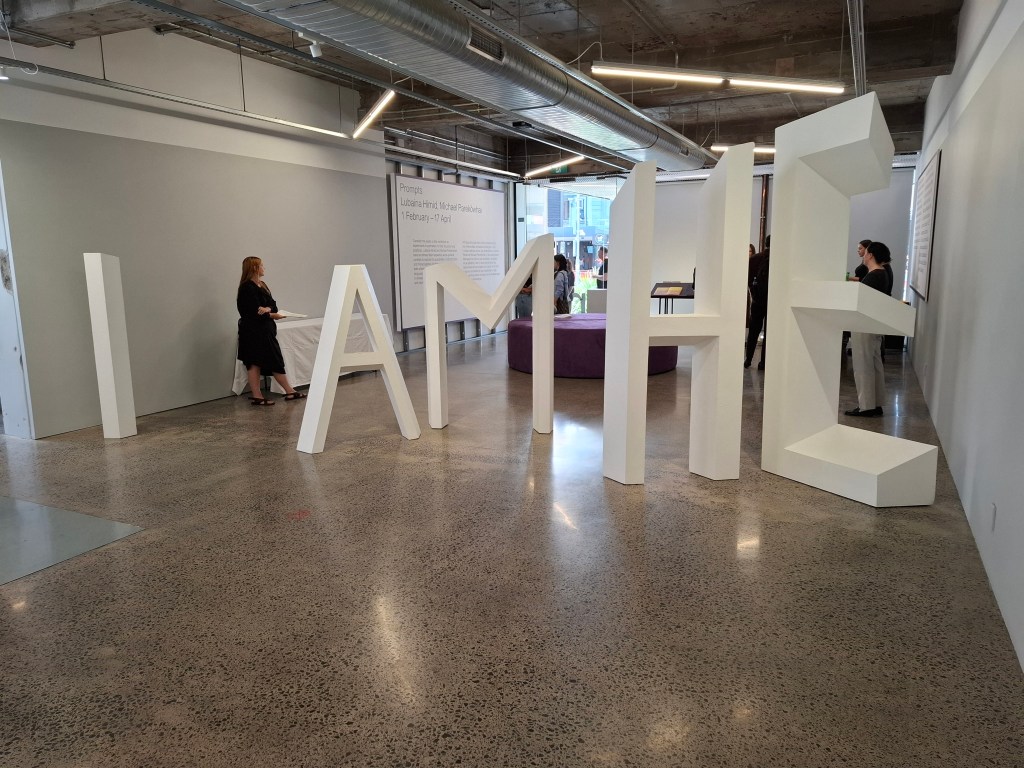
Artspace is exhibiting Michael Parekōwhai’s sculptural object, “The Indefinite Article (1990) which had previously been shown at Artspace in 1990 in the show “Choice” curated by George Hubbard
The large letters based on McCahon’s cubist stylised letters constructed of MDF spell out the words “I AM HE”. Which references some of the McCahon paintings featuring the words “I Am”.
While borrowing from McCahon the work can also be seen as creating a bilingual pun linking the words to te reo where “HE” can be read as the indefinite article where the word can be defined as -a, an, some – or it can also mean something is wrong, mistaken or incorrect.
Other linguistic variations can be identified with the words. During the ”Cultural Safety” exhibition in Frankfort in 1995 where the work was shown this reviewer noted at the time – “His large word sculpture using the words of the Colin McCahon painting I AM HE was quickly identified by one perceptive German journalist as coming from the pen of John Lennon in “I Am the Walrus” [I am he as you are he, as you are me and we are all together] rather than the Bible or McCahon.
The “Follow button” at the bottom right will appear and clicking on that button will allow you to follow that blog and all future posts will arrive on your email.
Gary McMillan, Scene 60 (detail)Elizabeth Rees, Low Tide
Gary McMillan, City in Progress
Fox Jensen McCrory Gallery
September/October
Elizabeth Rees, The Bay
ARTIS Gallery
Until October 7
Reviewed by John Daly-Peoples
Two recent exhibitions see artists responding to the to the light, colours and textures of the environment just as artists of 150 years ago did with some variations on Impressionism.
In his latest exhibition “City in Progress” Gary McMillan has continued his depiction of views of the inner city, the motorways and industrial buildings.
These are nearly all seen from the interior of a car, capturing the often-fleeting images we have when driving. He also captures light in its various forms –sunlight at dawn and dusk, reflected light, refracted light, motorway lamps, industrial lights and traffic lights.
Each of the images has the simple title of “Scene” plus a number, an indication of the artist’s referencing photography and film which gives many of the works a slightly surreal quality.
As well as the connections to film and photography his work connects with traditional realist painting, pointillism and neo-Impressionism.
Many of the works capture the flash of recognition, of half seeing objects seen from a moving car as Scene 52 ($9500) – the rain speckled windscreen, parts of the car, overhead road signs, lamp standards and a blinding sun. They are the impressions the brain takes in as it makes the journey.
Gary McMillan, Scene 63
Scene 63 ($9500) provides a complex view – light blooming on the car’s window screen, light shining through obscuring foliage, another view reflected in the cars side mirror. It becomes an image composed of different elements of light. But these various elements of light are all painted illusions created by the artist.
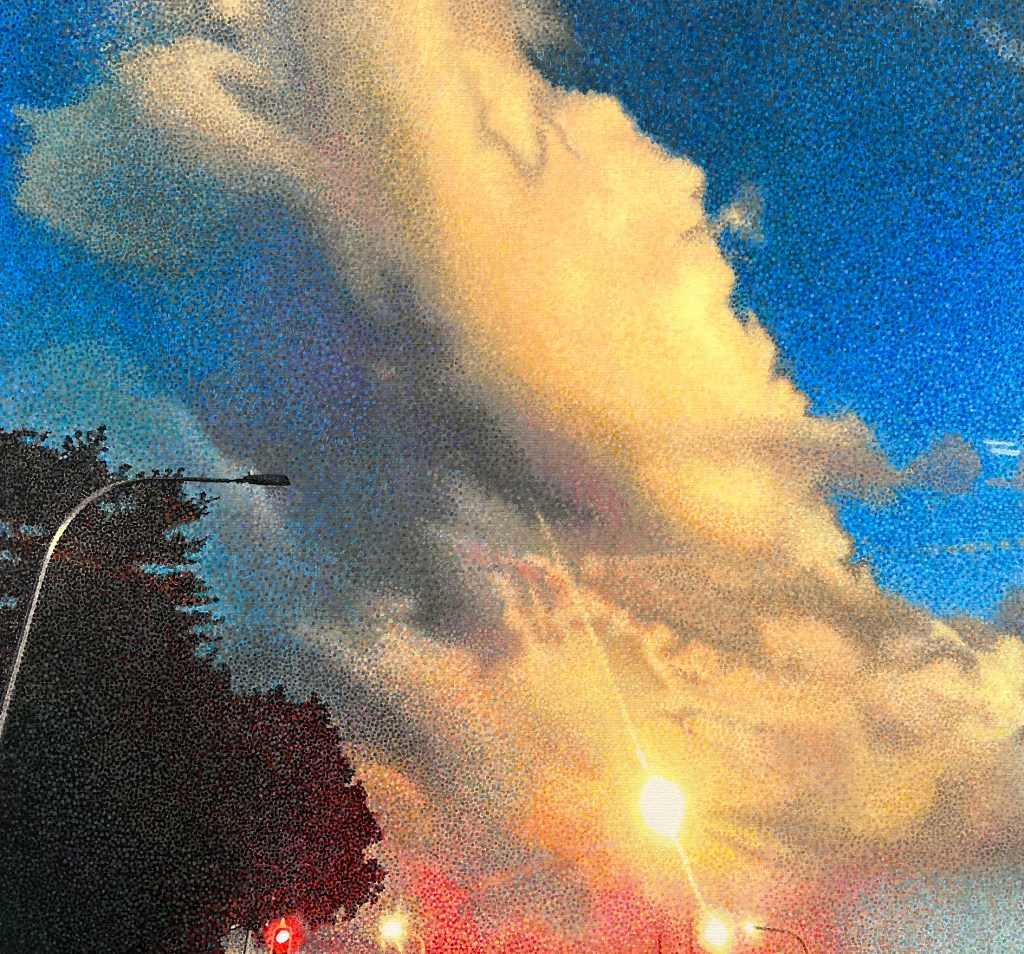
In these works, he investigates the way in which paint creates the illusion of the photographic pixel as well as the painterly impressionist dot.
At a distant his works look like photographs but as the viewer gets closer to the work one is more aware of the Seurat-like pointillism or the pixilation of low-resolution photographs.
With “Scene 57” ($5500) the pointillism is far more apparent with the sky and clouds stippled with the small dots of colour. The artist has added a sense of structure to the work with parallel power lines and one of his ever-present lamp posts.
Gary McMillan Scene 60
This focus on sky and cloud is also seen in “Scene 60”($8000) where the billowing cloud looks like a massive explosion saturated with colour.
Where Gary McMillans exhibition looks at the urban environment Elizabeth Rees’s work is focussed on an isolated area of Northland. As she notes in the catalogue – “”The Bay” is a response to my new small-town life in the Bay of Islands where light ever changes the sea and bushclad land. My recent acquisition of a boatshed in a small tidal bay has now become my full-time studio. Being surrounded by water, this change has offered me yet another perspective – being able so closely connected to the natural environment.”
Her paintings owe much to the style of the Impressionists with a sense of the artist painting in the open air surrounded by her subject.
In responding to an environment she feels some connection with these paintings are a record of the various times of day, moods and qualities of light she has observed
Many of her previous works featured figures in a landscape, their presence providing a sense of isolation. In these newer works it is the landscape itself which provides that sense of isolation.
Elizabeth Rees, A High Tide
Here there are brooding landscapes such as “Summer Shade” ($10,000) where the touches of colour seep through the dark foliage.
With works like “A High Tide” ($8000)) the colours are almost bleached out with light swirling around the shapes of trees.
Elizabeth Rees, On the Beach
A similar work “On the Beach” ($8000 where the foliage is almost shattered by light, could have been used as the cover illustration for the Nevil Shute novel “On the Beach” which tells of impending nuclear pollution in the South Pacific
A further connection could also see the work in reference to the origins of the title in the lines from T S Eliots “The Wasteland”
In this last of meeting places We grope together And avoid speech Gathered on this beach of the tumid river. connection
Two of the works features figures as in “Low Tide” ($8000) where the small figures contribute to the sense of isolation and drama. “Last Light” ($10,500) feels less successful as the two figures contemplating the vista do not contribute to the sense of remoteness.
With “The Bay” ($10,500) there is more colour contrast with the blue of the water and the sky more dominant and the colours of the foliage picked out by light.
Elizabeth Rees, The Bay
“Nestled in the Bay” ($13,500) also alludes to the human presence with several low buildings or boathouses which merge with the light colours of the sand and sea.
The merging of sands and sea is also apparent in “Dunes Beyond” ($10,500) where the dunes seem to be the foam of crashing waves.
With nearly all these works it is light which is the dominant aspect with the artist endeavouring to create an ethereal presence of cloud and sky .The hills and foliage created with scumbled paint give a sense of seeing through a darkened or fogged glass.
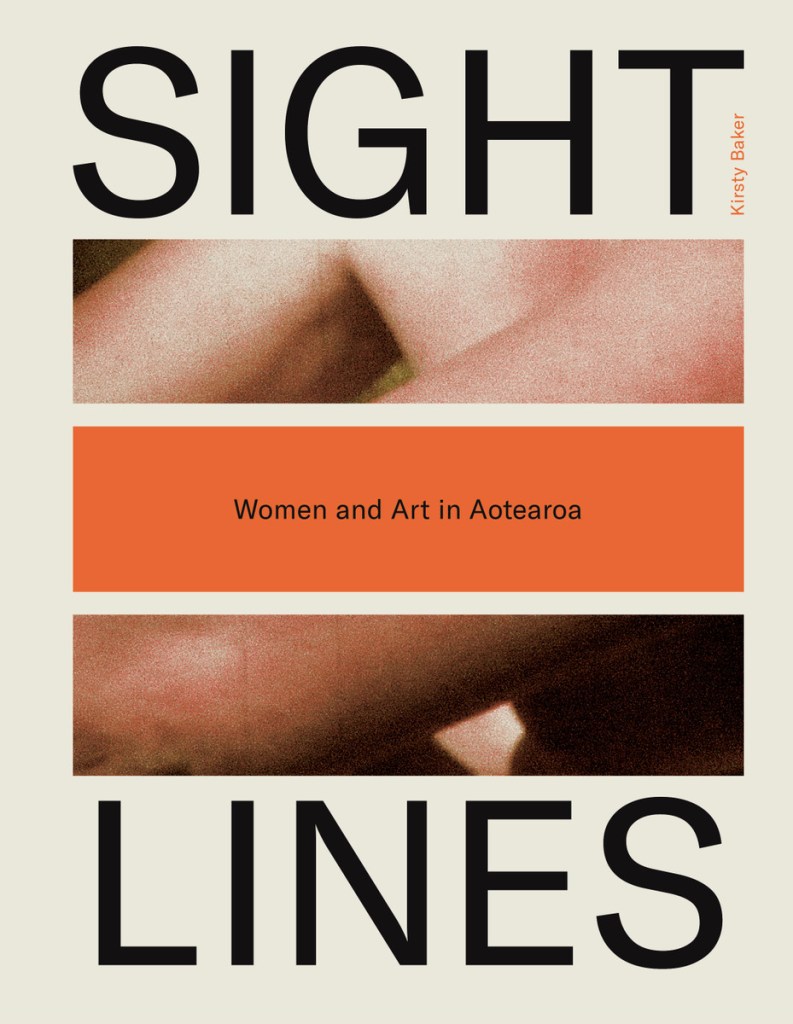
Sight Lines: Women and Art in Aotearoa is a bold and timely book exploring various threads of women’s art of the past as well as those creating art for our times. Editor and writer Kirst Baker acknowledges the complexity of bringing together writings for such a book in her introduction where she notes “It should come as no surprise that this book does not attempt to offer a complete history of women’s artmaking in this country. Such a project is doomed to fail… Instead, the book winds its way along a path that is both fragmented and politicised”.
Within that winding journey it is the through the fragments that we see ideas and revelations and make connections. It is through the practice of many of these artists and their working within a social and political context that we see the importance and ramifications of art.
Lisa Reihana, in Pursuit of Venus [infected], Auckland Art Gallery. single channel UHD video
The dozen chapters in the book have been written by Kirsty Baker along with Chloe Cull, Ngarino Ellis, Ioana Gordon-Smith, Rangimarie Sophie Jolley, Lana Lopesi, Hanahiva Rose, Huhana Smith and Megan Tamati-Quennell.
The essays are all thought-provoking with a mix of biography, narrative, interviews, observations and reflections. These offer new ways at looking at the art created by women but also the nature of art and art institutions.
Baker notes that there are a number of themes running through the book which are indicative of the often different world in which many female artists exist and work.
There is the way that women artists have interrogated their relationship with the land and place and the way they have pushed against gendered limitations.
There is also the way that artists have used their practice to comment on art history and arts institutions and the way that art making plays a role in the care and transmission of knowledge.
In not being a contiguous history of women’s art, the gaps and exclusions are often apparent. These gaps mean at times the book is less satisfying without the linkages of history and context.
While not a history the book covers over two hundred years of art making in New Zealand and includes painters, photographers, performers, sculptors, textile artists and writers. The work of these artists spans whatu kākahu through to the recent work of the Mataaho Collective. Along the away there are chapters on a diverse range of artists – Frances Hodgkins, Rita Angus, Rangimārie Hetet, Pauline Rhodes, Teuane Tibbo, Yuki Kihara and Ruth Buchanan.
With over 150 illustrations the books also provide a visual history of women’s art which is well integrated with the texts.
Julia Morison, Quiddities 1-10. Auckland Art Gallery, Cibachrome transparencies
The essay on Frances Hodgkins provides a succinct overview of her life and work while highlighting the issues which impacted on women artists of the early part of the twentieth century.
The essay on Kura Te Waru-Rewiri reveals the way in which Māori artists have addressed issues of mythology. history and land using abstraction as a means of conveying ideas.
Many of the chapters focus on the issues around the land, whānau and wāhine which is seen in the work of artists such as Robyn Kahukiwa so it is surprising that Robin White, Sylvia Siddell and Jaqueline Fahey who have documented the family and domesticity for several decades are not mentioned.
The other area of exclusion is around abstraction for while the work of Vivian Lynn, Kura Te Waru-Rewiri and Imogen Taylor is included artists such as Phillipa Blair and Gretchen Albrecht are omitted.
Maureen Lander, Ko nga puna waiora o Maunga Taranaki (detail), Govett-Brewster Gallery, mixed media
The final chapter in the book concerns the work by the Mataaho Collective, a group which has recently won the prestigious Golden Lion Award at the Venice Biennale. The chapter predates the win but much of what is written is relevant to the work which has generated more column inches than any previous New Zealand exhibition at the Venice event.
Here there seems to be a disconnection because of the six previous New Zealand female artists to exhibit at the Biennale. only Lisa Reihana and Yuki Kihara are mentioned. That the four other women selected over a twenty yar period to represent New Zealand at the world’s most high-profile event seems puzzling.
Despite this oversight and others, the book is still one which offers much in understanding the developing history of women’s art in New Zealand as well as way that they have been impacted by social acceptance and cultural institutions.
The “Follow button” at the bottom right will appear and clicking on that button will allow you to follow that blog and all future posts will arrive on your email.
Max Gimblett, Holy Gesture and The Golden Mountain after Botticelli
Max Gimblett, Hands of Gold
Gow Langsford Gallery, Auckland
Until June 29
Max Gimblett’s Hands of Gold features a new set of painting many of which make use of the quatrefoil shape which consists of four intersecting circles connecting at a central point is a feature in much Gothic and Renaissance architecture and art.
Gimblett also employs an elegantly or extravagant gestural brush stroke on several of these works which have links to the calligraphic traditions of eastern art and links to the artists interest in Zen which he says has given him ‘The impulse is to feel. I paint without thinking, in an unconscious, free way.’
This approach can also be seen to have links to the contemporary gestural art of the abstract expressionism of Jackson Pollock but with the gravitas of the Japanese artist Sengai Gibbon. These approaches have meant that his work has a sense of the instant -when emotion is realised and intuition revealed.
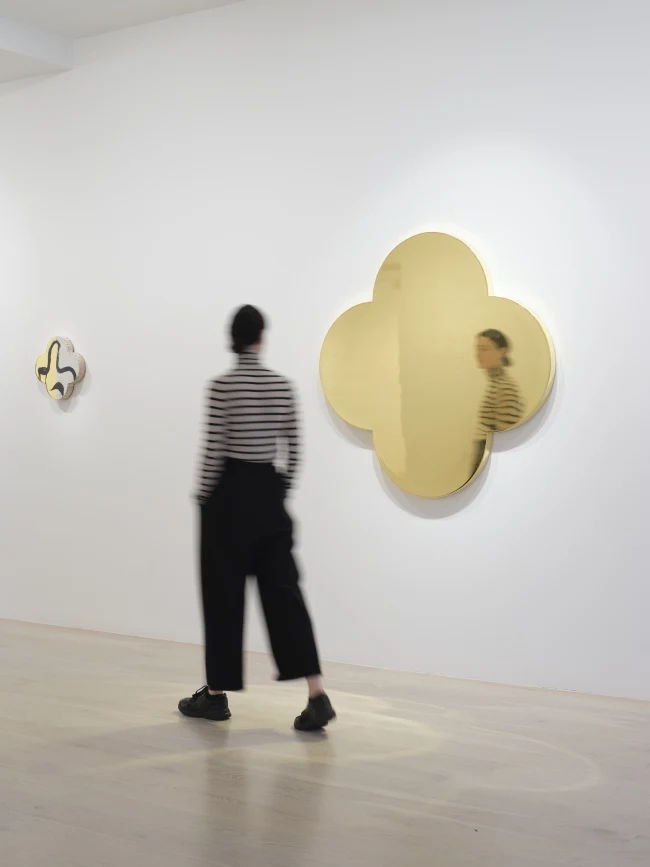
Several of the works have a simplicity to them demonstrating the artists craftsman like approach which goes back centuries to medieval art. There is “The Golden Mountain after Botticelli” ($78,000) in which the artist has used gold foil over panel, creating an almost seamless reflective surface which becomes almost a sculptural piece. The reflective surface means that the viewer becomes an integral part of the work.
There are also smaller works such as “The Golden Diadem” ($20,000) where the gilded surface appears to be almost liquid, the paint sliding over the surface.
There are smaller versions of this large work such as “Eve” ($40,000) and “Moon Suite” ($60,000). where the artist includes a gestural sweep across the surface. These calligraphic strokes the artist employs look as though they trace out the trajectory of a magician wand as in “Holy Gesture” ($28,000).
In some cases these marks are only just visible and these is a sense of the calligraphy emerging magically out of the gilded surface of the work.
Max Gimblett, The River and the Jungle
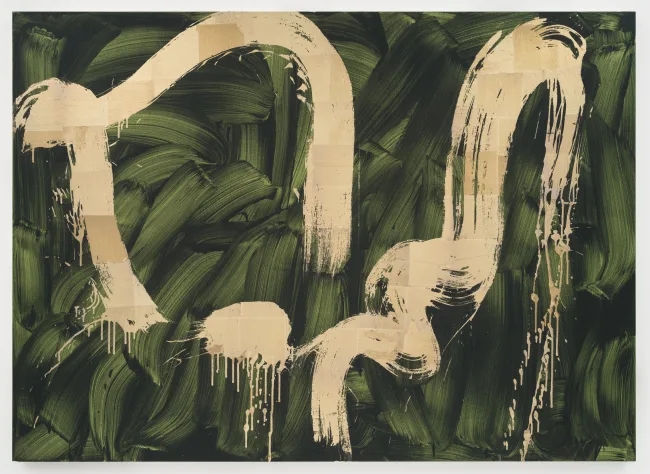
With the rectangular “The River and the Jungle’ ($85,000) the abstract patterns and the golden swirl takes on almost landscape features of river threading through a lush green environment.
Phillipa Blair, Venice CA Revisited
Orexart
Until July 6
Phillipa Blair, Angelus Place 4
Orexart is presenting works by Philippa Blair which span the period 1997 to 2006 and includes five works she made in the late nineteen nineties with her husband John Porter in her Venice California studio. At the time, she was exhibiting regularly alongside contemporary American abstractionists in museum and gallery exhibitions in Los Angeles and New York.
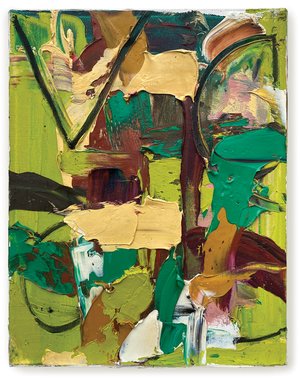
At the heart of her work is the uncertainty and contradictions between chaos and order. This contrast can be seen in both the ideas which pervade the work as well as the physical making and arrangement within the paintings themselves, a duality which exists between the physical and the spiritual, between the random and the deliberate.
The works in the exhibition can be read in a variety of ways – as images relating to events in her personal life, those of the wider world or of abstract conceits.
There are several works under the general title “Angelus Place” ($4800 each), after the street where she lived for many years. With their tightly massed colours one can detect elements of the physical location with hints of palm trees, the triangular shape of the studio roof and shafts of light.
There is a vibrancy to the artist’s work as with “O” ($35,000) with the striations across the surface creating rhythms which suggest dance or music. Her paintings dance with colour, shape and movement and at the microscopic level it is the dance of the atoms.
Phillipa Blair, Breakdance
In the spacious Breakdance ($28,000) of 2006 the sense of dance is also present with jostling blocks of colour and dramatic swirls of paint.
The works all have an inherent volatility and tactility, not so much of the artists applying paint but rather the colours and forms erupting out of the canvas to envelop the viewer.
While there is a tension between the notions of order and chaos implicit in the works there is also the physical tension between the both the myriad colours she uses and the various techniques she employs which sees areas of colours resisting, merging and colliding.
Emily Wolfe, Long Distance
Melanie Rogers Gallery
Until June 27
Emily Wolfe, Strata
Many of Emily Wolfe’s previous works had the look of paintings from a previous period and this latest exhibition “Long Distance “ there isa sense of searching for The Sublime, dwelling on the beauty and drama of nature. The title might also be referring back to that time, and the search for The Sublime. She is also referencing her distance from New Zealand as all the works were painted in London.
These paintings are about the nature of art itself, the colours, the quality of the light an interest in the depiction of surfaces and textures and an awareness of the painter’s skills and techniques in the pursuit of the illusions.
The works feature sections of typical romantic landscapes – pastoral landscapes with distant hills, and framing trees. The paintings also feature clouds recalling the numerous cloud studies of John Constable.
Some of the works have a surreal quality, reminiscent of Rene Magritte’s paintings with paintings such as “Drift” ($7000) where a painted section is overlaid onto a similar landscape view of the exterior world. That section could have come from “Off Centre” ($7000) where a section of canvas has been removed from a painting created an empty space.
Emily Wolfe, Light Years
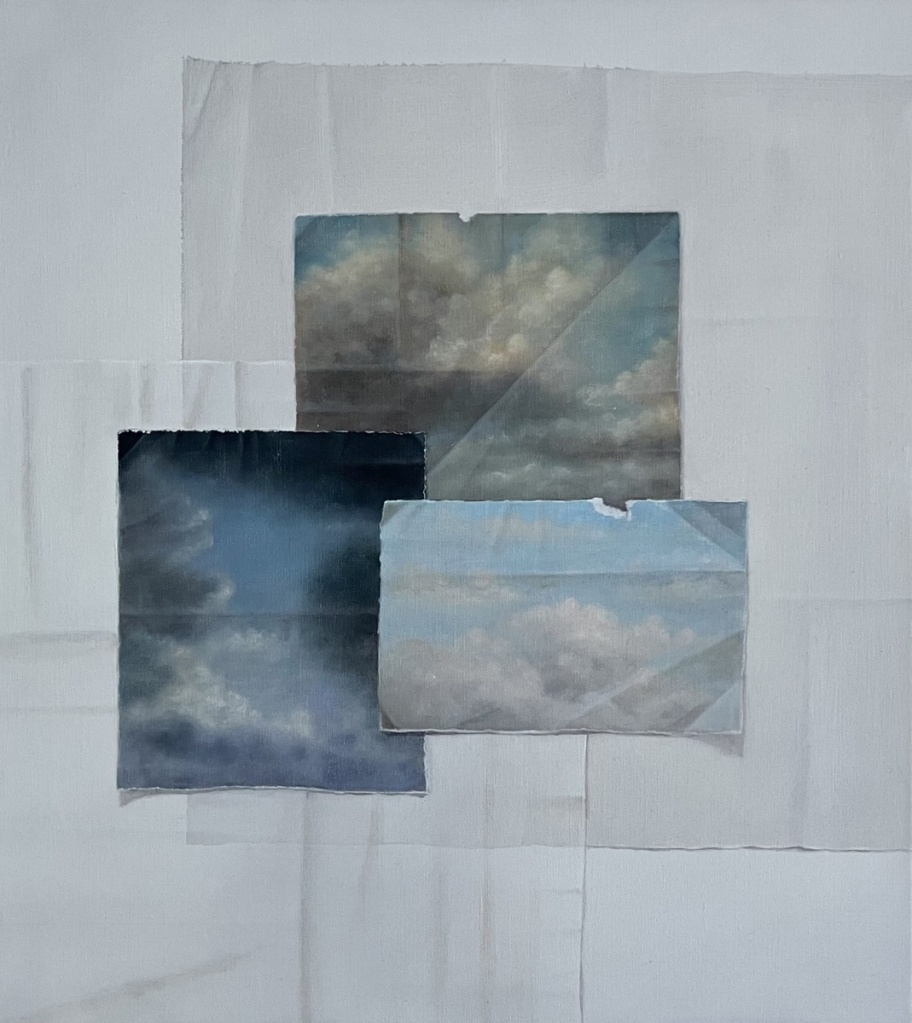
With “Light Years” ($7000) the artist has assembled five different pieces of paper / canvas to create collage of images for some future work. They are like swatches of varying colour intensity and light which the artist is playing with.
“Strata” ($14,000) is an impressive work featuring a dramatic alpine vista in the taped to the wall and floor . Resting on the work is a sheet of paper and an old-fashioned T square. The inclusion of the T Square as well as a tracing table in “Long Distance” ($14,000) are references to the aids often used by artists in the construction of their work.
With all these works she displays a shrewd visual language where representation and reality are playfully deconstructed, where light becomes a palpable component of the work and where time seems to stand still.
The “Follow button” at the bottom right will appear and clicking on that button will allow you to follow that blog and all future posts will arrive on your email.




 27/3/2025” where English and mathematics merge, similar to his Greek / English word play in “The Beginning and the End”.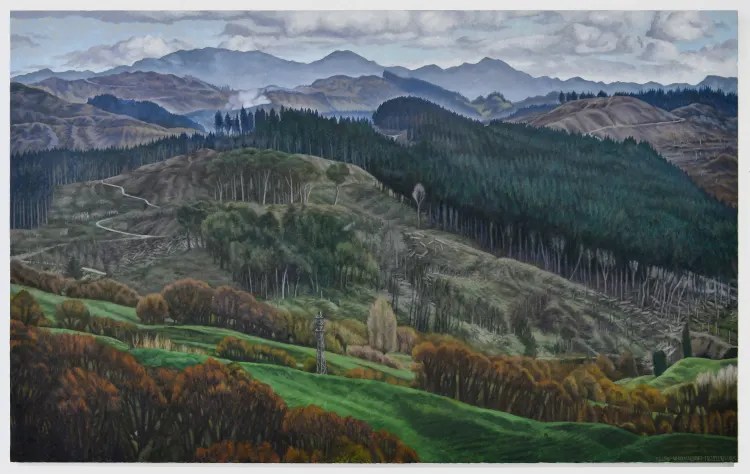













 New Zealand Arts Review