Reviewed by John Daly-Peoples
Max Gimblett, Hands of Gold
Gow Langsford Gallery, Auckland
Until June 29
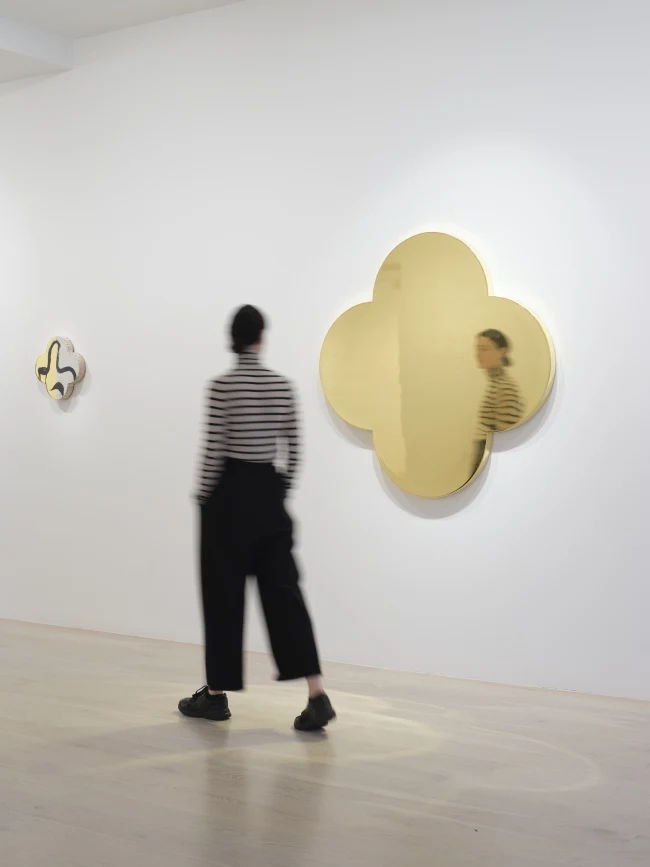
Max Gimblett’s Hands of Gold features a new set of painting many of which make use of the quatrefoil shape which consists of four intersecting circles connecting at a central point is a feature in much Gothic and Renaissance architecture and art.
Gimblett also employs an elegantly or extravagant gestural brush stroke on several of these works which have links to the calligraphic traditions of eastern art and links to the artists interest in Zen which he says has given him ‘The impulse is to feel. I paint without thinking, in an unconscious, free way.’
This approach can also be seen to have links to the contemporary gestural art of the abstract expressionism of Jackson Pollock but with the gravitas of the Japanese artist Sengai Gibbon. These approaches have meant that his work has a sense of the instant -when emotion is realised and intuition revealed.
Several of the works have a simplicity to them demonstrating the artists craftsman like approach which goes back centuries to medieval art. There is “The Golden Mountain after Botticelli” ($78,000) in which the artist has used gold foil over panel, creating an almost seamless reflective surface which becomes almost a sculptural piece. The reflective surface means that the viewer becomes an integral part of the work.
There are also smaller works such as “The Golden Diadem” ($20,000) where the gilded surface appears to be almost liquid, the paint sliding over the surface.
There are smaller versions of this large work such as “Eve” ($40,000) and “Moon Suite” ($60,000). where the artist includes a gestural sweep across the surface. These calligraphic strokes the artist employs look as though they trace out the trajectory of a magician wand as in “Holy Gesture” ($28,000).
In some cases these marks are only just visible and these is a sense of the calligraphy emerging magically out of the gilded surface of the work.
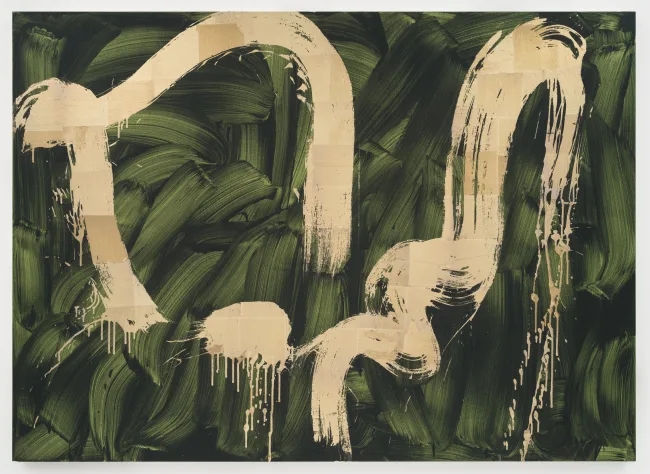
With the rectangular “The River and the Jungle’ ($85,000) the abstract patterns and the golden swirl takes on almost landscape features of river threading through a lush green environment.
Phillipa Blair, Venice CA Revisited
Orexart
Until July 6
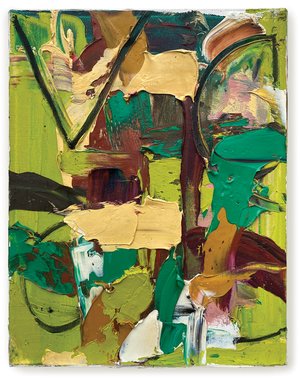
Orexart is presenting works by Philippa Blair which span the period 1997 to 2006 and includes five works she made in the late nineteen nineties with her husband John Porter in her Venice California studio. At the time, she was exhibiting regularly alongside contemporary American abstractionists in museum and gallery exhibitions in Los Angeles and New York.
At the heart of her work is the uncertainty and contradictions between chaos and order. This contrast can be seen in both the ideas which pervade the work as well as the physical making and arrangement within the paintings themselves, a duality which exists between the physical and the spiritual, between the random and the deliberate.
The works in the exhibition can be read in a variety of ways – as images relating to events in her personal life, those of the wider world or of abstract conceits.
There are several works under the general title “Angelus Place” ($4800 each), after the street where she lived for many years. With their tightly massed colours one can detect elements of the physical location with hints of palm trees, the triangular shape of the studio roof and shafts of light.
There is a vibrancy to the artist’s work as with “O” ($35,000) with the striations across the surface creating rhythms which suggest dance or music. Her paintings dance with colour, shape and movement and at the microscopic level it is the dance of the atoms.

In the spacious Breakdance ($28,000) of 2006 the sense of dance is also present with jostling blocks of colour and dramatic swirls of paint.
The works all have an inherent volatility and tactility, not so much of the artists applying paint but rather the colours and forms erupting out of the canvas to envelop the viewer.
While there is a tension between the notions of order and chaos implicit in the works there is also the physical tension between the both the myriad colours she uses and the various techniques she employs which sees areas of colours resisting, merging and colliding.
Emily Wolfe, Long Distance
Melanie Rogers Gallery
Until June 27

Many of Emily Wolfe’s previous works had the look of paintings from a previous period and this latest exhibition “Long Distance “ there isa sense of searching for The Sublime, dwelling on the beauty and drama of nature. The title might also be referring back to that time, and the search for The Sublime. She is also referencing her distance from New Zealand as all the works were painted in London.
These paintings are about the nature of art itself, the colours, the quality of the light an interest in the depiction of surfaces and textures and an awareness of the painter’s skills and techniques in the pursuit of the illusions.
The works feature sections of typical romantic landscapes – pastoral landscapes with distant hills, and framing trees. The paintings also feature clouds recalling the numerous cloud studies of John Constable.
Some of the works have a surreal quality, reminiscent of Rene Magritte’s paintings with paintings such as “Drift” ($7000) where a painted section is overlaid onto a similar landscape view of the exterior world. That section could have come from “Off Centre” ($7000) where a section of canvas has been removed from a painting created an empty space.
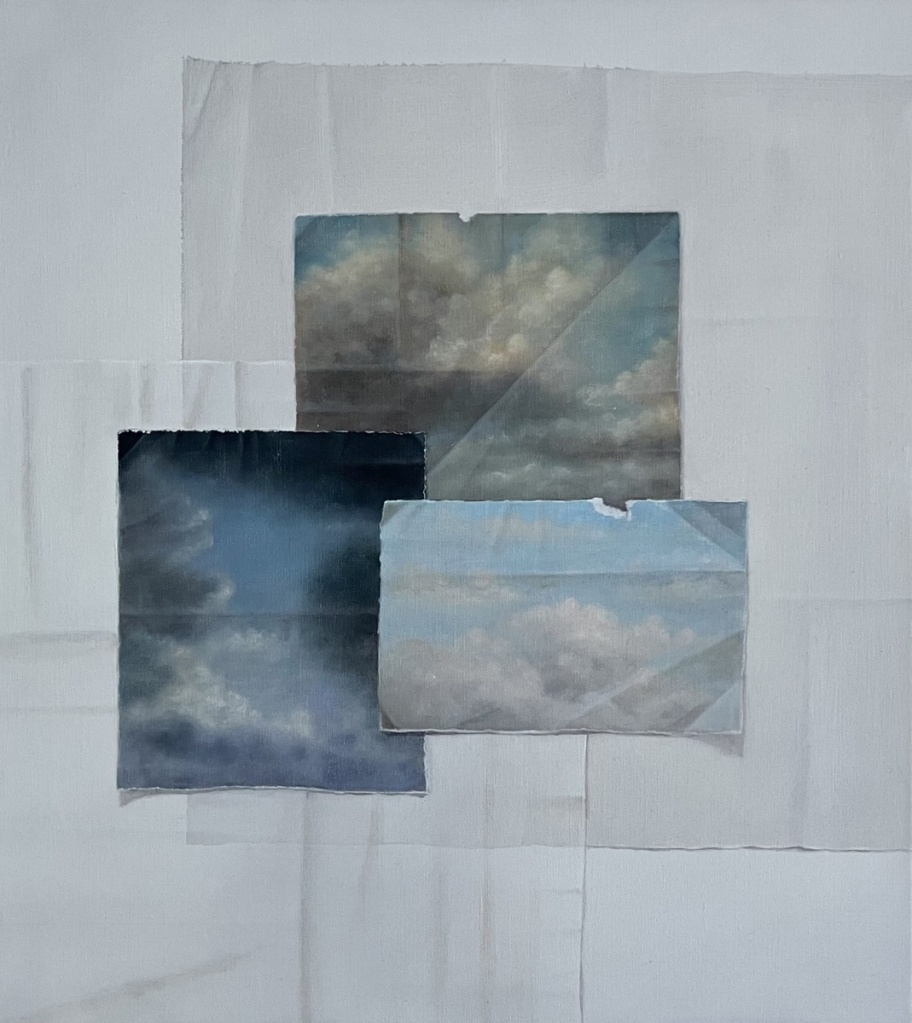
With “Light Years” ($7000) the artist has assembled five different pieces of paper / canvas to create collage of images for some future work. They are like swatches of varying colour intensity and light which the artist is playing with.
“Strata” ($14,000) is an impressive work featuring a dramatic alpine vista in the taped to the wall and floor . Resting on the work is a sheet of paper and an old-fashioned T square. The inclusion of the T Square as well as a tracing table in “Long Distance” ($14,000) are references to the aids often used by artists in the construction of their work.
With all these works she displays a shrewd visual language where representation and reality are playfully deconstructed, where light becomes a palpable component of the work and where time seems to stand still.
To subscribe or follow New Zealand Arts Review site – www.nzartsreview.org.
The “Follow button” at the bottom right will appear and clicking on that button will allow you to follow that blog and all future posts will arrive on your email.
Or go to https://nzartsreview.org/blog/, Scroll down and click “Subscribe”