Categories
Reviews, News and Commentary

Rarely seen American and European art at the Auckland Art Gallery

Reviewed by John Daly-Peoples

Auguste Renoir, Road at Wargemont, 1879, Toledo Museum of Art, Purchased with funds from the Libbey Endowment, Gift of Edward Drummond Libbey

A Century of Modern Art

Auckland Art Gallery  

June 7 – September 28

John Daly-Peoples

A Century of Modern Art which has just opened at the Auckland Art Gallery is one of the most significant exhibitions mounted by the gallery in the last few years. It is on loan from the Toledo Museum of Art, Ohio, and provides  a survey of the major artists who transformed modern art  from the mid nineteenth century to the mid twentieth century.

The exhibition features 57 works by 53 artists, including Paul Cezanne, Edgar Degas, Helen Frankenthaler, Édouard Manet, William Merritt Chase, Amedeo Modigliani, Berthe Morisot, Claude Monet, Pablo Picasso, Camille Pissarro, Robert Rauschenberg, Pierre-Auguste Renoir, Vincent van Gogh, James McNeill Whistler, among others.

The Toledo Art Museum was established and funded by Edward Drummond Libby and still has a substantial Endowment Trust in his name . The endowment has some $330 million and a budget of more than $20 million a year,. Many of the works in the exhibition were gifted by Libby or acquired through the Libbey Endowment.

Georges Braque, Still Life with Fish, 1941, Toledo Museum of Art, Purchased with funds from the Libbey Endowment, Gift of Edward Drummond Libbey

Some of the Impressionist / Post Impressionist works by artists such as Renoir, van Gogh, Morisot and Gauguin are major works whle some of them are of unfamiliar subjects such as Renoir’s ”Road at Wargemont”

Several of the works are excellent examples of their work such as van Gogh’s “Wheat Fields with Reaper, Auvers” and Monet’s Water Lilies of 1922, one of the many images of the flower he created in his later years.

The show also features some unfamiliar names of American artists such as Luther Emerson van Gorder whose “Flower Market, Paris” (late 19ht century) could be mistaken for a Pissarro.

Flower Market, PLuther Emerson, Van Gorder, Flower Market, Paris, late 19th century- early 20th century. Toledo Museum of Art, Gift of the artist

The small Whistler work ”Crepuscule in Opal, Trouville” of 1865 is an interesting inclusion in the show, the landscape with its slash of colour is an almost abstract work

Among the more contemporary work is Helen Frankenthaler “Blue Jay” painted at a transition time between paintings of organic forms and colour field paintings. There is also a Morris Louis whose work has not been seen in Auckland since his large exhibition at the gallery in 1971

Helen Frankenthaler, Blue Jay, 1963, Toledo Museum of Art, Gift of The Woodward Foundation

There are also works by artists who we rarely see but whose work shows high level of sophistication such as Piet Mondrian’s Composition with Red, Blue, Yellow, Black, and Gray”, László Moholy-Nagy’s ”Am2”, and Max Beckmann’s “The Trapeze”.

Max Beckmann, German, 1884-1950; The Trapeze; 1923; oil on canvas;H: 77 3/8 in. (196.5 cm); W: 33 1/8 in. (84 cm);Toledo Museum of Art; 1983.20;

There are a few important American artists  as Stanton Macdonald-Wright who was one of the early American abstract artists and his  “Synchromy, Blue-Green”, of  1916 is  an example of the abstraction which developed in America in the early twentieth century.

Other American artists in the show include Gertrude Glass Green  who was an important constructivist artist and Grace Hartigan who was a  member of the New York School in the 1950’s and 60’s.

To subscribe or follow New Zealand Arts Review site – www.nzartsreview.org.

The “Follow button” at the bottom right will appear and clicking on that button  will allow you to follow that blog and all future posts will arrive on your email.

Or go to https://nzartsreview.org/blog/, Scroll down and click “Subscribe”

Categories
Reviews, News and Commentary

Black Grace’s Rage Rage: focussed and potent dance

Reviewed by John Daly-Peoples

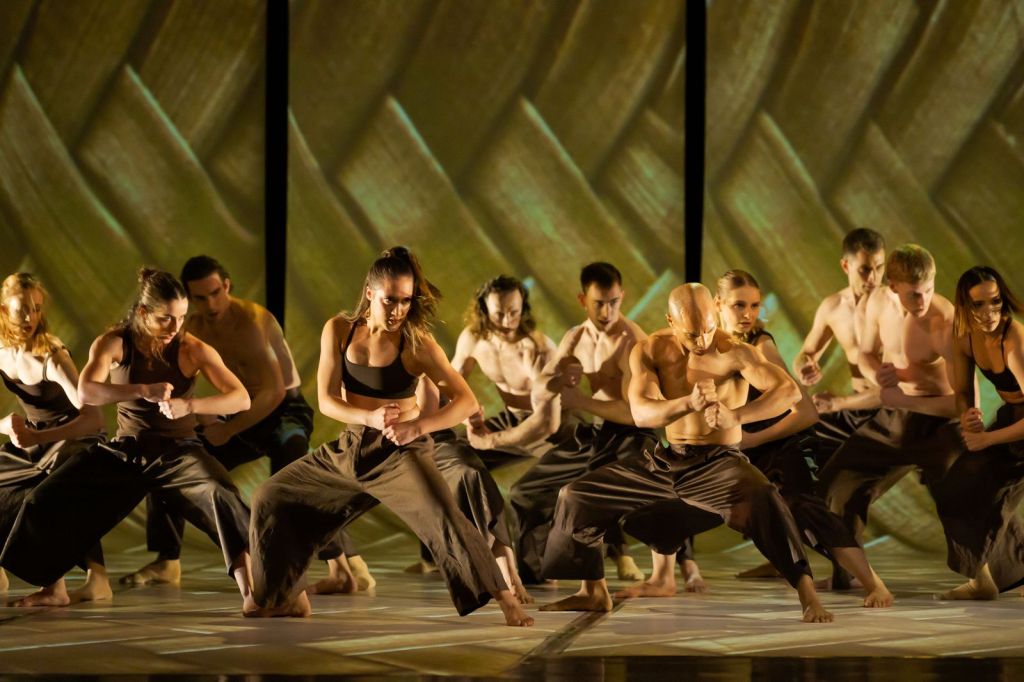
Black Grace , Company B Image; Jinki Cambronero

Rage Rage

Black Grace, Company B

Hunua Room

Aotea Centre

Until June 5

Reviewed by John Daly-Peoples

For Black Grace’s “Rage Rage” the Aotea Centre’s Hunua Room was set up with a high catwalk built through the centre of the space.

Was this nod to Dylan Thomas’s “Rage rage against the dying of the light” or a personal rage of Neil Ieremias. His work has always had an element of the personal and the political with works which are confrontational both between the performers themselves and between performers and audience.

Up to a couple of dozen performers race around the stage, in waves of massed groups, performing a series of linked dances to a range of music from traditional Samoan to contemporary rap.

Like all Ieremia’s shows this was a high energy and relentless performance combining many of the elements of his previous explorations in dance.

There is the hand clapping, foot stomping, the falls / collapses, hand movements like a form of deaf signing and arms used as a kind of semaphore.

The various sequences are introduced by Strictly Brown founders Leki Jackson-Bourke and Saale Ilaua who reminisce about their time at school, favourite TV and films and playground games. These reminiscences lead the company into surges of movement.

The sounds are a mixture of the traditional and the modern as the dancers negotiate issues of the present which are rooted in the past. Some of these are addressed in the latter part – Covid, climate change and the future of Tuvalu.

Many of routines seem based on the schoolyard ‘game’ of Rush, some of which morph into fights or just dissipate.

The final sequence is a mix of despair and celebration danced to a nihilistic vocal soundtrack-

“I don’t belong here

I’m a weirdo

What the hell am I doing here”

With the refrain

You don’t belong here

Which encapsulates so .much feeling and emotion focused on the emptiness of contemporary life.

Like much of Black Grace dances there is a tension and drama created by the action and reaction, between rapid movement and calm, between a zombie-like state and intense animation.

Throughout the performances there is an awareness of the beauty and intensity of the dance and the strange conflicting visceral and abstract nature of the dancing which underlines Ieremia’s ability to create dance which is focused and potent

To subscribe or follow New Zealand Arts Review site – www.nzartsreview.org.

The “Follow button” at the bottom right will appear and clicking on that button  will allow you to follow that blog and all future posts will arrive on your email.

Or go to https://nzartsreview.org/blog/, Scroll down and click “Subscribe”

Categories
Reviews, News and Commentary

Mark Adams: Photographs across time and cultures

Reviewed by John Daly-Peoples

Mark Adams A survey — He kohinga whakaahua

Mark Adams and Sarah Farrar

Massey University Press

80.00

Mark Adams: A Survey | He Kohinga Whakaahua

Auckland Art Gallery

Until August 17

Reviewed by John Daly-Peoples

The current exhibition “Mark Adams: A Survey | He Kohinga Whakaahua” is the artists first comprehensive exhibition of his work and features more than 65 works spanning his 50-years as a photographer. documenting the land, the people and its history. These photographs are of places across the Pacific, the United Kingdom and Europe.

Much of his practice documenting sites of significance across the country, include places where Captain James Cook and his crew came ashore on their visits in 1769 and the 1770s, as well as locations where Te Tiriti o Waitangi was signed in 1840.

Over the decades, Adams has sustained a deep and ongoing engagement with subjects of interest. He has photographed whakairo Māori (Māori carving) both here and overseas and the work of, Samoan master tattoo artists, Māori–Pākehā interactions in Rotorua, carved meeting houses, locations of significance for Ngāi Tahu in Te Waipounamu and  the place of museums and photography in the area of cross-cultural exchange.


It includes photographs taken across the Pacific, the United Kingdom and Europe that explore the migration of artistic and cultural practices across the globe, and examine the role of museums, and photography itself, in the ongoing area of cross-cultural exchange.

The various sections of the book show Adams’ range of work from his early works, his focus on Rotorua, tatau, Treaty Signing Sites, Museums, Cooks Sites Māori meeting house in overseas locations, Te Waipounamu and his more recent interest in Photograms.

Several of his multi-image work are fascinating in their scope and production but the book does not do them credit, even when spread across several pages. With these works the exhibition at the Auckland Art Gallery make an impression in some cases filling an entire wall of the gallery. “0 degrees” is such  a work, a  panoramic 360-degree set of images taken at Greenwich Park which includes the Royal Observatory, the home of Greenwich Mean Time and Prime Meridian.

Other works on a grand scale  include  his “Nine Fathoms Passage”, the photographers view replicating William Hodges view of Dusky Sound, and his panorama of the  meeting house, Hinemihi in the grounds of Clandon Park in Surrey, England as well as the magnificent meeting house Rauru in the Museum am Rothenbaum in Hamburg.

Mark Adams, 13.11.2000. Hinemihi. Clandon Park. Surrey. England. Ngā tohunga whakairo: Wero Tāroi, Tene Waitere, 2000, colour inkjet prints, Auckland Art Gallery Toi o Tāmaki, gift of the Patrons of the Auckland Art Gallery, 2014.

Author of the book Sarah Farrar says “You could say that, in many respects, Mark has been ahead of his time as a Pākehā and Palagi artist. But what does that really mean — to be ‘early’ or ‘ahead of one’s time’? It’s all relative and I’m sure many people would view a respectful approach to tangata whenua and tangata o le moana as seriously overdue.”

Adams’ photographs are of exceptional quality and intriguing in their distinctive approach to subject matter. The viewer is challenged to interpret , question and reflect on them. One commentator, Damian Skinner has noted that Adams photographs “offer no resolution, only problems. They patiently track the material traces of various forces that coalesce in specific sites”.

Mark Adams, 19.05.1989. Te Ana o Hineraki. Moa Bone Point Cave. Redcliffs. Ōtautahi Christchurch. Te Waipounamu South Island, 1989, gold-toned silver bromide fibre-based prints, Auckland Art Gallery Toi o Tāmaki, gift of the Patrons of the Auckland Art Gallery, 2014.

Generally, with photographs of important sites the photographer is essentially saying – “I was here – this is how it looks”. However, with many of Mark Adams photographs of historical sites, the land seems of little interest, often devoid of figures. With these the photographer seems to be saying “this is how it looked”. The photographs require the viewer to transport themselves back to that place but in another time.

Sarrah Farrar notes “His photographs of museums and art galleries remind me of the artifice and stagecraft that we are actively involved in as curators and museum professionals. Every decision we make communicates something to audiences. We construct meaning through the selection of objects (even those that are absent), their placement and their interpretation. Mark’s photographs remind me of the power dynamics and knowledge systems that are inscribed in museum, library and art gallery experiences — even embedded into the design of the buildings themselves. A great example of this is Mark’s panorama of the science-fiction-like modernist design of Berlin’s Staatsbibliothek, which feels so at odds with the fact that it’s the home of the journals of Georg Forster, the naturalist who travelled with James Cook on his second voyage.”

Mark Adams, 1988. Hori Korei. George Grey monument. Albert Park. Tāmaki Makaurau Auckland, 1988, silver bromide print, courtesy of the artist.

The book is a stylish, superbly-designed production with over 200 images, mainly black and white. It features  an excellent text by Sarah Farrar as well as a forward by Ngahuia te Awekotuku and afterword by Nichlos Thomas

Categories
Reviews, News and Commentary

Peter Cleverly: The artist revealed

Reviewed by John Daly-Peoples

Peter Cleverly: Between Transience and Eternity

Alistair Fox

Quentin Wilson Publishing

RRP $60

Reviewed by  John Daly-Peoples

Peter Cleverly has rarely shown his work in Auckland galleries apart from a few times the early 1990’s, so for many his work is unknown apart from images in publications.

However, a new book, “Peter Cleverly: Between Transience and Eternity” by Alistair Fox will correct this.

The heavily illustrated book traces the artists career from the 1980’s to the present with images of his work across more than four decades.

These four decades of art practice have seen him developing a personal style partly influenced by other New Zealand artists as well as his personal, response to his environment –  physical, social and political.

His early work was predominantly figurative but from the 1990’s these were replaced with landscapes, often with texts and then. more recently the  inclusion of figurative elements again.

His work, particularly early on was influenced in different ways by Toss Woollaston, and McCahon.

McCahon probably influenced his palette and his use of text but he may have also gained an understanding of McCahon’s approach. Unlike many artists influenced by McCahon he referenced A C Cotton’s book “Geomorphology” which was a prime source for both artists and Cleverly uses Cottons illustrations and shapes. He also used objects such as the pitcher as symbols in his work.

Other influences include New Zealand artists Bill Sutton and Tony Fomison while the importance of several international artists  such as George Baselitz, Mimmo Paladino and David Salle and appears to  have adapted their thinking about art.

His early landscapes owe much to McCahon shapes in “Six Days in Nelson and Canterbury while interiors such as “Still life kitchen Oamaru” are Post Impressionist distilled though Woollaston.

Peter Cleverly, All twenty-nine

His figurative work often dwells on mortality and death. “All Twenty-nine” his response to the death of 29 miners at Pike River. Here and in many other works the artist has a personal and visceral approach to his subject.

This is also seen in “Couriers” featuring two distorted hanging figures – is reaction to the incarceration of drug couriers Lorraine and Aaron Cohen. Often his figures are something  between flayed corpses and angels.

Peter Cleverly, Seadog

Cleverly has developed his own distinctive iconography including a dog shape/face which serves a range of emotional and symbolic purposes as in “Seadog”. 

The book is a very readable account of the artists varied life which has had an impact on the way he sees the world and the influences on his practice as well as an understanding of the artists thoughts and motivations.

Categories
Reviews, News and Commentary

The Art of Banksy coming to Auckland

John Daly-Peoples

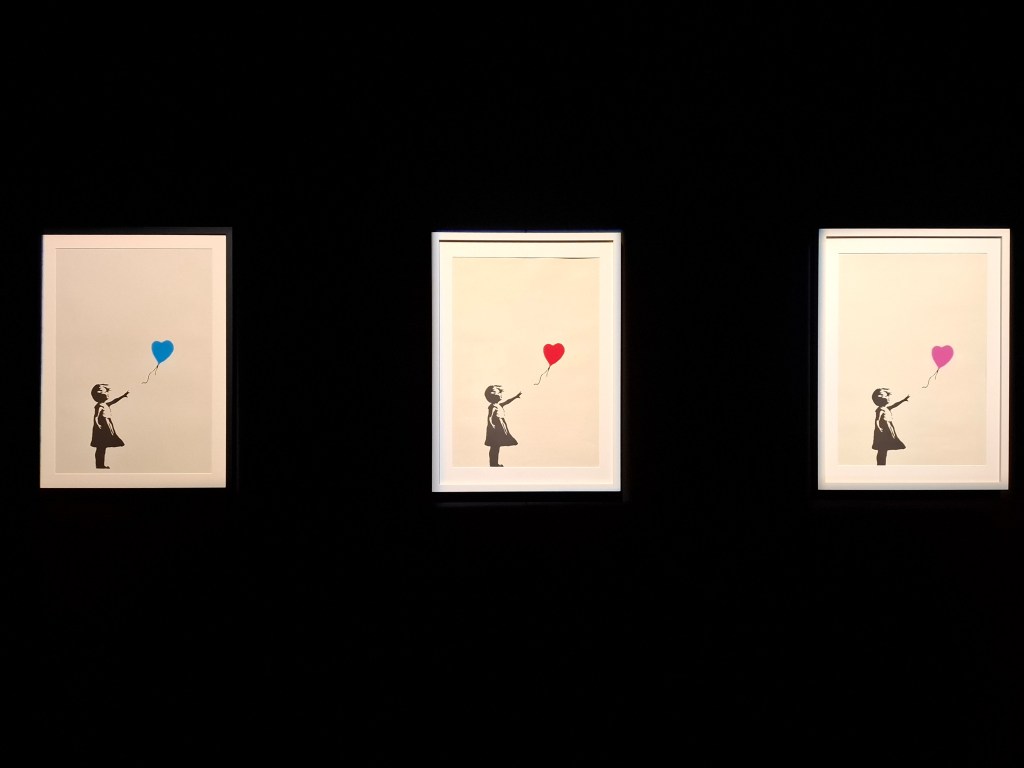
Girl With Balloon
The Art of Banksy – the major exhibition which has brought Banksy’s era defining works to over 1.5 million visitors in 19 cities across the globe will visit Auckland for a final and strictly limited New Zealand season. The exhibition will be hosted at Tāmaki Makaurau Auckland’s Aotea Centre (Hunua Rooms) from Monday 7 July through Sunday 3 August 2025.

The Art of Banksy is the world’s largest collection of original and authenticated Banksy art showcasing more than 150 pieces including prints, canvases and unique works. The collection wowed thousands of Wellingtonians in 2024 and now it’s Auckland’s turn.

Michel Boersma, curator and producer of the exhibition says: “Following a hugely successful 19 city global tour and 2 years in London, UK, we’re very excited to bring this larger-than-ever collection to Auckland, bigger and better! The last 9 years we have been working with collectors in expanding the collection which we are able to display, from 70 in Auckland in 2018 to over 150 authenticated and genuine works, no replicas – the real deal. I am particularly proud that trusted associates of Banksy, for example Ben Eine, have been willing to contribute to the exhibit with their privately held works, gifts and hand drawn sketches and video testimonials. This way The Art of Banksy is able to lift the veil on how some of the iconic Banksy works were created and reveals some of the secret stunts they got up to.” 

Daniel Clarke, Tātaki Auckland Unlimited Director of Performing Arts, leading Auckland Live adds: “We’re delighted to be working with GTP Exhibitions to bring The Art of Banksy to Tāmaki Makaurau Auckland. As one of the world’s most successful contemporary artists Banksy’s work consistently captures the public’s attention and imagination – over a million people worldwide have seen the exhibition – so to have this number of works on show is a hugely exciting addition to our winter events season.”

Visitors at The Art of Banksy can expect to see the seminal artworks that brought the infamously anonymous artist international notoriety such as Girl With Balloon in four different colour variations, including the rare Gold Edition. Banksy fans can also see unique personalised gift prints created for friends, associates and lovers. The exhibition also focuses on Banksy’s Dismaland and recent artworks acknowledging the ongoing war in Ukraine.


Many of Banksy’s iconic works are also featured in the exhibition including a very rare collection of ‘thank you prints which Banksy created as gifts to staff and team members who worked with him at Dismaland and other Banksy stunts. The exhibition also features a series of unique hand drawn sketches by Banksy. The fragile pieces of paper are one-of-a-kind depicting Banksy’s working on versions of his famous rat images.

The Art of Banksy is an unmissable show for anyone who wants to learn more about one of the world’s most important current artists and what their work reveals today; the power of art to affect social change, inspire the public and lay bare the undercurrents of social issues.

The Art of Banksy is not curated or authorised by the artist and only displays authenticated art sold or gifted by the Artist, no replicas or art removed from the street.
Banksy’s Dismaland
ART OF BANKSY
 
Monday 7 July – Sunday 3 August 2025
Mon – Wed: 10am – 6pm
Thu – Sun: 10am – 9pm
 
Tickets start from $39.50. Service fees apply
 
Tickets on sale from Wednesday 7 May
Categories
Reviews, News and Commentary

Groundwork: The Art and Writing of Emily Cumming Harris

Reviewed by John Daly-Peoples

Groundwork: The Art and Writing of Emily Cumming Harris

By Michele Leggott and Catherine Field-Dodgson

Te Papa Press

RRP $60

Reviewed by John Daly-Peoples

Botanical painters have been an integral part of the botanical and artistic history of New Zealand since Joseph Banks accompanied Cook on his voyage to New Zealand and his publication of detailed illustrations of the exotic plant species he found here.

Since the time of Banks there have been many other artists who have devoted themselves to depicting the flora of New Zealand .A new book “Groundwork” by Michele Leggott and Catherine Field-Dodgson reveals one of the first women botanical artists in New Zealand. Emily Cumming Harris who was born in England in 1837 spent most of her life in New Zealand, mainly in the Taranaki and Nelson areas.

During this time, she painted numerous examples of plant life as well as landscapes, a number of which were exhibited locally and internationally.

Her works were exhibited at the Sydney International Exhibition in 1879, the 1880–81 Melbourne International Exhibition and the Colonial and Indian Exhibition in London in 1886. At the New Zealand Industrial Exhibition held in Wellington in 1885 she won first prize and a silver medal for a painted screen.

Emily Cumming Harris, Kiekie (Freycinetia banksii), nikau (Rhopalostylis sapida), five finger (Pseudopanax arboreum) and karaka (Corynocarpus laevigata) in fruit, 1879, watercolour, 389 x 506mm. Reproduced as a Turnbull Library print in 1980. Alexander Turnbull Library,

Throughout her life she also had solo exhibitions, selling a number of works, the sales of which provided useful financial assistance to her and her family.

The book documents her career as an artist and even though this was never to be a full-time career she amassed a large collection of images many of which are in public collections. Leggott and Catherine Field-Dodgson’s research, along with other individuals reveal a woman whose work lies between the scientific, botanical illustration and artistic.

The book has been the result of a lot of detective work, research in various museums and some family history. Michelle Leggott ‘s interest came about when she was researching about Emily’s father, Edwin who had painted several views of New Plymouth at the time of the Land Wars in Taranaki. His paintings are also included in the book.

Emily Cumming Harris, Hector’s tree daisy Brachyglottis hectorii, oil on straw board, 690 x 470mm. Galpin collection, Pauanui

The authors also discovered a number of paintings Emily had done of astronomical subjects – The Total Eclipse of the Sun in1885 and a double tailed comet in 1901.

The book includes a number of her poems which range in quality but the occasional one shows some literary skills and keen observation.

Her “The mountain looks down on the river” contains some lines which indicate an awareness of the situation of Māori.

But the forest which grew by the river,

And the flowers on the mountain that bloomed

Will they gladden our hearts for ever

Or pass like a race that is doomed?

In 1890, she published three books, New Zealand flowers, New Zealand ferns, and New Zealand berries. Each contained twelve lithographs with descriptive text, and some copies were hand-coloured by Harris herself.

Emily Cumming Harris, Celmisia chapmanii – Campbell Island; Celmisia vernicosa – Campbell Island, 1890s, watercolour, 310 x 440mm. Alexander Turnbull Library

All her paintings as well as her writings and poems provide a portrait of a woman of great talent and enterprise but social convention prevented her developing an independent career and she was viewed merely as a gifted illustrator.”

This has meant she has not been well served by history but this book will do much to correct that.

Categories
Reviews, News and Commentary

Tony Fomison : Life of the Artist

Reviewed by John Daly-Peoples

Tony Fomison : Life of the Artist

By Mark Forman

Auckland University Press

RRP $59.99

Reviewed by John Daly-Peoples

Mark Forman’s new book on Tony Fomison is a superb piece of scholarship which adds to our understanding of the life of one of the great New Zealand artists of the late twentieth century.  His writing is particularly informative as there are no images of Fomison’s work in the book. The trustees of his estate, his three daughters, withheld permission to use his work because of assumptions and inaccuracies.

Forman has made up for this with perceptive descriptions of many of the artists important works as well as providing an understanding of the artist and the environment in which he developed his work

Forman’s detailed research, obvious from his bibliography along with the numerous interviews he had with other artists, family members and friends enabled him to give the reader insights into Fomison life and thoughts. He has also included a number of quotes from newspapers and magazines of reviews of the artist’s work and there are also accounts of Fomison irritation at unfavourable reviews.

Fomison had been to Ilam Art School at Canterbury University where he had met  a number of artists who he would be friends for the rest of his life including Quentin McFarlane and Des Helmore, Later he would meet Philip Clairmont, Allen Maddox and Colin McCahon. He was also influenced by some of the tutors at Ilam notably Bill Sutton and Rudi Gopas.

In the chapters covering his later life Forman has accounts of his involvement with his various gallerists including Elva Bett, Tina and Kees Hos, Peter McLeavey as well as John Gow and Gary Langsford. There were also other important figures who helped and supported him such as Charles Brasch and Jim and Mary Barr

In the 1960s, Fomison began painting and exhibiting portraits that were, even then very different from many of the other portraits by his peers. His were often distorted, maniacal and tapped into his own troubled life.

Also in the 1960’s as well as pursuing an art career he studied and recorded a number of the Māori rock drawings in Canterbury which became part of his art references

The 1970s was a particularly troubled period in Fomison’s life  after he had returned from  Europe which had included a spell in a mental institution.

He was down and out, grappling with drug addiction, and he began producing  work which was contemptuous and cynical about society.

Many of these artists he identified with were ‘outsider artists’ which Fomison identified with and his dark figures and landscape  began to emerge in his paintings. His monsters, misfits, and medical deformities challenged polite society, and explored what it means to be an outsider. Fomison began to paint people on the edges of society, such as prisoners and the disfigured.

Tony Fomison Grotto Road, Onehunga, Auckland. Image Mark Adams

Living in Auckland for much of his life, he had a strong connection to the local Samoan community and in 1980 made the decision to be tattooed with a Samoan pe’a.  This and his response to the Springbok tour of 1981was part of the artists unconventional or subversive approach to social and political issues

Forman includes numerous quotes from friends and fellow artists along with reviews which allude to Fomison’ s art as being related to distant periods rather than addressing contemporary issues  so that Francis Pound said of his work that it was “akin to that of a seventeenth century primitive” while Hamish Keith wrote that his figures were “sinister and unpleasant… giving of an Old Master complex” and Peter Simpson said he “has something of the impoverished yet eloquent beauty of late Michelangelo”

Fomison led a challenging personal life, which often could be seen in his paintings. As Ian Wedde says, ‘Fomison persisted with thinking and with making art out of his thoughts.’ Following a trip to Europe in the mid 1960s, and a short stint in institutions, Fomison began to paint people on the edges of society, such as prisoners and the disfigured. He would repeatedly return to the theme of the ‘outsider’. Fomison’s work was also often ‘socially committed’, protest the state of the world.

In his career spanning three decades, Fomison produced some of New Zealand’s most significant paintings and drawings, which seemed to incorporate elements of his own  physical journey as well as the spiritual and aesthetic journey, linking ideas that he developed along with his whimsical and dark attitude to life.

To subscribe or follow New Zealand Arts Review site – www.nzartsreview.org.

The “Follow button” at the bottom right will appear and clicking on that button  will allow you to follow that blog and all future posts will arrive on your email.

Or go to https://nzartsreview.org/blog/, Scroll down and click “Subscribe”
Categories
Reviews, News and Commentary

Lula Washington Dance Theatre

Reviewed by John Daly-Peoples

Lula Washington Dance Theatre

Aotea Centre

March 13 -16

Reviewed by John Daly-Peoples

The Lula Washington Dance Theatre is a contemporary modern dance company  in Los Angeles which has performed across the United States and toured internationally. It was established forty years ago when Lula Washington realised there were few black dance institutions in America  .

They have a stylish approach to contemporary dance incorporating elements of African and Caribbean dance as well as contemporary modern dance and ballet. All these elements were seen in the opening number where three dancers – Love, Faith and Hope,  performed to  heavy beats, foot stomping and clapping with the audience encouraged to add to the heavy clapping to that of the dancers and he riotous drumming morphed from African beats to something closer to hip hop.

Three female dancers were joined by male dancers who became intertwined and there was a sense of the dancers and audience all part of a church service, street performance or gym workout.

Accompanying the hectic dancing were references to American segregation, slavery, lynchings and race riots – Charleston, Springfield, Watts and an image of George Floyd

Accompanying this dancing was some relentless drumming with and  intense energy more akin to that of a night club and each of the sequences was given multiple bursts of applause from the audience.

Throughout this sequence the woman danced like ghost or departed spirits, their dancing a combination of celebration and remembrance of the African roots of the movements and music.

Because of the emphasis on these aspects the dances all seemed to be something of a political force and the dancers’ political activists.

In a later sequence one of the dancers shouts out the repeated chant “America is killing me” and this was accompanied by a visceral scream, a dramatic event one would not encounter in a Royal New Zealand Ballet performance and shows the level of the political urgency behind the Lula Washington project.

There was an intensity to many  of the dances with a physically close to that of a Whirling Dervish. But alongside this there were elements of playfulness and whimsy which were all performed with a finesse close to that of classical ballet dancers.

The political or polemical aspects of the dances often felt to be less satisfying of the performance without a dance vocabulary which did not express the angst and anger which was conveyed in the words which accompanied the dance.

Categories
Reviews, News and Commentary

A Mixtape for Maladies:   Music and  Memories of a War

Ravikanth Gurunathan (Vishwanathan), Tiahli Martyn (Subbalaxmi), Ahilan Karunaharan (Rajan), Gemma-Jayde Naidoo (Sangeetha – past) Image – Andi Crown

A Mixtape for Maladies 

By Ahilan Karunaharan 

Director, Jane Yonge  

Auckland Theatre Company  

Until March 23

Reviewed by John Daly-Peoples

The Sri Lankan Civil War of the latter part of the 20th century provides the backdrop for Ahklan Karunaharan’s “A Mixtape for Maladies” which explores the lives of a Tamil family, who are caught up in the conflict, some of whom are killed or immigrate to New Zealand.

The play explores the reality of living in a different time and culture in a period of tension and transition and we identify and sympathize with the family’s trials of living through a war.

I was jolted back to another reality at the end of the show however. My Uber driver looked South Asian, so I mentioned about the show and how it combined politics and family. He was from Sri Lanka and acknowledged the tragedy of the war and its impact on the country. But his experience was very different from the family I had just witnessed on stage as he had been an air force pilot during the war contributing to the death and destruction, providing an alternative history of the period  

One of the few things that Sangeetha (Ambicka G.K.R.) one of the daughters has brought to New Zealand was a tape recording of songs she loved growing up. Her New Zealand born son, Deepan (Shaan Kesha) finds the tape and plays the songs during his online podcast which trigger personal and political memories for her. 

Through the course of the play Deepan plays these songs and Sangeetha remembers elements of the family’s life – hearing about the war, her and her sister hanging around the store where Anton (Bala Murali) works because he plays all the latest local and international songs as well as songs from the movies. 

Shaan Kesha (Deepan), Ambika (Sangeetha – present) Image Andi Crown

While some of the songs are played on the tape recorder others are sung by various members of the cast, accompanied by a duo (Ben Fernandez and Seyorn Arunagirinathan) playing a variety of instruments – keyboard, Carnatic violin and flute. Ahilan Karunaharan (Rajan), and Bala Murali give particularly fine vocal performances while Tiahli Martyn’s (Subbalaxmi) display of Tamil dance was skillful. These vocal and dance  performances had many of the Tamil audience singing and swaying along to the music.

Among the tunes were Doris Day singing” Que Sera Sera”. “La Bamba” and some Tamil songs. These songs act as a cultural glue which holds the family together but also reminds us that these songs had universal appeal listened to by Sri Lankans as well as New Zealanders at the time.

The play is a mixture of social history, family exploration, cabaret and personal journey with music playing a central role in the play as well as the instruments the family would have listened to the songs on – an old turntable, a hi-fi player and the tape recorder.

The simple set features Dareen and Sangeetha in his podcast studio on one side and musicians on the other, flanking the family home and Anton’s general store.

The exploration by Dareen is initially an innocent enquiry into his mother’s music choices but becomes a journey into Sri Lanka’s history as well as triggering memories of his mothers and her family’s past and the impact of the war on their lives.

To subscribe or follow New Zealand Arts Review site – www.nzartsreview.org.

The “Follow button” at the bottom right will appear and clicking on that button  will allow you to follow that blog and all future posts will arrive on your email.

Or go to https://nzartsreview.org/blog/, Scroll down and click “Subscribe”

Categories
Reviews, News and Commentary

A Century of Modern Art coming to the Auckland Art Gallery in June

John Daly-Peoples

Claude Monet, French, 1840-1926; Water Lilies ; about 1922;oil on canvas Toledo Museum of Art, purchased with funds from the Libbey Endowment, Gift of Edward Drummond Libbey

A Century of Modern Art

Auckland Art Gallery  

June 7 – September 28

John Daly-Peoples

Auckland Art Gallery has announced that the exhibition “A Century of Modern Art” will be  its special winter exhibition this year, running from  June & through till September 28th.

The exhibition will be on loan from the Toledo Museum of Art, Ohio, and will provide  a survey of the major artists who transformed modern art.

The exhibition will consist of 57 works by 53 artists, including Paul Cezanne, Edgar Degas, Helen Frankenthaler, Édouard Manet, William Merritt Chase, Amedeo Modigliani, Berthe Morisot, Claude Monet, Pablo Picasso, Camille Pissarro, Robert Rauschenberg, Pierre-Auguste Renoir, Vincent van Gogh, James McNeill Whistler, among others.

Director of Auckland Art Gallery Toi o Tāmaki, Kirsten Lacy says the calibre of works and artists in this collection is exceptional and not to be missed.  “A Century of Modern Art showcases the diversity and innovation that defined modern art movements,” says Lacy. “From the emotive brushstrokes of Van Gogh to the evocative landscapes of Monet and Rauschenberg’s bold abstractions, these works not only revolutionised Western art history but continue to inspire new generations.”

“The exhibition includes works by legendary art figures, including Vincent van Gogh, whose work hasn’t been publicly displayed here in Aotearoa in over a decade. It is made available to us due to renovations that are taking place at Toledo Museum of Art, and we are honoured to be working with the Museum to make the most of this rare opportunity.”

The centrepiece of the show will be Claude Monet’s  “Water Lilies” Purchased with funds from the Libbey Endowment, Gift of Edward Drummond Libbey    Plants, water, and sky seem to merge in Claude Monet’s evocative painting of his lily pond at Giverny. The disorienting reflections, bold brushstrokes, and lack of horizon line or spatial depth make Water Lilies appear almost abstract. Painted about 1922, it belongs to a grand project that Monet had conceived as far back as 1897:

“Imagine a circular room whose wall . . . would be entirely filled by a horizon of water spotted with [water lilies]… the calm and silence of the still water reflecting the flowering display; the tones are vague, deliciously nuanced, as delicate as a dream.”

Monet began this ambitious project in 1914, finally completing it shortly before his death in 1926. Over those years he executed more than 60 paintings of his water garden, capturing the light conditions at different times of day and in different weather. Twenty-two of these large panels were installed in the Orangerie in the Tuileries Gardens, Paris, as a gift to France. The  Toledo’s work was is possibly a study for one of the three panels of the Orangerie composition” Morning”.

Berthe Morisot, In the Garden at Maurecourt. (Purchased with funds from the Libbey Endowment, Gift of Edward Drummond Libbey)

Included in the exhibition is a work by artists Berthe Morisot one of the few female Impressionist artists. Her work “In the Garden at Maurecourt” (Purchased with funds from the Libbey Endowment, Gift of Edward Drummond Libbey) is set in Morisot’s sister Edma country house outside Paris and probably shows Morisot’s daughter, Julie, and one of Edma’s daughters.

She was born to an upper-middle class family and was the great-niece of Rococo artist Jean-Honoré Fragonard. Morisot rejected the social expectations of her class and gender by pursuing a professional career as an artist. In 1868 she met and became close friends with artist Édouard Manet, marrying his younger brother Eugène in 1874, the same year she participated in the first Impressionist group exhibition.

Paul Gauguin, French, 1848-1903; Street in Tahiti; 1891;oil on canvas (Purchased with funds from the Libbey Endowment, Gift of Edward Drummond Libbey)


There is also a work by the recently deemed “controversial” Paul Gauguin. His work “Street in Tahiti” (Purchased with funds from the Libbey Endowment, Gift of Edward Drummond Libbey) which predates his Tahitian figurative works was among the first group of paintings Gauguin produced in Tahiti during his initial two-year stay. He conveyed something of the special character of the place—the limpid light, rich colour, lush vegetation, and lofty mountains—through his use of strong contours, flattened shapes, repeated curving rhythms, and tautly patterned brushstrokes. However, minor notes of strain, such as the brooding woman and heavy clouds pressing down from above, introduce undertones of sadness and disquiet.

A Century of Modern Art will make use of its current major exhibition “The Robertson Gift: Paths through Modernity” which includes works by. Georges Braque, Paul Cezanne, Fernand Léger, Henri Matisse, Piet Mondrian and Pablo Picasso.

Together the two exhibitions will trace out the birth of modern painting, beginning with the Impressionists in the 1860s, and follows its evolution through key movements such as Post- Impressionism, Symbolism, Cubism, Surrealism, Constructivism, German Expressionism, Bauhaus, De Stijl, Precisionism, and Colour Field Painting and Abstract Expressionism.

Adam Levine, the Edward Drummond and Florence Scott Libbey President, Director and CEO of the Toledo Museum of Art, says, “The Toledo Museum of Art is distinguished by the quality of its collection. Each acquisition in our institution’s history has been oriented to acquiring artworks of superlative aesthetic merit. Never have so many of our masterworks travelled together, and we could not be more excited for them to debut in Auckland.”

A Century of Modern Art is organised by the Toledo Museum of Art, Ohio and has been supported by HSBC and Auckland Art Gallery Foundation. Co-ordinating curator of the exhibition is Dr Sophie Matthiesson

To subscribe or follow New Zealand Arts Review site – www.nzartsreview.org.

The “Follow button” at the bottom right will appear and clicking on that button  will allow you to follow that blog and all future posts will arrive on your email.

Or go to https://nzartsreview.org/blog/, Scroll down and click “Subscribe”