Categories
Reviews, News and Commentary

Rarely seen American and European art at the Auckland Art Gallery

Reviewed by John Daly-Peoples

Auguste Renoir, Road at Wargemont, 1879, Toledo Museum of Art, Purchased with funds from the Libbey Endowment, Gift of Edward Drummond Libbey

A Century of Modern Art

Auckland Art Gallery  

June 7 – September 28

John Daly-Peoples

A Century of Modern Art which has just opened at the Auckland Art Gallery is one of the most significant exhibitions mounted by the gallery in the last few years. It is on loan from the Toledo Museum of Art, Ohio, and provides  a survey of the major artists who transformed modern art  from the mid nineteenth century to the mid twentieth century.

The exhibition features 57 works by 53 artists, including Paul Cezanne, Edgar Degas, Helen Frankenthaler, Édouard Manet, William Merritt Chase, Amedeo Modigliani, Berthe Morisot, Claude Monet, Pablo Picasso, Camille Pissarro, Robert Rauschenberg, Pierre-Auguste Renoir, Vincent van Gogh, James McNeill Whistler, among others.

The Toledo Art Museum was established and funded by Edward Drummond Libby and still has a substantial Endowment Trust in his name . The endowment has some $330 million and a budget of more than $20 million a year,. Many of the works in the exhibition were gifted by Libby or acquired through the Libbey Endowment.

Georges Braque, Still Life with Fish, 1941, Toledo Museum of Art, Purchased with funds from the Libbey Endowment, Gift of Edward Drummond Libbey

Some of the Impressionist / Post Impressionist works by artists such as Renoir, van Gogh, Morisot and Gauguin are major works whle some of them are of unfamiliar subjects such as Renoir’s ”Road at Wargemont”

Several of the works are excellent examples of their work such as van Gogh’s “Wheat Fields with Reaper, Auvers” and Monet’s Water Lilies of 1922, one of the many images of the flower he created in his later years.

The show also features some unfamiliar names of American artists such as Luther Emerson van Gorder whose “Flower Market, Paris” (late 19ht century) could be mistaken for a Pissarro.

Flower Market, PLuther Emerson, Van Gorder, Flower Market, Paris, late 19th century- early 20th century. Toledo Museum of Art, Gift of the artist

The small Whistler work ”Crepuscule in Opal, Trouville” of 1865 is an interesting inclusion in the show, the landscape with its slash of colour is an almost abstract work

Among the more contemporary work is Helen Frankenthaler “Blue Jay” painted at a transition time between paintings of organic forms and colour field paintings. There is also a Morris Louis whose work has not been seen in Auckland since his large exhibition at the gallery in 1971

Helen Frankenthaler, Blue Jay, 1963, Toledo Museum of Art, Gift of The Woodward Foundation

There are also works by artists who we rarely see but whose work shows high level of sophistication such as Piet Mondrian’s Composition with Red, Blue, Yellow, Black, and Gray”, László Moholy-Nagy’s ”Am2”, and Max Beckmann’s “The Trapeze”.

Max Beckmann, German, 1884-1950; The Trapeze; 1923; oil on canvas;H: 77 3/8 in. (196.5 cm); W: 33 1/8 in. (84 cm);Toledo Museum of Art; 1983.20;

There are a few important American artists  as Stanton Macdonald-Wright who was one of the early American abstract artists and his  “Synchromy, Blue-Green”, of  1916 is  an example of the abstraction which developed in America in the early twentieth century.

Other American artists in the show include Gertrude Glass Green  who was an important constructivist artist and Grace Hartigan who was a  member of the New York School in the 1950’s and 60’s.

To subscribe or follow New Zealand Arts Review site – www.nzartsreview.org.

The “Follow button” at the bottom right will appear and clicking on that button  will allow you to follow that blog and all future posts will arrive on your email.

Or go to https://nzartsreview.org/blog/, Scroll down and click “Subscribe”

Categories
Reviews, News and Commentary

La Traviata coming to Auckland with the Auckland Philharmonia

John Daly-Peoples

Luiza Fatyol (Violetta) Image Credit Luiza Fatyol

La Traviata

Pub Charity Opera in Concert

Auckland Philharmonia with The Freemasons Foundation NZ Opera Chorus

Auckland Town Hall

July 5

John Daly-Peoples

La Travitaa  is one of the  most popular of Verdi’s operas and the scale is more intimate than much of his output, with no grand historical or political elements. The opera concerns itself with social issues contemporary to Verdi, almost autobiographical in places with regard to his relationship with the singer Giuseppina Strepponi who he had a scandalous relationship with in the 1840’s

It is also the only one of Verdi’s operas to specifically take place in his own time, although, the premiere was censored on moral grounds and he was forced to shift the period, from the contemporary to one hundred years earlier

The opera set in 19th Century Paris features Violetta, a high-class courtesan and the most celebrated figure of the Parisian social scene. She is carefree, attached to no-one, her own woman. But she  is also seriously ill.

She  meetsAlfredo, a poet who shows Violetta real, unconditional love for the first time. She falls for him and, abandoning her career, the two escape to a country retreat to live in domestic bliss. That is until Alfredo’s father shows up. He is unhappy with how his son’s relationship with a ‘fallen woman’ is damaging the family’s reputation and persuades Violetta to end things with Alfredo via a letter and return to the city.

Much later, Alfredo’s father is remorseful and finally reveals to his son why Violetta left him. He rushes to be with her, but Violetta’s sickness is now much worse

Oliver Sewell (Alfredo) Image Emma Brittenden

In the role of Violetta Valéry, Romanian soprano Luiza Fatyol will make her Australasian debut while Oliver Sewell (tenor) makes a welcome return to Auckland as, Alfredo, following his second season as a member of the principal ensemble at Germany’s Theater Bremen. He will be joined by Phillip Rhodes (baritone) as Alfredo’s father Germont, who reprises this role following his debut with Opera Australia last year.

Phillip Rhodes

Also performing with the Auckland Philharmonia will be acclaimed rising Kiwi stars James Ioelu (bass-baritone) as Marquis D’Obigny, Felicity Tomkins (soprano), winner of the 2024 Herald Sun Aria Competition, as Annina, 2024 Lexus Song Quest winner Katie Trigg (mezzo-soprano) as Flora Bervoix and popular Samoan baritone Joel Amosa as Doctor Grenvil.

The cast will be complemented by The Freemasons Foundation NZ Opera Chorus.

To subscribe or follow New Zealand Arts Review site – www.nzartsreview.org.

The “Follow button” at the bottom right will appear and clicking on that button  will allow you to follow that blog and all future posts will arrive on your email.

Or go to https://nzartsreview.org/blog/, Scroll down and click “Subscribe”

Categories
Reviews, News and Commentary

The Walter Cook Collection: a small jewel in the crown of Te Papa

Reviewed by John Daly-Peoples

Towards Modernism: The Walter Cook Collection at Te Papa

A treasure trove of design.

By Justine Olsen 

RRP $75

Reviewed by John Daly-Peoples

“In 1965 a twenty-four-year-old Bachelor of Arts student named Walter Cook bought an Art Nouveau tea set at the Willis St Wellington secondhand shop Odds & Ends. In the context of mid 1960’s design, with its flat patterns and stainless steel, the Liberty & Co pewter tea set would have seemed totally old fashioned to most but Cook saw it for style”.

This is how a new book on the unlikely art collector, Walter Cook opens. The book Towards Modernism: The Walter Cook Collection at Te Papa celebrates the collection which is a small jewel in Te Papa’s crown. It also acknowledges the Wellington collector’s life and commitment  over several decades with the book which illustrates over 200 works from the collection with full page colour illustrations

From that first work Walter Cook went on to amass a highly significant collection of ceramic, glassware and metal work. Apart from the collections importance it also shows how a collection can be built up without having to pay high auction house prices.

This Japanese-inspired jug with a cherry blossom pattern and bamboo handle was bought in Blenheim. Its manufacturer, Pinder, Bourne & Co of Stoke-on-Trent, was taken over by Doulton in 1882.
Jug, 1877. Manufacturer: Pinder, Bourne & Co, England. Stoneware, pewter, 210 x 145 x 145mm, CG001804.

For most of Cook’s purchases the book documents the date of acquisition along with the place and price paid. These notes in themselves provide and insight into Cook’s buying. While a number of the works were bought in Wellington there are also purchases made in Auckland and London. There are purchases from department stores, antique shops, secondhand shops, and markets,

One of the earliest works is a Doulton “Jug” by Hannah Barlow (1873) bought from Alma Fosters antique store on Dixon St in 1980. And the latest purchase was of some1979 salt and pepper mills designed by Thygesen & Sorensen from the Danish firm PP Linie

Most of his purchases were from retail stores where he paid the current retail prices of $30 – $100 but he appears to have found many of his works in secondhand stores. So, a Susie Cooper tea set was bought in 1981on the Wakefield Markets at a stall run by Paul Orsman.

There was Pilkington Vase purchased for $30 in 1982, a Watcombe Pottery Palm Pot for $3.00 two “Morris” ware candlesticks for$5 in 1965, , a “Tudric” Vase for $5 and  a “Tudric” dish for $2.00.

Two bowls by the Swedish artist Stig Lindberg were purchased in 1985 – “Pungo for $35 and Veckla for $6.00.

This ‘Tudric’ ware vase evokes the tulip form with its rising stem and cup-like flower. It was bought from Joanna Holmes Antiques, Masterton, in 1969 for $5
Tulip vase, ‘Tudric’, c.1905. Commissioner: Liberty & Co. England. Manufacturer: WH Haseler Ltd. Pewter, 220 ×165 ×110mm, GH004284.

The book has full page illustrations of the works from the collection grouped within particular periods – The Arts and Crafts Movement, Aestheticism, Art Nouveau, Art Deco and the interwar period and Postwar Modernism.

For each of these chapters Olsen provides descriptions of the history and aesthetic thinking behind the works created. So, we get details about the potteries and the individuals who created the works as well as an indication of how the works in the collection fit within the development of the art form.

Cook also acquired an example of Bretby Art Pottery which was purchased at the New Zealand Exhibition in Christchurch of 1906 / 07 and later purchased from Neale Auld’s Willbank Court Antiques.

In this early period there are also examples of Royal Copenhagen work with some ceramic plates

Along with information on the potteries and artists of the period including a profile of the importance of Christopher Dresser an important artist, designer and promoter English design in the latter part of the nineteenth century.

This ‘Syren’, sometimes referred to as ‘Duveen’, pattern set by Royal Doulton was bought from Alma Foster in 1980.
Coffee service, ‘Syren’, c.1932. Manufacturer: Royal Doulton & Co Ltd, England. Ceramic. From Left: Cup, 60 x 75 x 75mm, CG001905; saucer, 15 x 115 x 115mm, CG001905; coffee pot, 205 x 75 x 145mm, CG001903; jug, 75 x 73 ×45mm, CG001904/1.
04

The Art Nouveau section features some of the elaborate work of the time with work from the Minton Pottery, Villeroy & Bosch as well as metalwork from the German company Wurttembergische Metallwarenfabrik.

The Art Deco section features a number of works from the Doulton and Co factory along with biographies of some of the importance female designers including Clarice Cliff, Truda Carter and Susie Cooper.

There is also a substantial entry about Keith Murray who worked for Wedgewood and whose designs influenced Ernest Shufflebotham who had a major impact on New Zealand pottery through Crown Lynn.

The Postwar Modernism section features work by Susie Cooper and Scandinavian Design which includes Rosenthal and designers Nittsjo Keramik, Carl-Harry Stallhane and Stig Lindberg.

This Italian glass ‘Fazzoletto’, or handkerchief, vase expressed the imagination and technical sophistication of the mid-twentieth century Italian glassmakers Venini & Co. Its latticino and pink filagree patterns drew on traditional Murano glass techniques and it was designed by leading Murano glass designer Fulvio Bianconi (1915–1996). The vase was bought from Linley Halliday and David Owens’ Curiosity Shop on Constable Street in Wellington.
Vase, ‘Fazzoletto (handkerchief)’, c.1950. Manufacturer: Venini & Co, Italy. Designer: Fulvio Bianconi. Maker/artist: Paolo Venini. Glass, 98 x 135 x 128mm, CG001949.

What the book also reveals is that a collector of any type of artwork needs to have all the qualities Walter Cook had -.an understanding of the market, the history of the objects, a knowledge of aesthetics, dedication and a keen eye

To subscribe or follow New Zealand Arts Review site – www.nzartsreview.org.

The “Follow button” at the bottom right will appear and clicking on that button  will allow you to follow that blog and all future posts will arrive on your email.

Or go to https://nzartsreview.org/blog/, Scroll down and click “Subscribe”

Categories
Reviews, News and Commentary

Black Grace’s Rage Rage: focussed and potent dance

Reviewed by John Daly-Peoples

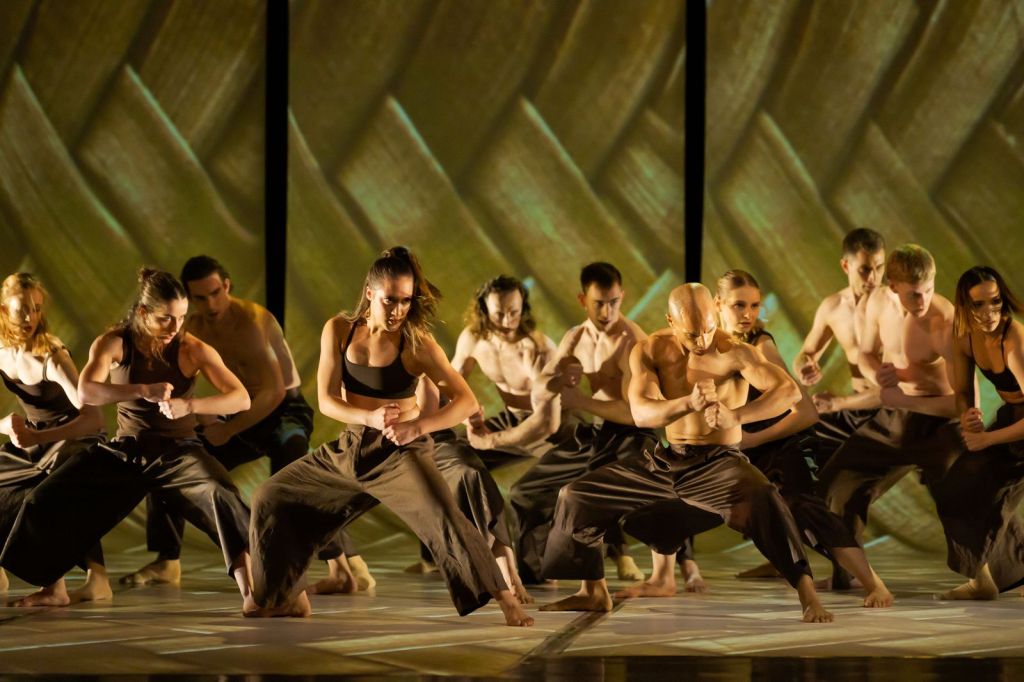
Black Grace , Company B Image; Jinki Cambronero

Rage Rage

Black Grace, Company B

Hunua Room

Aotea Centre

Until June 5

Reviewed by John Daly-Peoples

For Black Grace’s “Rage Rage” the Aotea Centre’s Hunua Room was set up with a high catwalk built through the centre of the space.

Was this nod to Dylan Thomas’s “Rage rage against the dying of the light” or a personal rage of Neil Ieremias. His work has always had an element of the personal and the political with works which are confrontational both between the performers themselves and between performers and audience.

Up to a couple of dozen performers race around the stage, in waves of massed groups, performing a series of linked dances to a range of music from traditional Samoan to contemporary rap.

Like all Ieremia’s shows this was a high energy and relentless performance combining many of the elements of his previous explorations in dance.

There is the hand clapping, foot stomping, the falls / collapses, hand movements like a form of deaf signing and arms used as a kind of semaphore.

The various sequences are introduced by Strictly Brown founders Leki Jackson-Bourke and Saale Ilaua who reminisce about their time at school, favourite TV and films and playground games. These reminiscences lead the company into surges of movement.

The sounds are a mixture of the traditional and the modern as the dancers negotiate issues of the present which are rooted in the past. Some of these are addressed in the latter part – Covid, climate change and the future of Tuvalu.

Many of routines seem based on the schoolyard ‘game’ of Rush, some of which morph into fights or just dissipate.

The final sequence is a mix of despair and celebration danced to a nihilistic vocal soundtrack-

“I don’t belong here

I’m a weirdo

What the hell am I doing here”

With the refrain

You don’t belong here

Which encapsulates so .much feeling and emotion focused on the emptiness of contemporary life.

Like much of Black Grace dances there is a tension and drama created by the action and reaction, between rapid movement and calm, between a zombie-like state and intense animation.

Throughout the performances there is an awareness of the beauty and intensity of the dance and the strange conflicting visceral and abstract nature of the dancing which underlines Ieremia’s ability to create dance which is focused and potent

To subscribe or follow New Zealand Arts Review site – www.nzartsreview.org.

The “Follow button” at the bottom right will appear and clicking on that button  will allow you to follow that blog and all future posts will arrive on your email.

Or go to https://nzartsreview.org/blog/, Scroll down and click “Subscribe”

Categories
Reviews, News and Commentary

La Clique: A magical and adventurous show

Reviewed by John Daly-Peoples

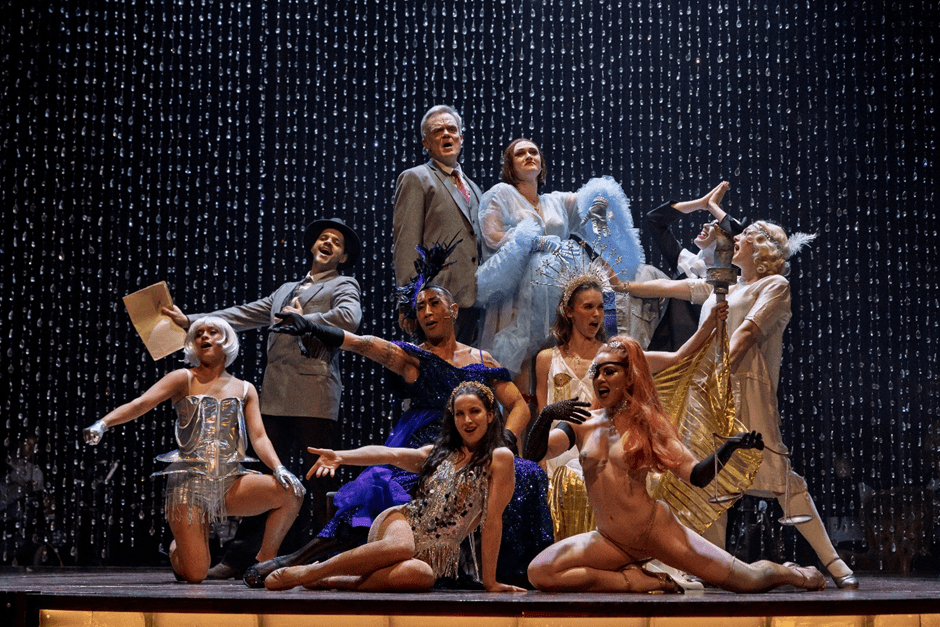
Tara Boon Image Liam Newth /Auckland Live

La Clique

Cabaret Festival

Civic Theatre

June 3 – 15

Reviewed by John Daly-Peoples

Headlining Auckland’s Cabaret Festival starting this week is La Clique featuring a range of performers with some of them presenting at a press preview.

La Clique has been performing for many years with their performers changing over the years. It was here at the Auckland Arts Festival in 2007 and while some of the performers have changed the class, innovation  and magic is still there.

Performing in the Civic, the show is particularly magical, not just being in the Civic but being on the Civic’s stage. The lights, curtains and apparatus that we never see takes the audience into a very different space and looming over us are the seats of the stalls and balcony  and above them the ceiling of the Civic with its twinkling stars of the solar system.

Tara Boon is a foot juggler which sounds like a pretty easy trick to take to the beach  later in the year,  that is,  until you realise that some people can’t even get their shoes on without becoming a contortionist.  Boon is as dexterous with her feet as ordinary people are with their hands. Resting on her reclining chair, she initially upends an umbrella which showers the stage with red petals and with her act she is able to manipulate up to four oriental umbrellas – on the handle or on their edges.

It’s a simple  slick stylish  act performed to the song “Umbrella” by Mechanical Bride and you keep forgetting how difficult it is to manipulate an umbrella, let alone four of them.

Byron Hutton is a juggler who is as clever with his hands as Boon is with her feet. He manages to juggle with his hands as well as other parts of his body, the  clubs dancing  and cavorting around him in fluid  movements.

He showed his consummate skill a couple of times when he lost a club and instantly caught another from his offsider before moving on to the next routine.

Heather Holliday Image: Liam Newth / Auckland LIve

The act which attracted thy most gasps was the fire eating Queen, Heather Holliday. I’ve seen a few fire eaters before but never up close, so close I could feel the heat of the flames. I know they use low combustion fuels which are less dangerous than things like alcohol and petrol but even so it all looks a bit scary, especially when she takes her flaming batons and drags them across her skin

At the end of her performance, her offsider came on with a flute  full of what I thought was a celebratory glass of champagne. But no. This was a glass full of her flame throwing fluid. She drank the flute and then spouted out a flaming jet like a flamethrower which had all the audience recoiling .

We saw just three acts but on the night, there will be a dozen. It will be a night full of the  sexy, the funny and the dangerous

Categories
Reviews, News and Commentary

N. Z. Opera’s La Boheme

Reviewed by John Daly-Peoples

La Boheme, The student garret / studio (Act I & IV) Image. Andi Crown

La Boheme

Composer Giacomo Puccini

Librettists Luigi Illica, Guiseppe Giacosa

N Z Opera

Kiri te Kanawa Theatre

Until June 6

Then

Wellington 18 – 22 June

Christchurch 2 – 6 July

Reviewed by John Daly-Peoples

There are no gods or fairies in La Boheme. There are no heroic figures in La Boheme. There are no evil or deeply flawed characters in La Boheme and there are no complicated plots or byzantine machinations in La Boheme.

All the characters we encounter are young and ordinary, all making their first steps into adulthood, living in a bohemian environment, full of possibilities.

This ordinariness is in contrast to many other great operas where characters face great moral dilemmas, battle tyrants or life’s injustices. This is one of the few great operas where we see characters on stage who we can recognize as very much like ourselves – or twenty year old versions of ourselves.

Four of the very ordinary characters live in a very ordinary student flat and the opera opens with Rodolfo, a writer and his artist friend Marcello struggling to create masterpieces while they battle the freezing temperature by burning one of Rodolfo’s plays to keep warm. Colline, a philosopher, and Schaunard enter with food and drink but instead of paying the rent they decide to celebrate Christmas at the Café Momus, where they encounter  Marcello’s girlfriend, Musetta who is with her sugar daddy Alcindora.

At the same time Rodolfo meets the frail seamstress Mimi, and they fall in love. But their tender romance is doomed, for Mimi is ill with consumption, and Rodolfo is too poor to help her. Through the opera they also have to confront the other aspects of life and love -jealousy, guilt and despair which comes with that love. As a contrast is Musetta whose love has a wider focus given to Marcello, Alcindora as well as others.

Ji-Min Park (Rodolfo) and Elena Perroni (Mimi) Image. Andi Crown

The slowly dying Mimi (Elena Perroni) who all but whispers in many of her arias gives memorable performances. While she presents a gentle voice often almost whispering while at other times she was able to sustain an expressive intensity as with her “Donde Lieta Usci”aria

Rodolfo and Mimi have a purity of soul which seems to bond them despite their Act 3 questioning of their relationship and this is reflected in their voices. Ji-Min Park (Rodolfo) is able to express an urgency with his rich voice while both Elena Perroni’s voice and demeanor coveys a sensitivity and frailty.

Rodolfo’s three friends  also contribute  some lively singing with their first act witty dialogue and humorous interchange with the landlord Benoit. Marcello  provides some brilliant duos with Mimi and Musetta, notably the third and fourth acts while the philosopher Colline ( Hadleigh Adams) provides an additional concept of love with his aria dwelling on his much-loved coat.

The musician Schaunard (Benson Wilson) contributes slightly to the singing in the opera but his main purpose seems is to always have some money and always has food or wine available as the hedonist of the group and a contrast to Rodolfo.

Emma Pearson (Musetta) Image. Andi Crown

The setting has been changed for Mid nineteenth century to Paris in in 1947 and the bohemian nature of the artist’s lives in seen ibn some huge paintings like those of Pierre Soulages in the studio / garret. The post war date also means the costume designer (Gabrielle  Dalton) have been able to give the Musetta and Mimi some contemporary fashion with Musetta being attired in some stylish Dior inspired outfits.

The simplicity and honesty of La Boheme  has meant it is always accessible with a story which is clear, immediate and romantic and universal. Director Bruno Ravella and Conductor Brad Cohen have ensured that the story and  the characters are brought to life with sensitivity, authenticity and joie de vivre.

Categories
Reviews, News and Commentary

Mark Adams: Photographs across time and cultures

Reviewed by John Daly-Peoples

Mark Adams A survey — He kohinga whakaahua

Mark Adams and Sarah Farrar

Massey University Press

80.00

Mark Adams: A Survey | He Kohinga Whakaahua

Auckland Art Gallery

Until August 17

Reviewed by John Daly-Peoples

The current exhibition “Mark Adams: A Survey | He Kohinga Whakaahua” is the artists first comprehensive exhibition of his work and features more than 65 works spanning his 50-years as a photographer. documenting the land, the people and its history. These photographs are of places across the Pacific, the United Kingdom and Europe.

Much of his practice documenting sites of significance across the country, include places where Captain James Cook and his crew came ashore on their visits in 1769 and the 1770s, as well as locations where Te Tiriti o Waitangi was signed in 1840.

Over the decades, Adams has sustained a deep and ongoing engagement with subjects of interest. He has photographed whakairo Māori (Māori carving) both here and overseas and the work of, Samoan master tattoo artists, Māori–Pākehā interactions in Rotorua, carved meeting houses, locations of significance for Ngāi Tahu in Te Waipounamu and  the place of museums and photography in the area of cross-cultural exchange.


It includes photographs taken across the Pacific, the United Kingdom and Europe that explore the migration of artistic and cultural practices across the globe, and examine the role of museums, and photography itself, in the ongoing area of cross-cultural exchange.

The various sections of the book show Adams’ range of work from his early works, his focus on Rotorua, tatau, Treaty Signing Sites, Museums, Cooks Sites Māori meeting house in overseas locations, Te Waipounamu and his more recent interest in Photograms.

Several of his multi-image work are fascinating in their scope and production but the book does not do them credit, even when spread across several pages. With these works the exhibition at the Auckland Art Gallery make an impression in some cases filling an entire wall of the gallery. “0 degrees” is such  a work, a  panoramic 360-degree set of images taken at Greenwich Park which includes the Royal Observatory, the home of Greenwich Mean Time and Prime Meridian.

Other works on a grand scale  include  his “Nine Fathoms Passage”, the photographers view replicating William Hodges view of Dusky Sound, and his panorama of the  meeting house, Hinemihi in the grounds of Clandon Park in Surrey, England as well as the magnificent meeting house Rauru in the Museum am Rothenbaum in Hamburg.

Mark Adams, 13.11.2000. Hinemihi. Clandon Park. Surrey. England. Ngā tohunga whakairo: Wero Tāroi, Tene Waitere, 2000, colour inkjet prints, Auckland Art Gallery Toi o Tāmaki, gift of the Patrons of the Auckland Art Gallery, 2014.

Author of the book Sarah Farrar says “You could say that, in many respects, Mark has been ahead of his time as a Pākehā and Palagi artist. But what does that really mean — to be ‘early’ or ‘ahead of one’s time’? It’s all relative and I’m sure many people would view a respectful approach to tangata whenua and tangata o le moana as seriously overdue.”

Adams’ photographs are of exceptional quality and intriguing in their distinctive approach to subject matter. The viewer is challenged to interpret , question and reflect on them. One commentator, Damian Skinner has noted that Adams photographs “offer no resolution, only problems. They patiently track the material traces of various forces that coalesce in specific sites”.

Mark Adams, 19.05.1989. Te Ana o Hineraki. Moa Bone Point Cave. Redcliffs. Ōtautahi Christchurch. Te Waipounamu South Island, 1989, gold-toned silver bromide fibre-based prints, Auckland Art Gallery Toi o Tāmaki, gift of the Patrons of the Auckland Art Gallery, 2014.

Generally, with photographs of important sites the photographer is essentially saying – “I was here – this is how it looks”. However, with many of Mark Adams photographs of historical sites, the land seems of little interest, often devoid of figures. With these the photographer seems to be saying “this is how it looked”. The photographs require the viewer to transport themselves back to that place but in another time.

Sarrah Farrar notes “His photographs of museums and art galleries remind me of the artifice and stagecraft that we are actively involved in as curators and museum professionals. Every decision we make communicates something to audiences. We construct meaning through the selection of objects (even those that are absent), their placement and their interpretation. Mark’s photographs remind me of the power dynamics and knowledge systems that are inscribed in museum, library and art gallery experiences — even embedded into the design of the buildings themselves. A great example of this is Mark’s panorama of the science-fiction-like modernist design of Berlin’s Staatsbibliothek, which feels so at odds with the fact that it’s the home of the journals of Georg Forster, the naturalist who travelled with James Cook on his second voyage.”

Mark Adams, 1988. Hori Korei. George Grey monument. Albert Park. Tāmaki Makaurau Auckland, 1988, silver bromide print, courtesy of the artist.

The book is a stylish, superbly-designed production with over 200 images, mainly black and white. It features  an excellent text by Sarah Farrar as well as a forward by Ngahuia te Awekotuku and afterword by Nichlos Thomas

Categories
Reviews, News and Commentary

The Play That Goes Wrong: skillfully executed chaos

Reviewed by Malcolm Calder

The Mischief Theatre Production of 
THE PLAY THAT GOES WRONG  

By Henry Lewis, Jonathan Sayer and Henry Shields

GMG Productions & Stoddart Entertainment Group
Associate director – Anna Marshall
Resident director – Nick Purdie
With Olivia Charalambous, Edmund Eramiha, Tom Hayward, Stephanie Astrid John, Joe Kosky, Jonathan Martin, Jack Buchanan, Anthony Craig and Kira Josephson

ASB Waterfront Theatre, Auckland

Until 1 June

Reviewer Malcolm Calder

The crew were frantically seeking a missing dog called Winston (I thought that was pretty funny from the outset), couldn’t find a missing CD, contending with a tricky door that wouldn’t latch, dealing with a floorboard that seemed have a mind of its own and contending with a mantlepiece wouldn’t mantle.  All this before the show had even started.

Their crew’s efforts were entirely unsuccessful of course and the litany of woes continued once things got underway.  But the teddibly English lads and lasses of the fictitious Cornley Polytechnic Drama Society struggled on in their efforts to ensure their eminently forgettable murder-mystery actually took place, with nowhere near understanding their own characters or, it seemed at times, even the plot.  Not to mention a set that seemed intent on total disintegration.  Their efforts certainly did go wrong and they eventually staggered to a dis-assembled conclusion.

However that’s not what The Play That Went Wrong is all about.  Rather, it uses the context of an amateur theatre production to very quickly hit the spot demonstrating both subtle and in-your-face comic writing, exquisite nuance and a mature command of the farce-wrapped-in-slapstick idiom whilst totally demolishing the fourth wall.

Lewis, Sayer and Shields, formed Mischief Theatre in 2008 and created The Play That Went Wrong while still studying at the London Academy of Music and Dramatic Art.  Originally titled The Murder Before Christmas, their production opened initially on the Edinburgh Fringe, enjoyed enormous success, moved to a pub on London and then quickly transferred to the West End.  It has been winning accolades around the world ever sinceand has even spawned a range of not unrelated television spinoffs.

This cast is very much an ensemble.  In performance they consummately demonstrate a broad-ranging set of physical theatre skills, demonstrate the importance of timing in making these work and do pretty well in convincing the audience that this is a collection of loosely-linked, impromptu standup snatches despite being a meticulously scripted work.

On Oening Night in Auckland I noticed a couple of rather precious looking luvvies in deep discussion during interval but they appeared to have missed the point entirely.   Deep, thought-provoking, question-raising theatre this is not.  Technique – yes!  But, rather, if set in the context of a funeral parlour, not dissimilar gags, techniques and characters these writers could probably transmogrify it quite readily into The Funeral That Goes Wrong.

After any number of productions that occasionally take themselves a little too seriously, we seem to be on something of a comedy roll of late.  Down at the water-side anyway.  The Play That Goes Wrong is the second bout of hilarity in a row with another soon to follow.

Categories
Reviews, News and Commentary

Peter Cleverly: The artist revealed

Reviewed by John Daly-Peoples

Peter Cleverly: Between Transience and Eternity

Alistair Fox

Quentin Wilson Publishing

RRP $60

Reviewed by  John Daly-Peoples

Peter Cleverly has rarely shown his work in Auckland galleries apart from a few times the early 1990’s, so for many his work is unknown apart from images in publications.

However, a new book, “Peter Cleverly: Between Transience and Eternity” by Alistair Fox will correct this.

The heavily illustrated book traces the artists career from the 1980’s to the present with images of his work across more than four decades.

These four decades of art practice have seen him developing a personal style partly influenced by other New Zealand artists as well as his personal, response to his environment –  physical, social and political.

His early work was predominantly figurative but from the 1990’s these were replaced with landscapes, often with texts and then. more recently the  inclusion of figurative elements again.

His work, particularly early on was influenced in different ways by Toss Woollaston, and McCahon.

McCahon probably influenced his palette and his use of text but he may have also gained an understanding of McCahon’s approach. Unlike many artists influenced by McCahon he referenced A C Cotton’s book “Geomorphology” which was a prime source for both artists and Cleverly uses Cottons illustrations and shapes. He also used objects such as the pitcher as symbols in his work.

Other influences include New Zealand artists Bill Sutton and Tony Fomison while the importance of several international artists  such as George Baselitz, Mimmo Paladino and David Salle and appears to  have adapted their thinking about art.

His early landscapes owe much to McCahon shapes in “Six Days in Nelson and Canterbury while interiors such as “Still life kitchen Oamaru” are Post Impressionist distilled though Woollaston.

Peter Cleverly, All twenty-nine

His figurative work often dwells on mortality and death. “All Twenty-nine” his response to the death of 29 miners at Pike River. Here and in many other works the artist has a personal and visceral approach to his subject.

This is also seen in “Couriers” featuring two distorted hanging figures – is reaction to the incarceration of drug couriers Lorraine and Aaron Cohen. Often his figures are something  between flayed corpses and angels.

Peter Cleverly, Seadog

Cleverly has developed his own distinctive iconography including a dog shape/face which serves a range of emotional and symbolic purposes as in “Seadog”. 

The book is a very readable account of the artists varied life which has had an impact on the way he sees the world and the influences on his practice as well as an understanding of the artists thoughts and motivations.

Categories
Reviews, News and Commentary

Auckland Philharmonia’s “Tchaikovsky 5”

Reviewed by John Daly-Peoples

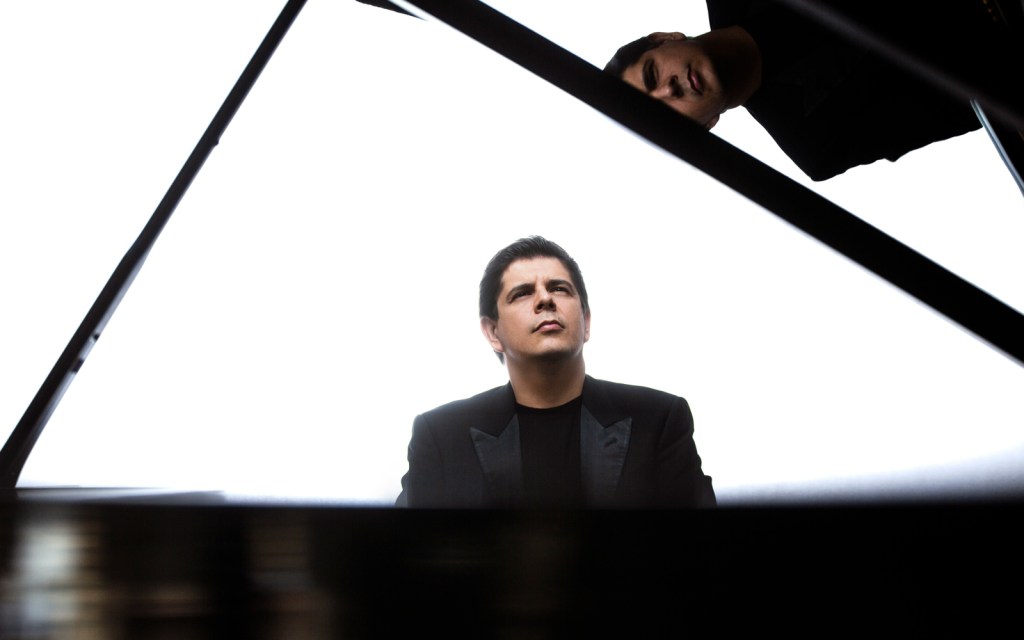
Alexander Gavrylyuk Image Adrian Malloch

Tchaikovsky 5

Auckland Philharmonia

Auckland Town Hall

April 15

Reviewed by John Daly-Peoples

First up on the Auckland Philharmonia’s “Tchaikovsky 5” programme was Kenneth Young’s “Douce Tristesse”, a work composed in 2012 in response to the composer’s final visit to the  long-time family holiday spot near Tauranga.

Strings and woodwind opened the work with a description of landscape, with swathes of colour conveying the changing light and textures of the land, sea and sky.

These vignettes were studded with musical highlights deftly conveyed by the small group of percussion instruments – cymbals, glockenspiel, crotales and harp suggesting the sparkles of light on water, the movement of clouds and the chirping of birdlife.

The work manages to suggest panoramic images from dawn to dusk suggesting the romanticism of the idyllic as well as a nostalgia for lost times and memories.

The composer says that the title ‘Douce Tristesse’ means ‘ sweer sadness and that the piece is about looking at a familiar scene for the last time, a view never to be seen again.

Prokofiev’s third Piano Concerto was written in 1921 during a period of self-imposed exile from Russia and a period when he did not feel oppressed by war or demands on his time and seems to have  more leisurely ambience . The work was first performed in Chicago with the composer playing. The audience and press raved over the music with The Chicago Daily Herald calling it the “the most beautiful modern concerto for piano,”

It opens with the sounds of a clarinet and strings playing a floating melody emblematic of his own more relaxed life. This led quickly to pianist Alexander Gavrylyuk racing into the first movement of the work with fiery sounds from both orchestra and  pianist who played as  though the piano were a percussion instrument

Hunched over the piano his playing was by turns delicate and ferocious as he grappled with the various sequences. There were times when his sounds were languid and romantic and other times when he took a delicate almost spiderly  approach to his playing.

In the second movement he turned the slow dance-like opening into a cacophony of jarring sounds and the intense finale of the third movement saw him in studious concentration.

He displayed a mastery of stylish playing, able to ignite the orchestra with his passion and drive.

His playing technique – changing tempos, charging through themes and varying the tonal qualities added to the excitement of the playing and appeared to enliven conductor Shiyeon Sung well as the orchestra.

Shiyeon Sung Image Adrian Malloch

The major work on the programme was Tchaikovsky’s “Symphony No 5” which saw Shiyeon Sung and the APO deliver one of their outstanding performances. The work is full of sensuous melodies, intense emotions and dramatic climaxes which make it one of the composers more invigorating works.

Some of the sequences are monumental with music similar to his 1812 Overture while there were traces of his ballet music in others.

Sung deftly, guided the orchestra, building musical images, of landscapes, seasons and events creating a world of sensation and emotions.

There were joyous  moments throughout the work but these were set against contemplative sections with the composer finding redemption in the grandeur of the work.

From the anguish of the first movement through the graceful mid-section and onto the final tumultuous fourth movement the orchestra provided a rich and satisfying performance.

While the orchestra was expertly conducted and the players superbly coordinated there were some stand-out performances by the bassoons, flutes, clarinets and French horns.