Categories
Reviews, News and Commentary

APO’s Other Worlds

Reviewed by John Daly-Peoples
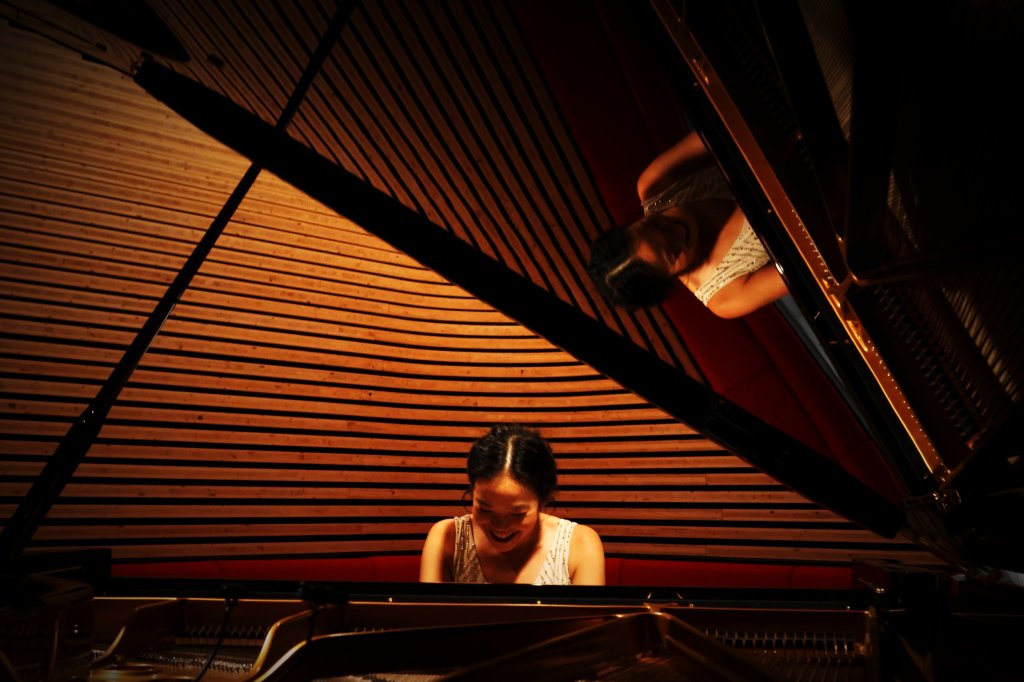
Shuiyeon Sung

Other Worlds

Auckland Philharmonia

Auckland Town Hall

March 28

Reviewed by John Daly-Peoples

It’s easy to appreciate why Sibelius’s Symphony No 2 has been  seen as a programmatic work conveying idea about patriotism and nationalism. At the time of writing the symphony the Russian  occupiers were restricting the use of the Finnish language and attempting to change the nature of Finnish society.

So, with this symphony, while the Finnish language was being stifled  Sibelius was allowing the Finnish voice to be heard through music  which reflected on Finnish language, landscape  and history.

He attempted to convey in music what the painting, ”The Attack” by the Finnish artist Edward Isto did visually. Painted at the same time it illustrated the feelings of many Finns. The work depicts a double headed eagle, representing the Russian state, attempting to snatch a book of laws from a while clad female.

Edward Isto, The Attack

The opening movement with its stirring blasts of the woodwinds and horns followed by the surging strings provided musical images of landscape which conveyed ideas of Finnish Nationalism.  Later when the vigorously plucked cellos contrasted with the deep sounds of the  bassoons there  a sense of personal loneliness or struggle.

The notion of the individual alone in the landscape and awe at their surroundings which is present throughout the work was also apparent in the opening work on the programme, Mendelssohn’s “Hebrides Overture” which also linked landscape, history and myth.

Later the militaristic sounds of a rampant orchestra ended with  a triumphant anthem all this sounding like  a great storm  and its aftermath.

The work was by turns  nostalgic, revolutionary and celebratory with repeated themes evoking a call to arms and a new dawn.

The newest work on the programme saw a trio of South Korean artists  on stage with violinist Inmo Yang playing Unsuk Chin’s 2001 work  “Violin Concerto No 1“ and the orchestra conducted by Shuiyeon Sung.

Inmo Yang

Unsuk Chin’s Violin Concerto is one of her most famous works and has won a number of awards and is  fine example of cross-cultural music where the experimental and the traditional are fused.

Inmo Yang backed by a percussion rich orchestra – marimba, gongs, harps, bells and xylophone  gave an extraordinary performance.

From the first bars of the first movement with his rapid bowing, he attempted to dominate the orchestra in what seemed at times like a competition.

His almost dementated, playing and the  abstract sequences he produced contrasted with the more controlled playing of the orchestra with many of the sequences sounding  as though Yang and the orchestra were responding to  different musical scores.

His high-pitched sounds worked well with the percussion instruments producing otherworldly feelings and soft disturbing moments. There were also random moments of intimacy as well as magical sounds full of exuberant colour as he joined with and riffed off the various percussion instruments.

In the final movement his dexterous playing  set the stage for  a battle between violin and orchestra where their sounds would combine and then separate with a massive sonic, Doppler Effect.

Chin’s violin concerto requires a player who has focus, exceptional technical skills and understanding of the work. Inmo Yang possessed all those qualities.

Future APO concerts

April 11th

Viennese Feast

Conductor Christoph Altstaedt
Violin Amalia Hall

Brahms Variations on a Theme by Haydn
Haydn Violin Concerto No.1
Mahler (arr. Britten) What the Wild Flowers Tell Me
Schubert Symphony No.6 ‘Little C major’

May 2

Bach & Bruckner

Conductor Johannes Fritzsch
Piano David Fray

J.S. Bach Keyboard Concerto No.5, BWV 1056
J.S. Bach Keyboard Concerto No.4, BWV 1055
Bruckner Symphony No.9

To subscribe or follow New Zealand Arts Review site – www.nzartsreview.org.

The “Follow button” at the bottom right will appear and clicking on that button  will allow you to follow that blog and all future posts will arrive on your email.

Or go to https://nzartsreview.org/blog/, Scroll down and click “Subscribe”

Categories
Reviews, News and Commentary

Dear Colin, Dear Ron

Reviewed by John Daly-Peoples

Dear Colin, Dear Ron

By Peter Simpson

Te Papa Press

RRP $65.00

Reviewed by John Daly-Peoples

“I feel very strongly that where I’m going is where paintings must go.”

So wrote Colin McCahon in his  final letter to his friend Ron O’Reilly. The two of them had been writing to each other for thirty-seven years and in many ways their letters chart the history of McCahon to the point that he was justified in making such as statement.

This statement and other observations about his own art and the development of art in New Zealand over four decades are revealed in new book “Dear Colin, Dear Ron” by Peter Simpson. It adds new dimensions to our knowledge of the life of Colin McCahon as well as exploring the art scene of the 1940’ through to the 1980’s.

“Entombment (after Titian”), oil on cardboard on hardboard, 1947

Simpson has brought together the correspondence of Colin McCahon and O’Reilly who first met in 1938, in Dunedin when McCahon was 19 and O’Reilly 24. They remained close, writing regularly to each other until 1981, when McCahon became too unwell to write.

Their 380 letters, more than 165,000 words covers McCahon’s art practice, the contemporary art scene, ideas, philosophy and the spiritual life. Their letters deal with a wide range of interests and reveal two men deeply committed to the notion that art can make  a difference to society ..

O’Reilly was a philosophy graduate who for many years worked for the Canterbury Public Library where he was influential in showing and collecting the work of McCahon. He subsequently became the director of the Govett Brewster Art Gallery.

This regard for each other can be seen when McCahon applied for job at Elam . O’Reilly wrote: ‘After years of viewing, as I know from the works of his that I possess, one is still discovering more in them, is still more and more impressed by the acuteness of the perception, the fineness of the thought and the breadth of the compassion revealed in their artistry. There is no other artist in New Zealand of whom I would say this. It should be clear that I regard Mr McCahon as the foremost painter in New Zealand and a very great man.’

Reilly’s respect for McCahon can be seen throughout the letters along with his intense interest in getting the rest of New Zealand to see the value of the artist’s work and he worked tirelessly to organise exhibitions of the artist’s work.  

Their friendship and correspondence brought out the best in each other – intelligence, empathy, compassion, loyalty, trust: these qualities are obvious  through the letters as though the two men appreciated that the issues the y were addressing were important to themselves as well as for posterity.

The book is illustrated with 64 images of McCahon’s work along with some of the drawings which the artist included in some of his letters to illustrate idea about composition.

The letters reveal O’Reilly to be a more intellectual and focussed thinker with carefully considered pieces of writing  while McCahon’s responses  seems to be more urgent but there are many passages of serious reflection.

The book is sprinkled with snippets of information about other artists, exhibitions and the art world  generally   which provides a sense of the emerging art scene.

There is Ron O’Reilly’s reports on talks by the visiting British critic Herbert read in 1963  and the American critic  Clement Greenberg in 1968 where the notions of international versus the local and the local were addressed.

There is also references to the arts politics of various arts institutions, art events and artists. In a couple of letters Ron O’Reilly (at the time the director of the Govett Brewster Art Gallery) writes about Billy Apple who was going to have a show at the gallery. He notes that ”Billy is a good man and a serious and dedicated artist. He is also touchy and won’t play when people want to use him or assume ever so bigheartedly that he is an entertainer cum pervert or treat him as a bum”.

The letters are full of such perceptive observations about artists and institutions. They also provide a fascinating insight into a relationship which is both personal as well as verging on the philosophical and spiritual as they both try to understand  their own and each other’s motivations and ideas.

Simpson says there are many interesting comments  about the nature of the paintings in the letters. In 1950 “Colin spoke of making changes to Easter Morning, a painting Ron especially liked. Ron wrote: ‘I am sorry you felt the Easter Morning needed altering: no doubt there are things one is trying for which are not achieved to satisfaction: however I wonder if one ever does achieve them by long labour on the same work. That picture had a magnificent feeling: the quiet movement of the women, the expectancy the fulfilment, the lovely early morning light . . . What you do is so good, so good, it doesn’t seem to me to matter much if you leave a painting which is not quite what you want: the development goes on so richly’. Colin replied: ‘About repainting, I don’t know, but I think Picasso is right that nothing is lost the destroyed discovery reappears in a new and better form. The Easter Morning is certainly better. The three women [in The Marys at the Tomb] remain – the alterations are to the angel[;] he has been enlarged & the landscape, lowered & the colour gone from blue to red[;] there is now a warmth as well as early morning coolness & a less cramped appearance to the whole picture.’

McCahon makes many comments about his own work. At one point in 1958  when he was working on the panels for “The Wake” which was based on the  John Caselberg poem he write to O Reilly saying

“The Wake” (panel one) ink and oil on unstretched canvas on sixteen panels, 1956

“I don’t understand the poem with any thoroughness at all either before I started work on it or when I finished. The feelings of what was being expressed comes over strongly – all builds into one feeling & builds this very largely by piling up of word on word in just such a relentless fashion”. Then in reference to the opening line of the poem,

“Your going maims God: God”

He writes “It is a line where bitterness is so strong that all the other feelings seem cancelled  & is I feel foreign to the quality of a wake.”

But just a few lines later he writes “I think I’m wrong in what I say of the first line. I can’t work out what I do feel about it…No doubt this bitterness is right as a start.”

The book is  a masterpiece of academic scholarship and shows a daunting level of  hard work with Simpson transcribing the letters as well as researching and writing 1500 explanatory notes to make the contents of the letters fully accessible to contemporary readers.

O’Reilly’s son Matthew O’Reilly and McCahon’s grandson Finn McCahon-Jones contribute insightful essays that round out the unique perspective the letters afford.

Categories
Reviews, News and Commentary

Barton and Brodsky

Reviewed by John Daly-Peoples

Auckland Arts Festival

Barton and Brodsky

Auckland Concert Chamber

May 22

Reviewed by John Daly-Peoples

It seems misleading  to describe the didgeridoo as a primitive instrument. The sounds it makes fit well within the scope of much contemporary music, there is  complexity to their playing and they have an extraordinary musical history which parallels the history of many European instruments.

The instrument’s voice also seems to connect with the land and the history of the Aboriginal  people with a deep spirituality .

The opening of the recent Barton and Brodsky concert heard that voice as  the rumble of  the didgeridoo  welled up from the underworld to fill the Auckland Concert Chamber. This was didgeridoo of William Barton joining the string quarter for a remarkable concert of music, where the instrument contributed to several of the works.

Barton performed in Peter Sculthorpe’s “String Quartet No 11 “Jabiru Dreaming” which describes the Australian landscape and its animal life. His fitful and variable  breathing  gave a sense of the breath of life which giving soul to the land, and the sharp bursts of sound mapped out the patterns of landscape and geology. The strings contributed sharp shrill sounds of bird life and the murmurs of the bush.

In” Minjerribah” by Robert Davidson which paints a picture of the North Stradbroke Island Bartons didgeridoo again  provided a sense of the timeless landscape while the strings created  an almost romantic vision with evocative sounds of bird life,  the shrill of cicadas, waves churning over beaches, deep blue skies and sun.

Barton also made a major contribution to the concert with his own composition “Square Circles beneath the Red Desert Sand” which he introduced walking from the rear of the hall channelling the spirits and the song lines of Australia, the sounds of his  voice echoed by the strings.  His singings took the form of a ritual, like the chants of many religions. Here along with the savage strings of the quartet, the sounds of the European instruments and didgeridoo showed the power of music to provide memory and narrative  reaching across cultures.

Before the two works featuring the didgeridoo, the quartet played Henry Purcell’s early “Fantasia No 5 in D Minor” with all the elegance the work requires with Paul Cassidy’s viola adding a deep sonorous tone.

This finely crafted work was in marked contrast to the main work on the programme, “Janacek’s  String Quartet No 11”. This work is subtitled “Intimate Letters” and is a musical representation of some 700 letters sent between Janáček and Kamila Stösslová which represented the composer’s intense emotions in  that doomed  relationship.

Passages of the work were played at not much more than a whisper which were then punctuated by dramatic piecing sounds from the strings as though representing the turmoil of  the composer’s mind. In many of the sequences, violinist Krysia Ocostowicz led the group with her insistent playing and in the final movement played with a fevered urgency mirroring that of the composer.

The group also  played Stravinsky’s “Three Pieces for String Quartet” which was written after his ballet music for Petrushka and owes much to folk music , the carnival and snippets recalling Latin chants.

They also played Salina Fisher’s “Torino – Echoes of the Putorino”. The putorino is  a Māori instrument which can produce sounds as varied as a trumpet or a flute which the group were able to replicate. But while they were able to produce the sounds of the instrument, they were also imitating the sounds of the New Zealand bush and the native birds with the bright strings achieving the sound of several birds including the kiwi.

With Andrew Ford’s “String Quartet No 7: Eden Ablaze” which was a memorial and requiem to the Australian bush fires of 2019 / 20 the group captured the drama of the event, visions of the devastated landscape and the flight of the animals.  There were surging sounds of the combined strings as well high-pitched sounds of distress while  the didgeridoo provided a plaintive background.

To subscribe or follow New Zealand Arts Review site – www.nzartsreview.org.

The “Follow button” at the bottom right will appear and clicking on that button  will allow you to follow that blog and all future posts will arrive on your email.

Or go to https://nzartsreview.org/blog/, Scroll down and click “Subscribe”
Categories
Reviews, News and Commentary

Diptych: Memorable Risk with Rewards aplenty

Reviewed by Malcolm Calder

Reviewed by Malcolm Calder

Auckland Arts Festival

Diptych

Peeping Tom, Belgium

Kiri Te Kanawa Theatre, Aotea Centre

Diptych: The missing door & The lost room

Concept / Directors, Gabriela Carrizo and FranckChartier

Until 24 March

Review by Malcolm Calder

I normally try and write these words as soon as possible after a performance.  But this time I couldn’t and eventually decided to sleep on it.  Only I couldn’t sleep either.  In my mind images and thoughts swirled in what I could only describe as atmospheric convolution.

But first things first. Diptych comprises two parts – the first about a missing door, and the second about a lost room.  There is a third part, making it a Triptych, but we don’t see that here in this Auckland program.

My over-weaning sense of this company is the dynamic, slick and truly mesmerising movement in its choreography.  Belgian founders Gabriela Carrizo and Franck Chartier have established Peeping Tom as a unique force in dance theatre transforming hyperrealist settings into unstable universes that defy the logic of time, space, and mood.  This work and the company’s lineage to Pina Bausch are clearly evident and I can easily see why Artistic Director Shona McCullagh chose it as one of the centrepieces of her 2024 Festival.

As well as movement, Diptych also owes much to an all-enveloping soundscape that adds a hypnotic quality, overlaying music with live percussion and everyday noises.  This underpins the sheer physicality and many of the jarring and emotional shocks that lie ahead.

The staging starts out tiny and winds up using the full breadth of the stage giving it a cinemascopic quality.  And, just in case we missed it, the entire work is cinematic.  This is underscored by the introduction of rolling klieg lights, a boom mic and a set that is deconstructed then reconstructed by technicians in full view of the audience.

Completing the context, and further highlighting the illusion, are costumes that writhe and twist almost becoming creatures and taking on characters of their own, whilst echoing the movements of the dancers whose movements who, it seems, are controlled by non-logical and even gravitational forces.

Then my mind returned to ponder the word ‘convolution’ itself.  Turns out it’s a term that describes a form or shape that is folded in tortuous windings, or one of the irregular ridges on the cerebrum of higher mammals oran intricacy of form, design, or structure in which the combinations of power and the caprices of the powerful are ever-present dangers to survival (thanks Mr Merriam-Webster).

Yep, that’s about right I decided.  And henceforth, for me, Diptych became a convoluted dance theatre work.

I knew it was about a man’s mental anguish and I immersed myself in that tangled web.  It has no single direction veering between reality, memories, desires, dreams and nightmares.  At times I was slow to grasp a thread; at others I got it instantly.

Eventually I just stopped fretting about trying to work things out in any logical or linear fashion, sat back and let it wash or surge, over me.  And I’m glad I did because that is what Diptych is all about.  Rather than trying to ‘understand’ what Carrizo and Chartier were trying to say, the production itself taught me to just soak in it, to absorb it.

Yes, there was a missing door; and yes there were many surprises when some were opened.  But the perceptions, context, memory and horrors of doing so were different for every character on stage.   Similarly, an entire room got lost and the same applied.

What Festivals are supposed to do is introduce us to the new, the different and the normally unattainable.  So congratulations to the Festival for taking this risk with Dyptych.  It was certainly memorable for me – so much so that it never occurred to turn my phone back on again when leaving the theatre and I missed a raft of calls the next morning.

To subscribe or follow New Zealand Arts Review site – www.nzartsreview.org.

The “Follow button” at the bottom right will appear and clicking on that button  will allow you to follow that blog and all future posts will arrive on your email.

Or go to https://nzartsreview.org/blog/, Scroll down and click “Su

Categories
Reviews, News and Commentary

Gravity & Grace : a refreshing and inventive NZ play

Reviewed by John Daly-Peoples

Auckland Arts Festival

Gravity & Grace by Eleanor Bishop and Karin McCracken.

Q Theatre

Until March 24

Reviewed by John Daly-Peoples

Gravity  & Grace is adapted from Kraus’ account of the unsuccessful film she made in the 1990’s – Gravity & Grace. That film follows Grace as she finds a connection to a cult predicting doomsday and the arrival of a spaceship, and Gravity, who leaves New Zealand to try her luck as an artist in New York City.

Kraus is probably most well known for her book and TV series “I Love Dick” but Eleanor Bishop and Karin McCracken have mined he obscure Gravity & Grace to make a play which addresses ideas about the flawed or failed artist as well as reflecting on the creative process generally.

The play set in the US and New Zealand where much of the filming was shot because she had obtained NZ Arts Council funding. We follow her inexperienced attempts as a director and her unsuccessful efforts to get interest from the film festivals and agents. Along with this we delve into her personal and professional relationships which blight the films development.

Her own attempts at creating art works are paralleled in her homage  to three other flawed creatives: the French writer and philosopher Simone Weil and her book La pesanteur et la grâce (Gravity and Grace), the American artist Paul Thek whose star burnt out after an initial burst of success and  the German Red Army activist Ulrike Meinhof.

Its as if she is saying these great artists also made mistakes, just like  me.

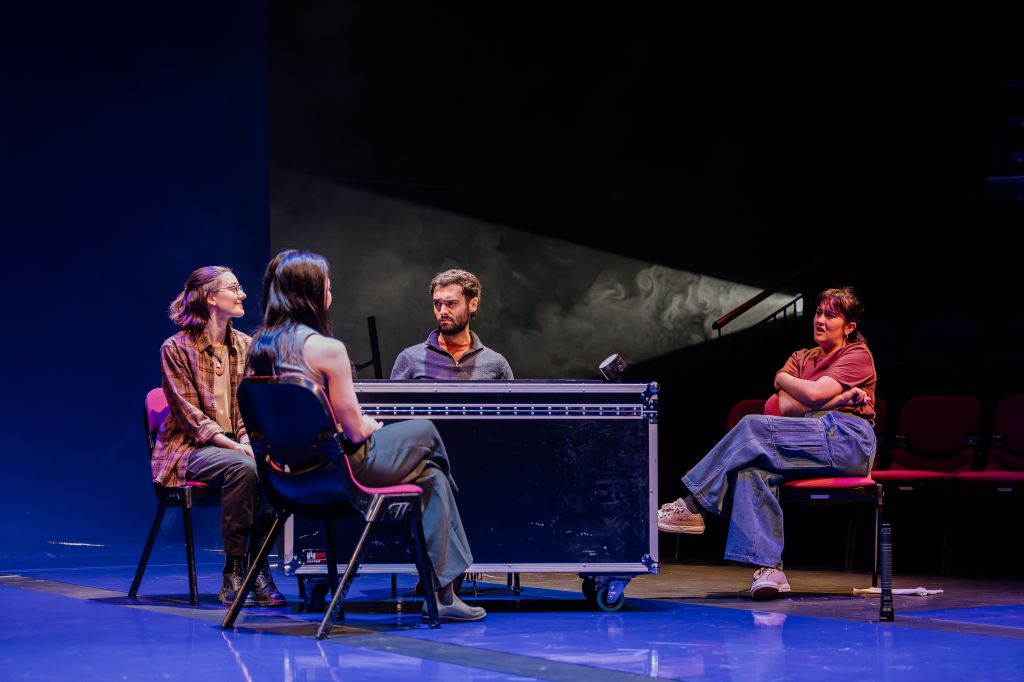
The two writers of the play also are the stars of the work with Eleanor Bishop’s faultless direction and  Karin McCracken giving an incisive portrayal of  Chris Kraus.

McCracken is on stage the whole time and holds the play together with her range of emotions as well as some witty dialogue . She is  also cleverly presented with many sequences featuring her filmed. Often her projected head loomed over her as she sat at her desk or she was shown from strange angles suggesting the characters many dimensions.

The cast play a variety of roles including Andy Warhol (Sam Snedden); Ulrike Meinhof (Ni Dekkers-Reihana); Simone Weil (Rongopai Tickwell) and Paul Thek (Simon Leary). Sneddon also plays Sylvère Lotringer, Kraus’s husband as well as Gavin her S&M phone lover.

Much of the success of the play comes from the innovative staging created by designer Meg Rollandi, the visuals of Owen McCarthy, and Rachel Neser, the soundscape designed  by Emi 恵美 Pogoni and lighting by Rob Larsen.

The work is overwritten at times and could do with a trim and there are a few sequences such as the cast working on what was possibly a Paul Thek mural which doesn’t seem to add much to the work.

But it is one of the most refreshing and inventive recent New Zealand works with  fine writing, and suburb stage craft.

To subscribe or follow New Zealand Arts Review site – www.nzartsreview.org.

The “Follow button” at the bottom right will appear and clicking on that button  will allow you to follow that blog and all future posts will arrive on your email.

Or go to https://nzartsreview.org/blog/, Scroll down and click “Subscribe”
Categories
Reviews, News and Commentary

A Very Old Man With Enormous Wings: Delightful Ingenuity

Reviewed by Malcolm Calder

Genevieve Hulme-Beamanand Manus Halligan

Auckland Arts Festival

A Very Old Man With Enormous Wings

By Dan Colley and Riverbank Arts Centre, Newbridge

Based on the short story by Gabriel García Márquez

Herald Theatre, Aotea Centre

Until 24 March

Review by Malcolm Calder

Director, Dan Colley

Lighting, Sarah Shiels

Sound, Alma Kelliher

Just outside of Dublin is a small town in Co Kildare called Newbridge. Its Riverbank Arts Centre, is funded by both the local authority and the Arts Council of Ireland, and it serves its community well. Rather like similar ventures in this country its facilities are available to local community groups, but at its artistic heart is a carefully-curated program featuring selectively chosen professional work from all over Ireland, the UK and Europe.

Unlike the vast majority of its New Zealand counterparts however, the Riverbank Centre is much more than just a receiving theatre. It also carefully nurtures talent and creativity and has developed into what is referred to in the trade as a ‘producing theatre’ with some of its work touring extensively

A Very Old Man With Enormous Wings typifies this. It is the work of a small cooperative group under the leadership of Dan Colley who have created a perfect show for young and old to share, gorgeously formed around music, puppetry and live video, but also thoughtful and emotionally rich in its exploration of human nature.

Its informality and studied casualness is very quickly established. Non-speaking actor Manus Halligan (well he makes some mouth-noises) is ‘doing things’ with tiny models on a table as the audience is seated. When the lights find a little focus, narrator Genevieve Hulme-Beaman simply announces “we’ve started”. She goes on to urge the audience for this offbeat adaptation of Gabriel García Márquez’s children’s story, to not go looking for a lesson. “There isn’t one.”

And that’s precisely what we get. It’s like a children’s story told by children and, as is often the case with children’s stories, introduces flashes of unexpected insight and depth. The story certainly examines the human response to those who are weak, dependent, and different and there are moments of striking cruelty and callousness throughout. But it essentially brings a magical revelation of itself to the stage and reveals itself through a beautiful, strange, emotional richness. It is offbeat, quirky, funny and its 43-minute runtime flies.

Above all it reveals what creative minds can generate using little more than ingenuity. And what can gestate in a small regional arts centre where producing is as important as receiving.

Categories
Reviews, News and Commentary

Demanding Play is a Festival Highlight

Reviewed by Malcolm Calder

Auckland Arts Festival

The Sun and the Wind

Taurima Vibes

Loft, Q Theatre

Writer and Set Design, Tainui Tukiwaho

Director, Edward Peni

With Taungaroa Emile, Julie Edwards, Joe Dekkers-Reihana, Tuakoi Okia

Lighting, Katrina Chandra

Sound, Eve Gordon

Until 24 March

Review by Malcolm Calder

Conceived during lockdown, Tainui Tukiwaho’s The Sun and the Wind is demanding for an audience. At times it mixes the real and the surreal, throws in a pinch of the tender and the touching, and then explodes with emotion, truth becomes blurred and we start unravelling things all over again. It is a highlight of this year’s Festival.

Set at a birthday party for an ageing couple, heartrendingly comfortable and practised in each other’s company,  Hūkerikeri seems like a kind and gentle kuia caring for her Rangi in his dotage.  I initially wondered if I had accidentally strayed into some kind of social commentary on contemporary aged care.

But the sudden and noisy arrival of a younger couple crashing into their home intent on robbing them quickly put that thought to bed. 

The newcomers soon become mistaken for a long-deceased son and his pregnant wife – in the mind of the birthday couple anyway.  From there The Sun and the Wind quickly becomes an emotional rollercoaster.  Factual memory blurs with confused recollection, two levels of whanau intermingle and become one or maybe not, and quiet introspection gives way to sudden violence.

How much of it is real ?  Perhaps that is summed up by the presence of a gun – which may or may not be real.

The Sun and the Wind owes something Aesop’s fable The North Wind and the Sun, a moral allegory which sees persuasion triumph over force.  The way Tukiwaho spins it though, things are never quite that simple.   That is why this play demands a lot from its audience.

Nevertheless, I occasionally wondered if Tukiwaho had over-written in patches, but he quickly jolted me back to the main course with more sudden and unexpected twists, turns and confusions.

Edward Peni directed with aplomb – an extremely demanding task on a play if this type.

Julie Edwards makes an enchanting Hūkerikeri, endearingly loveable but with sudden vituperative barks of fury.  She is so, so on point. Taungaroa Emile gives us a Rangi, whose mind wanders with vivid clarity, his love of whanau omnipresent.

I felt quite sorry for poor Hihi (Joe Dekkers-Reihana) who is flung from doorpost to doormat as he struggles to make sense of everything.  It is left to his heavily pregnant partner Kate (Tuakoi Okia) to slide the occasionally grounded, and often humourous, comment in from time to time.

Although it generates the occasional laugh, this play is not a comedy.  It marks a big step forward for Tainui  and demands a lot from its audience.  So, if you are one of those who lament the  plethora of highly subjective immature frivolity seen today on many of Aotearoa’s stages, you should certainly not miss this one.

Categories
Reviews, News and Commentary

Derek Jarman’s Delphinium Days coming in June

John Daly-Peoples

Derek Jarman, The Garden

Derek Jarman: Delphinium Days
Gus Fisher Gallery, 15 June-14 September 2024
City Gallery Wellington, 19 October 2024- 2 February 2025

John Daly-Peoples

This June, Auckland’s Gus Fisher Gallery opens Derek Jarman: Delphinium Days, New Zealand’s first exhibition of this highly significant figure influential artists and gay rights activists of his generation. Entry is free. 

He was the first public figure in the UK to make his HIV positive status known, the exhibition marks 30 years since his untimely death to an AIDS related illness at the age of 52. 

The exhibition curated by Lisa Beauchamp, ( Gus Fisher Gallery), Aaron Lister (City Gallery , and Michael Lett will feature seen paintings, films, photographs and archival material by and about the artist, which will offer an in-depth and affecting view of this celebrated cultural figure whose impact remains profound today. 

Beauchamp says “The exhibition will also cement Jarman’s familial connection to Aotearoa through his father Lancelot,” she says. 

Jarman’s father Lancelot Elworthy Jarman was born in Canterbury in 1907 after Jarman’s grandparents immigrated from Britain in 1888. 

“To bring this part of his life to the fore in Derek Jarman: Delphinium Days will add so much to our understanding and connection to him as one of the most enduringly relevant and impactful artists of modern times,” adds Beauchamp.

Jarman was a prolific creative best known for his avant-garde films, who pushed boundaries to move skilfully between painting, film, writing, set design, performance and gardening. 

Jarman was an early campaigner for the rights of the LGBTQIA+ community and people with AIDs, after being diagnosed as HIV positive himself in 1986.

Co-curator Michael Lett says: “Derek Jarman was one of my first encounters with a fully formed, human gay man. As a teenager reading “Modern Nature” quietly in my room, I found a complex man, who had friends, had sex, got angry, liked to garden and was open about being HIV positive.” 

Jarman’s films are widely known, including Caravaggio (1986) and The Garden (1990) starring his longtime collaborator and muse Tilda Swinton; cult-favourite Jubilee (1978) and his last ever feature film Blue (1993). In Auckland, Gus Fisher Gallery will partner with The Capitol Cinemas to present a selection of Jarman’s most well-loved feature films by the artist.

Jarman helped set the cultural zeitgeist for the time, with his art speaking to and for the dispossessed and alienated, as well as his writing, including Modern Nature (1991) and At your own risk (1992). Many will also be familiar with his music videos for iconic bands like Pet Shop Boys, The Smiths, and Sex Pistols. 

Major painted works from Jarman’s late ‘Evil Queen’ series will be included in the exhibition, as well as a selection of his famous tar paintings and landscapes that connect to his garden at Dungeness. A selection of Jarman’s rarely seen Super 8 films will also be featured.  

The artist himself will feature in a range of tender images by Jarman’s close friend and photographer Howard Sooley.

A dynamic public programme of events will be delivered in Auckland and Wellington to help the exhibition resonate with broad audiences, informed by kōrero with Aotearoa’s LGBTQIA+ communities. 

“By using the exhibition as a catalyst to reduce the stigma associated with HIV and AIDS, we plan to offer meaningful engagement opportunities for rainbow audiences and allies,” says Beauchamp. 

She says Jarman became a beacon of hope for those isolated from society. 

“His artworks and social commentary are a powerful mechanism against a rising tide of hatred and homophobia. Whether through painting, film, gardening or writing, his creativity knew no bounds and continues to influence generations of artists globally.”

Categories
Reviews, News and Commentary

Wonders: Scott Silven, mentalist, magician or trickster

Reviewed by John daly-Peoples

Auckland Arts Festival

Wonders

SkyCity Theatre

Until April 24th

Reviewed by John Daly-Peoples

Last night I went down that rabbit hole where Alice (In  Wonderland) went. Or rather, Scott Silven led me down it – to a world where the rules of logic don’t apply, where the random and unexpected are the norm. At least that’s what Silven had me thinking. After all, he is mentalist, maybe even a hypnotist so he can make me believe his extraordinary sleight of hand performances are real, or were they mere illusions or complex deceptions.

He doesn’t make objects disappear or turn pumpkins into rabbits but he does elaborate things with words, numbers and pictures.

Certainly he is a showman, having the gift of the gab with a history of invention and mentalism going back to his youth and the safe place he found in his grandparents attic where he found a  mental connection to the stars and the universe – and then to huis audience.

The set reflects that distant past and the attic with the comfortable leather chair, an artist’s easel and assorted chairs and furniture all of this bathed in soft lighting giving it the sense of a séance.  

His narrative connects his illusions (or are they tricks) which he learnt those  early years in his grandparents attic to the stage at SkyCity.

He starts the show with the simple guessing a number in someone’s head but then moves on to elaborate illusions where  guessing the number or the word goes through elaborates steps before the revelation. At one point the word turns out to be a number and the number refers to a page and line in a dictionary.

So, how’s this for a trick. Silven gets a husband and wife up on stage. The husband has to guess what his wife’s favourite place is. He guesses Italy but he is wrong so we get a bit of audience participation. A large map of the world get ripped up into about 500 pieces by the audience. The 500 pieces get put in a box and the husband chooses a sliver of paper, bearing – a bit of France.

There is quite a bit if audience participation Everyone in the audience gets given pencil and two pieces of paper one for a word one for a drawing which all get shared eventually. This all links to Silven’s proposition that we can collectively make things happen – it sounds like snake oil but it works.

Is Silven onto to something or is he on something, whatever it is he gives a captivating performer and his act is heightened by great sound track along with some dramatic used of lighting.

While you can be sceptical of all his little routines you still keep asking – how did he do that.

Categories
Reviews, News and Commentary

The Kings Singers: Vocal Magicians

Reviewed by John Daly-Peoples

Auckland Arts Festival

The King’s Singers, Finding Harmony

Holy Trinity Csthedral

March 14

Reviewed by John Daly-Peoples

The King’s Singers  are the most well-known and probably the greatest exponents of  cappella singing who have been touring the world’s major  concert venues for the last fifty years.

With their sole Auckland performance, “Finding Harmony they displayed their superb technical skills and an extraordinary blend of vocal cohesion.

As well their ability to sing like a choir of angels they can sing like a rowdy pub crowd or an earnest revolutionary mob.

They understand what music is capable of and why it is important. They are not merely singing great songs with interesting lyrics, they are singing songs which have inspired people at particular times.

Their programme presented songs grouped together with sets from the time of the Reformation, works from Africa, Georgia, Estonia and the Scottish Highlands.

They opened with songs under the title “I have a dream“ featuring music of the US Civil Rights movement including works by Mahalia Jackson and U2.

The U2 song, simply titled “M.L.K.” opened in a sombre mood with some of the voices created a bagpipe-like sound with the voices floating above the hum of the pipes, the  funereal sounds slowly changing to that of the reflective.

Another set was of songs focused on the Estonian struggles against the Soviet occupation of the late twentieth century.

There was “Parismaalase”  a work by Vejio Tormis with its primitive sounds and rhythms  and the refrain “tabu-tabu”  (taboo) repeated 300 times the chant referencing the inability of the Estonians to speak out during the Soviet occupation. Accompanied by a single drum their voices ranbged from that of a whisper to a shout.

With a trio of Georgian songs, the group explored several traditional songs which had a mix of extotic sounds which showed the influence of Eastern music and a different approach to singing with sounds like that of a mouth harp along with a piercing yodel-like sound in one of the works.

They introduced their suite of works under the title of “Lost Songs of the Highlands” with a short history of the Highland Clearances before singing John Cameron’s wistful longing for the Scottish landscape. Their singing of “Loch Lomond” which they made into an achingly sad work telling of the separation of  man and wife as well as the separation of the land. They gave these works a real power with their voices replicating the sounds of the pipes and fiddle along with some plaintive whistling.

They presented music of the Reformation much of which was set in motion by Martin Luther, developing an alternative to the spiritual monopoly of the Roman Catholic Church . This Protestant music changed from the  polyphonic motets sung in latin to a simpler style which was illustrated with  Luther’s very own hymn, “Ein feste Burg”, which became something of an anthem for the Protestant movement, being sung in the common language with more relevant lyrics.

They also sang works by the English composers William Byrd and Thomas Tallis who  were more Catholic in their output favouring elaborate compositions and the singers made the most of this quality with their entwined voices.

The final miscellany of works included a witty mashup of the Mary Poppins  song “Supercalifragilisticexpialidocious and “Take Care of the Children”,  a work composed by Robert Wiremu, setting the words of Dame Whina Cooper to music. Here the singers also managed to  imitate the sounds of the koauou (flute) and porotiti (whirling hummer). In a tribute to the visionary Māori leader.

The final work on the programme was their version of the Beatles song “When I’m Sixty-four” where the singers imitated the instrumental sounds rounding out a concert filled with moments of vocal magic.

To subscribe or follow New Zealand Arts Review site – www.nzartsreview.org.

The “Follow button” at the bottom right will appear and clicking on that button  will allow you to follow that blog and all future posts will arrive on your email.

Or go to https://nzartsreview.org/blog/, Scroll down and click “Subscribe”