Categories
Reviews, News and Commentary

Eddie Clemens’ new sculpture for Wellington

John Daly-Peoples

Eddie Clemens, Fibre-Optic Colonnade Car Wash Image Ted Whitaker

Eddie Clemens

Fibre-Optic Colonnade Car Wash

Shed 21 Wellington

John Daly-Peoples

Another outstanding public work of art for Wellington City has been opened this week. “Fibre-Optic Colonnade Car Wash” created by Eddie Clemes is an ambitious new work of art for Wellington that will transform a pedestrian thoroughfare linking the railway station with Wellington’s waterfront and CBD.

The Wellington Sculpture Trust recognised that the rather dark and cheerless Shed 21 Colonnade on Waterloo Quay (opposite the railway station) presented a perfect opportunity for a light work that would be visible both day and night.

Auckland-based artist, Eddie Clemens’, proposal for the space, fitted the brief perfectly with a work that is both recognisable, relatable and whimsical. A work that would provide an engaging and uplifting space for pedestrians through an architecturally significant heritage building space.

The work will be ‘switched on’ for the first time this week by Gisella Carr, Head of Creative Capital at Wellington Council. The Council is an important partner of the Trust’s and assumes ownership and ongoing maintenance of the works once gifted.

Jane Black, chair of the Wellington Sculpture Trust, said: “Eddie’s work fulfilled the Trust’s brief perfectly with his proposed work: “Fibre-Optic Colonnade Car Wash”, a kinetic light sculpture that takes the form of an automatic tunnel car wash with one dramatic twist: the bristles of the spinning car-wash brushes are fibre-optic cables, and will literally wash the colonnade and pedestrians in light and colour, softening the architecture and turning the space into a visually striking haven of moving light.”

The ‘carwash’ represents a significant development in a strand of Eddie’s practice that  began in 2009 with his original “Fibre-Optic Broom” which was exhibited in his Frances Hodgkins fellowship exhibition, “Delusional Architecture”.

His fibre-optic works transform everyday cleaning objects into items that transmit not only light but also programmed information – more a tool of science fiction than a household item.

Eddie Clemens says: “My recent work has been concerned with ideas of time and  subjectivity, building on my interest in cinema and the narrative potential of physical objects.

In “Fibre-Optic Colonnade Car Wash” (2025), a series of fibre-optic rollers suspended from the ceiling display moving patterns of light and colour, illuminating the urban environment while also alluding to the experience of a commercial car wash, where the passage of the brush heads over the windows can create the illusion that the car itself is moving. Walking through the Colonnade, pedestrians are themselves washed by the light, briefly separated and ensnared in a moment of informational and luminous uncertainty,” Eddie said.

He has been refining the work over the past five years, interrupted by Covid and the ensuing distribution problems, but also refining the work with ever-changing cutting-edge technology to make it more durable and robust.

Eddie Clemens, Fibre-Optic Colonnade Car Wash (detail) Image Ted Whitaker

Each of the seven ‘roller brush’ units of the Fibre-Optic Colonnade Car Wash contains 1000 addressable LEDS that are programmed to display a range of colourful animations, ensuring the work continues to mesmerise those passing through each day.

It is planned the work will operate in the mornings and evenings during peak pedestrian times: 7am-9am, 3.30pm-6.30pm, 8.00pm – 11.00pm, and for 10 minutes on the hour in between until 11pm.

Jane Black says: “The Trust is very grateful to the residents of Shed 21 who gave their permission for the work to be installed on the ceiling of the colonnade, and to the many donors who have generously contributed to funding the over $250,000 artwork.”

It has been a huge month for the Wellington Sculpture Trust, having just installed Seung Yul Oh’s work “KIMI/You are here” in Waitangi Park, and a big month for Wellington in terms of the addition of two exceptional works that will be gifted to the city. Eddie’s work is the 31st permanent public artwork to be commissioned by the Trust.

Jane Black says the two new artworks are major additions to Wellington’s collection of world class public sculpture. They bookend the waterfront and now form part of the Trust’s waterfront sculpture walk which includes Glen Hayward’s work, “The Grove”, a celebration of Wellington’s maritime history; and “Nga Kina”, a work by Michel Tuffery, marking the Kumutoto Pa and stream; and the temporary works placed on the 4 plinths outside Te Papa for the Collin Post Four Plinths Project.

“Eddie Clemens is a total maverick. His sci-fi tinged work is meta in its range of references and operations—sometimes head-scratching, always stimulating. This kinetic light sculpture comes from a line of glowing fibre-optic brooms and handscrubbers, of materialised fences and bridges that are put to work in and on specific spaces. His proposal to turn an entire colonnade into an fibre-optic, automatic tunnel car wash that is to be walked (not driven) through is out of the box brilliant thinking. It perfectly marries concept, a decade’s practice, and technology—all turned towards the specific dynamics of a very challenging site.”

Glen Hayward, “The Grove”
Seung Yul Oh’s work, KIMI/You are here Image, Robert Kitchin
Categories
Reviews, News and Commentary

Wellington Architecture: A Walking Guide

Reviewed by John Daly-Peoples

Wellington Architecture: A Walking Guide

John Walsh and Patrick Reynolds

Massey University Press

RRP $37.00

Reviewed by John Daly-Peoples

John Walsh and photographer Patrick Reynolds have just launched “Wellington Architecture, A Walking Guide” their third book in the series of architectural walking tours following on from their books on Auckland and Christchurch. It is a great addition to books which explore and explain our built environment.

 John Walsh in the introduction notes that he was born in Wellington which was as “compact and confined as a medieval city-state, intensely impressed itself on me, in the most impressionable part of my life. My mother had moved to Wellington where she met my father, and they were married in the church at St Gerard’s Monastery. I remember the Freyberg Pool, where I learned to swim; the summer lights strung on the Norfolk pines along Oriental Parade; and the council yard where my father worked, next to the Herd Street Post and Telegraph Building. My high school was near the old National Art Gallery and Dominion Museum; we’d be sent to mass at St Mary of the Angels and, in blazers and ties, despatched from Wellington Railway Station on rugby expeditions into the hinterlands of the Hutt Valley.”

Public Trust Building

This reviewer also grew up in  Wellington, living in the National Hotel  across from  the corner of Stout St and  Lambton Quay. From our front room we had an impressive architectural vista including The Public Trust Building The Government Departmental Building and The State Insurance Building. Further down the street was the Wellington Railway Station  and the Seamans Mission Building.

On my way to school I passed  Ernst Plischke’s Massey House, The Old Supreme Court, The Old Government Building, The Beehive, Parliament building, the General Assembly Library, Turnbull House and the rather unfortunate Cathedral of St Paul. These were the background to my life at the time and it was only when I moved to suburban Karori that I noticed the difference in my daily environment.

Shed 7, Wellington Harbour Board

The place of architecture in our environment and in our personal and social history is important often more noticeable when we are in foreign cities. A city’s buildings are important in defining the nature of a place. When visiting a place for the first time the visitor will map a city through its buildings. The materials, the orientation, the colours, the decoration and the forms all help create the language of the way the city is perceived.

The buildings of Auckland Wellington and Christchurch have many similarities but the accumulation of the various periods of construction and styles in each of those places has created very individual environments.

“Wellington Architecture, A Walking Guide” features more than 120 significant buildings describing their purpose and history as well as  providing a background on  the architects who designed them. The buildings are grouped into five self-guided walking routes, each with a map together with itineraries which collectively create a portrait of the  city.

St John’s

The building are  a mix of colonial, nineteenth century Gothic, mid-century modernism and buildings of the last fifty years illustrating the changing nature of the architecture along with the changing nature of New Zealand and the city. The buildings are banks, businesses, government departments, churches, apartment buildings libraries, hotels, apartments, and a few  private houses.

One of the tours features several of the government institutions surrounding Parliament including the Old Government Building (now the Victoria University Law School) and one on the largest wooden buildings in the world, all those other buildings I passed on the way to school along with the more recent  brutalist National Library and the modernist Freyberg Building.

Several architects feature with a number of buildings such as Gummer & Ford, Thomas Turnbull and Ian Athfield who is represented by the Wellington Library (soon to be reopened) and his Oriental Parade flats as well as a few, often controversial,  additions he made to existing buildings

DeLoitte, 20 Customhouse Quay

While all the buildings are significant there are a number  scattered through the  walk which have importance beyond their architectural qualities. There are the Dixon Street Flats which were the first multi-story modernist block of flats created under the First Labour Government which show the influence of overseas trends introduced to New Zealand by Plischke.

There is also the remarkable Futuna Chapel designed by John Scott the Māori architect who managed to combine aspects of Māori and mainstream architecture. Walsh notes that Futuna is  one of the few buildings one could refer to as “iconic”.

Asked which building he regarded as the most interesting new building in Wellington he has stated that it is Heke Rua the new building for New Zealand’s Archive beside the National library, both for its architecture as well its signaling a commitment to preserving the nations documentary heritage.

Walsh writes in an informative style, providing wide ranging information to provide a context for the buildings so that while the book is an ideal complement to a walking tour of the city it is also provides a potted history of the social, political and aesthetics development over 150 years in the city as seen through the buildings.

The photography of Patrick Reynolds enhances the text with many of them showing an appreciation of the design elements of the buildings, 

Anscombe Flats
Categories
Reviews, News and Commentary

Wellington Architecture: a Walking Guide

Wellington Architecture: A Walking Guide

John Walsh and Patrick Reynolds

Massey University Press

RRP $37.00

Reviewed by John Daly-Peoples

John Walsh and photographer Patrick Reynolds have just launched “Wellington Architecture, A Walking Guide”  a revised edition of the book first published in 2022. This is their third book in the series of architectural walking tours following on from their books on Auckland and Christchurch. It is a great addition to books which explore and explain our built environment.

 John Walsh in the introduction notes that he was born in Wellington which was as “compact and confined as a medieval city-state, intensely impressed itself on me, in the most impressionable part of my life. I remember the Freyberg Pool, where I learned to swim; the summer lights strung on the Norfolk pines along Oriental Parade; and the council yard where my father worked, next to the Herd Street Post and Telegraph Building. My high school was near the old National Art Gallery and Dominion Museum; we’d be sent to mass at St Mary of the Angels and, in blazers and ties, despatched from Wellington Railway Station on rugby expeditions into the hinterlands of the Hutt Valley.”

A building with a dome on the top

AI-generated content may be incorrect.Public Trust Building

This reviewer also grew up in Wellington, living in the National Hotel across from the corner of Stout St and Lambton Quay. From our front room we had an impressive architectural vista including The Public Trust Building, The Government Departmental Building and The State Insurance Building. Further down the street was the Wellington Railway Station.

On my way to school I passed Ernst Plischke’s Massey House, The Old Supreme Court, The Old Government Building, The Beehive, Parliament building, the General Assembly Library, Turnbull House and the rather unfortunate Cathedral of St Paul. These were the background to my life at the time and it was only when I moved to suburban Karori that I noticed the difference in my daily environment.

A building with a dome top

AI-generated content may be incorrect.Shed 7, Wellington Harbour Board

The place of architecture in our environment and in our personal and social history is important often more noticeable when we are in foreign cities. A city’s buildings are important in defining the nature of a place. When visiting a place for the first time the visitor will map a city through its buildings. The materials, the orientation, the colours, the decoration and the forms all help create the language of the way the city is perceived.

The buildings of Auckland Wellington and Christchurch have many similarities but the accumulation of the various periods of construction and styles in each of those places has created very individual environments.

“Wellington Architecture, A Walking Guide” features more than 126 significant buildings describing their purpose and history as well as providing a background on the architects who designed them. The buildings are grouped into five self-guided walking routes, each with a map together with itineraries which collectively create a portrait of the city.

A church with a tall steeple

AI-generated content may be incorrect.St John’s

The building are a mix of colonial, nineteenth century Gothic, mid-century modernism and buildings of the last fifty years illustrating the changing nature of the architecture along with the changing nature of New Zealand and the city. The buildings are banks, businesses, government departments, churches, apartment buildings libraries, hotels, apartments, and a few private houses.

One of the tours features several of the government institutions surrounding Parliament including the Old Government Building (now the Victoria University Law School) and one on the largest wooden buildings in the world, all those other buildings I passed on the way to school along with the more recent  brutalist National Library and the modernist Freyberg Building.

Several architects feature with a number of buildings such as Gummer & Ford, Thomas Turnbull and Ian Athfield who is represented by the Wellington Library (soon to be reopened) and his Oriental Parade flats as well as a few, often controversial,  additions he made to existing buildings.

Asked which building he regarded as the most interesting nee building in Wellington he has stated that it is Heke Rua the new building for New Zealand’s Archive beside the National library, both for its architecture as well its signaling a commitment to preserving the nations documentary heritage.

Categories
Reviews, News and Commentary

Wellington Architecture: A Walking Guide

Reviewed by John Daly-Peoples

Wellington Architecture: A Walking Guide

John Walsh and Patrick Reynolds

Massey University Press

RRP $37.00

Reviewed by John Daly-Peoples

John Walsh and photographer Patrick Reynolds have just launched “Wellington Architecture, A Walking Guide”  a revised edition of the book first published in 2022. This is their third book in the series of architectural walking tours following on from their books on Auckland and Christchurch. It is a great addition to books which explore and explain our built environment.

 John Walsh in the introduction notes that he was born in Wellington which was as “compact and confined as a medieval city-state, intensely impressed itself on me, in the most impressionable part of my life. I remember the Freyberg Pool, where I learned to swim; the summer lights strung on the Norfolk pines along Oriental Parade; and the council yard where my father worked, next to the Herd Street Post and Telegraph Building. My high school was near the old National Art Gallery and Dominion Museum; we’d be sent to mass at St Mary of the Angels and, in blazers and ties, despatched from Wellington Railway Station on rugby expeditions into the hinterlands of the Hutt Valley.”

A building with a dome on the top

AI-generated content may be incorrect.Public Trust Building

This reviewer also grew up in Wellington, living in the National Hotel across from the corner of Stout St and Lambton Quay. From our front room we had an impressive architectural vista including The Public Trust Building, The Government Departmental Building and The State Insurance Building. Further down the street was the Wellington Railway Station.

On my way to school I passed Ernst Plischke’s Massey House, The Old Supreme Court, The Old Government Building, The Beehive, Parliament building, the General Assembly Library, Turnbull House and the rather unfortunate Cathedral of St Paul. These were the background to my life at the time and it was only when I moved to suburban Karori that I noticed the difference in my daily environment.

A building with a dome top

AI-generated content may be incorrect.Shed 7, Wellington Harbour Board

The place of architecture in our environment and in our personal and social history is important often more noticeable when we are in foreign cities. A city’s buildings are important in defining the nature of a place. When visiting a place for the first time the visitor will map a city through its buildings. The materials, the orientation, the colours, the decoration and the forms all help create the language of the way the city is perceived.

The buildings of Auckland Wellington and Christchurch have many similarities but the accumulation of the various periods of construction and styles in each of those places has created very individual environments.

“Wellington Architecture, A Walking Guide” features more than 126 significant buildings describing their purpose and history as well as providing a background on the architects who designed them. The buildings are grouped into five self-guided walking routes, each with a map together with itineraries which collectively create a portrait of the city.

A church with a tall steeple

AI-generated content may be incorrect.St John’s

The building are a mix of colonial, nineteenth century Gothic, mid-century modernism and buildings of the last fifty years illustrating the changing nature of the architecture along with the changing nature of New Zealand and the city. The buildings are banks, businesses, government departments, churches, apartment buildings libraries, hotels, apartments, and a few private houses.

One of the tours features several of the government institutions surrounding Parliament including the Old Government Building (now the Victoria University Law School) and one on the largest wooden buildings in the world, all those other buildings I passed on the way to school along with the more recent  brutalist National Library and the modernist Freyberg Building.

Several architects feature with a number of buildings such as Gummer & Ford, Thomas Turnbull and Ian Athfield who is represented by the Wellington Library (soon to be reopened) and his Oriental Parade flats as well as a few, often controversial,  additions he made to existing buildings.

Asked which building he regarded as the most interesting nee building in Wellington he has stated that it is Heke Rua the new building for New Zealand’s Archive beside the National library, both for its architecture as well its signaling a commitment to preserving the nations documentary heritage..

Categories
Reviews, News and Commentary

Music without end: A book of listening

Reviewed by John Daly-Peoples

Music Without End; A book of listening

Roger Horrocks

Atuanui Press

RRP $45.00

Reviewed by John Daly-Peoples

We are surrounded by music every day, in our houses, in the public space in shopping malls and with our audio devices and through this soundscape to our lives which we build up a huge sound bank of songs and music. Often, we are not aware of how this music is created but we are conscious of its components such as melody, harmony, rhythm, tempo, dynamics, timbre, texture, and form, which work together to create a piece of music. But we rarely investigate them, they are magically and mysteriously assembled, providing enjoyment and diversion There are many though who become obsessed by what a composer, band  or singer have created and how these creators have seemingly produced something which touches on our psyche, our emotions and our way of seeing the world. There are some writers, composers and philosophers who try and understand this fascination with what music is and what it does.

Roger Horrocksm is deeply interested in this world of music and his new book  “Music Without End; A book of listening” which follows on from his 2022 book “A book of Seeing” delves  into areas of music which will resonate with readers as well as offering new perspectives and insights.

As the author says in his preface “I take a very broad approach … since I am interested in popular music, jazz, classical music contemporary classical sounds and music form non-Western traditions (including, Indian, African and Māori).

This very catholic approach has resulted in a book which covers the musical landscapes which most readers will be aware of but also presents new landscapes which will be new, novel and intriguing sending readers off in a quest for these often unknown composers, musicians and compositions.

The four chapters of the book are Music and Listening: A personal History, On Listening, Interviews and Music without End: A History of Western Classical Music

The opening chapter reads very much like the account many music lovers would write- early encounters with music which stimulated great interest in listening and collecting music. For Horrocks this has led to a very wide interest in both classical and popular music. He recounts his exploration of music with its various interwoven strands such as hearing Vivaldi’s “Four Season as the soundtrack to Kenneth Angers 1953 short film “Eaux d’Artifice” filmed at the Villa d’Este

His music education really developed when he spent time in the1960’s is the US One encounter meant that he saw the Merce Cunningham dance groups performing to music by John Cage and David Tudor and also got to talk with John Cage. An encounter with Arab / Andalusian music in a taxi in Paris as well as exposure to the experimental jazz of the of the 1960’s hearing musicians such as Ornette Coleman and archie Shepp

He also includes miscellany of musical events such as a performance of Handel’s “Messiah” at Crystal Palace in 1857 which had an orchestra of 500 and 2000 singers. Providing a New Zealand context, he notes that two years before the concert the infant Auckland Choral Society had performed the work in Auckland.

For the third chapter the author interviewed ten contemporary musicians who offer different perspectives on the Importance of listening, inspiration and process in the creation of music. These include contemporary composers Eve De Castro Robinson and Annea Lockwood, conductor / composer /performer, Petere Scholes and   singer Caitlin Smith,

“Music Without End: A history of Western Classical Music”, is the final chapter in the book takes a broad approach to the history of Western Music. As the author notes, ‘What interests me is the constant evolution of styles and genres, along with development of instruments, venues and technologies.

Here he follows the course of the Western music over 800 years looking at the major periods – Baroque, Romanticism, Late Romanticism, Modernism, as well Atonal Music Serialism and Minimalism, He also devotes space to many of the Russian composers. including Sofia Gubaidulina, Alfred Schnittke and Valentin Silvestrov.

As well as looking at various aspects of music he devotes much of the book in tracing out the historical threads of Western Music he interested is in trying to understand how the music got to be written and the changes in approaches to composition.

In his exploration of the nature of listening he broadens out his enquiry, looking (and listening) at music from various perspectives such as the compositions of John Cage where the music is close to a theoretical or philosophical model.

This exceptional book not only introduces readers to many specialist areas of music, but it does so using an accessible language, providing interesting anecdotes and providing readers with a way of understanding their own approaches to music.

To subscribe or follow New Zealand Arts Review site – www.nzartsreview.org.

The “Follow button” at the bottom right will appear and clicking on that button  will allow you to follow that blog and all future posts will arrive on your email.

Or go to https://nzartsreview.org/blog/, Scroll down and click “Subscribe”

Categories
Reviews, News and Commentary

Joyce DiDonato’s ravishing singing of Berlioz’s Summer Nights

Reviewed by John Daly-Peoples

Joyce DiDonato Image; Phoebe Tuxford/NZSO

Summer Nights, Joyce DiDonato

New Zealand Symphony Orchestra

Auckland Town Hall

November 29

Reviewed by John Daly-Peoples

The message came though just a short time before the NZSO’s “Summer Nights” concert – “Due to the global grounding of Airbus aircraft today, the NZSO can’t fly enough players from Wellington to Auckland to perform Bruckner’s Seventh Symphony in tonight’s programme. It has been replaced by Mozart’s Symphony No.41 Jupiter

The change does not impact on American mezzo-soprano Joyce DiDonato’s debut with the NZSO in Auckland tonight.

So, it was the Mozart symphony No 21 which opened the “Summer Nights” concert with Berlioz’s “Les Nuits de ete” becoming the major work of the concert featuring Joyce DiDonato’s.

The song cycle is a setting of six poems by Theophile Gautier which Berlioz began in 1841. The work which began as a piece for soloist and piano accompaniment was later orchestrated with an additional song in 1856. It is now one of the composer’s most popular works.

 The theme of the work is the progress of love, from youthful innocence to loss and finally renewal.

The opening “Villanelle” invites the beloved to wander through the forest in springtime and features a simple, melody above a chirping accompaniment but there were intimations of darker forces hovering above the surface.

There followed the evocative “The Spectre of the Rose”, the lament “On the lagoon”, the chilling “In the Cemetery” and onto the surreal “Unknown Sea”, depicting a lover steering a ship into the unknown future.

 Along with her expressive voices DiDonato conjured up the notion of the lover with gestures which reinforced the text.

Between the songs she appeared to enter a period of repose in which she contemplated the sounds of the orchestra as well as apparitions in the hall as though taking inspiration from them

Her ravishing  voice, full of depth flowed effortlessly around the hall, along with the inventive music – the soft pizzicato of the strings or the almost whispering sequences of the strings where the orchestra played what seemed like the soft rumour of a voice.

Then her voice would be increasingly dramatic, singing with an intensity which hovered over the orchestra like cloudburst, a voice which could shatter glass as well as hearts.

She was very attentive to Conductor New, the orchestra as well as the audience and with many of the sequences her forceful gestures and demeanour meant that her singing took on a more  operatic dimension, her singing drenched with power and emotion which almost overwhelmed the orchestra.

After rapturous applause she delivered two powerful encores. The first a stunning interpretation of Bizet’s “Habanera” from Bizet’s Carmen which she delivered in true operatic style. This was followed by “Somewhere over the Rainbow” a song which was personally relevant to be sung by a gal from Kansas.

Opening the concert was Mozart’s Jupiter Symphony, a remarkable work which the composer himself probably never heard performed; it certainly owes its name to somebody else. One scholar described it as ‘the greatest orchestral work of the world which preceded the French Revolution’ and the NZSO played the work as if they agreed with that dizzy estimation.

Gemma New reinforced the dance-like qualities of the music with some of her gesture and dance movements. She also was able to explore the qualities of the music bringing out the elegance of the music. So, the opening had an operatic quality much like the opening of “Don Giovani” (which he composes at the same time as the symphony) and many parts of the music had a sense of a conversation, the music often sounding soto voce.

She also highlighted some of the instruments notably the flute playing of Bridget Douglas and the double basses.

 The way the symphony combines both clarity and complexity, especially in the last movement, was apparent throughout the orchestra’s sparkling rendition. We may not have got to hear Bruckner’s great work we were well compensated by one of Mozart’s last symphonies.

To subscribe or follow New Zealand Arts Review site – www.nzartsreview.org.

The “Follow button” at the bottom right will appear and clicking on that button  will allow you to follow that blog and all future posts will arrive on your email.

Or go to https://nzartsreview.org/blog/, Scroll down and click “Subscribe”

Categories
Reviews, News and Commentary

Black Grace at 30

Reviewed by John Daly-Peoples

Black Grace, If there ever was a time Image: Jinki Cabronero

Black Grace: Celebrating 30 years

Civic Theatre, Auckland

November 21

Then Isaac Theatre Royal, Christchurch

November 25 & 26

Reviewed by John Daly-Peoples

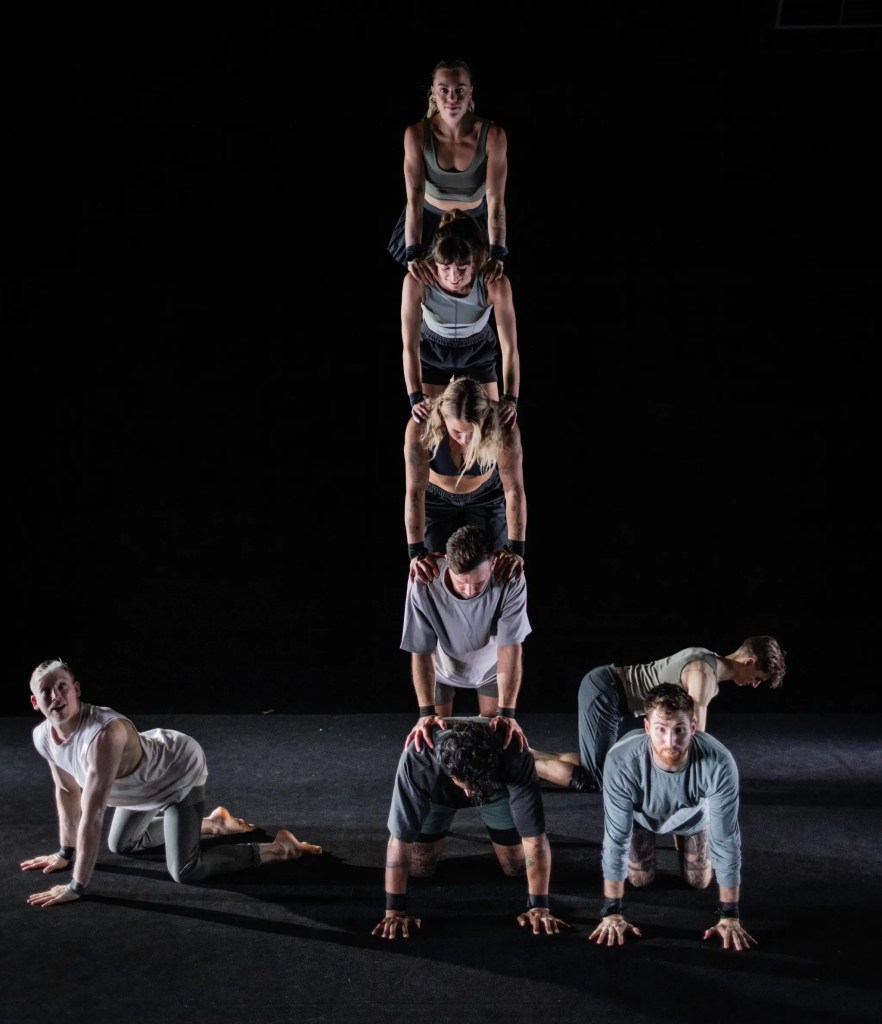
For their thirtieth anniversary finale Black Grace presented two works, one a new piece by Neil Ieremia and a work by the legendary American choreographer Paul Taylor, created in 1975.

Of the first work on the programme “If there ever was a time” Ieremia notes, “I was raised in the church, carried along by its stories, its hymns, its promises. I have been losing my religion for the last forty years. This work is my response to what I see as the weaponisation of faith”.

The work takes an ambivalent approach to his dilemma with the music he uses to propel the dancers a mixture of traditional Pacific music – Samoa Sila Sila and contemporary music including “Voodoo in my Blood” from Massive Attack & Young Fathers and “Monolith” featuring DJ Krush with their anti-capitalist rages.

The set featured a large image of the moon which slowly moved across the rear of the stag while above the stage was cloud form of wispy fabric which ultimately collapses, a metaphor for the failure of the old order and religion.

The music was a mixture of traditional Pacific music – Samoa Sila Sila and contemporary music including “Voodoo in my Blood” from Massive Attack & Young Fathers and “Monolith” featuring DJ Krush.

The work is like a series of rituals with repeated movements and sequences of action and reaction where the physical exertion of the dancers reflect idea about passion and emotion.

Like a lot of contemporary dance, the work owes much to the Stravinsky / Nijinsky ballet “The Rite of Spring” with its rituals and confrontations.

“If there ever was a time” used some of these ideas in addressing issues around religion, colonialism and Ieremia’s ambivalence about religio and its effects on the Pacic Island communities.

The dancers’ gestures and movements are those which have often been used by the company for many years – signalling with the hand, arm and leg displays which are strongly angular and abrupt. Some of the movements are close to rap moves with sharp slides, leaps and pivots, the agitated movements mirroring the frantic sounds of the music.

At one point group of dancers form an elaborate multi-faceted form – a parasite or insect which inches across the stage menacing the sole dancer who skips relentlessly.

The image of this confrontation evokes the imagery of Franz Kafka’s “Metamorphosis” where an individual struggles to find identity and break from conformity.

In another sequence two figures – a betrothed couple, one holding a wedding bouquet enter from either side of the stage, their heads wrapped in cloth, restrained by straining figures. Their anonymity and desperation seem to have been taken from the Magritte painting “The Lovers” where two figures, their heads wrapped in cloth attempt to kiss, suggesting the complexities of love and intimacy.

The choreography was endlessly original and interesting where simple dance steps evolve into unusual and unsettling movements and as the music changes the forms, dynamics and energy evolve.

Black Grace , Esplanade Image; Jinki Cambronero

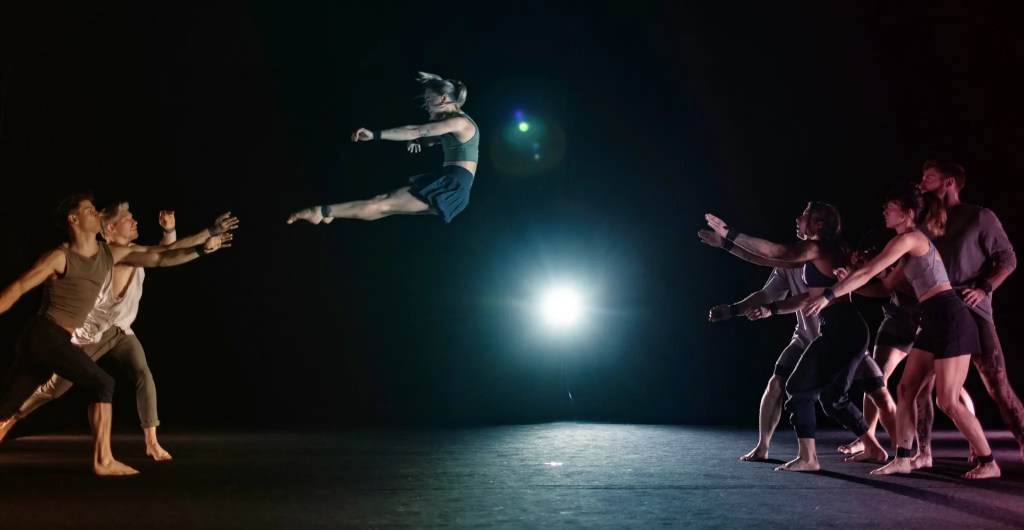
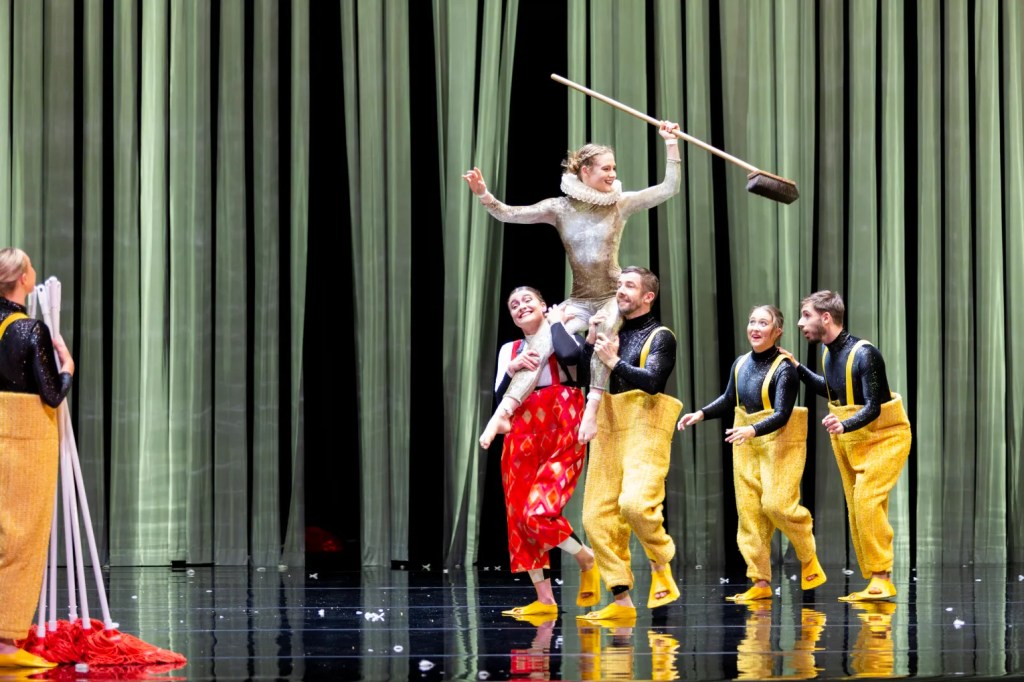
The second work on the programme was Paul Taylor’s 1975 work “Esplanade”, a piece Ieremia had been wanting to present for many years. It was inspired by the sight of a young woman running to catch a bus. This notion of using everyday movement and elevating it to dance has been a central concept of Black Grace dance since its inception.

The work links ballet, court dance and contemporary movement danced to Bach violin concertos providing a mix of elegance and simplicity.

Much of the time the dancers walk, run, slide, and whirl around the stage seeming to follow some predetermined paths in fluid and orderly formations. Elizabethan court dance refashioned in a modern form.

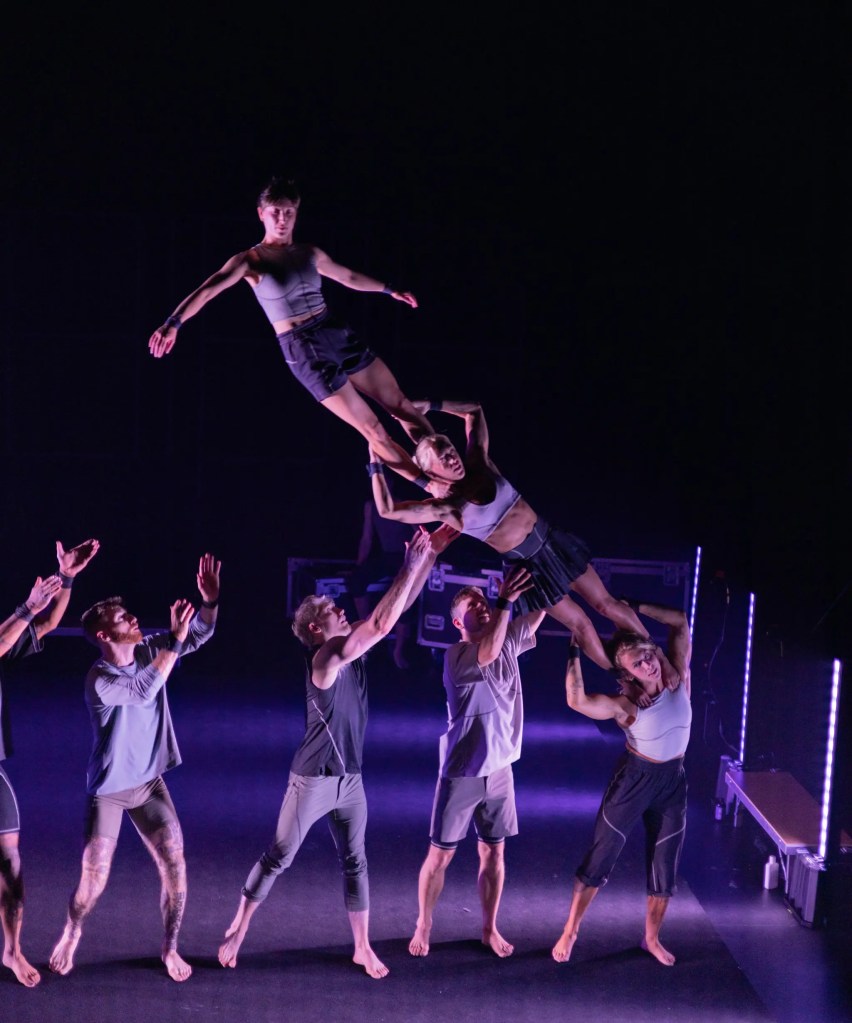
There were elements of energy and drama when the women took giant leaps into the male dancers’ arms as they rotated around the stage. These bolds moves contrasted with the more tender sequences which emphasised weightlessness and where the dancers met casually, touched lightly, bracing and gesturing in languid movements.

While much of the dancing was at frenetic pace there were also times when the dancers seemed to slow their movements to become more like stop motion sequences highlighting the nature of movement

While the work is based on the movement of the street there is a vibrancy and energy to the work with its combination of rushing and motionless dancers giving the work a visual and emotional power.

To subscribe or follow New Zealand Arts Review site – www.nzartsreview.org.

The “Follow button” at the bottom right will appear and clicking on that button  will allow you to follow that blog and all future posts will arrive on your email.

Or go to https://nzartsreview.org/blog/, Scroll down and click “Subscribe”

Categories
Reviews, News and Commentary

Auckland Philharmonia’s astounding performance of Mahler’s Symphony No 3

Reviewed by John Daly-Peoples

Auckland Philharmonia, Deborah Humble, Kirstin Middle School Singers and Women of Choirs Aotearoa Photo: Thomas Hamill

Mahler 3

Auckland Philharmonia (in association with the Australian Academy of Music)

Auckland Town Hall

November 20

Reviewed by John Daly-Peoples

With the last of the Auckland Philharmonia Premier Series concerts for the year the orchestra presented Mahler’s Symphony No3. This is Mahler’s longest work of six movements and close to an hour and three quarters long. It also features over one hundred musicians, two choirs, (Women of Choirs Aotearoa and Kirstin Middle School Singers) and mezzo-soprano Deborah Humble.

It was described by Mahler as a gigantic musical poem and offers one of the most complete statements of the Austrian composer’s world view. Each of the movements represents an element of the universe – plants, animals, people, angels – culminating in a tranquil deeply felt finale, the celebration of divine love and the culmination of the works giant structure. Mahler once said “A symphony must be like the world. It must contain everything”. This performance certainly had everything with a huge range of instrument including four flutes, four oboes, four bassoons, eight horns, four trumpets, post horn, three trombones, bass and contrabass tuba, timpani, glockenspiel, and a large string section.

Where many great nineteenth century composers explored the nature of Man, in this symphony however it was the composer’s relationship with Nature which was his focus.

The massed sounds of the orchestra were impressive, notably the opening of the first movement with its two march-like themes which can be seen as a description and reflection on Nature and the evolutionary theories of Darwin.

There were several other sequences which featured the delicate and nuanced playing of individual instruments such as Andrew Beer’s violin solo and the sounds of birds brought to life by the woodwinds.

Deborah Humble and Giordano Bellincampi Image Thomas Hamill

Mezzo-soprano Deborah Humble sang Nietzsche’s Midnight Song from Thus Spoke Zarathustra, her mournful voice soaring above the plaintive orchestra, expressing sadness and frailty, suggested the words of a requiem.

The choirs gave a bright, simple delivery of one of the composer’s songs, “Kling! Glocken hell kling!” (Ring! Bells, ring!). Here, the choir imitating sounds of bells and a female chorus joined by the soloist represent the voice of angels in a joyous and innocent depiction of a heavenly scene.

Mahler’s used the instrument to create a sense of life evolving which along with the relentless march tunes which suggest the progress of Man. Throughout the work the massed instrument, often led by the horns sounded like the breathing of a huge entity.

Conductor Giordano Bellincampi generally took a precise and measured approach, balancing the various parts of the orchestra and ensuring that even the quietest of moments made an impression. However, with the more dramatic sequences he seemed to be imbued with the same fervour as the music.

This was an intense and rewarding performance by an orchestra which could take its place in any great concert chamber in the world with an astounding performance filled with profound emotion.

To subscribe or follow New Zealand Arts Review site – www.nzartsreview.org.

The “Follow button” at the bottom right will appear and clicking on that button  will allow you to follow that blog and all future posts will arrive on your email.

Or go to https://nzartsreview.org/blog/, Scroll down and click “Subscribe”

Categories
Reviews, News and Commentary

The Collector: Thomas Cheeseman and the making of the Auckland Museum

Reviewed by John Daly-Peoples

The Collector; Thomas Cheesemen and the making of the Auckland Museum

Andrew McKay and Richard Wolfe

Massey University Press

RRP $65.00

Reviewed by John Daly-Peoples

Museums have had a lot of critical press over the past few years, viewed as agents of the colonizers because their collections often contain artifacts taken from colonized countries, and their early practices reinforced colonial ideologies by presenting the colonizer as superior. They functioned as a means of control, where European museums collected objects from voyages of exploration and colonies to showcase their dominance and justify the imperial project. But a major thrust of museums has also been to preserve, interpret, and exhibit the local cultural and scientific heritage serving as a bridge between the past and present by collecting objects, telling stories, and providing a space for people to learn, reflect, and connect with history, art, and science.

That has certainly been the aim of the Auckland Museum and the individuals who initiated it, guided it and developed it. A new book “The Collector; Thomas Cheeseman and the making of the Auckland Museum” tells how the Auckland Museum, like man y other museums in the nineteenth century were guided by visionary individuals.

The newly opened Auckland and Institute in 1876 Thomas Cheeseman stands in the doorway

Authors Andrew McKay and Richard Wolfe write about the establishment of the museum’s first custom-built building in 1876 at the northern end of Princes Street.  When it opened the director was Thomas Cheesman who had been in the post since 1874, remaining in the post remained in that post until his death in 1923.

They write about the original building which was unfavourably compared to the more ambitious Christchurch Museum. It was “plain, improvised and almost invisible … It was housed in an old public building, with little funding and few staff. But that’s what makes the story compelling. The contrast between the buildings isn’t just architectural — it reflects differing levels of civic support, cultural ambition and access to resources. Auckland’s museum didn’t look like much, but it had people with vision, especially Thomas Cheeseman. Over time, he took that underwhelming space and turned it into a serious scientific institution.”

Under his visionary guidance the Museum and its collections flourished, necessitating a further move and the commissioning of a world-wide architectural competition to design a new Museum for Auckland which would be combined with a war memorial to commemorate soldiers lost in World War I. That new museum opened on its current site in 1929.

Not only did Cheesman manage to the institution for nearly fifty years but as a self-taught botanist he travelled the length and breadth of New Zealand, collecting and recording plants, and observing the geography of the country. During his career, Cheeseman also published numerous important papers on a range of flora, described three plant genera, and numerous plant species from New Zealand and the Cook Islands. At the request of the New Zealand government, Cheeseman began his magnum opus, Manual of the New Zealand flora, which was first published in 1906and in 1914 he edited the two-volume work Illustrations of the New Zealand flora.

Thomas Cheeseman

Cheeseman met or corresponded with many of the scientists in New Zealand as well as extensive professional relationships with local and international colleagues, including  the German-born geologist and director of the Canterbury Museum, Julius von Haast, the geologist James Hector of the the Colonial Museum, the geologist, zoologist and museum director Frederick Hutton as well as  Sir Joseph Hooker at the Royal Botanic Gardens in Kew, England. 

Early on in his career he even corresponded with Charles Darwin as the authors write. “Charles Darwin was arguably the most famous scientist in the world and also one of the most controversial. And it wasn’t just a lucky moment. Cheeseman’s note was careful, respectful and scientifically rigorous. It showed that he wasn’t just some amateur with an opinion — he was a careful observer who took the work seriously. Darwin saw that. For Cheeseman, it must have been thrilling and validating. It also helped open doors — that exchange helped establish his credibility in the scientific world, and it reinforced the idea that valuable knowledge didn’t just come from Oxford or London, it could come from a young man on the edge of empire, with a sharp mind and a notebook. That Cheeseman dared to write at all — and so confidently — speaks volumes about both his scientific maturity and his quiet self-assurance.”

The book highlights Cheeseman’s efforts to develop the taonga Māori component of the museum and also touches on the ethically sensitive area of collecting the art and culture of Māori noting ‘While Thomas Cheeseman was largely guided by the norms of nineteenth-century science, some of his actions — particularly around the acquisition and display of taonga Māori — now fall into ethically ambiguous, if not outright troubling, territory. His drive to build the Auckland museum’s collections sometimes led him to treat cultural objects as specimens, detached from the communities that made and valued them.

His acquisition methods could also be problematic. In several cases, taonga were obtained through missionary networks, collectors or private sales, often with little documentation about provenance or permission. Cheeseman rarely questioned the ethics of these transactions… These actions were not driven by malice, but rather by an unshakeable belief in the civilising power of museums and the primacy of scientific classification.”

The book tells the history and development of the Auckland Museum and its progress over more than fifty years to the triumph of the building on the present site in Auckland Doman. It also tells of the journey of Thomas Cheeseman who become a great person of influence not just in Auckland but nationally.  The book also gives an account of the changing scientific and cultural landscape of the latter part of the nineteenth century and the early part of the twentieth century.

It is a well-researched and written book, thoughtfully designed with numerous images which help tell the entwined stories of Cheeseman, the development  of scientific inquiry, the museum and museum’s collections.

Andrew McKay holds a PhD in art history from the University of Auckland and was a Professional Teaching Fellow in the university’s art history department.

Richard Wolfe is an Associate Emeritus of the Auckland War Memorial Museum and from 1978 to 1997 was Curator of Display. He has written numerous books on New Zealand art, history and popular culture.

To subscribe or follow New Zealand Arts Review site – www.nzartsreview.org.

The “Follow button” at the bottom right will appear and clicking on that button  will allow you to follow that blog and all future posts will arrive on your email.

Or go to https://nzartsreview.org/blog/, Scroll down and click “Subscribe”

Categories
Reviews, News and Commentary

Daniel Muller-Schott’s elegant and expressive performance

Reviewed by John Daly-Peoples

Daniel Muller-Schott Image, Uve Arens

Auckland Philharmonia

Schumann Cello Concerto

Auckland Town Hall

November 13

Reviewed by John Daly-Peoples

The Auckland Philharmonia’s Schumann’s “Cello Concerto” concert opened with Schubert’s “Rosamunde Overture”, a work which was written at a time when all of Beethoven’s symphonies (apart from his final – the Ninth) had been performed and composers made attempts at homages to the composer.

The opening features much of the drama typical of Beethoven with the dance-like passages caried along by the woodwinds. The joyous melodies are an ideal introduction to the play Rosamunde which tells of the adventures of a shepherdess in some idyllic settings.

Some of the dance-like music sounds like precursor of the later Viennese dance music which would come several years later. Conductor Giordano Bellincampi seemed to be inspired by the music, his arms performing arabesques as he responded to the passionate dance-like melodies.

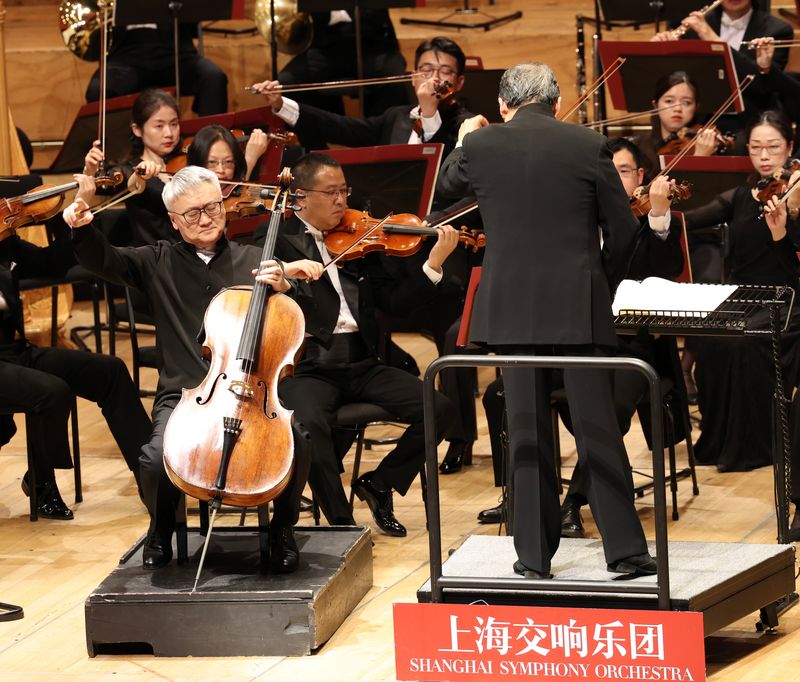
The major work on the programme was Schumann’s “Cello Concerto”, a work which has some funereal tones throughout and is often thought of as foreshadowing his death. Cellist Daniel Muller-Schott opened the work with some melancholic sounds which slowly evolved into playing which was more ethereal and meditative with sequence which were supported by the strings.

With much of his playing he took a serious and studious approach as he explored some of the darker elements of the work which then morphed into more uplifting passages.

The second movement saw Muller-Schott playing in a more cautious manner and there was sense of apprehension before returning to the earlier theme as both he and the orchestra engaged in dramatic interchanges.

Muller-Schott played with a range of approaches. At times he was lethargic while at other times dramatic and towards the conclusion he took a more tentative approach as through trying to rediscover the main theme before producing a dramatic conclusion.

Overall Muller-Schott gave an elegant and expressive performance which showed him to be totally in control but also that he had an awareness of the orchestra and the emotional qualities of the music.

The final work on the programme was one of Beethoven earliest major works, “The Creation of Prometheus”, written for a ballet at the imperial court of Austria choreographed by Calvatore Vigano. The work has a similar theme to that which Mary Shelley explored in her “Frankenstein – a Modern Prometheus” – the implication s of man attempting to create life.

The ballet tells of Promethea creating a man and woman from stone statues, but they have no souls. Apollo helps Prometheus teaching them music, dance and drama. Through the series of dances Beethoven’s provides music which explores the qualities which make humans more knowledgeable and spiritual.

Each of the sections featured one of the orchestral sections – delicate music with strings harp and woodwinds, a brilliant cello sequence played by Ashley Brown, flute playing for a court dance sequence and a country dance by strings and woodwind. Beethoven seemed to have allocated certain instruments to characters in the ballet – Apollo the harp, Melpomene the oboe, the Male Creature the oboe bassoon.

While the music serves the ballet well it can also be seen as something of a calling card for Beethoven who had only written two of his symphonies at the time. With this work he showed his mastery of composition, his knowledge of the orchestra’s instruments.

With the various sections Beethoven also provided himself with melodies which he used in some of his later work with one of the sequences being used for his Eroica symphony.

To subscribe or follow New Zealand Arts Review site – www.nzartsreview.org.

The “Follow button” at the bottom right will appear and clicking on that button  will allow you to follow that blog and all future posts will arrive on your email.

Or go to https://nzartsreview.org/blog/, Scroll down and click “Subscribe”