John Daly-Peoples
Sincere Apologies
Don Koop, Jamie Lewis and David Wiliams
Auckland Arts Festival
Loft, Q Theatre
Until March 22
Reviewed by John Daly-Peoples
It’s opening night of Sincere Apologies but there are only twenty-five people in the Loft at Q with seating for more than one hundred. Maybe people have read about the show already and have found out that they may have to speak. That’s a big no-no for some New Zealanders. Public speaking – that’s when you make a complete idiot of yourself with the wedding speech, or the farewell speech at the office. No wonder only twenty-five turned up.
[I attended the opening night and some adjustments have been made based on feedback from this preview]
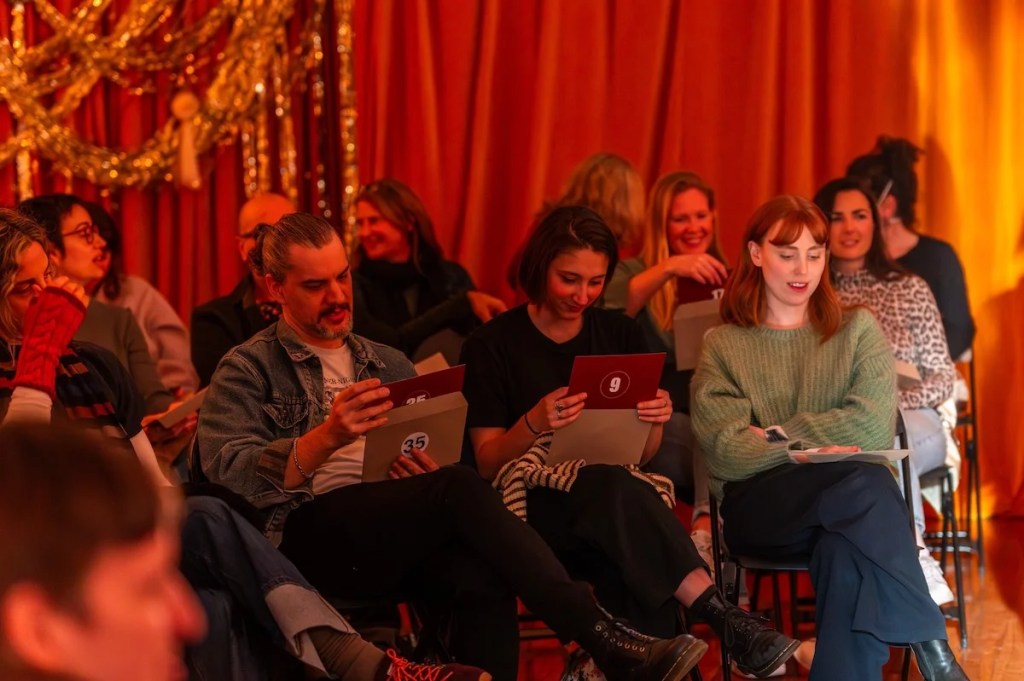
It all starts simply enough. An envelope is handed round the group with instructions to keep it moving until the music runs out. Just a version of pass the parcel, and then the lucky person gets to read out the instructions and hand out fifty envelopes.
These are fifty real apologies that are distributed to the audience. They are mainly from the last fifty years, all of them factual, collected by the three creators, Dan Koop, Jamie Lewis and David Williams. There are apologies from government ministers, public figures as well as private individuals, all expressing remorse for things they have said or done or their governments have done. One by one, the audience members step up to the microphone and read them out aloud.
There are some important apologies. New Zealand government ministers apologizing for the government actions during the Land Wars, an on-air apology by Paul Henry to the Governor General Anand Satyanand for dumb things he said on radio and there is also Kanya West apologising to Taylor Swift and Beyonce for dumb things he has said about them.
I got to read out two apologies. One by the chairman of the Fukushima Power Board apologizing for the trouble and harm caused by the explosion and release of radioactive materials into the sea and air.
The other was by Geroge Bush apologising for the treatment of Japanese /American citizens during the Second World War.
There were lots of other apologies for the harm done by war with some private individuals apologising for what their German and Japanese parents may have done during the Second World War.
There was a range of apologies from all walks of life and for all sorts of reasons. There was Tiger Woods apologizing for his infidelity and an apology for the harm caused by the Dawn raids.
There were also a couple of apologies to theatre goers who had made complaints to Q Theatre for unstated reasons.
One apology was very succinct – “Fuck”.
There are no actors in this mix of ordinary people but some of them were as assured as if they were. Others displayed a bit of hesitancy, but all seem to relate to the apology they were reading. Some of the apologies from government ministers were a bit formulaic and those apologies were buried under the same set of words. When these statements are stripped of power, position, and spin they seem hollow, lacking real meaning. Other apologies like Jacinda Ardern’s apology for the Christchurch Mosque murders were filled with meaning and history seemed particularly relevant.
Hearing these apologies, one is made aware of the power of language and sometimes because of the way in which people read them the readings were given an added emotional tone.
There are couple of made-up apologies with dates set in the future – an apology in 2065 to Kiribati and other island nations for the inundations of 2050 and one from the Australian government acknowledging the death of the last koala in existence. The one disappointment was that there was no discussion at the end of the session, only applause by the audience for their own collective performance.
 Public Trust Building
 Shed 7, Wellington Harbour Board
 St John’s


 New Zealand Arts Review