In the hands of the Australian company Circe the world’s most romantic ballet is re-imagined as a circus spectacular, full of Circa’s signature physicality and shot through with cheeky humour and a thoroughly contemporary energy.
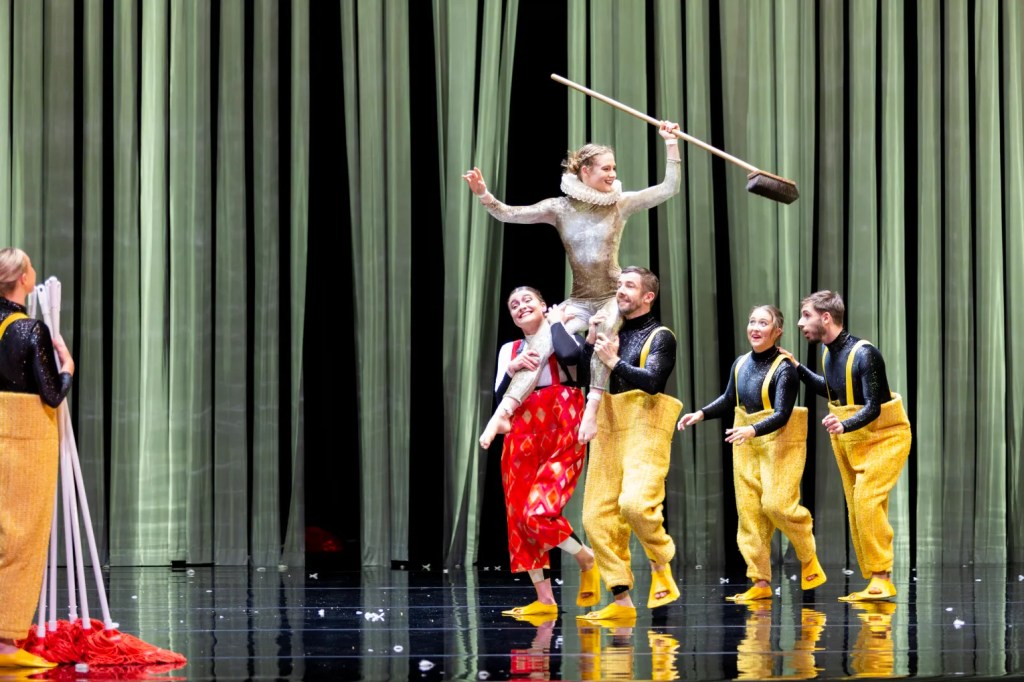
The audience is swept away by this tale of swans and hapless princes sparkling with quirky touches like the sequinned flipper-wearing duck army and a burlesque black swan. There are sumptuous aerials performances, jaw-dropping acrobatics and many feathers.
The show has been seen around the world and a review of Duck Pond in The Guardian by Lindsey Winship was enthusiastic.
“Australian company Circa are masters of modern circus, often eschewing obvious exhibitionism, and instead weaving acrobatic skills with a dance and theatre sensibility to make mood pieces.
The name is a parody of Swan Lake and it borrows from the famous ballet – shards of Tchaikovsky’s score feed into Jethro Woodward’s soundtrack – and also from another fairytale, the Ugly Duckling. So we get a love triangle of sorts between a prince, an ugly duck and a vivacious black swan. The conceit might seem to promise a more conventional narrative, but it delivers something a little different. The mood is understated, classy, colours of black and gold, a clan of performers in shimmering velvet catsuits. The music is a constant underscore rather than a game of set-ups and climaxes.
There is a lot of beautiful skill on show. Acrobats climb up human towers; flyers somersault between bases. Their formations of three are especially inventive: ornate arrangements of bodies in fine-tuned equilibrium, toes anchored on hips, lower backs, shoulders, anywhere they can get a foothold. There are some lovely moments of flow between couples who lift and fling, curl and unfurl, balance and counterbalance. Bodies tie themselves in knots on the trapeze; others soar on the silks. The ugly duck is revealed to be a swooping swan; the black swan has a dominatrix moment walking over a man’s bare back in red stilettos. But there are lulls too, such as a pillow fight that turns into an anticlimax.
Story-wise, director Yaron Lifschitz puts a couple of nice twists on the Swan Lake narrative but it lacks a big emotional payoff. Low-key lyricism, rather than transactional tricks for applause is Circa’s way and Duck Pond is a lovely show, with warmth, skill and some wow moments.”
In 1926 the iconic red telephone box which was designed by British architect Sir Giles Gilbert Scott first appeared in the UK making communication between individuals easier.
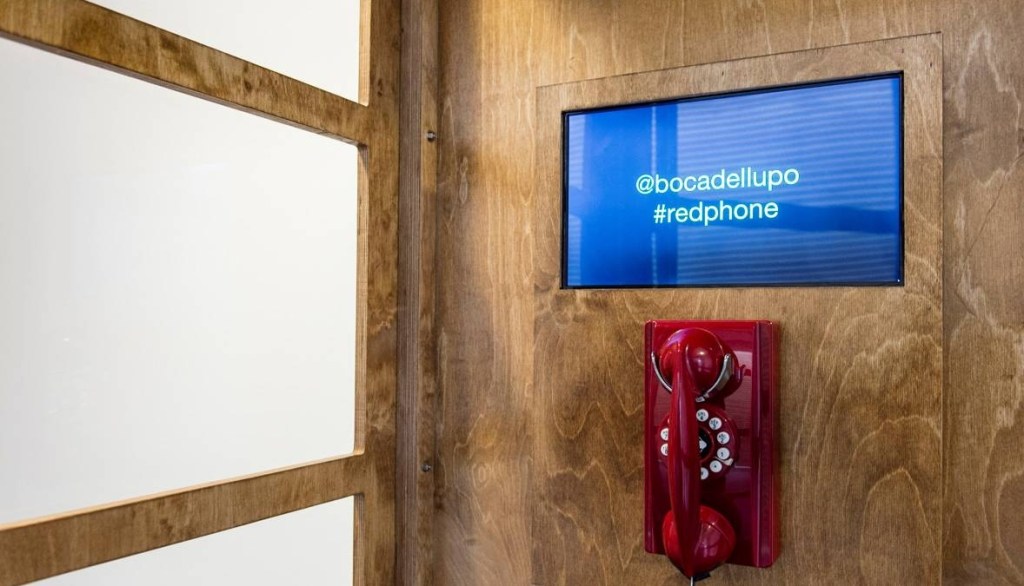
Now 100 years later as part of the Auckland Arts Festival telephone users can enter a modern telephone booth as participants in an art event which breaks down the boundary between artist and audience.
For the next three days on Level 3 of the Aotea Centre, you can be part of an art event where you become the actor in scenarios which you create.
Pick up your phone and you are connected to another random audience member or friend. You are confronted with a teleprompter which provides you a collection of scripts, including one by New Zealand playwright Victor Rodger.
You become part of an evolving dialogue which is part theatre and part social intervention. You become both performer and spectator, creating unique dialogues which will surprise, embarrass and entertain you.
Jay Dodge, one of the creators of Red Phone“When this project started, we had five or six local writers, and now we have representation from dozens of countries.
“We asked writers to connect and think about what they love about performance but in a creative way where they can be free and not obliged to reflect what is happening right now,” said Sherry Yoon another creator. “There is so much now going on right now, that we will see artists being both reflective and relevant to now, but also to engage in work that can continue on past our global pandemic. What really resonated with us and the presenters and artists we have engaged is to give audiences a work that isn’t here to replace theatre but is in essence of what we love about live performance — the emotional ride, the intimacy, etc.”
This free installation by Canadian interdisciplinary theatre company Boca del Lupo has toured Canada, Norway, and Latin America to critical acclaim. Now it is presented in Auckland for a strictly limited season.
With (alphabetical) Laura Bird, Haley Flaherty, James Bisp, Kristian Lavercombe, Ryan Carter-Wilson, Daisy Steer, Stephen Webb, Morgan Jackson, Edward Bullingham, Jesse Chidera, Nathan Zach Johnson, Tyla Dee Nurden, Bethany Amber Perrins
Civic Theatre, Auckland 26 Feb – 9 Mar 2026
Then Isaac Theatre Royal, Christchurch
St James Theatre, Wellington
Reviewer Malcolm Calder
27 Feb 2026
Many words have been spilled detailing the Rocky Horror story, some with a little licence, so I won’t reiterate them here. Rather, what follows are a couple of more personal anecdotal recollections. Well, maybe a couple of reflections towards the end.
When in my early teens I joined a bikie gang hooning around the streets of Hamilton and haunting bars on weekends. A pushbike gang. In milk bars. And most Saturdays we would go to the ‘pitchers’ at the Embassy ‘pitcher’ Theatre – especially for the b&w serials which updated and changed weekly. The Phantom, The Lone Ranger, The Roy Rogers Show with Trigger, etc. Our parents were not exactly supportive of our adventures but tolerated them mainly after trotting out the usual parental missives of the day … you know, smarten yourself up son, wash your face, get a haircut, and taking the mudguards off does NOT necessarily make your bike go faster! But we did. And maybe even managed the very occasional haircut from the apprentice barber next to the Embassy (remember, these were pre- Beatles days.
Fast forward a dozen or more years, by which time I was living in the UK and had developed something of an interest in ‘legit’ theatre. A friend convinced me to accompany him to the ‘veddy, veddy proper’ Royal Court Theatre in Chelsea’s Sloan Square. Apparently a budding youngish Australian theatrical tyro named Jim Sharman, already with productions of Hair and Jesus Christ Superstar to his name, was putting together an experimental and very avant garde piece called They Came from Denton High. It had been originally devised by an actor no one had heard of called Richard O’Brien, and was planned as only a very brief season at the tiny, semi-round, and recently-renovated roof space of the Royal Court known affectionately as simply ’The Upstairs’.
There were heaps of improvisation, script changes, musical variations, some additions, some deletions and, just prior to opening, Sharman felt that Rocky Horror Show better aligned with its intermeshed themes of transvestism, a satirical take on horror movies and science fiction all built around a full-on rock score. My friend and I were both becoming enamoured of the new, the daring and the provocatively different and to say we were blown away would be an understatement. This show ventured where theatre had rarely been before. It was rough, raw and totally outrageous. I remember being particularly enthralled by the pure power and presence of Tim Curry and a by the omnipresence of a rather scrawny little bloke playing Riff Raff. Richard O’Brien we discovered later.
Many others were similarly excited of course. Rocky Horror Show had somehow struck exactly the right chord at exactly the right time in 1970s Britain. Fairly rapidly, various eminent British producers saw its commercial potential, it was upscaled to a more proscenium-arch staging and the rest, as they say, is history.
Subsequently I moved onto various humble roles in the industry and have been fortunate to have either seen, or hosted, many productions of the Rocky Horror Show across the US, Australia and New Zealand as well as Europe. In several different languages.
Fast forward a few more years and I even recall convincing a couple of rather cynical American friends to accompany me to the recently-released Rocky Horror Picture Show at a drive-in near Philadelphia in 1976. Unfortunately, that particular screening cooincided with a rather heavy snowstorm and both wipers and the plug-in heater-on-a-pole had to work overtime. Needless to say, the car bounced up and down more than a bit and my American friends enrolled on the spot as members of the international Rocky Horror Show cheer squad.
Or, a few years on again, an Australian colleague’s costume hire business in Adelaide avoided bankruptcy only as a direct result of seemingly endless late-night, dress-up singalongs at the Goodwood (‘pitcher’) Theatre.
I even recall seeing a stage production in Barcelona where the audience knew all the words. In English!
Anyway, I digress. Fast forward quite a few more years and I returned to Hamilton where, celebrating Rocky Horror’s 50th anniversary, the Hamilton Operatic Society staged a remarkably workmanlike pro-am production under the capable guidance of David Sidwell. Initially I felt the bronze statue of Riff Raff in Victoria Street sort of acknowledged this and I thought how kind of the city fathers to allow some well-made street art. However, a little research revealed, only then, that Richard O’Brien hailed from Hamilton. I had previously known of him only as an actor chasing his dream in London and had always presumed him to be English. I had no idea.
However … there’s more. The Embassy Theatre is now long gone and so is part of the block adjacent – which used to be a barbershop. That is where statue stood … on the very spot where the apprentice barber had cut my hair, and that of the entire bikie gang, all those years ago!
Today my understanding is that Richard is now a Patron of HOS and the statue has been relocated to the recently- opened new BNZ Waikato Regional Theatre. How appropriate.
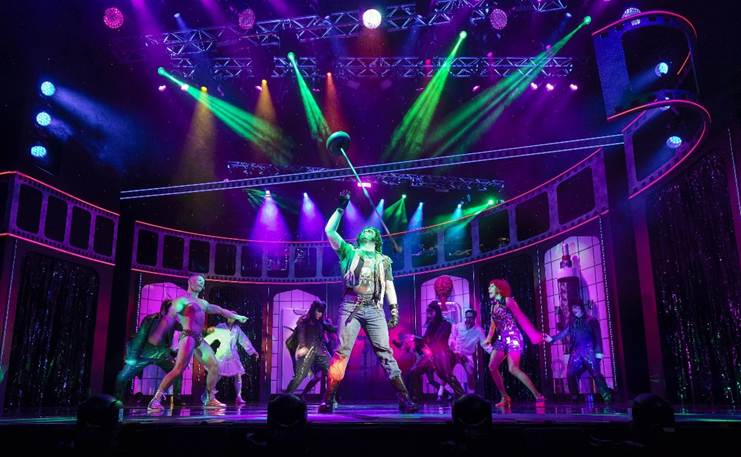
This Rocky Horror Show has a crispness and a professionalism that will linger. It extended from before the house lights went down, right through to when they went up again.
This was a cast of strong experienced actors rather than one padded out with soap stars, rock singers and ‘personalities’ as has sometimes been the case elsewhere.
Laura Bird’s opening Science Fiction – Double Feature. backed by a strong, tight and semi-visible band under Adam Smith, sets the scene and made one immediately sit up and think ‘wow this is serious stuff’. She was followed by the Brad and Janet’s Damnit Janet with a Janet (Haley Lafferty) who bore an uncanny (if unintentional) resemblance to a certain Deputy Mayor!
From there it … well it just flowed. James Bisp gave us a surprisingly strong Brad, Stephen Webb an even stronger Frank N Furter, and Kristian Lavercombe (Welsh-born but we’ll claim him as ‘ours’) a Narrator that was deliciously nuanced, through to the dynamically scene-stealing Eddie (Edward Bullingham) and a truly professional ensemble. That showed everywhere. In spades.
This current production of Rocky Horror Show goes on to Christchurch and Wellington after its Auckland season and that is to be applauded. In fact the Civic, and perhaps other venues too, has been looking and feeling a little forlorn of late and to see a full-on high-calibre British music-theatre production on its stage is something to be savoured. So congratulations to the producers on this venture. Let’s hope there’s more to come.
A delightful ending to the evening too when elder statesman Richard O’Brien was introduced to the stage post-curtain to rapturous applause, and who then brought on Little Nell Campbell, the original Columbine back in 1973.
Branden Reiners (Macbeth), Ana Gallardo Lobaina (Lady Macbeth) Image: Ross Brown
The Royal New Zealand Ballet
Macbeth
Wellington, Auckland and Christchurch
March 2026
John Daly-Peoples
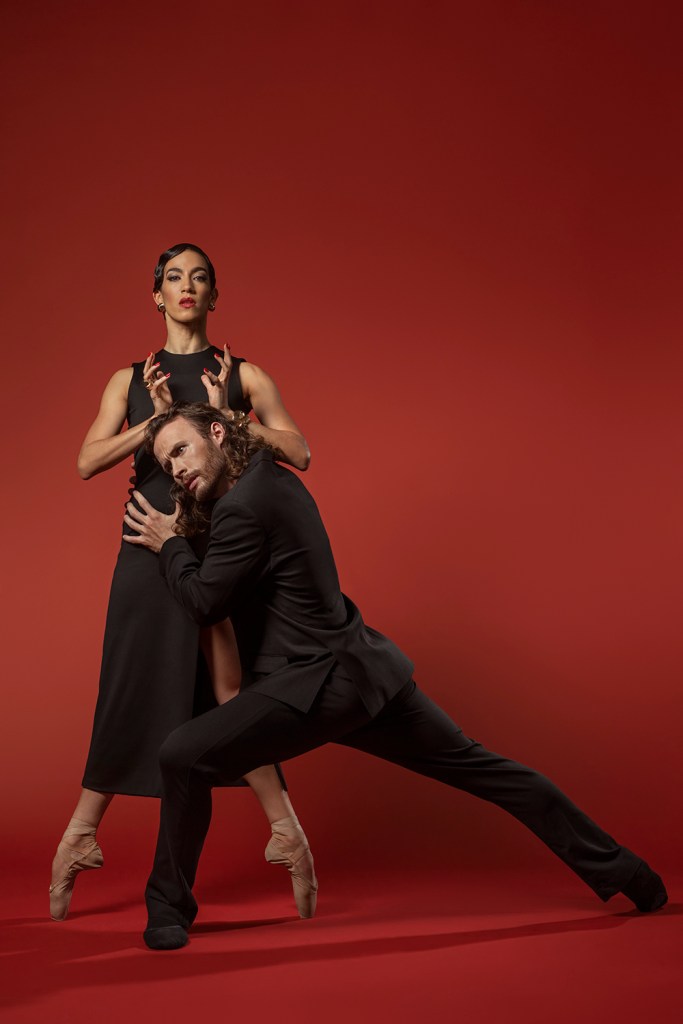
The Royal New Zealand Ballet open its 2026 season with a contemporary reimagining of Macbeth, Shakespeare’s most brutal tragedy. Created by internationally acclaimed choreographer Alice Topp (Aurum, Logos, High Tide), the ballet unfolds in a ruthless modern world shaped by political ambition, media manipulation and the fatal seduction of power.
The production will feature Ana Gallardo Lobaina as Lady Macbeth and Branden Reiners as Macbeth.
“Macbeth is one of Shakespeare’s great tragedies, exploring themes as current today as they were when first written,” says Alice Topp. “An epic story fuelled by political ambition, passion, desire for power and the burden of guilt, its potency endures. Our Macbeth is set in a hierarchy-hungry, high-society city, where political storms, media frenzy and personal ambition collide.”
While ballet companies across the world regularly perform “Romeo and Juliet” and “A Midsummers Night Dream” based on Shakespeare’s plays very few of his other works are performed. “A Winter’s Tale”, “Hamlet”, “Othello” and “The Tempest” are occasionally performed.
Just in the last couple of years there have been other productions of Macbeth with the National Ballet of Japan performing “The Tragedy of Macbeth” by British choreographer and director Will Tuckett in 2023 and last year the Dutch National Ballet presented a “Lady Macbeth” choreographed by Helen Pickett.
This new co-production with West Australian Ballet will see Macbeth premiere as part of the Aotearoa New Zealand Festival of the Arts in Wellington and the Auckland Arts Festival, before touring to Christchurch and Dunedin. Presented in association with Avis, this ambitious new work places Shakespeare’s iconic story of ambition, power and moral collapse into a volatile modern world shaped by political manoeuvring and relentless media scrutiny.
At the centre of the ballet is the rise and fall of Macbeth and his formidable wife – a dazzling power couple whose ascent to influence is as intoxicating as it is catastrophic. Propelled by ambition and fanned by public adulation, the Macbeths scale extraordinary heights, only to find themselves consumed by guilt, paranoia and violence. Through the visceral language of contemporary ballet, their psychological unravelling is laid bare in an explosive portrait of power gained and power lost.
For Topp, the translation of Shakespeare’s dense, language-driven tragedy into movement is not an act of reduction, but of revelation. “Shakespeare’s text might be dense, but it also has movement written into the language,” she says. “The story is a psychological drama, full of behaviours, emotions and atmosphere. All the movement is right there in his words, and my role is to find where those emotions land in the body and let them speak physically.”
Award-winning designer Jon Buswell, a long-time RNZB collaborator, will create both set and lighting, shaping a darkly glamorous world that reflects the ballet’s volatile political landscape. Costumes are by Sydney-based designer Aleisa Jelbart, renowned for her bold contemporary designs across ballet, opera and theatre, bringing a sharp modern aesthetic that underscores the work’s themes of power, status and image.
The production will also feature a newly commissioned contemporary score by composer Christopher Gordon, performed with a live string ensemble from the New Zealand Symphony Orchestra. Layering full orchestral textures with driving, heavy-metal influences, the music provides an unrelenting pulse that mirrors the characters’ accelerating descent.
Ana Gallardo Lobaina (Lady Macbeth) Image: Ross Brown
Ana Gallardo Lobaina has danced numerous roles for the RNZB including Cinderella and Stepmother in Loughlan Prior’s Cinderella. and she featured roles in Alice Topp’s Aurum and Logos.
Branden Reiners joined the Royal New Zealand Ballet in 2023 and his roles to date include Siegfried and Rothbart in Swan Lake, Tybalt and Lord Capulet in Romeo & Juliet, Serenade, the ‘Clay’ pas de deux in Alice Topp’s Logos.
Artistic Director Ty King-Wall says the new production showcases the RNZB at its most daring and expansive. “Macbeth is the Royal New Zealand Ballet as you’ve never seen us before,” says King-Wall. “Alice is bringing a world of bloodshed, betrayal and intrigue to our stages, in a cutting-edge production which draws upon the versatility of our dancers, the skill of our technical team, and demonstrates our incredible artistic range as a company.”
Macbeth stands as one of the most ambitious new works in the company’s recent history. A bold and bloody retelling of Shakespeare’s tragedy, it promises audiences a searing, high-octane theatrical experience – one that speaks urgently to the contemporary world while honouring the enduring power of the original story.
2026 TOUR DATES Wellington, St James Theatre, 25-28 February
Auckland, Kiri Te Kanawa Theatre, Aotea Centre, 4-7 March
Black Grace, If there ever was a time Image: Jinki Cabronero
Black Grace: Celebrating 30 years
Civic Theatre, Auckland
November 21
Then Isaac Theatre Royal, Christchurch
November 25 & 26
Reviewed by John Daly-Peoples
For their thirtieth anniversary finale Black Grace presented two works, one a new piece by Neil Ieremia and a work by the legendary American choreographer Paul Taylor, created in 1975.
Of the first work on the programme “If there ever was a time” Ieremia notes, “I was raised in the church, carried along by its stories, its hymns, its promises. I have been losing my religion for the last forty years. This work is my response to what I see as the weaponisation of faith”.
The work takes an ambivalent approach to his dilemma with the music he uses to propel the dancers a mixture of traditional Pacific music – Samoa Sila Sila and contemporary music including “Voodoo in my Blood” from Massive Attack & Young Fathers and “Monolith” featuring DJ Krush with their anti-capitalist rages.
The set featured a large image of the moon which slowly moved across the rear of the stag while above the stage was cloud form of wispy fabric which ultimately collapses, a metaphor for the failure of the old order and religion.
The music was a mixture of traditional Pacific music – Samoa Sila Sila and contemporary music including “Voodoo in my Blood” from Massive Attack & Young Fathers and “Monolith” featuring DJ Krush.
The work is like a series of rituals with repeated movements and sequences of action and reaction where the physical exertion of the dancers reflect idea about passion and emotion.
Like a lot of contemporary dance, the work owes much to the Stravinsky / Nijinsky ballet “The Rite of Spring” with its rituals and confrontations.
“If there ever was a time” used some of these ideas in addressing issues around religion, colonialism and Ieremia’s ambivalence about religio and its effects on the Pacic Island communities.
The dancers’ gestures and movements are those which have often been used by the company for many years – signalling with the hand, arm and leg displays which are strongly angular and abrupt. Some of the movements are close to rap moves with sharp slides, leaps and pivots, the agitated movements mirroring the frantic sounds of the music.
At one point group of dancers form an elaborate multi-faceted form – a parasite or insect which inches across the stage menacing the sole dancer who skips relentlessly.
The image of this confrontation evokes the imagery of Franz Kafka’s “Metamorphosis” where an individual struggles to find identity and break from conformity.
In another sequence two figures – a betrothed couple, one holding a wedding bouquet enter from either side of the stage, their heads wrapped in cloth, restrained by straining figures. Their anonymity and desperation seem to have been taken from the Magritte painting “The Lovers” where two figures, their heads wrapped in cloth attempt to kiss, suggesting the complexities of love and intimacy.
The choreography was endlessly original and interesting where simple dance steps evolve into unusual and unsettling movements and as the music changes the forms, dynamics and energy evolve.
Black Grace , Esplanade Image; Jinki Cambronero
The second work on the programme was Paul Taylor’s 1975 work “Esplanade”, a piece Ieremia had been wanting to present for many years. It was inspired by the sight of a young woman running to catch a bus. This notion of using everyday movement and elevating it to dance has been a central concept of Black Grace dance since its inception.
The work links ballet, court dance and contemporary movement danced to Bach violin concertos providing a mix of elegance and simplicity.
Much of the time the dancers walk, run, slide, and whirl around the stage seeming to follow some predetermined paths in fluid and orderly formations. Elizabethan court dance refashioned in a modern form.
There were elements of energy and drama when the women took giant leaps into the male dancers’ arms as they rotated around the stage. These bolds moves contrasted with the more tender sequences which emphasised weightlessness and where the dancers met casually, touched lightly, bracing and gesturing in languid movements.
While much of the dancing was at frenetic pace there were also times when the dancers seemed to slow their movements to become more like stop motion sequences highlighting the nature of movement
While the work is based on the movement of the street there is a vibrancy and energy to the work with its combination of rushing and motionless dancers giving the work a visual and emotional power.
The “Follow button” at the bottom right will appear and clicking on that button will allow you to follow that blog and all future posts will arrive on your email.
Cirque du Soleil shows are always elaborate gymnastic displays, but they are always imbedded with a story or narrative which looslye holds all the characters and the events together. There is also a circus elemnst running through the shows, an element which recalls the mystery and delight of childhood and the surrealism of adult dreams.
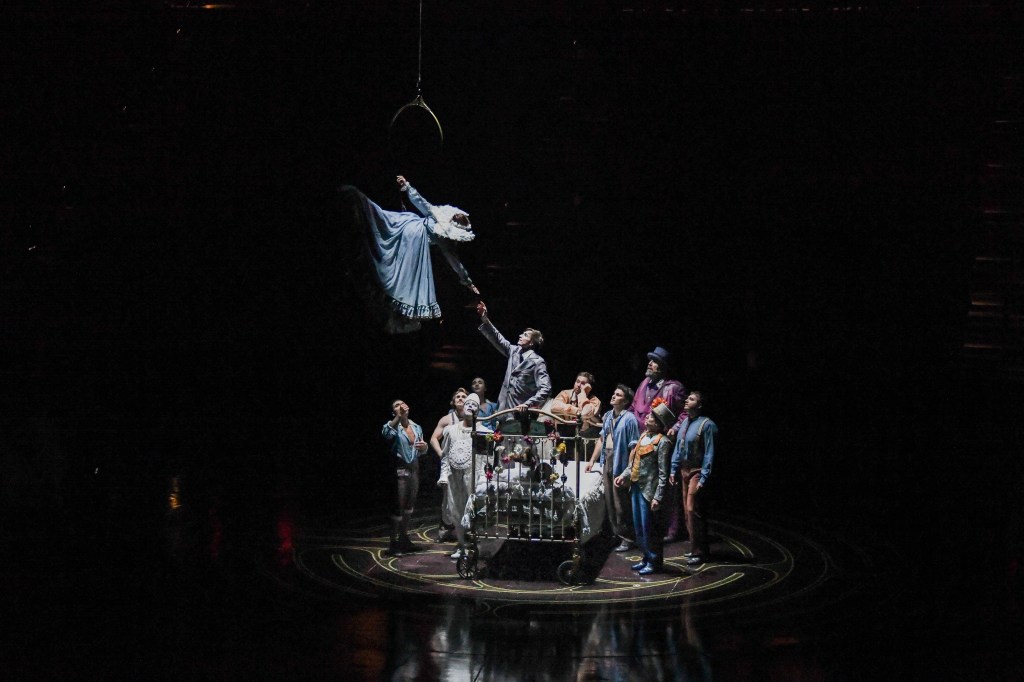
The story line for “Corteo” is that we are welcomed to the last minutes of the life of the famous clown Mauro and are then present as he reminiscences about his great days of his life on stage. He lies in his bed and his former colleagues visit him, bringing back memories and some of his acts which are repeated as the angles hover over his death bed.
After establishing the reason for being there the evening takes on a rather casual approach to the narrative which we are reminded of occasionally with angels making their appearance and in one scene providing Mauro with a set of wings and then, with a nod to the film ET Mauro also rode a bicycle up high, above the stage
The cast of circus characters that parade before Mauro are reminiscent of the closing scene in Fellin’s 8½ – a mixture of standard circus folk – ringmaster, clowns and acrobat along with the characters from Commedia dell’Arte.
This show, is one of the earliest of the Cirque shows, originally made in 2005 and since then has been performed to more than 12 million people and still has all the elements which make the shows impressive – world-class acrobatics, whimsical romanticism, some clever buffoonery and comedy all overseen by the angels floating on high.
Corteo, Cirque Du Soleil, Credit: Johan Persson
Unlike most other Cirque show which are set in a big tent the audience was seated on either side of the stage which featured amazing displays of ability and agility where technical expertise and extravagant design were woven together with fabulous costumes, amazing lighting, humour, and enchanting live music. The musicians tucked away at the sides of the stage displayed not only great musicianship but were remarkable performers themselves as they negotiate their various instruments – violin, drums, keyboard, bass, percussion and guitar.
Some of the performances were more spectacular than others with some not given the attention they deserved such as the Crystal Balls sequence where the subtly of the performance was probably lost on most. But there were more dramatic routines such as the young woman suspended from five balloons who floated around Spark Arena being helped by dozens of audience hands as drifted and bounced giving all her helpers a “thank, I love you”.
All the routines had something to offer whether the languid female performers swaying from the chandeliers, the beds transforming into trampolines where the performers didn’t try for height but rather split-second timing and there was the traditional balancing act which showed real agility as well as looking as though the body was being turned in on itself.
There was even a slightly confusing small theatrical work telling the Romeo and Juliet story which seemed to be closer to a Punch and Judy show full of the knock about comedy.
Then there was the clever duet between the Ringmaster and musicians with the Ringmaster whistling a Mozart melody before going into a ferocious duel with the violinist, backed by the orchestra.
This is a show packed with drama, comedy, colour and surprise to delight the whole family.
What are we going to do without Roger Hall? Is this really the end of a theatrical era? Will regional theatre companies collapse?
These are some of the questions which theatre lovers, theatre companies and Creative New Zealand will be addressing over the next few years.
With the retirement of Roger Hall from playwriting New Zealand theatre scene will be dealt something of a body blow.
But those questions and their answers are for next week, next year. In the meantime, we have another Roger Hall play, probably his last production with “End of Summer Time.”
With his latest play Hall gives a nod to one of the important milestones in New Zealand theatre history, Bruce Mason “End of the Golden Weather”. Even the publicity material features images of Rangitoto and Takapuna Beach which was the site of Masons play.
The play charts the problems of older people thrust into a new social environment as well as discovering the joys and drawbacks of living in a new town.
We have met Dickie Hart before in two of Halls plays “C’mon Black” and “You Gotta be Joking”. Hart has moved to the big smoke from Wellington, moving into an apartment on the North Shore.
Dickie (Andrew Grainger) is confronted by a lot of problems in his transition to Auckland and apartment living and Hall has exploited all these situations. Dickie has to manage his wife Glenda’s new interests in the library and yoga and he has to deal with issues around the body corporate and the South African block manager.
He also has to manage more personal issues such as getting a health check from the doctor for his driving license, particularly the cognitive test as well as trying to fill in the census form and its questions on gender. identity
There is a scary account of the Dickie’s-first time visit to inner Auckland, navigating the motorway system, the bridge and the netherworld of the Aotea Centre carpark.
Dickie has moved to Auckland partly to spend time with his grandkids – a task that is which is not all that simple but he manages educational outings to Auckland volcanic cones brilliantly by combining these trips with visits to Auckland’s great dining establishments – MacDonalds, KFC and Subway.
The play is essentially in two halves– pre and post Covid , the second half being a bit more reflective.
Hall has developed a clever approach to his characters and their comments on life politics and relationship, a style somewhere between the misogynistic and woke, it’s a tenuous area but Hall negotiates it skilfully and Andrew Grainger pulls it off with a breezy, nonchalant style.
Hall is able to assemble his string of one-liners into a coherent, monologue which acts as political and social commentary of issues of the present day as well as providing a compelling portrait of a typical New Zealand character.
The play is a brilliant and sustained piece of comedy throughout, But at one point play turns into tragedy with a few lines and some convincing acting which demonstrates Halls consummate writing, Quigan’s directorial skill and Grainger’s intelligent acting.
Much of Dickie’s identity is linked to rugby and throughout the play there are mentions of the Rugby world Cup as well as images of Rugby games on the TV which dominated the apartment. The local library also gets a favourable mention as Dickie manages to find a copy of Brian Turners book on Colin Meads
Grainger takes on Roger Halls monologue with an energetic enthusiasm, the conservative cow cocky only just managing to adjust to a new life as he prowls the pared back apartment-cum-prison set designed by John Parker.
As with all Hall’s work this is an engaging play with sparkling dialogue and consummate acting.
The “Follow button” at the bottom right will appear and clicking on that button will allow you to follow that blog and all future posts will arrive on your email.
For Black Grace’s “Rage Rage” the Aotea Centre’s Hunua Room was set up with a high catwalk built through the centre of the space.
Was this nod to Dylan Thomas’s “Rage rage against the dying of the light” or a personal rage of Neil Ieremias. His work has always had an element of the personal and the political with works which are confrontational both between the performers themselves and between performers and audience.
Up to a couple of dozen performers race around the stage, in waves of massed groups, performing a series of linked dances to a range of music from traditional Samoan to contemporary rap.
Like all Ieremia’s shows this was a high energy and relentless performance combining many of the elements of his previous explorations in dance.
There is the hand clapping, foot stomping, the falls / collapses, hand movements like a form of deaf signing and arms used as a kind of semaphore.
The various sequences are introduced by Strictly Brown founders Leki Jackson-Bourke and Saale Ilaua who reminisce about their time at school, favourite TV and films and playground games. These reminiscences lead the company into surges of movement.
The sounds are a mixture of the traditional and the modern as the dancers negotiate issues of the present which are rooted in the past. Some of these are addressed in the latter part – Covid, climate change and the future of Tuvalu.
Many of routines seem based on the schoolyard ‘game’ of Rush, some of which morph into fights or just dissipate.
The final sequence is a mix of despair and celebration danced to a nihilistic vocal soundtrack-
“I don’t belong here
I’m a weirdo
What the hell am I doing here”
With the refrain
You don’t belong here
Which encapsulates so .much feeling and emotion focused on the emptiness of contemporary life.
Like much of Black Grace dances there is a tension and drama created by the action and reaction, between rapid movement and calm, between a zombie-like state and intense animation.
Throughout the performances there is an awareness of the beauty and intensity of the dance and the strange conflicting visceral and abstract nature of the dancing which underlines Ieremia’s ability to create dance which is focused and potent
The “Follow button” at the bottom right will appear and clicking on that button will allow you to follow that blog and all future posts will arrive on your email.
La Boheme, The student garret / studio (Act I & IV) Image. Andi Crown
La Boheme
Composer Giacomo Puccini
Librettists Luigi Illica, Guiseppe Giacosa
N Z Opera
Kiri te Kanawa Theatre
Until June 6
Then
Wellington 18 – 22 June
Christchurch 2 – 6 July
Reviewed by John Daly-Peoples
There are no gods or fairies in La Boheme. There are no heroic figures in La Boheme. There are no evil or deeply flawed characters in La Boheme and there are no complicated plots or byzantine machinations in La Boheme.
All the characters we encounter are young and ordinary, all making their first steps into adulthood, living in a bohemian environment, full of possibilities.
This ordinariness is in contrast to many other great operas where characters face great moral dilemmas, battle tyrants or life’s injustices. This is one of the few great operas where we see characters on stage who we can recognize as very much like ourselves – or twenty year old versions of ourselves.
Four of the very ordinary characters live in a very ordinary student flat and the opera opens with Rodolfo, a writer and his artist friend Marcello struggling to create masterpieces while they battle the freezing temperature by burning one of Rodolfo’s plays to keep warm. Colline, a philosopher, and Schaunard enter with food and drink but instead of paying the rent they decide to celebrate Christmas at the Café Momus, where they encounter Marcello’s girlfriend, Musetta who is with her sugar daddy Alcindora.
At the same time Rodolfo meets the frail seamstress Mimi, and they fall in love. But their tender romance is doomed, for Mimi is ill with consumption, and Rodolfo is too poor to help her. Through the opera they also have to confront the other aspects of life and love -jealousy, guilt and despair which comes with that love. As a contrast is Musetta whose love has a wider focus given to Marcello, Alcindora as well as others.
Ji-Min Park (Rodolfo) and Elena Perroni (Mimi) Image. Andi Crown
The slowly dying Mimi (Elena Perroni) who all but whispers in many of her arias gives memorable performances. While she presents a gentle voice often almost whispering while at other times she was able to sustain an expressive intensity as with her “Donde Lieta Usci”aria
Rodolfo and Mimi have a purity of soul which seems to bond them despite their Act 3 questioning of their relationship and this is reflected in their voices. Ji-Min Park (Rodolfo) is able to express an urgency with his rich voice while both Elena Perroni’s voice and demeanor coveys a sensitivity and frailty.
Rodolfo’s three friends also contribute some lively singing with their first act witty dialogue and humorous interchange with the landlord Benoit. Marcello provides some brilliant duos with Mimi and Musetta, notably the third and fourth acts while the philosopher Colline ( Hadleigh Adams) provides an additional concept of love with his aria dwelling on his much-loved coat.
The musician Schaunard (Benson Wilson) contributes slightly to the singing in the opera but his main purpose seems is to always have some money and always has food or wine available as the hedonist of the group and a contrast to Rodolfo.
Emma Pearson (Musetta) Image. Andi Crown
The setting has been changed for Mid nineteenth century to Paris in in 1947 and the bohemian nature of the artist’s lives in seen ibn some huge paintings like those of Pierre Soulages in the studio / garret. The post war date also means the costume designer (Gabrielle Dalton) have been able to give the Musetta and Mimi some contemporary fashion with Musetta being attired in some stylish Dior inspired outfits.
The simplicity and honesty of La Boheme has meant it is always accessible with a story which is clear, immediate and romantic and universal. Director Bruno Ravella and Conductor Brad Cohen have ensured that the story and the characters are brought to life with sensitivity, authenticity and joie de vivre.
The Mischief Theatre Production of THE PLAY THAT GOES WRONG
By Henry Lewis, Jonathan Sayer and Henry Shields
GMG Productions & Stoddart Entertainment Group Associate director – Anna Marshall Resident director – Nick Purdie With Olivia Charalambous, Edmund Eramiha, Tom Hayward, Stephanie Astrid John, Joe Kosky, Jonathan Martin, Jack Buchanan, Anthony Craig and Kira Josephson
ASB Waterfront Theatre, Auckland
Until 1 June
Reviewer Malcolm Calder
The crew were frantically seeking a missing dog called Winston (I thought that was pretty funny from the outset), couldn’t find a missing CD, contending with a tricky door that wouldn’t latch, dealing with a floorboard that seemed have a mind of its own and contending with a mantlepiece wouldn’t mantle. All this before the show had even started.
Their crew’s efforts were entirely unsuccessful of course and the litany of woes continued once things got underway. But the teddibly English lads and lasses of the fictitious Cornley Polytechnic Drama Society struggled on in their efforts to ensure their eminently forgettable murder-mystery actually took place, with nowhere near understanding their own characters or, it seemed at times, even the plot. Not to mention a set that seemed intent on total disintegration. Their efforts certainly did go wrong and they eventually staggered to a dis-assembled conclusion.
However that’s not what The Play That Went Wrongis all about. Rather, it uses the context of an amateur theatre production to very quickly hit the spot demonstrating both subtle and in-your-face comic writing, exquisite nuance and a mature command of the farce-wrapped-in-slapstick idiom whilst totally demolishing the fourth wall.
Lewis, Sayer and Shields, formed Mischief Theatre in 2008 and created The Play That Went Wrong while still studying at the London Academy of Music and Dramatic Art. Originally titled The Murder Before Christmas, their production opened initially on the Edinburgh Fringe, enjoyed enormous success, moved to a pub on London and then quickly transferred to the West End. It has been winning accolades around the world ever sinceand has even spawned a range of not unrelated television spinoffs.
This cast is very much an ensemble. In performance they consummately demonstrate a broad-ranging set of physical theatre skills, demonstrate the importance of timing in making these work and do pretty well in convincing the audience that this is a collection of loosely-linked, impromptu standup snatches despite being a meticulously scripted work.
On Oening Night in Auckland I noticed a couple of rather precious looking luvvies in deep discussion during interval but they appeared to have missed the point entirely. Deep, thought-provoking, question-raising theatre this is not. Technique – yes! But, rather, if set in the context of a funeral parlour, not dissimilar gags, techniques and characters these writers could probably transmogrify it quite readily into The Funeral That Goes Wrong.
After any number of productions that occasionally take themselves a little too seriously, we seem to be on something of a comedy roll of late. Down at the water-side anyway. The Play That Goes Wrong is the second bout of hilarity in a row with another soon to follow.




 New Zealand Arts Review