Cirque du Soleil shows are always elaborate gymnastic displays, but they are always imbedded with a story or narrative which looslye holds all the characters and the events together. There is also a circus elemnst running through the shows, an element which recalls the mystery and delight of childhood and the surrealism of adult dreams.
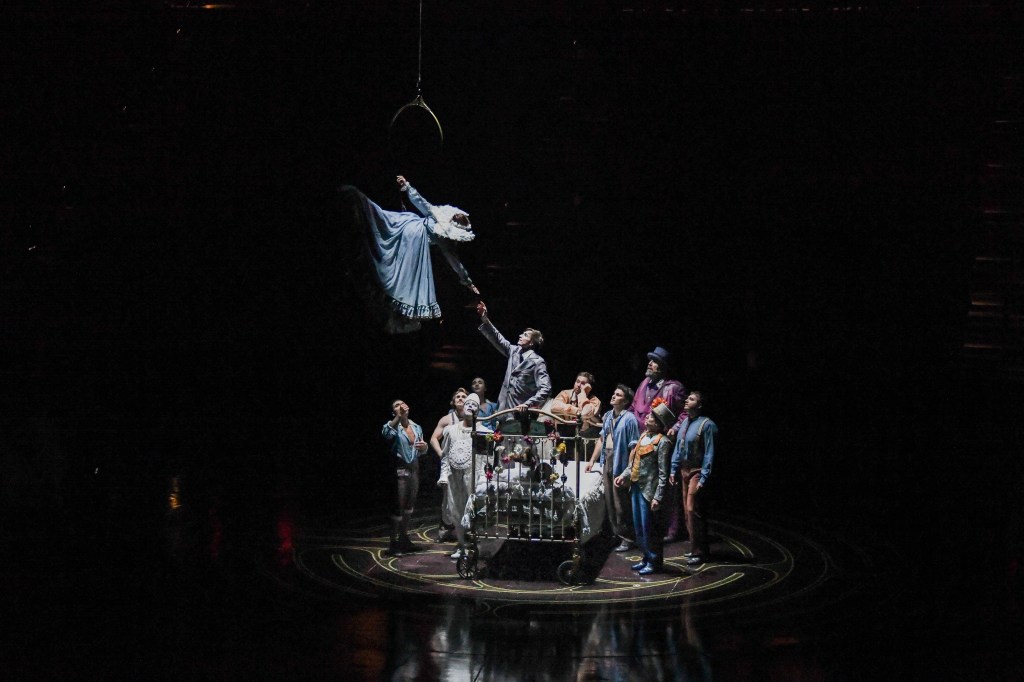
The story line for “Corteo” is that we are welcomed to the last minutes of the life of the famous clown Mauro and are then present as he reminiscences about his great days of his life on stage. He lies in his bed and his former colleagues visit him, bringing back memories and some of his acts which are repeated as the angles hover over his death bed.
After establishing the reason for being there the evening takes on a rather casual approach to the narrative which we are reminded of occasionally with angels making their appearance and in one scene providing Mauro with a set of wings and then, with a nod to the film ET Mauro also rode a bicycle up high, above the stage
The cast of circus characters that parade before Mauro are reminiscent of the closing scene in Fellin’s 8½ – a mixture of standard circus folk – ringmaster, clowns and acrobat along with the characters from Commedia dell’Arte.
This show, is one of the earliest of the Cirque shows, originally made in 2005 and since then has been performed to more than 12 million people and still has all the elements which make the shows impressive – world-class acrobatics, whimsical romanticism, some clever buffoonery and comedy all overseen by the angels floating on high.
Corteo, Cirque Du Soleil, Credit: Johan Persson
Unlike most other Cirque show which are set in a big tent the audience was seated on either side of the stage which featured amazing displays of ability and agility where technical expertise and extravagant design were woven together with fabulous costumes, amazing lighting, humour, and enchanting live music. The musicians tucked away at the sides of the stage displayed not only great musicianship but were remarkable performers themselves as they negotiate their various instruments – violin, drums, keyboard, bass, percussion and guitar.
Some of the performances were more spectacular than others with some not given the attention they deserved such as the Crystal Balls sequence where the subtly of the performance was probably lost on most. But there were more dramatic routines such as the young woman suspended from five balloons who floated around Spark Arena being helped by dozens of audience hands as drifted and bounced giving all her helpers a “thank, I love you”.
All the routines had something to offer whether the languid female performers swaying from the chandeliers, the beds transforming into trampolines where the performers didn’t try for height but rather split-second timing and there was the traditional balancing act which showed real agility as well as looking as though the body was being turned in on itself.
There was even a slightly confusing small theatrical work telling the Romeo and Juliet story which seemed to be closer to a Punch and Judy show full of the knock about comedy.
Then there was the clever duet between the Ringmaster and musicians with the Ringmaster whistling a Mozart melody before going into a ferocious duel with the violinist, backed by the orchestra.
This is a show packed with drama, comedy, colour and surprise to delight the whole family.
What are we going to do without Roger Hall? Is this really the end of a theatrical era? Will regional theatre companies collapse?
These are some of the questions which theatre lovers, theatre companies and Creative New Zealand will be addressing over the next few years.
With the retirement of Roger Hall from playwriting New Zealand theatre scene will be dealt something of a body blow.
But those questions and their answers are for next week, next year. In the meantime, we have another Roger Hall play, probably his last production with “End of Summer Time.”
With his latest play Hall gives a nod to one of the important milestones in New Zealand theatre history, Bruce Mason “End of the Golden Weather”. Even the publicity material features images of Rangitoto and Takapuna Beach which was the site of Masons play.
The play charts the problems of older people thrust into a new social environment as well as discovering the joys and drawbacks of living in a new town.
We have met Dickie Hart before in two of Halls plays “C’mon Black” and “You Gotta be Joking”. Hart has moved to the big smoke from Wellington, moving into an apartment on the North Shore.
Dickie (Andrew Grainger) is confronted by a lot of problems in his transition to Auckland and apartment living and Hall has exploited all these situations. Dickie has to manage his wife Glenda’s new interests in the library and yoga and he has to deal with issues around the body corporate and the South African block manager.
He also has to manage more personal issues such as getting a health check from the doctor for his driving license, particularly the cognitive test as well as trying to fill in the census form and its questions on gender. identity
There is a scary account of the Dickie’s-first time visit to inner Auckland, navigating the motorway system, the bridge and the netherworld of the Aotea Centre carpark.
Dickie has moved to Auckland partly to spend time with his grandkids – a task that is which is not all that simple but he manages educational outings to Auckland volcanic cones brilliantly by combining these trips with visits to Auckland’s great dining establishments – MacDonalds, KFC and Subway.
The play is essentially in two halves– pre and post Covid , the second half being a bit more reflective.
Hall has developed a clever approach to his characters and their comments on life politics and relationship, a style somewhere between the misogynistic and woke, it’s a tenuous area but Hall negotiates it skilfully and Andrew Grainger pulls it off with a breezy, nonchalant style.
Hall is able to assemble his string of one-liners into a coherent, monologue which acts as political and social commentary of issues of the present day as well as providing a compelling portrait of a typical New Zealand character.
The play is a brilliant and sustained piece of comedy throughout, But at one point play turns into tragedy with a few lines and some convincing acting which demonstrates Halls consummate writing, Quigan’s directorial skill and Grainger’s intelligent acting.
Much of Dickie’s identity is linked to rugby and throughout the play there are mentions of the Rugby world Cup as well as images of Rugby games on the TV which dominated the apartment. The local library also gets a favourable mention as Dickie manages to find a copy of Brian Turners book on Colin Meads
Grainger takes on Roger Halls monologue with an energetic enthusiasm, the conservative cow cocky only just managing to adjust to a new life as he prowls the pared back apartment-cum-prison set designed by John Parker.
As with all Hall’s work this is an engaging play with sparkling dialogue and consummate acting.
The “Follow button” at the bottom right will appear and clicking on that button will allow you to follow that blog and all future posts will arrive on your email.
For Black Grace’s “Rage Rage” the Aotea Centre’s Hunua Room was set up with a high catwalk built through the centre of the space.
Was this nod to Dylan Thomas’s “Rage rage against the dying of the light” or a personal rage of Neil Ieremias. His work has always had an element of the personal and the political with works which are confrontational both between the performers themselves and between performers and audience.
Up to a couple of dozen performers race around the stage, in waves of massed groups, performing a series of linked dances to a range of music from traditional Samoan to contemporary rap.
Like all Ieremia’s shows this was a high energy and relentless performance combining many of the elements of his previous explorations in dance.
There is the hand clapping, foot stomping, the falls / collapses, hand movements like a form of deaf signing and arms used as a kind of semaphore.
The various sequences are introduced by Strictly Brown founders Leki Jackson-Bourke and Saale Ilaua who reminisce about their time at school, favourite TV and films and playground games. These reminiscences lead the company into surges of movement.
The sounds are a mixture of the traditional and the modern as the dancers negotiate issues of the present which are rooted in the past. Some of these are addressed in the latter part – Covid, climate change and the future of Tuvalu.
Many of routines seem based on the schoolyard ‘game’ of Rush, some of which morph into fights or just dissipate.
The final sequence is a mix of despair and celebration danced to a nihilistic vocal soundtrack-
“I don’t belong here
I’m a weirdo
What the hell am I doing here”
With the refrain
You don’t belong here
Which encapsulates so .much feeling and emotion focused on the emptiness of contemporary life.
Like much of Black Grace dances there is a tension and drama created by the action and reaction, between rapid movement and calm, between a zombie-like state and intense animation.
Throughout the performances there is an awareness of the beauty and intensity of the dance and the strange conflicting visceral and abstract nature of the dancing which underlines Ieremia’s ability to create dance which is focused and potent
The “Follow button” at the bottom right will appear and clicking on that button will allow you to follow that blog and all future posts will arrive on your email.
La Boheme, The student garret / studio (Act I & IV) Image. Andi Crown
La Boheme
Composer Giacomo Puccini
Librettists Luigi Illica, Guiseppe Giacosa
N Z Opera
Kiri te Kanawa Theatre
Until June 6
Then
Wellington 18 – 22 June
Christchurch 2 – 6 July
Reviewed by John Daly-Peoples
There are no gods or fairies in La Boheme. There are no heroic figures in La Boheme. There are no evil or deeply flawed characters in La Boheme and there are no complicated plots or byzantine machinations in La Boheme.
All the characters we encounter are young and ordinary, all making their first steps into adulthood, living in a bohemian environment, full of possibilities.
This ordinariness is in contrast to many other great operas where characters face great moral dilemmas, battle tyrants or life’s injustices. This is one of the few great operas where we see characters on stage who we can recognize as very much like ourselves – or twenty year old versions of ourselves.
Four of the very ordinary characters live in a very ordinary student flat and the opera opens with Rodolfo, a writer and his artist friend Marcello struggling to create masterpieces while they battle the freezing temperature by burning one of Rodolfo’s plays to keep warm. Colline, a philosopher, and Schaunard enter with food and drink but instead of paying the rent they decide to celebrate Christmas at the Café Momus, where they encounter Marcello’s girlfriend, Musetta who is with her sugar daddy Alcindora.
At the same time Rodolfo meets the frail seamstress Mimi, and they fall in love. But their tender romance is doomed, for Mimi is ill with consumption, and Rodolfo is too poor to help her. Through the opera they also have to confront the other aspects of life and love -jealousy, guilt and despair which comes with that love. As a contrast is Musetta whose love has a wider focus given to Marcello, Alcindora as well as others.
Ji-Min Park (Rodolfo) and Elena Perroni (Mimi) Image. Andi Crown
The slowly dying Mimi (Elena Perroni) who all but whispers in many of her arias gives memorable performances. While she presents a gentle voice often almost whispering while at other times she was able to sustain an expressive intensity as with her “Donde Lieta Usci”aria
Rodolfo and Mimi have a purity of soul which seems to bond them despite their Act 3 questioning of their relationship and this is reflected in their voices. Ji-Min Park (Rodolfo) is able to express an urgency with his rich voice while both Elena Perroni’s voice and demeanor coveys a sensitivity and frailty.
Rodolfo’s three friends also contribute some lively singing with their first act witty dialogue and humorous interchange with the landlord Benoit. Marcello provides some brilliant duos with Mimi and Musetta, notably the third and fourth acts while the philosopher Colline ( Hadleigh Adams) provides an additional concept of love with his aria dwelling on his much-loved coat.
The musician Schaunard (Benson Wilson) contributes slightly to the singing in the opera but his main purpose seems is to always have some money and always has food or wine available as the hedonist of the group and a contrast to Rodolfo.
Emma Pearson (Musetta) Image. Andi Crown
The setting has been changed for Mid nineteenth century to Paris in in 1947 and the bohemian nature of the artist’s lives in seen ibn some huge paintings like those of Pierre Soulages in the studio / garret. The post war date also means the costume designer (Gabrielle Dalton) have been able to give the Musetta and Mimi some contemporary fashion with Musetta being attired in some stylish Dior inspired outfits.
The simplicity and honesty of La Boheme has meant it is always accessible with a story which is clear, immediate and romantic and universal. Director Bruno Ravella and Conductor Brad Cohen have ensured that the story and the characters are brought to life with sensitivity, authenticity and joie de vivre.
The Mischief Theatre Production of THE PLAY THAT GOES WRONG
By Henry Lewis, Jonathan Sayer and Henry Shields
GMG Productions & Stoddart Entertainment Group Associate director – Anna Marshall Resident director – Nick Purdie With Olivia Charalambous, Edmund Eramiha, Tom Hayward, Stephanie Astrid John, Joe Kosky, Jonathan Martin, Jack Buchanan, Anthony Craig and Kira Josephson
ASB Waterfront Theatre, Auckland
Until 1 June
Reviewer Malcolm Calder
The crew were frantically seeking a missing dog called Winston (I thought that was pretty funny from the outset), couldn’t find a missing CD, contending with a tricky door that wouldn’t latch, dealing with a floorboard that seemed have a mind of its own and contending with a mantlepiece wouldn’t mantle. All this before the show had even started.
Their crew’s efforts were entirely unsuccessful of course and the litany of woes continued once things got underway. But the teddibly English lads and lasses of the fictitious Cornley Polytechnic Drama Society struggled on in their efforts to ensure their eminently forgettable murder-mystery actually took place, with nowhere near understanding their own characters or, it seemed at times, even the plot. Not to mention a set that seemed intent on total disintegration. Their efforts certainly did go wrong and they eventually staggered to a dis-assembled conclusion.
However that’s not what The Play That Went Wrongis all about. Rather, it uses the context of an amateur theatre production to very quickly hit the spot demonstrating both subtle and in-your-face comic writing, exquisite nuance and a mature command of the farce-wrapped-in-slapstick idiom whilst totally demolishing the fourth wall.
Lewis, Sayer and Shields, formed Mischief Theatre in 2008 and created The Play That Went Wrong while still studying at the London Academy of Music and Dramatic Art. Originally titled The Murder Before Christmas, their production opened initially on the Edinburgh Fringe, enjoyed enormous success, moved to a pub on London and then quickly transferred to the West End. It has been winning accolades around the world ever sinceand has even spawned a range of not unrelated television spinoffs.
This cast is very much an ensemble. In performance they consummately demonstrate a broad-ranging set of physical theatre skills, demonstrate the importance of timing in making these work and do pretty well in convincing the audience that this is a collection of loosely-linked, impromptu standup snatches despite being a meticulously scripted work.
On Oening Night in Auckland I noticed a couple of rather precious looking luvvies in deep discussion during interval but they appeared to have missed the point entirely. Deep, thought-provoking, question-raising theatre this is not. Technique – yes! But, rather, if set in the context of a funeral parlour, not dissimilar gags, techniques and characters these writers could probably transmogrify it quite readily into The Funeral That Goes Wrong.
After any number of productions that occasionally take themselves a little too seriously, we seem to be on something of a comedy roll of late. Down at the water-side anyway. The Play That Goes Wrong is the second bout of hilarity in a row with another soon to follow.
With Bronwen Ensor (Greta Ohlsson), Sophie Henderson (Countess Andreyi), Jennifer Ludlam (Princess Dragomiroff), Mayen Mehta (Hector McQueen), Ryan O’Kane Col Arbuthnot/Samuel Ratchett), Mirabai Pease (Mary Debenham), Cameron Rhodes (Hercule Poirot), Jordan Selwyn (Michael/Head Waiter), Rima Te Wiata (Helen Hubbard), Edwin Wright (Monsieur Bouc)
ASB Waterfront Theatre
Until 10 May
Reviewer Malcolm Calder
Photo: Andi Crown
I’ve had a busy time of it lately. What with school holidays, two successive long weekends and a seemingly endless round of rather long and demanding days, I had half a mind to settle for a quiet glass of red, a good book and an early bedtime blithely avoiding any additional responsibilities that might involve going out to the theatre. Had to rush to make the 7pm start too!
Thank goodness I didn’t.
With this re-vamp of the original classic, Director Shane Bosher has turned in a blinder for Auckland Theatre Company and come up with something that is pure, unadulterated entertainment.
Adaptor Ken Ludwig’s cull of the original murder mystery, after having been approached by Agatha Christie’s grandson for the Christie Estate, was first performed in 2017. So if you are a Christie devotee looking for a simply stage-adaptation of her original go no further.
Ludwig adamantly insists that he is a writer of plays and not simply a ‘murder-mystery guy’. As a result he has redrawn, reduced and compacted the number of characters, enhanced the comedy and come up with a tightly-scripted and genuine ensemble piece that adds to the already enormous output that has made him arguably the most produced playwright of his generation.
It is sometimes suggested that more serious undertones may have underpinned aspects of Christie’s original but few are evident here. Bosher may have drawn some slight allusions to contemporary geo-political issues that underpin the entire structure but this may or may not be the case. What he has done however, is generate something that entertains big time.
The result is an actor’s piece to die for. And this cast do more than just deliver. Just as Auckland Theatre Company, CEO Jonathan Bielski has urged audiences to avoid spoilers about resolution of the murder, mystery and mayhem of the play itself, it would be churlish to single out any one cast member. The entire cast is let loose, projecting archetypes rather than convincing portrayals of real people. Each character is distinct, their backgrounds are as varied as their accents and the ensemble functions as a singular unit predominantly by using that essence of great comedy – precision timing and the credibility of relationships between them.
ATC is to be congratulated too on once again continuing to develop pathways for increasing numbers of younger actors and production people who we are seeing as first-time performers with ATC.
This is a consummate, professional ensemble and even a tiny glitch with a prop on opening night was more than successfully ad-libbed around, the comedy was sustained and the professionalism acknowledged by an audience who got it.
I am advised that ticket sales for MOTORE are already strong and ATC is to be congratulated on both the production itself and for hopefully hitting a jackpot.
The 7pm start time may have been a bit of a scramble but it had the bonus of my being home and abed well before 10pm. No book though – my head was still laughing inside itself.
It was not much of an act, chucking an egg in the air, have it land on your back and keep it there while you jiggle around. Anyone could do it , except one of the performers in the Quebec based group “Animal” had to have three goes at it. One of the eggs splatting on his back and head and two more landing on the stage. He got more applause for the broken eggs than did his two fellow perfomers for their safely caught eggs.
It’s always great to see performers achieving pulling off acts , but it’s more amusing when they fail – fail, recover and get on with the show. It often reveals the skill and dexterity of the performer and shows up our own lack of skill. In another of their acts one of the females spins a bucket full of seeds which is supposed to keep the seeds inside . She misjudges and we get a stage strewn with seeds and she doesn’t miss a beat – it almost seems as if she meant that to happen. I think the little children may have learned one of their basic science lessons about centripetal force.
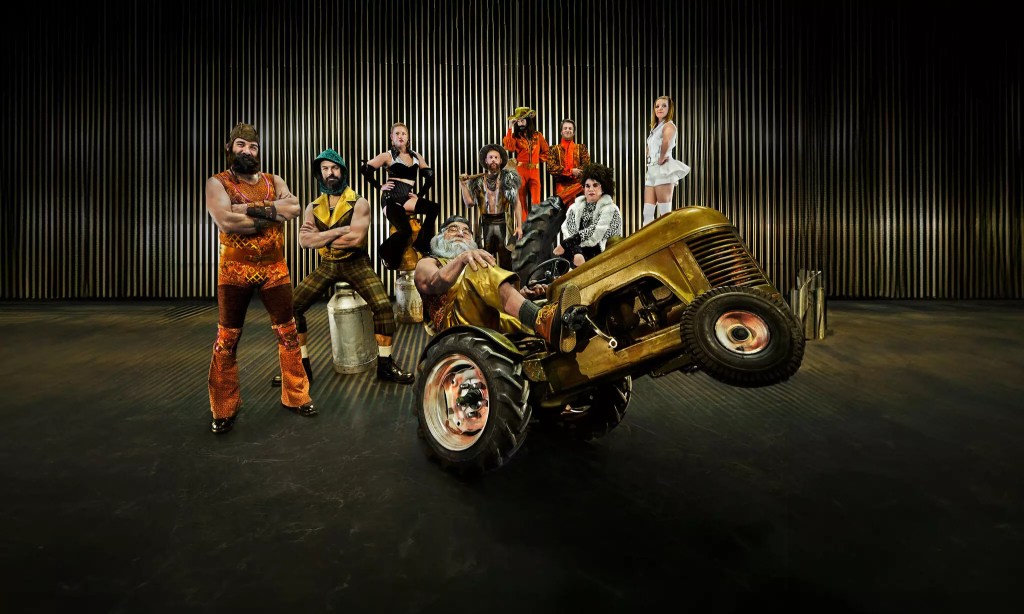
Theres a lot of basic science in” Animal” along with basic acrobatics as the group perform basic balancing, juggling and springboard work. They take the audience on a slightly surreal journey through their weird farm of outlandish animal and wacky activities – tossing pitch forks, balancing on milk churns, riding bucking cows.
As well as being skilled acrobats and contortionists the group are also skilled musicians playing guitar, trumpets, a range of percussion instruments, flute and keyboard – and they can sing too, belting out their own French compositions which are probably very witty if you are up on your French.
The Canadian Cirque Du Soliel group has shown us how to put on a high-powered performance with cool moves and dazzling costumes but “Animal” is more down to earth, using all the contraptions from the farm, – wheelbarrows. milk churns and hay forks, along with a jumble of clothes and hats which they must have found around the barn. Their routines are all clever and entertaining, bringing together circus, song, dance and theatre with some quirky live music.
It may be designed for children but it has a universal appeal with their displays of strength agility and balance in their boutique version of the grander Cirque displays.
The “Follow button” at the bottom right will appear and clicking on that button will allow you to follow that blog and all future posts will arrive on your email.
The Lula Washington Dance Theatre is a contemporary modern dance company in Los Angeles which has performed across the United States and toured internationally. It was established forty years ago when Lula Washington realised there were few black dance institutions in America .
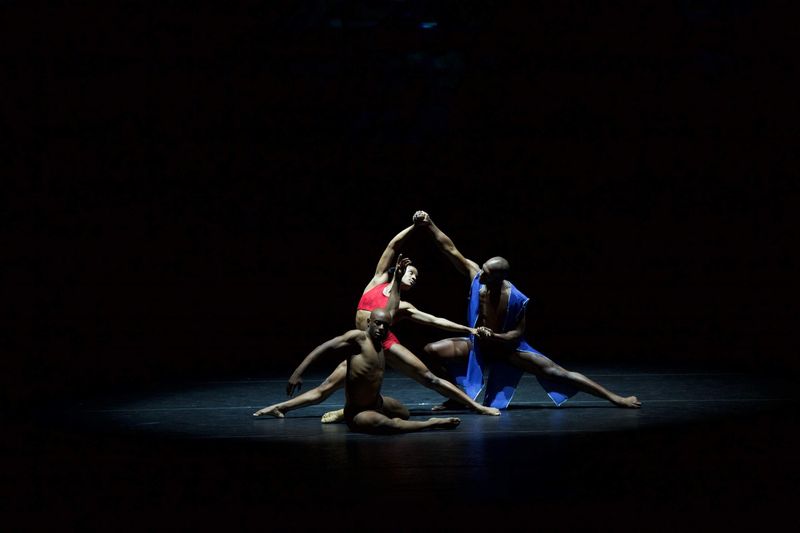
They have a stylish approach to contemporary dance incorporating elements of African and Caribbean dance as well as contemporary modern dance and ballet. All these elements were seen in the opening number where three dancers – Love, Faith and Hope, performed to heavy beats, foot stomping and clapping with the audience encouraged to add to the heavy clapping to that of the dancers and he riotous drumming morphed from African beats to something closer to hip hop.
Three female dancers were joined by male dancers who became intertwined and there was a sense of the dancers and audience all part of a church service, street performance or gym workout.
Accompanying the hectic dancing were references to American segregation, slavery, lynchings and race riots – Charleston, Springfield, Watts and an image of George Floyd
Accompanying this dancing was some relentless drumming with and intense energy more akin to that of a night club and each of the sequences was given multiple bursts of applause from the audience.
Throughout this sequence the woman danced like ghost or departed spirits, their dancing a combination of celebration and remembrance of the African roots of the movements and music.
Because of the emphasis on these aspects the dances all seemed to be something of a political force and the dancers’ political activists.
In a later sequence one of the dancers shouts out the repeated chant “America is killing me” and this was accompanied by a visceral scream, a dramatic event one would not encounter in a Royal New Zealand Ballet performance and shows the level of the political urgency behind the Lula Washington project.
There was an intensity to many of the dances with a physically close to that of a Whirling Dervish. But alongside this there were elements of playfulness and whimsy which were all performed with a finesse close to that of classical ballet dancers.
The political or polemical aspects of the dances often felt to be less satisfying of the performance without a dance vocabulary which did not express the angst and anger which was conveyed in the words which accompanied the dance.
“Belle” had all the elements to make it a stand-out performance however it never quite managed to make it a truly thrilling show.
The all-female cast of skilled aerialist / dancers/ singers performed a range of acts with a touch of magic and their routines were all immersed in a riotous soundscape and a remarkable light and fog environment.
Sometimes it felt a though someone had told the musicians that they only needed to play loudly and that would cover any mistakes or lack of continuity.
There was also a lack of cohesion between the various sections or vignettes which was a major problem. Even though the acts were spectacular, there was no sense of narrative or trajectory.
Many of the sections had a sense of cavorting angels or goddesses and this could have related to the figures and Ranginui and Papatūānuku in the digital work “Ihi” by Lisa Reihana which is in the Aotea Centre foyer.
Most of the acts were performed in a half light, with the performers often seen in silhouette. Along with the dramatic use of light this added to the drama of the performance but it also meant the audience was often not able to appreciate the athleticism of the performers.
Some of the acts were brilliant conceived with figure rising and falling from the stage and disappearing into the enveloping fog of the stage. Other sequences saw the cast using elaborate equipment such as aerial wheels and large pivoting wheels.
But the lack of interconnection and lack of coordination between the sequences and music did a disservice to the acts and a disappointment to the audience.
It would be easy to pigeon-hole SIX as a high energy show with lots of froth and bubble, and aimed fairly and squarely at the tiktok generation. But you would be wrong. It is rather more.
All things must change and musical theatre is no different. SIX is important enough to represent another of those significant change points in history – following in the footsteps trodden by Oklahoma or West Side Story or Cats or Hamilton.
On leaving, I overheard an audience member mutter something about SIX being really just a glossed up pub cabaret. And, to a certain extent, it is. Originally conceived by a couple of then relatively unknown Cambridge students in 2017, Moss and Marlow took it to the Edinburgh Fringe that year, was a huge success and soon wound up at the Arts Theatre in the West End before a Broadway opening almost immediately before Covid struck. There was a sort of relaunch in 2021 and SIX now enjoys semi-permanent residence in both London and New York and has gone on to world-wide success with multiple productions all over the anglosphere, as well as Europe and in Asia.
So what has driven this success? A well-known Australian commentator once suggested it resembles a Spice Girls concert directed by Baz Luhrman – but one where the girls can actually sing. Quite apt I thought at the time. But this show is a lot more than that. It is VERY much a significant part of the musical theatre tradition. In fact there are so many references, acknowledgments and subtle nuances running through SIX that enumerating all of them becomes difficult.
First and foremost, this is a NOW show. As such it reaches its target easily and then some. So, yes, to the tiktok generation. But it is bigger than that and, while it might help grow memberships of amateur music theatre organisations, that is rather simplistic view as it impact is considerably greater. Not to put too fine a point on it, the key fundamental of SIX is pure entertainment built around that old adage – a good story told well that enthrals its audience. And good entertainment knows no age boundaries – the grandmother in front of me was up and out-boogying her two grandchildren at the end. Underlying import counts too.
The stories of the six queens are told in the language of the second decade of the 21st century – not by the archival or even slanted recollections of historians about the politics and intrigue surrounding the first Tudor king. Most of whom were men, and of a fairly clearly-defined social class at that. Further, it is told from a women’s perspective. And remember, some of the queens were all exceptionally young when they married and the Royal Court revolved around power, politics and intrigue. So we leap immediately to empowerment for women – a rallying cry for millions – and a clear audience profile for SIX.
Structurally, as the fairly comprehensive promotional campaign has pointed out, SIX is built around a history lesson and a competition. OK. Thank you. Got that. It puts the six queens up against each other each other – an Eisteddfod if you will – or is that merely a device for something bigger?
The six queens never leave the stage and their individual songs merge into six-voice choral arrangements, complimentarily and contrapuntally at times, with occasional snatches of spoken dialogue (but not very much at all). The staging itself is outstandingly conceived by Emma Bailey and reflects a modern high-tech concert stage that integratesTim Deiling’s dynamic lighting and Paul Gastrehouses’s sound in a way that clearly works. The stage is also peopled by an astonishingly well-rehearsed, syncopathic and complimentary all-girl band for the entire show.
This primarily Australian cast comes well credentialled. Dancing skills are clearly in evidence with very tight routines throughout and, even if there were one or two very minor vocal wobbles, vocal strength was generally strong and led by the assurance of Loren Hunter (Jane Seymour). But let’s face it, this show is presented more like an eisteddfod or a competition and it doesn’t really matter – one voice will always overlap another. The tenderness of Heart Of Stone and the hilarious rap of Haus of Holbein were both standouts for me.
The primary focus of attention however is largely rivetted on Gabriella Slade’s award-winning costumes. Little wonder that her outfits have a dash of Spice Girls about them as she devised Spice World back in the 1990s. But now she has embellished some glittering and futuristic sequinned outfits in ways that not only catch the eye, but help tell each queen’s story. The ‘beheadeds’ have chokers for example, Jane Seymour’s black and white bodice echoes the half-timbered houses of Tudor England, the green of Anne Boleyn’s outfit references the popular myth that this evergreen was composed by the much-wedded Henry VIII himself (that’s factually incorrect, but let’s stick with the myth). It’s interesting that one interpretation of this song concerns the promiscuity in young women, something Henry’s henchman Archbishop Cranmer used in arranging divorce and subsequent beheading.
The references go on. In fact they are never ending. There are the pop divas found in the songs : I think I heard echoes of Beyonce, Ariana Grande and Alicia Keys and probably missed a few more.
The sense of fun and campness is constant. SIX takes neither itself, nor musical theatre in general, seriously and whimsy is everywhere. Phones in the theatre, for example, were quite correctly asked to be turned off pre-show and then during the encore (or more correctly the ‘finale’), encouraged the audience to light them up again. And they certainly did. It was another moment of sheer joy and made the audience a part of the show. I think that grandma in front of me got a pretty good video take.
Any good production simply tells a story. SIX does so with succinctness and very, very well. It is not a long show, but is pretty demanding on both voices and the attention-span of audiences.
I always relish a well written show that is objective and contemporary rather than one that delves into the introspective meanderings of L-plate writers. SIX is mature writing and very clever staging.
The filmed on-stage reunion of Six’s original West End queens will be released in cinemas next month and, rather ironically, Auckland’s Civic remains one of the larger in-theatre venues it has played. After here, it’s off to complete its second lap of Australia at the Civic’s sister in Newcastle, while Asia awaits
The “Follow button” at the bottom right will appear and clicking on that button will allow you to follow that blog and all future posts will arrive on your email.