Categories
Reviews, News and Commentary

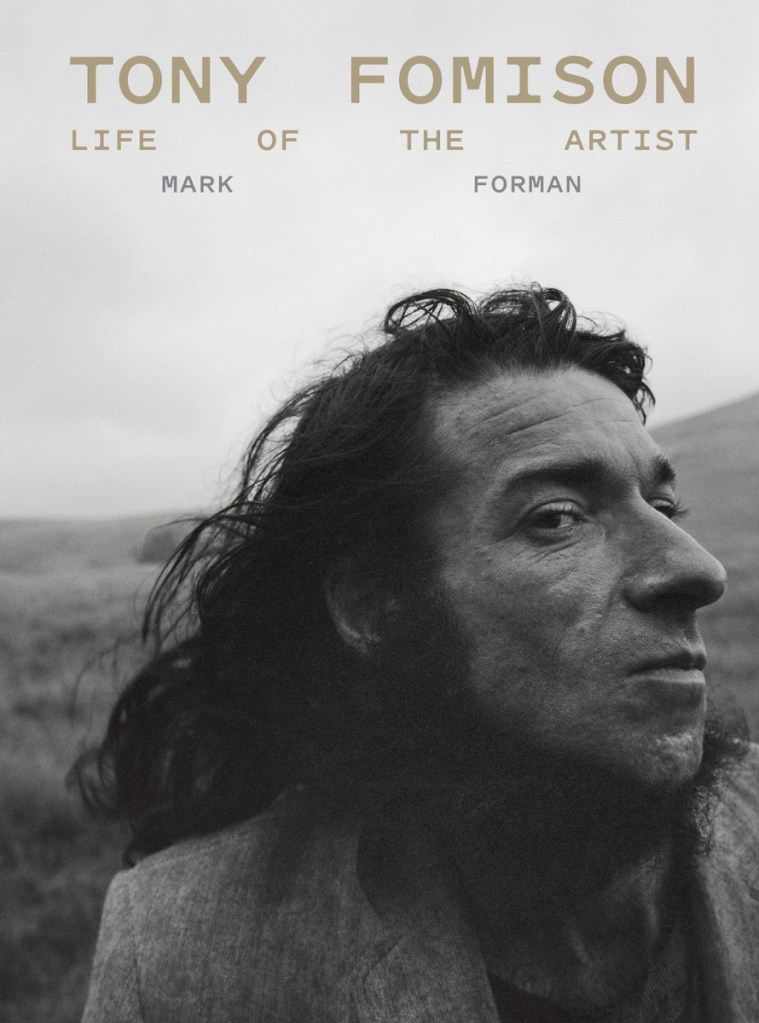
Tony Fomison : Life of the Artist

Reviewed by John Daly-Peoples

Tony Fomison : Life of the Artist

By Mark Forman

Auckland University Press

RRP $59.99

Reviewed by John Daly-Peoples

Mark Forman’s new book on Tony Fomison is a superb piece of scholarship which adds to our understanding of the life of one of the great New Zealand artists of the late twentieth century.  His writing is particularly informative as there are no images of Fomison’s work in the book. The trustees of his estate, his three daughters, withheld permission to use his work because of assumptions and inaccuracies.

Forman has made up for this with perceptive descriptions of many of the artists important works as well as providing an understanding of the artist and the environment in which he developed his work

Forman’s detailed research, obvious from his bibliography along with the numerous interviews he had with other artists, family members and friends enabled him to give the reader insights into Fomison life and thoughts. He has also included a number of quotes from newspapers and magazines of reviews of the artist’s work and there are also accounts of Fomison irritation at unfavourable reviews.

Fomison had been to Ilam Art School at Canterbury University where he had met  a number of artists who he would be friends for the rest of his life including Quentin McFarlane and Des Helmore, Later he would meet Philip Clairmont, Allen Maddox and Colin McCahon. He was also influenced by some of the tutors at Ilam notably Bill Sutton and Rudi Gopas.

In the chapters covering his later life Forman has accounts of his involvement with his various gallerists including Elva Bett, Tina and Kees Hos, Peter McLeavey as well as John Gow and Gary Langsford. There were also other important figures who helped and supported him such as Charles Brasch and Jim and Mary Barr

In the 1960s, Fomison began painting and exhibiting portraits that were, even then very different from many of the other portraits by his peers. His were often distorted, maniacal and tapped into his own troubled life.

Also in the 1960’s as well as pursuing an art career he studied and recorded a number of the Māori rock drawings in Canterbury which became part of his art references

The 1970s was a particularly troubled period in Fomison’s life  after he had returned from  Europe which had included a spell in a mental institution.

He was down and out, grappling with drug addiction, and he began producing  work which was contemptuous and cynical about society.

Many of these artists he identified with were ‘outsider artists’ which Fomison identified with and his dark figures and landscape  began to emerge in his paintings. His monsters, misfits, and medical deformities challenged polite society, and explored what it means to be an outsider. Fomison began to paint people on the edges of society, such as prisoners and the disfigured.

Tony Fomison Grotto Road, Onehunga, Auckland. Image Mark Adams

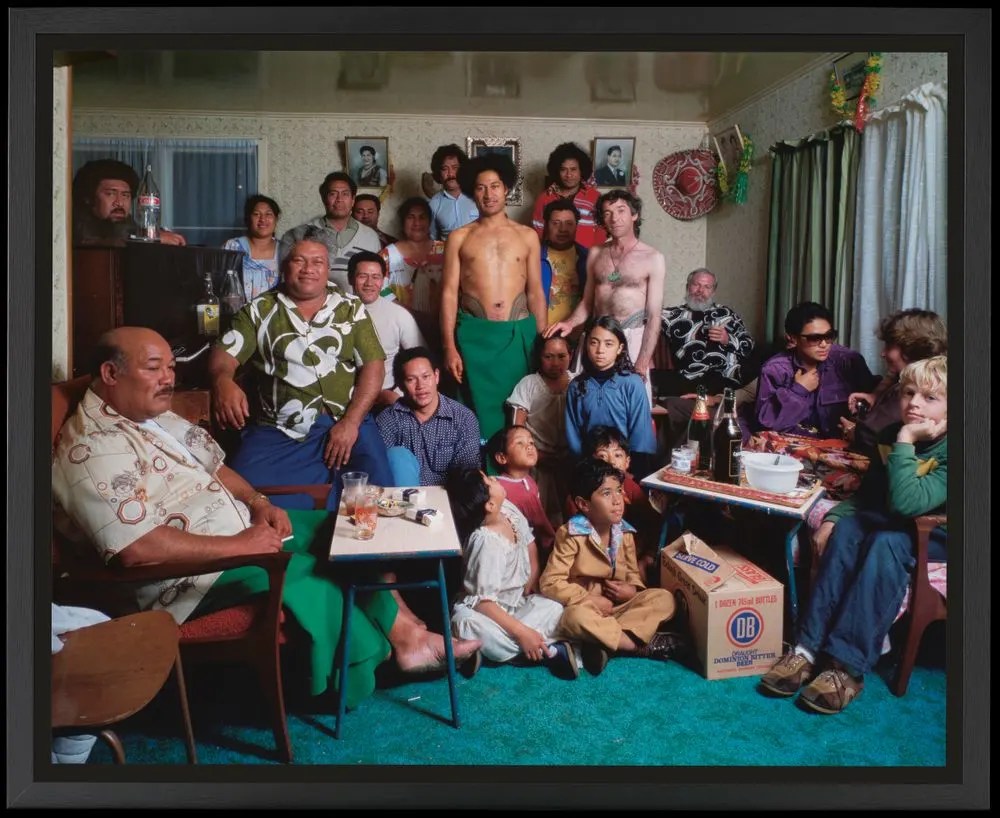
Living in Auckland for much of his life, he had a strong connection to the local Samoan community and in 1980 made the decision to be tattooed with a Samoan pe’a.  This and his response to the Springbok tour of 1981was part of the artists unconventional or subversive approach to social and political issues

Forman includes numerous quotes from friends and fellow artists along with reviews which allude to Fomison’ s art as being related to distant periods rather than addressing contemporary issues  so that Francis Pound said of his work that it was “akin to that of a seventeenth century primitive” while Hamish Keith wrote that his figures were “sinister and unpleasant… giving of an Old Master complex” and Peter Simpson said he “has something of the impoverished yet eloquent beauty of late Michelangelo”

Fomison led a challenging personal life, which often could be seen in his paintings. As Ian Wedde says, ‘Fomison persisted with thinking and with making art out of his thoughts.’ Following a trip to Europe in the mid 1960s, and a short stint in institutions, Fomison began to paint people on the edges of society, such as prisoners and the disfigured. He would repeatedly return to the theme of the ‘outsider’. Fomison’s work was also often ‘socially committed’, protest the state of the world.

In his career spanning three decades, Fomison produced some of New Zealand’s most significant paintings and drawings, which seemed to incorporate elements of his own  physical journey as well as the spiritual and aesthetic journey, linking ideas that he developed along with his whimsical and dark attitude to life.

To subscribe or follow New Zealand Arts Review site – www.nzartsreview.org.

The “Follow button” at the bottom right will appear and clicking on that button  will allow you to follow that blog and all future posts will arrive on your email.

Or go to https://nzartsreview.org/blog/, Scroll down and click “Subscribe”

Categories
Reviews, News and Commentary

Three exhibitions K Rd – Palmer, Creed, Parekōwhai.

Reviewed by John Daly-Peoples

Martin Creed, Work No 3769, Work No 3764, Work No 2053

Three exhibitions K Rd – Palmer, Creed, Parekōwhai.

Stanley Palmer, New Work

Melanie Roger Gallery

Until February 22

Martin Creed, Like Favourite Socks in a Drawer

Michael Lett

Until March 1

Michael Parekōwhai, The Indefinite Article

Artspace Aotearoa

Until April 17

Reviewed by John Daly-Peoples

Current exhibitions along Karangahape Rd offers a range of art works from the  realist depictions of the landscape to abstract paintings and conceptual construction.

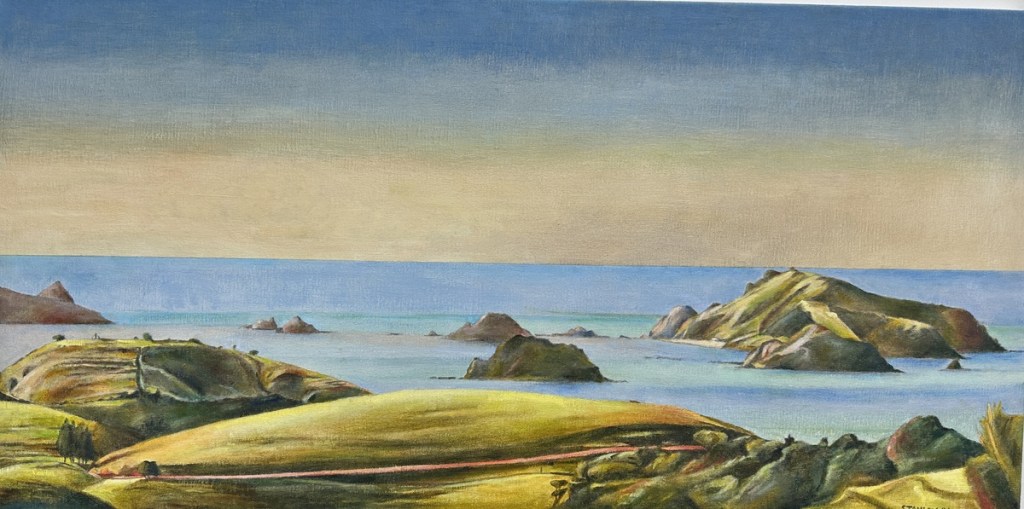
With his latest exhibition at Melanie Roger Gallery Stanley Palmer continues  his depictions of the New Zealand landscape. Like many of his previous exhibition he has painted views of the New Zealand coastline featuring dramatic vistas of headlands and offshore islands.

With this new series of works he has revisited many of his previous subjects including depictions of Karamea, Great Barrier Island, Chathams, Great Mercury Island and Matauiri. While these are mainly landscape there are a few which also feature other element in the landscape which add a visual drama as in “Akiaki – Chathams” ($30,000) where he has included windswept  trees and grazing sheep.

Stanley Palmer, “Akiaki – Chathams”

These paintings seem to be less detailed than some of his previous work and there is a simplicity which gives these works an added drama. Part of this drama comes from the artists shrewd use of paint, so that in “Awana- Aotea Great Barrier” ($22,000) the eroded cliffs are highlighted by the gash of earthy colours and in “Mataurui” ($28,000) the red line of a track is like an abstract slash through the landscape.

Stanley Palmer “Mataurui”

In most of the works the background of sea meeting sky shows a clever juxtaposition of shimmering abstract blues with subtle variations between each of the paintings

Also included in the exhibition are some of the artist’s earlier bamboo prints of the early 1970’s including “Hillside Town Kohukohu” ($2250).

Stanley Palmer “Hillside Town Kohukohu”

Martin Creed’s minimalist works have always played with the definition of art and art making starting with his Turner winning installation “Work No. 227: The lights going on and off: an empty room” in which the gallery lights switched on and off at 5-second intervals.

His work is  a mixture of the witty, poetic and philosophical, making use of a range of everyday materials and approaches which challenge traditional views of art.

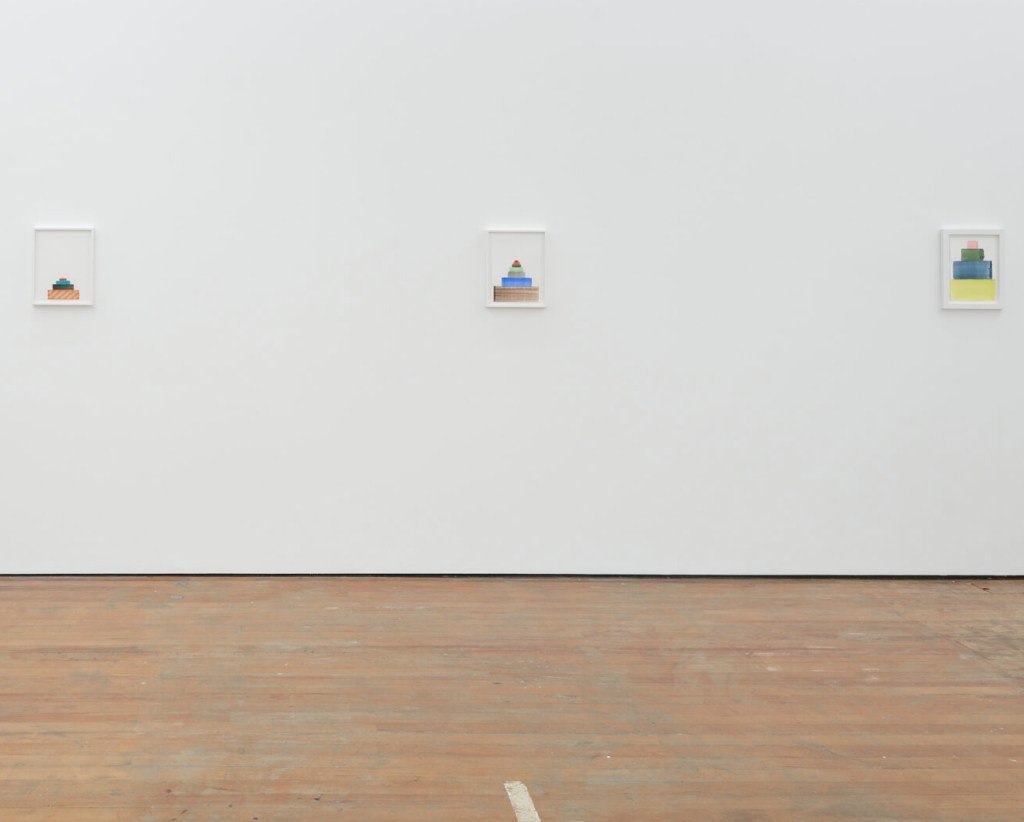
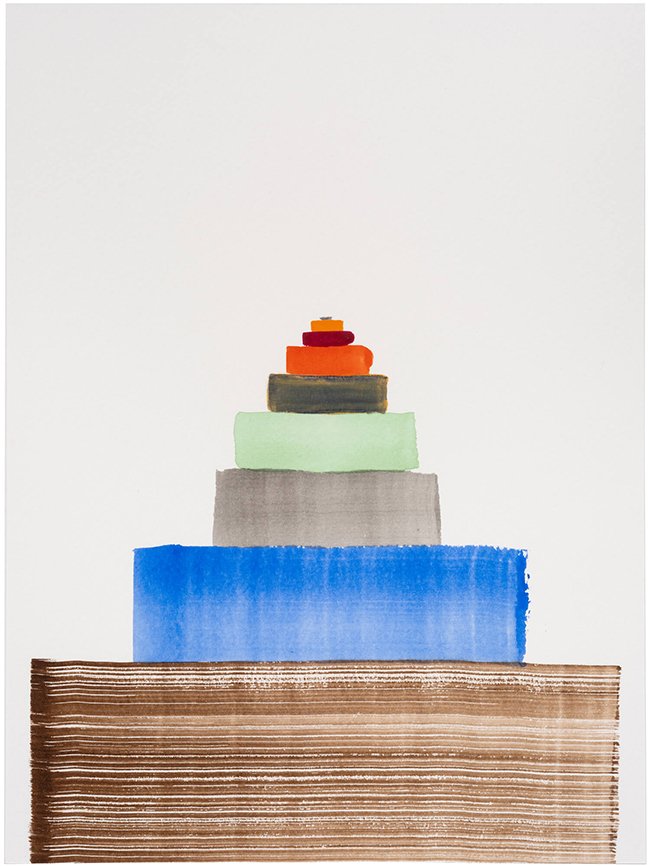
His current show “Like Favourite Socks in a Drawer” brings together elements of chance, time and structure with a series of ziggurat shaped works. The works  started with his decision to buy an ordinary multi pack of commercial paint brushes.

Martin Creed, Work No 3764

With these he applied paint in different colours  with the varying brush sizes, stacking the colours one above the other to create stepped, random bands of colour.

The paintings/designs can be seen as referencing the ziggurat forms of ancient Mesopotamia and Mexico as well as more recent brutalist constructions and has connections with Rewi Thompson’s block-like house in Kohimarama. There are also hints of Frank Stella, Donald Judd and Cuisenaire rods.

Creed says of the works “A step pyramid is solid and easy to understand. It is a safe structure that is not going to fall down. It is trustworthy. You can see how it is built. The steps are hopefully leading to the top, and you can enjoy the colours on the way up. In a blobby, soupy, ill-defined world it can be helpful to put your ducks in a row.”

The works have a sense of the structure to them with their build-up of coloured shapes and in works such as  “Work No 3764” (USD $22,000 plus GST) there is sense of the artist gestural involvement  where the striations of the brown / sepia are visible as a single calligraphic stroke. With others there is the notion of time with the various strokes of colour measuring out the time taken to complete each work

Martin Creed, Work No 3766

Some of the work display additions to the quick gesture with Creed scumbling the yellow band in “Work No 3766” (USD $22,000 plus GST). This work like some other has a humorous element with the painting looking like a celebratory, multi-layered birthday cake.

The works all convey  Creed’s minimalism of means, notions of time along with the structuring and ordering of objects shapes and colours.

Michael Parekōwhai, The Indefinite Article

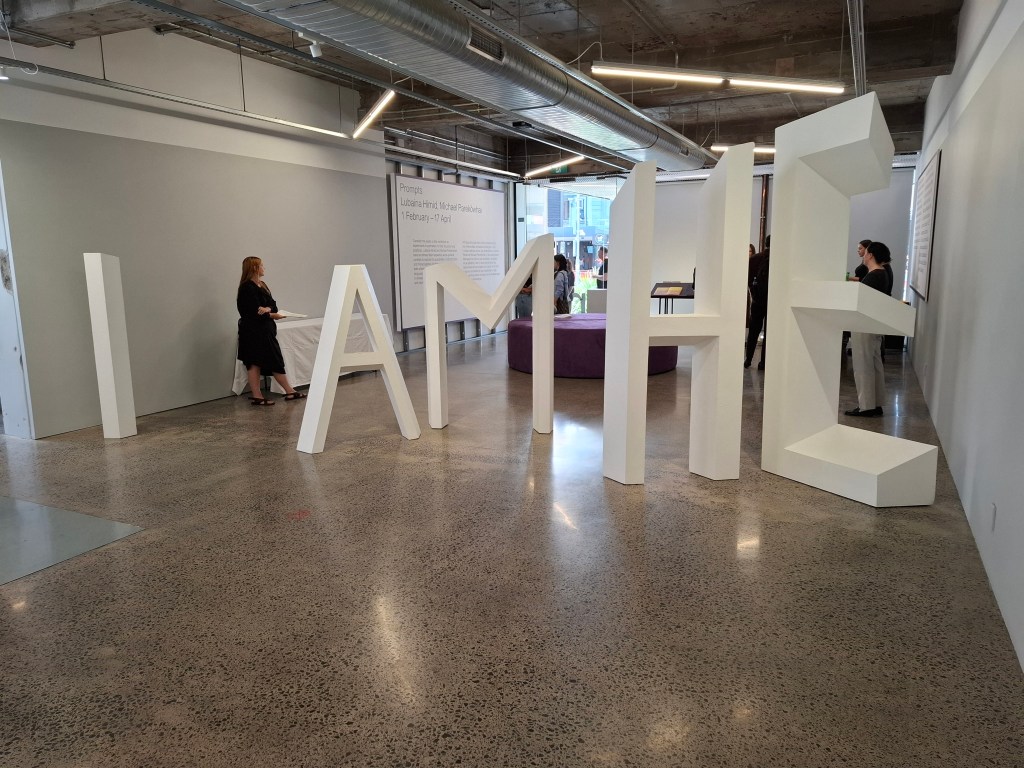
Artspace is exhibiting Michael Parekōwhai’s sculptural object, “The Indefinite Article (1990) which had previously been shown at Artspace in 1990 in the show “Choice” curated by George Hubbard

The large letters based on McCahon’s cubist stylised letters  constructed of MDF spell out the words “I AM HE”. Which references some of the McCahon paintings featuring the words “I Am”.

While borrowing from McCahon the work can also be seen as creating a bilingual pun linking the words to te reo where “HE” can be read  as the indefinite article where the word can be  defined as -a, an, some – or it can  also  mean something is  wrong, mistaken or incorrect.

Other linguistic variations can be identified with the words. During the ”Cultural Safety” exhibition in Frankfort in 1995 where the work was shown this reviewer noted at the time – “His large word sculpture using the words of the Colin McCahon painting I AM HE was quickly identified by one perceptive German journalist as coming from the pen of John Lennon in “I Am the Walrus” [I am he as you are he, as you are me and we are all together] rather than the Bible or McCahon.

To subscribe or follow New Zealand Arts Review site – www.nzartsreview.org.

The “Follow button” at the bottom right will appear and clicking on that button  will allow you to follow that blog and all future posts will arrive on your email.

Or go to https://nzartsreview.org/blog/, Scroll down and click “Subscribe”

Categories
Reviews, News and Commentary

Te Whare o Rehua Sarjeant Gallery

Reviewed by John Daly-Peoples

Te Whare o Rehua Sarjeant Gallery

A Whanganui biography

By Martin Edmond

Massey University Press

RRP $65.00

Reviewed by John Daly-Peoples

Whanganui’s Serjeant Gallery has just reopened after having been closed for ten years with  an opening season entitled “Nō Konei | From Here” (Until 11 May 2025). The exhibition features over 200 artworks, spanning four centuries of European and New Zealand art history. Filling the gallery’s newly expanded exhibition spaces, works range from traditional gilt-framed paintings to contemporary practice in a variety of media.
Coinciding with the opening is the publication of “Te Whare o Rehua Sarjeant Gallery” which tells the gallery’s 100-year history.

Written by Martin Edmond the book charts the Sarjeant Gallery’s early years and its development as a collecting and exhibiting institution that is now recognised as one of the major New Zealand’s art galleries.

The gallery  which is one of the most elegant and imposing buildings in the country is located at a central point in the city and has been of significance to the development of the city.

Henry Sarjeant whom the gallery is named after had lived in the area since the 1860’s and had  a lifelong interest in the arts, visiting the major galleries of Europe during a number of trips abroad. When he died in 1912, aged 82, he left property valued at £30,000 in trust to the Wanganui Borough Council for the purpose of building and maintaining an art gallery. The design of the gallery was won by Dunedin architect Edmund Anscombe and the building was constructed in the shape of a Greek Cross and  faced with Oamaru stone.

The Governor General, the earl of Liverpool, laid the foundation stone on 20 September 1917, and on 6 September 1919 the Prime Minister, W. F. Massey, officially opened the gallery.

Frank Denton, The Sarjeant Gallery, 1926. Collection of Te Whare o Rehua Sarjeant Gallery.

While the gallery was the dream of Henry Serjeant Martin Edmond notes that it was Sergeant’s wife, Ellen who was the driving force after his death.

“Ellen Sarjeant was a remarkable woman and without her we probably wouldn’t have the gallery we do today. She was almost 40 years younger than her first husband, Henry Sarjeant, the benefactor of the gallery; the eldest daughter of one of his close friends. It would be interesting to have some insight into the dynamics of their marriage but they were very discreet. It’s possible that he had the money and she had everything else: the drive and enthusiasm, the artistic insight, the business sense and the administrative skills. He would have seen this and I suspect their partnership was intended to transform the city the way the Sarjeant has. Ellen was among those who oversaw the building of the gallery; she was, with her second husband, John Neame, the initiator of its first acquisitions, both in New Zealand and overseas.”

The importance of Bill Millbank (Director 1978 – 2006) in developing the galleries status in his time at the gallery was a period when the institution became an important institution in developing a major programme as well as curating exhibition of national importance.

Edmond notes that the while Millbank initially had no real interest in the arts this changed with his travels overseas.

“crisscrossing Europe in a Kombi van, visiting galleries and churches, looking at art ‘all the time’. There was a revelation in Toledo, in front of an El Greco, when Milbank understood a hitherto obscure (to him) connection between these works and a painting he had admired on his weekly visits to the Sarjeant. He wondered, naively, if the Sarjeant painting was in fact by El Greco. It turned out to be the aforementioned Gethsemane by New Zealand artist Lois White.

Among the significant exhibitions that Millbank was responsible for was the first exhibition of “The Given as an Art-Political Statement” by Billy Apple in 1979. The exhibition included a controversial intervention by Apple, where he removed the sculpture “The Wrestlers” (Raffaello Romanelli) from its prominent position and replaced it with photographs of the sculpture on the surrounding walls.

He also initiated Te Ao Marama: Seven Māori Artists which showcased contemporary Māori art and travelled to Sydney.

Millbank was also responsible for the development of the Tylee Cottage residency which has seen over sixty artists make use of the programme including Laurence Aberhart, Mervyn Williams, Bronwynne Cornish, Adrian Jackman, Anne Noble  and Jade Townsend

Edmond also writes of the pivotal role of Gordon Brown  who was the first full time director between 1974 and  1977).

The book has the subtitle of “A Whanganui biography” and Edmond rounds out both history of the gallery and its place in the city’s history as well as the directors of the institution. He includes many incidental aspects of the city’s history both of artistic as well as general interest.

He includes the D’Arcy Cresswell drama where the poet was shot and injured  by  the  Mayor Charles Mackay who had made homosexual advances towards him in the mayoral office. The incident brought Mackay’s 11-year career as mayor of Whanganui and as a major supporter of the gallery to a shocking end.

While the galleries new extension has been many years in planning and execution it was hampered early on by the mayor Michale Laws. He had Goebbels-like approach to culture, seeing the “arts community consisting mainly as bludgers and elitists”. His attempts to stop the building was a low point in the city’ s artistic history.

Threaded through the gallery’s history are accounts of the developing collection including donations, European buying sprees and local acquisitions. Over its 100 year the  gallery has acquired a number of important works as well as establishing a fine collection of local artists including Edith Collier.

It is a compelling read full of lively, far sighted and dubious characters along with interesting accounts of the development of a public institution.

The book is generously illustrated with many works from the Sarjeant’s rich, varied and important collection. It also provides a full list of all the staff since the gallery’ inception as well as all the artists who have been Tylee Cottage residents.

Categories
Reviews, News and Commentary

Shane Cotton. New Paintings and new directions

Reviewed by John Daly-Peoples

Shane Cotton, Super Radiance

Shane Cotton

New Paintings

Gow Langsford, Onehunga

Until November 16

Reviewed by John Daly-Peoples

Shane Cotton has progressively mined the history and myth of Māori along with its intersection with European colonisation, featuring images which recall stories, along with references to historical and mythical figures and locations.

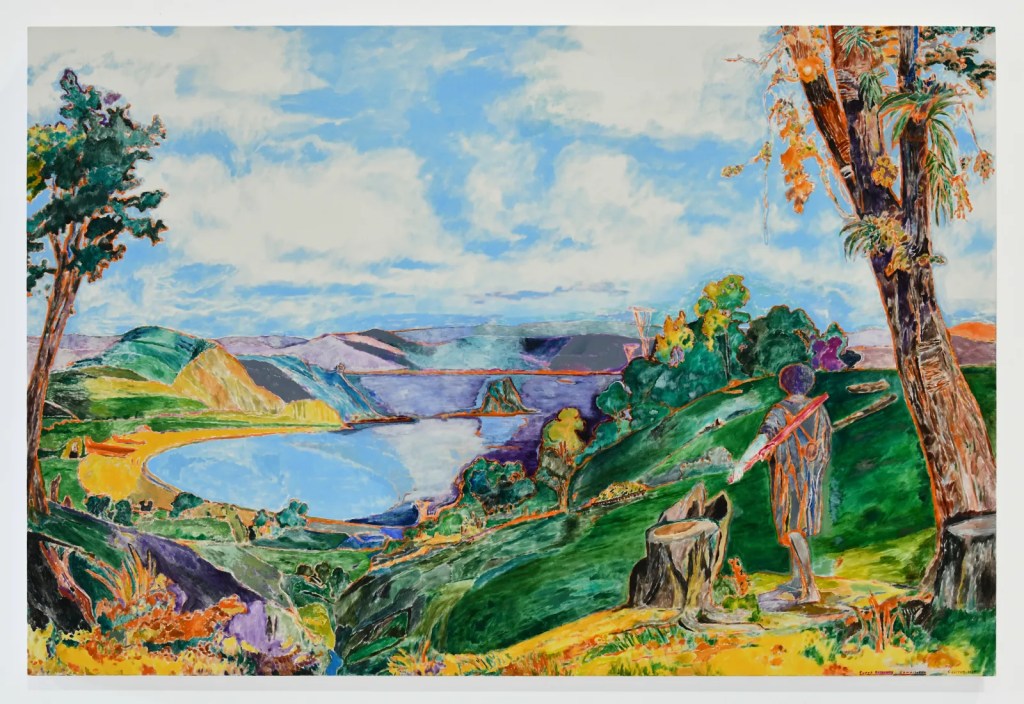
With his latest exhibition of “New Paintings” the artist  could be seen as entering his  Fauvist period with many of the paintings having the features of the Fauves. Those painters of the early part of the twentieth century employed simplified shapes along with intense and juxtaposed colours.

The “He Waka Karaka” ($9000) featuring a small  Pacific craft with a sail exemplifies this aspect with intense blues, purples and green while the large, colourful “Super Radiance” ($90,000) is an example of one of the new directions of Cottons painting – more traditional landscape painting. Even though his previous works have featured landscape forms these were generally refined and abstracted.

There are several works of Cotton’s Toi Moko works where the  tattooed and preserved ‘shrunken’ Māori heads reference conflict, trade, and repatriations. In works such as “The Great Attractors” ($55,000) the tattoo lines tracing out genealogy are linked to the notion of neural connections, knowledge links and computer networks.

Shane Cotton, The Great Attractors

Apart from the shrunken heads Cotton has rarely included figures in his work but in this show, there are several which connect with his living in Northland and revisiting some of his earlier work and the notions of colonialism and cultural exchange.

Shane Cotton, The Walker

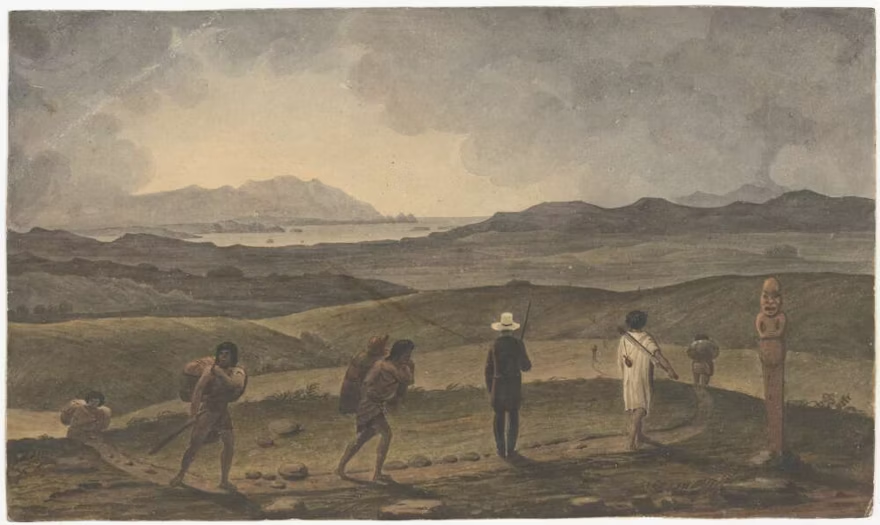
In “The Walker” ($8500) he has replicated the self portrait of the early explorer/artist Augustus Earle taken from Earle ‘s painting “Distant view of the Bay of Island”. Cotton has also appropriated another figure from the work , A Māori with a taiaha who is leading Earle . This figure is also present in “Super Radiance”, “Sunset Gate” ($48,000) and “He tangata hikoi” ($8500) acting as a guide through the landscapes of the North.

Augustus Earle, Distant view of the Bay of Island

Cotton has also used an image of missionary and publisher of Māori works Thomas Kendall taken from the painting “Hongi Hika and Waikato” with Thomas Kendall in England in 1820” by James Barry.

James Barry, Hongi Hika and Waikato” with Thomas Kendall in England in 1820

This image is used in the small portrait “Internal Visions” ($8750) and “The Visitation” ($8500) where Cotton has depicted him contemplating a colourful, modernist manaia form where in the original painting he is looking at Hongi Hika and Waikato.

Shane Cotton, The Visitation

There are also a few of the artists flower painting such as “Insert” ($12,500) which have developed over the years for his early  plant paintings.

There are a number of the artist’s three panel works most of which feature a manaia figure flanked by delicate foliage while others have landscape/vegetation  panels or in the case of ”Ahuaiti’s Cave” ($130,000) images of the sea. This work refers to the Ahuaiti who was rejected by her husband, forcing her to live in a cave on the Northland coast with her son Uenuku Kuare who is depicted at the base of the painting as a tiny figure, the same image as Earle’s guide  in “Distant view of the Bay of Island”.

Shane Cotton, Ahuaiti’s Cave

This linking of mythic figure to historical figure to an  invented guide inhabiting some the paintings is an example of Cottons ability to transition across myth, history, time and location.

To subscribe or follow New Zealand Arts Review site – www.nzartsreview.org.

The “Follow button” at the bottom right will appear and clicking on that button  will allow you to follow that blog and all future posts will arrive on your email.

Or go to https://nzartsreview.org/blog/, Scroll down and click “Subscribe”

Categories
Reviews, News and Commentary

Some Neo Impressionists: Gary McMillan and Elizabeth Rees

Reviewed by John Daly-Peoples

Gary McMillan, Scene 60 (detail)
Elizabeth Rees, Low Tide

Gary McMillan, City in Progress

Fox Jensen McCrory Gallery

September/October

Elizabeth Rees, The Bay

ARTIS Gallery

Until October 7

Reviewed by John Daly-Peoples

Two recent exhibitions see artists responding to the to the light, colours and textures of the environment just as artists of 150 years ago did with some variations on Impressionism.

In his latest exhibition “City in Progress” Gary McMillan has continued his depiction of views of the inner city, the motorways and industrial buildings.

These are nearly all seen from the interior of a car, capturing the often-fleeting images we have when driving. He also captures light in its various forms –sunlight at dawn and dusk, reflected light, refracted light, motorway lamps, industrial lights and traffic lights.

Each of the images has the simple title of “Scene” plus a number, an indication of the artist’s referencing photography and film which gives many of the works a slightly surreal quality.

As well as the connections to film and photography his work connects with traditional realist painting, pointillism and neo-Impressionism.

Many of the works capture the flash of recognition, of half seeing objects seen from a moving car as Scene 52 ($9500) – the rain speckled windscreen, parts of the car, overhead road signs, lamp standards and a blinding sun. They are the impressions  the brain takes in as it makes the journey.

Gary McMillan, Scene 63

Scene 63 ($9500) provides a complex view – light blooming on the car’s window screen, light shining through obscuring foliage, another view reflected in the cars side mirror. It becomes an image composed of different elements of light. But these various elements of light are all painted illusions created by the artist.

In these works, he investigates the way in which paint creates the illusion of the photographic pixel as well as the painterly impressionist dot.

At a distant his works look like photographs but as the viewer gets closer to the work one is more aware of the Seurat-like pointillism or the pixilation of low-resolution photographs.

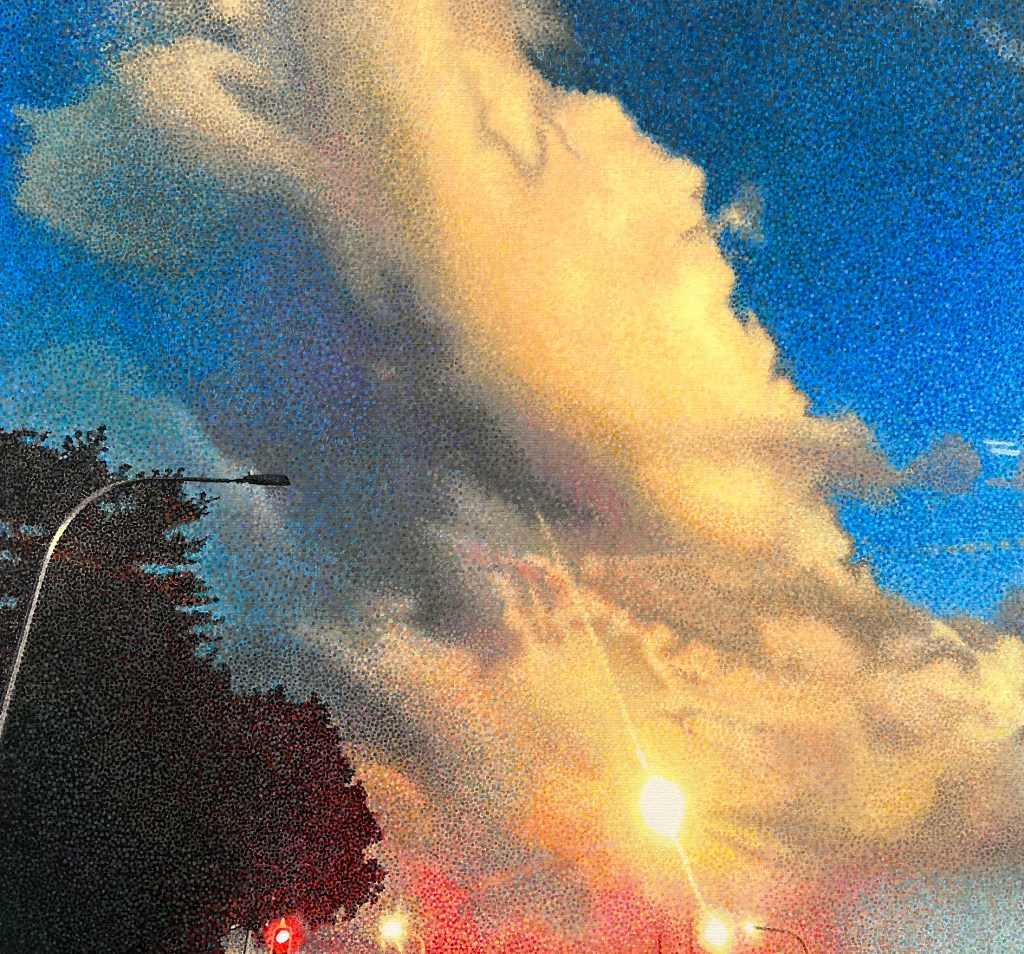
With “Scene 57” ($5500) the pointillism is far more apparent with the sky and clouds stippled with the small dots of colour. The artist has added a sense of structure to the work with parallel power lines and one of his ever-present lamp posts.

Gary McMillan Scene 60

This focus on sky and cloud is also seen in “Scene 60”($8000) where the billowing cloud looks like a massive explosion saturated  with colour.

Where Gary McMillans exhibition looks at the urban environment Elizabeth Rees’s work is focussed on an isolated area of Northland. As she notes in the catalogue – “”The Bay” is a response to my new small-town life in the Bay of Islands where light ever changes the sea and bushclad land. My recent acquisition of a boatshed in a small tidal bay has now become my full-time studio. Being surrounded by water, this change has offered me yet another perspective – being able so closely connected to the natural environment.”

Her paintings owe much to the style of the Impressionists with a sense of the artist painting in the open air surrounded by her subject.

In responding to an environment she feels some connection with these paintings are a record of the various times of day, moods and qualities of light she has observed

Many of her previous works featured figures in a landscape, their presence providing a sense of isolation. In these newer works it is the landscape itself which provides that sense of isolation.

Elizabeth Rees, A High Tide

Here there are brooding landscapes such as  “Summer Shade” ($10,000) where the touches of colour seep through the dark foliage.

With works like “A High Tide” ($8000)) the  colours are almost bleached out with light swirling around the shapes of trees.

Elizabeth Rees, On the Beach

A similar work “On the Beach” ($8000 where the foliage is almost shattered by light, could have been used as the cover illustration for  the Nevil Shute novel “On the Beach” which tells of impending nuclear pollution in the South Pacific

A further connection could also see the work in reference to the origins of the title in the lines from T S Eliots “The Wasteland”

In this last of meeting places
We grope together
And avoid speech
Gathered on this beach of the tumid river. connection

Two of the works features figures as in   “Low Tide” ($8000) where the small figures contribute to the sense of isolation and drama. “Last Light” ($10,500) feels less successful as the two figures contemplating the vista do not contribute to the  sense of remoteness.

With “The Bay” ($10,500) there is  more colour contrast with the blue of the water and the sky more dominant and the colours of the foliage picked out by light.

Elizabeth Rees, The Bay

“Nestled in the Bay” ($13,500) also alludes to the human presence with several low buildings or boathouses which merge with the light colours of the sand and sea.

The merging of sands and sea is also apparent in “Dunes Beyond” ($10,500) where the dunes seem to be the foam of crashing waves.

With nearly all these works it is light which is the dominant aspect with the artist endeavouring to create an ethereal presence of cloud and sky .The hills and foliage created with scumbled paint give a sense of seeing through a darkened or fogged glass.

Categories
Reviews, News and Commentary

Resetting the Coordinates of Performance art in NZ

Reviewed by John Daly-Peoples

Resetting the Coordinates

An anthology of performance art in Aotearoa New Zealand

Edited by Christopher Braddock, Ioana Gordon-Smith, Layne Waerea and Victoria Wynne-Jones

Massey University Press

Published September 2024

RRP $65.00

Reviewed by John Daly-Peoples

In 2014 The Walters Prize  included a work by Kalisolaite ‘Uhila where the artist inhabited the Auckland Art Gallery precinct for several months, living as a homeless person – eating sleeping and communicating with visitors, staff and other destitute  people. The work  was intended to draw attention to the plight of the homeless.

However, going to the gallery to find the ”art” and the artist necessitated searching the art gallery, the nearby park and streets until I found him wedged into an overhang on the gallery’s roof.

This search seemed more like a game of hide and seek rather than being immersed in a social /political experience /experiment. At the time It seemed to only involve me and the artist, reflecting on an encounter.

That encounter is what can loosely be called an example of  post-object art or performance art which has been evolving in New Zealand since the 1970’s.

With that encounter and many others one can see that performance  art requires an audience as well as documentation as many of the events are transient.

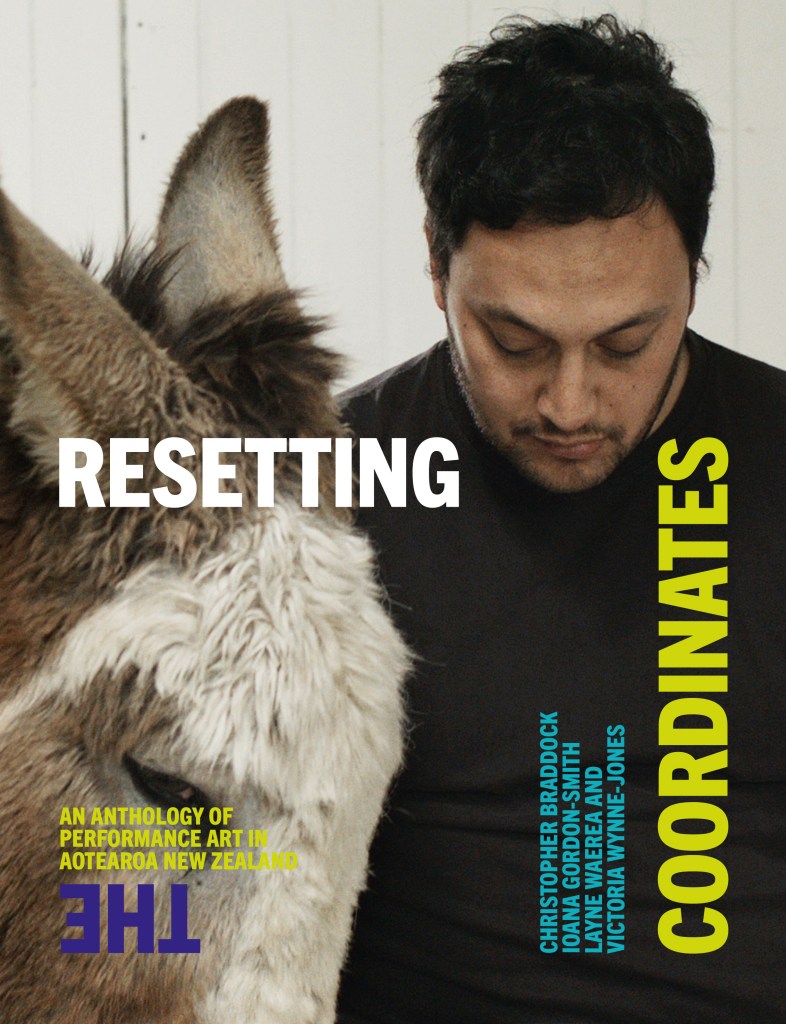
Now an  anthology/reader of performance art in New Zealand, ”Resetting the Coordinateshas been published,providing an in-depth survey of the artists and artworks in the  performance area which have happened over the past fifty years.

At the core of performance art  is the audience and the performer/artist,  the works having a theatrical element to them in which artist often draw attention to time, space, and body,

The  goal of these actions is to generate a reaction with themes which are commonly linked to life experiences of the artist themselves along with social and political criticism.

Darcell Apelu:, New Zealand Axemens Association: Womens subcommittee president
2 August 2014, documentation of performance.
Courtesy Artspace, Auckland. Photo by Peter Jennings

The book records a number of the activities which occurred as described in the introduction by editor Christiopher Braddock,

“If, on 2 April 1971, you had journeyed out across the unsealed metal roads to the west coast of the Tāmaki Makaurau Auckland region of the North Island of Aotearoa New Zealand, venturing as far as the remote Karekare Beach, to the north of Whatipu Beach and the great Manukau Harbour and south of Piha Beach, you would have come across the mystifying scene of ten people arduously sweeping the beach with long-handled yard brooms. “

Organised by Phil Dadson and colleagues this was the first in a series of purposeless works of which Dadson said : ‘This was work for the sake of the work, no particular purpose, no rewards’ across a ‘pointless-to-sweep stretch of beach’ in ‘communion with the elements and the place’.

These activities often existed outside the confines of the mainstream contemporary art scene  and were often undocumented. Many of the names included in the anthology will be recognisable because of their wide-ranging practice, others however have had lower profiles.

Central figures have been Phil Dadson, Jim Allen, Annea Lockwood, Peter Roche & Linda Buis, Andrew Drummond, Daniel Malone, Shannon Te Ao and Lonnie Hutchinson. There have also been numerous other practitioners who are included in the book.

Christopher Braddock, one of the editors says “Mainstream art history tends to prioritise static forms of art that are more commodifiable and saleable such as painting and sculpture. Anthologies often prioritise these artforms, such as Michael Dunn’s “New Zealand Painting: A Concise History| published in 2004. Furthermore, large-scale anthologies can cement these institutional prejudices, such as Hamish Keith’s The Big Picture: The History of New Zealand Art from 1642 (2007) which largely ignores performance art.”

The book underlines the fact that performance art is a distinctive part of recent art history, with its activities presenting  social and political  approaches which  emphasises the  connections between artist, audience and art critic /  historian.

These events often combined elements of anarchy,  humour, spirituality, repetition, the unplanned and unexpected.

There are a several chapters which examine the  history and development of performance art, some which look at the aspects of woman’s art practice, the development of Māori and Pacific based works, queer performance art and performance art in post -quake Christchurch.

There are numerous photographs and records of the activities which only give a limited appreciation of the performances such as Annae Lockwood piano burning while the multiple images of Andrew Drummond’s projects give some sense of the scale of his work.

CardboardConfessional_
Audrey Baldwin, Oscar Bannan, Bridget Harris, NeilMacLeod, Annemieke Montagne, Pat Parkin, Jennifer. Katherine Shield
2016, documentation of performance for the Centre of Contemporary Art Toi Moroki programme,Ōtautahi Christchurch.
Courtesy Centre of Contemporary Art Toi Moroki. Photo by Janneth Gi

Among the other projects included are the documentation project of the Christchurch “Cardboard Confessional” (2016) developed by Audrey Baldwin et al, Louise Potiki Bryant’s dance work “Te Taki o te Ua / The Sound of Rain” (2001), Jeremy Leatinu’u’s Queen Victoria (2013) where the artist contemplated statues of the queen,  Juliet Batten’s Women’s Project of 1985 at Te Henga Beach and Bruce Barber’s “Mt Eden Crater Performance  (1973) which was a collaboration with Solar Plexus as part of the drumming event initiated by Phil Dadson..

It is a fascinating book with lots of performances which have been rarely written about, seemingly lost to history but which tell us much about the social, political and spiritual examinations and soundings which artists have made.

The writers include  Natasha Conland, Gregory Burke, Ioana Gordon-Smith, Khye Hitchcock, Audrey Baldwin, Bruce E Phillips and Heather Galbraith

To subscribe or follow New Zealand Arts Review site – www.nzartsreview.org.

The “Follow button” at the bottom right will appear and clicking on that button  will allow you to follow that blog and all future posts will arrive on your email.

Or go to https://nzartsreview.org/blog/, Scroll down and click “Subscribe”

Categories
Reviews, News and Commentary

Three exhibitions: Max Gimblett, Phillipa Blair and Emily Wolfe

Reviewed by John Daly-Peoples

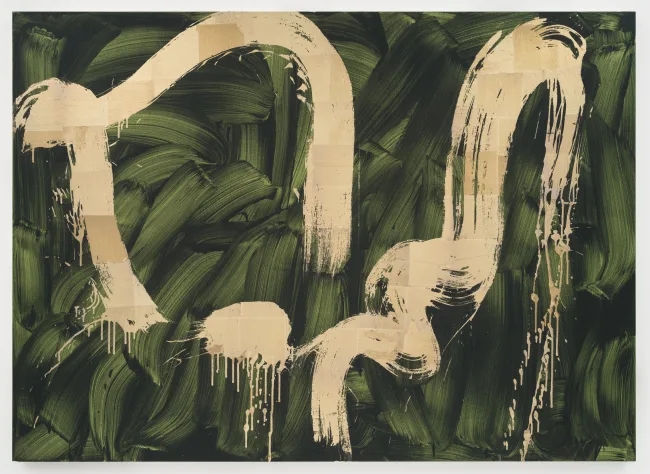
Max Gimblett, Holy Gesture and The Golden Mountain after Botticelli

Max Gimblett, Hands of Gold

Gow Langsford Gallery, Auckland

Until June 29

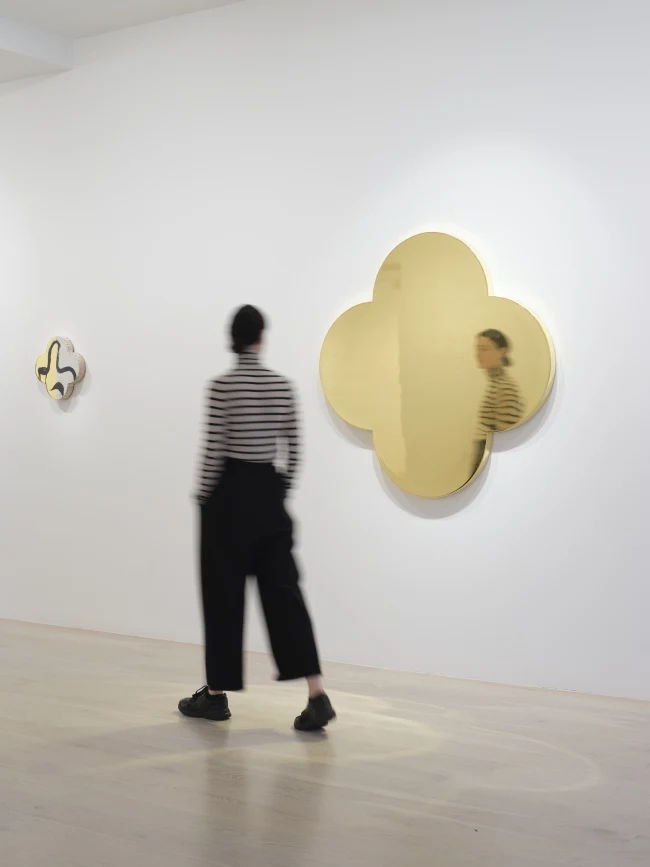
Max Gimblett’s Hands of Gold features a new set of painting many of which  make use of the  quatrefoil shape  which consists of four intersecting circles connecting at a central point is a feature in much Gothic and Renaissance architecture and art.

Gimblett also employs an elegantly or extravagant gestural brush stroke on several of  these works which have links to the calligraphic traditions of eastern art and links to the artists interest in Zen which he says has given him ‘The impulse is to feel. I paint without thinking, in an unconscious, free way.’  

This approach can also be seen to have links to the contemporary gestural art of the abstract expressionism of Jackson Pollock but with the gravitas of the Japanese artist Sengai Gibbon. These approaches have meant that his work has a sense of the instant -when emotion is realised and intuition revealed. 

Several of the works have a simplicity to them demonstrating the artists craftsman like approach which goes back centuries to medieval art. There is “The Golden Mountain after Botticelli” ($78,000) in which the artist has used gold foil over panel, creating an almost seamless reflective surface which becomes almost a sculptural piece. The reflective surface means that the viewer becomes an integral part of the work.

There are also smaller works such as “The Golden Diadem” ($20,000) where the gilded surface appears to be almost liquid, the paint sliding over the surface.

There are smaller versions of this large work such as “Eve” ($40,000) and “Moon Suite” ($60,000). where the artist includes a gestural sweep across the surface. These calligraphic strokes the artist employs look as though they trace out the trajectory of a magician wand  as in “Holy Gesture” ($28,000).

 In some cases these marks are only just visible and these is a sense of the calligraphy emerging magically out of the gilded surface of the work.

Max Gimblett, The River and the Jungle

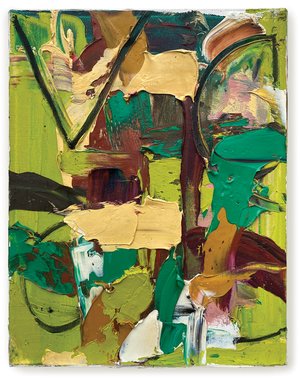
With the rectangular “The River and the Jungle’ ($85,000) the abstract patterns and the golden swirl takes on almost landscape features of  river threading through a lush green environment.

Phillipa Blair, Venice CA Revisited

Orexart

Until July 6

Phillipa Blair, Angelus Place 4

Orexart is presenting works by Philippa Blair which span  the period 1997 to 2006 and includes five  works she made in the late nineteen nineties with her husband John Porter in her Venice California studio. At the time, she was exhibiting regularly alongside contemporary American abstractionists in museum and gallery exhibitions  in Los Angeles and New York. 

At the heart of her work is the uncertainty and contradictions between chaos and order. This contrast can be seen in both the ideas which pervade the work as well as the physical making and arrangement within the paintings themselves, a duality which exists between the physical and the  spiritual, between the random and the deliberate.

The works in the exhibition can be read in a variety of ways – as  images relating to events in her personal life, those of the wider world or of abstract conceits.

There are several works under the general title  “Angelus Place” ($4800 each), after the street where she lived for many years. With their tightly massed colours one can detect elements of the physical location with hints of palm trees, the triangular shape of the studio roof and shafts of light.

There is a vibrancy to the artist’s work as with “O” ($35,000) with the striations across the surface creating rhythms which suggest dance or music. Her paintings dance with colour, shape and movement  and at the microscopic level it is the dance of the atoms.

Phillipa Blair, Breakdance

In the spacious Breakdance ($28,000) of 2006   the sense of dance is also present with jostling blocks of colour and dramatic swirls of paint.

The works all have an inherent  volatility and tactility, not so much of the artists applying paint but rather the colours and forms erupting out of the canvas to envelop the viewer.

While there is a tension between the notions of order and chaos implicit in the works there is also  the physical tension between the both the myriad colours  she uses and the various techniques she employs which sees areas of colours resisting, merging and colliding.

Emily Wolfe, Long Distance

Melanie Rogers Gallery

Until June 27

Emily Wolfe, Strata

Many of Emily Wolfe’s previous works had the look of paintings from a previous period and this latest exhibition “Long Distance “ there isa sense of searching for The Sublime, dwelling on  the beauty and drama of nature. The title  might also be referring back to that time, and the search for The Sublime. She is also  referencing her distance from New Zealand as all the works were painted  in London.

These paintings are about the nature of art itself, the colours, the quality of the light an interest in the depiction of surfaces and textures and an awareness of the painter’s skills and techniques in the pursuit of the illusions.

The works feature  sections of typical romantic landscapes – pastoral landscapes with distant hills, and  framing trees. The paintings also  feature clouds recalling the numerous cloud studies of John Constable.

Some of the works have a surreal quality, reminiscent of  Rene Magritte’s paintings with paintings such as “Drift” ($7000) where a painted section is overlaid onto a similar landscape view  of the exterior world.  That section could have come  from “Off Centre” ($7000) where a section of canvas has been removed from a painting created an empty space.

Emily Wolfe, Light Years

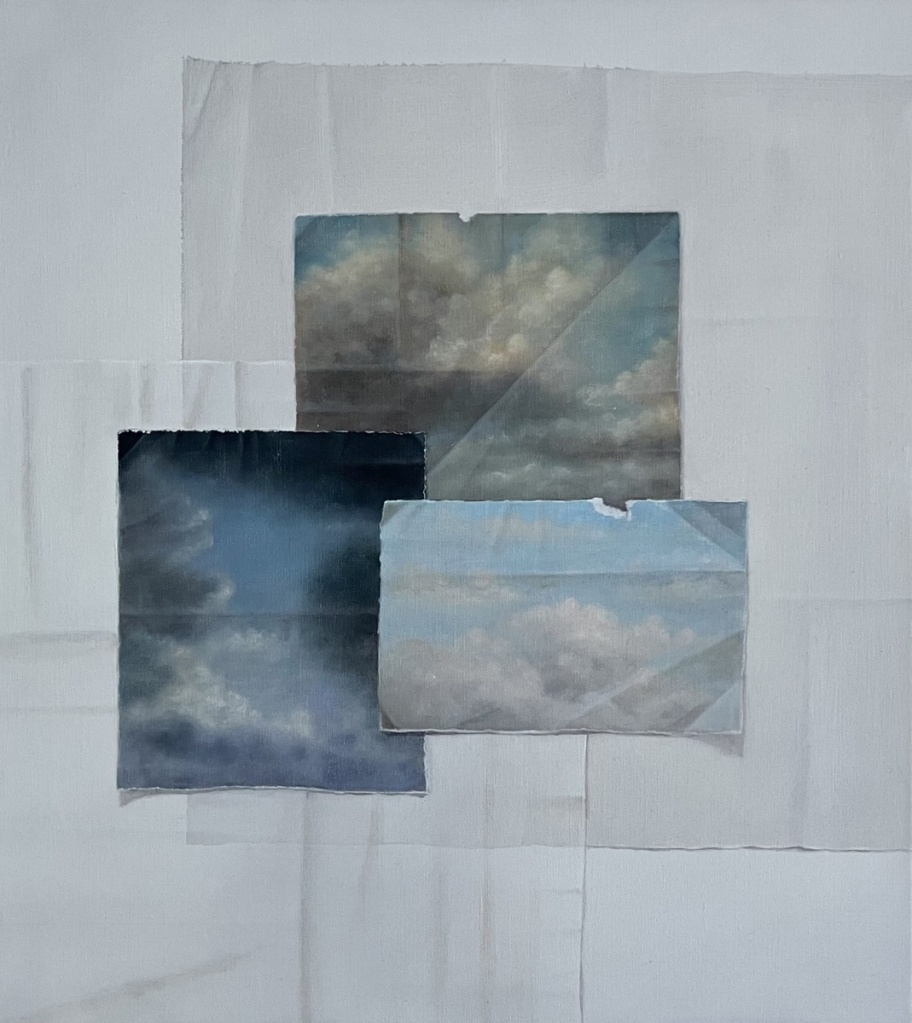
With “Light Years” ($7000) the artist has assembled five different pieces of paper  / canvas to create  collage of images for some  future work. They are like swatches of varying colour intensity and light which the artist is playing with.

 “Strata” ($14,000) is an impressive work featuring a  dramatic alpine vista in the taped to the wall and floor . Resting on the work is a sheet of paper and an old-fashioned T square. The inclusion of the T Square as well as  a tracing table in “Long Distance” ($14,000)  are references to the aids often used by artists in the construction of their work.

With all these works she displays a shrewd visual language where representation and reality are playfully deconstructed, where light becomes a palpable component of the work and where time   seems to  stand still.

To subscribe or follow New Zealand Arts Review site – www.nzartsreview.org.

The “Follow button” at the bottom right will appear and clicking on that button  will allow you to follow that blog and all future posts will arrive on your email.

Or go to https://nzartsreview.org/blog/, Scroll down and click “Subscribe”

Categories
Reviews, News and Commentary

New exhibitions by John Pule and Fatu Feu’u

Reviewed by John Daly-Peoples

John Pule. As we stood one misty morning near the ocean the desire the solitude gone gone forever

Haia

John Pule

Gow Langsford, Onehunga

Until June 8

Vai Manino

Fatu Feu’u

Artis Gallery

Until June 9

Reviewed by John Daly-Peoples

Two recent exhibition by Pacific artists focus on the ways in which artists draw on the physical and topographic  and historic , merging them, with social, political and personal insight and visions.

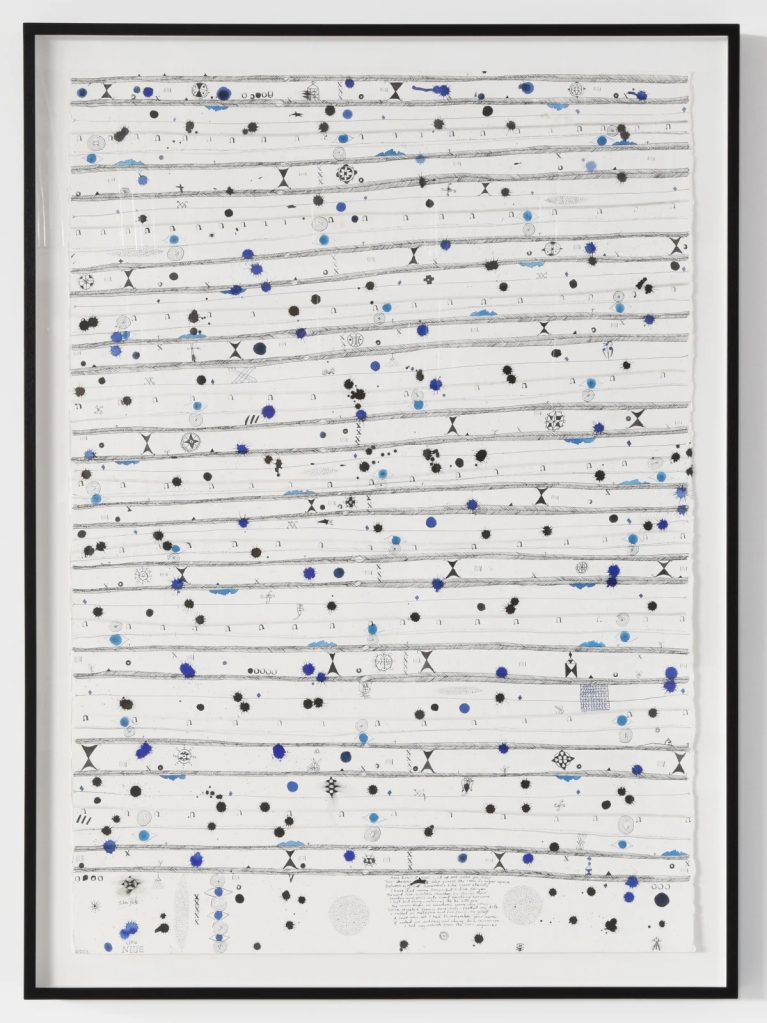
John Pule’s latest exhibition “Haia” was  the result of a nine-month residency in Niue provided by the government in 2023. The work contains much of the artist previous iconography but have a greater immediacy given the artists response to in his ancestral land.

The works are in a sense both a discovery and rediscovery  of the land and its mythologies as well as the artists own journeys.

As he says in his notes to the exhibition

“For nine months I rode my bike each day through the canopy forest from Liku to Alofi [around 15 kilometres]. Through rain or shine, winds, storm, or calm. The road is bordered with plantations, forests, tracks into the interior. Big blue skies and clouds, shadows of trees stretch across the makatea (limestone) road. Returning to Liku every evening, the sun is warm on my back.  These paintings and drawings are about that particular time.”

His works have often dealt with his growing up in New Zealand, his discovery of traditional Niuean art, the islands history, flora and fauna and developing his own iconography. This had led to him dealing with wider issues of colonialism, the impact of Christianity as well as  the mythology and spirituality of Niue.

John Pule. Many times at night I sit up and watch you sleep

Works such a “Many times at night I sit up and watch you sleep” with their strips of images – symbols, shapes and figures are like the trails that that the artist has ridden on his bike but also the pathways which reach back in time. They are analogous to the songlines of aboriginal art as well as the lines of musical compositions, imagining the way the sounds evolve, carrying a narrative expressing joy. sorrow and wonderment.

In the more dramatic paintings  such as “As we stood one misty morning near the ocean the desire the solitude gone gone forever” a road snakes into the distance and there are several figures  depicted recalling tales of the Bible and other mythological histories. 

The foliage depicted is at once colourful and local as well as surreal and mythological – a portrays of Pule’s Niue as well as an imagined paradise.

The pathways and journeys depicted in his paintings are metaphors for the artist’s own physical, spiritual and aesthetic journeys.

John Pule. Foulua Pukenamo Tau Misi

Other works such as “Foulua Pukenamo Tau Misi” feature plans,  grids and designs – locating islands, stars, measuring winds and sea currents, all ways of comprehending the environment

Fatu Feu’u. The Golden Age

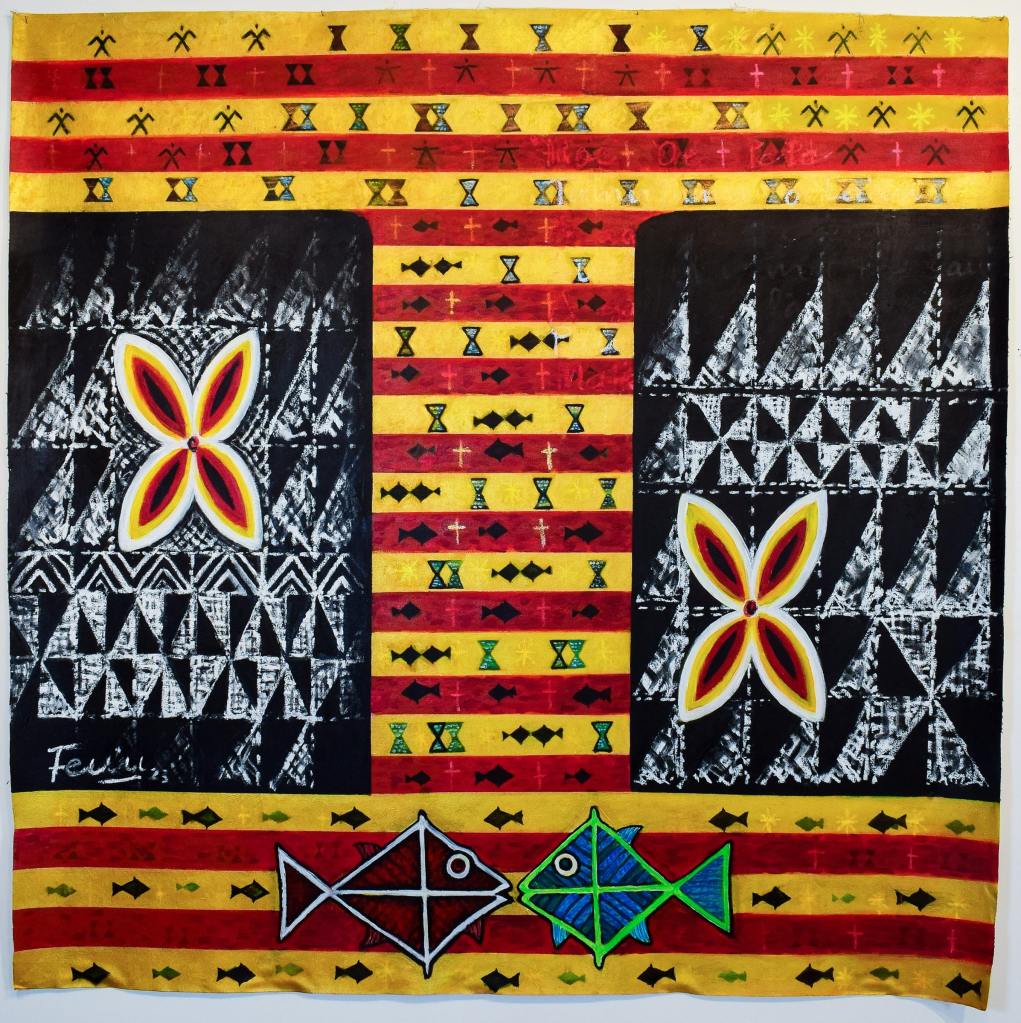
In his latest exhibition “Vai Manino” (Clear Water) Fatu Feu’u focusses on the social political and historical aspects of Samoan fisheries with works that follow on from his previous exhibitions which have  addressed social, political and environmental issues which are confronting Samoan society. Several are  based on the Samoan tradition of ‘ifoga’ or reconciliation/rebuilding with the dominating  central letter ‘I’ as a motif captures this, with different colours coalescing. The large “I” which he has used many times before also references Colin McCahons use of the letter / symbol.

His work draws inspiration from ancient designs and patterns – from tapa cloth. siapo, lapita pottery and tattoo along with contemporary Samoan design. There are also the influences of abstract art and that of other artists such as Colin McCahon and Tony Fomison.  The artist has employed shapes and symbols that he has developed over many years – masks, fish, birds and sails along with hints of human figures and landscape. Many of the siapo patterns themselves are derived from insects, leaves, shells, animals and fish.

Fatu Feu’u First Ritual

In many of the works such as “First Ritual” there are swirls of colours which seem to reference shoals of fish and  the ocean currents along with curving lines which can indicate the trawling nets used by fisherman.

Works such as “Pacific Conference II” have more complex structures with reference to the historical and mythological past pf the Pacific with an Easter Island monolith. The swarms of fish which morph into humans and birds refence journeys, distance and the dependence on the sea.

Fatu Feu’u. “Pacific Conference II”

Like the works of John Pule several of the paintings feature bands of colour representing journeys and histories. And with both artists there are gridded area which are related to cartography, structure and measurement

To subscribe or follow New Zealand Arts Review site – www.nzartsreview.org.

The “Follow button” at the bottom right will appear and clicking on that button  will allow you to follow that blog and all future posts will arrive on your email.

Or go to https://nzartsreview.org/blog/, Scroll down and click “Subscribe”.

Categories
Reviews, News and Commentary

Dear Colin, Dear Ron

Reviewed by John Daly-Peoples

Dear Colin, Dear Ron

By Peter Simpson

Te Papa Press

RRP $65.00

Reviewed by John Daly-Peoples

“I feel very strongly that where I’m going is where paintings must go.”

So wrote Colin McCahon in his  final letter to his friend Ron O’Reilly. The two of them had been writing to each other for thirty-seven years and in many ways their letters chart the history of McCahon to the point that he was justified in making such as statement.

This statement and other observations about his own art and the development of art in New Zealand over four decades are revealed in new book “Dear Colin, Dear Ron” by Peter Simpson. It adds new dimensions to our knowledge of the life of Colin McCahon as well as exploring the art scene of the 1940’ through to the 1980’s.

“Entombment (after Titian”), oil on cardboard on hardboard, 1947

Simpson has brought together the correspondence of Colin McCahon and O’Reilly who first met in 1938, in Dunedin when McCahon was 19 and O’Reilly 24. They remained close, writing regularly to each other until 1981, when McCahon became too unwell to write.

Their 380 letters, more than 165,000 words covers McCahon’s art practice, the contemporary art scene, ideas, philosophy and the spiritual life. Their letters deal with a wide range of interests and reveal two men deeply committed to the notion that art can make  a difference to society ..

O’Reilly was a philosophy graduate who for many years worked for the Canterbury Public Library where he was influential in showing and collecting the work of McCahon. He subsequently became the director of the Govett Brewster Art Gallery.

This regard for each other can be seen when McCahon applied for job at Elam . O’Reilly wrote: ‘After years of viewing, as I know from the works of his that I possess, one is still discovering more in them, is still more and more impressed by the acuteness of the perception, the fineness of the thought and the breadth of the compassion revealed in their artistry. There is no other artist in New Zealand of whom I would say this. It should be clear that I regard Mr McCahon as the foremost painter in New Zealand and a very great man.’

Reilly’s respect for McCahon can be seen throughout the letters along with his intense interest in getting the rest of New Zealand to see the value of the artist’s work and he worked tirelessly to organise exhibitions of the artist’s work.  

Their friendship and correspondence brought out the best in each other – intelligence, empathy, compassion, loyalty, trust: these qualities are obvious  through the letters as though the two men appreciated that the issues the y were addressing were important to themselves as well as for posterity.

The book is illustrated with 64 images of McCahon’s work along with some of the drawings which the artist included in some of his letters to illustrate idea about composition.

The letters reveal O’Reilly to be a more intellectual and focussed thinker with carefully considered pieces of writing  while McCahon’s responses  seems to be more urgent but there are many passages of serious reflection.

The book is sprinkled with snippets of information about other artists, exhibitions and the art world  generally   which provides a sense of the emerging art scene.

There is Ron O’Reilly’s reports on talks by the visiting British critic Herbert read in 1963  and the American critic  Clement Greenberg in 1968 where the notions of international versus the local and the local were addressed.

There is also references to the arts politics of various arts institutions, art events and artists. In a couple of letters Ron O’Reilly (at the time the director of the Govett Brewster Art Gallery) writes about Billy Apple who was going to have a show at the gallery. He notes that ”Billy is a good man and a serious and dedicated artist. He is also touchy and won’t play when people want to use him or assume ever so bigheartedly that he is an entertainer cum pervert or treat him as a bum”.

The letters are full of such perceptive observations about artists and institutions. They also provide a fascinating insight into a relationship which is both personal as well as verging on the philosophical and spiritual as they both try to understand  their own and each other’s motivations and ideas.

Simpson says there are many interesting comments  about the nature of the paintings in the letters. In 1950 “Colin spoke of making changes to Easter Morning, a painting Ron especially liked. Ron wrote: ‘I am sorry you felt the Easter Morning needed altering: no doubt there are things one is trying for which are not achieved to satisfaction: however I wonder if one ever does achieve them by long labour on the same work. That picture had a magnificent feeling: the quiet movement of the women, the expectancy the fulfilment, the lovely early morning light . . . What you do is so good, so good, it doesn’t seem to me to matter much if you leave a painting which is not quite what you want: the development goes on so richly’. Colin replied: ‘About repainting, I don’t know, but I think Picasso is right that nothing is lost the destroyed discovery reappears in a new and better form. The Easter Morning is certainly better. The three women [in The Marys at the Tomb] remain – the alterations are to the angel[;] he has been enlarged & the landscape, lowered & the colour gone from blue to red[;] there is now a warmth as well as early morning coolness & a less cramped appearance to the whole picture.’

McCahon makes many comments about his own work. At one point in 1958  when he was working on the panels for “The Wake” which was based on the  John Caselberg poem he write to O Reilly saying

“The Wake” (panel one) ink and oil on unstretched canvas on sixteen panels, 1956

“I don’t understand the poem with any thoroughness at all either before I started work on it or when I finished. The feelings of what was being expressed comes over strongly – all builds into one feeling & builds this very largely by piling up of word on word in just such a relentless fashion”. Then in reference to the opening line of the poem,

“Your going maims God: God”

He writes “It is a line where bitterness is so strong that all the other feelings seem cancelled  & is I feel foreign to the quality of a wake.”

But just a few lines later he writes “I think I’m wrong in what I say of the first line. I can’t work out what I do feel about it…No doubt this bitterness is right as a start.”

The book is  a masterpiece of academic scholarship and shows a daunting level of  hard work with Simpson transcribing the letters as well as researching and writing 1500 explanatory notes to make the contents of the letters fully accessible to contemporary readers.

O’Reilly’s son Matthew O’Reilly and McCahon’s grandson Finn McCahon-Jones contribute insightful essays that round out the unique perspective the letters afford.

Categories
Reviews, News and Commentary

Multi-million dollar gift goes on show at the Auckland Art Gallery

John Daly-Peoples

Pablo Picasso, Mère aux enfants à l’orange (Mother and children with an orange), 1951, 
Auckland Art Gallery Toi o Tāmaki, gift of Julian and Josie Robertson through the Auckland Art Gallery Foundation, 2023

The Robertson Gift: Paths through Modernity

Auckland Art Gallery

February 9 – February 2026

Opening at the Auckland Art Gallery on 9 February and running for two years will be the exhibition “The Robertson Gift: Paths through Modernity” comprising fifteen major artworks valued in excess of $250million. The works are a long-promised gift from the collection of New York philanthropists Julian (1932– 2022) and Josie Robertson (1943–2010).

The collection features influential modern European artists, including Pierre Bonnard, Georges Braque, Paul Cezanne, Salvador Dalí, André Derain, Henri Fantin-Latour, Paul Gauguin, Fernand Léger, Henri Matisse, Piet Mondrian and Pablo Picasso.

Director of Auckland Art Gallery, Kirsten Lacy says that the Gallery could not realise such a selection of artworks without Julian and Josie’s vision.

“Patronage of this scale is unprecedented, and the collection of modern masterpieces is unique. The Robertson’s gift is unquestionably the most transformative bequest of international art to the country in the past century,” says Lacy.

The couple divided their lives between New York and Aotearoa New Zealand ever since their first visit to Tāmaki Makaurau Auckland in 1978–1979. The Robertson’s extraordinary gift acknowledges the lasting connections the couple formed with Aotearoa New Zealand and their passion for modern art. Robertson was an investor and developer in the US and New Zealand. He owned three lodges including  Kauri Cliffs Lodge and several wineries. He was also one of the few non-New Zealanders to receive a knighthood.

Beginning with post-Impressionist works of the late 19th century and ending with a monumental colour-field painting from the 1960s, the exhibition takes visitors on a journey through the major art movements of the modern era, including Impressionism, Post-Impressionism, Fauvism, Cubism, Surrealism, and post-war abstraction.

Henri Matisse, Espagnole (buste). (The Spanish Woman), 1922. Auckland Art Gallery Toi o Tāmaki, gift of Julian and Josie Robertson through the Auckland Art Gallery Foundation, 2023

Included in the 23 mainly works on paper  by Matisse is “Espagnole (buste) [The Spanish Woman]” painted in  1922. The work was purchased at Sotheby’s in 2007 for between  USD 12,000,000 – 16,000,000 .

The auction house described the work as one of the finest portraits from Matisse’s Nice period of the 1920s, when his skills as a colourist were at their most expressive.   This is one of his more intimate compositions that allows for a close engagement with the young model, who is dressed in the exotic costume of a Spanish women.  Matisse’s best pictures of this period focused on light-filled, and often profusely decorated interiors, with seductive models.

The work is very similar to “Espagnole: Harmonie en bleu (Spanish Woman: Harmony in Blue)” of the same period which is in the collection of the MET in New York.

André Derain, Paysage à l’Estaque (Estaque Landscape), 1906, Auckland Art Gallery Toi o Tāmaki, gift of Julian and Josie Robertson through the Auckland Art Gallery Foundation, 2023

Derain’s  “Estaque Landscape” of 1906 was painted when the artist and Henri Matisse, spent the transformative summer of 1905 in Collioure in the south of France. Together, they painted similar views of the coastal village, encouraging one another to adopt brighter colours, bolder brushstrokes, and flatter compositions in their depictions of the surrounding landscape. This style of painting, became known as Fauvism

A recent Christies Auction featured a similar work which sold for USD $5,580,000

Georges Braque, Le Guéridon (Vase Gris et Palette). Pedestal table (Grey vase and palette), 1938, Auckland Art Gallery Toi o Tāmaki, gift of Julian and Josie Robertson through the Auckland Art Gallery Foundation, 2023

Georges Braque, said of works such as  “Le Guéridon (Vase Gris et Palette). Pedestal table (Grey vase and palette)”, “No object can be tied down to any one sort of reality. Everything, I realized, is subject to metamorphosis; everything changes according to the circumstances. So when you ask me whether a particular form in one of my paintings depicts a woman’s head, a fish, a vase, a bird, or all four at once, I can’t give you a categorical answer, for this ‘metamorphic’ confusion is fundamental to what I am out to express”

Fernand Léger, Les Pistons (The Pistons), 1918, Auckland Art Gallery Toi o Tāmaki, gift of Julian and Josie Robertson through the Auckland Art Gallery Foundation, 2023

Fernand Léger’s, Les Pistons (The Pistons), of 1918, is from a series  which references  contemporary urban life and features many abstract shapes including mechanical, tubular forms, discs, vertical, horizontal and diagonal bands of colour as well as other less clearly definable shapes that coexist with glimpses of modern urban architecture and the anonymous citizens who animate it.

Salvador Dalí, Instrument masochiste (Masochistic Instrument), circa 1934, Auckland Art Gallery Toi o Tāmaki, gift of Julian and Josie Robertson through the Auckland Art Gallery Foundation, 2023

Salvador Dalí’s, “Instrument masochiste (Masochistic Instrument)’ shows a nude woman shedding a part of her skin in the form of a violin. The violin is the protagonist and the woman is an antagonist in the painting. Symbolically, it identifies Dali’s strong resistance towards music. The bow hitting the cypress tree adds his imagination of equating music with mortality and despair. It also represents Dali’s impotence obsession and overall neurosis. The cypress trees reminded him of the Pitchot estate, where he would spend long, happy hours in erotic daydreams.

Another of the works from this series sold recently 2019 for GBP 611,250

Paul Gauguin, Cow in Meadow, Rouen, 1884, Auckland Art Gallery Toi o Tāmaki, gift of Julian and Josie Robertson through the Auckland Art Gallery Foundation, 2023

Paul Gauguin’s “Cow in meadow Rouen” is part of a group of interrelated paintings, where he focused his attention on rural views such as a stream where cows came to water, selecting a different vantage point for each composition
Three or four canvases from this experimental group were among the nineteen paintings that Gauguin showed at the eighth and final Impressionist Exhibition in 1886.

A similar work from the period sold in 2019  for USD 783,750

Pablo Picasso, Femme à la résille (Woman in a hairnet), 1938, Auckland Art Gallery Toi o Tāmaki, gift of Julian and Josie Robertson through the Auckland Art Gallery Foundation, 2023

Pablo Picasso painted “Femme à la résille (Woman in a hairnet)” in 1938, at the height of his relationship with the photographer Dora Maar

A similar work from the series but twice the size of the Robertson work sold at Christies in 2015 for USD67million.

The other Pablo Picasso in the collection, his “Mere Aux Enfants A L’Orange” was sold at Sotheby’s November 2002. for USD 3,639,500

 To subscribe or follow New Zealand Arts Review site – www.nzartsreview.org.

The “Follow button” at the bottom right will appearand clicking on that button  will allow you to follow that blog and all future posts will arrive on your email.

Or go to https://nzartsreview.org/blog/, Scroll down and click Subscribe