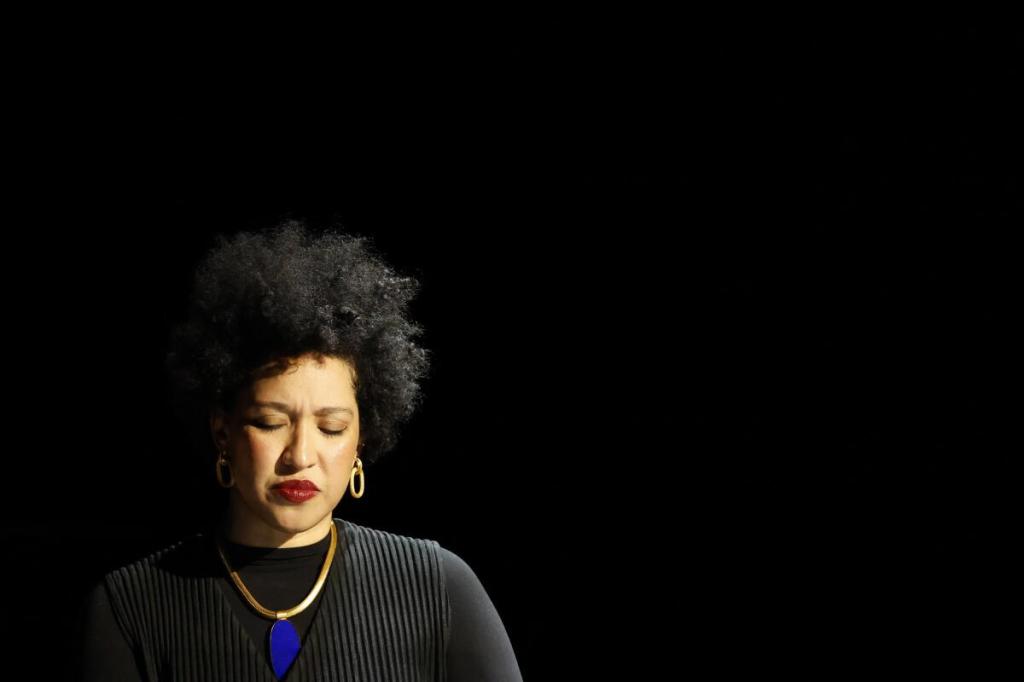
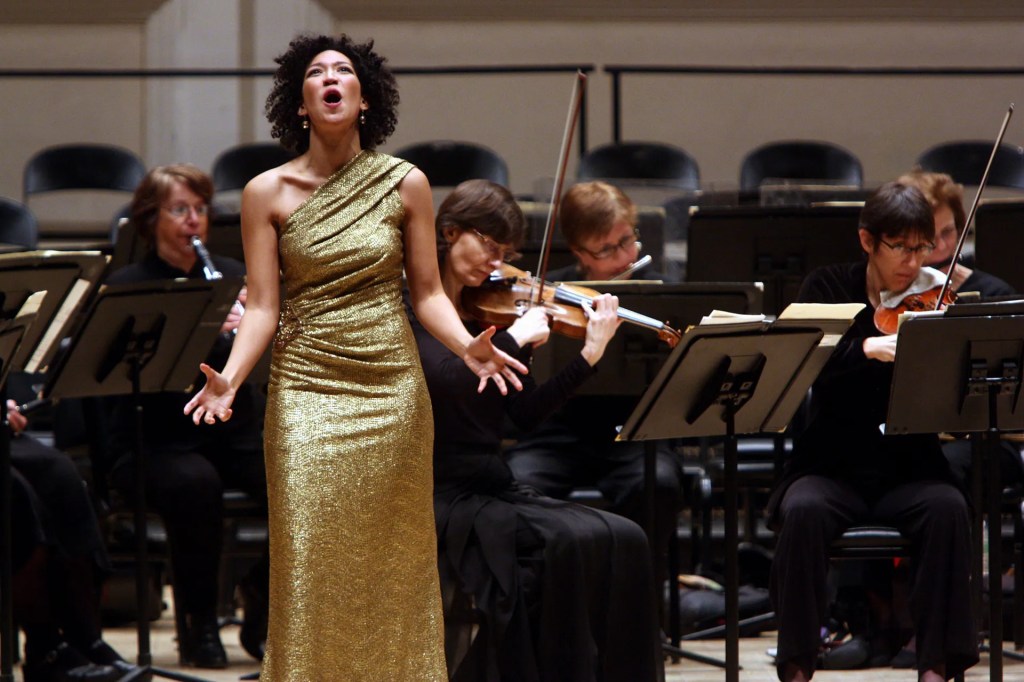
In her recent concert at the Auckland Town Hall Julia Bullock sang a group of songs which she considered as having an “American” sound. These included George Gershwin, Leonard Bernstein and Margaret Bonds. Bonds is a pianist / composer who Bullock has championed for several years a major black composer who was overlooked for many years primarily due to systemic racism and sexism in the classical music industry, exacerbated by the loss of her manuscripts and a lack of publication.
Bullock included three settings of poems by Langston Hughes – “The Negro speaks of Rivers”, “Winter Moon” and “Poeme D’Automne” which gave voice to black aspirations in the 1920’s. With Bullocks singing of “The Negro speaks of Rivers” she provided a fine sense of the Negro spiritual, the softness of her delivery veiling a strong, insistent voice and a slowly developing dramatic force. Her voice delivered an emotional and haunting tone capturing the essence of heritage and endurance.
“Poeme D’Automne” was an astonishing song in which images of falling leaves and the colours of autumn were linked to the human body. She sang this with a surging operatic voice providing and intense and emotional sound.
“Winter Moon” was a short piece, but it showed that Bond was not just writing music to accompany the words of the poem, she had the ability to write dramatic meaningful music.
She sang Stephen Sonfheim’s “Somewhere” as though it was an anthem for the displaced and disadvantaged – a piece very relevant today’s America. There was also the poem “To Julia de Burgos” by Bernstein, a vibrant piece of music which spoke of an angry revolutionary adventure in which she projected the words as though a personal statement.
She also sang a couple of George Gerswin songs, “Somebody from Somewhere” and “Summertime “from “Porgy and Bess”.
She also sang “La Conga Blicoti” a vibrant, Afro-Cuban jazz-influenced song performed by Josephine Baker with the Lecuona Cuban Boys, which features a distinctive conga rhythm.
She also sang Billy Taylor’s “I wish I knew how it feels to be free” like a requiem or funeral lament, very appropriate as a song for freedom.
There was also “I have Two Cities” by the French composer Henri Varna and lyricist Geo Koegar with lines such as
Manhattan is beautiful,
But why deny it.
What enchants me is Paris,
All of Paris
Which she sang as a hymn to Josephine Baker.
The concert opened with the Auckland Philharmonia playing Erich Korngolds “Theme and Variations” and closed with them playing Kurt Weill’s “Symphony No 2”.
Bullock has an affinity for the outsider artist which has led to her interest in Josephine Baker who made the journey from the US to Europe where she made her name while the two composers became outsiders under the Nazis and were forced to move from Europe to the US.
Korngold who was a major composer in Austria influenced the style of composition and singing in the 1920’s and 30’s with operas such as “Die Tote Stadt” while Weill was influential in bringing Bertolt Brecht’s work to the public with works including “The Threepenny Opera”.
Julia Bullock, Bluebeards Castle, Sincere Apologies
The New York Classic review last year featured a review of Julia Bullock by Rick Perdian
“It would have once been almost impossible to imagine a vocal recital by a major artist with songs by Alban Berg, Bob Dylan, and Rodgers & Hammerstein on the program. These are different times, however, and what once would have been dubious box-office is now perfectly attuned to the times.
Bullock opened the recital with songs by Samuel Barber, whose embrace of Romanticism put him at odds with the more progressive elements of the musical establishment in mid-twentieth-century America. The three songs which she sang—“My Lizard (Wish for a Young Love),” “Nuvoletta,” and “The Daisies”—outlined the wistful nostalgia, zaniness, and embrace of the bizarre that would course through the recital.
As with the Barber songs, Bullock performed songs by Kurt Weill which spanned the composer’s career from his collaboration with Bertolt Brecht in Germany to his Broadway hit, Lady in the Dark.
The outlier was the first, “Complainte de la Seine,” which Weill composed in Paris after fleeing Nazi Germany. This setting, like earlier songs dating from Weill’s collaboration with Brecht, “Ballade vom ertrunkenden Mädchen” and “Song of the Hard Nut,” show the composer at his most hard-edged and bleak. With crystalline tone, perfect pitch, and a delivery void of sentiment, Bullock sang of cadavers resting at the bottom of the Seine, the Marxist revolutionary Rosa Luxemburg’s decaying corpse in a Berlin canal, and the calculated transactions that fuel capitalism. With “The “Princess of Pure Delight,” Bullock switched gears, projecting a cool sophistication that evoked the era.
Bullock’s most sublime singing came with Berg’s Altenberg Lieder. Viennese audience’s greeted the songs with such derision in 1913 that Berg never permitted them to be performed during his lifetime. The five songs are settings of enigmatic verses by the poet Peter Altenberg which he sent to friends on postcards.
A substantial portion of the second half of the recital was devoted to songs by Richard Rodger and Oscar Hammerstein. Bullock told the audience that their music had been a part of her life from her earliest years growing up in St. Louis. “Dites-Mois” from South Pacific was the first song that she ever sang in public at the age of ten before an audience of thousands.
The audience was enthralled as Bullock sang some of the greatest hits from The Sound of Music and South Pacific. For the most part, these were straightforward renditions of beloved songs, but Bullock and Brown could be provocative, such as in “You’ve Got to Be Carefully Taught” from South Pacific. Bullock delivered the song’s message with a matter-of-fact directness which was intensified by Brown’s punctuation from the piano.
There were also songs linked to Odetta Holmes,who was known as the voice of the American civil rights movement in the Sixties. Bullock sang Bob Dylan’s “Masters of War” with a penetrating, unflinching directness. Odetta’s arrangement of “Going Home” and Elizabeth’s Cotten’s “Freight Train” followed.
Bullock ended the recital with Converse’s poignant ballad “How Sad, How Lovely,” a meditation on the loveliness and sadness of life.”
Bluebeards Castle
This version of Bluebeards Castel was previously performed in Wellington and Christchurch in 2023. Elizabeth Kerr reviewed the work in Five Lines.
“The dramatic trajectory of this contemporary production of Bluebeard’s Castle is vivid and deeply moving from its opening bars till the passionate conclusion. ..For me, its greatest wonder is the faithful use of the original text and music to tell a tragic story of today, a superb creative reimagining of Bartók ‘s only opera.
Bartók wrote Bluebeard’s Castle in 1911. He was 30 years old. The Gothic work, with a libretto by the composer’s friend, poet Béla Balázs, was based on the French folk tale published in the 17th century by Charles Perrault.
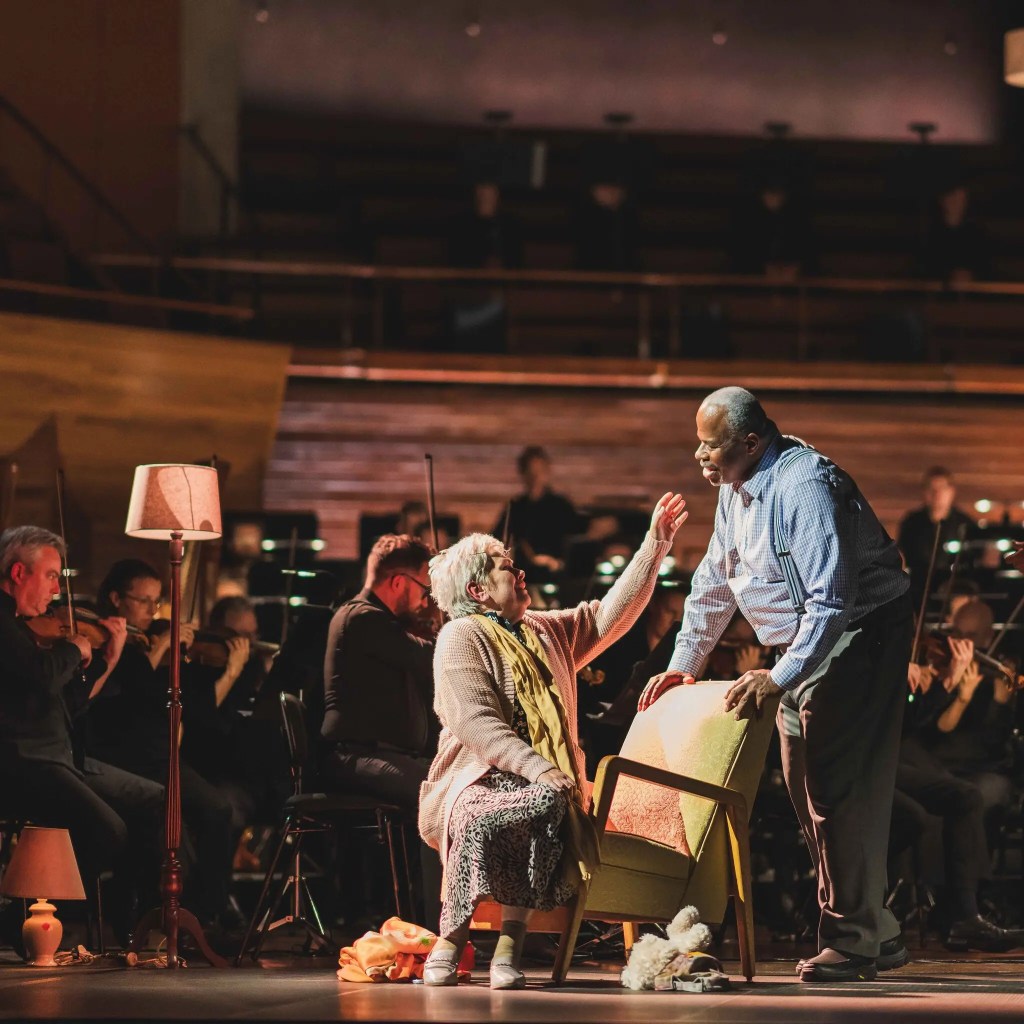
The opera has a singing cast of two with a full orchestra. The role of Bluebeard is sung in this New Zealand performance by US baritone Lester Lynch, and his wife Judith by UK soprano Susan Bullock. As the semi-staged production opens, the strings of the NZSO set a rather creepy mood. The couple arrive onstage, Judith appearing confused and troubled. “If you left me, I’d be lost and all alone here,” she sings.
In the original, Judith was Bluebeard’s very young wife, brought to his cold, dark castle and confronted by seven locked doors, which open in turn throughout the opera, revealing their disturbing contents. The locked doors are replaced by a suitcase, and from it are drawn contents representing memories of Judith’s life and their relationship.
Bluebeard’s Castle is often described as a Symbolist opera and symbolism remains strong in this production. ..This is the writing of a young Bartók, strongly influenced by Romantic composers and Debussy, and his score, including the challenging and chromatic vocal lines, is beautiful, colourful and lush. It is also highly dramatic and alongside the theatrical symbolism are meaningful musical motives, most noticeable the “blood” motive of a minor second, a semitone, appearing whenever Judith, remembering past losses and fears, refers to blood.
A final “door” brings the impassioned denouement. “When this door is opened, Judith, you will find my wife there waiting”, sings Bluebeard, handing her a mirror from the suitcase. The poetry in the libretto really blooms here, as Bluebeard sings of his former wives, the young lover, wife of the dawn, the young wife of his “noontime”, the mother, wife of his evening.
The younger wives return, also holding mirrors, and as Bluebeard sings of each, Judith offers a repetitive and sad little refrain from her chair. “Ah, compared to her, I am nothing.” But she is, he tells her, his wife of the night. Musically, Bartók brings the opera to its big romantic climax. “Eternal beauty!” sings Bluebeard. “Now, all turns to darkness.”
The mood in music and staging fades quietly. Tenderly, Bluebeard brings Judith a cup of tea. The lights also fade to blackness.”
Sincere Apologies
“Sincere Apologies” is an Australian production with relevance to New Zealand with a recent review of the production in “My Melbourne Arts” praising the low key, audience based play.
“Sincere Apologies” begins unassumingly: an envelope is handed to an audience member and it is passed from hand to hand. No words are exchanged, no introduction is made, no actors are present. It’s just a low-key game of “pass the parcel” that opens the door to a chorus of voices and a world of regret.
Fifty real apologies are sealed inside fifty envelopes that are distributed to the audience. These span from 1990 all the way into the future, each one factual and collected from documented expressions of remorse by public figures, private correspondence, and personal moments by the shows three creators, Dan Koop, Jamie Lewis and David Williams. One by one, in numerical order, audience members step up to a microphone and read them aloud.
Some are weighty and political – a Prime Minister’s apology to the Stolen Generation or BP’s statement following an oil spill. Others tap into pop culture’s hall of infamy – like Kanye West and Taylor Swift. Then, there are the apologies from the creators themselves, adding a deeper intimate layer to the mix. There are no actors in Sincere Apologies. No one introduces the show or welcomes the audience. Even at the end, when we clap, it’s not for performers on stage, but for each other, and the three tech staff quietly stationed in the corner. The audience is the cast, and in that shared vulnerability something almost communal forms. Strangers stumble over words, laugh nervously, or surprisingly choke up. You start to listen differently, not as a spectator, but as part of a temporary community bound by confession.
As the reading unfolds, you find yourself unexpectedly drawn in, paying attention not only to the words themselves, but to the way they are spoken. Stripped of power, fame, and PR polish, these words take on new meanings. When random people speak them, they can come across as absurd, hollow, or even heartbreaking and genuine. The performance asks: what happens when we remove status from an apology? Can tone, delivery, and intent make any acknowledgment register as authentic – or insincere?
A carefully crafted score heightens the work, as subtle sound effects and rhythmic pulses heighten particular instances, building a hypnotic rhythm that pulls the audience into this collective act of reckoning.
By the end, this experience is strangely moving. There’s humour and absurdity, yes, but there is a weight to hearing the people in the room attempt to make things right. It’s exhausting and cathartic, and a reminder that “sorry” is both universal and endlessly complicated.”
The message came though just a short time before the NZSO’s “Summer Nights” concert – “Due to the global grounding of Airbus aircraft today, the NZSO can’t fly enough players from Wellington to Auckland to perform Bruckner’s Seventh Symphony in tonight’s programme. It has been replaced by Mozart’s Symphony No.41 Jupiter
The change does not impact on American mezzo-soprano Joyce DiDonato’s debut with the NZSO in Auckland tonight.
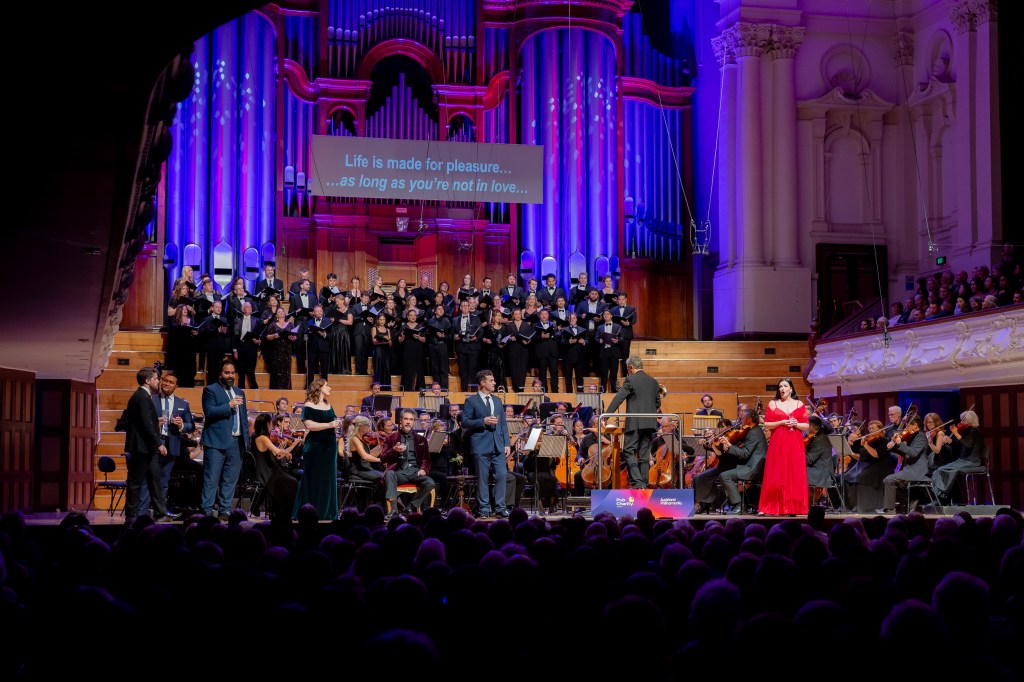
So, it was the Mozart symphony No 21 which opened the “Summer Nights” concert with Berlioz’s “Les Nuits de ete” becoming the major work of the concert featuring Joyce DiDonato’s.
The song cycle is a setting of six poems by Theophile Gautier which Berlioz began in 1841. The work which began as a piece for soloist and piano accompaniment was later orchestrated with an additional song in 1856. It is now one of the composer’s most popular works.
The theme of the work is the progress of love, from youthful innocence to loss and finally renewal.
The opening “Villanelle” invites the beloved to wander through the forest in springtime and features a simple, melody above a chirping accompaniment but there were intimations of darker forces hovering above the surface.
There followed the evocative “The Spectre of the Rose”, the lament “On the lagoon”, the chilling “In the Cemetery” and onto the surreal “Unknown Sea”, depicting a lover steering a ship into the unknown future.
Along with her expressive voices DiDonato conjured up the notion of the lover with gestures which reinforced the text.
Between the songs she appeared to enter a period of repose in which she contemplated the sounds of the orchestra as well as apparitions in the hall as though taking inspiration from them
Her ravishing voice, full of depth flowed effortlessly around the hall, along with the inventive music – the soft pizzicato of the strings or the almost whispering sequences of the strings where the orchestra played what seemed like the soft rumour of a voice.
Then her voice would be increasingly dramatic, singing with an intensity which hovered over the orchestra like cloudburst, a voice which could shatter glass as well as hearts.
She was very attentive to Conductor New, the orchestra as well as the audience and with many of the sequences her forceful gestures and demeanour meant that her singing took on a more operatic dimension, her singing drenched with power and emotion which almost overwhelmed the orchestra.
After rapturous applause she delivered two powerful encores. The first a stunning interpretation of Bizet’s “Habanera” from Bizet’s Carmen which she delivered in true operatic style. This was followed by “Somewhere over the Rainbow” a song which was personally relevant to be sung by a gal from Kansas.
Opening the concert was Mozart’s Jupiter Symphony, a remarkable work which the composer himself probably never heard performed; it certainly owes its name to somebody else. One scholar described it as ‘the greatest orchestral work of the world which preceded the French Revolution’ and the NZSO played the work as if they agreed with that dizzy estimation.
Gemma New reinforced the dance-like qualities of the music with some of her gesture and dance movements. She also was able to explore the qualities of the music bringing out the elegance of the music. So, the opening had an operatic quality much like the opening of “Don Giovani” (which he composes at the same time as the symphony) and many parts of the music had a sense of a conversation, the music often sounding soto voce.
She also highlighted some of the instruments notably the flute playing of Bridget Douglas and the double basses.
The way the symphony combines both clarity and complexity, especially in the last movement, was apparent throughout the orchestra’s sparkling rendition. We may not have got to hear Bruckner’s great work we were well compensated by one of Mozart’s last symphonies.
The “Follow button” at the bottom right will appear and clicking on that button will allow you to follow that blog and all future posts will arrive on your email.
The NZSO latest concert “Stabat Mater featured two works based on the image of the Virgin Mary standing at the site of Christ’s crucifixion which had led to numerous compositions and art works has which has added to the church’s iconography and rituals.
Rossini’s Stabat Mater complete in 1841 was based on the medieval Latin poem describing the Virgin Mary’s grief at the crucifixion of her son while Victoria Kelly’s Stabat Mater was a response to both Rossini’s work and the medieval text. Kelly’s work was less of a sorrowful meditation on to the event but rather a reflection on the misogynistic nature of the text.
Rossini’s Stabat Mater featured three New Zealand singers: soprano Madison Nonoa, mezzo-soprano Anna Pierard, tenor Filipe Manu along with Australian bass-baritone Jeremy Kleeman.
The singers were joined by Voices New Zealand Chamber Choir, which also performed during Kelly’s new work.
The orchestral opening of Rossini’s Stabat Mater was very operatic contrasting with the low, soft sounds of the choir, as though angelic voices were descending.
The Air that followed had a rather breezy tone and Filipe Manu finely nuance delivery was rich in emotion as he sang about the sword that pierced the Virgins heart. Jeremy Kleeman in a later Air displayed a fine tightly controlled voice with a luxurious sound.
The duet revealed the colourful voice of Madison Nonoa along with the more fulsome sounds of Anna Pierard. Together they were able to convey the torment and grief of the Virgen.
The Quartet which saw the four soloists elegantly interpreted the text, their voices complementing g each other. Their singing did highlight one of the problems with Rossini’s major failing with the work in not assigning characters at the crucifixion to the individual singer – The Virgin, Mary Magdalen, John, the two thieves.
In the Cavatina section Anna Pierard showed drama in her voice along with some terse vibrato and in her Air Madison Nono started off with barely a whisper which was take up by the choir which turned inti a thunderous sound, her light, piercing voice seeming to be the Virgin overwhelmed by the choir
In the final quartet the four soloists emphasised their individua voices, seemingly disconnected unfocussed somehow replicating the discord and cacophony which would have occurred during the time of the crucifixion. All this was brought to a conclusion with the chorus and their transcendental Amen.
Victoria Kelly’s response to the medieval text and Rossini use of it “provoked an overwhelming sense of rase and sorrow in me” she has written. Rather than see the texts and the event form a religious perspective she has seen the misogynistic and religious oppression which is tied to much of the church’s teachings. She has taken a revisionist approach and her text for the work is full of critical lines such as
“She wants no choirs castrated,
No congregation tithed,
no people bound and silenced.
no false priests fellated.
The work opening with a low electronic sound leading to the murmuring strings which created a sense of travel or /transition as though we were being transported back to an earlier time.
Much of the time the work sounded like a lament, the sombre singing of the choir and the music interwoven, the text reinforced by the tension and intensity of the choir.
The choir displayed a nice balance between singing and choral speaking their quality, pitch, power, tempo, effective in conveying the meaning and emotion of the work.
The phrase” She does not mourn” occurred several times through the work and was repeated at the conclusion as the words slowly and softly disappeared.
The dark brooding sounds of the final moments of the music contrasted with the angelic voices of the choir and rather than end with a b ang something triumphant like the Rossini it ended with a whimper.
Making her New Zealand debut was Italian conductor Valentina Peleggi whose lively conducting, sweeping gestures and close attention to the soloists and choir ensured an impressive performance.
The “Follow button” at the bottom right will appear and clicking on that button will allow you to follow that blog and all future posts will arrive on your email.
Auckland Philharmonia and the Freemasons Foundation NZ Opera Chorus
Aotea Centre, Auckland
June 7
Violetta Valéry Luiza Fatyol
Alfredo Germont Oliver Sewell
Giorgio Germont Phillip Rhodes
Annina Felicity Tomkins
Flora Bervoix Katie Trigg
Doctor Grenvil Joel Amosa
Baron Douphol Pelham Andrews
Marquis D’Obigny James Ioelu
Gastone de Letorières Andrew Goodwin
Reviewed by John Daly-Peoples
“La traviata” or “The Fallen Woman” centres on the life of Violetta Valéry, a courtesan living in Paris, and her struggle to find love and escape her past. It deals with the societal and familial judgments faced by her due to her profession and choices, highlighting the opera’s themes of love, sacrifice, and social hypocrisy.
The opera is more intimate than much of Verdi’s output, focussing on contemporary social issues and has autobiographical elements paralleling his relationship with the singer Giuseppina Strepponi with whom he had a scandalous relationship in the 1840’s It is also the only one of Verdi’s operas to specifically take place in his own time,
At the centre of the various themes of the opera is the nature of love in all its forms – romantic love, lust, the love of family and the love of individual freedoms.
Being a work about love any production succeeds or fails on the way in which these notions of love are conveyed and emphasised. Without sets which can often add to the drama and symbolism it means it is the voices which have to convey the emotional nature of the story and relationships.
This production succeeded by having exceptional voices, intelligent direction and a superb conductor.
In the first half of the opera we were treated to some impressive singing by Luiza Fatyol dressed in red, standing out from the black costumers of the chorus.
Oliver Sewell (Alfredo) and Luiza Fatyol (Violetta) Image Sav Schulman)
Almost immediately the two lovers, Violetta and Alfredo (Oliver Sewell) sing “Un di, felicé, eterea” in which they speak of the torments and delights of love, succinctly capturing the nature of their love and love generally.
Luiza Fatyol provided some touching moments with her singing notably with the aria “Sempre Libera” at the beginning of the opera, after Alfredo confesses his love. Here she is torn between wanting to be free to live her life and reflecting on her possible future with her lover.
That division between the two lovers was emphasised by Alfredo singing in a distant voice from offstage.
At times she seemed to be singing directly to the audience, baring her soul as in her singing of “Un di, felicé, eterea”. Where she lamented her fate “alone in the desert of Paris”
There were times when she used her calm recitative voice to convey secrecy and at other times her voice was not much more than a whisper. Then, in her meeting with Giorgio Germont she engaged in a raging vocal duel and in her final minutes her voice sounded as though sung from a failing body, robbed of sensation.
Later in the opera she produced some stunning singing as with her “Alfredo, di queste core” (If you know how much I loved you), which she sang with a forlorn pathos flecked with anguish and despair. Her final death scene was heart wrenching as her voice gasped and quavered with a real sense of loss, love and sadness.
Oliver Sewell as Alfredo was impeccable . He presented as a simple down-to-earth male whose life is suddenly filled with an urgent passion and the realization of his mature love.
He gave the role a realism and authenticity expressing his love, anger and turmoil
with genuine emotion .
Oliver Sewell (Alfredo) and Phillip Rhodes (Giorgio Germont) Image Sav Schulman
Phillip Rhodes was impressive as Giorgio Germont, Alfredo’s father. He provided a strong emotional character with his furious and exciting singing, which was genuinely powerful and unsettling. He brilliantly conveyed, with gesture demeanour and voice a man using his superior moral station to impose his will.
All the main characters as well as having great voices also displayed great acting talent conveying personalities through well-judged voice action and facial expression.
The Freemasons Foundation NZ Opera Chorus, as ever sang gloriously and inhabited the upper levels of the Auckland Town Hall stage in a relaxed and realistic way. Although the “dance sequence” featuring Gypsies and Matadors could have been better performed with only a few of the cast.
The Auckland Philharmonia was guided by conductor Giordano Bellincampi who followed the singers intently and ensured that the music added to the emotional drama of the opera, never dominating the singers, creating a rich soundscape which enveloped cast and audience making for a moving and inspiring evening.
The “Follow button” at the bottom right will appear and clicking on that button will allow you to follow that blog and all future posts will arrive on your email.
Auckland Philharmonia with The Freemasons Foundation NZ Opera Chorus
Auckland Town Hall
July 5
John Daly-Peoples
La Travitaa is one of the most popular of Verdi’s operas and the scale is more intimate than much of his output, with no grand historical or political elements. The opera concerns itself with social issues contemporary to Verdi, almost autobiographical in places with regard to his relationship with the singer Giuseppina Strepponi who he had a scandalous relationship with in the 1840’s
It is also the only one of Verdi’s operas to specifically take place in his own time, although, the premiere was censored on moral grounds and he was forced to shift the period, from the contemporary to one hundred years earlier
The opera set in 19th Century Paris features Violetta, a high-class courtesan and the most celebrated figure of the Parisian social scene. She is carefree, attached to no-one, her own woman. But she is also seriously ill.
She meetsAlfredo, a poet who shows Violetta real, unconditional love for the first time. She falls for him and, abandoning her career, the two escape to a country retreat to live in domestic bliss. That is until Alfredo’s father shows up. He is unhappy with how his son’s relationship with a ‘fallen woman’ is damaging the family’s reputation and persuades Violetta to end things with Alfredo via a letter and return to the city.
Much later, Alfredo’s father is remorseful and finally reveals to his son why Violetta left him. He rushes to be with her, but Violetta’s sickness is now much worse
Oliver Sewell (Alfredo) Image Emma Brittenden
In the role of Violetta Valéry, Romanian soprano Luiza Fatyol will make her Australasian debut while Oliver Sewell (tenor) makes a welcome return to Auckland as, Alfredo, following his second season as a member of the principal ensemble at Germany’s Theater Bremen. He will be joined by Phillip Rhodes (baritone) as Alfredo’s father Germont, who reprises this role following his debut with Opera Australia last year.
Phillip Rhodes
Also performing with the Auckland Philharmonia will be acclaimed rising Kiwi stars James Ioelu (bass-baritone) as Marquis D’Obigny, Felicity Tomkins (soprano), winner of the 2024 Herald Sun Aria Competition, as Annina, 2024 Lexus Song Quest winner Katie Trigg (mezzo-soprano) as Flora Bervoix and popular Samoan baritone Joel Amosa as Doctor Grenvil.
The cast will be complemented by The Freemasons Foundation NZ Opera Chorus.
The “Follow button” at the bottom right will appear and clicking on that button will allow you to follow that blog and all future posts will arrive on your email.
La Boheme, The student garret / studio (Act I & IV) Image. Andi Crown
La Boheme
Composer Giacomo Puccini
Librettists Luigi Illica, Guiseppe Giacosa
N Z Opera
Kiri te Kanawa Theatre
Until June 6
Then
Wellington 18 – 22 June
Christchurch 2 – 6 July
Reviewed by John Daly-Peoples
There are no gods or fairies in La Boheme. There are no heroic figures in La Boheme. There are no evil or deeply flawed characters in La Boheme and there are no complicated plots or byzantine machinations in La Boheme.
All the characters we encounter are young and ordinary, all making their first steps into adulthood, living in a bohemian environment, full of possibilities.
This ordinariness is in contrast to many other great operas where characters face great moral dilemmas, battle tyrants or life’s injustices. This is one of the few great operas where we see characters on stage who we can recognize as very much like ourselves – or twenty year old versions of ourselves.
Four of the very ordinary characters live in a very ordinary student flat and the opera opens with Rodolfo, a writer and his artist friend Marcello struggling to create masterpieces while they battle the freezing temperature by burning one of Rodolfo’s plays to keep warm. Colline, a philosopher, and Schaunard enter with food and drink but instead of paying the rent they decide to celebrate Christmas at the Café Momus, where they encounter Marcello’s girlfriend, Musetta who is with her sugar daddy Alcindora.
At the same time Rodolfo meets the frail seamstress Mimi, and they fall in love. But their tender romance is doomed, for Mimi is ill with consumption, and Rodolfo is too poor to help her. Through the opera they also have to confront the other aspects of life and love -jealousy, guilt and despair which comes with that love. As a contrast is Musetta whose love has a wider focus given to Marcello, Alcindora as well as others.
Ji-Min Park (Rodolfo) and Elena Perroni (Mimi) Image. Andi Crown
The slowly dying Mimi (Elena Perroni) who all but whispers in many of her arias gives memorable performances. While she presents a gentle voice often almost whispering while at other times she was able to sustain an expressive intensity as with her “Donde Lieta Usci”aria
Rodolfo and Mimi have a purity of soul which seems to bond them despite their Act 3 questioning of their relationship and this is reflected in their voices. Ji-Min Park (Rodolfo) is able to express an urgency with his rich voice while both Elena Perroni’s voice and demeanor coveys a sensitivity and frailty.
Rodolfo’s three friends also contribute some lively singing with their first act witty dialogue and humorous interchange with the landlord Benoit. Marcello provides some brilliant duos with Mimi and Musetta, notably the third and fourth acts while the philosopher Colline ( Hadleigh Adams) provides an additional concept of love with his aria dwelling on his much-loved coat.
The musician Schaunard (Benson Wilson) contributes slightly to the singing in the opera but his main purpose seems is to always have some money and always has food or wine available as the hedonist of the group and a contrast to Rodolfo.
Emma Pearson (Musetta) Image. Andi Crown
The setting has been changed for Mid nineteenth century to Paris in in 1947 and the bohemian nature of the artist’s lives in seen ibn some huge paintings like those of Pierre Soulages in the studio / garret. The post war date also means the costume designer (Gabrielle Dalton) have been able to give the Musetta and Mimi some contemporary fashion with Musetta being attired in some stylish Dior inspired outfits.
The simplicity and honesty of La Boheme has meant it is always accessible with a story which is clear, immediate and romantic and universal. Director Bruno Ravella and Conductor Brad Cohen have ensured that the story and the characters are brought to life with sensitivity, authenticity and joie de vivre.
From the opening doom-laden chords through to the anguished sounds of the final moments of Rigoletto the audience was carried along by the glorious music which conjured up feelings of love, despair, anger and malevolence as we follow one mans destiny, overcome by the deceitful and immoral world he lives in.
Tyrants, and corrupt leaders have always had the ability to corrupt other people and surround themselves with equally corrupt yes men. Rigoletto takes us into that world of, deceit and amorality. It is a bleak world where the occasional flicker of light and love is quickly extinguished
The first act opens with the Duke of Mantua and his courtiers cavorting in an impressive reception room with references to La dolce Vita of the 1950’s. It is a world where the dinner suits and fabulous dresses disguise the lecherous goings on.
We also encounter Rigoletto dressed as the court jester – a mixture of Ronald McDonald and Joaquin Phoenix’s Joker as he peels off his make up surrounded by his various costumes. He is an actor who must play many parts, just as the other members of the Dukes court play out their roles.
The first act’s dramatic opening is just the start of probably one of the most mature and intelligent productions of the opera and one which kept the audience enthralled.
One of the problems I have always had with the opera is the curse with which Monterone damns Rigoletto and the duke early on. The notion that he has been cursed preys on Rigoletto mind throughout the opera and when his daughter dies in his arms, he shrieks about the curse has been fulfilled. Of course, the evil Duke still lives, so the curse has not affected him.
In fact, Rigoletto himself is the reason his daughter has been killed, Rigoletto himself is the curse and she dies because of his deceit and immorality rather than anyone else’s.
The Duke and his various courtiers are not particularly evil. They act as many men of business or politicians, using or skirting the law in an amoral fashion. It is Rigoletto who embarks on a course of revenge with the decision to hire an assassin to kill the Duke.
The courtiers and the Duke are also upfront about what they do. It is Rigoletto who presents a façade at court as well as to his daughter, withholding the truth of his relationship with the Duke and his early life even from her.
This veneer which he presents is his undoing. His pretense of an irritating, sycophantic fool at court hides a deep-seated resentment. His lack of awareness of his involvement with amoral activities as well as presenting as a cloying and over protective father is his weakness, his flaw, his curse.
James Clayton in the role of Rigoletto has to convey Rigoltto’s complex set of attributes and flaws. His character never becomes over demonstrative, there is always a sense of him holding back in his expression of love, hate, contempt. It is too easy to have Rigoletto portrayed as a twisted character who is obviously deformed physically as well as mentally and Clayton carefully avoids this.
His “Pari siama” (How alike we are) when singing of the assassin Sparafucile is haunting in its exposure of Rigoletto’s awareness of his own wretchedness, his voice catches with shuddering emotion at just the right point. Then he superbly transitions to his singing as devoted father of Gilda. This ability to capture his two personalities, the heartless and the warm showed in just a couple minutes showed a singer with able to convey deep psychological states with exquisite refinement.
Gilda (Elena Perroni and the Duke (Amitai Pati) Image Jinki Cambronero
As Gilda, Elena Perroni created a character which expressed all the conflicting emotions of a young woman exposed to the ache and desperation of love, the terror of kidnap, the embarrassment of talking to her father about her seduction and the confusion of being dragged into the adult world.
Her voice soars with emotional expression in arias such as “Care nome” (Dear name) where effervescent and passion erupt.
Amitai Pati sang gloriously as the hedonist Duke with just the right mix of bravado and self-awareness. In his role as Gilda’s lover his voice took on an elegant combination of romanticism and cynicism which helped create a fully rounded, disreputable character.
Maddalena (Sian Sharp) and Sparafucile (Jud Arthur) Image Jinki Cambronero
Jud Arthur’s Sparafucile was suitably threatening with his mundane approach to killing,. His silky voice resonated with darkness and menace, his body tense with suppressed nervous energy.
Sian Sharp was impressive as Maddalena, Sparafucile’s sister and she added a sensual dimension to the final quartet when she sings with the Duke, Rigoletto and Gilda in a profound “Bella figlia” (Lovely woman).
The set designs by Michael Yeargan are impressive from the lavish palace interior to the brilliantly detailed house/ bar interior constructed on a revolving stage which helps concentrate the action.
This is a restaging of the work originally directed by Elijah Moshinsky and rehearsed by Shane Placentino who has done a splendid job in realizing the work.
As ever the New Zealand Opera Chorus was in great form and conductor James Judd deftly led the Auckland Philharmonia ensuring that the music added to the overall dramatic effect, dominating when it needed to but always allowing the singers the space to let their voices shine.
With this production director, designers, soloists chorus and musicians have brought together a seamless tale of brilliantly rounded characters with vivid emotions and contemporary relevance.
The “Follow button” at the bottom right will appear and clicking on that button will allow you to follow that blog and all future posts will arrive on your email.
Tristan (Simon O’Neill) and Isolde (Ricarda Merbeth) Image – Sav Schulman
Auckland Philharmonia
Richard Wagner
Tristan and Isolde
Auckland Town Hall
August 10
Reviewed by John Daly-Peoples
The Auckland Philharmonia’ s recent production of Tristan and Isolde was probably the highlight of this year’s programme. The opera, lasting over five hours is a marathon for audience, singers and orchestra and requires exceptional singers and players which this performance delivered.
With Tristan and Isolde Wagner began moving opera in a new direction away from the traditional love story format, using opera to express ideas about the nature of love, sex. death and existence.
While Wagner may have been influenced by Schopenhauer’s ideas about love and the links between love, sex, and death the composer was probably more interested in providing some sort of rational for his infatuation and possible adulterous relationship with his patron’s wife – Mathilde Wesedonck.
The opera has a simple plot line – Tristan who had previously killed Isolde’s fiancé is taking her to England to marry King Marke but they become attracted to each other (partly due to having drunk a love potion). The king is told of their relationship and seeks to kill Tristan but who dies from wounds and Isolde expired from a broken heart. They presumably become immortal just as all Wagner’s later gods and enter Valhalla.
The opera really only needs the two main characters as well as the music but Wagner gives it a narrative structure and a few other characters who provide contrast and tension.
Johan Reuter as Kurwenal, Simon O’Neill as Tristan, Ricarda Merbeth as Isolde and Katarina Karnéus as Brangäne. Image – Sav Schulman
The music describes the emotions and drama emanating from the two characters with the opening Prelude and the closing Liebestad or “love death song” sung divinely by Isolde over Tristan’s body.
The music of the Prelude was used extensively by Lars van Trier in his film Melancholia expressing something of the same ethos as Tristan and Isolde with ideas about the nature of love, knowledge of our death and the end of civilization.
With Tristan and Isolde the two lovers embody different aspects of love and this is expressed through their singing and their acting.
Act II which takes place over a single night presents an emotional landscape where we experience their unfolding relationship with its deep emotional conflicts,
Their duo “O eternal Night”, touches on a number of aspects of their love and the urgency of their singing conveys a sense of bliss and transcendence.
O’Neill gave an impressive account of Tristan with potent stage presence enhanced by his stance and gestures. He was able to convey a sense of the nobility of love while Merbeth’s Isolde expressed the passion and emotion. With much of her singing her ferocious voice seemed to effortlessly express the conflicting emotions of anger and passion.
This was a semi-staged performance but Frances Moore’s clever staging gave the performance some added drama with several of the cast making use of the various parts of the Town Hall.
Isolde made her final sensational entrance in walking up the centre aisle of the hall, Andrew Goodwin’s ship’s captain made a dramatic appearance singing from the Circle in Act I and Katarina Karneus singing an elegant Brangane sang from the Circle, looking down on the couple in Act II.
Albert Dohmen gave a forceful performance as King Marke singing from up by the organ, towering about the orchestra and Jared Holt as Melot, Tristan’s one-time friend turned villain gave a nuanced performance with his long denunciation.
Johan Reuter gave an impressive account as Kurwenal, Tristan’s servant capturing the close ties between the two men with his sympathetic voice.
The orchestra provided the backbone for the opera and under the skilful direction of Giordano Bellincampi provided sustained emotional and dramatic music, particularly the opening Prelude which made for a magnificent musical experience.
Last Saturday’s performance of Tosca at the Sydney Opera House didn’t go quite as planned. The role of Tosca which had been played by a now ill Giselle Allen was to be replaced with Natalia Aroyan
Allen’s Tosca had previously been reviewed in Limelight where her performance was described as “a wonderfully capricious creation; a haughty, self-absorbed prima donna one minute and tragic heroine the next”.
This was to be Aroyan’s first outing in the role but she has had several roles in other Australian Opera productions and has previously even performed with Dame Kiri te Kanawa.
From the first moment we hear Tosca calling her lover’s name from offstage to her bursting onto the stage any concerns about her abilities vanished. She revealed the power and lyricism the role requires immediately. We also heard the notes of the recurring love theme, sometimes calm, at other times agitated, mirroring Tosca’s changing moods. In this opening scene she also revealed other aspects of her complex nature, playfulness egotism, jealousy and romanticism, giving the audience one of the crucial aspects of the opera – a believable character who, she says “lives for art”.
Her voice in Act II traversed a huge range of emotion, – pure love, pain and yearning while her soaring rendition of the aria“ Vissi d’arte ” captured an almost ethereal dimension.
In a sense she is the alter ego of Puccini who saw the opera a political work which had a strong political thread with a plot that revolved around the historical and political narrative of Italian nationalism. While the opera was originally set in Rome in the early part of the nineteenth century, Director Edward Dick has set the work firmly in the twenty-first century with laptops, CCTV and earpieces. All this provides a very clear reference to the growth of contemporary fascism.
The story , set in Rome still revolves around the tragic love triangle between Floria Tosca , the famous opera singer ; Mario Cavaradossi , a painter ; and Baron Scarpia , the sadistic chief of police .
The opera opens with the escaped revolutionary Angelotti (David Parkin) making a dramatic descent by a rope from the opening in a painted dome in the ceiling of a church. This oculus can be seen as a reference to the ceiling opening of the Patheon in Rome. Cavaradossi comes to his aid and in so doing implicates himself and Tosca in his escape and that knowledge is exploited by Scarpia in order to capture the escaped Angelotti, punish Cavaradossi and seduce Tosca.
From the first mention of Scarpia’s name we hear the ominous sequence of three, strident chords that represent the evil character. Sung by Gevorg Hakobyan he emanates ruthlessness and amorality with a sinister voice and the actions of a disturbed man. This is highlighted in the powerful Te Deum sequence at the end of Act I where the power of the state is linked to that of the church and the choir sings along with Scarpia as he fantasises about his seduction of Tosca.
Giselle Allen (Tosca) and Gevorg Hakobyan (Scarpia) Image. Keith Saunders
While Hakobyan conveys a narcissism and cruelty with a searing, caustic voice it is Young Woo Kim singing the role of Cavaradossi who was the standout performer of the opera with a powerful voice with which he conveyed a range of rich emotions along with a very honest portrayal of character.
The set in each of the acts is dominated by a large dome shape with an image of the virgin which works effectively and the oculus in the final act becomes the space from which Tosca plunges to her death.
In Act II the central feature of the set is Scarpia’s four poster bed which becomes the site of seduction as well as acting as a cage within which much of the strugglers between Scarpia and Tosca take place
The work really relies on its wonderful, evocative music, emotionally charged with some poignant orchestral passages which requires a conductor who is aware of that emotional and dramatic range. In Johannes Fritzsch and the Opera Australia Orchestra all the great qualities of the music were delivered.
With ten performances to go Tosca is one great reason for a short holiday across to Sydney.
Future operas at the Sydney Opera House
Brett Dean/ Matthew Jocelyn, Hamlet, July 20 – August 9








 New Zealand Arts Review