Categories
Reviews, News and Commentary

Simon O’Neill and Pietari Inkinen shine in NZSO’s Radiance

Simon O’Neill Photo: Phoebe Cassidy / NZSO

Radiance

New Zealand Symphony Orchestra

Conductor: Pietari Inkinen

Tenor: Simon O’Neill

Auckland Town Hall

August 21

Reviewed by John Daly-Peoples

Normally one has to wait till either the Wellington or Auckland Arts festivals brings together a couple of international stars, but the NZSO Radiance concert brought together conductor Pietari Inkinen and tenor Simon O’Neill provided an exceptional linking of two international stars along with an inspirational NZSO.

Both O’Neill and Inkinen have become international names in concerts hall around the world, regarded as Wagner specialists.

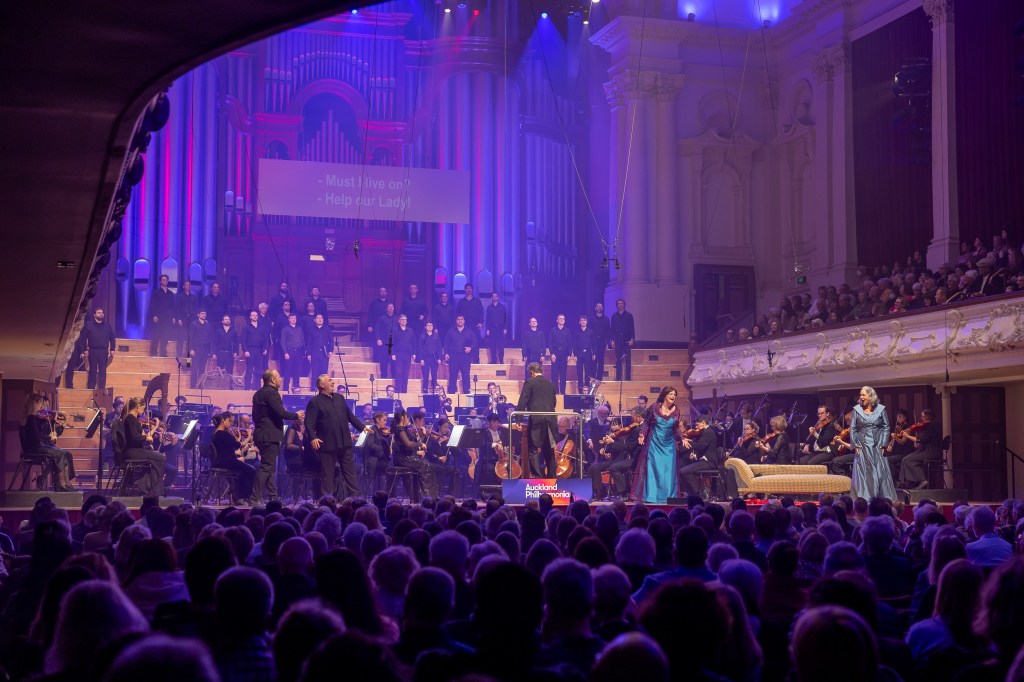
With the eerie green light projected onto the Town Hall’s organ pipes, the vast array of instruments on stage and a sold-out performance the concert promised to be a major event. And it was.

Out of the huge orchestra came the initial light tones of the Tannhauser Overture which slowly increased in volume and within a few minutes came the full force and musical energy of Wagner’s music under the baton of Pietari Inkinen

 Carefully shaping the orchestral sound, revealing the brilliance of the music, he made the audience aware of all the hallmarks of Wagner. Mystery, myth, magical spaces, human sacrifice and redemption. Linking the heroic past to contemporary German nineteenth century German religious ideas and nationalism.

It was several minutes into the music that O’Neil entered, bemoaning his condition. His distinctive voice rising above the sounds of the orchestra.

While the workbegins with the quiet, noble hymn representing redemption and faith it soon erupts into swirling, chromatic agitation depicting sensual temptation.

This was music that followed the ideas of the composer – the total work of art with richly orchestrated music, dramas driven by recurring, psychologically shifting leitmotifs and extreme chromatic harmony. It was music which emphasised the ideas of aspiration, regeneration, hope and nobility.

O’Neill fiercely conveyed the idea of a hero struggling against forces beyond his control, with his sharp angular movements and gestures as well as focussed singing.

Under Inkinen’s direction the NZSO provided a perceptive clarity to the music, sensitive to the singing of O’Neill and providing the emotional depth to the unfolding narrative.

There was drama and violence as well as calm and sweetness to the O’Neill’s voice and he demonstrated his total control, his posture, gestures and all his movements seemed natural and he was the embodiment of the Tannhauser, providing a nuanced depiction of the hero.

A Wagner performance is dependent on the role of the conductor, who needs to understand the music’s structure appreciate the connection between singers and the music and is able to balance the needs of the orchestra and the singers.

Pietari Inkinen Photo: Phoebe Cassidy / NZSO

Central toTannhäuser is the exploration on the deep, conflictbetween carnal desire and spiritual purity which prevents Tannhäuser from achieving a psychological wholeness. Rather than a simple moral tale of sin and repentance, it is also Wagners attempt to reconcile his own attempt to understand his own ego driven life and the fate of German ideas.

O’Neill approached the role with immense commitment, his tenor voice powerful and his projection flawless. He maintained an intense, radiant quality particularly in the lengthy Rome narrative section as well his farewell to Venus.

His singing, from the quiet, noble passages representing redemption and faith, through the swirling chromatic agitation depicting sensual temptation of the Venusberg section was always focussed.

Parsifal opens with an achingly beautiful prelude where out of silence, a simple melody emerges, played by the strings, and seems to hover there creating a sense of otherworldliness and later adding grandeur and nobility.

Many of the work’s motifs notably those associated with the Grail and the Spear as well as abstract ideas like sorrow and faith, shame and torment are revealed in the music — the restless string rhythms and shifting harmonies always searching for resolution.

The success of Parsifal relies heavily on an orchestra and conductor appreciating the needs of the soloist and the way Wagner’s music supports the singer and O’Neill was able to balance heroic aspects of the role along with his anguished search for redemption.

The audience was provided with the German text and a translation but only those near to the stage would have had sufficient illumination to read the words. Providing surtitles has become essential for any opera production and should have been available for the Radiance concert.

Just because Bayreuth doesn’t provide surtitles doesn’t mean audiences around the world have to make do without them as well.

Categories
Reviews, News and Commentary

APO’s Tristan and Isolde a magnificent musical experience

Reviewed by John Daly-Peoples

Tristan (Simon O’Neill) and Isolde (Ricarda Merbeth) Image – Sav Schulman

Auckland Philharmonia

Richard Wagner

Tristan and Isolde

Auckland Town Hall

August 10

Reviewed by John Daly-Peoples

The Auckland Philharmonia’ s recent production of Tristan and Isolde was probably the highlight of this year’s programme. The opera, lasting over five hours is a marathon for audience, singers and orchestra and requires exceptional singers and players which this performance delivered.

With Tristan and Isolde Wagner began moving opera in a new direction  away from the traditional love story format, using opera to express ideas about the nature of love, sex. death and existence.

While Wagner may have been influenced by Schopenhauer’s ideas about love and the links between love, sex, and death the composer was probably more interested in providing some sort of rational for his infatuation and possible  adulterous  relationship with his patron’s wife – Mathilde Wesedonck.

The opera has a simple plot line – Tristan who had previously killed Isolde’s fiancé is taking her to England to marry King Marke but they become attracted to each other (partly due to having drunk a love potion). The king is told of their relationship and seeks to kill Tristan but who dies from wounds and Isolde expired from a broken heart. They presumably become immortal just as all Wagner’s later gods and enter Valhalla.

The opera really only needs the two main characters as well as  the music but Wagner gives it a narrative structure and a few other characters who provide contrast and  tension.

Johan Reuter as Kurwenal, Simon O’Neill as Tristan, Ricarda Merbeth as Isolde and Katarina Karnéus as Brangäne. Image – Sav Schulman

The music describes the emotions and drama emanating from the two characters with the opening Prelude  and the closing  Liebestad or “love death song” sung divinely by Isolde over Tristan’s body.

The music of the  Prelude was used extensively by Lars van Trier in his film Melancholia expressing something of the same ethos as Tristan and Isolde with ideas about the nature of love, knowledge of our death and the end of civilization.

With Tristan and Isolde the two lovers embody different aspects of love  and this is expressed through their singing and their acting.

Act II which takes place over a single night presents an emotional landscape where we experience their unfolding  relationship with its deep emotional conflicts,

Their   duo “O eternal Night”, touches on a number of aspects of their love and the urgency of their singing  conveys a sense of bliss and transcendence.

O’Neill gave an impressive account of Tristan with potent stage presence enhanced by his stance and gestures. He was able to convey a sense of the nobility of love while  Merbeth’s Isolde expressed  the passion and emotion. With much of her singing her ferocious voice seemed to effortlessly express the conflicting emotions of anger and passion.

This was a semi-staged performance but Frances Moore’s clever staging  gave the performance some added drama with several of the cast making use of the various parts of the Town Hall.

Isolde made her final sensational entrance in walking up the centre aisle of the hall, Andrew Goodwin’s ship’s captain made a dramatic appearance singing from the Circle in Act I  and Katarina Karneus singing an elegant Brangane sang from the Circle, looking down on the couple in Act II.

Albert Dohmen gave a forceful performance as King Marke singing from up by the organ, towering about the orchestra and Jared Holt as Melot, Tristan’s one-time friend turned villain gave a nuanced performance with his long denunciation.

Johan Reuter gave an impressive account as Kurwenal, Tristan’s servant capturing the close ties between the two men with his sympathetic voice.

The orchestra provided the backbone for the opera and under the skilful direction of Giordano Bellincampi  provided sustained emotional and dramatic music, particularly  the opening Prelude which made for a magnificent  musical experience.

Categories
Reviews, News and Commentary

Opera Australia’s memorable Brisbane Ring Cycle

Reviewed by John Daly-Peoples

Brunnhilde and Siegfried on her Walkure platform   Image – Wallis Media

The Ring Cycle

Opera Australia

Lyric Theatre, Brisbane

8 – 14  December 2023

Reviewed by John Daly-Peoples

Opera Australia’s  fully digital Ring Cycle opened in Brisbane last month to critical acclaim and huge audience responses. Three separate seasons of the four-work opera were presented at Brisbane’s Lyric Theatre. The production was originally scheduled for 2020, but postponed twice due to the COVID pandemic,

The scale and scope of the story is epic. It follows the struggles of gods, heroes and several mythical creatures over a magic ring which has been forged by the Nibelung dwarf Alberich from gold he stole from the Rhine maidens. It is a ring that grants domination over the entire world. The drama and intrigue continue through three generations of protagonists, until the final cataclysm at the end of the final opera, “Götterdämmerung”.

Director Chen Shi-Zheng drew on the best of the best talent from Australia, New Zealand and around the globe creating a futuristic version of the Norse mythology into which he wove weave Chinese mythology into the production.

Along with some of the sculptural design features the production will be remembered for the digital staging. Designed by, Leigh Sachwitz, it made use of LED screens with AI auto-generated graphics, audiovisual projections and 3D printed set pieces.

Throughout the operas  abstract patterns and colours were used as motifs for various characters as well as being used  to represent the emotions and the internal struggles of the main characters. 

These design elements were dramatically used in the opening scene of “Das Rheingold” featuring the three Rhine Maidens who were perched on a huge chunk of coral / gold.

The Rhine Maidens              Image – Wallis Media

Above and behind them were their three doubles, who swam and cavorted in the projected waters, waves and bubbles of the Rhine as though in a huge aquarium.

Later we entered the  underground Nibelung, home to the dwarves, with its digitally created atmospheric, dark cave with accompanying brooding music.

At the opening of “Die Walkure” the stage was dominated by a large icy white, bonsai tree which featured the sword Nothung embedded by Wotan in its trunk – the sword which Siegmund later  releases. This is one of Wagner’s many nods to other mythologies in this case Excalibur, the mythical sword of King Arthur which had magical powers related to  the rightful sovereignty of Britain.

Siegmund, Nothung and the tree   Image – Wallis Media

At the conclusion of “Die Walkure” Brunnhilde (Lisa Lindstrom) ascended  a platform/ fortress  which was supported on Walkure spears. At this point as she and her father Wotan (Daniel Sumegi)  engage in an emotive duet about their parting a huge metallic Chinese dragon encircles the  platform to protect Brunnhilde, erupting with flames  from its body.

In “Siegfried” when the hero forges the broken sword, Nothung  after the failure of Mime to do so the digital screens pulsed with giant images of the sword and  flashing flames all accompanied by dancers  rushing around stage trailing ribbons.

When Siegfried enters the forest, the labyrinth he encounters is one of dramatic images, puzzling shapes and symbols while his encounter with Fafner  has him slicing into the dragon-like figure as he progresses from one realm to another though a series of grotesque images.

The final scene of Gotterdammerung     Image – Wallis Media

The conclusion of “Götterdämmerung” featured a pyramidal shape representing  a sacrificial pyre for Siegfried as well as symbolising the ancient notions of life, death and rebirth.

In the final as moments as Brunnhilde mounted the pyramid it blazed with colour while various screen images came alive with bursts of colour and ring images. Then the images which had previously been used throughout the operas were displayed in reverse order as the memories of the gods were replayed in their final moments.

Here the Rhine maidens again appeared, swimming down to retrieve the  ring from Brunnhilde before she was consumed by fire.

There were several  stand out performers in this Ring. Lise Lindstrom was a remarkable Brunnhilde, investing the role with emotional clout. Her presence on stage showed a well-honed acting ability in her various encounters with her lover Siegfried, her husband Gunther as well as her father, Wotan. Throughout her voice was sharp and she conveyed the emotional relationships with both the notions of a  demigod as well as those of a passionate human.

As Wotan Daniel Sumegi was a powerful presence on stage conveying a real sense of a god with his strange godly flaws and weird relationship with wife and daughter.

Warwick Fyfe’s Alberich was a careful mixture of the malevolent and the comic, a menacing presence in the cave of the Nibelung contrasting with his bumbling tussle with the Rhine maidens.

Stefan Vinke as Siegfried had some huge passages to sing and he dealt with them brilliantly both with his macho duet with Luke Gabbedy (Gunther) and his passionate duet with Lise Lindstrom (Brunnhilde).

The Queensland Symphony Orchestra under Phillipe Augin was probably the most impressive part of the four operas, playing for  fifteen and a half hours and never once seeming to flag.

Opera Australia’s 2024 season offers some spectacular operas performances including.

Verdi, La Traviata

2 January – 14 March 2024

Glamour, riches and a tragic secret: La Traviata is the story of a courtesan falling in love. Classic opera with stunning costumes, outstanding music and a fresh perspective.

Gluck, Orpheus & Eurydice

12 – 31 January 2024

Journey to the underworld and back with the grieving Orpheus. Awe-inspiring acrobatics meet Gluck’s exquisite music in this genre-busting production.

Mozart, The Magic Flute

1 February – 16 March 2024, Sydney Opera House
9 – 16 November 2024, Geelong Arts Centre

Embark on an enchanting adventure and meet a host of wondrous characters in Mozart’s The Magic Flute. This production in sung in English.

Bernstein, West Side Story

22 March – 21 April 2024
Handa Opera on Sydney Harbour

A musical masterpiece returns to Handa Opera on Sydney Harbour in a thrilling, larger-than-life staging. Dynamic dance numbers along with fireworks above the harbour.

Puccini, Tosca

24 – 30 May 2024, Margaret Court Arena
25 June – 16 August 2024, Sydney Opera House

A thriller with sensational music, opera’s best villain and an unforgettable ending, Tosca will keep you on the edge of your seat.

To subscribe or follow New Zealand Arts Review site – www.nzartsreview.org.

The “Follow button” at the bottom right will appear and clicking on that button  will allow you to follow that blog and all future posts will arrive on your email.

Or go to https://nzartsreview.org/blog/, Scroll down and click “Subscribe”