Categories
Reviews, News and Commentary

Ka Mua Ka Muri: Backwards to the Future

Reviewed by Malcolm Calder

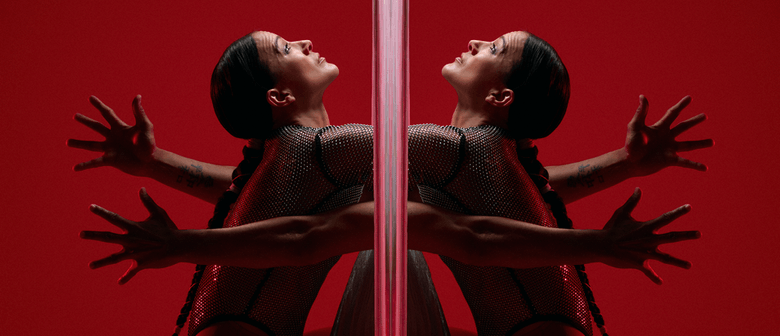
Ka Mua Ka Muri Image, Andi Crown

Ka Mua Ka Muri

Choreographers: Bianca Hyslop and Eddie Elliott

Sound composition: Eden Mulholland

Set and costume design: Rona Ngahuia Osborne

Lighting design: Owen McCarthy

Projection Design: Owen McCarthy (Remain), Dan Mace (Whakamaheahea)

With Abbie Rogers, Caleb Heke, Madi Tumataroa, Matiu Hamuera, Oli Mathiesen, Tai Taranui Hemana, Toalei Roycroft,

An Atamira Dance Company production

Q Theatre, Rangitira

Until 27 July

Then Clarence Street Theatre, Hamilton 29 July.

Review by Malcolm Calder

25 July 2024

This significant work comprises two collaborative creations without an interval – Eddie Elliott’s Remain followed by Bianca Hyslop’s Whakamaheahea.  Although each could easily stand alone, they are not really a double bill.  There is no interval, simply a pause, or perhaps a lengthy segue between the two, and each reflects the other.  Hence the title which loosely translates into Before and After.

Elliott’s Remain does far more than simply relate the past and provide a context for today however.  It helps to explain that past and how the intertwining of traditions with their origins, social practice and evolution delivers a whakapapa that is as rich with meaning and significance in contemporary Aotearoa as it has been since Ranginui and Papatūānuku.

Elliott has mined the humour and playfulness of everyday life, pride in achievement and evolutionary contributions to making Aotearoa what it is today.  And, no, it is far from a sugar-coating.  There are brief flashes of anger, resentment and disagreement and, after all, that’s life.

Conversely, Hyslop’s Whakamaheahea takes all this as a given or starting point and looks to the world we live in today while providing a basis for navigating the path ahead.  A future that shimmers one moment and then cowers the next.  As Hyslop has noted, cultural identity is a continuum and the place of māoritanga is clearly identified and deeplyembedded in the social context of our country.

The dancers provide a strong ensemble quality with individual characters allowed to emerge and some of the solo work is of a high quality indeed.

Of special mention is the creative team who handled the production aspects of this work admirably.  It is slick, extremely contemporary and entirely captivating.

Importantly, this work acknowledges and further develops the legacy that is Altamira Dance Company.  Yes, there may be some ‘fooling about’ along the way but there is also a strong sense of empowerment, transformation, and resilience that underpins Ka Mua Ka Muri.  It has the potential to inspire a bright collective future.

Categories
Reviews, News and Commentary

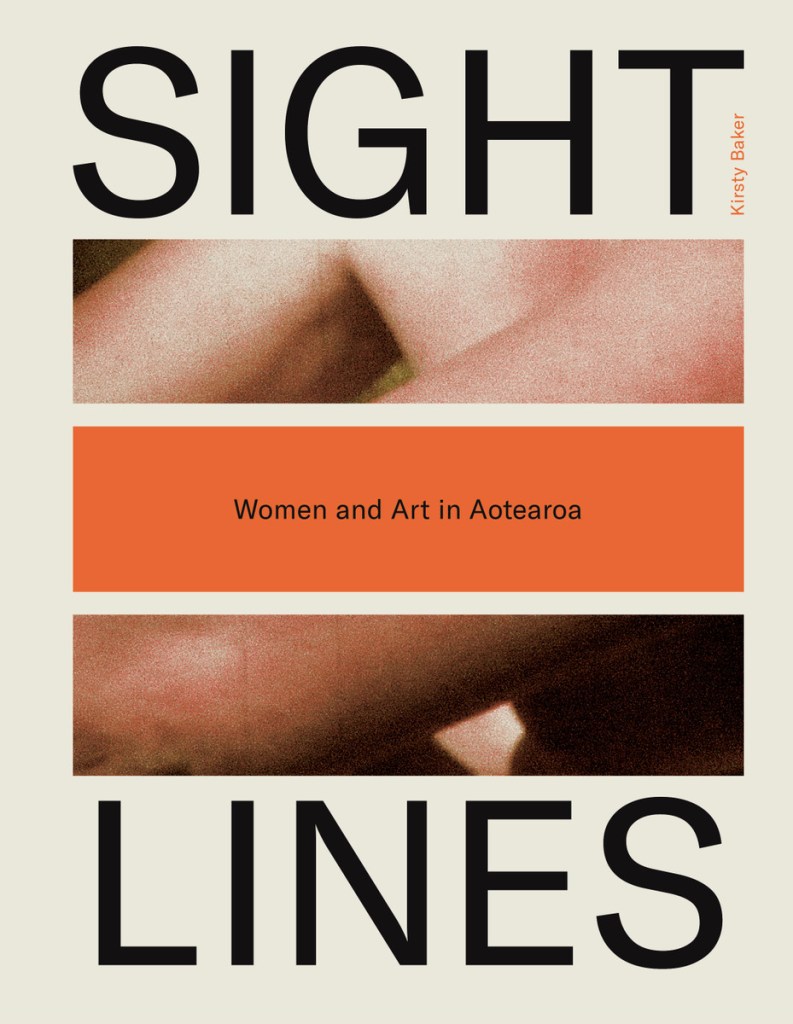
Sight Lines: Women and Art in Aotearoa

Reviewed by John Daly-Peoples

Sight Lines: Women and Art in Aotearoa

By Kirsty Baker

Auckalnd University Press

RRP $69.99

Reviewed by John Daly-Peoples

Sight Lines: Women and Art in Aotearoa is a bold and timely book exploring various threads of women’s  art  of the past as well as those creating art for our times. Editor and writer Kirst Baker acknowledges the complexity of bringing together writings for  such a book in her introduction  where she notes “It should come as no surprise that this book does not attempt to offer a complete history of women’s artmaking in this country. Such a project is doomed to fail… Instead, the book winds its way along a path that is both fragmented and politicised”.

Within that winding journey it is the through the fragments that we see ideas and revelations and make connections. It is through the practice of many of these artists and their working within a social and political context that we see the importance and ramifications of art.

Lisa Reihana, in Pursuit of Venus [infected], Auckland Art Gallery. single channel UHD video

The dozen chapters in the book have been written by Kirsty Baker along with  Chloe Cull, Ngarino Ellis, Ioana Gordon-Smith, Rangimarie Sophie Jolley, Lana Lopesi, Hanahiva Rose, Huhana Smith and Megan Tamati-Quennell.

The essays are all thought-provoking with a mix of biography, narrative, interviews, observations and reflections. These offer new ways at looking at the art created by women but also the nature of art and art institutions.

Baker notes that there are a number of themes running through the book which are indicative of the often different world in which many female artists exist and work.

There is the way that women artists have interrogated their relationship with the land and place and the way they have pushed against gendered limitations.

There is also the way that artists have used their practice to comment on art history and arts institutions and the way that art making plays a role in the care and transmission of knowledge.

In not being a contiguous history of women’s art, the gaps and exclusions are often apparent. These gaps mean at times the book is less satisfying without the linkages of history and context.

While not a history the book covers over two hundred years of art making in New Zealand and includes painters, photographers, performers, sculptors,  textile artists and writers. The work of these artists spans whatu kākahu through to the recent work of the Mataaho Collective. Along the away there are chapters on a diverse range of artists –  Frances Hodgkins, Rita Angus, Rangimārie Hetet, Pauline Rhodes, Teuane Tibbo, Yuki Kihara and Ruth Buchanan.

With over 150 illustrations the books also provide a visual history of women’s art which is well integrated with the texts.

Julia Morison, Quiddities 1-10. Auckland Art Gallery, Cibachrome transparencies

The essay on Frances Hodgkins provides a succinct overview of her life and work while highlighting the issues which impacted on women artists of the early part of the twentieth century.

The essay on Kura Te Waru-Rewiri reveals the way in which Māori artists have addressed issues of mythology. history  and land using abstraction as a means of conveying ideas.

Many of the chapters focus on the issues around the land, whānau and wāhine which is seen in the work of artists such as Robyn  Kahukiwa so it is surprising that  Robin White, Sylvia Siddell and Jaqueline Fahey who have documented the family and domesticity for several decades are not mentioned.

The other area of exclusion is around abstraction for while the work  of Vivian Lynn, Kura Te Waru-Rewiri and Imogen Taylor is included artists such as Phillipa Blair and Gretchen Albrecht are omitted.

Maureen Lander, Ko nga puna waiora o Maunga Taranaki (detail), Govett-Brewster Gallery, mixed media

The final chapter in the book concerns the  work by the Mataaho Collective, a group which has recently won the prestigious Golden Lion Award at the Venice Biennale. The chapter predates the win but much of what is written is relevant to the work which has generated more column  inches than any previous New Zealand exhibition at the Venice event.

Here there seems to be a disconnection because of the six previous New Zealand female artists to exhibit at the Biennale. only Lisa Reihana and Yuki Kihara are mentioned. That the four other women selected over a twenty yar period to represent New Zealand at the world’s most high-profile event seems puzzling.

Despite this oversight and others, the book is still one which offers much in understanding the developing history of women’s art in New Zealand as well as way that they have been impacted  by  social acceptance and cultural institutions.

To subscribe or follow New Zealand Arts Review site – www.nzartsreview.org.

The “Follow button” at the bottom right will appear and clicking on that button  will allow you to follow that blog and all future posts will arrive on your email.

Or go to https://nzartsreview.org/blog/, Scroll down and click “Subscribe”

Categories
Reviews, News and Commentary

Aotearoa Contemporary to open at the Auckland Art Gallery in July

John Daly-Peoples

Maungarongo Te Kawa, Celestial Stargate for Invisible People, 2024 (detail). Photo by Jemma Mitchell

Aotearoa Contemporary

Auckland Art Gallery

July 6 – October 20

 The Auckland Art Gallery Toi o Tāmaki and Ngāti Whātua Orākei have announced a new contemporary art triennial at Auckland Art Gallery which will celebration of the breadth of contemporary art in New Zealand.

“The Gallery is thrilled to partner with Ngāti Whātua Ōrākei to present a new generation of talented artists and showcase Aotearoa New Zealand’s diverse artistic environment.”

“Set to occur every three years, the exhibition provides ongoing representation and pathways for new artistic voices, bolstering the future resilience of New Zealand art. Aotearoa needs a contemporary art triennial and it now has one.” adds Lacy.

Ngāti Whātua Ōrākei Trust Deputy Chair Ngarimu Blair says, “Our tupuna Apihai Te Kawau gifted 3000 acres of land on the Waitematā on 18th September in 1840 to become a city which welcomed people, cultures and ideas from afar. Our relationship with Auckland Art Gallery is founded in the shared goal to foster the arts reflective of our multi-cultural community in Aotearoa.”

With an emphasis on artists not previously exhibited at the Gallery, the exhibition presents 27 artists and 22 compelling new projects in a range of media including painting, textiles, sculpture, ceramics, photography, and performance.

Senior Curator, Contemporary Art, Natasha Conland says, “Aotearoa Contemporary reveals a new cluster of artists who work afresh with ritual and storytelling, mythology, rhythm, indigenous space and materials. There is also a special emphasis on art’s relationship with choreography through the commission of four dance works.”

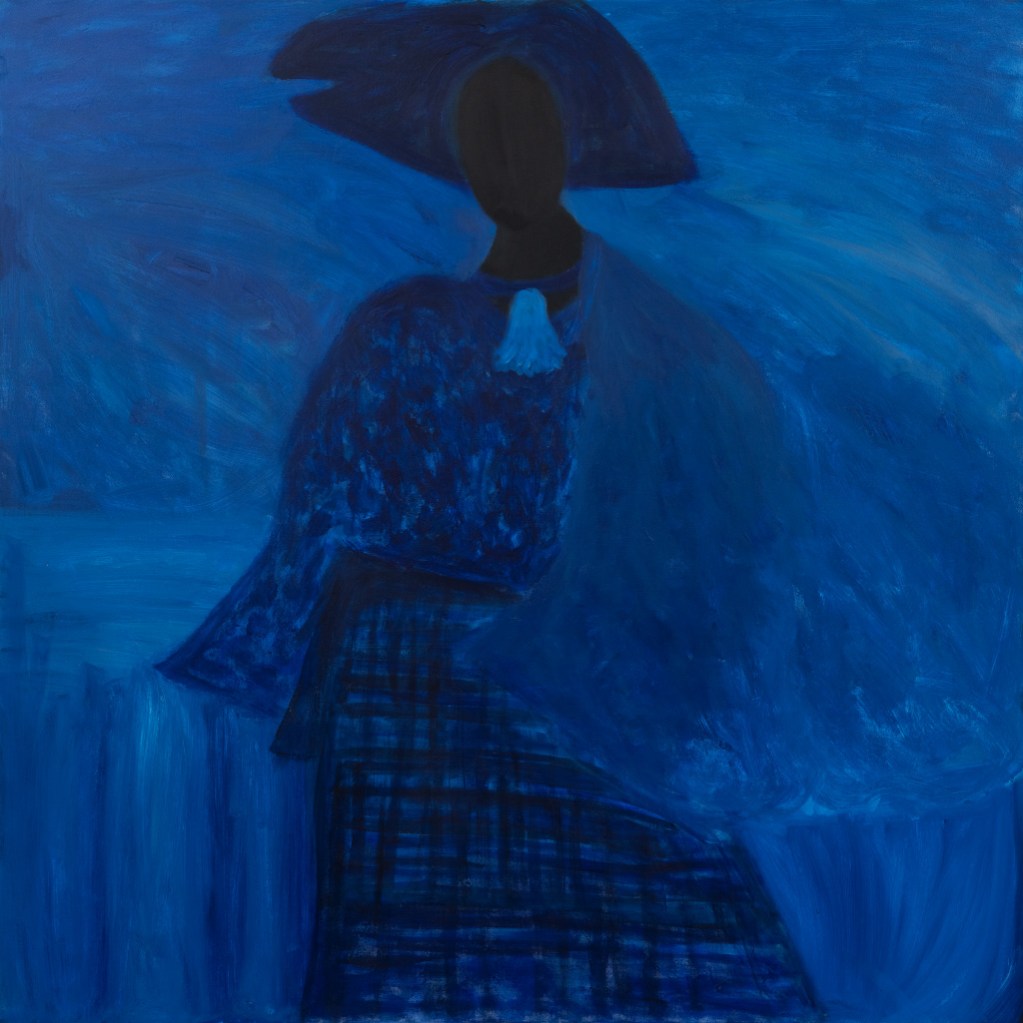
Curator, Pacific Art, Cameron Ah Loo-Matamua adds, “From Ruth Ige’s enigmatic blue paintings of anonymous figures, to the art collective The Killing’s installation of supersized soft-toys in a state of play, there is something for everyone in this exhibition. Amongst the ambitious new commissions is a three-channel video by Qianye and Qianhe Lin featuring mythology set in Hailing Island off the coast of China and Aotearoa.”

Aotearoa Contemporary is proudly supported by Ngāti Whātua Ōrākei, Auckland Art Gallery Foundation and the Chartwell Trust.

Aotearoa Contemporary has been scheduled to coincide with New Zealand’s leading contemporary art award, The Walters Prize 2024, to provide a broad overview of contemporary art in New Zealand in the Gallery’s winter programme.

The exhibition has been curated by Cameron Ah Loo-Matamua, Natasha Conland and Ane Tonga with support from Ruth Ha.

Artists featured in Aotearoa Contemporary

Emerita Baik, Leo Baldwin-Ramult, Heidi Brickell, Pelenakeke Brown, Jack Hadley, Ruth Ige, Hannah Ireland, Xin Ji, Reece King, Qianye Lin and Qianhe Lin, Te Ara Minhinnick, Ammon Ngakuru, Amit Noy, Sung Hwan Bobby Park, Meg Porteous, Maungarongo (Ron) Te Kawa, Tyrone Te Waa, The Killing (collective), Anh Trân, Manuha’apai Vaeatangitau, Jahra Wasasala and George Watson.

Jahra ‘Rager’ Wasasala by Jocelyn Janon

Jahra ‘Rager’ Wasasala is an award-winning cross-disciplinary artist of Fijian/NZ European descent. As an artist, Jahra investigates her ancestral connections through the art mediums of performance activation, contemporary dance and poetry, and has extensively toured her performance works both nationally and internationally.

As a child of the Pasifika diaspora, Jahra is invested in translating her shared internal conflict into an accessible, yet confrontational, physicalised language. Her most recent performance work titled “a world, with your wound in it” focuses on the complex relationship between the earth and a woman’s body, a theme Jahra continues to investigate in her developing work.

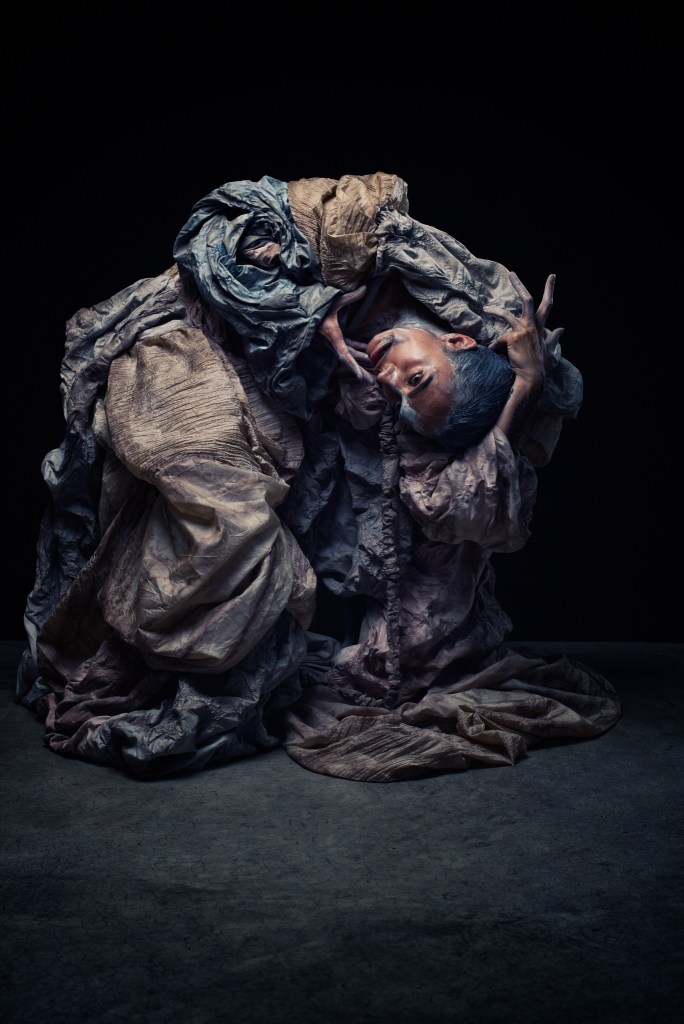
Maungarongo Te Kawa is a takatāpui fabric artist, educator, and storyteller. His practice makes old pūrākau newly relevant using brilliant colour, fluid design, and infectious good humour. Following a career in costume design and fashion, Te Kawa dedicated himself to full-time art-making and teaching. In addition to producing his own elaborate whakapapa quilts, he runs sewing workshops, guiding participants to express their creativity and genealogy through fabric.

Ruth Ige is a Nigerian New Zealand-based painter whose intimate, evocative compositions oscillate between bodily forms and painterly abstractions. While some resemble traditional portraiture, others consist of colour fields that capture a more mysterious, ethereal effect. Hands, shoulders, and faces emerge from a watery facture. “I am interested in creating images that are not easily understood,” says Ige. She considers her unique figuration, which renders her subjects featureless and inscrutable, to be a form of “veiling.”

Performances

The commissioned performances in Aotearoa Contemporary include Pelenakeke Brown, Is this a performance 1+2, Xin Ji, Doco Dance, Amit Noy, Errant and Jahra Wasasala, DRA.

To subscribe or follow New Zealand Arts Review site – www.nzartsreview.org.

The “Follow button” at the bottom right will appear and clicking on that button  will allow you to follow that blog and all future posts will arrive on your email.

Or go to https://nzartsreview.org/blog/, Scroll down and click “Subscribe”

Categories
Reviews, News and Commentary

Three exhibitions: Max Gimblett, Phillipa Blair and Emily Wolfe

Reviewed by John Daly-Peoples

Max Gimblett, Holy Gesture and The Golden Mountain after Botticelli

Max Gimblett, Hands of Gold

Gow Langsford Gallery, Auckland

Until June 29

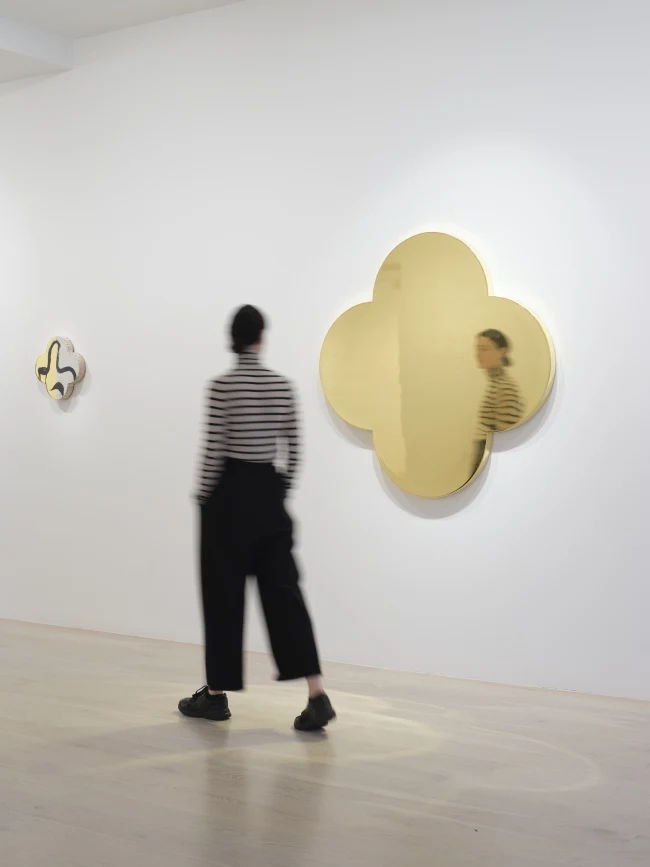
Max Gimblett’s Hands of Gold features a new set of painting many of which  make use of the  quatrefoil shape  which consists of four intersecting circles connecting at a central point is a feature in much Gothic and Renaissance architecture and art.

Gimblett also employs an elegantly or extravagant gestural brush stroke on several of  these works which have links to the calligraphic traditions of eastern art and links to the artists interest in Zen which he says has given him ‘The impulse is to feel. I paint without thinking, in an unconscious, free way.’  

This approach can also be seen to have links to the contemporary gestural art of the abstract expressionism of Jackson Pollock but with the gravitas of the Japanese artist Sengai Gibbon. These approaches have meant that his work has a sense of the instant -when emotion is realised and intuition revealed. 

Several of the works have a simplicity to them demonstrating the artists craftsman like approach which goes back centuries to medieval art. There is “The Golden Mountain after Botticelli” ($78,000) in which the artist has used gold foil over panel, creating an almost seamless reflective surface which becomes almost a sculptural piece. The reflective surface means that the viewer becomes an integral part of the work.

There are also smaller works such as “The Golden Diadem” ($20,000) where the gilded surface appears to be almost liquid, the paint sliding over the surface.

There are smaller versions of this large work such as “Eve” ($40,000) and “Moon Suite” ($60,000). where the artist includes a gestural sweep across the surface. These calligraphic strokes the artist employs look as though they trace out the trajectory of a magician wand  as in “Holy Gesture” ($28,000).

 In some cases these marks are only just visible and these is a sense of the calligraphy emerging magically out of the gilded surface of the work.

Max Gimblett, The River and the Jungle

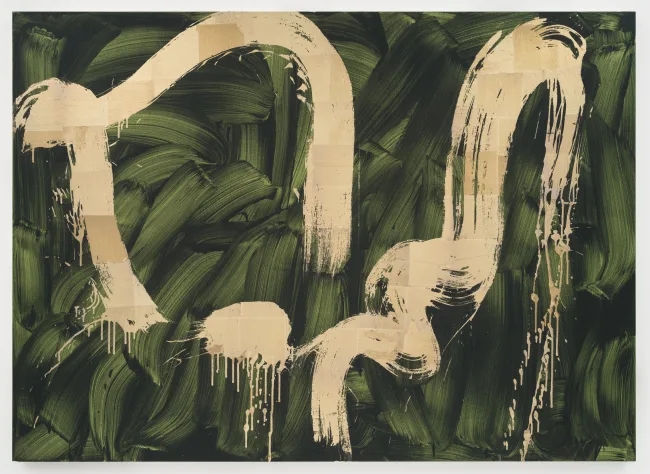
With the rectangular “The River and the Jungle’ ($85,000) the abstract patterns and the golden swirl takes on almost landscape features of  river threading through a lush green environment.

Phillipa Blair, Venice CA Revisited

Orexart

Until July 6

Phillipa Blair, Angelus Place 4

Orexart is presenting works by Philippa Blair which span  the period 1997 to 2006 and includes five  works she made in the late nineteen nineties with her husband John Porter in her Venice California studio. At the time, she was exhibiting regularly alongside contemporary American abstractionists in museum and gallery exhibitions  in Los Angeles and New York. 

At the heart of her work is the uncertainty and contradictions between chaos and order. This contrast can be seen in both the ideas which pervade the work as well as the physical making and arrangement within the paintings themselves, a duality which exists between the physical and the  spiritual, between the random and the deliberate.

The works in the exhibition can be read in a variety of ways – as  images relating to events in her personal life, those of the wider world or of abstract conceits.

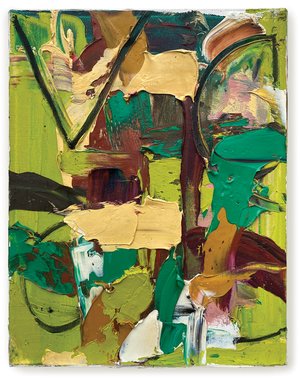
There are several works under the general title  “Angelus Place” ($4800 each), after the street where she lived for many years. With their tightly massed colours one can detect elements of the physical location with hints of palm trees, the triangular shape of the studio roof and shafts of light.

There is a vibrancy to the artist’s work as with “O” ($35,000) with the striations across the surface creating rhythms which suggest dance or music. Her paintings dance with colour, shape and movement  and at the microscopic level it is the dance of the atoms.

Phillipa Blair, Breakdance

In the spacious Breakdance ($28,000) of 2006   the sense of dance is also present with jostling blocks of colour and dramatic swirls of paint.

The works all have an inherent  volatility and tactility, not so much of the artists applying paint but rather the colours and forms erupting out of the canvas to envelop the viewer.

While there is a tension between the notions of order and chaos implicit in the works there is also  the physical tension between the both the myriad colours  she uses and the various techniques she employs which sees areas of colours resisting, merging and colliding.

Emily Wolfe, Long Distance

Melanie Rogers Gallery

Until June 27

Emily Wolfe, Strata

Many of Emily Wolfe’s previous works had the look of paintings from a previous period and this latest exhibition “Long Distance “ there isa sense of searching for The Sublime, dwelling on  the beauty and drama of nature. The title  might also be referring back to that time, and the search for The Sublime. She is also  referencing her distance from New Zealand as all the works were painted  in London.

These paintings are about the nature of art itself, the colours, the quality of the light an interest in the depiction of surfaces and textures and an awareness of the painter’s skills and techniques in the pursuit of the illusions.

The works feature  sections of typical romantic landscapes – pastoral landscapes with distant hills, and  framing trees. The paintings also  feature clouds recalling the numerous cloud studies of John Constable.

Some of the works have a surreal quality, reminiscent of  Rene Magritte’s paintings with paintings such as “Drift” ($7000) where a painted section is overlaid onto a similar landscape view  of the exterior world.  That section could have come  from “Off Centre” ($7000) where a section of canvas has been removed from a painting created an empty space.

Emily Wolfe, Light Years

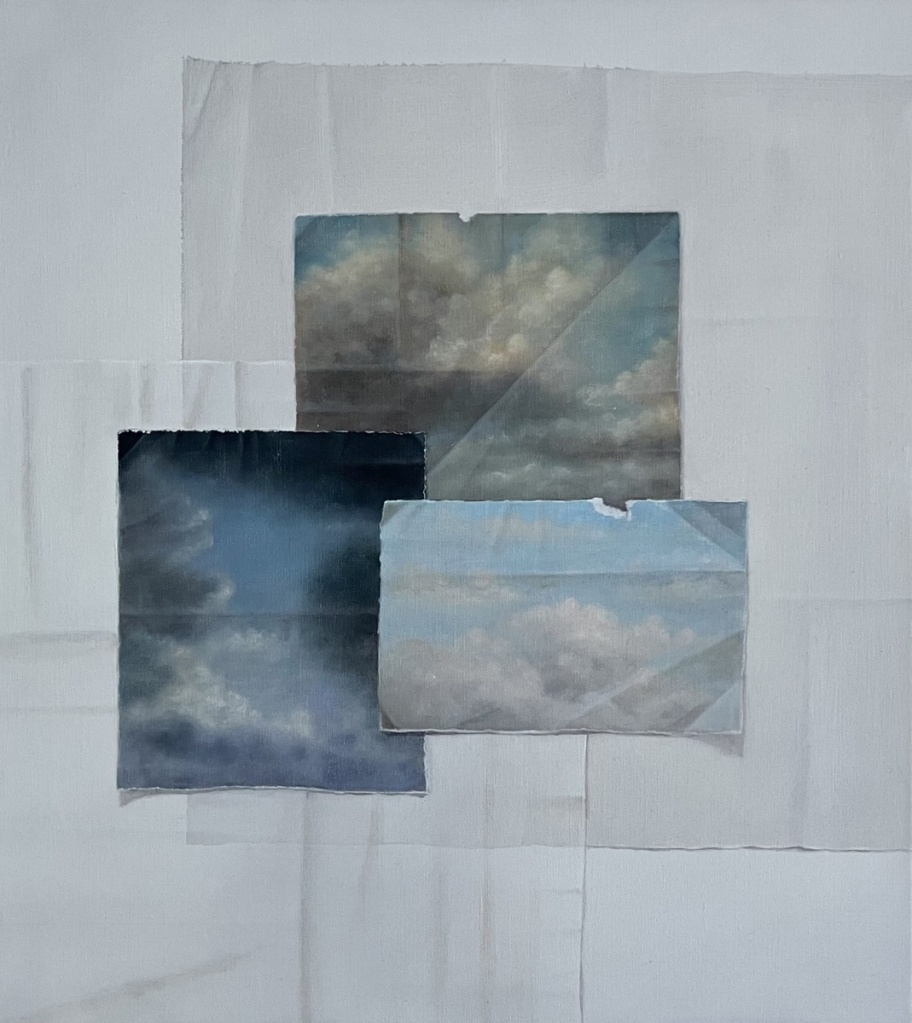
With “Light Years” ($7000) the artist has assembled five different pieces of paper  / canvas to create  collage of images for some  future work. They are like swatches of varying colour intensity and light which the artist is playing with.

 “Strata” ($14,000) is an impressive work featuring a  dramatic alpine vista in the taped to the wall and floor . Resting on the work is a sheet of paper and an old-fashioned T square. The inclusion of the T Square as well as  a tracing table in “Long Distance” ($14,000)  are references to the aids often used by artists in the construction of their work.

With all these works she displays a shrewd visual language where representation and reality are playfully deconstructed, where light becomes a palpable component of the work and where time   seems to  stand still.

To subscribe or follow New Zealand Arts Review site – www.nzartsreview.org.

The “Follow button” at the bottom right will appear and clicking on that button  will allow you to follow that blog and all future posts will arrive on your email.

Or go to https://nzartsreview.org/blog/, Scroll down and click “Subscribe”

Categories
Reviews, News and Commentary

New exhibitions by John Pule and Fatu Feu’u

Reviewed by John Daly-Peoples

John Pule. As we stood one misty morning near the ocean the desire the solitude gone gone forever

Haia

John Pule

Gow Langsford, Onehunga

Until June 8

Vai Manino

Fatu Feu’u

Artis Gallery

Until June 9

Reviewed by John Daly-Peoples

Two recent exhibition by Pacific artists focus on the ways in which artists draw on the physical and topographic  and historic , merging them, with social, political and personal insight and visions.

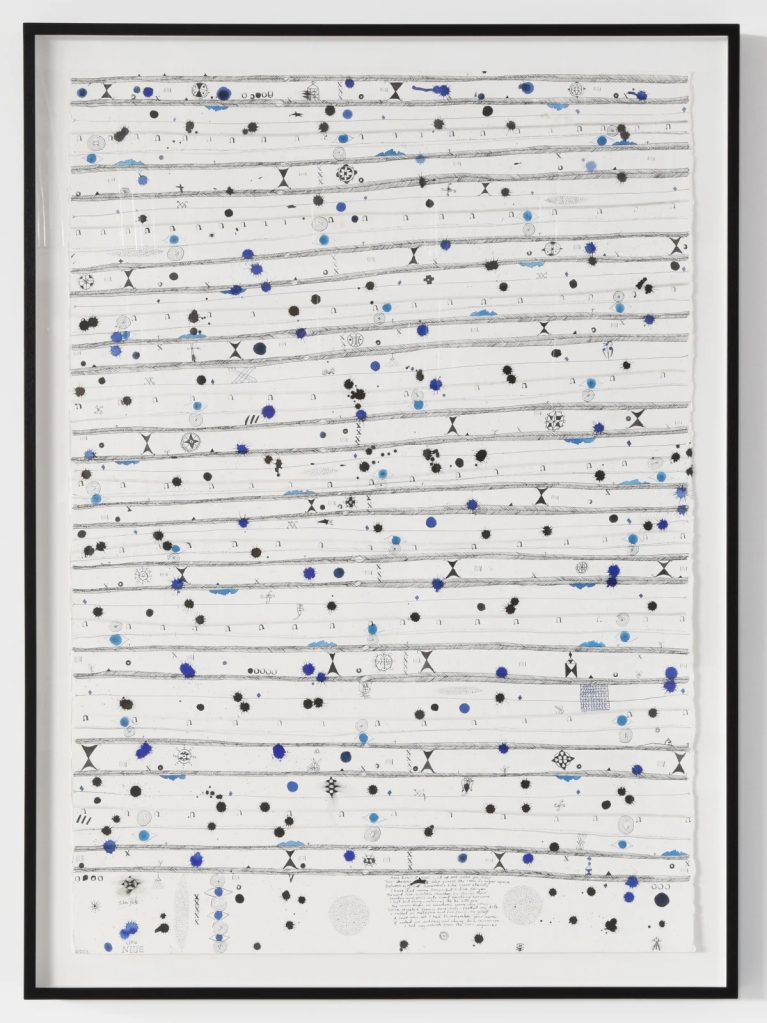
John Pule’s latest exhibition “Haia” was  the result of a nine-month residency in Niue provided by the government in 2023. The work contains much of the artist previous iconography but have a greater immediacy given the artists response to in his ancestral land.

The works are in a sense both a discovery and rediscovery  of the land and its mythologies as well as the artists own journeys.

As he says in his notes to the exhibition

“For nine months I rode my bike each day through the canopy forest from Liku to Alofi [around 15 kilometres]. Through rain or shine, winds, storm, or calm. The road is bordered with plantations, forests, tracks into the interior. Big blue skies and clouds, shadows of trees stretch across the makatea (limestone) road. Returning to Liku every evening, the sun is warm on my back.  These paintings and drawings are about that particular time.”

His works have often dealt with his growing up in New Zealand, his discovery of traditional Niuean art, the islands history, flora and fauna and developing his own iconography. This had led to him dealing with wider issues of colonialism, the impact of Christianity as well as  the mythology and spirituality of Niue.

John Pule. Many times at night I sit up and watch you sleep

Works such a “Many times at night I sit up and watch you sleep” with their strips of images – symbols, shapes and figures are like the trails that that the artist has ridden on his bike but also the pathways which reach back in time. They are analogous to the songlines of aboriginal art as well as the lines of musical compositions, imagining the way the sounds evolve, carrying a narrative expressing joy. sorrow and wonderment.

In the more dramatic paintings  such as “As we stood one misty morning near the ocean the desire the solitude gone gone forever” a road snakes into the distance and there are several figures  depicted recalling tales of the Bible and other mythological histories. 

The foliage depicted is at once colourful and local as well as surreal and mythological – a portrays of Pule’s Niue as well as an imagined paradise.

The pathways and journeys depicted in his paintings are metaphors for the artist’s own physical, spiritual and aesthetic journeys.

John Pule. Foulua Pukenamo Tau Misi

Other works such as “Foulua Pukenamo Tau Misi” feature plans,  grids and designs – locating islands, stars, measuring winds and sea currents, all ways of comprehending the environment

Fatu Feu’u. The Golden Age

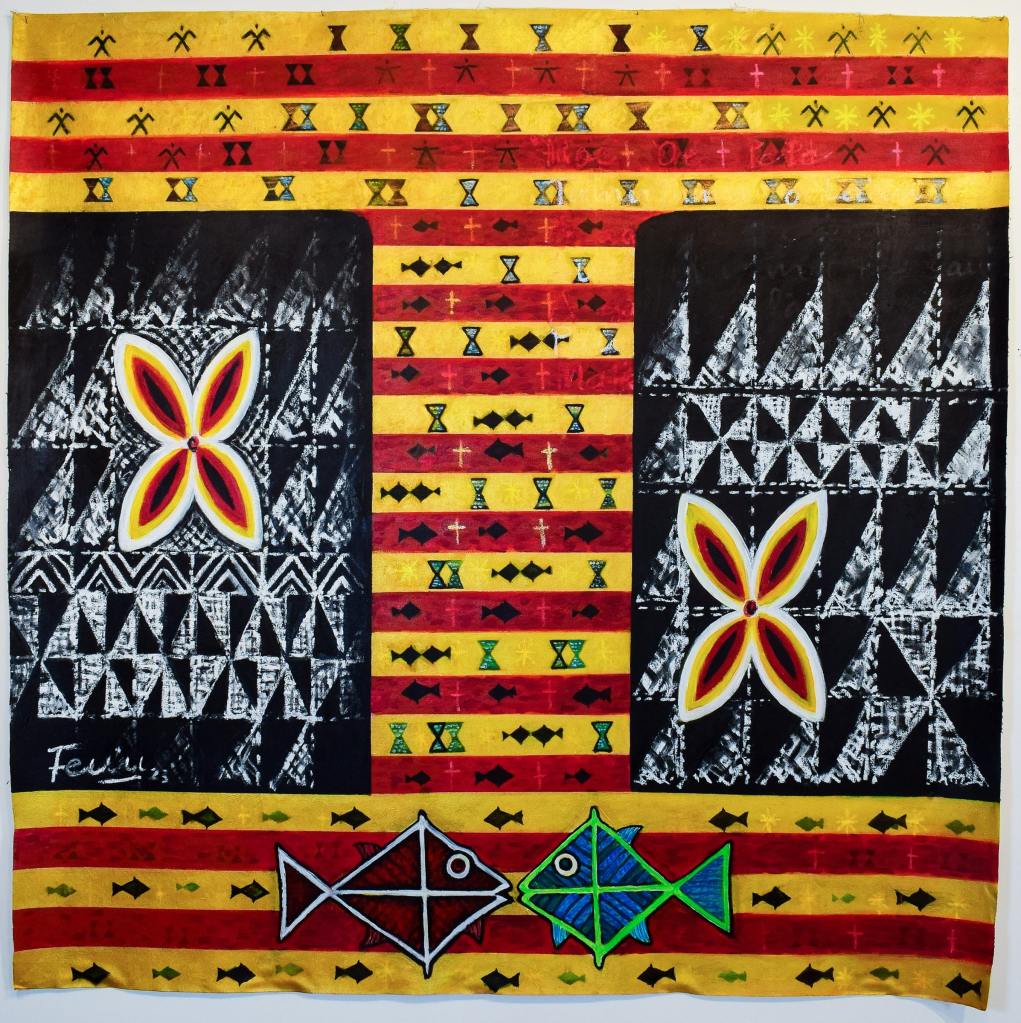
In his latest exhibition “Vai Manino” (Clear Water) Fatu Feu’u focusses on the social political and historical aspects of Samoan fisheries with works that follow on from his previous exhibitions which have  addressed social, political and environmental issues which are confronting Samoan society. Several are  based on the Samoan tradition of ‘ifoga’ or reconciliation/rebuilding with the dominating  central letter ‘I’ as a motif captures this, with different colours coalescing. The large “I” which he has used many times before also references Colin McCahons use of the letter / symbol.

His work draws inspiration from ancient designs and patterns – from tapa cloth. siapo, lapita pottery and tattoo along with contemporary Samoan design. There are also the influences of abstract art and that of other artists such as Colin McCahon and Tony Fomison.  The artist has employed shapes and symbols that he has developed over many years – masks, fish, birds and sails along with hints of human figures and landscape. Many of the siapo patterns themselves are derived from insects, leaves, shells, animals and fish.

Fatu Feu’u First Ritual

In many of the works such as “First Ritual” there are swirls of colours which seem to reference shoals of fish and  the ocean currents along with curving lines which can indicate the trawling nets used by fisherman.

Works such as “Pacific Conference II” have more complex structures with reference to the historical and mythological past pf the Pacific with an Easter Island monolith. The swarms of fish which morph into humans and birds refence journeys, distance and the dependence on the sea.

Fatu Feu’u. “Pacific Conference II”

Like the works of John Pule several of the paintings feature bands of colour representing journeys and histories. And with both artists there are gridded area which are related to cartography, structure and measurement

To subscribe or follow New Zealand Arts Review site – www.nzartsreview.org.

The “Follow button” at the bottom right will appear and clicking on that button  will allow you to follow that blog and all future posts will arrive on your email.

Or go to https://nzartsreview.org/blog/, Scroll down and click “Subscribe”.

Categories
Reviews, News and Commentary

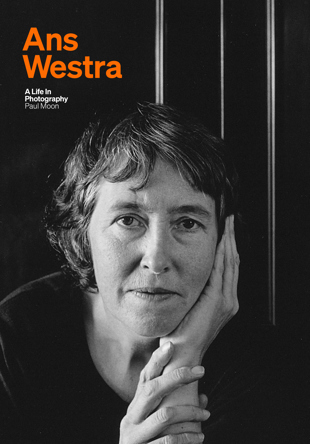
Ans Westra: A life in photography

Reviewed by John Daly-Peoples

Ans Westra: A life in photography

By Paul Moon

Massey University Press

Published May 2024

RRP $49,99

Reviewed by John Daly-Peoples

Ans Westra, who died in 2023 was probably the  most prolific contemporary photographer  who focussed on  recording the life and times of New Zealanders.

With a career spanning over sixty years, she took hundreds of thousands of photographs of people, places and events.
Now a new book “Ans Westra: A life in photography” by cultural historian  Paul Moon documents her life and her contribution to the cultural life of the country.

The book charts her photographic career  from her early involvement with the Wellington Camera Club in the 1960’s and her first sale  of a work to the quarterly journal Te Ao Hou, a publication she would continue to provide images for,

She also gained early recognition in 1961 winning a prize in a photographic competition run by Arts Committee of the Festival of  Wellington.

Much of her work was commissioned for publications originated with the Department of Education and several of her books were for educational publishers as well. One of her earliest publications was ”Viliami of the Friendly Isles” based on her travels to Tonga, Fiji and Samoa in 1962. As well as taking the pictures she wrote the text which describes the dramas, tragedies and excitement of the various locations and events she encountered.

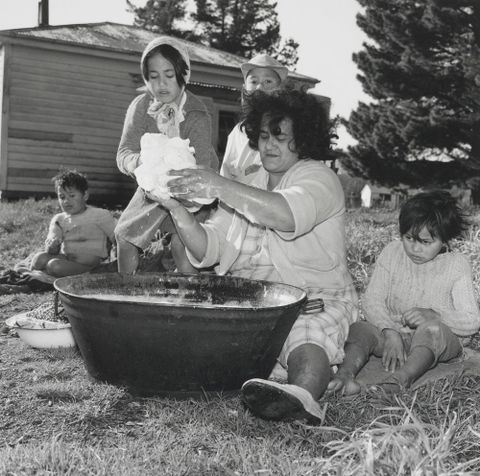
Then there was the controversial booklet “Washday at the Pa”  which was a school bulletin published in 1964 by the Education Department’s School Publications section. Ans Westra wrote the text and took the photographs during a visit to Ruatōria.

Ans Westra, Ruatoria, 1963 (from ‘Washday at the Pa’), courtesy of {Suite} Gallery

The bulletin followed a day in the life of a rural Māori family with nine children. Her images of the family’s living conditions caused enormous controversy, notably from The Māori Women’s Welfare League and the work was subsequently removed from schools and destroyed. Only latterly was the work republished by her Wellington gallery Suite.

Her more substantial publication “Māori” was published by Alistair Taylor in 1967 which was co-produced with James Ritchie and designed by Gordon Walters.

Her motive for participating  in the project was the misguided notion, held by many pakeha writers that Māori were likely to become extinct at some time in the future and their culture needed to be recorded.

She was also involved with another controversial publication “Down Under the Plumtree” published by Alistair Taylor. Published in 1972, the book openly discussed sex, sexuality and drugs at a time when there was very little reliable information on these issues for young people. 

Moon writes about all her major bodies of work such as “Notes on the Country I live in”  and “We Live by a lake” which was written by Noel Hilliard.

He also outlines the rational and impetus for the various projects, the political and social climate at the time and the reactions to them.

The 84 images used to illustrate the book show the various aspect of her photographic  approach which changes over the years. One is conscious of her ability to frame an image, capture the sense of a person or place and find the drama of the moment.

Ans Westra, Wellington, 1974 courtesy of {Suite} Gallery

This ability to capture the sense of place can be seen in her “Wellington” of 1974 with the wet streets of the capital by the cenotaph.

She also shows an understanding  of architectural space with an image of the dam structure in “We Live by a Lake” and she is aware of the possibilities of contrast through light and shade as well as means of creating drama and movement as shown in her image of a policeman and dog confronting a protestor during the anti-Springboks tour campaign.

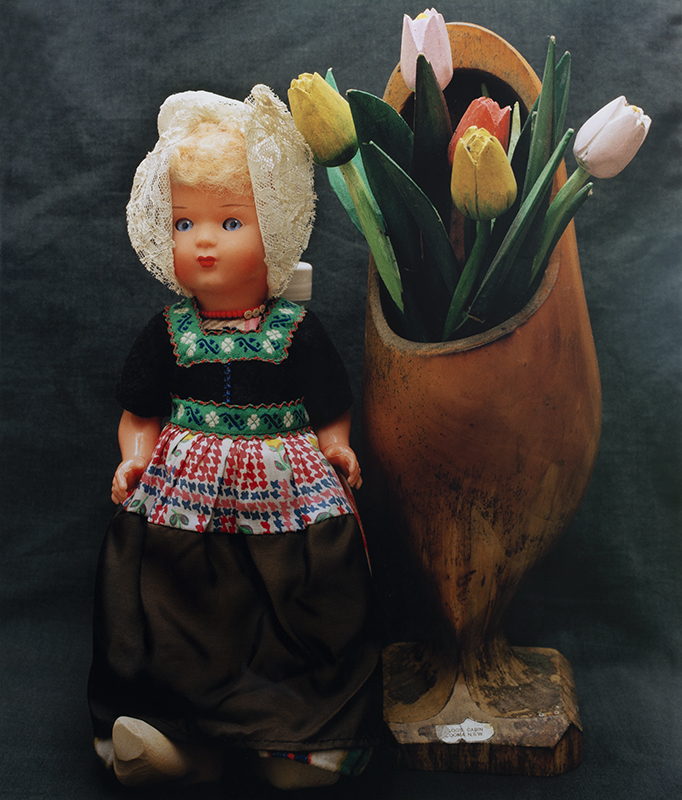
While she did not photograph all that much in colour, when she did, she was able to use colour to great effect as in her image of a Dutch doll from her Toyland series.

Ans Westra, Dutch Doll, 2004, courtesy of {Suite} Gallery

The book not only documents Westra’s immense contribution to our history in documenting social change but also reveals an enthusiastic and  dedicated  artist.

The book deals with several of the important events in her own life from her move from Holland in her youth, the brief  return to Holland in the late 1960’s and her short-lived affair with the writer Barry Crump  and the resulting son, Erik.

Dr Paul Moon ONZM is professor of history at Auckland University of Technology’s Te Ara Poutama, the Faculty of Māori Development, where he has taught since 1993. He is the prolific author of many books, including biographies of William Hobson, Robert FitzRoy, and the Ngāpuhi rangatira Hone Heke and Hone Heke Ngapua. He is a Fellow of both the Royal Historical Society at University College London and of the Royal Society of Arts.

All Images extracted from Ans Westra: A Life In Photography by Paul Moon, published by Massey University Press,

Categories
Reviews, News and Commentary

Dear Colin, Dear Ron

Reviewed by John Daly-Peoples

Dear Colin, Dear Ron

By Peter Simpson

Te Papa Press

RRP $65.00

Reviewed by John Daly-Peoples

“I feel very strongly that where I’m going is where paintings must go.”

So wrote Colin McCahon in his  final letter to his friend Ron O’Reilly. The two of them had been writing to each other for thirty-seven years and in many ways their letters chart the history of McCahon to the point that he was justified in making such as statement.

This statement and other observations about his own art and the development of art in New Zealand over four decades are revealed in new book “Dear Colin, Dear Ron” by Peter Simpson. It adds new dimensions to our knowledge of the life of Colin McCahon as well as exploring the art scene of the 1940’ through to the 1980’s.
“Entombment (after Titian”), oil on cardboard on hardboard, 1947

Simpson has brought together the correspondence of Colin McCahon and O’Reilly who first met in 1938, in Dunedin when McCahon was 19 and O’Reilly 24. They remained close, writing regularly to each other until 1981, when McCahon became too unwell to write.
Their 380 letters, more than 165,000 words covers McCahon’s art practice, the contemporary art scene, ideas, philosophy and the spiritual life. Their letters deal with a wide range of interests and reveal two men deeply committed to the notion that art can make  a difference to society ..

O’Reilly was a philosophy graduate who for many years worked for the Canterbury Public Library where he was influential in showing and collecting the work of McCahon. He subsequently became the director of the Govett Brewster Art Gallery.

This regard for each other can be seen when McCahon applied for job at Elam . O’Reilly wrote: ‘After years of viewing, as I know from the works of his that I possess, one is still discovering more in them, is still more and more impressed by the acuteness of the perception, the fineness of the thought and the breadth of the compassion revealed in their artistry. There is no other artist in New Zealand of whom I would say this. It should be clear that I regard Mr McCahon as the foremost painter in New Zealand and a very great man.’

Reilly’s respect for McCahon can be seen throughout the letters along with his intense interest in getting the rest of New Zealand to see the value of the artist’s work and he worked tirelessly to organise exhibitions of the artist’s work.  

Their friendship and correspondence brought out the best in each other – intelligence, empathy, compassion, loyalty, trust: these qualities are obvious  through the letters as though the two men appreciated that the issues the y were addressing were important to themselves as well as for posterity.

The book is illustrated with 64 images of McCahon’s work along with some of the drawings which the artist included in some of his letters to illustrate idea about composition.

The letters reveal O’Reilly to be a more intellectual and focussed thinker with carefully considered pieces of writing  while McCahon’s responses  seems to be more urgent but there are many passages of serious reflection.

The book is sprinkled with snippets of information about other artists, exhibitions and the art world  generally   which provides a sense of the emerging art scene.

There is Ron O’Reilly’s reports on talks by the visiting British critic Herbert read in 1963  and the American critic  Clement Greenberg in 1968 where the notions of international versus the local and the local were addressed.

There is also references to the arts politics of various arts institutions, art events and artists. In a couple of letters Ron O’Reilly (at the time the director of the Govett Brewster Art Gallery) writes about Billy Apple who was going to have a show at the gallery. He notes that ”Billy is a good man and a serious and dedicated artist. He is also touchy and won’t play when people want to use him or assume ever so bigheartedly that he is an entertainer cum pervert or treat him as a bum”.

The letters are full of such perceptive observations about artists and institutions. They also provide a fascinating insight into a relationship which is both personal as well as verging on the philosophical and spiritual as they both try to understand  their own and each other’s motivations and ideas.

Simpson says there are many interesting comments  about the nature of the paintings in the letters. In 1950 “Colin spoke of making changes to Easter Morning, a painting Ron especially liked. Ron wrote: ‘I am sorry you felt the Easter Morning needed altering: no doubt there are things one is trying for which are not achieved to satisfaction: however I wonder if one ever does achieve them by long labour on the same work. That picture had a magnificent feeling: the quiet movement of the women, the expectancy the fulfilment, the lovely early morning light . . . What you do is so good, so good, it doesn’t seem to me to matter much if you leave a painting which is not quite what you want: the development goes on so richly’. Colin replied: ‘About repainting, I don’t know, but I think Picasso is right that nothing is lost the destroyed discovery reappears in a new and better form. The Easter Morning is certainly better. The three women [in The Marys at the Tomb] remain – the alterations are to the angel[;] he has been enlarged & the landscape, lowered & the colour gone from blue to red[;] there is now a warmth as well as early morning coolness & a less cramped appearance to the whole picture.’

McCahon makes many comments about his own work. At one point in 1958  when he was working on the panels for “The Wake” which was based on the  John Caselberg poem he write to O Reilly saying

“The Wake” (panel one) ink and oil on unstretched canvas on sixteen panels, 1956

“I don’t understand the poem with any thoroughness at all either before I started work on it or when I finished. The feelings of what was being expressed comes over strongly – all builds into one feeling & builds this very largely by piling up of word on word in just such a relentless fashion”. Then in reference to the opening line of the poem,

“Your going maims God: God”

He writes “It is a line where bitterness is so strong that all the other feelings seem cancelled  & is I feel foreign to the quality of a wake.”

But just a few lines later he writes “I think I’m wrong in what I say of the first line. I can’t work out what I do feel about it…No doubt this bitterness is right as a start.”

The book is  a masterpiece of academic scholarship and shows a daunting level of  hard work with Simpson transcribing the letters as well as researching and writing 1500 explanatory notes to make the contents of the letters fully accessible to contemporary readers.

O’Reilly’s son Matthew O’Reilly and McCahon’s grandson Finn McCahon-Jones contribute insightful essays that round out the unique perspective the letters afford.

Categories
Reviews, News and Commentary

Diptych: Memorable Risk with Rewards aplenty

Reviewed by Malcolm Calder

Reviewed by Malcolm Calder

Auckland Arts Festival

Diptych

Peeping Tom, Belgium

Kiri Te Kanawa Theatre, Aotea Centre

Diptych: The missing door & The lost room

Concept / Directors, Gabriela Carrizo and FranckChartier

Until 24 March

Review by Malcolm Calder

I normally try and write these words as soon as possible after a performance.  But this time I couldn’t and eventually decided to sleep on it.  Only I couldn’t sleep either.  In my mind images and thoughts swirled in what I could only describe as atmospheric convolution.

But first things first. Diptych comprises two parts – the first about a missing door, and the second about a lost room.  There is a third part, making it a Triptych, but we don’t see that here in this Auckland program.

My over-weaning sense of this company is the dynamic, slick and truly mesmerising movement in its choreography.  Belgian founders Gabriela Carrizo and Franck Chartier have established Peeping Tom as a unique force in dance theatre transforming hyperrealist settings into unstable universes that defy the logic of time, space, and mood.  This work and the company’s lineage to Pina Bausch are clearly evident and I can easily see why Artistic Director Shona McCullagh chose it as one of the centrepieces of her 2024 Festival.

As well as movement, Diptych also owes much to an all-enveloping soundscape that adds a hypnotic quality, overlaying music with live percussion and everyday noises.  This underpins the sheer physicality and many of the jarring and emotional shocks that lie ahead.

The staging starts out tiny and winds up using the full breadth of the stage giving it a cinemascopic quality.  And, just in case we missed it, the entire work is cinematic.  This is underscored by the introduction of rolling klieg lights, a boom mic and a set that is deconstructed then reconstructed by technicians in full view of the audience.

Completing the context, and further highlighting the illusion, are costumes that writhe and twist almost becoming creatures and taking on characters of their own, whilst echoing the movements of the dancers whose movements who, it seems, are controlled by non-logical and even gravitational forces.

Then my mind returned to ponder the word ‘convolution’ itself.  Turns out it’s a term that describes a form or shape that is folded in tortuous windings, or one of the irregular ridges on the cerebrum of higher mammals oran intricacy of form, design, or structure in which the combinations of power and the caprices of the powerful are ever-present dangers to survival (thanks Mr Merriam-Webster).

Yep, that’s about right I decided.  And henceforth, for me, Diptych became a convoluted dance theatre work.

I knew it was about a man’s mental anguish and I immersed myself in that tangled web.  It has no single direction veering between reality, memories, desires, dreams and nightmares.  At times I was slow to grasp a thread; at others I got it instantly.

Eventually I just stopped fretting about trying to work things out in any logical or linear fashion, sat back and let it wash or surge, over me.  And I’m glad I did because that is what Diptych is all about.  Rather than trying to ‘understand’ what Carrizo and Chartier were trying to say, the production itself taught me to just soak in it, to absorb it.

Yes, there was a missing door; and yes there were many surprises when some were opened.  But the perceptions, context, memory and horrors of doing so were different for every character on stage.   Similarly, an entire room got lost and the same applied.

What Festivals are supposed to do is introduce us to the new, the different and the normally unattainable.  So congratulations to the Festival for taking this risk with Dyptych.  It was certainly memorable for me – so much so that it never occurred to turn my phone back on again when leaving the theatre and I missed a raft of calls the next morning.

To subscribe or follow New Zealand Arts Review site – www.nzartsreview.org.

The “Follow button” at the bottom right will appear and clicking on that button  will allow you to follow that blog and all future posts will arrive on your email.

Or go to https://nzartsreview.org/blog/, Scroll down and click “Su

Categories
Reviews, News and Commentary

Derek Jarman’s Delphinium Days coming in June

John Daly-Peoples

Derek Jarman, The Garden

Derek Jarman: Delphinium Days
Gus Fisher Gallery, 15 June-14 September 2024
City Gallery Wellington, 19 October 2024- 2 February 2025

John Daly-Peoples

This June, Auckland’s Gus Fisher Gallery opens Derek Jarman: Delphinium Days, New Zealand’s first exhibition of this highly significant figure influential artists and gay rights activists of his generation. Entry is free. 

He was the first public figure in the UK to make his HIV positive status known, the exhibition marks 30 years since his untimely death to an AIDS related illness at the age of 52. 

The exhibition curated by Lisa Beauchamp, ( Gus Fisher Gallery), Aaron Lister (City Gallery , and Michael Lett will feature seen paintings, films, photographs and archival material by and about the artist, which will offer an in-depth and affecting view of this celebrated cultural figure whose impact remains profound today. 

Beauchamp says “The exhibition will also cement Jarman’s familial connection to Aotearoa through his father Lancelot,” she says. 

Jarman’s father Lancelot Elworthy Jarman was born in Canterbury in 1907 after Jarman’s grandparents immigrated from Britain in 1888. 

“To bring this part of his life to the fore in Derek Jarman: Delphinium Days will add so much to our understanding and connection to him as one of the most enduringly relevant and impactful artists of modern times,” adds Beauchamp.

Jarman was a prolific creative best known for his avant-garde films, who pushed boundaries to move skilfully between painting, film, writing, set design, performance and gardening. 

Jarman was an early campaigner for the rights of the LGBTQIA+ community and people with AIDs, after being diagnosed as HIV positive himself in 1986.

Co-curator Michael Lett says: “Derek Jarman was one of my first encounters with a fully formed, human gay man. As a teenager reading “Modern Nature” quietly in my room, I found a complex man, who had friends, had sex, got angry, liked to garden and was open about being HIV positive.” 

Jarman’s films are widely known, including Caravaggio (1986) and The Garden (1990) starring his longtime collaborator and muse Tilda Swinton; cult-favourite Jubilee (1978) and his last ever feature film Blue (1993). In Auckland, Gus Fisher Gallery will partner with The Capitol Cinemas to present a selection of Jarman’s most well-loved feature films by the artist.

Jarman helped set the cultural zeitgeist for the time, with his art speaking to and for the dispossessed and alienated, as well as his writing, including Modern Nature (1991) and At your own risk (1992). Many will also be familiar with his music videos for iconic bands like Pet Shop Boys, The Smiths, and Sex Pistols. 

Major painted works from Jarman’s late ‘Evil Queen’ series will be included in the exhibition, as well as a selection of his famous tar paintings and landscapes that connect to his garden at Dungeness. A selection of Jarman’s rarely seen Super 8 films will also be featured.  

The artist himself will feature in a range of tender images by Jarman’s close friend and photographer Howard Sooley.

A dynamic public programme of events will be delivered in Auckland and Wellington to help the exhibition resonate with broad audiences, informed by kōrero with Aotearoa’s LGBTQIA+ communities. 

“By using the exhibition as a catalyst to reduce the stigma associated with HIV and AIDS, we plan to offer meaningful engagement opportunities for rainbow audiences and allies,” says Beauchamp. 

She says Jarman became a beacon of hope for those isolated from society. 

“His artworks and social commentary are a powerful mechanism against a rising tide of hatred and homophobia. Whether through painting, film, gardening or writing, his creativity knew no bounds and continues to influence generations of artists globally.”

Categories
Reviews, News and Commentary

Sculpture on the Gulf: Waiheke’s great art exhibition

Reviewed by John Daly-Peoples

Brett Graham “Wakefield Dreaming”

Sculpture on the Gulf

Waiheke Island

Until April 1

Reviewed by John Daly-Peoples

A few years ago Waiheke’s Sculpture on the Gulf was included in the New York Times top things to do and the event is regarded by many as one of the great outdoor sculpture exhibitions, not just for the standard of the sculpture but also for the experience of the two kilometre walk with a backdrop of  bush, hills, sea and headlands as well as  panoramic  views of distant Auckland and  the islands of the gulf.

The event attracts tens of thousands of people for the five week show which features over twenty-one works, down from the twenty-seven of the last show two years ago.

There is a bit of a surprise mid-way through sculpture walk seeing  Jorge Wright’s monumental Corten steel work “Head Within” standing only a few metres from where it was two years. It was bought by the owner of the property which abuts the sculpture walk.

Many of the works in this years exhibition have strong architectural and historical connections, reflecting on the changing built environment and the congruent changes to the natural environment.

Turumeke Harrington “Stumped I-XII”

Turumeke Harrington slices of  native trees in “Stumped I-XII” reference the trees which once covered Tamaki Makura while  Chevron Hassett’s “Te Kupenga” welcoming entranceway with its 19th century fretwork would have been built with that cut timber.

Chevron Hassett “Te Kupenga”

There is Ana Iti’s “Whakaruruhau”, a deconstructed work of structural elements which is also similar to the more elaborate work of Lonnie Hutchinson’s “Moemoea – A model for Dreaming”  where her designs in turn relate to Chevron Hassett’s “Te Kupenga”.

Yona Lee’s “Fountain in Transit” uses the steel tubing she often uses to construct interior space with her to create a shower nestled in the bush.

Oliver Stretton-Pow’s marooned lighthouse “Hard Graft” links architecture to plant growth, timber and the tendrils of ocean creatures, referencing the country’s maritime history.

There are references to international architecture and art with  Natalie Guy’s “The Staircase” a homage to Carla Scarpa’s innovative use of materials and designs. Another reference to international art can be seen in Seung Yul Oh’s “Cycloid I, II, III, IV, V, and VI” which mimic Alexander Calder’s lively and colourful shapes . Here the works are like abstract bushes  growing alongside the path.

Seung Yul Oh “Cycloid I, II, III, IV, V, and VI”

There is an architectural component to Nicholas Galanin’s “An Unmarked Grave Deep Enough to Bury Colony and Empire” which uses the outline of Queen Victorias statue as a template for the grave he has dug on the headland.

The most powerful of the architectural works is Brett Graham’s “Wakefield Dreaming” which dominates the headland with his references to the justice system and the overreach of surveillance

Gavin Hipkins’ “Hotel Flag”  evolved from the nautical flag representing the letter H, the first letter of the artists name, it also references the abstract geometric art of Malevich or Stephen Bambury.

Steve Carr’s bronze tires “In Bloom (Waiheke)” can be seen as a sort of self-portrait while Eddie Clemens’ “Cognitive Reorientation” also references his interest in cars as a defining aspect.

Combing aspects of rural farm architecture and religious iconography is Ralph Hotere’s “Taranaki Gate Stations”. The work is based on the Passion of Jesus Christ and originally conceived for Easter 1981

Ralph Hotere “Taranaki Gate Stations”

The work consists of  a cruciform-shaped pen using fourteen standard pipe-and-mesh farm-fence units, with fourteen numbered sheep in.  The gates are marked with Roman numerals (I–XIV) and the sheep painted with Arabic ones (1–14), both in a spectrum of fourteen colours. The various shapes and numbers relate to the stations of the cross and other religious concepts. The work also links back twenty years  to Gregor Kregar’s “Mathew 12/12” shown St  at SOTG in 2003 where he displayed 12 live sheep linked to the biblical text.

Zac Langdon-Pole “Chimera”

Probably the strangest work in the show is Zac Langdon-Pole’s “Chimera”, a dinosaurs skull hanging from a crane which could have been unearthed from the Queen Victoria excavation in a quirky reference to the country’s past.