Categories
Reviews, News and Commentary

Mozart & Shostakovich impress at Auckland Philharmonia concert

Reviewed by John Daly-Peoples

Benjamin Grovsner

Auckland Philharmonia

Mozart & Mischief

Auckland Town Hall

September 9

Reviewed by John Daly-Peoples

The opening work on the Auckland Philharmonia’s “Mozart & Mischief” programme was Respighi’s music for the ballet “La boutique fantasque” of 1919 which he had adapted from some of Rossini’s piano music from fifty years before.

The eight-part work is set in dolls shop and revolves around the dollmaker on a pair of cancan dolls who are going to be sold and separated. The two heartbroken dolls are eventually saved and united by the other dolls in the shop.

The eight-part work developed a narrative not unlike the ballet Coppelia written by Léo Delibes and features similar music with various clever dances designed to present   different styles of dance and show off the dancers’ skills. So, there is a cancan, a waltz, a Cossack dance and a galop.

The music replicated the sprightly steps and graceful movement of the dolls with some spirited music from the greatly expanded orchestra which included a harp, celesta and castanets to create inventive sounds.

The eight sections of the work meant there were changing moods and magical moments such as the pizzicato section for the strings, the vigorous cancan and the sounds of the busy workshop.

The second work n the programme was Mozart’s Piano Concerto No 21 which features the well-known “Elvira Madigan” theme in the second movement.

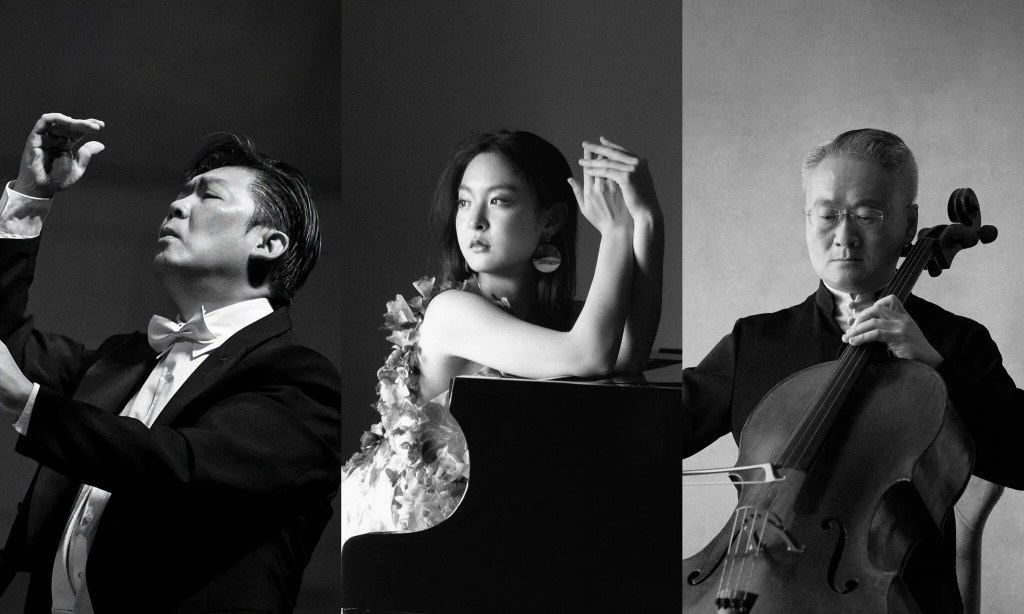
Pianist Benjamin Grovsner played with a restrained focus which suited the piece with its charming lyricism. His shimmering arpeggios and his careful detailing of individual notes showed him to be in total control as well as understanding the structure of the work.

Conductor Shiyeon Sung ensured that the graceful opening of the work, with the flute introducing the piano before Grovsner embarked on his many arpeggios and other technical feats. His faultless command of the keyboard with light, tentative playing had a delicacy to it but which he was able to slowly transform to more elaborate and tantalizing passages. Throughout that first movement he moved from the introspective to the more dramatic and expansive

Throughout the work Sung conducted with the same precise approach which Grosvenor displayed, carefully and deliberately picking away at the keys.

In the second movement (Elvira Madigan) he manged to expertly deliver the lyrical qualities of the work with playing which captured an emotional quality before embarking on invigorating finale.

The other major work on the programme was Shostakovich’s Symphony No 9 which when it premiered in 1945 was expected to be like his earlier wartime symphonies, reflected the scale and horror of the Great Patriotic War.

Instead, this short work was full of humour and cynicism rather then heroism and valour. The irony of the work reflected the composer’s regard with Stalin’s regime. Within the jollity of much of the work there is a kernel of melancholy, his only way of showing his despair and distrust of the ruling elite.

The irony of the work can be heard in passages like opening movement with its classical style and an impish piccolo which seems to hide something malignant and then the wistful opening of the second movement where the clarinets and flutes sound as they are on the edge of despair.

Throughout work the music is full of tentative elements suggesting freedom along with passages which seem to be hemmed in, as though the melodies are trying to escape the music continually undercutting the false jollity.

The third movement featured a playground scene but it reveals, not happy children’s activity but detritus and barren landscape conveyed by mournful strings and soulful brass with more dark sounds from the bassoons before turning into a sequence of edgy, mocking music.

The work concluded with a Carnival of Lost Souls, a weird dance or march of hopelessness and death.

To subscribe or follow New Zealand Arts Review site – www.nzartsreview.org.

The “Follow button” at the bottom right will appear and clicking on that button  will allow you to follow that blog and all future posts will arrive on your email.

Or go to https://nzartsreview.org/blog/, Scroll down and click “Subscribe”

Categories
Reviews, News and Commentary

Peter James Smith’s Zealandia

Reviewed by John Daly-Peoples

Peter James Smith, Zealandia

Orexart

Until 27 September

Reviewed by John Daly-Peoples

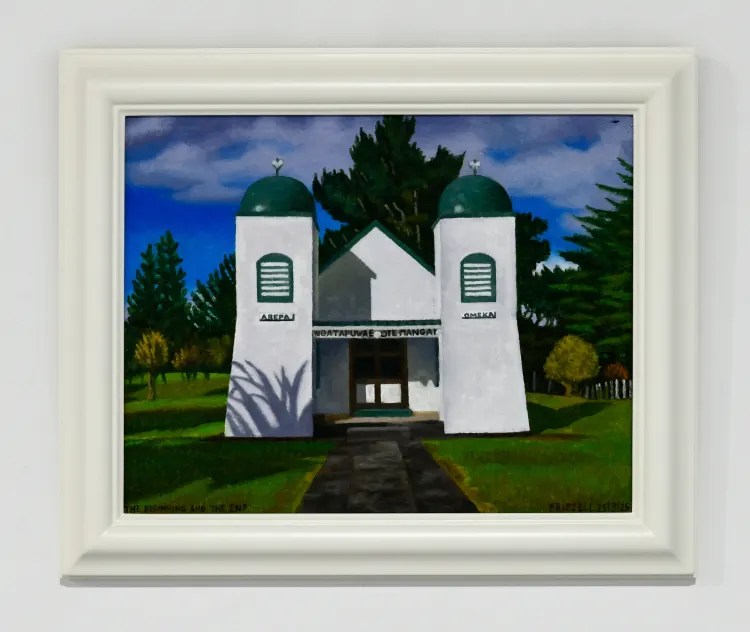
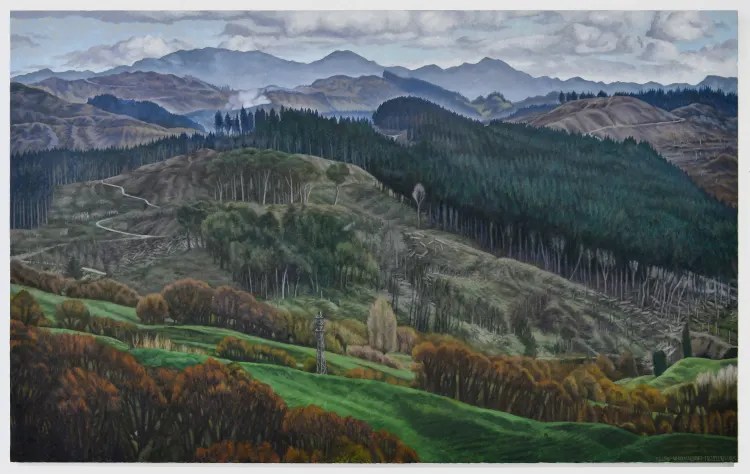
Peter James Smith in speaking about the impetus behind his landscape paintings has noted his debt to T S Eliot’s “Four Quartets” and in particular “Burnt Norton” with its notion of transcending time to achieve a sense of timelessness.

Time before and time after
In a dim light: neither daylight
Investing form with lucid stillness
Turning shadow into transient beauty

This can be seen in his latest exhibition “Zealandia” where the artist examines Zealandia, the earth’s largely submerged continent beneath the waters of the Southwest Pacific Ocean with only a few islands like New Zealand and New Caledonia breaking the surface to reveal parts of the super continent of Gondwana. 

These islands, historical remnants of an ancient time and still revealing themselves, link past and present through a process of discovery both scientific and historical.

With many of his paintings the landscape forms are often shrouded in this dim light and their shadowy forms seem to take on a substantial form, transporting them from the eighteenth century and the voyages of Capt Cook as well as later voyagers.

With “Zealandia” ($8500) there is sense that the artist is describing the underlying landscape of rocks, islands and headlands beneath the water’s surface, as though these forms are thrusting their way upwards.

Smith like many other artists with a Romantic approach to landscape see his subjects as a powerful, emotional forces, depicting the raw, uncontrollable aspects of nature such as storms, mountains, and wild, untamed places. The landscapes used to express subjective feelings and the sublime, highlighting nature’s grandeur.

Unlike many Romantic artist Smith does not include human figures to emphasis the grandeur of nature but rather includes ideas about man’s measurement of the forces of nature.

In his paintings he employs diagrammatic symbols and marks which indicate of natural forces and aspects of scientific enquiry such as concepts of the angle of sunlight, speed of tide or ocean currents.

The marks he often applies to his paintings can be cartographic indicating the outlines of landscape or the passages into harbours, they can also be the recording of rainfall or the forces of nature.

Then there are the written descriptions of the landscape giving the location, the dates of original or important events as well as a references to Plato’s concept of perception which is noted in “Rain Shadow (Lake Tekapo”) ($8,500).

With his “The Passage of History” ($15,500) the artist includes a short summary of Captain John Grono’s adventures in Doubtful sounds in 1813 where he rescued several marooned sealers. He also includes a map of the area as well as a distance indicator in sea miles.

A similar work “Wind Across Dusky Bay” ($15,500) features a map of the Dusky Bay area with a text about Capt.  Cook’s arrival in 1773 which includes the route taken by his ship “Resolution”. He has also included wispy shapes of the water being driven across the surface of the bay.

The view in this work is frames as though being seen through an observation window, emphasizing the notion of historical distance and that this was the area where Cook established an observatory so enable him to accurately fix his position in New Zealand.

The work “Leaps of the Spirit” ($10,500) which depicts the Lady Bowen Falls combines Romantic landscapes with gestural marks exploring themes of artistic intervention, history, time, and perception. 

The works full title “Leaps of the Spirit Across the Void” has something of a Miltonian flavour and reflects the artists notion of the interconnectedness of science and spirituality, where mathematical certainty meets artistic vision to create a holistic understanding of the world. 

To subscribe or follow New Zealand Arts Review site – www.nzartsreview.org.

The “Follow button” at the bottom right will appear and clicking on that button  will allow you to follow that blog and all future posts will arrive on your email.

Or go to https://nzartsreview.org/blog/, Scroll down and click “Subscribe”

Categories
Reviews, News and Commentary

Louise Bourgeois exhibition coming to the Auckland Art Gallery

John Daly-Peoples

Louise Bourgeois, The Couple, 2003, Auckland Art Gallery Toi o Tāmaki, on loan from a private collection. Photo: Christopher Burke, © The Easton Foundation /Licensed by Copyright Agency, AU

Louise Bourgeois: In Private View 

Auckland Art Gallery

September 27 – March 15 2026

John Daly-Peoples

Auckland Art Gallery Toi o Tāmaki will present the first solo exhibition in Aotearoa New Zealand of Louise Bourgeois (1911–2010), one of the most intriguing and influential artists of the last century.

Opening 27 September, Louise Bourgeois: In Private View brings together a selection of works from an international private collection, exhibited publicly for the first time. The exhibition spans over six decades of Bourgeois’s career, from early paintings made in 1945 to a fabric work from the final year of her life

Auckland Art Gallery Senior Curator, Global Contemporary Art, Natasha Conland, says, “Bourgeois remains a defining figure in late twentieth-century art with the ripples of her influence still being felt today. She is known for her highly personal and idiosyncratic sculptural practice which has lent her a special place in the history of art.” “The works in the exhibition are from a private collection lived with over many years, reflecting a deep and personal appreciation of her practice.”

Widely celebrated for her psychologically charged and bold sculptural practice, Bourgeois explored themes of memory, family, the body and the subconscious, often drawing from personal experiences.

She is best known for her series of large spider sculptures, which have been installed in many major international cities.

Highlights include paintings and her first series of sculptures, the Personages, from the 1940s and early ‘50s; Lair sculptures from the early 1960s; and significant later works, such as textile-based sculptures and sculptural enclosures.

Louise Bourgeois. Spider VI

Spider VI (2002) is a wall-mounted example of her internationally acclaimed series of spider sculptures, which she began in the mid-1990s. Also featured is her extraordinary hanging sculpture, The Couple, and late outdoor piece, Eyes.

 A series of curator tours and talks, open lates, as well as family-friendly activities has been programmed with the exhibition. The Gallery Shop has also launched a new range of Bourgeois inspired products which includes socks, brooches, books and more.

Categories
Reviews, News and Commentary

Pop to Present at Auckland Art Gallery

John Daly-Peoples

Andy Warhol. Triple Elvis

Pop to Present: American Art from the Virginia Museum of Fine Arts 

Auckland Art Gallery

November 8th 2025–March 15  2026

John Daly-Peoples

This year the Auckland Art Gallery  scored a great success with their “A century of Modern Art” exhibition sourced from the Toledo Museum of Art. Not only was it an extensive look at the art of the twentieth century but also included some significant works.

Later this year the  gallery will be looking to repeat the success of that exhibition with “Pop to Present” a major show highlighting the diverse artistic voices from the United States, spanning from1945 to the present day.

Opening in November, “Pop to Present:” will be showing American Art from the Virginia Museum of Fine Arts,  52 works reflecting eight decades of extraordinary artistic experimentation and cultural transformation in the United States. The exhibition includes abstract paintings, vibrant Pop canvases and hyper-detailed photorealist compositions along with Minimalist sculptures, richly textured pieces inspired by craft and domestic traditions, and contemporary figurative works that explore questions of identity, power and representation.

Showcasing 28 works by women and African American and Indigenous artists, the exhibition places well-known names in conversation with artists from diverse backgrounds to offer a broad and inclusive overview of recent American art. Artists featured in this comprehensive survey include Benny Andrews, Thornton Dial, Roslyn Drexler, Elaine de Kooning, Willem de Kooning, Helen Frankenthaler, Sam Gilliam, Philip Guston, Barkley L. Hendricks, Norman Lewis, Virgil Ortiz, Howardena Pindell, Jackson Pollock, Martin Puryear, Jaune Quick-to-See Smith, Mark Rothko, Kiki Smith, Clyfford Still and Andy Warhol.

“Experimenting with new materials while responding to the cultural and technological shifts of their time, the artists featured in Pop to Present challenged America’s social and artistic norms in ways that are still meaningful today,” says Kenneth Brummel, Curator, International Art, Auckland Art Gallery. “The exhibition also presents a large number of works by artists rarely seen in this part of the world”

Alma Thomas. Forsythia and Pussy Willows Begin Spring

Standouts in the exhibition include” Forsythia and Pussy Willows Begin Spring” a vibrant colour-field abstraction by Alma Thomas, an iconic Pop landscape by Roy Lichtenstein, and Andy Warhol’s Triple Elvis (1963).

Warhol’s “Triple Elvis” was based on the  singer-turned-gunslinger portrait of Elvis Presley on a publicity photograph for the 1960 western Flaming Star. This public persona was ideally suited to Warhol’s aim to focus on surface appearance rather than psychological interpretation. The overlapping multiple figures suggest individual film frames and cinematic motion, while the work’s metallic background evokes Hollywood’s silver screen.

Barkley Hendricks. Sisters (Susan and Toni)

Barkley Hendricks was an American painter and photographer who revolutionized portraiture through his realist and post-modern paintings of Black Americans living in urban areas in the 1960s and 1970s. “Sisters (Susan and Toni)” is a painting of two stylish women Hendricks met in Boston belongs to a series of works with dark backgrounds, against which the bright shirts and jewellery stands out.

This work and others in the exhibition are an indication of the strength of the museum’s holdings of art by black American artists of the American South.

The museum is among the largest art museum in North America for area of exhibition space and its comprehensive art collection includes ancient art, African art and American art, British sporting art, and Himalayan art. As part of their exhibit of decorative arts the museum has the largest public display of Faberge eggs outside of Russia, owning five. It is one of the first museums in the American South to be operated by state funds.

“We are proud to share the overall breadth of the VMFA collection, and in particular the importance of the Sydney and Frances Lewis collection that anchors it”  says exhibition curators Sarah Powers and Alexis Assam the Regenia A. Perry Assistant Curator of Global and Contemporary Art at the Virginia Museum of Fine Arts.

To subscribe or follow New Zealand Arts Review site – www.nzartsreview.org.

The “Follow button” at the bottom right will appear and clicking on that button  will allow you to follow that blog and all future posts will arrive on your email.

Or go to https://nzartsreview.org/blog/, Scroll down and click “Subscribe”

Categories
Reviews, News and Commentary

Aroha Gossage. Into the Light

Reviewed by John Daly-Peoples

Aroha Gossage, Anahera

Aroha Gossage

Into The Light

Artis Gallery

August 12 – 24

Reviewed by John Daly-Peoples

The paintings in Aroha Gossage’s new exhibition “Into the Light” are grounded in her connection to the whenua of Pakiri, north of Auckland where she lives.

They continue Gossage’s exploration of land, light, and ancestry, the paintings serving as links between observation of her environment and reflections on her connections to the land  and to her ancestors.

Several of the works are titled after their subject matter, simple renderings of native trees –  Nikau, Macrocarpa and Manuka. These works follow in the tradition of botanical artists such as Sir Joseph Banks who identified Manuka in 1769 during his time with Captain Cook on his first voyage aboard the Endeavour and many artists have depicted trees and their flowers since then notably Emily Cumming Harris and Shane Cotton.

Aroha Gossage, Manuka

Gossage’s “Manuka” ($2700) is painted in golden tones giving it an enigmatic quality where earth and foliage are connected, creating an image which transcends the physical. ”Manuka” is part of group of four small works which have distinctive colouring, due to the earth pigments the artist has collected from sites around her local environment.

While most of her works are of botanical subjects there are a few which include figures, or at least the spirits or manifestations of figures. Rather than earthly figures they suggest ancestral presence. As the title of the show suggest these figures are journeying towards the light of a new place or a new understanding.

In the  large ”Anahera” ($9800) a caped / shrouded figure inhabits an abstract environment with traces of foligare snaking through the work. There is a sense of another world in which ancestors dwell, the paintings connecting the physicality of this world with the spirituality of the other-world .

Aroha Gossage, Light

This can also be seen in “Light” ($2700) with one indistinct form and “Tupuna” ($9800) with several shapes inhabiting a forest of trees. With the works that include figures it is noticeable that while the trees are painted with  distinctive realism the figures are indistinct and ethereal.

Some of her works such as “Witi” ($4750) have a quiet drama to them like Rita Angus’ “Tree”. ”Witi” is also impressive because of its deep red earth pigment which seems to it refer to bush fires, destruction and renewal.

Works such as “Hine” ($2700)  and “Macrocarpa” with their dark tones seem to be ghost-like images of the trees rather than mere depictions, as though  inhabiting another dimension.

The suggestion of another world is created in many of these painting by veils of overlapping colour where the air around the foliage and figures in infused with earthy tones.

There are a  couple of works which are pure landscape “Pakiri Dunes” ($9800) and “Kaitaki” ($9800).These do not have the same density or richness as the others works being descriptive with fewer  allusions to another dimension.

Categories
Reviews, News and Commentary

Home, Land and Sea

Reviewed by John Daly-Peoples

The Way Alone Photo credit: Stephen A’Court

Home, Land and Sea

Royal New Zealand Ballet & The New Zealand Dance Company

Kiri te Kanwa Theatre, Aotea Centre, Auckland

July 31

Reviewed by John Daly-Peoples

Choreography: Stephen Baynes, Shaun James Kelly, Moss Te Ururangi Patterson
Music: Pyotr Ilyich Tchaikovsky, Philip Glass, Shayne P. Carter
Set Design: Jon Buswell (Home, Land and Sea)
Costume Design: Stephen Baynes with RNZB Costume Department, Rory William Docherty, Moss Te Ururangi Patterson with RNZB Costume Department
Lighting Design: Jon Buswell, Daniel Wilson

“Home, Land and Sea”, The Royal New Zealand Ballet’s Triple Bill featured three very different works each with a distinctive mood and choreography, all had links to the land with styles ranging from the abstract to the deeply connected.

The opening work, Stephen Baynes’ “The Way Alone” was originally performed in Hong Kong in 2008 for a Tchaikovsky programme and is a response to some of the composers lesser-known music  included some of his choral works. Firmly in the classical tradition the dancing was a direct response to the textures and rhythms of the music. the choreography emphasising the qualities of weightiness, graceful movements and subtle gestures as well as accentuating the dancer’s integration with aspects of light and shadow.

The work owed much to concepts of ritual with an elegance and refinement to the dancing which featured some beautifully articulated pas de deux and pas de trios.

The only problem with this sequence was that the recorded sound lacked the refinement of the dancing and created a disconnection between audio and visual. It was an issue that did not affect the other two works.

Chrysalis, Kate Kadow and Calum Gray Photo credit: Stephen A’Court.

After the first interval was the premiere of  Shaun James Kelly’s “Chrysalis” set to the Phillip Glass music “Metamorphosis” which was inspired by the Franz Kafka short story of  a man who wakes up to find his body has been changed to that of a large insect or chrysalis.

The setting for the dance also gave a nod to Kafka’s other work “The Trial” with various figures, some in trench coats roaming the stage, divesting themselves of items of clothing , an act which provided a clever metaphor for transformation – the shedding of skin and the emergence of the butterfly from the chrysalis.

The music features Glass at his minimalist  best with repeated phrases and  eerie looping sequences. There were also long, enigmatic  silences which were as expressive as the music and emphasised the notions of the dream, the surreal and the transformation.

The musical landscape with its abrupt, stark sounds was echoed by  the dancers with their carefully choreographed movements,  rapid changes and tense interactions.

Home, Land and Sea Photo credit: Stephen A’Court

The  third work on the programme was “Home, Land and Sea” choreographed by Moss Te Ururangi Patterson’s (Ngāti Tūwharetoa), the  Artistic Director of The New Zealand Dance Company. This was the first the Royal New Zealand Ballet has partnered with The New Zealand Dance Company with members from both companies performing.

The stage featured five panels on which were projected images linked to the dance – tāniko, vegetation, clouds and sea.

The work combined contemporary dance and kapa haka suggesting elements of journey, history and tradition.

The music for the work composed by Shayne P. Carter had a harsh quality to it which was emphasised by the dancing where there was much angularity in the gestures and movements, combining the sinuous quality of contemporary dance with the intensity and athleticism of kapa haka.

The  element of sound often associated with kapa hake -was also much in evidence – slapping, stamping and breathing, all adding to the physicality of the work.

In the latter part of the dance when the dancers became more dynamic and  the music more aggressive, the roiling mass of dancers seemed to become a force of nature transcending their human condition to become god-like in their expression.

Categories
Reviews, News and Commentary

World Press Photo Contest: the best of photojournalism

Reviewed by John Daly-Peoples

Image Ye Aung Thu Documenting the conflict in Burma

World Press Photo Contest

Presented by Rotary Club of Auckland

131 Queen St Auckland

Until 24 August,

Reviewed by John Daly-Peoples


The World Press Photo Contest is one of the most important photographic exhibitions and has been held every year since 1955.

While the focus is on the major political, social development and changes around the world it also presents aspects of sports and culture along with the drama and humour of everyday life.

The 2025 exhibition has six worldwide regions – Africa, Asia, Europe, North & Central America, South America, and Southeast Asia & Oceania and four categories (Single, Story, Long Term Project and Open Format). The winning entries from the six regions in each category form this exhibition with four global winners chosen.

The exhibition highlights significant global events and issues through powerful photojournalism and documentary photography. This year’s exhibition, presents a diverse range of subjects, including the human cost of conflict, the impact of climate change (like the Amazon droughts), political events, and stories of human resilience and cultural identity.

The exhibition rarely shows New Zealand work  but this year the Belarusian, New Zealand based photographer Tatsiana Chypsanava is included with her award-winning group of photographs titled “Te Urewera The living ancestor of the Tuhoe people” which includes is an image of Tama Iti.

The top honour for 2025 was awarded to Samar Abu Elouf’s haunting image of nine-year-old Mahmoud Ajjour, who lost both arms in an Israeli airstrike in Gaza City.

Image by Samar Abu Elouf

The exhibition includes a special display marking 70 years of World Press Photo, offering a look back at the evolution of photojournalism and its impact.

Donald Trump is the focus of a work by Jabin Botsford showing members of the US Secret Service helping Republican presidential nominee Donald Trump off stage moments after a bullet hit his ear during a campaign rally at the Butler Farm Show Grounds, Pennsylvania

Image by Jabin Botsford

Mosab Abushama’s image of a groom at his wedding in Omdurman, Sudan, where weddings are traditionally  announced with celebratory gunfire. He asked a friend to document his wedding on his cellphone in a city constantly targeted by airstrikes.

image by Mosab Abushama

Gaby Oráa photograph shows Venezuelan opposition leader María Corina Machado as she greets supporters during a campaign rally in 2024. She was barred from running and as a result, she endorsed the former ambassador as the opposition’s candidate and led his political campaign across the country.

Image Gaby Oráa

Brazil’s Gabriel Medina was captured by Jérôme Brouillet as he bursts out triumphantly from a large wave in the fifth heat of round three of men’s surfing, during the Olympic surfing at Teahupo’o, Tahiti, French Polynesia  in 2024.

Jérôme Brouillet

The exhibition is brought to Auckland by the Rotary Club of Auckland as a fundraiser for charity. This year the profits will go to Rotary youth programmes, interact and Rotaract, and PHAB an inclusive organisation dedicated to empowering individuals with disabilities.

Categories
Reviews, News and Commentary

The Art of Banksy

Reviewed by John Daly-Peoples

Banksy, Girl with a balloon

The Art of Banksy

Hunua Rooms, Aotea Centre

Until  3 Aug.

Reviewed by John Daly-Peoples

The Art of Banksy, is a  major exhibition of the artist’s work which has now been seen by 1.5 million visitors in 18 cities around  the world.

The collection of 150 original and authenticated works features more than 150 pieces, including prints, canvases, unique works, and ephemera.

There are several versions of his well-known pieces such as the “Girl with a balloon” and “Flower Thrower,” also known as “Love is in the Air,”

As with many of his works Banky borrows from other sources, changing the original intention, subverting the original meaning as well as trawling the world for the symbols and highlights in other artworks.

So, there are references, adaptations and reworkings of Christian iconography, news photographs, Disney images along with the work of Andy Warhol, Keith Harring and even Degas.

Banksy, Ballerina with Action Man parts

It is the clever borrowing of images which appeals to adult audiences as well as well as children and his images which undermine capitalism will bring a smile to both to the conservative as well as the revolutionary.

The exhibition spans his output from the 1990’s to the present-day showing examples of his satirical and subversive output  often appearing in public places around the world.

His iconic artwork depicting a masked figure or rioter, about to throw a bunch of flowers is taken for a newspaper image of a rioter throwing a projectile. This substitution is an obvious message advocating for love and peace over conflict and war.

Banksy, Trolley Hunters

There are other works like “Trolley Hunters” that satirize consumerism by depicting cavemen hunting shopping trolleys instead of wild animals. As well as being a clever juxtaposition of elements it is also a commentary on how modern society has become overly reliant on mass-produced goods and detached from nature.

Banksy, Souvenirs

Some of his work has more immediacy such as the several works related to his Walledoff Hotel in Bethlehem including some hand painted souvenirs. There are also images of his “Dismaland”, his take on Disney World ,creating a dystopian “bemusement park” located at the Tropicana in Weston-Super-Mare in 2015.

The exhibition also helps expand our understanding of the artist with numerous quotes by the artist about his history and approach to his work along with commentary by some of his collaboratives.

While here are many of his famous work there are also some of his original pencil sketches for the finished works

The works in the exhibition show that Banksy can be viewed  from various perspectives – a cartoonist, a comic, a satirist, an agent provocateur or an  advertising guru,

Categories
Reviews, News and Commentary

Grace Wright, Grand Illusions

Reviewed by John Daly-Peoples

Grace Wright, The Truth Is In The Depths

Grace Wright

Grand Illusions

Gow Langsford, Onehunga

Until July 19

Reviewed by John Daly-Peoples

“In the beginning how the heavens and earth

Rose out of Chaos:”

John Milton “Paradise Lost”

John Miltons lines at the beginning of Paradise Lost provide a succinct description of Grace Wrights suite of paintings in her show Grand Illusions. Equally the description of Charles Albury’s who was an observer of the effects of the atomic bomb at Hiroshima are also applicable – “We watched that cloud rise. It had every colour of the world up there, beautiful colours. To me it looked like salmon colours, blues, greens.”

Theses impressions  of shape, design and colour are something we also see in  the  images of the heavens taken by NASA revealing what appears to be chaos in the Milky Way and other galaxies.

Grace Wright, The Causes of Seeds, Plants and Fruit

Wright’s paintings conjure up a range of associations, from the of cosmic to the microscopic with some of her images  linked to brain scans and the flares of neurological synapses as in her “The Causes of Seeds Plants and Fruit”.

As with her previous work the artist explores the confluence between abstraction, symbolism and realism with a colour palette echoing the renaissance masters as well as the great Impressionist.

Grace Wright, On the Disposition which Characterizes the Wise

With a lot of her work she appears to have a contemporary take on the Baroque with images such as  “On the Disposition which Characterise the Wise)” with its drama and exuberance. Here the brush strokes suggesting the writhing bodies of baroque paintings in the paintings of Giovanni Battista Gaulli, at the Il Gesu church in Rome.

With “Cosmology” there is a sense of floating diaphanous fabrics in pastel colours while works like “The Causes of Atmospheric Phenomena provide a sense of dramatic skies after a storm .

Grace Wright, Cosmology

The small lively brushstrokes in several of the works suggest small birds in flight (On the Beauty of Song” or carefully described shell forms (Projections). These lively brushstrokes also make the viewer aware of following the mark making of the artist, both the small tentative marks as well as the grand gestures.

To subscribe or follow New Zealand Arts Review site – www.nzartsreview.org.

The “Follow button” at the bottom right will appear and clicking on that button  will allow you to follow that blog and all future posts will arrive on your email.

Or go to https://nzartsreview.org/blog/, Scroll down and click “Subscribe”

Categories
Reviews, News and Commentary

Ruth Cleland’s exploration of the enigmatic quality of concrete

Reviewed by John Daly-Peoples

Ruth Cleland Concrete 3

Ruth Cleland, Concrete

Sumer Fine Art

Until July 22

Reviewed by John Daly-Peoples

In her latest exhibition ”Concrete” Ruth Cleland continues her interest in the accurate depiction of her environment along with the use of the grid.

Gridding is a technique that has been used by many artists throughout history using horizontal and vertical lines over drawings or photographs for enlargement and transfer purposes.

Cleland uses a grid to transfer images of concrete floors onto board using either graphite pencil or acrylic. These images such as “Concrete Floor 3” ($12,8000) show the polished concrete surface with imbedded scoria along with signs of previous uses and marks.

The works are akin to the work of the Boyle Family who randomly chose sites or parts of the body which they then recreated, the completed work offering new interpretations of the environment or body.

These images of concrete floors could be of the floor of the gallery with its various  sections of ground and polished concrete laid over the years. They are in fact of a supermarket floor that the artist has previously used as subject matter. One image, “Concrete Path” ($12,800) has a more personal connection being the concrete path outside the artist’s home.

These images of concrete are meticulous in their accuracy but the artist shows her skill in the depiction of both ambient light sources as well as overhead lights.

Ruth Cleland, Concrete Floor 1
Ruth Cleland Gris (Concrete Floor 1)

In some cases there is a companion piece to the photorealistic image as with “Concrete Floor 1” and “Grid / Concrete Floor 1” ($12,800 pair). The lines drawn on the grid have been used here to indicate the striations seen in the drawing as well as light intensity. This recording adds to the enigmatic nature of the work suggesting there is an underlying plan or logic inherent in the image itself which the artist has revealed.

To subscribe or follow New Zealand Arts Review site – www.nzartsreview.org.

The “Follow button” at the bottom right will appear and clicking on that button  will allow you to follow that blog and all future posts will arrive on your email.

Or go to https://nzartsreview.org/blog/, Scroll down and click “Subscribe”