By Dan Colley and Riverbank Arts Centre, Newbridge
Based on the short story by Gabriel García Márquez
Herald Theatre, Aotea Centre
Until 24 March
Review by Malcolm Calder
Director, Dan Colley
Lighting, Sarah Shiels
Sound, Alma Kelliher
Just outside of Dublin is a small town in Co Kildare called Newbridge. Its Riverbank Arts Centre, is funded by both the local authority and the Arts Council of Ireland, and it serves its community well. Rather like similar ventures in this country its facilities are available to local community groups, but at its artistic heart is a carefully-curated program featuring selectively chosen professional work from all over Ireland, the UK and Europe.
Unlike the vast majority of its New Zealand counterparts however, the Riverbank Centre is much more than just a receiving theatre. It also carefully nurtures talent and creativity and has developed into what is referred to in the trade as a ‘producing theatre’ with some of its work touring extensively
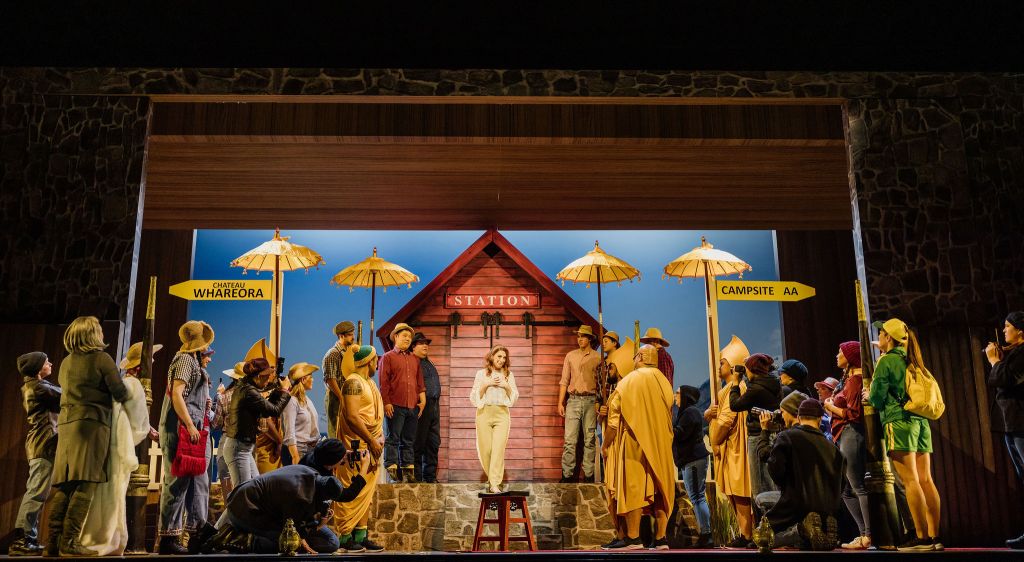
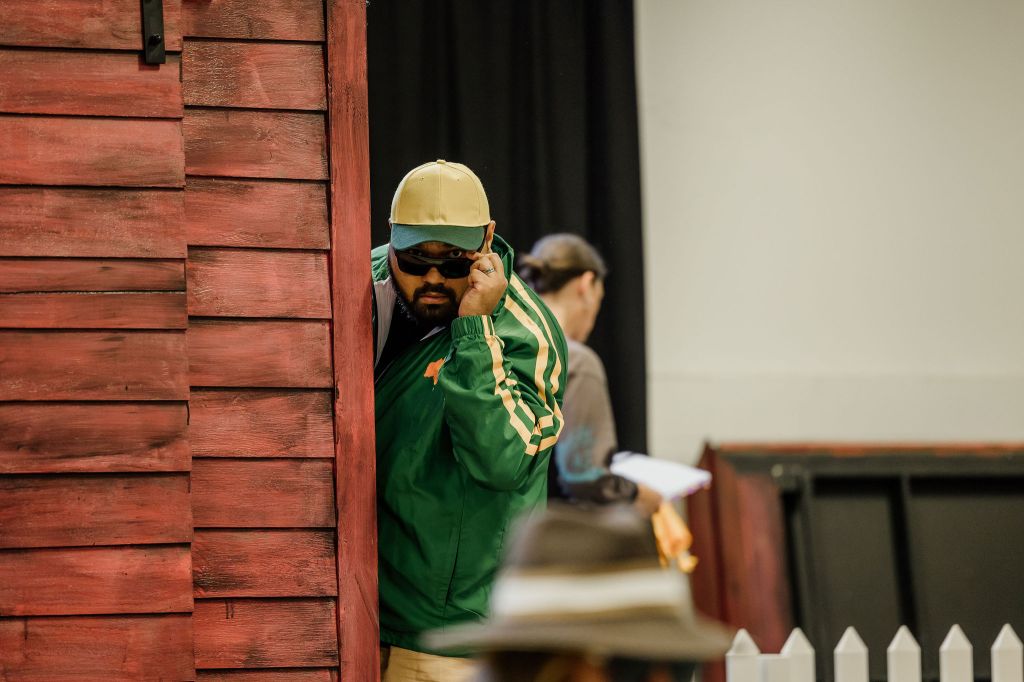
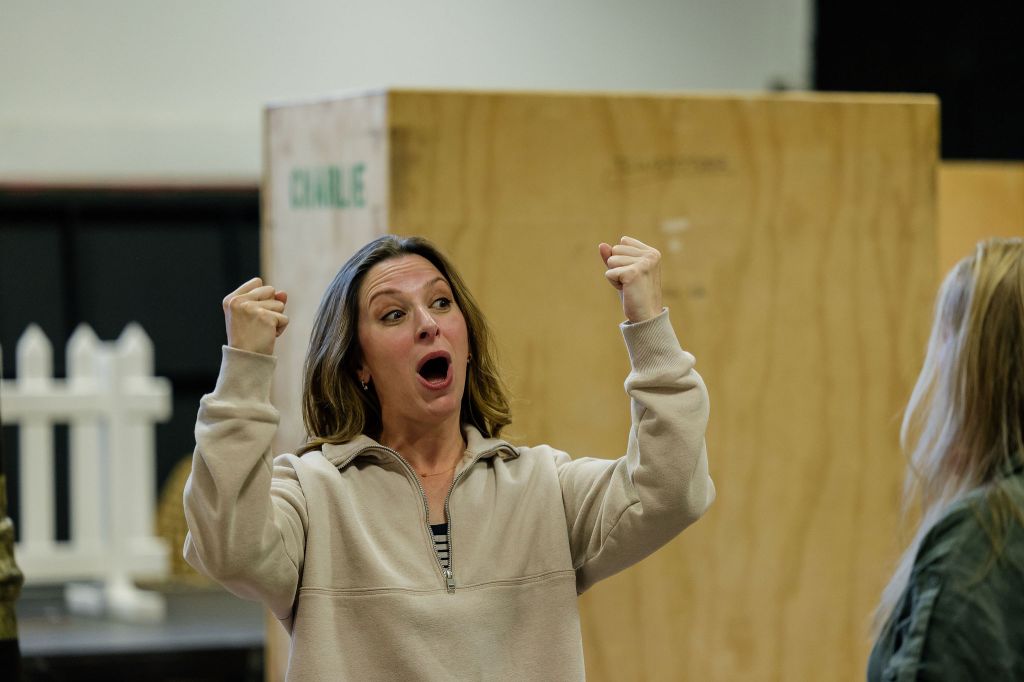
A Very Old Man With Enormous Wings typifies this. It is the work of a small cooperative group under the leadership of Dan Colley who have created a perfect show for young and old to share, gorgeously formed around music, puppetry and live video, but also thoughtful and emotionally rich in its exploration of human nature.
Its informality and studied casualness is very quickly established. Non-speaking actor Manus Halligan (well he makes some mouth-noises) is ‘doing things’ with tiny models on a table as the audience is seated. When the lights find a little focus, narrator Genevieve Hulme-Beaman simply announces “we’ve started”. She goes on to urge the audience for this offbeat adaptation of Gabriel García Márquez’s children’s story, to not go looking for a lesson. “There isn’t one.”
And that’s precisely what we get. It’s like a children’s story told by children and, as is often the case with children’s stories, introduces flashes of unexpected insight and depth. The story certainly examines the human response to those who are weak, dependent, and different and there are moments of striking cruelty and callousness throughout. But it essentially brings a magical revelation of itself to the stage and reveals itself through a beautiful, strange, emotional richness. It is offbeat, quirky, funny and its 43-minute runtime flies.
Above all it reveals what creative minds can generate using little more than ingenuity. And what can gestate in a small regional arts centre where producing is as important as receiving.
With Taungaroa Emile, Julie Edwards, Joe Dekkers-Reihana, Tuakoi Okia
Lighting, Katrina Chandra
Sound, Eve Gordon
Until 24 March
Review by Malcolm Calder
Conceived during lockdown, Tainui Tukiwaho’s The Sun and the Wind is demanding for an audience. At times it mixes the real and the surreal, throws in a pinch of the tender and the touching, and then explodes with emotion, truth becomes blurred and we start unravelling things all over again. It is a highlight of this year’s Festival.
Set at a birthday party for an ageing couple, heartrendingly comfortable and practised in each other’s company, Hūkerikeri seems like a kind and gentle kuia caring for her Rangi in his dotage. I initially wondered if I had accidentally strayed into some kind of social commentary on contemporary aged care.
But the sudden and noisy arrival of a younger couple crashing into their home intent on robbing them quickly put that thought to bed.
The newcomers soon become mistaken for a long-deceased son and his pregnant wife – in the mind of the birthday couple anyway. From there The Sun and the Wind quickly becomes an emotional rollercoaster. Factual memory blurs with confused recollection, two levels of whanau intermingle and become one or maybe not, and quiet introspection gives way to sudden violence.
How much of it is real ? Perhaps that is summed up by the presence of a gun – which may or may not be real.
The Sun and the Wind owes something Aesop’s fable The North Wind and the Sun, a moral allegory which sees persuasion triumph over force. The way Tukiwaho spins it though, things are never quite that simple. That is why this play demands a lot from its audience.
Nevertheless, I occasionally wondered if Tukiwaho had over-written in patches, but he quickly jolted me back to the main course with more sudden and unexpected twists, turns and confusions.
Edward Peni directed with aplomb – an extremely demanding task on a play if this type.
Julie Edwards makes an enchanting Hūkerikeri, endearingly loveable but with sudden vituperative barks of fury. She is so, so on point. Taungaroa Emile gives us a Rangi, whose mind wanders with vivid clarity, his love of whanau omnipresent.
I felt quite sorry for poor Hihi (Joe Dekkers-Reihana) who is flung from doorpost to doormat as he struggles to make sense of everything. It is left to his heavily pregnant partner Kate (Tuakoi Okia) to slide the occasionally grounded, and often humourous, comment in from time to time.
Although it generates the occasional laugh, this play is not a comedy. It marks a big step forward for Tainui and demands a lot from its audience. So, if you are one of those who lament the plethora of highly subjective immature frivolity seen today on many of Aotearoa’s stages, you should certainly not miss this one.
Derek Jarman: Delphinium Days Gus Fisher Gallery, 15 June-14 September 2024 City Gallery Wellington, 19 October 2024- 2 February 2025
John Daly-Peoples
This June, Auckland’s Gus Fisher Gallery opens Derek Jarman: Delphinium Days, New Zealand’s first exhibition of this highly significant figure influential artists and gay rights activists of his generation. Entry is free.
He was the first public figure in the UK to make his HIV positive status known, the exhibition marks 30 years since his untimely death to an AIDS related illness at the age of 52.
The exhibition curated by Lisa Beauchamp, ( Gus Fisher Gallery), Aaron Lister (City Gallery , and Michael Lett will feature seen paintings, films, photographs and archival material by and about the artist, which will offer an in-depth and affecting view of this celebrated cultural figure whose impact remains profound today.
Beauchamp says “The exhibition will also cement Jarman’s familial connection to Aotearoa through his father Lancelot,” she says.
Jarman’s father Lancelot Elworthy Jarman was born in Canterbury in 1907 after Jarman’s grandparents immigrated from Britain in 1888.
“To bring this part of his life to the fore in Derek Jarman: Delphinium Days will add so much to our understanding and connection to him as one of the most enduringly relevant and impactful artists of modern times,” adds Beauchamp.
Jarman was a prolific creative best known for his avant-garde films, who pushed boundaries to move skilfully between painting, film, writing, set design, performance and gardening.
Jarman was an early campaigner for the rights of the LGBTQIA+ community and people with AIDs, after being diagnosed as HIV positive himself in 1986.
Co-curator Michael Lett says: “Derek Jarman was one of my first encounters with a fully formed, human gay man. As a teenager reading “Modern Nature” quietly in my room, I found a complex man, who had friends, had sex, got angry, liked to garden and was open about being HIV positive.”
Jarman’s films are widely known, including Caravaggio (1986) and The Garden (1990) starring his longtime collaborator and muse Tilda Swinton; cult-favourite Jubilee (1978) and his last ever feature film Blue (1993). In Auckland, Gus Fisher Gallery will partner with The Capitol Cinemas to present a selection of Jarman’s most well-loved feature films by the artist.
Jarman helped set the cultural zeitgeist for the time, with his art speaking to and for the dispossessed and alienated, as well as his writing, including Modern Nature (1991) and At your own risk (1992). Many will also be familiar with his music videos for iconic bands like Pet Shop Boys, The Smiths, and Sex Pistols.
Major painted works from Jarman’s late ‘Evil Queen’ series will be included in the exhibition, as well as a selection of his famous tar paintings and landscapes that connect to his garden at Dungeness. A selection of Jarman’s rarely seen Super 8 films will also be featured.
The artist himself will feature in a range of tender images by Jarman’s close friend and photographer Howard Sooley.
A dynamic public programme of events will be delivered in Auckland and Wellington to help the exhibition resonate with broad audiences, informed by kōrero with Aotearoa’s LGBTQIA+ communities.
“By using the exhibition as a catalyst to reduce the stigma associated with HIV and AIDS, we plan to offer meaningful engagement opportunities for rainbow audiences and allies,” says Beauchamp.
She says Jarman became a beacon of hope for those isolated from society.
“His artworks and social commentary are a powerful mechanism against a rising tide of hatred and homophobia. Whether through painting, film, gardening or writing, his creativity knew no bounds and continues to influence generations of artists globally.”
Last night I went down that rabbit hole where Alice (In Wonderland) went. Or rather, Scott Silven led me down it – to a world where the rules of logic don’t apply, where the random and unexpected are the norm. At least that’s what Silven had me thinking. After all, he is mentalist, maybe even a hypnotist so he can make me believe his extraordinary sleight of hand performances are real, or were they mere illusions or complex deceptions.
He doesn’t make objects disappear or turn pumpkins into rabbits but he does elaborate things with words, numbers and pictures.
Certainly he is a showman, having the gift of the gab with a history of invention and mentalism going back to his youth and the safe place he found in his grandparents attic where he found a mental connection to the stars and the universe – and then to huis audience.
The set reflects that distant past and the attic with the comfortable leather chair, an artist’s easel and assorted chairs and furniture all of this bathed in soft lighting giving it the sense of a séance.
His narrative connects his illusions (or are they tricks) which he learnt those early years in his grandparents attic to the stage at SkyCity.
He starts the show with the simple guessing a number in someone’s head but then moves on to elaborate illusions where guessing the number or the word goes through elaborates steps before the revelation. At one point the word turns out to be a number and the number refers to a page and line in a dictionary.
So, how’s this for a trick. Silven gets a husband and wife up on stage. The husband has to guess what his wife’s favourite place is. He guesses Italy but he is wrong so we get a bit of audience participation. A large map of the world get ripped up into about 500 pieces by the audience. The 500 pieces get put in a box and the husband chooses a sliver of paper, bearing – a bit of France.
There is quite a bit if audience participation Everyone in the audience gets given pencil and two pieces of paper one for a word one for a drawing which all get shared eventually. This all links to Silven’s proposition that we can collectively make things happen – it sounds like snake oil but it works.
Is Silven onto to something or is he on something, whatever it is he gives a captivating performer and his act is heightened by great sound track along with some dramatic used of lighting.
While you can be sceptical of all his little routines you still keep asking – how did he do that.
The King’s Singers are the most well-known and probably the greatest exponents of cappella singing who have been touring the world’s major concert venues for the last fifty years.
With their sole Auckland performance, “Finding Harmony they displayed their superb technical skills and an extraordinary blend of vocal cohesion.
As well their ability to sing like a choir of angels they can sing like a rowdy pub crowd or an earnest revolutionary mob.
They understand what music is capable of and why it is important. They are not merely singing great songs with interesting lyrics, they are singing songs which have inspired people at particular times.
Their programme presented songs grouped together with sets from the time of the Reformation, works from Africa, Georgia, Estonia and the Scottish Highlands.
They opened with songs under the title “I have a dream“ featuring music of the US Civil Rights movement including works by Mahalia Jackson and U2.
The U2 song, simply titled “M.L.K.” opened in a sombre mood with some of the voices created a bagpipe-like sound with the voices floating above the hum of the pipes, the funereal sounds slowly changing to that of the reflective.
Another set was of songs focused on the Estonian struggles against the Soviet occupation of the late twentieth century.
There was “Parismaalase” a work by Vejio Tormis with its primitive sounds and rhythms and the refrain “tabu-tabu” (taboo) repeated 300 times the chant referencing the inability of the Estonians to speak out during the Soviet occupation. Accompanied by a single drum their voices ranbged from that of a whisper to a shout.
With a trio of Georgian songs, the group explored several traditional songs which had a mix of extotic sounds which showed the influence of Eastern music and a different approach to singing with sounds like that of a mouth harp along with a piercing yodel-like sound in one of the works.
They introduced their suite of works under the title of “Lost Songs of the Highlands” with a short history of the Highland Clearances before singing John Cameron’s wistful longing for the Scottish landscape. Their singing of “Loch Lomond” which they made into an achingly sad work telling of the separation of man and wife as well as the separation of the land. They gave these works a real power with their voices replicating the sounds of the pipes and fiddle along with some plaintive whistling.
They presented music of the Reformation much of which was set in motion by Martin Luther, developing an alternative to the spiritual monopoly of the Roman Catholic Church . This Protestant music changed from the polyphonic motets sung in latin to a simpler style which was illustrated with Luther’s very own hymn, “Ein feste Burg”, which became something of an anthem for the Protestant movement, being sung in the common language with more relevant lyrics.
They also sang works by the English composers William Byrd and Thomas Tallis who were more Catholic in their output favouring elaborate compositions and the singers made the most of this quality with their entwined voices.
The final miscellany of works included a witty mashup of the Mary Poppins song “Supercalifragilisticexpialidocious and “Take Care of the Children”, a work composed by Robert Wiremu, setting the words of Dame Whina Cooper to music. Here the singers also managed to imitate the sounds of the koauou (flute) and porotiti (whirling hummer). In a tribute to the visionary Māori leader.
The final work on the programme was their version of the Beatles song “When I’m Sixty-four” where the singers imitated the instrumental sounds rounding out a concert filled with moments of vocal magic.
The “Follow button” at the bottom right will appear and clicking on that button will allow you to follow that blog and all future posts will arrive on your email.
There’s something about a standing ovation. Especially when it’s totally impromptu and anything less would either seem churlish and suggest one had possibly been asleep for the last 80 minutes or so.
But that’s what Shane Blaney received at the end of In the Name of the Son at Q theatre on Thursday night. And rightly so.
My initial thoughts were that we were going to get yet another a diatribe about political injustice during the Troubles. But I needn’t have worried. This was merely a context for a story about Gerry Conlon’s personal journey and traces his successive leaps following a 15-year mis-sentence through to international recognition and a descent that plumbs the depths of the human spirit. Ultimately however, it demonstrates the triumph of that spirit over extreme adversity which makes for a very good story indeed.
It seems so long ago now – the IRA Guildford Pub bombings Four and the political upheaval that eventually resulted in their being freed after 15 years in prison. But I remember it well. What I was unaware of however was Gerry Conlon’s journey.
In the Name of the Son achieves this by introducing us to many, many characters and Blaney swiftly skips from one to the other with impeccable timing, sparkling wit and he wrings remarkable depth from each in this one-man show. There are so many I lost count but they are colourful and they are memorable. Blaney even manages to slip in a memorable one-liner from Jack Nicholson and a goodly chunk of Springsteen’s ‘Born to Run’ while in toilet at the Oscars.
The play even manages a subtle side-swipe at Daniel Day Lewis and other cinematic A-listers (the film was the titled ‘In the name of the Father’, a dramatization of the political side).
In the Name of the Son by Gerry’s lifelong friend Richard O’Rawe and Martyn Lynch tells it as it was. And Blaney delivers it switching seamlessly between the different genders, ages and accents of those who played a role in Conlon’s fascinating story. That is what makes this otherwise harrowing tale of injustice worth nothing less than the standing ovation he received at opening night.
A few years ago Waiheke’s Sculpture on the Gulf was included in the New York Times top things to do and the event is regarded by many as one of the great outdoor sculpture exhibitions, not just for the standard of the sculpture but also for the experience of the two kilometre walk with a backdrop of bush, hills, sea and headlands as well as panoramic views of distant Auckland and the islands of the gulf.
The event attracts tens of thousands of people for the five week show which features over twenty-one works, down from the twenty-seven of the last show two years ago.
There is a bit of a surprise mid-way through sculpture walk seeing Jorge Wright’s monumental Corten steel work “Head Within” standing only a few metres from where it was two years. It was bought by the owner of the property which abuts the sculpture walk.
Many of the works in this years exhibition have strong architectural and historical connections, reflecting on the changing built environment and the congruent changes to the natural environment.
Turumeke Harrington “Stumped I-XII”
Turumeke Harrington slices of native trees in “Stumped I-XII” reference the trees which once covered Tamaki Makura while Chevron Hassett’s “Te Kupenga” welcoming entranceway with its 19th century fretwork would have been built with that cut timber.
Chevron Hassett “Te Kupenga”
There is Ana Iti’s “Whakaruruhau”, a deconstructed work of structural elements which is also similar to the more elaborate work of Lonnie Hutchinson’s “Moemoea – A model for Dreaming” where her designs in turn relate to Chevron Hassett’s “Te Kupenga”.
Yona Lee’s “Fountain in Transit” uses the steel tubing she often uses to construct interior space with her to create a shower nestled in the bush.
Oliver Stretton-Pow’s marooned lighthouse “Hard Graft” links architecture to plant growth, timber and the tendrils of ocean creatures, referencing the country’s maritime history.
There are references to international architecture and art with Natalie Guy’s “The Staircase” a homage to Carla Scarpa’s innovative use of materials and designs. Another reference to international art can be seen in Seung Yul Oh’s “Cycloid I, II, III, IV, V, and VI” which mimic Alexander Calder’s lively and colourful shapes . Here the works are like abstract bushes growing alongside the path.
Seung Yul Oh “Cycloid I, II, III, IV, V, and VI”
There is an architectural component to Nicholas Galanin’s “An Unmarked Grave Deep Enough to Bury Colony and Empire” which uses the outline of Queen Victorias statue as a template for the grave he has dug on the headland.
The most powerful of the architectural works is Brett Graham’s “Wakefield Dreaming” which dominates the headland with his references to the justice system and the overreach of surveillance
Gavin Hipkins’ “Hotel Flag” evolved from the nautical flag representing the letter H, the first letter of the artists name, it also references the abstract geometric art of Malevich or Stephen Bambury.
Steve Carr’s bronze tires “In Bloom (Waiheke)” can be seen as a sort of self-portrait while Eddie Clemens’ “Cognitive Reorientation” also references his interest in cars as a defining aspect.
Combing aspects of rural farm architecture and religious iconography is Ralph Hotere’s “Taranaki Gate Stations”. The work is based on the Passion of Jesus Christ and originally conceived for Easter 1981
Ralph Hotere “Taranaki Gate Stations”
The work consists of a cruciform-shaped pen using fourteen standard pipe-and-mesh farm-fence units, with fourteen numbered sheep in. The gates are marked with Roman numerals (I–XIV) and the sheep painted with Arabic ones (1–14), both in a spectrum of fourteen colours. The various shapes and numbers relate to the stations of the cross and other religious concepts. The work also links back twenty years to Gregor Kregar’s “Mathew 12/12” shown St at SOTG in 2003 where he displayed 12 live sheep linked to the biblical text.
Zac Langdon-Pole “Chimera”
Probably the strangest work in the show is Zac Langdon-Pole’s “Chimera”, a dinosaurs skull hanging from a crane which could have been unearthed from the Queen Victoria excavation in a quirky reference to the country’s past.
Oum with conductor Fawzi Haimor and the NZSO Image Jono Tucker
Auckland Arts Festival
Beyond Words
New Zealand Symphony Orchestra
Auckland Town Hall
March 10
Reviewed by John Daly-Peoples
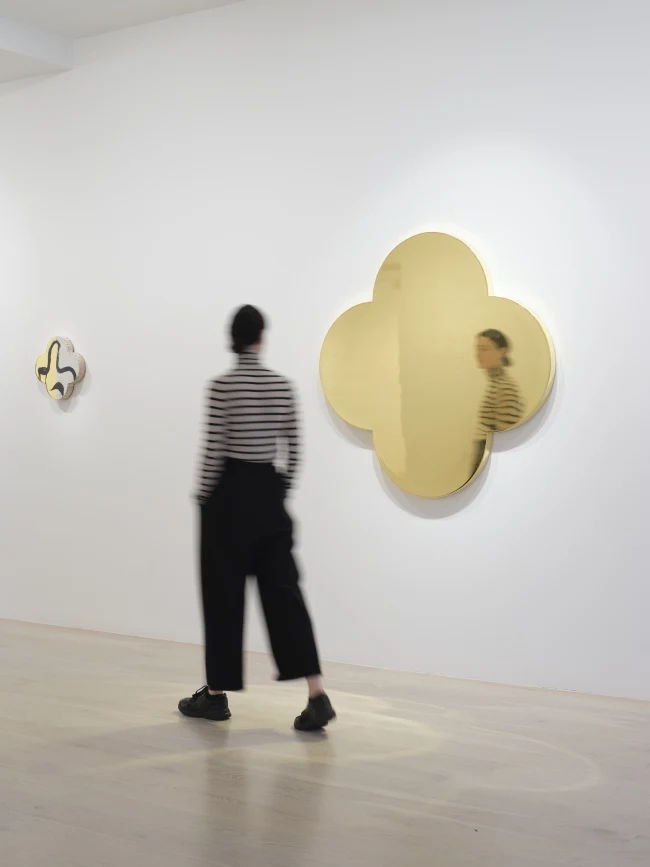
The “Beyond Words” concert which had its third performance following its premiere in Christchurch and a performance in Wellington was a collaboration to promote unity and peace through music and to honour the lives lost in Ōtautahi Christchurch on 15 March 2019.
Conducted by Fawzi Haimor the concert featured the Moroccan vocalist OUM El Ghait Benessahraoui and Cypriot/Greek oud player Kyriakos Tapakis.
Vocalist Abdelilah Rharrabti, saz player Liam Oliver, vocalist and daf player Esmail Fathi, oud player Kyriakos Tapakis, vocalist Oum and composer John Psathas [From Wellington concert] image Jono Tucker
The concert also featured works by the American Valerie Coleman, Reza Vali, Arvo Pärt and the world premiere of a new work by the New Zealand composer John Psathas.
Psathas’ “Ahlan wa Sahlan”, composed in collaboration with OUM and Tapakis, uses the Arabic welcome to let people know they are in a place where they belong. The work fused together musical styles from Eastern and Western music traditions.
The work features energetic and dramatic sounds with subtle changes of texture and moods, providing a background for the two soloists OUM El Ghait Benessahraoui and Kyriakos Tapakis.
The composer as previously demonstrated his ability to compose celebratory anthems having written works for the ceremonies at 2004 Athens Olympics and with this work there is sense of the music being both a lament, a reflection and a celebration. With waves of shifting percussive and evocative sounds
OUM was resplendent in her shimmering gown and elaborate head covering Her voice with its roots in Morocco and in the tradition of Egyptian singers of the 1930’s like Umm Kulthum drifted and soared above the orchestra’s tapestry of eastern sounds along with answering voice of Tapakis’s oud.
Her singing and movements at times suggested she was in a trance-like state while at other times she exuded an emotional intensity and in her singing “Hijra” she sounded like a French chaunteuse. Later there were passages where her voice was close to over-elaborate crooning.
Tapakis provided a riveting performance where he played together with Xylophone and timpani in a filmic sounding section filled with percussive sounds
The other major work in the programme was Arvo Pärt‘s Silouan’s Song which is fine example of the composer’s low-key minimalism with simple repetition and contemplation sequences of notes.
This was a reflective piece which connected contemporary music with Medieval plainchant and Eastern mystical music and the various sections were stressed by the meditative silences between them giving the work a ritualistic feel.
In the first part of the programme there were five shorter works including a traditional work sung by Hasbi Rabbi and Molle Mamad Jan which had an achingly unsettling melodic line as well as a beguiling performance by OUM.
There was also contemplative, work by the Iranian Reza Vali which was filled with despondency and funeral sounds hinting at a vision of paradise.
Kyriakos Tapakis performed his own work “Mantilatos” which was filled with extraordinary sounds and rhythms. While the NZSO accompanied him, emphasising much of the work it would have been more interesting if he had been able to play as a soloist.
A major disappointment with the programme was the lack of English translations for the various vocal segments. Presumably the lyrics were relevant to the spirit of the event and even though the concert was one that was “beyond words” with the music conveying emotional and spiritual dimensions it was pity the audience was not able to appreciate the greater depth which would have come from a knowledge of the word.
The “Follow button” at the bottom right will appear and clicking on that button will allow you to follow that blog and all future posts will arrive on your email.
I am a palangi and my knowledge and detailed understanding of fa’asāmoa is rudimentary at best. So it would be presumptuous to pretend that I do – and no doubt very few Samoans would speak to me again.
My own antecedents settled here from Scotland, harking back mainly to small village communities in the north. I have enjoyed visiting many times and am constantly learning things about their society from long ago. So it would be presumptuous to pretend that I do – and no doubt very few Samoans would speak to me again!
My own antecedents settled here from Scotland, harking back mainly to small village communities in the north where they worked as crofters. I have enjoyed visiting many times and am constantly learning things about their society and the customs young and productive people left behind in the fairly feudal society four or five generations ago when they sought betterment through emigration elsewhere.
However some customs and traditions travelled with them and scraps of those links remain today. The result remains as some kind of low key but deeply-rooted spiritual melange – sort of what was ‘then’ overlaid with what is ‘now’. Let’s face it, in my own case I have a spine that unfailingly frizzles each time I see and hear that lone piper playing Flower of Scotland high on the roof at Murrayfield before a rugby test.
All of which is a long way from Samoa. But the parallels are not dissimilar even though I approached O Le Pepelo with a certain sense of trepidation and even wondered if I had made a dreadful mistake during the first couple of context-setting scenes which are conducted almost entirely in Samoan. Good heavens, I thought – Samoan speakers in the audience seem to be getting all the jokes while I didn’t have a clue!
But that soon changed as Samoan merged with English, my trepidatious concerns evaporated and I became totally absorbed as an excellent piece of theatre revealed itself. You know … something about a simple story told well.
O Le Pepelo started out that way. The publicity machine had outlined the basic plot well – an ageing and ill village elder, concerned about who should inherit his position and status on his passing and the decisions this would require. But that is just a context and this is a play that is so much more. It is about a clash between the traditional value systems and customs confronting Pili and a more modern world where lifestyle becomes a determinant. They are in no way simple.
This leads quite easily to discussion and debate, to adaptation and expectation, and eventually to a form of resolution. Different characters flesh out these themes, and the more they do so, the more complexity and depth is revealed. In fact, this simple story told well quickly moves to a grander more universal scale without losing its more intimate familial setting.
The bones of O Le Pepola are fleshed out with sparkling characterisations, liberal sprinklings of comedy and a remarkably competent cast, while my more personal echoes of the Scottish diaspora points to its universality. Keni and So point to this using a fairly classic idiom that echoes the dilemma of a certain Shakespearean king.
In the village of Moa there are three key protagonists. The ill, aged and dying Pili Sā Tauilevā (Semu Filipo), a longstanding chief or Ali’i and his two children. His eldest son Matagi (Haanz Fa’avae-Jackson) is a traditionalist with high expectations, while his daughter Vailoloto (Ana Corbett) returns from New Zealand embracing the new and the future, appalled because she cannot get a strong wifi signal. Pili is strongly supported by his wife Fa’asoa (Aruna Po-Ching) . But it is Masina (Andy Tilo-Faiaoga) who quietly and assuredly reinforces the dignity, wisdom and humility that underpins the both th inherited position and the play itself and becomes a significant part in its resolution.
Billed as a darkly comic exploration of mores and debate, O Le Pepola expands on something we all know a little about, gives it a contemporary currency and its key characters will remain with me for a while yet.
Auckland Theatre Company and Auckland Festival are to be congratulated on bringing this work to life. It is on point.
The “Follow button” at the bottom right will appear and clicking on that button will allow you to follow that blog and all future posts will arrive on your email.
Goethe once noted that “Ein alter Mann ist stets ein König Lear” – an old man is a King Lear, meaning that the problems which Lear faced were the same for all old men.
Lear’s problems were not necessarily of his own making as events and people conspired to take advantage of him and he found himself virtually alone, deprived of home, authority and family.
This gradual loss of place in society is central to a new play “Not King Lear” which is directed by Adrain Jackson who has worked for many years Royal Shakespeare Company and with people experiencing street homelessness in London
In this latest play he has created a playful yet serious retelling of the story of an old man in conflict with his children, who gives away his authority and falls into homelessness and mental ill-health.
“Not King Lear” has had input from and is performed by members of the Hobson Street Theatre Company which works in partnership with the Auckland City Mission, with an aim to tell stories that are based on real life experiences, addressing social issues.
There is level of sophistication to the play that is rewarding both in terms of the ideas it explores about relationships and homelessness but also in its approach to theatre.
In making use of Shakespeare’s original text, they are able to background some of the issues with a few passages from the play and some brief character and plot outlines. They present most of the Act I dialogue of the speeches of the three sisters which includes the powerful speech by Lear.
The cast also use this as an opportunity for jokes about the characters with Regan being referred to as Vegan and Cordelia as Corduroy. There are other parts of the play which are dealt with in a light hearted and ironic way while others are eloquent and insightful.
The players are uneven in their acting skills but there is a passion and honesty to all the performances which make for a rewarding theatrical experience. Some of the actors are brilliant with the one playing Lear providing a profound and expressive interpretation of the character.
The play has elements of Shakespeare’s approach to drama with the idea of the play within play as we see in Hamlet or Midsummers Nights Dream while another sequence features is a Men’s Group which touches on the issue of estrangement.
The audience participation is at a very different level. Early on the audience was asked to take out their cell phones, divided up into groups who then have to find things on their phones which will get used later in the show. So people had to search for Branch, Climate change, Storm and Trumpet. These then became the source of sounds which audience could then contribute to the soundscape. So when the King first appears the Trumpets let their trumpets blast away.
There is some very effective staging as in the final sequences where projected images of the mean streets of Auckland are used as a counterpoint to Lear’s blasted heath and the filmed images of the homeless pushing shopping trolleys is replicated with a shopping trolley being moved around the stage.
The inclusion of this work by the Hobson Street Theatre Company alongside international productions in the Auckland Arts Festival is to be commended and shows that New Zealand theatre has a crucial role to play in addressing social and personal issues as well as reaching new audiences.
The “Follow button” at the bottom right will appear and clicking on that button will allow you to follow that blog and all future posts will arrive on your email.