Categories
Reviews, News and Commentary

The Play That Goes Wrong: skillfully executed chaos

Reviewed by Malcolm Calder

The Mischief Theatre Production of 
THE PLAY THAT GOES WRONG  

By Henry Lewis, Jonathan Sayer and Henry Shields

GMG Productions & Stoddart Entertainment Group
Associate director – Anna Marshall
Resident director – Nick Purdie
With Olivia Charalambous, Edmund Eramiha, Tom Hayward, Stephanie Astrid John, Joe Kosky, Jonathan Martin, Jack Buchanan, Anthony Craig and Kira Josephson

ASB Waterfront Theatre, Auckland

Until 1 June

Reviewer Malcolm Calder

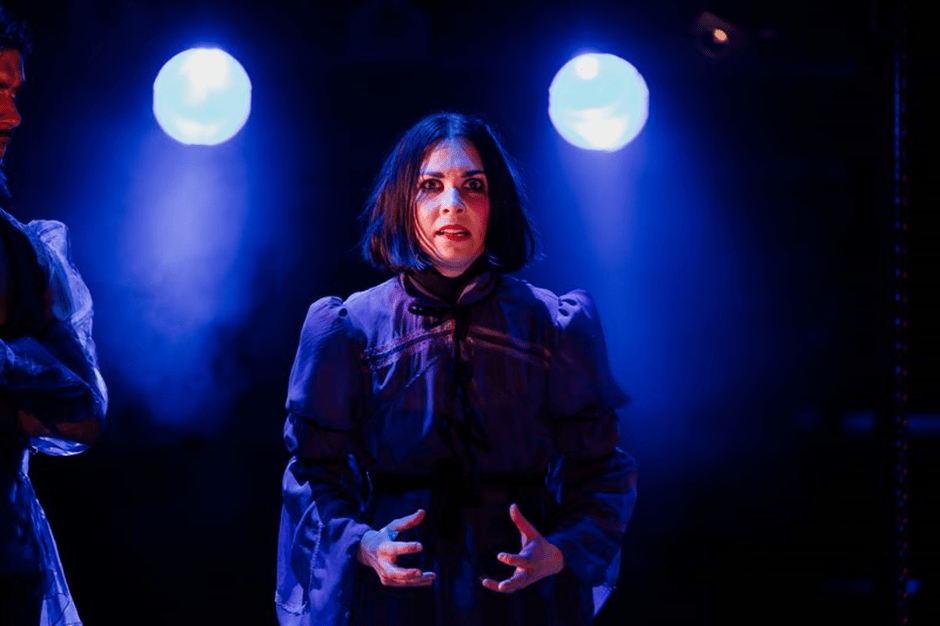
The crew were frantically seeking a missing dog called Winston (I thought that was pretty funny from the outset), couldn’t find a missing CD, contending with a tricky door that wouldn’t latch, dealing with a floorboard that seemed have a mind of its own and contending with a mantlepiece wouldn’t mantle.  All this before the show had even started.

Their crew’s efforts were entirely unsuccessful of course and the litany of woes continued once things got underway.  But the teddibly English lads and lasses of the fictitious Cornley Polytechnic Drama Society struggled on in their efforts to ensure their eminently forgettable murder-mystery actually took place, with nowhere near understanding their own characters or, it seemed at times, even the plot.  Not to mention a set that seemed intent on total disintegration.  Their efforts certainly did go wrong and they eventually staggered to a dis-assembled conclusion.

However that’s not what The Play That Went Wrong is all about.  Rather, it uses the context of an amateur theatre production to very quickly hit the spot demonstrating both subtle and in-your-face comic writing, exquisite nuance and a mature command of the farce-wrapped-in-slapstick idiom whilst totally demolishing the fourth wall.

Lewis, Sayer and Shields, formed Mischief Theatre in 2008 and created The Play That Went Wrong while still studying at the London Academy of Music and Dramatic Art.  Originally titled The Murder Before Christmas, their production opened initially on the Edinburgh Fringe, enjoyed enormous success, moved to a pub on London and then quickly transferred to the West End.  It has been winning accolades around the world ever sinceand has even spawned a range of not unrelated television spinoffs.

This cast is very much an ensemble.  In performance they consummately demonstrate a broad-ranging set of physical theatre skills, demonstrate the importance of timing in making these work and do pretty well in convincing the audience that this is a collection of loosely-linked, impromptu standup snatches despite being a meticulously scripted work.

On Oening Night in Auckland I noticed a couple of rather precious looking luvvies in deep discussion during interval but they appeared to have missed the point entirely.   Deep, thought-provoking, question-raising theatre this is not.  Technique – yes!  But, rather, if set in the context of a funeral parlour, not dissimilar gags, techniques and characters these writers could probably transmogrify it quite readily into The Funeral That Goes Wrong.

After any number of productions that occasionally take themselves a little too seriously, we seem to be on something of a comedy roll of late.  Down at the water-side anyway.  The Play That Goes Wrong is the second bout of hilarity in a row with another soon to follow.

Categories
Reviews, News and Commentary

Peter Cleverly: The artist revealed

Reviewed by John Daly-Peoples

Peter Cleverly: Between Transience and Eternity

Alistair Fox

Quentin Wilson Publishing

RRP $60

Reviewed by  John Daly-Peoples

Peter Cleverly has rarely shown his work in Auckland galleries apart from a few times the early 1990’s, so for many his work is unknown apart from images in publications.

However, a new book, “Peter Cleverly: Between Transience and Eternity” by Alistair Fox will correct this.

The heavily illustrated book traces the artists career from the 1980’s to the present with images of his work across more than four decades.

These four decades of art practice have seen him developing a personal style partly influenced by other New Zealand artists as well as his personal, response to his environment –  physical, social and political.

His early work was predominantly figurative but from the 1990’s these were replaced with landscapes, often with texts and then. more recently the  inclusion of figurative elements again.

His work, particularly early on was influenced in different ways by Toss Woollaston, and McCahon.

McCahon probably influenced his palette and his use of text but he may have also gained an understanding of McCahon’s approach. Unlike many artists influenced by McCahon he referenced A C Cotton’s book “Geomorphology” which was a prime source for both artists and Cleverly uses Cottons illustrations and shapes. He also used objects such as the pitcher as symbols in his work.

Other influences include New Zealand artists Bill Sutton and Tony Fomison while the importance of several international artists  such as George Baselitz, Mimmo Paladino and David Salle and appears to  have adapted their thinking about art.

His early landscapes owe much to McCahon shapes in “Six Days in Nelson and Canterbury while interiors such as “Still life kitchen Oamaru” are Post Impressionist distilled though Woollaston.

Peter Cleverly, All twenty-nine

His figurative work often dwells on mortality and death. “All Twenty-nine” his response to the death of 29 miners at Pike River. Here and in many other works the artist has a personal and visceral approach to his subject.

This is also seen in “Couriers” featuring two distorted hanging figures – is reaction to the incarceration of drug couriers Lorraine and Aaron Cohen. Often his figures are something  between flayed corpses and angels.

Peter Cleverly, Seadog

Cleverly has developed his own distinctive iconography including a dog shape/face which serves a range of emotional and symbolic purposes as in “Seadog”. 

The book is a very readable account of the artists varied life which has had an impact on the way he sees the world and the influences on his practice as well as an understanding of the artists thoughts and motivations.

Categories
Reviews, News and Commentary

Auckland Philharmonia’s “Tchaikovsky 5”

Reviewed by John Daly-Peoples

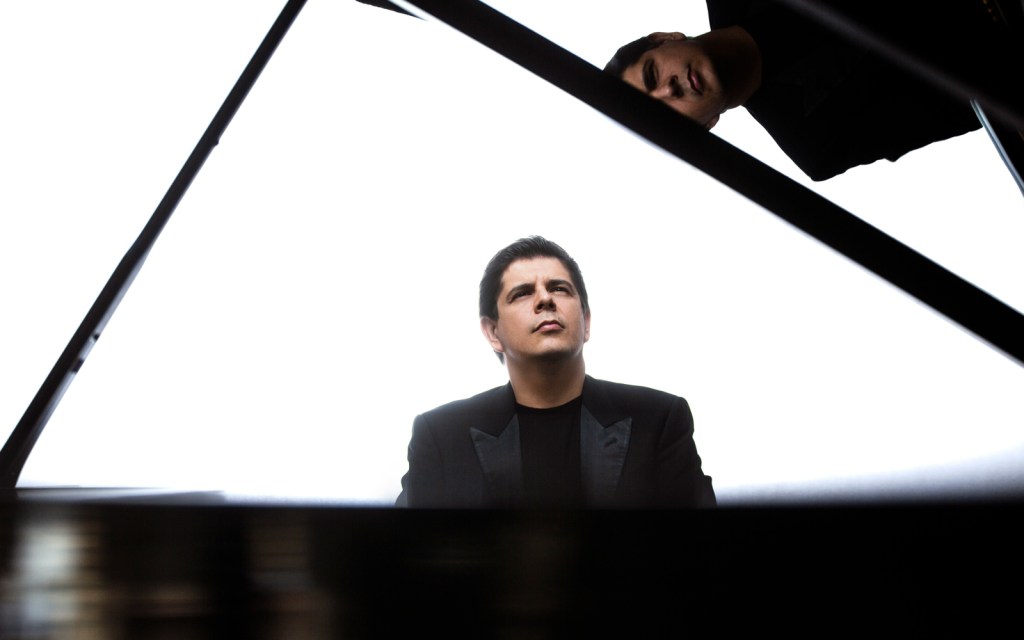
Alexander Gavrylyuk Image Adrian Malloch

Tchaikovsky 5

Auckland Philharmonia

Auckland Town Hall

April 15

Reviewed by John Daly-Peoples

First up on the Auckland Philharmonia’s “Tchaikovsky 5” programme was Kenneth Young’s “Douce Tristesse”, a work composed in 2012 in response to the composer’s final visit to the  long-time family holiday spot near Tauranga.

Strings and woodwind opened the work with a description of landscape, with swathes of colour conveying the changing light and textures of the land, sea and sky.

These vignettes were studded with musical highlights deftly conveyed by the small group of percussion instruments – cymbals, glockenspiel, crotales and harp suggesting the sparkles of light on water, the movement of clouds and the chirping of birdlife.

The work manages to suggest panoramic images from dawn to dusk suggesting the romanticism of the idyllic as well as a nostalgia for lost times and memories.

The composer says that the title ‘Douce Tristesse’ means ‘ sweer sadness and that the piece is about looking at a familiar scene for the last time, a view never to be seen again.

Prokofiev’s third Piano Concerto was written in 1921 during a period of self-imposed exile from Russia and a period when he did not feel oppressed by war or demands on his time and seems to have  more leisurely ambience . The work was first performed in Chicago with the composer playing. The audience and press raved over the music with The Chicago Daily Herald calling it the “the most beautiful modern concerto for piano,”

It opens with the sounds of a clarinet and strings playing a floating melody emblematic of his own more relaxed life. This led quickly to pianist Alexander Gavrylyuk racing into the first movement of the work with fiery sounds from both orchestra and  pianist who played as  though the piano were a percussion instrument

Hunched over the piano his playing was by turns delicate and ferocious as he grappled with the various sequences. There were times when his sounds were languid and romantic and other times when he took a delicate almost spiderly  approach to his playing.

In the second movement he turned the slow dance-like opening into a cacophony of jarring sounds and the intense finale of the third movement saw him in studious concentration.

He displayed a mastery of stylish playing, able to ignite the orchestra with his passion and drive.

His playing technique – changing tempos, charging through themes and varying the tonal qualities added to the excitement of the playing and appeared to enliven conductor Shiyeon Sung well as the orchestra.

Shiyeon Sung Image Adrian Malloch

The major work on the programme was Tchaikovsky’s “Symphony No 5” which saw Shiyeon Sung and the APO deliver one of their outstanding performances. The work is full of sensuous melodies, intense emotions and dramatic climaxes which make it one of the composers more invigorating works.

Some of the sequences are monumental with music similar to his 1812 Overture while there were traces of his ballet music in others.

Sung deftly, guided the orchestra, building musical images, of landscapes, seasons and events creating a world of sensation and emotions.

There were joyous  moments throughout the work but these were set against contemplative sections with the composer finding redemption in the grandeur of the work.

From the anguish of the first movement through the graceful mid-section and onto the final tumultuous fourth movement the orchestra provided a rich and satisfying performance.

While the orchestra was expertly conducted and the players superbly coordinated there were some stand-out performances by the bassoons, flutes, clarinets and French horns.

Categories
Reviews, News and Commentary

Mozart’s Jupiter: Musical foothills and a mighty mountain

Reviewed by Peter Simpson

Genevieve Lacey Photo. Pia Johnson

Mozart’s Jupiter

Auckland Philharmonia Orchestra

Auckland Town Hall

May 1

Reviewed by Peter Simpson

Thursday’s Mayday concert by the Auckland Philharmonia Orchestra consisted of some pleasant foothills leading to a mighty mountain. The foothills were all acts of homage by different composers to a major predecessor: Tchaikovsky honouring Mozart; Australian composer Elena Kats-Cherwin (born 1957) honouring Bach, and British composer George Benjamin (born 1960) honouring Purcell. The mighty mountain was Mozart’s sublime ‘Jupiter Symphony’, No. 41.

The conductor, Leo Hussain (born 1978), is British and is currently Principal Guest Conductor of the George Enescu Philharmonic in Bucharest; he also worked with Simon Rattle at the Berlin Philharmonic and is probably He is best known as a conductor of opera. In Auckland he began the concert informally with a brief verbal introduction emphasising the linking theme of homage and describing the Mozart symphony as the summation not only of Mozart’s career but of the whole Classical period in music. His control of the orchestra was impeccable throughout and the whole concert was warmly received.

Tchaikovsky’s ‘Mozartiana’, dating from 1887, orchestrated what the composer called ‘gems of musical art, unpretentious in form, but containing incomparable beauties’. The first three movements are tasty miniatures; the final movement, a set of variations, based on Mozart after a theme by Gluck, is more extensive and includes some effects a million miles from Mozart; the variations fully explore the large orchestra’s resources, one being entirely for strings, another entirely for woodwind, and including solo turns by clarinet, flute, violin and glockenspiel. The performance was spirited.

Elena Kats-Chernin describes her six-part work as ‘Re-inventions (after Bach)’; they are based on some of the great composer’s inventions for keyboard. Scored for small string orchestra and solo recorders the performance featured entertaining solos on four different recorders (discount, tenor, bass, sopranino) by Australian virtuoso Genevieve Lacey who impressed the audience (especially in her bird-song imitation encore) with her skill and vivacity.

Composer George Benjamin was a pupil of Messiaen; his ‘Three Consorts’ responds particularly to the ‘mesmerising intersection of line and harmony’ in Henry Purcell’s 1680 Fantasias. The middle piece was especially sonorous and pleasing.

Mozart’s Jupiter symphony is an astonishing work which the composer himself probably never heard performed; it certainly owes its name to somebody else. One scholar described it as ‘the greatest orchestral work of the world which preceded the French Revolution’ and the APO played the work as if they agreed with that dizzy estimation. The way the symphony combines both clarity and complexity, especially in the last movement, was apparent throughout the orchestra’s sparkling rendition. Glorious music!

Categories
Reviews, News and Commentary

Murder on the Orient Express: Unadulterated Entertainment

Reviewed by Malcolm Calder

Cameron Rhodes (Hercule Poirot), Edwin Wright (M Bouc) Photo Andi Crown

Agatha Christie’s Murder on the Orient Express

Adapted for the stage by Ken Ludwig

Auckland Theatre Company

Dir: Shane Bosher

Set: John Verryt

Lighting: Sean Lynch

Costumes: Elizabeth Whiting

Composition and Sound: Paul McLaney

Motion: Harley Campbell

Dialect: Kirstie O’Sullivan

Intimacy: Todd Emerson

Engine Room Assistant Director: Nī Dekkers-Reihana

With Bronwen Ensor (Greta Ohlsson), Sophie Henderson (Countess Andreyi), Jennifer Ludlam (Princess Dragomiroff), Mayen Mehta (Hector McQueen), Ryan O’Kane Col Arbuthnot/Samuel Ratchett), Mirabai Pease (Mary Debenham), Cameron Rhodes (Hercule Poirot), Jordan Selwyn (Michael/Head Waiter), Rima Te Wiata (Helen Hubbard), Edwin Wright (Monsieur Bouc)

ASB Waterfront Theatre

Until 10 May

Reviewer Malcolm Calder

Photo: Andi Crown

I’ve had a busy time of it lately.  What with school holidays, two successive long weekends and a seemingly endless round of rather long and demanding days, I had half a mind to settle for a quiet glass of red, a good book and an early bedtime blithely avoiding any additional responsibilities that might involve going out to the theatre. Had to rush to make the 7pm start too!

Thank goodness I didn’t.

With this re-vamp of the original classic, Director Shane Bosher has turned in a blinder for Auckland Theatre Company and come up with something that is pure, unadulterated entertainment. 

Adaptor Ken Ludwig’s cull of the original murder mystery, after having been approached by Agatha Christie’s grandson for the Christie Estate, was first performed in 2017.  So if you are a Christie devotee looking for a simply stage-adaptation of her original go no further.

Ludwig adamantly insists that he is a writer of plays and not simply a ‘murder-mystery guy’.  As a result he has redrawn, reduced and compacted the number of characters, enhanced the comedy and come up with a tightly-scripted and genuine ensemble piece that adds to the already enormous output that has made him arguably the most produced playwright of his generation.

It is sometimes suggested that more serious undertones may have underpinned aspects of Christie’s original but few are evident here.  Bosher may have drawn some slight allusions to contemporary geo-political issues that underpin the entire structure but this may or may not be the case.  What he has done however, is generate something that entertains big time. 

The result is an actor’s piece to die for.  And this cast do more than just deliver.   Just as Auckland Theatre Company, CEO Jonathan Bielski has urged audiences to avoid spoilers about resolution of the murder, mystery and mayhem of the play itself, it would be churlish to single out any one cast member.  The entire cast is let loose, projecting archetypes rather than convincing portrayals of real people.  Each character is distinct, their backgrounds are as varied as their accents and the ensemble functions as a singular unit predominantly by using that essence of great comedy – precision timing and the credibility of relationships between them.

ATC is to be congratulated too on once again continuing to develop pathways for increasing numbers of younger actors and production people who we are seeing as first-time performers with ATC.

This is a consummate, professional ensemble and even a tiny glitch with a prop on opening night was more than successfully ad-libbed around, the comedy was sustained and the professionalism acknowledged by an audience who got it.

I am advised that ticket sales for MOTORE are already strong and ATC is to be congratulated on both the production itself and for hopefully hitting a jackpot.

The 7pm start time may have been a bit of a scramble but it had the bonus of my being home and abed well before 10pm.  No book though – my head was still laughing inside itself.

Categories
Reviews, News and Commentary

The Art of Banksy coming to Auckland

John Daly-Peoples

Girl With Balloon
The Art of Banksy – the major exhibition which has brought Banksy’s era defining works to over 1.5 million visitors in 19 cities across the globe will visit Auckland for a final and strictly limited New Zealand season. The exhibition will be hosted at Tāmaki Makaurau Auckland’s Aotea Centre (Hunua Rooms) from Monday 7 July through Sunday 3 August 2025.

The Art of Banksy is the world’s largest collection of original and authenticated Banksy art showcasing more than 150 pieces including prints, canvases and unique works. The collection wowed thousands of Wellingtonians in 2024 and now it’s Auckland’s turn.

Michel Boersma, curator and producer of the exhibition says: “Following a hugely successful 19 city global tour and 2 years in London, UK, we’re very excited to bring this larger-than-ever collection to Auckland, bigger and better! The last 9 years we have been working with collectors in expanding the collection which we are able to display, from 70 in Auckland in 2018 to over 150 authenticated and genuine works, no replicas – the real deal. I am particularly proud that trusted associates of Banksy, for example Ben Eine, have been willing to contribute to the exhibit with their privately held works, gifts and hand drawn sketches and video testimonials. This way The Art of Banksy is able to lift the veil on how some of the iconic Banksy works were created and reveals some of the secret stunts they got up to.” 

Daniel Clarke, Tātaki Auckland Unlimited Director of Performing Arts, leading Auckland Live adds: “We’re delighted to be working with GTP Exhibitions to bring The Art of Banksy to Tāmaki Makaurau Auckland. As one of the world’s most successful contemporary artists Banksy’s work consistently captures the public’s attention and imagination – over a million people worldwide have seen the exhibition – so to have this number of works on show is a hugely exciting addition to our winter events season.”

Visitors at The Art of Banksy can expect to see the seminal artworks that brought the infamously anonymous artist international notoriety such as Girl With Balloon in four different colour variations, including the rare Gold Edition. Banksy fans can also see unique personalised gift prints created for friends, associates and lovers. The exhibition also focuses on Banksy’s Dismaland and recent artworks acknowledging the ongoing war in Ukraine.


Many of Banksy’s iconic works are also featured in the exhibition including a very rare collection of ‘thank you prints which Banksy created as gifts to staff and team members who worked with him at Dismaland and other Banksy stunts. The exhibition also features a series of unique hand drawn sketches by Banksy. The fragile pieces of paper are one-of-a-kind depicting Banksy’s working on versions of his famous rat images.

The Art of Banksy is an unmissable show for anyone who wants to learn more about one of the world’s most important current artists and what their work reveals today; the power of art to affect social change, inspire the public and lay bare the undercurrents of social issues.

The Art of Banksy is not curated or authorised by the artist and only displays authenticated art sold or gifted by the Artist, no replicas or art removed from the street.
Banksy’s Dismaland
ART OF BANKSY
 
Monday 7 July – Sunday 3 August 2025
Mon – Wed: 10am – 6pm
Thu – Sun: 10am – 9pm
 
Tickets start from $39.50. Service fees apply
 
Tickets on sale from Wednesday 7 May
Categories
Reviews, News and Commentary

Delicacy and grandeur in nineteenth century masterworks

Inon Barnatan. Image. Sav Schulman

Romantic Brahms

Auckland Philharmonia

Auckland Town Hall

April 10

Reviewed by Peter Simpson

The April 10 concert of the Auckland Philharmonia headed ‘Romantic Brahms’, placed the audience squarely in the nineteenth century (where most audiences most like to be), with an overture from 1834, a concerto from 1881 and a symphony from 1888. The conductor was the Swiss-Australian Elena Schwarz who is currently with Klangforum, a chamber orchestra specialising in contemporary music based in Vienna; she is also a guest conductor with leading orchestras in Europe, America and Australia.  Elegant and agile in her dark trouser suit she seemed completely in command of these complex scores.

Louise Farrenc (1804-1975) was famous in her time (and is now undergoing recuperation) as a pianist, teacher and composer in Paris, earning the respect of Schumann and Berlioz for her compositions which included symphonies and chamber works as well as two orchestral overtures in 1834, the second of which played in Auckland demonstrates her confident control of the post-Beethoven orchestra and musical idioms.

Brahms’ Piano Concerto No. 2 is possibly his greatest orchestral work, at least I have thought so since the early 1960s when I first heard Sviatoslav Richter’s famous recording with the Chicago Symphony under Erich Leinsdorf made during Richter’s first tour of America. Israeli-pianist Inon Barnatan was well up to the demands of this heroic score ranging as it does from  extreme delicacy – as in the opening exchanges between piano and horn (the beginning slightly fluffed by APO’s horn soloist) – to full orchestral grandeur in the many climactic passages. For his encore the pianist unusually chose a graceful duet by Rachmaninov with a cellist instead of a solo piece, perhaps in recognition of the lovely ‘cello solo at the start of the third movement of the concerto.

According to Heath Lees’ programme notes, César Franck’s Symphony in D has somewhat lost favour with modern audiences compared to its earlier fame, but it still comes across as a noble and majestic piece, especially in its swelling major theme which recurs throughout the circular structure The texture of the work can sometimes seem a bit muddy but not in Elena Schwarz’s expert separating out of the separate layers of sound. It was a fitting conclusion to a stirring and satisfying evening of Romantic music.

Categories
Reviews, News and Commentary

High Couture meets High Country

Reviewed by John Daly-Peoples

Central Otago Couture: The Eden Hore Collection

By Jane Malthus and Claire Regnault, photographs by Derek Henderson

Te Papa Press

RRP $70.00

Reviewed by John Daly-Peoples

We know who all the great names in New Zealand fashion of last century  are  -Karen Walker, Kate Sylvester, Trelise Cooper, the list goes on. There are even some key male figures – Gus Fisher, Adrian Hailwood and Francis Hooper.

One name though  has been missing from that list for many years. Eden Hore. A merino farmet from the Maniototo of Central Otago, he epitomises the “Southern Man” having been one of the first farmers to introduce cattle to the normally sheep running areas of Central Otago.

But his main claim to fame is his collection of high couture garments which he has amassed since the 1970’s and is considered to be one of the most impressive collections of garments in the Southern hemisphere.

Barbara McKain strapless dress with tulip hemline, early 1980s.
Flannel-blend fabric and sequins, EH79.
Photographed at Two Paddocks Vineyard, Earnscleugh, 2024
Model:Alannah Kwant
Image supplied by Te Papa Press/Eden Hore Central Otago
Image/s © Derek Henderson

A new book “Central Otago Couture: The Eden Hore Collection” by Jane Malthus and Claire Regnault with photographs by Derek Henderson is a remarkable publication documenting the life and times of Eden Hore, his collection and the development of the high fashion industry in New Zealand  

Along with the release of the book there will be exhibitions at Toitū Otago Settlers Museum and Art Gallery, Alexandra, celebrating Hore’s remarkable history of collecting and his unique museum which held his collection for many years – a converted shed on his farm.

Vinka Lucas evening dress and cape, early 1970s.
Taffeta, synthetic voile, feathers and swansdown, EH48.
Photographed at Lake Dunstan, 2024
Model:Alannah Kwant
Image supplied by Te Papa Press/Eden Hore Central Otago
Image/s © Derek Henderson

The designers of many of the clothes featured in the book  were all well-known in fashion circles in the 1970s and 1980s – Kevin Berkahn, Vinka Lucas, John West, Rosalie Gwilliam, Jo Dunlap, Wapiti Handcrafts, Annie Bonza and James Jaye Leathers.

The photographs of the garments in the book were taken by Derek Henderson during two photoshoots in Central Otago in 2024 and 2019 with models Ngahuia Williams, Alannah Kwant and Hannah Clark.

The dozens of designs which he has photographed are set in the stunning landscapes of Central Otago. There are the tussock lands, vineyards, orchards, lakes, rugged hills and  old stone buildings.

In many of the photographs the striking garments contrast with the lands  and building while others blend in with the landscape. Colours and textures of some seem to have grown out of the landscape and there are some shown with iconic images of the area such as the photospread with the Wedderburn goods sheds made famous by Grahame Sydney.

Kevin Berkahn evening dress, 1973.
Pleated taffeta ruffles on nylon net, EH23.
Photographed at Little Valley Road, Alexandra, 2024
Model:Ngahuia Williams
Image supplied by Te Papa Press/Eden Hore Central Otago
Image/s © Derek Henderson
 

Jane Malthus is a dress historian and honorary curator for the dress collection at Tūhura Otago Museum, and has an academic background in textiles, clothing and fashion, history and fine arts. She has been Involved with Eden Hore’s collection since the 1980s.

Claire Regnault is Senior Curator New Zealand Histories & Cultures at Te Papa and is the author of Dressed: Fashionable Dress in Aotearoa New Zealand from 1840 to 1910 (2021), and co-author of The Dress Circle: New Zealand Fashion Design Since 1940 (2010). She is the President of Costume & Textiles Aotearoa New Zealand, and a member of the Eden Hore Central Otago steering committee.

Categories
Reviews, News and Commentary

Groundwork: The Art and Writing of Emily Cumming Harris

Reviewed by John Daly-Peoples

Groundwork: The Art and Writing of Emily Cumming Harris

By Michele Leggott and Catherine Field-Dodgson

Te Papa Press

RRP $60

Reviewed by John Daly-Peoples

Botanical painters have been an integral part of the botanical and artistic history of New Zealand since Joseph Banks accompanied Cook on his voyage to New Zealand and his publication of detailed illustrations of the exotic plant species he found here.

Since the time of Banks there have been many other artists who have devoted themselves to depicting the flora of New Zealand .A new book “Groundwork” by Michele Leggott and Catherine Field-Dodgson reveals one of the first women botanical artists in New Zealand. Emily Cumming Harris who was born in England in 1837 spent most of her life in New Zealand, mainly in the Taranaki and Nelson areas.

During this time, she painted numerous examples of plant life as well as landscapes, a number of which were exhibited locally and internationally.

Her works were exhibited at the Sydney International Exhibition in 1879, the 1880–81 Melbourne International Exhibition and the Colonial and Indian Exhibition in London in 1886. At the New Zealand Industrial Exhibition held in Wellington in 1885 she won first prize and a silver medal for a painted screen.

Emily Cumming Harris, Kiekie (Freycinetia banksii), nikau (Rhopalostylis sapida), five finger (Pseudopanax arboreum) and karaka (Corynocarpus laevigata) in fruit, 1879, watercolour, 389 x 506mm. Reproduced as a Turnbull Library print in 1980. Alexander Turnbull Library,

Throughout her life she also had solo exhibitions, selling a number of works, the sales of which provided useful financial assistance to her and her family.

The book documents her career as an artist and even though this was never to be a full-time career she amassed a large collection of images many of which are in public collections. Leggott and Catherine Field-Dodgson’s research, along with other individuals reveal a woman whose work lies between the scientific, botanical illustration and artistic.

The book has been the result of a lot of detective work, research in various museums and some family history. Michelle Leggott ‘s interest came about when she was researching about Emily’s father, Edwin who had painted several views of New Plymouth at the time of the Land Wars in Taranaki. His paintings are also included in the book.

Emily Cumming Harris, Hector’s tree daisy Brachyglottis hectorii, oil on straw board, 690 x 470mm. Galpin collection, Pauanui

The authors also discovered a number of paintings Emily had done of astronomical subjects – The Total Eclipse of the Sun in1885 and a double tailed comet in 1901.

The book includes a number of her poems which range in quality but the occasional one shows some literary skills and keen observation.

Her “The mountain looks down on the river” contains some lines which indicate an awareness of the situation of Māori.

But the forest which grew by the river,

And the flowers on the mountain that bloomed

Will they gladden our hearts for ever

Or pass like a race that is doomed?

In 1890, she published three books, New Zealand flowers, New Zealand ferns, and New Zealand berries. Each contained twelve lithographs with descriptive text, and some copies were hand-coloured by Harris herself.

Emily Cumming Harris, Celmisia chapmanii – Campbell Island; Celmisia vernicosa – Campbell Island, 1890s, watercolour, 310 x 440mm. Alexander Turnbull Library

All her paintings as well as her writings and poems provide a portrait of a woman of great talent and enterprise but social convention prevented her developing an independent career and she was viewed merely as a gifted illustrator.”

This has meant she has not been well served by history but this book will do much to correct that.

Categories
Reviews, News and Commentary

Auckland Philharmonia’s Enigma

Reviewed by John Daly-Peoples

Enigma

Auckland Philharmonia

Auckland Town Hall

March 27

Conductor Karl-Heinz Steffens

Grieg, Norwegian Dances
James MacMillan, Concerto for Orchestra ‘Ghosts’ (NZ premiere)
Elgar, Enigma Variations

On the programme for the Auckland Philharmonia’ s “Enigma” concert was a newly commissioned  work by the Scottish composer James MacMillan. His “Concerto for Orchestra” was subtitled “Ghosts” and had an enigmatic quality to it.

As the composer says of the work, “The music seems to be haunted by other, earlier musical spirits and memories,” These musical memories which creep into the composition can be seen in the reference to Beethoven’s “Ghost”  trio along with other musical references – Debussy, Scottish traditional music and an eastern musical hymn.

These musical references emerge from the composition like ghostly figures, sometimes gradually appearing, sometimes unexpectedly while some of the themes overlap.  The music is full of juxtapositions and surprises as various instruments and combinations of instruments introduce new themes and spiritedly amplify them.

The lively spirits of the opening were created by dramatic percussion and piercing brass which led to a great chattering of sounds with some eerie conversations between the strings and brass.

Throughout the work there is a sense of the instruments floating around, trying to discover and capture themes which have been lost. This floating, colliding and capturing of elusive themes creates a tension within the piece. The dramatic flourishes of percussion, the sinuous sounds of the strings as well as some jazzy sequences all add to the works restlessness and urgency.

The sounds all helped create a dreamscape of remembered, and reimagined sounds and like some ghostly figures were continually slipping and finally the wispy sounds disappear.

The piece recalls the Shakespeare line from the Tempest

The isle is full of noises,
Sounds, and sweet airs, that give delight and hurt not.
Sometimes a thousand twangling instruments
Will hum about mine ears, and sometime voices

Many of the same musical ideas appear in Elgars “Enigma Variations” where various musical instruments are used to convey impression of people that were close to the composer. The one theme that is probably never heard is the one that represents the composer himself. The variations feature the composer’s own ideas about his friends and close contacts conveying their physical, psychological and spiritual personalities.

The variations with their delightful impressions include variation I said to be of his wife, has a wistful quality and  an anthem overflowing with joy but also with s hint of sadness, Variation IX Nimrod with its heavenly sounds and the violas solo in Variation VI – Ysobel

Conductor Karl-Heinz Steffens was able to ensure that each of the portraits was interpreted with the appropriate mood, pace and colour and he seemed to relish both the music and the narratives of the work and his sharp, sensitive gestures had him performing like some grand puppet master manipulating the  dozen characters of Elgar’s world.

The opening work on the programme was Grieg’s “Norwegian Dances” and Steffens was able to lead the orchestra through the spirited dances with its changing portraits of the people, the history  and landscape effortlessly, taking the orchestra from lethargic to happy and ebullient.