Categories
Reviews, News and Commentary

Wall to Wall Māfana

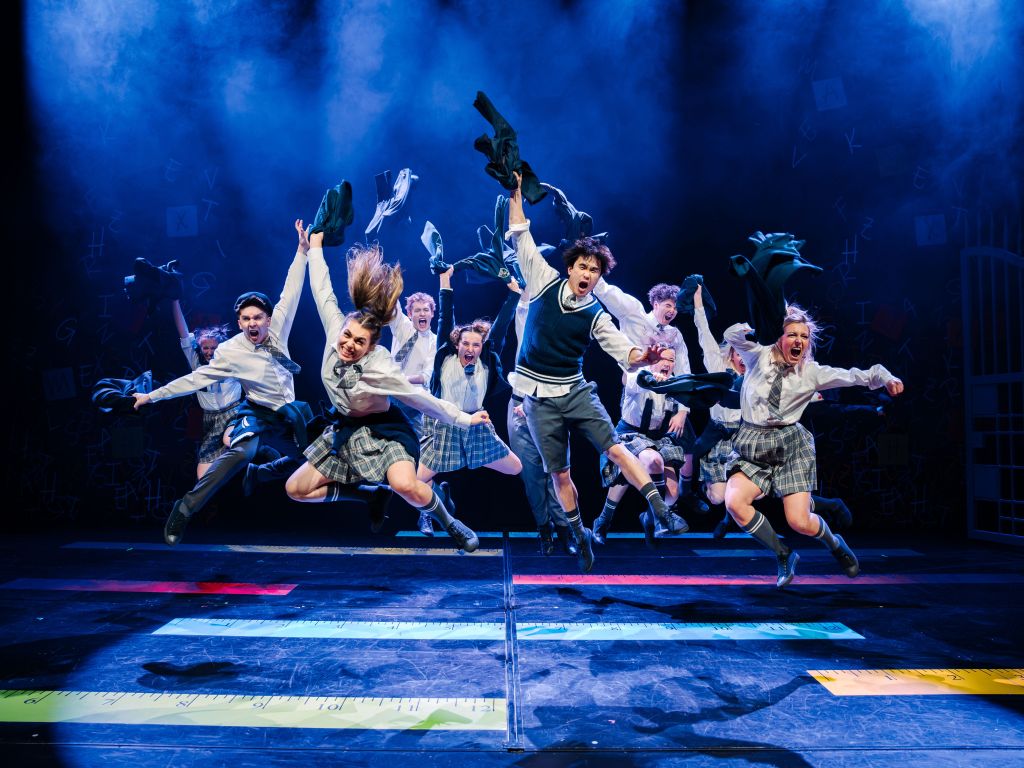
Red White and Brass: The Play

Stage adaptation by Leki Jackson-Bourne

Directors, Anapela Polata’ivao, Vela Manusaute

Musical Director, Joanna Mika Toloa

Production Design, Sean Coyle

Costume Design, Chrissy Vaega

Sound Design, Matt Eller

Choreography, Mario Faumui

With Haannz Fa’avae-Jackson, Mikey Falesiu, John-Paul ‘JP’ Foliaki, Onetoto Ikavuka, Saala Ilaua, Diamond Langi, Lauren Jackson, ‘Aisea Latu, Jason Manumu’a, Rocky Manusaute, Michaela Te Awa Bird, Kasi Valu

Original screenplay by Halaifonua Finau and Damon Fepulea’i

Co-produced by Piki Films and Miss Conception Films

A World Premiere

ASB Waterfront Theatre

Until 7 July

Reviewed by Malcolm Calder

Last weekend I had a cold and spent most of it confined to quarters.  You know – a bit of this, a bit of that and an overly-heavy dosage of highly-predictable news, current affairs and media gossip monochromatically detailing financial woes, political faux pas, a couple of murders, the inevitable obsession with car crashes and countless opinion from a whole heap of ‘experts’ confidently predicting an imminent emigration across the ditch. I was miserable.

Then I went to the Auckland Theatre Company’s world premiere of a new stage production of Red, White and Brass: The Play!  And I wondered what I was being miserable about.

The basic plot is well publicised and closely follows the original screenplay of the same name by Halaifonua Finau and Damon Fepulea’I about sporting underdogs who over-achieve just as Eddie the Eagle and those Jamaican bobsledders did at the Olympics.  Hollywood loves a good sports story especially where the underdog comes out on top and this story has a unique local flavour.

But this stage production is more subtly nuanced, goes well beyond sport and is weighted more towards capturing hearts and minds in ways that both embrace and express the social psyche that is Tongan Māfana.

It is a thing that generates joy and, without being in the slightest bit didactic about all things Tongan,

it assumes a knowledge of many things in a long, long list.  These range from the place of religion to the place of rugby; from gently acknowledging the contrapuntal role of the matriarch in a purportedly patriarchal society; from an acknowledgement that achievement rests ultimately on aspiration; from generational clash to resolution and to an understanding that even addresses the subsets within the contemporary urban Tongan diaspora in Aotearoa.

As Leki Jackson-Bourne has noted… this production is loud, proud and unapologetically Tongan. It is a statement about community, heritage and sense of self.  But it is more than that.  It also says something very important about our increasingly multicultural society and as such provides a further plank in the evolution of New Zealand theatre history.  It does so with unashamed pride and joy, and celebrates both.

JP Foliaki reprises the movie role of Maka, arguably with more light and shade than the movie allowed, and his relationship with his ‘bit less Tongan’ cousin Veni (Saale Ilaua) is well handled.  Overall the cast is strong and well-balanced and their choral work mesmerizingly memorable.

Sean Coyle’s busy set morphs well in multiple directions, the costumes are a hoot and the dialogue a completely understandable mix of Lea Faka-Tonga and English. The finale is a triumph- but no spoiler alert from me other than to say the band grows on one.

Congratulations to Auckland Theatre Company and mālō Leki – the last vestiges of my cold vanished on the spot!

To subscribe or follow New Zealand Arts Review site – www.nzartsreview.org.

The “Follow button” at the bottom right will appear and clicking on that button  will allow you to follow that blog and all future posts will arrive on your email.

Or go to https://nzartsreview.org/blog/, Scroll down and click “Subscribe”

Categories
Reviews, News and Commentary

Aotearoa Contemporary to open at the Auckland Art Gallery in July

John Daly-Peoples

Maungarongo Te Kawa, Celestial Stargate for Invisible People, 2024 (detail). Photo by Jemma Mitchell

Aotearoa Contemporary

Auckland Art Gallery

July 6 – October 20

 The Auckland Art Gallery Toi o Tāmaki and Ngāti Whātua Orākei have announced a new contemporary art triennial at Auckland Art Gallery which will celebration of the breadth of contemporary art in New Zealand.

“The Gallery is thrilled to partner with Ngāti Whātua Ōrākei to present a new generation of talented artists and showcase Aotearoa New Zealand’s diverse artistic environment.”

“Set to occur every three years, the exhibition provides ongoing representation and pathways for new artistic voices, bolstering the future resilience of New Zealand art. Aotearoa needs a contemporary art triennial and it now has one.” adds Lacy.

Ngāti Whātua Ōrākei Trust Deputy Chair Ngarimu Blair says, “Our tupuna Apihai Te Kawau gifted 3000 acres of land on the Waitematā on 18th September in 1840 to become a city which welcomed people, cultures and ideas from afar. Our relationship with Auckland Art Gallery is founded in the shared goal to foster the arts reflective of our multi-cultural community in Aotearoa.”

With an emphasis on artists not previously exhibited at the Gallery, the exhibition presents 27 artists and 22 compelling new projects in a range of media including painting, textiles, sculpture, ceramics, photography, and performance.

Senior Curator, Contemporary Art, Natasha Conland says, “Aotearoa Contemporary reveals a new cluster of artists who work afresh with ritual and storytelling, mythology, rhythm, indigenous space and materials. There is also a special emphasis on art’s relationship with choreography through the commission of four dance works.”

Curator, Pacific Art, Cameron Ah Loo-Matamua adds, “From Ruth Ige’s enigmatic blue paintings of anonymous figures, to the art collective The Killing’s installation of supersized soft-toys in a state of play, there is something for everyone in this exhibition. Amongst the ambitious new commissions is a three-channel video by Qianye and Qianhe Lin featuring mythology set in Hailing Island off the coast of China and Aotearoa.”

Aotearoa Contemporary is proudly supported by Ngāti Whātua Ōrākei, Auckland Art Gallery Foundation and the Chartwell Trust.

Aotearoa Contemporary has been scheduled to coincide with New Zealand’s leading contemporary art award, The Walters Prize 2024, to provide a broad overview of contemporary art in New Zealand in the Gallery’s winter programme.

The exhibition has been curated by Cameron Ah Loo-Matamua, Natasha Conland and Ane Tonga with support from Ruth Ha.

Artists featured in Aotearoa Contemporary

Emerita Baik, Leo Baldwin-Ramult, Heidi Brickell, Pelenakeke Brown, Jack Hadley, Ruth Ige, Hannah Ireland, Xin Ji, Reece King, Qianye Lin and Qianhe Lin, Te Ara Minhinnick, Ammon Ngakuru, Amit Noy, Sung Hwan Bobby Park, Meg Porteous, Maungarongo (Ron) Te Kawa, Tyrone Te Waa, The Killing (collective), Anh Trân, Manuha’apai Vaeatangitau, Jahra Wasasala and George Watson.

Jahra ‘Rager’ Wasasala by Jocelyn Janon

Jahra ‘Rager’ Wasasala is an award-winning cross-disciplinary artist of Fijian/NZ European descent. As an artist, Jahra investigates her ancestral connections through the art mediums of performance activation, contemporary dance and poetry, and has extensively toured her performance works both nationally and internationally.

As a child of the Pasifika diaspora, Jahra is invested in translating her shared internal conflict into an accessible, yet confrontational, physicalised language. Her most recent performance work titled “a world, with your wound in it” focuses on the complex relationship between the earth and a woman’s body, a theme Jahra continues to investigate in her developing work.

Maungarongo Te Kawa is a takatāpui fabric artist, educator, and storyteller. His practice makes old pūrākau newly relevant using brilliant colour, fluid design, and infectious good humour. Following a career in costume design and fashion, Te Kawa dedicated himself to full-time art-making and teaching. In addition to producing his own elaborate whakapapa quilts, he runs sewing workshops, guiding participants to express their creativity and genealogy through fabric.

Ruth Ige is a Nigerian New Zealand-based painter whose intimate, evocative compositions oscillate between bodily forms and painterly abstractions. While some resemble traditional portraiture, others consist of colour fields that capture a more mysterious, ethereal effect. Hands, shoulders, and faces emerge from a watery facture. “I am interested in creating images that are not easily understood,” says Ige. She considers her unique figuration, which renders her subjects featureless and inscrutable, to be a form of “veiling.”

Performances

The commissioned performances in Aotearoa Contemporary include Pelenakeke Brown, Is this a performance 1+2, Xin Ji, Doco Dance, Amit Noy, Errant and Jahra Wasasala, DRA.

To subscribe or follow New Zealand Arts Review site – www.nzartsreview.org.

The “Follow button” at the bottom right will appear and clicking on that button  will allow you to follow that blog and all future posts will arrive on your email.

Or go to https://nzartsreview.org/blog/, Scroll down and click “Subscribe”

Categories
Reviews, News and Commentary

The APO’s captivating musical tour of Rome

Reviewed by John Daly-Peoples

The Trevi Fountain

The Eternal City

Auckland Philharmonia Orchestra

Auckland Town Hall

June 13

Reviewed by John Daly-Peoples

Respighi’s Roman Trilogy takes the listener on a musical tour of Rome with three tone poems which celebrate the city’s fountains, pines and festivals. Along  the way we encounter the architecture, landscape and history  of the city with vibrant music which capture its moods, sounds and spectacles.

The three works were composed over a twelve-year period 1916 – 1928 and the APO presented the three works under the title of The Eternal City.

The programme opened with  Fountains of Rome, the purpose of which the composer said was “to give expression to the sentiments and visions suggested . . . by four of Rome’s fountains, contemplated at the hour in which their character is most in harmony with the surrounding landscape, or in which their beauty appears most impressive to the observer.”

In this work we encounter some of the smaller fountains like the one by the Villa Medici as well as the extravagant Trevi Fountain.

The first part of the work, inspired by the Fountain of Valle Giulia, depicted a pastoral landscape and  captured the early Romas  dawn with the strings and woodwinds.

This was followed by a sudden loud blast of the brass and percussion above the shrill tones of the orchestra, introducing the Triton who raises a conch to his lips and we also hear the sounds of activity around the fountain.


Next, he depicts The Trevi Fountain at midday, the theme, passing from the woodwind to the brass instruments, with the trumpets depicting the dramatic figure of  Neptune,  seahorses and another Triton blowing a conch shell, the sounds of which were depicted by the orchestra’s horns.


The fourth section depicting the Villa Medici Fountain at sunset captures the fading grandeur of the city with is a nostalgic theme and we hear the tolling of bells above the whispering strings of birds twittering.

The work which features much brass and percussion shows us a panoramic Rome filled with a sensory overload of excitement and activity.

The music captures the flow of water from a trickle to torrents with instruments providing flecks of light intermingled in the sprays of water.

The Pines of Rome

The second work, The Pines of Rome had an animated opening with a depiction of the trees around the Villa Borghese mixed  with the sounds of the city. The depiction then moves to the outer areas of the  city with a  melancholic mood in the area of  the catacombs highlighted with hints of the Latin mass .

The pines on the Janiculum Hill were introduced with timpani and gongs, giving a spacious vision, the trees picked out by the piano and clarinet. As though taking its cue from the clarinet comes a recording of a nightingale seeping into the hall only to disappear with the coming of night and the brooding sounds of the ghosts of centurions returning on the Appian Way. These sounds initially seem distant but then as the orchestra’s voice increases a sextet of brass instrument up by the organ let loose some triumphal sounds conveying the drama of Roman pomp and power.

A Roman Carnival

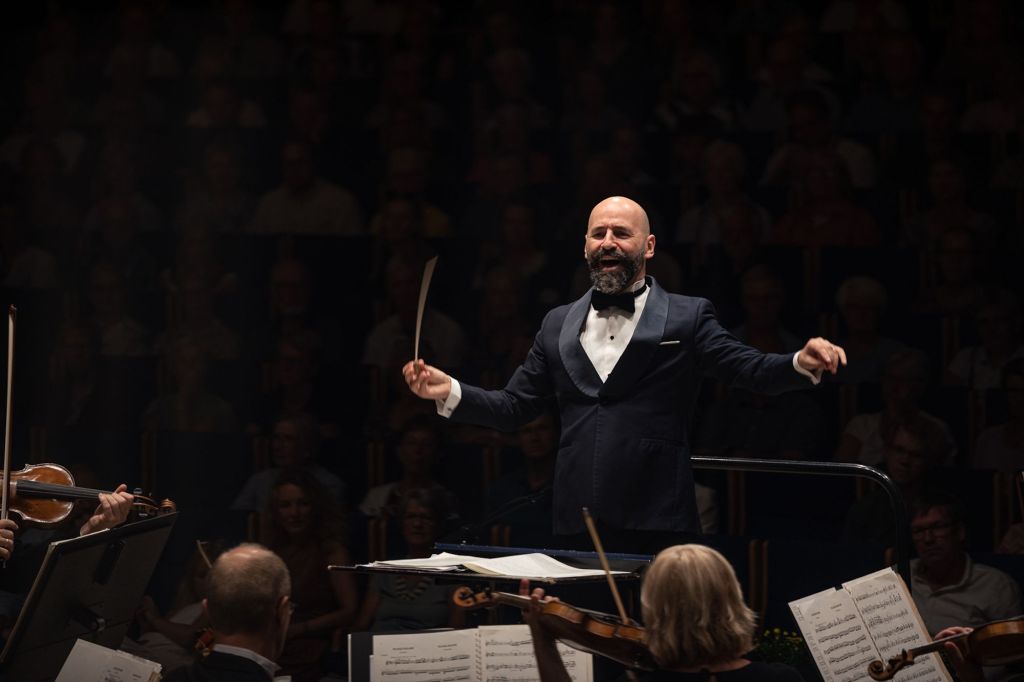
The third of the works “Roman Festivals” opens with  the same dramatic sounds which featured in the depiction of the Appian way. Here the triumphal sounds become the sounds of gladiatorial combat. After this overexcited opening there were some lovely, lethargic orchestral sounds with echoing strings. In the middle sections the music conveys all the excitement, colours and movement of the community festivals. Here conductor Bellincampi was agile in stressing both  the  clamorous sounds as well as the gentler ones.

The final movement featured a strong, slightly discordant section which morphed into  a folksy romanticism which included a mandolin-like sequence, before moving onto  some circus sounds which recall the cinematic compositions of  Nino Rota and his music for Fellini’s 8½ .The final movement ended with some thunderous sounds from the massed orchestra and  percussion, bringing to an end to a  entertaining journey.

The concert featured a number of musicians from the Australian National Academy of Music , as part of an ongoing collaboration with the APO. 

To subscribe or follow New Zealand Arts Review site – www.nzartsreview.org.

The “Follow button” at the bottom right will appear and clicking on that button  will allow you to follow that blog and all future posts will arrive on your email.

Or go to https://nzartsreview.org/blog/, Scroll down and click “Subscribe”

Categories
Reviews, News and Commentary

The amazing Jacob Rajan returns in Guru of Chai

Reviewed by John Daly-Peoples

Guru of Chai

Indian Ink Productions

Q Theatre

Until June 22

Reviewed by John Daly-Peoples

Jacob Rajan is an amazing actor and Guru of Chai is an amazing play

For many years Rajan has been presenting us with engaging stories with a hint of India. Over that time, he has moved his characters from the Krishna’s corner dairy to the streets of Bangalore and Delhi, to America and back to New Zealand and now returns to Bangalore.

Even though the geography has changed, the stories still have a universality about them with themes of love, tragedy, death and renewal.

Guru of Chai is told mainly through the eyes of the tea seller Kutisar who encounters seven abandoned sisters in the Bangalore Central Railway Station. In order to survive they sing on the station platform but the local mafia in the form of Thumby and the mysterious Fakir demand protection money.

The local policeman, officer, Punchkin, intervenes and becomes their protector with a particular concern for Balna.


Six of the seven sisters marry but Balna, having rejected Punchkin marries the poet Imran who later disappears, presumed killed. Balna, now pregnant, has to flee Bangalore and with the help of Punchkin, who has been rising through the ranks, starts a new life.

The story come to a head several years later when the young son, Imran who, after being brought up by his six aunts meets with Kutisar in his search for his mother in order to find out about the tragic events around the time of his  birth , It a quest which leads to further tragic events.

Jacob Rajan plays all the half dozen roles, but not has he has previously done by using masks. Now he conveys the demeanor and emotions of the characters by subtle nuances of the body generally but particularly his expressive face and hands. He also manages to capture the essence of the characters through the use of different voices. It is his remarkable combination of acting and mime skills which helps him carry off the undertaking.

He sketches in a portrait of India’s underclass and some of the social issues such as the place of women, the ever-present gods who inform and dominate all stages of life as well the weaknesses, joys and sorrows of everyday life such Kutisar’s fascination with the banned practice of cockfighting.

He is supported by Adam Ogle playing Dave, a mute musician, who contributes with a brilliant sound landscape as well as providing the back up on a couple of songs of the street..

He cleverly sets the evening up as a play within a play which he has been instructed to perform by the theatre management to entertain and enlighten the audinece whose lives are empty and lonely.

He also uses the audience as one of his many props, engaging with individuals – don’t sit in the front row as well as the wider audience in an extended version of a Monty Python parrot joke.

The Guru of Chai also owes much to co-writer and director Justin Lewis as well as dramaturge Murray Edmond and the charming, sets and costumes designed by John Verryt

Guru of Chai also at:

Coastlands Theatre, Te Raukura ki Kapiti, Kapiti
4 – 6 July
 
Hannah’s Playhouse, Wellington
1 – 11 August

To subscribe or follow New Zealand Arts Review site – www.nzartsreview.org.

The “Follow button” at the bottom right will appear and clicking on that button  will allow you to follow that blog and all future posts will arrive on your email.

Or go to https://nzartsreview.org/blog/, Scroll down and click “Subscribe”

Categories
Reviews, News and Commentary

Three exhibitions: Max Gimblett, Phillipa Blair and Emily Wolfe

Reviewed by John Daly-Peoples

Max Gimblett, Holy Gesture and The Golden Mountain after Botticelli

Max Gimblett, Hands of Gold

Gow Langsford Gallery, Auckland

Until June 29

Max Gimblett’s Hands of Gold features a new set of painting many of which  make use of the  quatrefoil shape  which consists of four intersecting circles connecting at a central point is a feature in much Gothic and Renaissance architecture and art.

Gimblett also employs an elegantly or extravagant gestural brush stroke on several of  these works which have links to the calligraphic traditions of eastern art and links to the artists interest in Zen which he says has given him ‘The impulse is to feel. I paint without thinking, in an unconscious, free way.’  

This approach can also be seen to have links to the contemporary gestural art of the abstract expressionism of Jackson Pollock but with the gravitas of the Japanese artist Sengai Gibbon. These approaches have meant that his work has a sense of the instant -when emotion is realised and intuition revealed. 

Several of the works have a simplicity to them demonstrating the artists craftsman like approach which goes back centuries to medieval art. There is “The Golden Mountain after Botticelli” ($78,000) in which the artist has used gold foil over panel, creating an almost seamless reflective surface which becomes almost a sculptural piece. The reflective surface means that the viewer becomes an integral part of the work.

There are also smaller works such as “The Golden Diadem” ($20,000) where the gilded surface appears to be almost liquid, the paint sliding over the surface.

There are smaller versions of this large work such as “Eve” ($40,000) and “Moon Suite” ($60,000). where the artist includes a gestural sweep across the surface. These calligraphic strokes the artist employs look as though they trace out the trajectory of a magician wand  as in “Holy Gesture” ($28,000).

 In some cases these marks are only just visible and these is a sense of the calligraphy emerging magically out of the gilded surface of the work.

Max Gimblett, The River and the Jungle

With the rectangular “The River and the Jungle’ ($85,000) the abstract patterns and the golden swirl takes on almost landscape features of  river threading through a lush green environment.

Phillipa Blair, Venice CA Revisited

Orexart

Until July 6

Phillipa Blair, Angelus Place 4

Orexart is presenting works by Philippa Blair which span  the period 1997 to 2006 and includes five  works she made in the late nineteen nineties with her husband John Porter in her Venice California studio. At the time, she was exhibiting regularly alongside contemporary American abstractionists in museum and gallery exhibitions  in Los Angeles and New York. 

At the heart of her work is the uncertainty and contradictions between chaos and order. This contrast can be seen in both the ideas which pervade the work as well as the physical making and arrangement within the paintings themselves, a duality which exists between the physical and the  spiritual, between the random and the deliberate.

The works in the exhibition can be read in a variety of ways – as  images relating to events in her personal life, those of the wider world or of abstract conceits.

There are several works under the general title  “Angelus Place” ($4800 each), after the street where she lived for many years. With their tightly massed colours one can detect elements of the physical location with hints of palm trees, the triangular shape of the studio roof and shafts of light.

There is a vibrancy to the artist’s work as with “O” ($35,000) with the striations across the surface creating rhythms which suggest dance or music. Her paintings dance with colour, shape and movement  and at the microscopic level it is the dance of the atoms.

Phillipa Blair, Breakdance

In the spacious Breakdance ($28,000) of 2006   the sense of dance is also present with jostling blocks of colour and dramatic swirls of paint.

The works all have an inherent  volatility and tactility, not so much of the artists applying paint but rather the colours and forms erupting out of the canvas to envelop the viewer.

While there is a tension between the notions of order and chaos implicit in the works there is also  the physical tension between the both the myriad colours  she uses and the various techniques she employs which sees areas of colours resisting, merging and colliding.

Emily Wolfe, Long Distance

Melanie Rogers Gallery

Until June 27

Emily Wolfe, Strata

Many of Emily Wolfe’s previous works had the look of paintings from a previous period and this latest exhibition “Long Distance “ there isa sense of searching for The Sublime, dwelling on  the beauty and drama of nature. The title  might also be referring back to that time, and the search for The Sublime. She is also  referencing her distance from New Zealand as all the works were painted  in London.

These paintings are about the nature of art itself, the colours, the quality of the light an interest in the depiction of surfaces and textures and an awareness of the painter’s skills and techniques in the pursuit of the illusions.

The works feature  sections of typical romantic landscapes – pastoral landscapes with distant hills, and  framing trees. The paintings also  feature clouds recalling the numerous cloud studies of John Constable.

Some of the works have a surreal quality, reminiscent of  Rene Magritte’s paintings with paintings such as “Drift” ($7000) where a painted section is overlaid onto a similar landscape view  of the exterior world.  That section could have come  from “Off Centre” ($7000) where a section of canvas has been removed from a painting created an empty space.

Emily Wolfe, Light Years

With “Light Years” ($7000) the artist has assembled five different pieces of paper  / canvas to create  collage of images for some  future work. They are like swatches of varying colour intensity and light which the artist is playing with.

 “Strata” ($14,000) is an impressive work featuring a  dramatic alpine vista in the taped to the wall and floor . Resting on the work is a sheet of paper and an old-fashioned T square. The inclusion of the T Square as well as  a tracing table in “Long Distance” ($14,000)  are references to the aids often used by artists in the construction of their work.

With all these works she displays a shrewd visual language where representation and reality are playfully deconstructed, where light becomes a palpable component of the work and where time   seems to  stand still.

To subscribe or follow New Zealand Arts Review site – www.nzartsreview.org.

The “Follow button” at the bottom right will appear and clicking on that button  will allow you to follow that blog and all future posts will arrive on your email.

Or go to https://nzartsreview.org/blog/, Scroll down and click “Subscribe”

Categories
Reviews, News and Commentary

The APO’s “Brahms and Bellincampi”

Reviewed by John Daly-Peoples

Alexander Melnikov and Giordano Bellincampi Image. Sav Schulman

Auckland Philharmonia Orchestra

Brahms and Bellincampi

Auckland Town Hall

June 6

Reviewed by John Daly-Peoples

The opening of Brahms’ Piano Concerto No 1 is dramatic with the timpani delivering a tumultuous sound accompanied by ferocious strings. The intense opening  was intended by the composer to be a depiction and reflection on  Robert Schumann’s attempted suicide in leaping into the Rhine at Dusseldorf few years earlier.

For the first few minutes it was the orchestra which dominated  as pianist Alexander Melnikov waited for his entry. Showing what would be his intense approach to playing he seemed  restless as he contemplated the piano – leaning into it and caressing its surface as though communing with the instrument.

Following the stormy performance of the orchestra Melnikov made his entrance, referencing the orchestras’ dramatic themes but with simple and deliberate playing as though reflecting on the drama which had just occurred.

Much of the first movement saw him responding to the themes that the orchestra had explored with a bravura performance where he developed  the main theme, playing with a relentless  insistence.

Melnikov’s relationship with the piano continued, at times he appeared to be praying and at other times conducting. All the time he appeared to physically respond to the performance of the orchestra, his body moving reflectively in time to the music.

In the second movement his playing was almost lethargic inserting some delicate passages into the orchestras brooding sounds. Then in the third movement the music seemed to electrify him with some relentless playing which was  almost  Byronic, of the individual confronting his demons, loves and destiny.

His Brahms encore finished as a cell phone call came through in the hall, so when he was leaving the stage, he put his hand to his ear with the universal sign of “I’ll call you”, eliciting  further applause from the audience.

The other work on the programme was Brahms’s symphony No 2, a glorious pastoral work inspired by a holiday at the resort of Lake Worth in Austria. The work is full of images of nature and the heightened drama of the alpine  environment.

While it is a captivating depiction of the landscape there are  undertones of melancholy with the strings, timpani and brass creating a sense of disquiet.

The more reflective second movement conveys a sense of an emotional  journey and the delights of life. all leading to enlightenment.

Then in the third movement there were charming dance-like seqcnces followed by the dramatic fourth movement with its big crescendos punctuated by idyllic interludes, the audience kept in suspense as the work raced to its fiery conclusion.

To subscribe or follow New Zealand Arts Review site – www.nzartsreview.org.

The “Follow button” at the bottom right will appear and clicking on that button  will allow you to follow that blog and all future posts will arrive on your email.

Or go to https://nzartsreview.org/blog/, Scroll down and click “Subscribe”

Categories
Reviews, News and Commentary

NZ Opera’s Le Comte Ory

Reviewed by John Daly-Peoples

Le Comte Ory (Act I) Image Andi Crown

NZ Opera

Le Comte Ory by Gioachino Antonio Rossini

Kiri Te Kanawa Theatre, Auckland

May 30 & June 1

Reviewed by John Daly-Peoples

If Rossini was still writing operas today his pick for a librettists would have to be Simon Phillips. The original libretto was by Eugene Scribe and Charles Delestre-Poirson, adapted from a comedy they had first written in 1817. While traces of the original can be detected in NZ Opera’s latest version it is Phillips’ new translation, re-write and update which dominates.

This update is what makes the work entertaining and significant. Phillips has taken something of risk in filling the libretto with colloquial speech but it makes for  a clearer understanding of the narrative and his contemporary references give the work an immediacy.

His new libretto avoids having to deal with  the issues of misogyny which are always there in Rossini’s works. It also avoids the contentious issue in the original of having one group of men going off to fight the crusade in Palestine.

Examples of his language updates include someone being referred to as “not a happy camper” “Stuff this for  a caper, I’m buggered” says The Coach after  one adventure, “He really found my chi”  exclaims of one ecstatic young woman  and at the point when Ory is unmasked the entire cast gives a sustained  “What the F…K”

There are lots of rugby references including mention of a John Eales award – this reinforces the idea that Ory’s team is Australian as New Zealand players would not engage in such dastardly undertakings.

The setting for the opera is moved from medieval France to New Zealand, probably the Central Plateau where we find the wives of a rugby team who are off on an international tour staying at a wellness centre in the Chateau Whareora.

Adjacent to the wellness centre is a campsite where Ory and his rugby teammates have set themselves up with the dodgy intentions.

Ory uses this base to  establish himself as a guru / advisor on matters of the heart in an attempt to woo Adele, the sister of the owner of the centre who is away on tour .The team’s personal physiotherapist, Isolier is also in love with Adele and tries to thwart Orys undertakings.

This conflict between pure love and the profane is actually more about a form of selfishness and narcissism which Ory shows in both words and deeds.

The opera revolves around lots of deception, disguises and sexual intrigue where the only character, Count Ory, seems to be in control, yet he is the one who constantly fails ,

Manase Latu as Ory captures the characters inflated sense of self with a bravura performance, parading around the stage in his orange Buddhist robes, behaving like a faith healing tele evangelist.

His voice had the richness of the glib politician / priest with touches of both wit and seriousness, brilliantly captures the suave veneer. In the first act he was great as a Dalai Lama character. Partly his acting, partly the libretto but his character comes over as flawed and despite his belief in his charms and sexual prowess he is never in control of his endeavours.

Emma Pearson as Adele displayed a range of emotional responses with her iridescent voice which at time conveys a sense of rapture.

Hanna Hipp as Isolier played an ambivalent character in taking on  the traditional ‘trouser role’ of female playing male as well as that of a bi-sexual woman in her relationship with Adele. Her duo with Ory was riveting with its mixture of the comic, and sexual friction.

The various duos are performed superbly while the septet at the end of Act I was a great showing off of their voices as they slowly morphed into what sounded like a delightful barbershop singing group.

Andrea Creighton’s Ragonde fulsome voice was a quiet force. Moses Mackay as Raimbaud displayed a fine sense of the comic and Wade Kernot as the Team Manager had a genial style with a nice flexibility of tone.

The sets and costumes by Tracy Grant Lord worked well in defining place and character but some of the costumes worn by the locals in Act I seem to have been borrowed from an amateur production of Oklahoma.

For a little-known opera this production offers originality, riotous performances  with  some of the country’s best voices. The APO conducted by  Brad Cohen brought Rossini’s sparkling music to life, particularly the two overtures.

St James Theatre, Wellington June 13 & 15

Isaac Theatre Royal, Christchurch June 27 & 29

To subscribe or follow New Zealand Arts Review site – www.nzartsreview.org.

The “Follow button” at the bottom right will appear and clicking on that button  will allow you to follow that blog and all future posts will arrive on your email.

Or go to https://nzartsreview.org/blog/, Scroll down and click “Subscribe”

Categories
Reviews, News and Commentary

New exhibitions by John Pule and Fatu Feu’u

Reviewed by John Daly-Peoples

John Pule. As we stood one misty morning near the ocean the desire the solitude gone gone forever

Haia

John Pule

Gow Langsford, Onehunga

Until June 8

Vai Manino

Fatu Feu’u

Artis Gallery

Until June 9

Reviewed by John Daly-Peoples

Two recent exhibition by Pacific artists focus on the ways in which artists draw on the physical and topographic  and historic , merging them, with social, political and personal insight and visions.

John Pule’s latest exhibition “Haia” was  the result of a nine-month residency in Niue provided by the government in 2023. The work contains much of the artist previous iconography but have a greater immediacy given the artists response to in his ancestral land.

The works are in a sense both a discovery and rediscovery  of the land and its mythologies as well as the artists own journeys.

As he says in his notes to the exhibition

“For nine months I rode my bike each day through the canopy forest from Liku to Alofi [around 15 kilometres]. Through rain or shine, winds, storm, or calm. The road is bordered with plantations, forests, tracks into the interior. Big blue skies and clouds, shadows of trees stretch across the makatea (limestone) road. Returning to Liku every evening, the sun is warm on my back.  These paintings and drawings are about that particular time.”

His works have often dealt with his growing up in New Zealand, his discovery of traditional Niuean art, the islands history, flora and fauna and developing his own iconography. This had led to him dealing with wider issues of colonialism, the impact of Christianity as well as  the mythology and spirituality of Niue.

John Pule. Many times at night I sit up and watch you sleep

Works such a “Many times at night I sit up and watch you sleep” with their strips of images – symbols, shapes and figures are like the trails that that the artist has ridden on his bike but also the pathways which reach back in time. They are analogous to the songlines of aboriginal art as well as the lines of musical compositions, imagining the way the sounds evolve, carrying a narrative expressing joy. sorrow and wonderment.

In the more dramatic paintings  such as “As we stood one misty morning near the ocean the desire the solitude gone gone forever” a road snakes into the distance and there are several figures  depicted recalling tales of the Bible and other mythological histories. 

The foliage depicted is at once colourful and local as well as surreal and mythological – a portrays of Pule’s Niue as well as an imagined paradise.

The pathways and journeys depicted in his paintings are metaphors for the artist’s own physical, spiritual and aesthetic journeys.

John Pule. Foulua Pukenamo Tau Misi

Other works such as “Foulua Pukenamo Tau Misi” feature plans,  grids and designs – locating islands, stars, measuring winds and sea currents, all ways of comprehending the environment

Fatu Feu’u. The Golden Age

In his latest exhibition “Vai Manino” (Clear Water) Fatu Feu’u focusses on the social political and historical aspects of Samoan fisheries with works that follow on from his previous exhibitions which have  addressed social, political and environmental issues which are confronting Samoan society. Several are  based on the Samoan tradition of ‘ifoga’ or reconciliation/rebuilding with the dominating  central letter ‘I’ as a motif captures this, with different colours coalescing. The large “I” which he has used many times before also references Colin McCahons use of the letter / symbol.

His work draws inspiration from ancient designs and patterns – from tapa cloth. siapo, lapita pottery and tattoo along with contemporary Samoan design. There are also the influences of abstract art and that of other artists such as Colin McCahon and Tony Fomison.  The artist has employed shapes and symbols that he has developed over many years – masks, fish, birds and sails along with hints of human figures and landscape. Many of the siapo patterns themselves are derived from insects, leaves, shells, animals and fish.

Fatu Feu’u First Ritual

In many of the works such as “First Ritual” there are swirls of colours which seem to reference shoals of fish and  the ocean currents along with curving lines which can indicate the trawling nets used by fisherman.

Works such as “Pacific Conference II” have more complex structures with reference to the historical and mythological past pf the Pacific with an Easter Island monolith. The swarms of fish which morph into humans and birds refence journeys, distance and the dependence on the sea.

Fatu Feu’u. “Pacific Conference II”

Like the works of John Pule several of the paintings feature bands of colour representing journeys and histories. And with both artists there are gridded area which are related to cartography, structure and measurement

To subscribe or follow New Zealand Arts Review site – www.nzartsreview.org.

The “Follow button” at the bottom right will appear and clicking on that button  will allow you to follow that blog and all future posts will arrive on your email.

Or go to https://nzartsreview.org/blog/, Scroll down and click “Subscribe”.

Categories
Reviews, News and Commentary

NZ Opera’s “Le comte Ory” to tour three centres

John Daly-Peoples

Manase Latu as The Count in rehearsal Image: Andi Crown

NZ Opera

Le comte Ory by Gioachino Antonio Rossini

Kiri Te Kanawa Theatre, Auckland May 30 & June 1

St James Theatre, Wellington June 13 & 15

Isaac Theatre Royal, Christchurch June 27 & 29

John Daly-Peoples

Rossini’s penultimate comic opera, Le Comte Ory has many of the qualities of his other operas with great melodies virtuosic singing and an anarchic plot. However it has  generally been overshadowed by his other works such as The Barber of Seville and La Cenerentola and has not attracted contemporary audiences. Recently however it has had a revival and been produced by a number of the international companies including the MET and Garsington Opera.

The gloriously ribald work was first performed in Paris in 1828, when it ran for over 400 performances. Rossini amalgamated some of his previous work  and  vaudeville components were altered and expanded into the two-act comic libretto with six extended musical numbers from his “Il Viaggio” recycled into the new score. At the time it was hailed as one of his wittiest and most seamless and sophisticated works.

The operas tells of  a libidinous aristocrat attempting to seduce the virtuous Countess Adele and other women while their menfolk are away. In his various attempts, he dons outrageous disguises but continues to fail in his amorous endeavours. .

The work was originally set in  medieval France, but this new production of Le comte Ory is relocated to New Zealand, which allows for more local humour.

Director Simon Phillips says “I have always believed that if you want people to laugh, the closer you bring something to a contemporary era, the more chance you’ll have. We can recognise ourselves, and elements of our society in what we’re watching – and it gives the satire more zing. This production felt like a brilliant opportunity to make a new version of this bonkers, madcap rom-com of an opera – unapologetic, irreverent and funny, just as Rossini intended it to be.”

Emma Pearson as Countess Adele in rehearsal Image: Andi Crown

The cast features some great talents including Manase Latu as The Count, Emma Pearson as Countess Adele,  Hannah Hipp as Isolier  as well as Moses Mackay, Wade Kernot, Andrea Creighton and Tayla Alexander.

Categories
Reviews, News and Commentary

NZ Trio’s “Unquiet Dream”

Reviewed by John Daly-Peoples

Amalia Hall, Sarah Watkins and Ashley Brown Image Chris Watson

NZ Trio

Unquiet Dream

Auckland Concert Chamber

May 19

Reviewed by John Daly-Peoples

With their latest concert “Unquiet Dream” the NZ Trio have shown again their ability to deliver concerts featuring music which is innovative as well as drawing on the established canon. This approach shows an intelligent and sophisticated approach to chamber music  which makes their concerts  always rewarding.

The first work on the programme was  Benjamin Britten’s “Introduction and Allegro for Piano Trio”, a very early work in which the young composer  was trying out his approaches to the modernist music which was then beginning to take an interest in.

The work opened with the instruments tentatively seeking out an elusive  melody, playing various sequences which overlapped and intersected as though the composer was assembling his musical structure out of disparate elements.

Many of these sequences were ethereal, touching on the flickering images of water, wind, shadows and scudding clouds. This search for physicality was reflected in the physicality of the playing of the instruments – the blunt striking of the piano and the sharp rasps of the violin and cello.

In Chris Cree Browns  “The Second Triumvirate”  he imagines each of the instruments having its own language  with which they engage in communications  which range from the  simple human conversations  to the more intricate interactions of animal and bird sounds. All these interchanges there are filled dramatic echoes and reverberations.

Lera Auerbach’s  “Trio No2 Triptych” is sub-titled “This mirror has three faces” and she says of the work that “one can look at three different faces or roles of the same person or at three different personalities”.

So, each of the instruments takes on an aspect of the personality which can be in conflict or in harmony with the other. This psychoanalytic approach hints at the idea of multiple personalities or the different faces a person presents – the public, the private or the intimate.

The work is filled with shifting dynamics. Simple sequences develop and change, minimalist statements escalate to create bold and adventurous musical forms.

Shards of music coalesce and then disperse, in surreal juxtaposition, the various elements leaving the image of the person unresolved.

Where  things seem to fall apart in Auerbach’s piece there is a very different outcome with Mendelsohn’s “Piano Trio in D Minor”. With this piece the Trio was focussed on drawing all the elements together to create a symphonic sweep for one of his great “songs without words” providing the work with an emotional richness and depth.

The work hints at the composer’s own desires and struggles using the instruments to create a narrative in which he is by turns heroic, romantic and despondent.  

Throughout the work pianist Sarah Watkins provided the measured mainstay with both a delicacy and vividness of expression. Amalia Hall’s violin  provided a range of emotion from the sensuous to the dramatic and Ashley Brown’s cello ranged from the melancholic to the agitated.

With their playing they were able to capture the romanticism, the wistfulness and the drama of the work as well as effortlessly  incorporating references to  the composers his own Midsummer Night’s Dream and the that of Bach.