Reviewed by John Daly-Peoples
New Zealand Symphony Orchestra
Rhythm & Dance
Auckland Town Hall
September 5
Reviewed by John Daly-Peoples
The four works on the NZSO’s Rhythm & Dance programme were infused with dance music of the twentieth century, all linked to the music of the Jazz Era with dance tunes which were immediately recognizable with infective portraits of places and events.
Ten years ago the Auckland Arts Festival presented a concert version of John Adam’s Nixon in China one of the great operatic works of the late twentieth century recounting the visit of President Nixon to the Republic of China in 1972 and his meeting with Mao Zedong.
The opera has several dance-like tunes and “The Chairman Dances” is an interlude with no singing that has been described by Adams as an “outtake” from the opera depicting Madame Mao gate-crashing a presidential banquet and performing a dance.
The percussion and woodwinds opened “The Chairman Dances” sequence before slowly building Adam’s minimalism sounds which featured a mixture of delicacy and robust sections.
The music relies on a clever mixture of percussion, bassoon, viola, along with an insistent, foxtrot rhythm with some bell–like sounds introduced Madame Mao along with music that referenced 1930s Chinese film music.
The work finished with a typical Adams percussion combination of piano, wood block and snare drum.
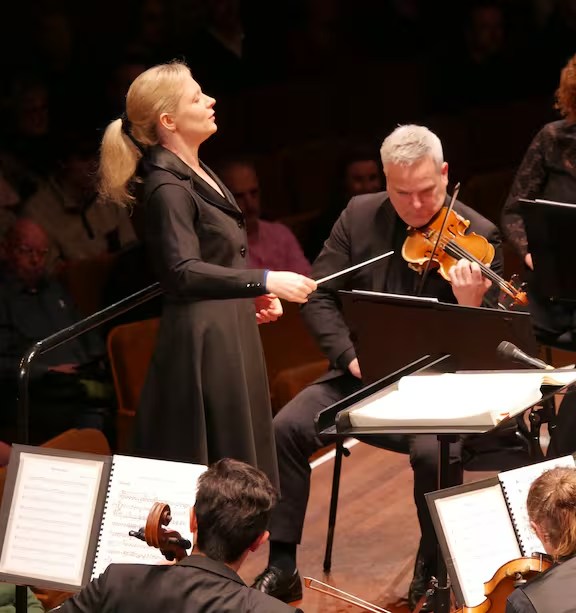
Conductor Gemma New responded to the music with her own flowing and floating gestures, notably in the animated fox trot sequence and the bell liken sounds which referenced Madame Mao’s early career as a film actress.

Copland’s “Clarinet Concerto” saw soloist Patrick Barry navigating the technical capabilities of the clarinet with a marvellous dexterity. After a soulful, filmic opening. his instrument soured above the orchestra, its bright sound weaving through the sounds of the orchestra.
There were sections where the clarinet captured the vast, open spirit of the American West and others where jazz was more dominant. Then there were passages when the orchestra seemed to be replicating the sounds of the clarinet and some boisterous sequences where the piano provided some gritty syncopation.
The orchestra and clarinet hurtled towards the finale with a fast and jazzy sounds, blending popular rhythms along with a reference to George Gershwin’s Rhapsody in Blue.
Gabriela Ortiz ‘s “Anropolis” is a portrait of Mexico City, describing the sounds and energy of the dance halls and clubs of the city. Central to the performance was the wide range of percussion instruments which delivered an edgy, constantly evolving percussion background.
From the massive opening drum and brass displays the work moved to a high energy soundscape punctuated by flute and brass where waves of sounds were constantly interrupted by the drum soloist. The work transitioned through different musical styles, including traditional Mexican sounds, mambo, and experimental punk with the musicians briefly shouting out in unison in a nod to dance hall routines.
This was high velocity music with some hectic, playful sequences which the orchestra players and conductor appeared to relish.
The last work on the programme was the “Symphonic Dances from West Side Story” by American conductor and composer Leonard Bernstein. Here, we get the ten-movement suite of orchestral music from West Side Story, with its recognizable tunes, familiar Latin rhythms and elements of jazz.
From the rhythmic finger snapping used by the Jets and the Sharks during the opening instrumental sequences through the jazzy dance sequences and the romantic interludes the music captured the spirit of New York.
The music has its emotional centre in the wholesomeness of Tony and Maria’s relationship conveyed by “Somewhere”, but it was shattered by the dark hatred of their environment and the gangs conveyed by the gangland themes.
Throughout the work Bernstein cleverly changes the pace of the music the high energy and jazzy sequences contrasting with the romantic scenes of the two lovers.


