Reviewed by John Daly-Peoples
NZ Trio, Reverie
Auckland Concert Chamber
October 8
Hanna Kulenty – A Cradle Song
Adam Schoenberg – Las Estrellas
Leonard Bernstein – Piano Trio
Karlo Margetić (NZ) – Icarus on Titan (2026 NZTrio / SOUNZ Tarling Trust Commission)
Robert Schumann – Piano Trio No. 3 in g minor
Reviewed by John Daly-Peoples
The NZ trio’s latest concert “Reverie” is a thoughtful reflection on the nature of the reverie or dream with the music depicting various states of mind or distinctive locations.
The first work on the programme was Polish composer Hanna Kulenty’s “String Quartet no. 4 (A Cradle Song)”. It is a work which is both a celebration of her daughter’s birth as well as lament on her death at the age of ten. The obsessive nature of the work seems to be a means of bringing together the idea of a cradle song for the child as well as a requiem acknowledging her death.
Throughout the work the composer was creating a space and sound between consciousness and nightmare.
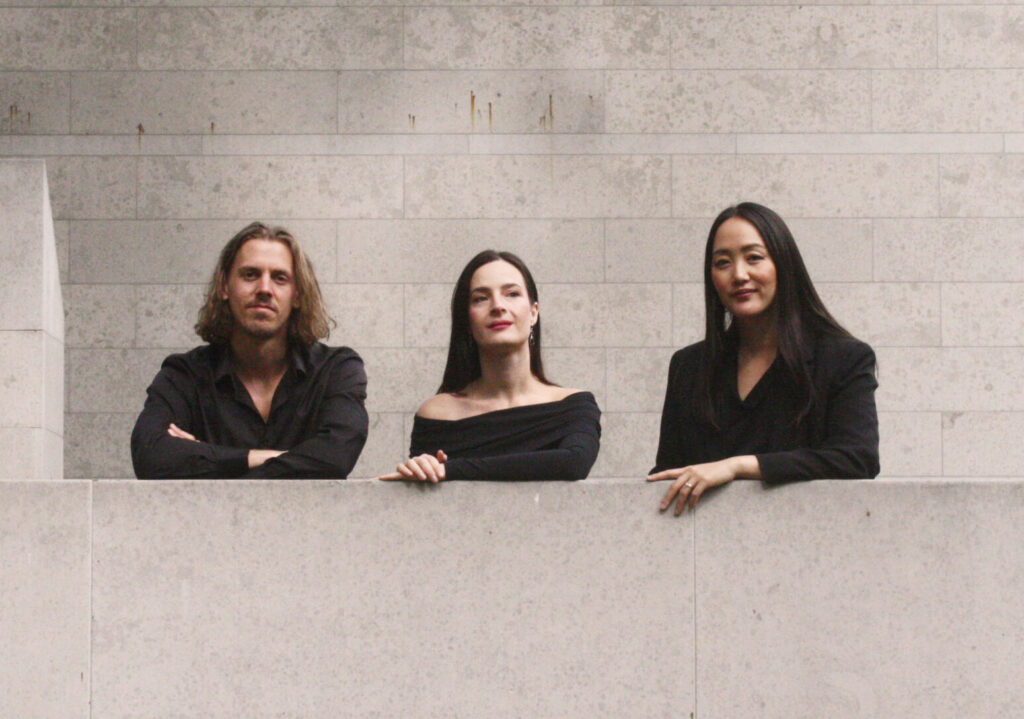
The work opened with Matthias Balzat’s hesitant cello seemingly searching for lost chords or notes, fading out once they were found. Somi Kim’s piano delivered a series of rarefied chords followed by Amalia Hall’s violin and the cello creating a sequence of discordant chords and the piano, a series of dramatic single notes.
In the central sequence the two string players used their hands to slide up and down their instrument’s strings seeking abandoned notes as though each instrument was attempting to engage with each other. They became increasingly more frantic in their bowing and the piano more insistent with dramatic chords.
The work ended with what seemed like the plaintive cry of a child.
Adam Schoenberg “Las Estrallas” carried on some of the features of Hanna Kulenty’s work with the music having some eerie and unconventional sounds. The slow methodical piano provided a background to the lyrical sounds of the violin and cello which made the piece very much a reverie as all three performers sought to find peace and equilibrium.
Throughout this piece the three musicians were attentive to each other’s playing, notably in the playing of the syncopated section which exploited the slight variations in the sounds of the three instruments.
One could sense the composer playing with the range of sonic sounds and the instrumental techniques. creating a work which kept hinting at an earlier piece of music while adding a contemporary flourish and flavour.
Leonards Bernstein’s youthful “Piano Trio” is a lively piece showing the composer trying out various musical styles –, classical, a hint of Bach as well a debt to stage and film music some jazz syncopation, blues notes, and dramatic tonal shifts. Much of the music is played by the boisterous cello and violin which show his debt to stage and film music and there was also a hint of Bach, some jazz syncopation, blues notes, and dramatic tonal shifts.
The second movement has a clever use of pizzicato along with staccato piano imitations, and some hectic passages overflowing with rhythmic drive, theatrical flair, and structural confidence.
Bernstein used some of the material from this early work in his 1944 musical On the Town.
The Wellington based composer Karlo Margetic had his Tarling Trust Commission played as part of NZTrio’s tour. The work “Icarus on Titan” imagines the Greek son of Daedalus trying to escape King Minos’s prison but flying too close to the Sun and falling to Earth. It is a cautionary myth about the dangers of hubris and youthful disobedience.
The music is derived from the sounds of science fiction films and the imagined sounds of another planet. The wavering sounds of piano, violin and cello lead to a cacophony of sounds, the wandering sequences suggesting the idea of another planet but soon become the soundtrack to a disturbing mental condition.
With each of the instruments the players extended the sound of the instruments using percussive approach – tapping the keys of the piano, plucking the strings of the cello and violin, sliding the hands over the stings, all creating the eerier sounds of outer space.
Long bowing sequences from the violin and the sawing and rasping sounds of the cello provided a physicality of striking intensity.
The final work on the programme was Robert Schumann’s “Piano Trio No3”. a passionate, stormy work that could be said to mirror the composer’s mental condition at the time and which may have foreshadowed his suicide.
The opening movement with its intense, dark, and sweeping sounds as well as the final movement which links thematic material and rhythmic energy from the earlier movements into a demanding conclusion all provide the listener with a sense of yearning, and ecstasy.
Whatever the intentions of the composer were, the three instrumentalists gave a strong expressive delivery. Their bodies appeared to be in tune with the music as well as each other’s playing. This great rapport saw each player intensely focussed on their individual playing but one was aware that they were part of a group.
Throughout the work there was a sense of the players relentless search for refinement in the music, striving to discover the emotional and spiritual depths of the piece. They seemed to continually propose and answer musical questions of each other, genuinely immersed in their musical conversation which grew in intensity and drama.