Reviewed by John Daly-Peoples
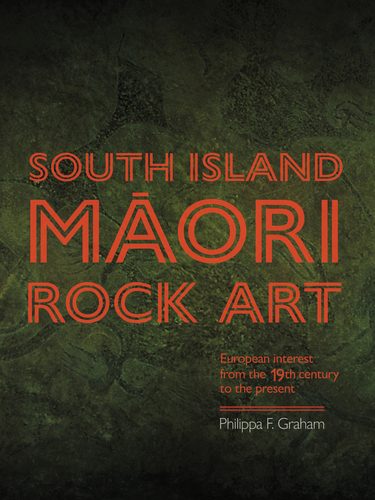
South Island Māori Rock Art: European interest from the 19th century to the present
Philippa F Graham
Canterbury Museum
RRP $89.99
Publication Date. September 1
Reviewed by John Daly-Peoples
Rock drawings are one of the oldest forms of art with numerous examples throughout the world. There are also many examples in both the North Island and South Island which have been well documented.
A new publication, South Island Māori Rock Art by Philippa Graham looks at the rock art from some of the South Island sites with numerous maps and photographs and graphic depictions of the artworks which were generally painted onto limestone.
The pale, fine textured limestone provided an ideal surface to draw on with artists using the closest material to hand. The black colour was usually charcoal (burnt stick from fires) while the red colour would have been made from Kokowai (red oxide of iron) mixed with bird or fish oil. Where there is no limestone, the drawings would have been incised on the smooth surface of grey-wacke rock.
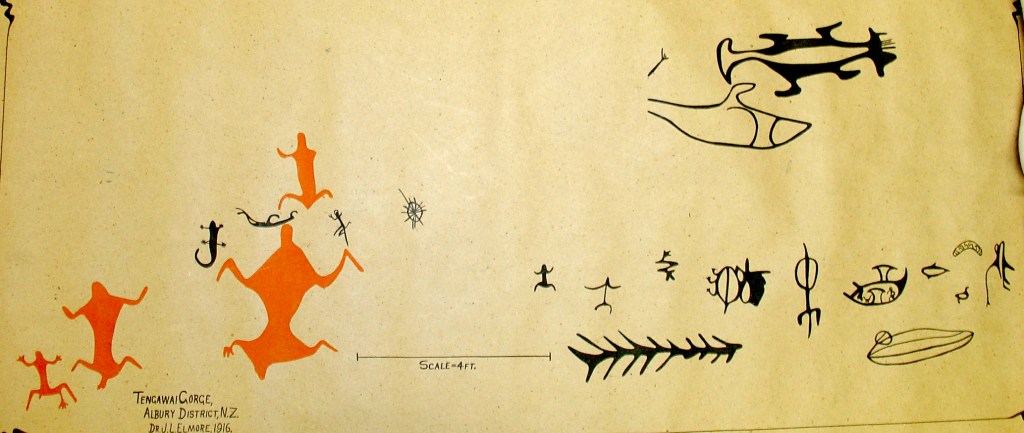
That the drawings were made with fugitive materials on perishable surfaces it is a wonder that they have lasted so long, exposed to all types of weather.
The South Island Māori rock drawings, dating back to early Māori occupation, were initially seen as scientific curiosities by many early European explorers and later, museum curators, including Julius von Haast, Alexander Hamilton, Robert
Speight, and H.D. Skinner.
Early on there was the debate in European circles about the artistic merits of the rock drawings, and their value to both local and international collectors. Experts such as Dr. J.L. Elmore a visiting American anthropologist and antiquarian collector documented, controversially damaged and removed portions of Māori rock art from sites in the South Island around 1916 encouraged by a few museum curators.
The scale of the paintings was minimal at some sites while at others they are quite extensive. The ornithologist and botanist W R B Oliver noted that at Weka Pass a portion of the paintings were 66 feet (20m) long with about 80 figures between two and three feet in height.
In the mid twentieth century, the different approaches to the works can be seen in the contrasting attitudes of archaeologist Roger Duff and artist Theo Schoon. Duff was initially dismissive of the rock art seeing the works as “doodles”. Theo Schooh however saw the drawing as having greater aesthetic and spiritual significance.
The book is the culmination of many years of exploring and checking the sites by local farmer Philippa Graham, encouraged by landowners, field staff from the
Department of Lands and Survey and the New Zealand Historic Places Trust.
There has been little written about the history of these rock art sites since Michael Trotter and Beverley McCulloch’s 1971 publication, Prehistoric Rock Art of New Zealand and now with South Island Māori Rock Art, Graham calls on her in-depth research at all of the major New Zealand institutions, in addition to the Thomas Burke Museum, Seattle. She has uncovered fresh material about the sites, the landowners, the governments of the times, archaeologists’ contributions, museums’ involvement, library records and attitudes towards local Māori in early days.
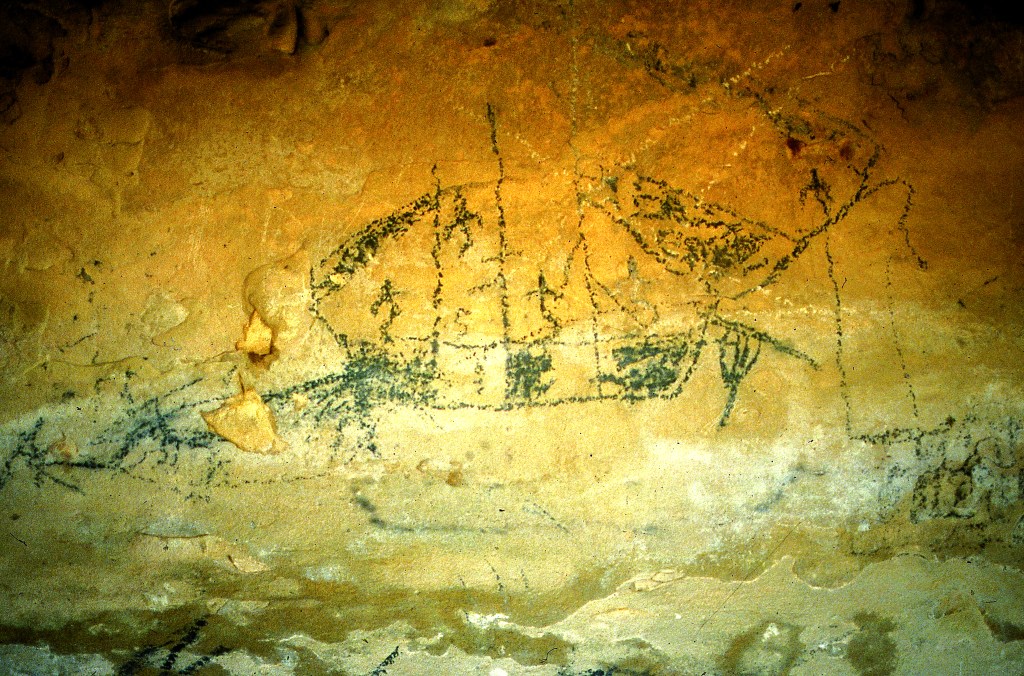
The nameless artists who first daubed charcoal and red ochre on these walls depicted subjects which were generally close to home. The images range from abstract forms, to bird, animal life and people. The presence of bones from moa and the extinct quail suggest that the people who made these images started early in terms of human habitation in the area. There may have been a long break in continuity, as there are also depictions of European sailing ships and animals suggesting that the practice may have been revived in the late eighteenth or early ninetieth century.
The book details the efforts to preserve and record the drawings at various sites. Among these efforts were the overpainting of works at Weka Pass by the and Thomas Herberley and the more recent drawings by Theo Schoon and Tony Fomision.
The book has more than 350 illustrations and maps, an index and a Māori glossary, as well as a chapter focusing on New Zealand artists who have been inspired by the rock drawings. In producing these images, the artists have often produced more refined images and in the case of the New Zealand postage stamps have brought these images to the wider public.
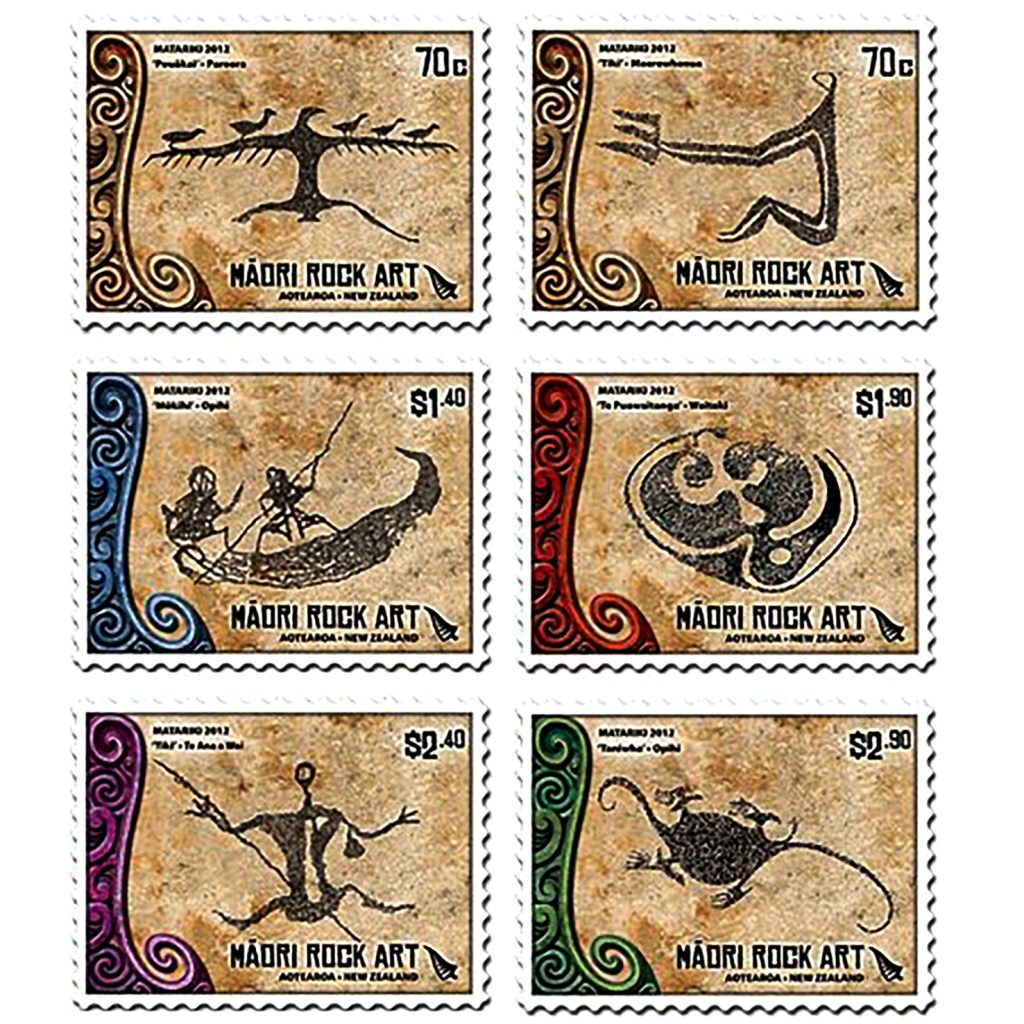
The artists who have used the imagery include James Turkington, Cliff Whiting, Selwyn Muru, John Bevan Ford, Tony Fomison, Rua Pick, Theo Schoon, Denis Knight Turner and Gordon Walters.


