Categories
Reviews, News and Commentary

Belle: Spectacular and disjointed

Reviewed by John Daly-Peoples
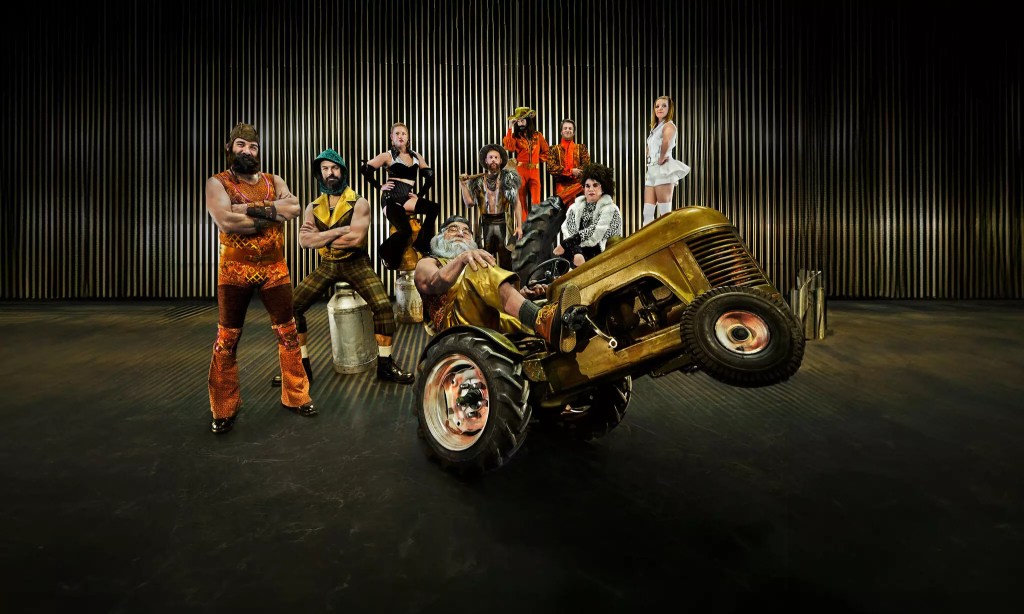
Belle Image. Andi Crown

Belle

A Performance of Air

Movement of the Human (MOTH)

Director / Producer, Malia Johnston

Kiri te Kanawa Theatre, Aotea Centre

March 6 – 9

Reviewed by John Daly-Peoples

“Belle” had all the elements to make it a stand-out performance however it never quite managed to make it a truly  thrilling show.

The all-female cast of skilled aerialist / dancers/ singers performed a range of acts with a touch of magic and their routines were all immersed in a riotous soundscape and a remarkable light and fog environment.

Sometimes it felt a though someone had told the musicians that they only needed to play loudly and that would cover any mistakes or lack of continuity.

There was also a  lack of cohesion between the various sections or vignettes which was a major  problem. Even though the acts were spectacular, there was no sense of narrative or trajectory.

Many of the sections had a sense of cavorting angels or goddesses and this could have related to the figures and Ranginui and Papatūānuku in the digital work “Ihi” by Lisa Reihana which is in the Aotea Centre foyer.

Most of the acts were performed in a half light, with the performers often seen in silhouette. Along with the dramatic use of light this added to the drama of the performance but it also meant the audience was often not able to appreciate the athleticism of the performers.

Some of the acts were brilliant conceived with figure rising and falling from the stage and disappearing into the enveloping fog of the stage. Other sequences saw the cast using elaborate equipment such as aerial wheels and large pivoting wheels.

But the lack of interconnection and lack of coordination between the sequences and music did  a disservice to the acts and a disappointment to the audience.

Categories
Reviews, News and Commentary

Shakespeare in the Park: A cold blooded tragedy and a highly promising comedy

Auckland Shakespeare in the Park 2025

A Shoreside Theatre production

Pumphouse Amphitheatre

(if wet – Pumphouse Theatre)

Richard III

By William Shakespeare

Dir Catherine Boniface

Jan 22, 23, 24, 28, 31, Feb 1, 5, 6, 9, 11, 13, 15

The Taming of the Shrew

By William Shakespeare

Dir Mags Delaney-Moffat

Jan 23, 29, 30, Feb 4, 7, 8, 10, 12, 14

Review by Malcolm Calder

22 January 2024

Richard, Duke of Gloucester (Chris Raven) surrounded by his friends, perceived rivals
and even some who survived his ascension to the throne

Tragedy is a commonly used euphemism in theatre for when lots of people die.  Richard III doesn’t quite reach Titus proportions, but it has to be up there and this particular production is in good company.

It is part of Shoreside Theatre’s annual Shakespeare in the Park series, now in its 29th iteration, and staged at the delightful, terraced, outdoor amphitheatre adjacent to Lake Pupuke at Takapuna’s Pumphouse theatre.

Rather than try and recreate Shakespeare’s historical setting and fail, Director Catherine Boniface has chosen to locate her Richard III in a seedy but sartorially splendid 1930s London.  Her program notes suggest the setting is reminiscent of Peaky Blinders – and, yes, there were some artfully angled flat caps on display.  Gangland in a word.  It works too, largely because it is analogously appropriate to the dastardly deeds that Richard, Duke of Gloucester got up to towards the end of the the English Civil Wars.

I won’t even begin to list all the deaths he generates.  Suffice to say it’s a lot – one might even suggest he ‘eliminated’ his way to the top.  And misogynistically too because, as far as I recall, all those who died were males.  Something to do with lineage in those dastardly days when York’s rose challenged that of Lancaster and the distaff lines were those who suffered the pain and of loss.

Richard, of course, received his final comeuppance and the reference to Leicester reminded me that his remains were eventually discovered under a carpark there only 15 years ago.

Chris Rather played Richard with a suavely cool and assured arrogance, his ambition plainly on display, and even his disintegrating final days were well handled.  He was a standout for me in 2024’s Measure for Measure and it was good to see him progress to the Richard role.  The supporting roles more than served to enhance and focus attention on Richard’s dominance but the standout for me this time was Suzie Sampson as Lady Margaret – subtle, nuanced and very, very professional.

The period setting on a simple stage is fairly stark but allowed the inclusion of some delightful props – the wooden Lancaster bomber, the pistols and, of course, the costumes.  I could swear the ghoulishly severed head with spectacles intact was still dripping blood.  Although I did wonder if the prominently held and waved cigarettes may have in fact been vapes.

On balance, another competent and highly entertaining part of the Shakespeare in the Park series.

Conversely the comedic Taming of the Shrew is the very antithesis of Richard.  Its content, gender-neutral casting and the fact that it is performed by what is effectively Shoreside’s youth company mean it would be facetious to compare the two.

Katerina (Matilda Chua) and Petrucio (Heather Warne) in The Taming of the Shrew

The plot itself of Shrew is well-known.  In overly-simple words, Lucentio loves Bianca but cannot court her until her shrewish older sister Katerina marries. The eccentric Petrucio marries the reluctant Katerina and uses guile and trickery to render her an obedient wife.  Lucentio marries Bianca and, in a contest at the end, Katerina proves to be a most obedient wife.  The end !

There is probably a moral in there somewhere but the play is almost like a minefield for actors with cross-cuts of double entendre, split-second timing and that all important factor – suspension of disbelief. Shrew calls for a closer understanding of, and appreciation of the nuance in Shakespeare’s words coupled with the timing that is essential to pull this off revealing the farce beneath.  Without them the humour just doesn’t work.

And that is where director Mags Delaney-Moffat is to be congratulated on clearly focussing her youthful and highly-promising cast.  They work as an ensemble, there are laughs aplenty and the work that has gone into achieving them is clearly on display.  

It would seem churlish to single out anyone but the work of Heather Warne (Petrucio) is almost upstaged at times by the wit, humour and general antics, and indeed the timing and presence, of Lizzie Morris as her ‘man’-servant Grumio.  And, despite a demure start, Matilda Chua (Katerina) grows in confidence as true love with Petrucio eventually blossoms.

But there are many highlights and both director and cast are to be congratulated.

The annual two-play Shoreside season is now firmly established on the Auckland theatrical calendar in this, its 29th season.

Note: If wet, transfers indoors.

To subscribe or follow New Zealand Arts Review site – www.nzartsreview.org.

The “Follow button” at the bottom right will appear and clicking on that button  will allow you to follow that blog and all future posts will arrive on your email.

Or go to https://nzartsreview.org/blog/, Scroll down and click “Subscribe”

Categories
Reviews, News and Commentary

The passion and drive of Alexander Gavrylyuk

Reviewed by John Daly-Peoples

Alexander Gavrylyuk

New Zealand Symphony Orchestra

Alexander Gavrylyuk

Auckland Town Hall

November 16

Reviewed by John Daly-Peoples

Opening the NZSO’s latest concert “Alexander Gavrylyuk”, conductor Vasily Petrenko spoke about the three works on the programme and what he saw as the  links between them. The three composers had all left their native homes – Lera Auerbach and Sergie Rachmaninov from Soviet Russia and Bela Bartok from Hungary to escape the Nazis. He also noted the three composers search for freedom of expression and the nature of transformation in the three works.

The major work on the programme was Rachmaninov’s “Rhapsody on a Theme of Paganini” which has some interesting history or mythology to it  . The nineteenth  century violinist Nicolò Paganini was such a virtuoso, that many believed he had made a pact with the devil. Rachmaninov seems to have subscribed to that view as he  includes a reference to  the medieval melody Dies Irae (Day of Wrath) and some of the darker elements in the music reflect those diabolic aspects.

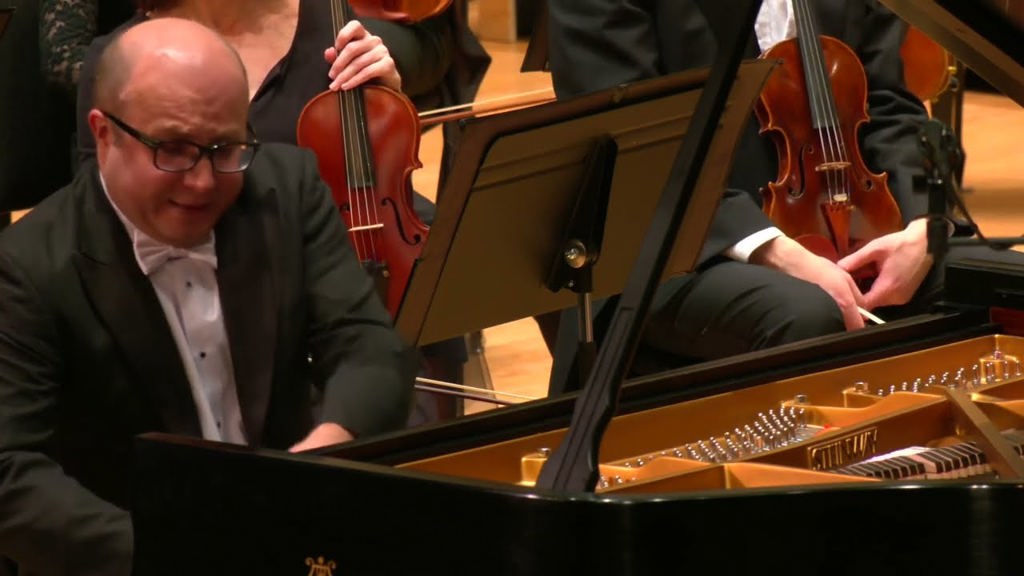
This drama and other elements were highlighted by pianist Alexander Gavrylyuk in a perfect performance that showed a perceptive approach to the music

He displayed a mastery of stylish playing, able to ignite the orchestra with his passion and drive.

His playing technique: changing tempos, charging through themes and varying the tonal qualities added to the excitement of the playing and appeared to enliven conductor Vasily Petrenko well as the orchestra.

Hunched over the piano his playing was by turns delicate, whimsical and ferocious. There were times when his sounds were like rippling water while at other times they were more like gushing torrents.

This was brazen and adventurous playing which slowly revealed the technical and emotional depths of the work moving from the childlike to the theatrical and  onto the grand and funereal.”

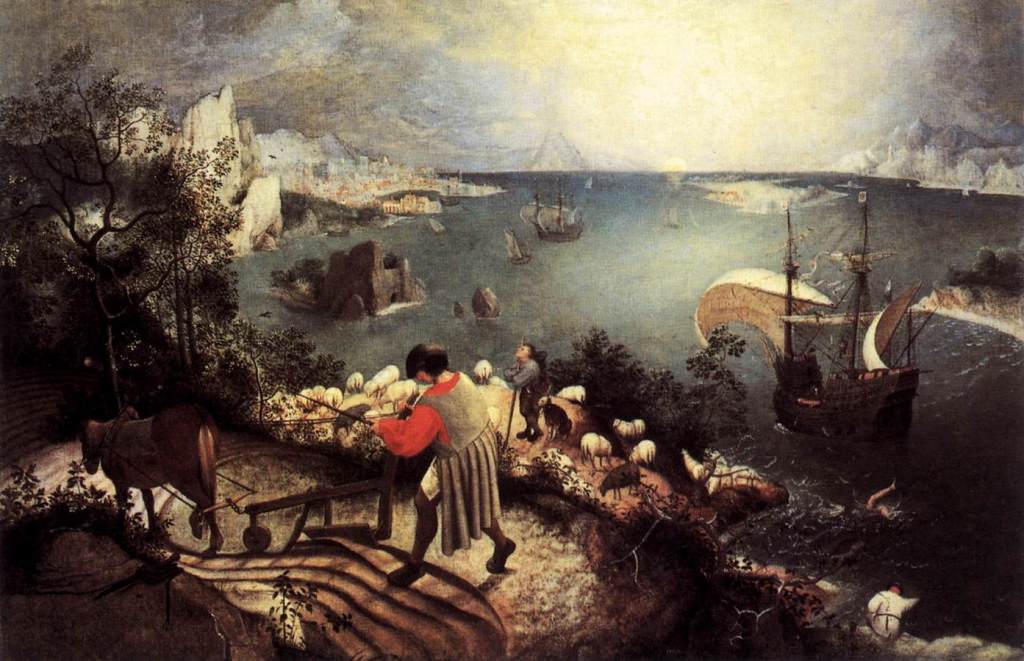
Breugel “The Fall of Icarus

The first work on the programme had been Lera Auerbach’s “Icarus” which tells of the myth of Icarus who ignored his father Daedalus and flew too close to the sun, causing the beeswax securing his wings to melt and him to fall into the sea.

The composer said of the work “What makes this myth so touching is Icarus’s impatience of the heart, his wish to reach the unreachable, the intensity of the ecstatic brevity of his flight and inevitability of his fall.”

The opening strings and brass provided a sense of take-off and the exhilaration of Icarus. This was followed by a galvanised orchestra and flutes suggesting flight. Sounds of alarm from  the orchestra signalled the coming disater  and Concertmaster  Vesa-Matti Leppanen brilliant little solo took a dreamlike diversion which became increasingly tense. This led to the insistent brass heralding Icarus’ fall.

The final sequences could be seen as the composer’s response to Bruegel’s painting “The Fall of Icarus” where the action of the event is reduced to a leg just visible, poking up  from the water . The pulsing strings suggested the vibrancy of the sun which is a counterpoint to the disaster, the quivering sounds a refence to Icarus’ fall into the water and the scattering of feathers. The work ends with a gentle requiem suggesting Icarus becoming a mythic hero.

The final work on the programme was Bartok’s five movement Concerto for Orchestra

It was his last major work and can be seen as some sort of musical autobiography of his last few years having had to leave his native Hungary and settle in the US

Composed a couple of years after his escape from Hungary it traces out his journeying from a bleak Europe to a new life, moving from a dark period in his life to one of  freedom and light. The music reflects this moving with ominous and threatening sounds through to lively and energetic melodies.

The work opened with sombre music punctuated by the flutes and raucous brass. Anguished strings confronted by ferocious brass, woodwind and percussion and the continued presence of the flutes sounded out the call for  freedom.

There was a sense of evolving events and narrative and about remembrance and loss with whimsical passages as well as a constant sense of oppression and mystery.

While there were references to horrors and drama of WWII the work is filled with inventive  music which was constantly evolving with a carnival-like sequence, playful sounds as well as hints of folk melodies  and strains of Eastern music.

The success of the work was in part due to the focused conducting of Vasily Petrenko with his lively and energetic approach and his precise direction in shaping the music’s dramatic sounds

Categories
Reviews, News and Commentary

This Doll’s House Sizzles

Reviewed by Malcolm Calder

Laura Hill (credit Tatiana Harper)

A Doll’s House Part 2

By Lucas Hnath

Directed by Paul Gittins

Design John Parker

Costumes Elizabeth Whiting

Lighting Jane Hakaraia

Production/SM Teresa Sokolich

With Laura Hill, Stephen Butterworth, Danyelle Mealings, Maya Dalziel

Herald Theatre, Aotea Centre, Auckland

14 Nov to 1 Dec 2024

Reviewed by Malcolm Calder

A Doll’s House, Part 2 runs about 90 minutes with no interval and is a bit like a well-cooked, multi-course series of tastes – or tapas if you will.  It is a meal that sizzles and left me feeling delightfully sated.

Each taste is marvelously well-prepared and each is impeccably presented.  Chef Hnath’s initial offerings covered ground prepared by others although he put an individual tweak to each and ensured they were delightfully delivered in ways that addressed time-proven issues of women’s independence, choice and self-fulfillment. 

His chief protagonist Nora Helmer arrives through the same door through which Ibsen had exited her 15 years previously.  But now she bears the scars, world-weariness and hard-won wisdom of a woman who has emphatically found and secured her place in the world as a clearly successful writer.  She is confronted by the worldly-wise Ann-Marie , Nanny to her abandoned children, an older woman who has looked, listened and learned much.  Ann-Marie is able to match Nora when it comes to verbal sparring and their discussion, debate, and general discourse delves into independence, freedom, patriarchies and the expectations of society.  And what that means.  But up to this point Hnath’s menu largely provides tastes with which we are familiar – albeit extremely well done with lashings of aspiration and confidence and some magical energy exchange between the two women.

Humour is never far away, arguments are sophisticated and standpoints and circumstances are outlined one after the other.

However well-presented these standpoints are and just as I was thinking I had heard most of their supporting arguments previously and had mistakenly arrived at a law moot, Hnath introduces Nora’s perhaps-former husband and not quite-ex Torvald.  His arrival is somewhat unexpected to the two women and now the meal and its courses becomes successively tastier.  New garnishes are added – subtly at first as incomprehension, resentment and self-doubt became apparent between all three.  But liberal sprinklings of emotion that initially bubble to the surface and then burst forth as spicy aromas that grow as they are savoured.

And that is the crux of Hnath’s play.  I sat enthralled as each new dish was served raising questions about family, marriage and responsibility.   Again, hardly new arguments, but assembled in dramatic combinations.

The dialogue is fast and vibrant – some of it using very modern vernacular. There is confusion and disagreement and miscomprehension that is sharp and pointed.

Director Paul Gittins is the interpreter of Hnath’s dishes and adds depth and nuance to each.  Designer John Parker enhances them with a simple set that is little more than a platform containing three or four chairs, a small table and an omni-present door frame that acknowledges where Ibsen left off.  Its very simplicity allows Gittins’ cast to better explore and extract light and shade.  Elizabeth’ Whiting’s costumes hint at Ibsen’s period, but nor are they of the present.  Timeless and script-driven are terms that spring to mind.

Rightly so, Laura Hill is billed as the ‘star’ and makes a compelling Nora as the chemistry between her and others is abundantly clear.  Her initial interactions with a remarkably strong Maya Dalziel as Nanny Anne-Marie and then with Torvald reveal the maelstrom that lurks beneath the surface of their worlds.

From being initially nervous and confused Torvald’s emotions soon take over and A Doll’s House 2 really starts to sizzle.  His Torvald is achingly sympathetic one moment, a blustering tyrant the next and ultimately a confused soul.

Their calm and rationale daughter Emmy (Danyelle Mealings) attempts to metaphorically and literally patch up the father-she-never-has-known as a voice of balanced reason but her voice is largely ignored, becoming almost that of a rather more dispassionate audience.

In conclusion one can only applaud.  This is an actor’s play that provokes its audience to empathise with different perspectives and director Gittins allows his universally strong and highly experienced cast to do so.

It is rather like that tapas meal where each course sizzles making A Doll’s House Part 2 a delight and, for me, one of the standouts of Auckland theatre in 2024.

As advised in all the pre-promotional material, familiarity with Ibsen’s 1879 original is not essential, but there are direct and indirect references and clues to it are strewn liberally throughout Hnath’s 21st century sequel. One might think of them as yet another layer of satisfaction – or a hidden dessert if you prefer.

Categories
Reviews, News and Commentary

Wall to Wall Māfana

Red White and Brass: The Play

Stage adaptation by Leki Jackson-Bourne

Directors, Anapela Polata’ivao, Vela Manusaute

Musical Director, Joanna Mika Toloa

Production Design, Sean Coyle

Costume Design, Chrissy Vaega

Sound Design, Matt Eller

Choreography, Mario Faumui

With Haannz Fa’avae-Jackson, Mikey Falesiu, John-Paul ‘JP’ Foliaki, Onetoto Ikavuka, Saala Ilaua, Diamond Langi, Lauren Jackson, ‘Aisea Latu, Jason Manumu’a, Rocky Manusaute, Michaela Te Awa Bird, Kasi Valu

Original screenplay by Halaifonua Finau and Damon Fepulea’i

Co-produced by Piki Films and Miss Conception Films

A World Premiere

ASB Waterfront Theatre

Until 7 July

Reviewed by Malcolm Calder

Last weekend I had a cold and spent most of it confined to quarters.  You know – a bit of this, a bit of that and an overly-heavy dosage of highly-predictable news, current affairs and media gossip monochromatically detailing financial woes, political faux pas, a couple of murders, the inevitable obsession with car crashes and countless opinion from a whole heap of ‘experts’ confidently predicting an imminent emigration across the ditch. I was miserable.

Then I went to the Auckland Theatre Company’s world premiere of a new stage production of Red, White and Brass: The Play!  And I wondered what I was being miserable about.

The basic plot is well publicised and closely follows the original screenplay of the same name by Halaifonua Finau and Damon Fepulea’I about sporting underdogs who over-achieve just as Eddie the Eagle and those Jamaican bobsledders did at the Olympics.  Hollywood loves a good sports story especially where the underdog comes out on top and this story has a unique local flavour.

But this stage production is more subtly nuanced, goes well beyond sport and is weighted more towards capturing hearts and minds in ways that both embrace and express the social psyche that is Tongan Māfana.

It is a thing that generates joy and, without being in the slightest bit didactic about all things Tongan,

it assumes a knowledge of many things in a long, long list.  These range from the place of religion to the place of rugby; from gently acknowledging the contrapuntal role of the matriarch in a purportedly patriarchal society; from an acknowledgement that achievement rests ultimately on aspiration; from generational clash to resolution and to an understanding that even addresses the subsets within the contemporary urban Tongan diaspora in Aotearoa.

As Leki Jackson-Bourne has noted… this production is loud, proud and unapologetically Tongan. It is a statement about community, heritage and sense of self.  But it is more than that.  It also says something very important about our increasingly multicultural society and as such provides a further plank in the evolution of New Zealand theatre history.  It does so with unashamed pride and joy, and celebrates both.

JP Foliaki reprises the movie role of Maka, arguably with more light and shade than the movie allowed, and his relationship with his ‘bit less Tongan’ cousin Veni (Saale Ilaua) is well handled.  Overall the cast is strong and well-balanced and their choral work mesmerizingly memorable.

Sean Coyle’s busy set morphs well in multiple directions, the costumes are a hoot and the dialogue a completely understandable mix of Lea Faka-Tonga and English. The finale is a triumph- but no spoiler alert from me other than to say the band grows on one.

Congratulations to Auckland Theatre Company and mālō Leki – the last vestiges of my cold vanished on the spot!

To subscribe or follow New Zealand Arts Review site – www.nzartsreview.org.

The “Follow button” at the bottom right will appear and clicking on that button  will allow you to follow that blog and all future posts will arrive on your email.

Or go to https://nzartsreview.org/blog/, Scroll down and click “Subscribe”

Categories
Reviews, News and Commentary

The amazing Jacob Rajan returns in Guru of Chai

Reviewed by John Daly-Peoples

Guru of Chai

Indian Ink Productions

Q Theatre

Until June 22

Reviewed by John Daly-Peoples

Jacob Rajan is an amazing actor and Guru of Chai is an amazing play

For many years Rajan has been presenting us with engaging stories with a hint of India. Over that time, he has moved his characters from the Krishna’s corner dairy to the streets of Bangalore and Delhi, to America and back to New Zealand and now returns to Bangalore.

Even though the geography has changed, the stories still have a universality about them with themes of love, tragedy, death and renewal.

Guru of Chai is told mainly through the eyes of the tea seller Kutisar who encounters seven abandoned sisters in the Bangalore Central Railway Station. In order to survive they sing on the station platform but the local mafia in the form of Thumby and the mysterious Fakir demand protection money.

The local policeman, officer, Punchkin, intervenes and becomes their protector with a particular concern for Balna.


Six of the seven sisters marry but Balna, having rejected Punchkin marries the poet Imran who later disappears, presumed killed. Balna, now pregnant, has to flee Bangalore and with the help of Punchkin, who has been rising through the ranks, starts a new life.

The story come to a head several years later when the young son, Imran who, after being brought up by his six aunts meets with Kutisar in his search for his mother in order to find out about the tragic events around the time of his  birth , It a quest which leads to further tragic events.

Jacob Rajan plays all the half dozen roles, but not has he has previously done by using masks. Now he conveys the demeanor and emotions of the characters by subtle nuances of the body generally but particularly his expressive face and hands. He also manages to capture the essence of the characters through the use of different voices. It is his remarkable combination of acting and mime skills which helps him carry off the undertaking.

He sketches in a portrait of India’s underclass and some of the social issues such as the place of women, the ever-present gods who inform and dominate all stages of life as well the weaknesses, joys and sorrows of everyday life such Kutisar’s fascination with the banned practice of cockfighting.

He is supported by Adam Ogle playing Dave, a mute musician, who contributes with a brilliant sound landscape as well as providing the back up on a couple of songs of the street..

He cleverly sets the evening up as a play within a play which he has been instructed to perform by the theatre management to entertain and enlighten the audinece whose lives are empty and lonely.

He also uses the audience as one of his many props, engaging with individuals – don’t sit in the front row as well as the wider audience in an extended version of a Monty Python parrot joke.

The Guru of Chai also owes much to co-writer and director Justin Lewis as well as dramaturge Murray Edmond and the charming, sets and costumes designed by John Verryt

Guru of Chai also at:

Coastlands Theatre, Te Raukura ki Kapiti, Kapiti
4 – 6 July
 
Hannah’s Playhouse, Wellington
1 – 11 August

To subscribe or follow New Zealand Arts Review site – www.nzartsreview.org.

The “Follow button” at the bottom right will appear and clicking on that button  will allow you to follow that blog and all future posts will arrive on your email.

Or go to https://nzartsreview.org/blog/, Scroll down and click “Subscribe”

Categories
Reviews, News and Commentary

NZ Opera’s Le Comte Ory

Reviewed by John Daly-Peoples

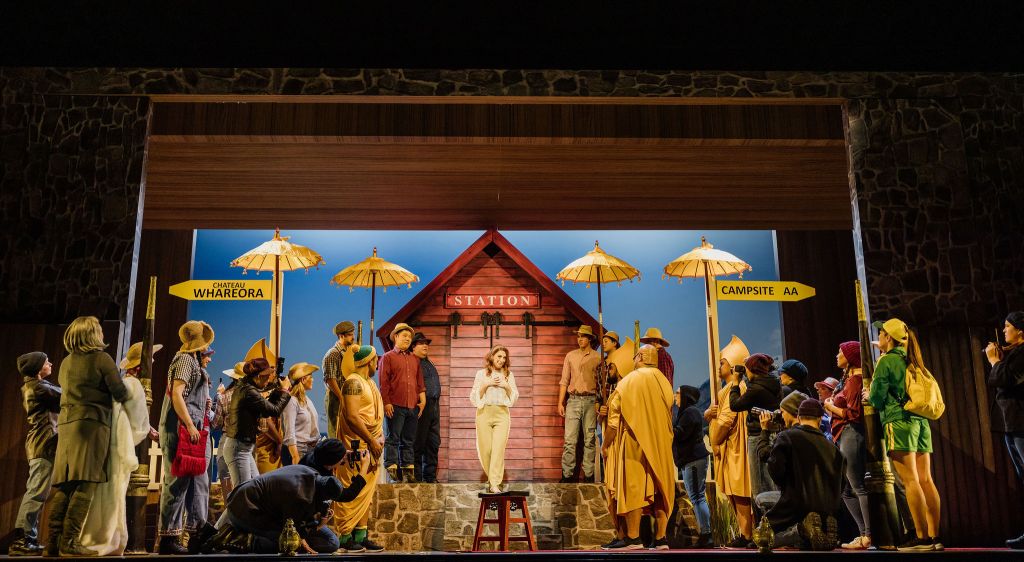
Le Comte Ory (Act I) Image Andi Crown

NZ Opera

Le Comte Ory by Gioachino Antonio Rossini

Kiri Te Kanawa Theatre, Auckland

May 30 & June 1

Reviewed by John Daly-Peoples

If Rossini was still writing operas today his pick for a librettists would have to be Simon Phillips. The original libretto was by Eugene Scribe and Charles Delestre-Poirson, adapted from a comedy they had first written in 1817. While traces of the original can be detected in NZ Opera’s latest version it is Phillips’ new translation, re-write and update which dominates.

This update is what makes the work entertaining and significant. Phillips has taken something of risk in filling the libretto with colloquial speech but it makes for  a clearer understanding of the narrative and his contemporary references give the work an immediacy.

His new libretto avoids having to deal with  the issues of misogyny which are always there in Rossini’s works. It also avoids the contentious issue in the original of having one group of men going off to fight the crusade in Palestine.

Examples of his language updates include someone being referred to as “not a happy camper” “Stuff this for  a caper, I’m buggered” says The Coach after  one adventure, “He really found my chi”  exclaims of one ecstatic young woman  and at the point when Ory is unmasked the entire cast gives a sustained  “What the F…K”

There are lots of rugby references including mention of a John Eales award – this reinforces the idea that Ory’s team is Australian as New Zealand players would not engage in such dastardly undertakings.

The setting for the opera is moved from medieval France to New Zealand, probably the Central Plateau where we find the wives of a rugby team who are off on an international tour staying at a wellness centre in the Chateau Whareora.

Adjacent to the wellness centre is a campsite where Ory and his rugby teammates have set themselves up with the dodgy intentions.

Ory uses this base to  establish himself as a guru / advisor on matters of the heart in an attempt to woo Adele, the sister of the owner of the centre who is away on tour .The team’s personal physiotherapist, Isolier is also in love with Adele and tries to thwart Orys undertakings.

This conflict between pure love and the profane is actually more about a form of selfishness and narcissism which Ory shows in both words and deeds.

The opera revolves around lots of deception, disguises and sexual intrigue where the only character, Count Ory, seems to be in control, yet he is the one who constantly fails ,

Manase Latu as Ory captures the characters inflated sense of self with a bravura performance, parading around the stage in his orange Buddhist robes, behaving like a faith healing tele evangelist.

His voice had the richness of the glib politician / priest with touches of both wit and seriousness, brilliantly captures the suave veneer. In the first act he was great as a Dalai Lama character. Partly his acting, partly the libretto but his character comes over as flawed and despite his belief in his charms and sexual prowess he is never in control of his endeavours.

Emma Pearson as Adele displayed a range of emotional responses with her iridescent voice which at time conveys a sense of rapture.

Hanna Hipp as Isolier played an ambivalent character in taking on  the traditional ‘trouser role’ of female playing male as well as that of a bi-sexual woman in her relationship with Adele. Her duo with Ory was riveting with its mixture of the comic, and sexual friction.

The various duos are performed superbly while the septet at the end of Act I was a great showing off of their voices as they slowly morphed into what sounded like a delightful barbershop singing group.

Andrea Creighton’s Ragonde fulsome voice was a quiet force. Moses Mackay as Raimbaud displayed a fine sense of the comic and Wade Kernot as the Team Manager had a genial style with a nice flexibility of tone.

The sets and costumes by Tracy Grant Lord worked well in defining place and character but some of the costumes worn by the locals in Act I seem to have been borrowed from an amateur production of Oklahoma.

For a little-known opera this production offers originality, riotous performances  with  some of the country’s best voices. The APO conducted by  Brad Cohen brought Rossini’s sparkling music to life, particularly the two overtures.

St James Theatre, Wellington June 13 & 15

Isaac Theatre Royal, Christchurch June 27 & 29

To subscribe or follow New Zealand Arts Review site – www.nzartsreview.org.

The “Follow button” at the bottom right will appear and clicking on that button  will allow you to follow that blog and all future posts will arrive on your email.

Or go to https://nzartsreview.org/blog/, Scroll down and click “Subscribe”

Categories
Reviews, News and Commentary

My Brilliant Divorce

Reviewed by Malcolm Calder

Jackie Clarke in My Brilliant Divorce                     Photo: Darren Meredith

My Brilliant Divorce

By Geraldine Aron

Dir Janice Finn

With Jackie Clarke

Tadpole Productions

Pumphouse Theatre, Takapuna

to 25 May

Review by Malcolm Calder

16 May 2024

As a mere male, I feel something of a fraud attempting to review something that tackles its subject entirely from a woman’s perspective.  But, rest assured, I have sought the opinions of female friends, so plough on (in truth ARE thoughts for menfolk in the work too).

Geraldine Aron’s play tracks one woman’s three-year path through a pending divorce after 20 or so years of marriage.  It is ripe for many emotional, social and potentially dangerous situations and that’s no bad thing.  In fact Aron’s script largely treats them as a self-deprecatingly comedic and the twinkling sparkle and dry self-observations of Jackie Clarke helps ensure this is the case – although not without some truly heart-rending moments along the way.

There is occasional recognition of Aron’s truths, but the laughter flows, there are giggles galore and  it is these spoonfuls of sugar that help ease the shock, the pain, the anxiety and the self-doubt – embarrassingly so at times. 

While Aron’s stereotypically deserted wife reflects with shredded self-esteem, loneliness and self-induced neuroses, she finds little support around her.  Older family members prefer to look to their own future with generational glee, children don’t look back too hard because they are focussed on other things, while men wish to pursue their new path clearly preferring glitz and glam (and youth of course, now THERE’S a stereotype).  And when the loyalty of her hitherto best friend the delightful Dexter wavers, she hits rock bottom.

In sum, My Brilliant Divorce portrays a women who has thought of herself as ‘provided for’ until she isn’t.  And then discovers her own future right in front of her.

Initially Jackie Clarke’s Angela Kennedy Lipsky came across as a little tense and a tad overly-quick with her delivery on Opening Night, but she soon grew into the character, quickly found her comic timing and really started to make the most of some of Aron’s delicious lines.  In fact, the way her girl-koala demolished her boy-koala (both longtime gifts from her ex), there was real venom behind it and even Dexter looked startled.  Even the audience lapped it up when she crawled off-stage looking for the bits.

Self-doubt is at the core of this play.  In one or two places it seemed a little dated and some of the localisations didn’t quite work, but that didn’t matter.  The audience intuitively knew it would all work out for the best in the long run.  Far be it for me provide a spoiler alert though.

Finally, congratulations once again to Tadpole, a company that knows and understands its audience rather well, and keeps coming up with productions to which they can relate.  That’s not to suggest the opening night audience for My Brilliant Career was stacked with divorcees.  Far from it.  In fact I have a feeling that many were there largely because of Jackie Clarke’s presence on stage.

Categories
Reviews, News and Commentary

The Insane and the Sane-for-Now

Zoë Robins (Connie Hall) and Jayden Daniels (Tristan Frey) Photo: Andi Crown

The Effect
By Lucy Prebble
Director, Benjamin Kilby-Henson
An Auckland Theatre Company Production
With Jayden Daniels, Jarod Rawiri, Zoë Robins, Sara Wiseman


Production Design, Dan Williams
Lighting Design, Jane Hakaraia
Sound Design, Chelsea Jade


ASB Waterfront Theatre
Until 11 May
Review by Malcolm Calder

Suggested in some quarters as a revival, Lucy Prebble’s The Effect could almost be described as a work in progress.

Its context is the clinical trial of a new anti-depressant drug featuring two young people. Very simply, the two fall in quite-possibly dopamine-fuelled love and this play tracks the development of their relationship while questioning the role of psychopharmacology and the intricate relationship between the heart and the brain. Is their love a meaningful long-term thing, or mere drug-inspired infatuation? All of this is observed through the eyes of a supervising psychologist and is overseen by a singularly focussed psychiatrist whose self-espoused objectivity is on the process and on the future.

But The Effect is more than this. While studying (what may be) his heart surgeon father’s brain, Dr Toby Sealey (Jarrod Rawiri) reflects that while traditional medical practices may have once referred to ‘the sane and the insane’, more recent treatment might instead refer to ‘the insane and the sane-for-now’! And therein lies the nub of Lucy Prebble’s The Effect.

Now 12 years old this play has been adapted and updated by its author taking on board increasingly complex and debateable practices about depression within the medical profession and the impact of Big Pharma and chemical treatments. Quite simply, it is about medical ethics. One wonders where this play may go to in another 12 years time.

Nonetheless, Prebble’s script is script-heavy, delightfully structured and demands close attention from its audience. It has light and shade, appropriate localisations and even unexpected flashes of comedy allowing director Ben Kilby-Henson to give full reign to an exceptionally strong cast.

Two ATC newcomers provide standout performances on their respective emotional roller coasters. Both Zoë Robins (Connie Hall) and Jayden Daniels (Tristan Frey) are driven with energy showing us blinding flashes of brilliance at times, while being riven with uncertainty at others. They are a wonderful example of younger actors coming to our stages.

Sara Wiseman (Dr Lorna James) and Jarod Rawiri (Dr Toby Sealey) counter balance them with assuredness and maturity and their respective disintegrations are handled with sensitivity, subtlety and a deftness that comes with experience. They watch and listen to each others’ arguments, articulate the core sense of The Effect with both passion and logic and leave the audience questioning – well, everything really.

No doubt echoing the somewhat scrambled state of its characters brains, Dan Williams’ set and presentation is high tech and another good example of the high production values we expect from ATC. At times this could almost have been a distraction but, on the other hand, it could also be a quite deliberate choice. Even when the younger actors struggled to find a light at times – they were struggling to find themselves.

So does The Effect work ? Emphatically yes

Prebble uses the situation to explore some big questions. It is contemporary. It is dynamic. And I resolutely agree with her ultimate truism – the future is unfinished.

Categories
Reviews, News and Commentary

Diptych: Memorable Risk with Rewards aplenty

Reviewed by Malcolm Calder

Reviewed by Malcolm Calder

Auckland Arts Festival

Diptych

Peeping Tom, Belgium

Kiri Te Kanawa Theatre, Aotea Centre

Diptych: The missing door & The lost room

Concept / Directors, Gabriela Carrizo and FranckChartier

Until 24 March

Review by Malcolm Calder

I normally try and write these words as soon as possible after a performance.  But this time I couldn’t and eventually decided to sleep on it.  Only I couldn’t sleep either.  In my mind images and thoughts swirled in what I could only describe as atmospheric convolution.

But first things first. Diptych comprises two parts – the first about a missing door, and the second about a lost room.  There is a third part, making it a Triptych, but we don’t see that here in this Auckland program.

My over-weaning sense of this company is the dynamic, slick and truly mesmerising movement in its choreography.  Belgian founders Gabriela Carrizo and Franck Chartier have established Peeping Tom as a unique force in dance theatre transforming hyperrealist settings into unstable universes that defy the logic of time, space, and mood.  This work and the company’s lineage to Pina Bausch are clearly evident and I can easily see why Artistic Director Shona McCullagh chose it as one of the centrepieces of her 2024 Festival.

As well as movement, Diptych also owes much to an all-enveloping soundscape that adds a hypnotic quality, overlaying music with live percussion and everyday noises.  This underpins the sheer physicality and many of the jarring and emotional shocks that lie ahead.

The staging starts out tiny and winds up using the full breadth of the stage giving it a cinemascopic quality.  And, just in case we missed it, the entire work is cinematic.  This is underscored by the introduction of rolling klieg lights, a boom mic and a set that is deconstructed then reconstructed by technicians in full view of the audience.

Completing the context, and further highlighting the illusion, are costumes that writhe and twist almost becoming creatures and taking on characters of their own, whilst echoing the movements of the dancers whose movements who, it seems, are controlled by non-logical and even gravitational forces.

Then my mind returned to ponder the word ‘convolution’ itself.  Turns out it’s a term that describes a form or shape that is folded in tortuous windings, or one of the irregular ridges on the cerebrum of higher mammals oran intricacy of form, design, or structure in which the combinations of power and the caprices of the powerful are ever-present dangers to survival (thanks Mr Merriam-Webster).

Yep, that’s about right I decided.  And henceforth, for me, Diptych became a convoluted dance theatre work.

I knew it was about a man’s mental anguish and I immersed myself in that tangled web.  It has no single direction veering between reality, memories, desires, dreams and nightmares.  At times I was slow to grasp a thread; at others I got it instantly.

Eventually I just stopped fretting about trying to work things out in any logical or linear fashion, sat back and let it wash or surge, over me.  And I’m glad I did because that is what Diptych is all about.  Rather than trying to ‘understand’ what Carrizo and Chartier were trying to say, the production itself taught me to just soak in it, to absorb it.

Yes, there was a missing door; and yes there were many surprises when some were opened.  But the perceptions, context, memory and horrors of doing so were different for every character on stage.   Similarly, an entire room got lost and the same applied.

What Festivals are supposed to do is introduce us to the new, the different and the normally unattainable.  So congratulations to the Festival for taking this risk with Dyptych.  It was certainly memorable for me – so much so that it never occurred to turn my phone back on again when leaving the theatre and I missed a raft of calls the next morning.

To subscribe or follow New Zealand Arts Review site – www.nzartsreview.org.

The “Follow button” at the bottom right will appear and clicking on that button  will allow you to follow that blog and all future posts will arrive on your email.

Or go to https://nzartsreview.org/blog/, Scroll down and click “Su