Categories
Reviews, News and Commentary

“The Effect”: A sizzling chemistry lesson coming to Auckland Theatre Company

John Daly-Peoples

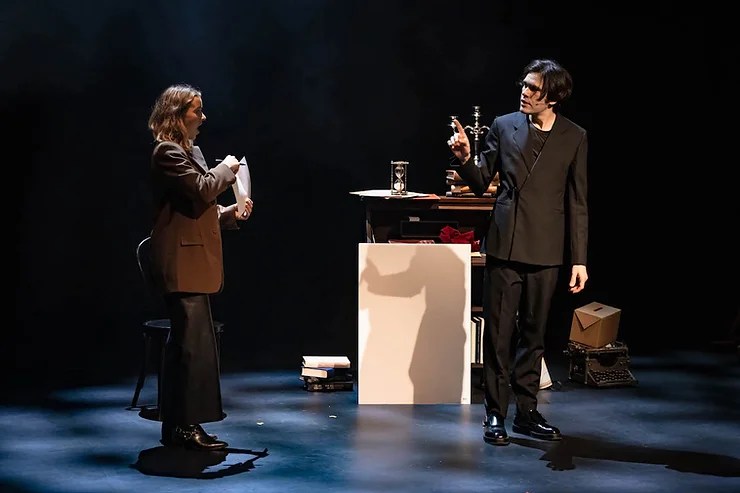
Zoe Robbins (Connie) and Jayden Daniels (Tristan)

The Effect by Lucy Prebble

Auckland Theatre Company

ASB Waterfront Theatre

 April 16 –  May 11

John Daly-Peoples

Straight off a highly acclaimed season at London’s National Theatre, Auckland Theatre Company is presenting The Effect, written by BAFTA, Golden Globe and Emmy award-winning co-executive producer and writer Lucy Prebble of the HBO international hit series, Succession (2018-2023) in their 2024 line up.

“The Effect” will be directed by Benjamin Kilby-Henson (King Lear) and feature major stage and screen stars including; Jayden Daniels (Head High, Celebrity Treasure Island), Zoë Robins (Amazon’s The Wheel of Time), Jarod Rawiri (Long Day’s Journey into Night) and New Zealand screen legend Sara Wiseman (Under the Vines, Creamerie).

British playwright and producer Lucy Prebble shows all the razor-sharp flair that made her a star writer on Succession in this deft dissection of medical ethics and the nature of human attraction.

The review of the work in the New York Times gave it a strong recommendation.

“Are you in love, or are you merely experiencing a giddy dopamine rush? Are those two states even meaningfully different? Is there a true, innermost “you” that is distinguishable from your neurochemistry?

These are some of the tricky questions explored by Lucy Prebble’s thought-provoking play, “The Effect”

The play revolves around two young people, Tristan and Connie, who take part in a trial for a dopamine-based psychiatric drug with powerful antidepressant properties. Initially, they seem to have little in common — he’s a working class lad from East London; she’s a bougie psychology student from Canada — but as the trial progresses, a tender rapport develops.

Throughout the study, the participants are monitored by two psychiatric doctors, Lorna and Toby, who debate their findings: Is the drug pulling their subjects together, or are their feelings organic? And if one of the trial participants was actually receiving a placebo the whole time, what then? Prebble keeps us guessing.

Throughout, the pair’s gradual transition from wary awkwardness to intense mutual magnetism is convincingly rendered, in large part thanks to the actors’ terrific onstage chemistry.

Things get messy in the latter stages of the experiment, as both the doses and the emotional stakes increase, leading to a fraught and affecting denouement.

The stiltedly ambivalent friendship between the two middle-aged doctors provides an intriguing subplot. We learn that Lorna and Toby once romantically involved, many years ago. Lorna is prone to bouts of depression, but refuses to take medication; Toby, on the other hand, is a true pharmaceutical believer.

“The Effect” is healthily skeptical about scientifically deterministic approaches to emotional well-being, channeling a dissenting tradition that dates back to the anti-psychiatry movement of the 1960s; its moral sensibility recalls Ken Kesey’s  1962 novel, “One Flew Over the Cuckoo’s Nest.” The play’s revival is particularly timely as a new generation of wellness gurus have, in recent years, latched onto the idea that much of human behavior can be explained away as neurotransmitters or hormones simply doing their thing.

Prebble invites us to ponder the implications of such thinking. Connie is initially uncomfortable with the notion that two people can fall in love just like that (“It takes work,” she insists), and wary of her attraction to Tristan. He, in response, makes the case for mystery, and thus articulates the play’s key message: That a world in which all feeling is viewed as a matter of chemistry would be a bleak one indeed.”


Categories
Reviews, News and Commentary

In The Zone of Interest don’t mention The Jews

Reviewed by John Daly-Peoples
Rudolf Höss (Christian Friedel) in his backyard zone

The Zone of Interest

Directed by Jonathan Glazer,

In cinemas from February 22

Reviewed by John Daly-Peoples

“The Zone of Interest” is based on the Martin Amis novel of the same name. Written and directed by Jonathan Glazer, the movie focusses on the daily life  of Rudolf Höss (Christian Friedel) the S.S. commandant of  Auschwitz, his wife Hedwig (Sandra Hüller)  and their children. 

It’s a story about The Holocaust but one which is just out of sight and mind. Kept at a distance by  closed walls and closed minds.

Höss, who admitted at his trial of being responsible  for the death of at least a million and a half people at Auschwitz was not named in the Amis book which used three fictional characters to create a wide-ranging narrative about the camp and The Final Solution.

If you didn’t know about Höss  or The Holocaust, Glazer’s film might appear to be enigmatic or mystifying. We do not really see the camp only the surrounding wall which is capped with barbed wire, the roofs of the barracks, a watch tower, the occasional smokestack and smoke. We see no inmates, guards or dogs.

We do hear the distant rumblings of the camp, the low sounds of voices, occasional shouts, and barks as well as random shots.

This distancing from the horrors on the other side of the wall is emphasised with much of the filming in long shot and the film features the Höss’ lush garden where Hedwig spends her time and the backyard swimming pool with the frolicking children.

The film is full of contrasts between the two environments – the camp and the house. But that contrast is generated by the viewers knowledge. So, we know the food that the family eat is sumptuous compared with what those on the other side of the wall eat. That the clothes they wear are better, that the environment is calm and relaxing. That their life is simple and ordered.

In one long sequence the camera follows Höss as he tours the house at night, turning off the light, closing doors checking on the sleeping children, bringing the day to a peaceful close.

One of the few sequences set inside the camp is of Höss supervising the unloading of people from a train. All we are shown is a low shot of Höss framed against the smoke-filled sky with the sounds of barked commands, whips cracking, crying and confusion.

One of the other dramatic intrusions of the camp into the idyllic life of the family is seen in a sequence where Höss and his children are swimming in  river. The tranquillity is abruptly cut short when Hoss discovers a bone fragment floating in the water and sees a scum floating towards them – the result of ash from the crematorium scattered deposited upriver. The children are them vigorously scrubbed free of the physical and racial taint.

In another scene Höss’ wife swans around her bedroom in an expensive fur coat which she insists needs to be cleaned, without stating why.

When the business of extermination is talked about it is in euphemisms or oblique language. In a meeting Höss has with engineers to discuss the new crematorium no mention is made of the number bodies which could be incinerated rather they refer to the possible “load” the ovens are capable of dealing with.

While there is no reaction by the family to the horrors over the wall, one of the young girls in the family appears to do into catatonic state as though blotting out her reactions. This psychological denial is then represented by some thermal imaging black and white sequences of a young girl placing food around the camp, seemingly at night, in a dream.

The reality of The Holocaust and of Auschwitz is made clear in the final moments of the film where Höss wanders through the silent corridors, his gaze seeming to be drawn to other activities. Then the film cuts to the  present-day museum at Auschwitz and we see the piles of suitcase, the stacks of crutches and mounds of shoes, all that remains of extinguished lives.

To subscribe or follow New Zealand Arts Review site – www.nzartsreview.org.

The “Follow button” at the bottom right will appear and clicking on that button  will allow you to follow that blog and all future posts will arrive on your email.

Or go to https://nzartsreview.org/blog/, Scroll down and click “Subscribe”
Categories
Reviews, News and Commentary

Measure for Measure: intrigue, sex and plenty of laughs

Reviewed by Malcolm Calder

Nick Milnes (Angelo), Stuart Tupp (Duke), Stephen Ellis (Escalus) and Āria Harrison-Sparke (Isabella)

Auckland Shakespeare in the Park 2024

Measure for Measure

By William Shakespeare

A Shoreside Theatre production

Pumphouse Amphitheatre

(if wet – Pumphouse Theatre)

Jan 23, 24, 26, 28, 30, Feb 6, 9, 10, 11, 13, 15, 17

Reviewed by Malcolm Calder

Measure for Measure is one of the comedies that’s billed as a play for today.  Peopled by a typically diverse cast, it’s hilarious and increasingly convoluted mundane day-to-day content provides context and plenty of laughs.  Some of Shakespeare’s characters simply fill space but a core soon emerges and, with them, the not uncommon Shakespearean themes of intrigue, manipulation and resolution are revealed.

For openers, the rather wearisome Duke of Vienna (Stephen Tupp) decides to take an extended timeout leaving his deputy Angelo (Nick Milnes) in charge.  And that’s where things get interesting because Angelo takes a more hardline view of both public morals and the law, before revealing a worldview that is essentially flawed.  In particular, he is concerned about sex outside of marriage.  So he sets about closing all Vienna’s brothels and heavily penalising anyone who dares fornicate privately – with the penalty being death of course.

One of the first to feel his ire is a likeable young chap called Claudio (Chis Raven) who has very few words in the playscript, but whose situation and fate quickly become something of a fulcrum for what follows.  He must have been a sweet-talker in private though because he has somehow managed to impregnate his publicly mute fiancée Juliet (Alice Dibble). 

However, when Claudio’s sister, the novice nun Isabella (Āria Harrison-Sparke), learns of this she is outraged and thereby hangs the nub of Shakespeare’s play.  Echoing social mores that are sometimes as prevalent today as they were 400 years ago, Angelo says he’ll only do it if Isabella yields her own virginity to him.  The cad!

Thus comedy becomes context, and hypocracy, truthfulness and justice are revealed as what this play is about. 

Rather than a strong Duke who eventually returns from his sojourn as a Friar and comes up with a Plan B that sees Angelo’s jilted fiancée Mariana (Terri Mellender) substitute for Isabella, the key protagonist is revealed instead to be Isabella herself. 

Āria Harrison-Sparke handles this with aplomb, assuredness and maturity.  In particular her command of Shakespearean dialogue is of a considerable order.

Nick Milnes ties himself in knots at times as Angelo and Terri Mellender makes a delightful, if giggly, wronged fiancée.  Escalus, ever the civil servant is played very straight by Stephen Ellis and the lesser character-roles provide some big laughs.  Perhaps of note was Michelle Atkinson (Provost) who introduced both subtlety and nuance to her Provost.

The set is fairly stark and simple, as are the props.  Of particularly ghoulish note was the severed head of not-Claudio and brought directly from his beheading and I could swear it as still dripping blood!

Eventually the good Duke shucks off his Friar mantle, resumes his Duke-ness, sentences Angelo to wed Mariana, then threatens to kill him as well. But Mariana and Isabella plead for Angelo’s life, reveal that Claudio is alive, the Duke pardons Angelo and proposes to Isabella, while Claudio and Juliet presumably live happily ever after – even if their newborn bites Claudio’s finger.

As I said, very convoluted, but also very Shakespearean.

Most audible, even from his proper tongue,
“An Angelo for Claudio, death for death.”
Haste still pays haste, and leisure answers leisure;
Like doth quit like, and measure still for measure.

Unlike last year’s Shakespeare-in-the-Park season where winds blew and cheeks cracked, Shoreside Theatre is looking forward to better weather this summer.   Nonetheless, the white noise created by even the gentlest breeze in the trees surrounding this outdoor venue makes it sometimes difficult for a cast to project beyond it so seating in the forwards rows is recommended.  Rather surprisingly it got a tad chilly as the evening wore on and a good jacket, or even a blanket, is suggested.

This annual two-play season (although not reviewed here, the other is A Midsummer Night’s Dream) is now firmly established on the Auckland theatrical calendar in this, its 28th season.

Categories
Reviews, News and Commentary

An Arts Festival show which has the reviewers wondering

John Daly-Peoples

Auckland Arts Festival

Scott Silven “Wonders”  

March 19 – 24

One of the more intriguing acts on at the Auckland Arts Festival this year will be Scott Silven’s Wonders.  The clairvoyant, mentalist, and performance artist has dedicated his career to unique form of theatrical  illusionism which fascinates audiences.

He studied hypnosis in Milan at 15, gained recognition from the American illusionist David Blaine at 19, and headlined one of the United Kingdom’s most prestigious theatres at 21.

In Wonders, Silven invites the audience on a journey through his childhood memories in the lowlands of Scotland, connecting his participants with the myth and mystery of the landscapes that shaped him. This show is said to go beyond the traditional theatre experience, offering an interactive, audience led, performance that explores the power of connection through illusions.

What is extraordinary about his show is the response of reviewers who grapple with trying to explain what they have witnessed in seeing one of his shows

A Melbourne Time Out reviewer said of Silven, who talks to the audience about his early exploration of the family attic –  “he also explored the corners of his own mind, and he claims that he began to discover his ability to make mental connections to the world around him in weird and wonderful ways. Interspersed in this narrative are demonstrations of Silven’s extraordinary skill as a mentalist, which involves audience members at every turn. His ability to convince that he’s reading minds – and that random audience members are able to perform similar feats under his instruction – is absolutely dazzling. The complexity of his work is spectacular, and he draws together the threads of just about every “ta-dah” moment in the final moments of the show. Even non-believers, like myself, will be blown away by the artistry.”

A Sydney reviewer was also baffled  “Silven does not perform your typical brand of magic, using visual illusions and tricks to stun the audiences. Instead, he uses the power of language and of the imagination to draw the audience in, fostering magic out of the power of human connection. One by one, he brought members of the audience up and seemed to be reading their minds. In reality, a lot of the time he was actually guiding them as to what to think. That prepared monologue at the start that felt out of place was actually an ingenious way of planting motifs and ideas in the audience’s mind that they would bring back to him later. Every little bit of speech had a purpose.

Some moments felt scarcely believable. When an audience member said their prize possession as a child was a “Snoopy” dog, Silven reached under his chair and pulled out a billboard he had written earlier predicting that the prize possession of the audience member he called upon would be a “Snoopy” dog. Is this too much of a coincidence? Did he have plants in the audience? Did he have an assistant furiously typing up a billboard backstage and slipping it under the stage curtain to his chair when we weren’t watching?”

And The Guardian reviewer said of another of his shows  “Silven’s use of storytelling and setting creates something genuinely magical, and it’s a joy to willingly suspend disbelief and slide into a sense of wonder not experienced since childhood.

And with that comes connection. Not the psychic kind Silven suggests, but the kind forged by a shared sense of discovery. Across the table, eyes are shining, guards are down, and there’s the odd report of goosebumps. The childhood game of Chinese whispers, further confounded by whisky, brings things to a delightfully silly finish.

I emerge still a sceptic, but certainly not a cynic.”