Categories
Reviews, News and Commentary

NZ Opera’s Rigoletto: a tale of love, despair, anger and corruption

Reviewed by John Daly-Peoples

Rigoletto (James Clayton) Image Jinki Cambronero

Rigoletto

Music by Giuseppe Verdi

Libretto by Francesco Maria Piave

NZ Opera, by arrangement with Opera Australia

Kiri Te Kanawa Aotea Centre

Until September 25

Reviewed by John Daly-Peoples

From the opening doom-laden chords through to the anguished sounds of the  final moments of Rigoletto the audience was carried along by the glorious music which conjured up feelings of love, despair, anger and malevolence as we follow one mans destiny, overcome by the deceitful and immoral world he lives in.

Tyrants, and  corrupt leaders have always had the ability to corrupt other people and surround themselves with equally corrupt yes men. Rigoletto takes us into that world of, deceit and amorality. It is a bleak world where the  occasional flicker of light and love is quickly extinguished

The first act opens with the Duke of Mantua and his courtiers cavorting in an impressive reception room with references to La dolce Vita of the 1950’s. It is a world where the dinner suits and fabulous dresses disguise the lecherous goings on.

We also encounter Rigoletto dressed as the court jester – a mixture of Ronald McDonald and Joaquin Phoenix’s Joker as he peels off his make up surrounded by his various costumes. He is an actor who must play many parts, just as the other members of the Dukes court play  out their roles.

The first act’s dramatic opening is just the start of probably one of the most mature and intelligent productions of the opera and one which kept the audience enthralled.

One of the problems I have always had with the opera is the curse with which Monterone damns Rigoletto and the duke early on. The notion that he has been cursed preys on Rigoletto mind throughout the opera and when his daughter dies in his arms, he shrieks about the curse has been fulfilled. Of course, the evil Duke still lives, so the curse has not affected him.

In fact, Rigoletto himself is the reason his daughter has been killed, Rigoletto himself is the curse and she dies because of his deceit and immorality rather than anyone else’s.

The Duke and his various courtiers are not particularly evil. They act as many men of business or politicians, using or skirting the law in an amoral fashion. It is Rigoletto who embarks on a course of revenge with the decision to hire an assassin to kill the Duke.

The courtiers and the Duke are also upfront about what they do. It is Rigoletto who presents a façade at court as well as to his daughter, withholding the truth of his relationship with the Duke and his early life even from her.

This veneer which he presents is his undoing. His pretense of an irritating, sycophantic fool at court hides a deep-seated resentment. His lack of awareness of his involvement with amoral activities as well as presenting as a cloying and over protective father is his weakness, his flaw, his curse.

James Clayton in the role of Rigoletto has to convey Rigoltto’s complex set of attributes and flaws. His character never becomes over demonstrative, there is always a sense of him holding back in his expression of love, hate, contempt. It is too easy to have Rigoletto portrayed as a twisted character who is obviously deformed physically as well as mentally and Clayton carefully avoids this.

His “Pari siama” (How alike we are) when singing of the assassin Sparafucile is haunting in its exposure of Rigoletto’s awareness of his own wretchedness, his voice catches with shuddering emotion at just the right point. Then he superbly transitions to his singing as devoted father of Gilda.  This ability to capture his two personalities, the heartless and the warm showed in just a couple minutes showed a singer with able to convey deep psychological states with exquisite refinement.
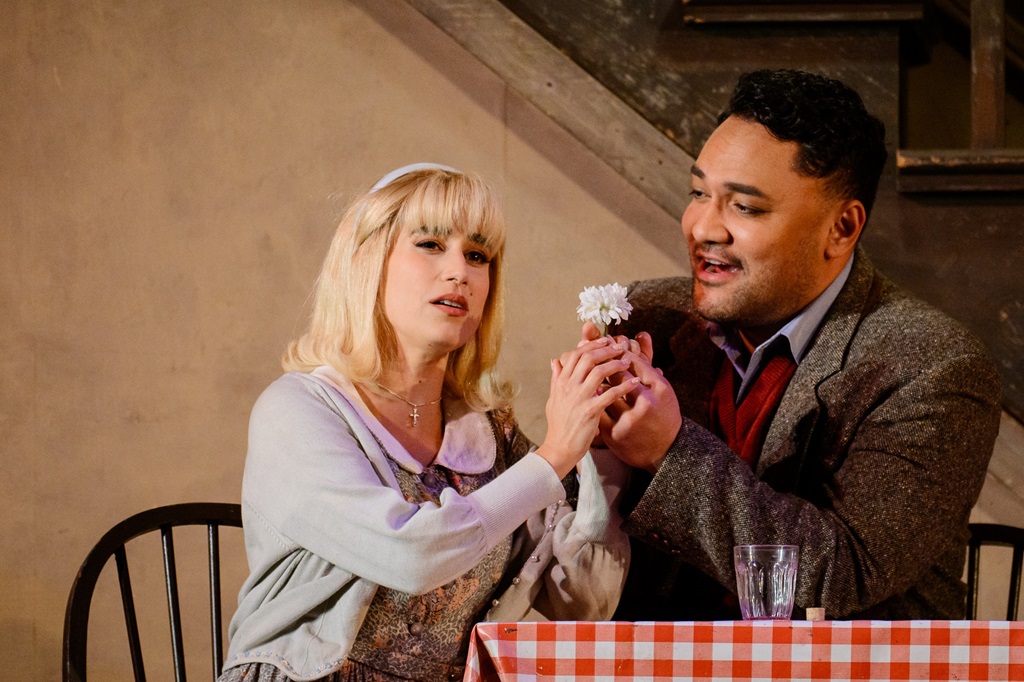
Gilda (Elena Perroni and the Duke (Amitai Pati) Image Jinki Cambronero

As Gilda, Elena Perroni created a character which expressed all the conflicting emotions of a young woman exposed to the ache and desperation of love, the terror of kidnap, the embarrassment of talking to her father about her seduction and the confusion of being dragged into the adult world.

Her voice soars with emotional expression in arias such as “Care nome” (Dear name) where effervescent and passion erupt.

Amitai Pati sang gloriously as the hedonist Duke with just the right mix of bravado and self-awareness. In his role as Gilda’s lover his voice took on an elegant combination of romanticism and cynicism which helped create a fully rounded, disreputable character.
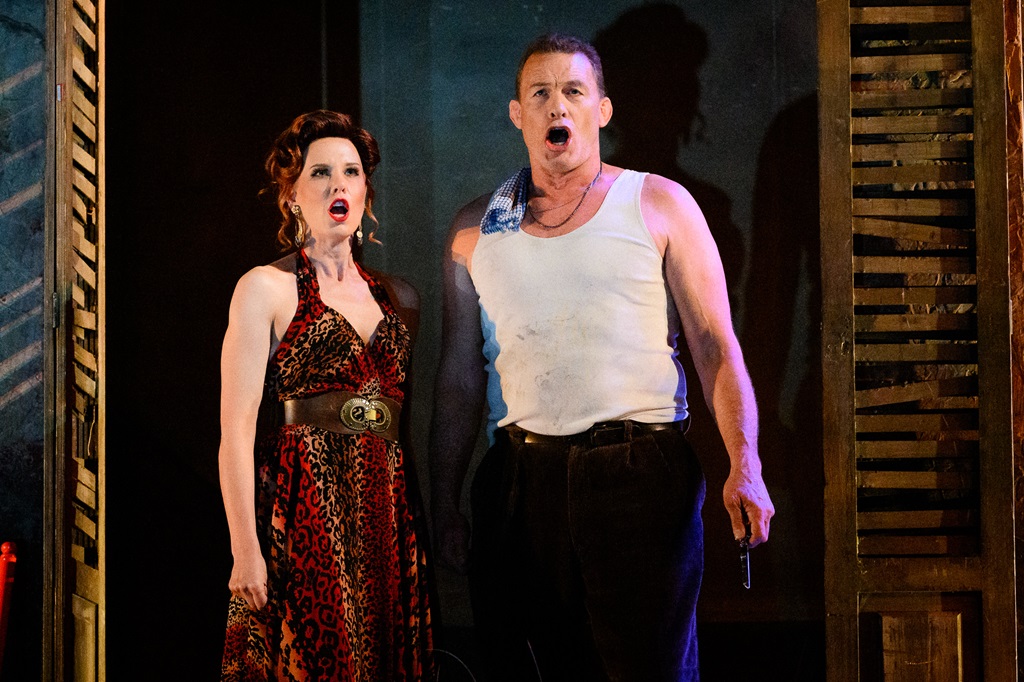
Maddalena (Sian Sharp) and Sparafucile (Jud Arthur) Image Jinki Cambronero

Jud Arthur’s Sparafucile was suitably threatening with his mundane approach to killing,. His silky voice resonated with darkness and menace, his body tense with suppressed nervous energy.

Sian Sharp was impressive as Maddalena, Sparafucile’s sister and she added a sensual dimension to the final quartet when she sings with the Duke, Rigoletto and Gilda in a profound “Bella figlia” (Lovely woman).

The set designs by Michael Yeargan are impressive from the lavish palace interior to the brilliantly detailed house/ bar interior constructed on a revolving stage which helps concentrate the action.

This is a restaging of the work originally directed by Elijah Moshinsky and rehearsed by Shane Placentino who has done a splendid job in realizing the work.

As ever the New Zealand Opera Chorus was in great form and conductor James Judd deftly led the Auckland Philharmonia ensuring that the music added to the overall dramatic effect, dominating when it needed to but always allowing the singers the space to let their voices shine.

With this production director, designers, soloists chorus and musicians have brought together a seamless tale of brilliantly rounded characters with vivid emotions and contemporary relevance.

To subscribe or follow New Zealand Arts Review site – www.nzartsreview.org.

The “Follow button” at the bottom right will appear and clicking on that button  will allow you to follow that blog and all future posts will arrive on your email.

Or go to https://nzartsreview.org/blog/, Scroll down and click “Subscribe”

Categories
Reviews, News and Commentary

ATC’s Girls and Boys: comic, dramatic, unexpected and gut wrenching.

Reviewed by John Daly-Peoples

Beatriz Romilly

Girls & Boys by Dennis Kelly

Directed by Eleanor Bishop

Auckland Theatre Company

ASB Waterfront  Theatre

Until September 22

Reviewed by John Daly-Peoples

Boys & Girls starts of as a very simple play with a clear narrative, some well-honed quips and some nicely sketched characters. All this is deftly presented by Beatriz Romilly as the sole unnamed central character who we meet standing in a queue at Naples airport where she tells of her misspent youth and her  as drunk / druggy / slaggy phase imbibing  drinks, drugs and a bit of cocaine. She gives us her youthful world-weary evaluation of a few European hot spots – Paris is a dump – Leeds with wider streets. Italians are fucked up but great.

Its also in this queue she meets her husband who endears himself to her by putting two wanna-be models in their place.  He is something of an entrepreneur, buying up old French and Italian furniture to sell in the UK.

Then its fast forward to her and the  children, who do have names – Leanne and Danny. And she gets a new job. She gets to be a PA in a TV company. She is good at her job, rises through the ranks to the point she is getting Baftas.

The first half of the play is pretty bright, the sex is terrific, the children predictable, she manages to thwart a potential rival, it’s a good life.

The latter part of the play is a bit darker. His business starts to falter, she suspects another woman, they are drifting apart. Its at this point she addresses the audience, as she has done a few times before _ “I am if course, just giving you one side”. While she doesn’t tell us what the other side is she comes to the realisation that he is jealous of her rising star while his is waning. The conclusion is devastating and echoes some of the remarks she makes earlier in the play about male violence and she muses in her final lines about the way the world has been made for men should be to stop men.

As well as giving life lessons to the children the woman also imparts them to the audience in her complex role of mother, shrink and life coach.

In charting the trajectory of her marriage she has to confront the puzzle of the man she loves and Romilly is able to convey her changing emotional states from the early,  witty observation to the visceral responeses she has to the final  tragedy. Romilly also manages to transform the physical nature of the woman herself from a statuesque figure at the beginning to a crumpled form at the conclusion.

Romilly gives a brilliantly textured performance as she builds a portrait of the woman, transitioning from her early  phase of her life to maturity with some clever vignettes as she takes on the voices of  other characters.

The simple set designed by Tracy Grant Lord was a masterpiece of design – at times just a small flat wall, then a doorway, then a dark box -and  was able  to change the dynamins of the action while the lighting of Filament 11 added to the atmosphere.

The soundscape created by Te Aihe Butler with its sounds of the outside world as well the music of Victoria Kelly all helped create intense  moods which were  generally, extremely effective but occasionally it becomes unnecessarily obvious and masked the dialogue.

The monologue at close to two hours is a remarkable display of acting – subtle, comic, dramatic, unexpected and gut wrenching.

The play is acutely relevant in telling of the tragedy of lives and families ripped apart by male violence and its debilitating aftereffects on individuals and society.

To subscribe or follow New Zealand Arts Review site – www.nzartsreview.org.

The “Follow button” at the bottom right will appear and clicking on that button  will allow you to follow that blog and all future posts will arrive on your email.

Or go to https://nzartsreview.org/blog/, Scroll down and click “Subscribe”

Categories
Reviews, News and Commentary

Ka Mua Ka Muri: Backwards to the Future

Reviewed by Malcolm Calder

Ka Mua Ka Muri Image, Andi Crown

Ka Mua Ka Muri

Choreographers: Bianca Hyslop and Eddie Elliott

Sound composition: Eden Mulholland

Set and costume design: Rona Ngahuia Osborne

Lighting design: Owen McCarthy

Projection Design: Owen McCarthy (Remain), Dan Mace (Whakamaheahea)

With Abbie Rogers, Caleb Heke, Madi Tumataroa, Matiu Hamuera, Oli Mathiesen, Tai Taranui Hemana, Toalei Roycroft,

An Atamira Dance Company production

Q Theatre, Rangitira

Until 27 July

Then Clarence Street Theatre, Hamilton 29 July.

Review by Malcolm Calder

25 July 2024

This significant work comprises two collaborative creations without an interval – Eddie Elliott’s Remain followed by Bianca Hyslop’s Whakamaheahea.  Although each could easily stand alone, they are not really a double bill.  There is no interval, simply a pause, or perhaps a lengthy segue between the two, and each reflects the other.  Hence the title which loosely translates into Before and After.

Elliott’s Remain does far more than simply relate the past and provide a context for today however.  It helps to explain that past and how the intertwining of traditions with their origins, social practice and evolution delivers a whakapapa that is as rich with meaning and significance in contemporary Aotearoa as it has been since Ranginui and Papatūānuku.

Elliott has mined the humour and playfulness of everyday life, pride in achievement and evolutionary contributions to making Aotearoa what it is today.  And, no, it is far from a sugar-coating.  There are brief flashes of anger, resentment and disagreement and, after all, that’s life.

Conversely, Hyslop’s Whakamaheahea takes all this as a given or starting point and looks to the world we live in today while providing a basis for navigating the path ahead.  A future that shimmers one moment and then cowers the next.  As Hyslop has noted, cultural identity is a continuum and the place of māoritanga is clearly identified and deeplyembedded in the social context of our country.

The dancers provide a strong ensemble quality with individual characters allowed to emerge and some of the solo work is of a high quality indeed.

Of special mention is the creative team who handled the production aspects of this work admirably.  It is slick, extremely contemporary and entirely captivating.

Importantly, this work acknowledges and further develops the legacy that is Altamira Dance Company.  Yes, there may be some ‘fooling about’ along the way but there is also a strong sense of empowerment, transformation, and resilience that underpins Ka Mua Ka Muri.  It has the potential to inspire a bright collective future.

Categories
Reviews, News and Commentary

Opera Australia’s “Tosca”

Reviewed by John Daly-Peoples

Tosca. The Te Deum sequence Image. Keith Saunders

Opera Australia

Tosca by Giacomo Puccini

Libretto by Luigi Illica and Giuseppe Giacosa

Sydney Opera House

July 13

Performances until August 16

Reviewed by John Daly-Peoples

Last Saturday’s performance of Tosca at the Sydney Opera House  didn’t go quite as planned. The role of Tosca which had been played by a now ill Giselle Allen  was to be replaced with Natalia Aroyan

Allen’s Tosca had previously been reviewed in Limelight where her performance  was described as “a wonderfully capricious creation; a haughty, self-absorbed prima donna one minute and tragic heroine the next”.

This was to be Aroyan’s first outing in the role but she has had several roles in other Australian Opera productions and has previously even performed with Dame Kiri te Kanawa.

From the first moment we hear Tosca calling her lover’s name from offstage to her bursting onto the stage any concerns about her abilities vanished. She revealed the power and lyricism the role requires immediately. We also heard the notes of the recurring love theme, sometimes calm, at other times agitated, mirroring Tosca’s changing moods. In this opening scene she also revealed other aspects of her complex nature, playfulness egotism, jealousy and romanticism, giving the audience one of the crucial aspects of the opera – a believable character who, she says “lives for art”.

Her voice in Act II traversed a huge range of emotion, – pure love, pain  and yearning while her soaring rendition of the aria“ Vissi d’arte ” captured an almost ethereal dimension.

In a sense she is the alter ego of Puccini who saw the opera a political work which had a strong political thread with a plot that revolved around the historical and political narrative of Italian nationalism. While the opera was originally set in Rome in the early part of the nineteenth century, Director Edward Dick has set the work firmly in the twenty-first century with laptops, CCTV and earpieces. All this provides a very clear reference to the growth of contemporary fascism.

The story , set in Rome still revolves around the tragic love triangle between Floria Tosca , the famous opera singer ; Mario Cavaradossi , a painter ; and Baron Scarpia , the sadistic chief of police .

The opera opens with the escaped revolutionary Angelotti (David Parkin) making a dramatic descent by a rope from the opening in a painted dome in the ceiling of a church. This oculus can be seen as a reference to the ceiling opening of the Patheon in Rome. Cavaradossi comes to his aid and in so doing implicates himself and Tosca in his escape and that knowledge is exploited by  Scarpia in order  to capture the escaped Angelotti, punish Cavaradossi and seduce Tosca.

From the first mention of Scarpia’s name we hear the ominous sequence of three, strident chords that represent the evil character. Sung by Gevorg Hakobyan he emanates ruthlessness and amorality with a sinister voice and the actions of a disturbed man. This is highlighted in the powerful Te Deum sequence at the end of Act I where the power of the state is linked to that of the church and the choir sings along with Scarpia as he fantasises about his seduction of Tosca.

Giselle Allen (Tosca) and Gevorg Hakobyan (Scarpia) Image. Keith Saunders

While Hakobyan conveys a narcissism and cruelty with a searing, caustic voice it is Young Woo Kim singing the role of Cavaradossi who was the standout performer of the opera with a powerful voice with which he conveyed a range of rich emotions along with a very honest portrayal of character.

The set in each of the acts is dominated by a large dome shape with an image of the virgin which works effectively and the oculus in the final act becomes the space from which Tosca plunges to her death.

In Act II the central feature of the set is Scarpia’s four poster bed which becomes the site of seduction as well as acting as a cage within which much of the strugglers between Scarpia and Tosca take place

The work really relies on its wonderful, evocative music, emotionally charged  with some poignant orchestral passages which requires a conductor who is aware of that emotional and dramatic range. In Johannes Fritzsch and the Opera Australia Orchestra all the great qualities of the music were delivered. 

With ten performances to go Tosca is one great reason for a short holiday across to Sydney.

Future operas at the Sydney Opera House

Brett Dean/ Matthew  Jocelyn, Hamlet, July 20 – August 9

Mozart, Cosi van Tutte, August 1 – 17

Categories
Reviews, News and Commentary

Sylvia Jiang’s lively and energetic performance of Prokofiev’s Piano Concerto

Reviewed by John Daly-Peoples

Sylvia Jiang

Auckland Philharmonia Orchestra

Scheherezade

Auckland Town Hall

July 4

Reviewed by John Daly-Peoples

The first half of the APO’s Scheherezade concert featured two works composed a century apart with Melody Eötvös’ “The Saqqara Bird” of 2016 and Prokofiev’s “Piano Concerto No 2 of 1913/1923.”

The highlight of the concert was the Prokofiev Piano Concerto played by Sylvia Jiang. She is a Chinese born New Zealander and Juilliard graduate  who was ranked as a Rising Star in the Asialaw Profiles of 2023.

Last year she performed Liszt’s Second Piano Concerto with the Auckland Philharmonia and later in the year she will also be making her debut national tour as a soloist with Chamber Music New Zealand playing seven concerts.

Prokofiev’s second Piano Concerto is considered to be one of the most difficult piano concertos to play. Thankfully Jiang appears to have not been told that and she never faltered in her exploration of the work even when she was faced  with the massive solo cadenza of the first movement.

This section saw Jiang playing vigorously for over 4 minutes before the orchestra joins in again.

She opened the work delicately creating  gentle, magical sounds along with the woodwinds and strings which hinted at a shimmering watery setting with the orchestra developing the theme and Jiang providing streaks of colour and drama.

This quiet lyricism didn’t last long and was soon interrupted by menacing sounds from the orchestra and a darkness emerged which overpowered the piano which then responded with some ferocious sounds.

This early interaction of orchestra and pianist highlighted the emphasis of the concerto. This was the sense of competition between player and orchestra. With most  concerti there is a collaboration between soloist and orchestra but with this work there was more of an antagonism and intervention.

This is in part due to Prokofiev s music where we hear a clash between romanticism and modernism which is an indication of the composer struggling with his own idea.

In playing the first movement solo cadenza Jiang seemed to be physically attacking the keys and her playing eventually revealed an emerging theme and she was rejoined with the orchestra which enveloped her with the gentler music which had preceded the cadenza.

The short second movement saw Jiang playing  with a  lively energy, butting up against the  savage and insistent tones of the orchestra.

The third movement which opens with huge swells of brass and percussion and a rustic theme where Jiang dashed off flashes bright notes inserting herself into the orchestral themes. Here again the pianist and orchestra were in competition, with the orchestra seeming to overpower Jiang who fought back with a relentless energy finishing the movement with a few quiet  notes of victory.

She opened the fourth movement with a rapid-fire assault on the piano followed by a lethargic sequence where her fingers seemed to wander across the keyboard in search of a theme. Then as she managed to discover the theme the orchestra joined in, expanding and enhancing it.

Her playing at times seemed to be urged on by the energetic orchestra while at other times she seemed to strive against the orchestra.

In the final minutes of the work her playing returned to a simple romanticism before morphing into some frantic playing matched by an equally frenetic orchestra which overpowered the piano before the  final race to the climatic conclusion.

The “Saqqara Bird” refers to a bird/plane shaped relic found at Saqqara in Egypt in the late nineteenth century whose function was unknown. Melody Eötvös’ work explores the imagined reasons behind its creations and purposes and envisages it in search of its identity.

The work opens with the sounds of bird-like twittering from the woodwinds and strings which seem to be emerging from a dark forest of sounds conveyed by the blasts of brass and thumping drums.

Several of the instruments appeared to have been adapted or employed to create eerie sounds as though a backdrop to a fairy tale filled with shadowy beings.

In the middle section the woodwinds replicate  the sounds and movement of birds along with the ghostly forms leading to enigmatic encounters and discoveries.

The intriguing music ranged from sequences of unruly and strident sounds to the use of the simple single note which ends the work.

Categories
Reviews, News and Commentary

Wall to Wall Māfana

Red White and Brass: The Play

Stage adaptation by Leki Jackson-Bourne

Directors, Anapela Polata’ivao, Vela Manusaute

Musical Director, Joanna Mika Toloa

Production Design, Sean Coyle

Costume Design, Chrissy Vaega

Sound Design, Matt Eller

Choreography, Mario Faumui

With Haannz Fa’avae-Jackson, Mikey Falesiu, John-Paul ‘JP’ Foliaki, Onetoto Ikavuka, Saala Ilaua, Diamond Langi, Lauren Jackson, ‘Aisea Latu, Jason Manumu’a, Rocky Manusaute, Michaela Te Awa Bird, Kasi Valu

Original screenplay by Halaifonua Finau and Damon Fepulea’i

Co-produced by Piki Films and Miss Conception Films

A World Premiere

ASB Waterfront Theatre

Until 7 July

Reviewed by Malcolm Calder

Last weekend I had a cold and spent most of it confined to quarters.  You know – a bit of this, a bit of that and an overly-heavy dosage of highly-predictable news, current affairs and media gossip monochromatically detailing financial woes, political faux pas, a couple of murders, the inevitable obsession with car crashes and countless opinion from a whole heap of ‘experts’ confidently predicting an imminent emigration across the ditch. I was miserable.

Then I went to the Auckland Theatre Company’s world premiere of a new stage production of Red, White and Brass: The Play!  And I wondered what I was being miserable about.

The basic plot is well publicised and closely follows the original screenplay of the same name by Halaifonua Finau and Damon Fepulea’I about sporting underdogs who over-achieve just as Eddie the Eagle and those Jamaican bobsledders did at the Olympics.  Hollywood loves a good sports story especially where the underdog comes out on top and this story has a unique local flavour.

But this stage production is more subtly nuanced, goes well beyond sport and is weighted more towards capturing hearts and minds in ways that both embrace and express the social psyche that is Tongan Māfana.

It is a thing that generates joy and, without being in the slightest bit didactic about all things Tongan,

it assumes a knowledge of many things in a long, long list.  These range from the place of religion to the place of rugby; from gently acknowledging the contrapuntal role of the matriarch in a purportedly patriarchal society; from an acknowledgement that achievement rests ultimately on aspiration; from generational clash to resolution and to an understanding that even addresses the subsets within the contemporary urban Tongan diaspora in Aotearoa.

As Leki Jackson-Bourne has noted… this production is loud, proud and unapologetically Tongan. It is a statement about community, heritage and sense of self.  But it is more than that.  It also says something very important about our increasingly multicultural society and as such provides a further plank in the evolution of New Zealand theatre history.  It does so with unashamed pride and joy, and celebrates both.

JP Foliaki reprises the movie role of Maka, arguably with more light and shade than the movie allowed, and his relationship with his ‘bit less Tongan’ cousin Veni (Saale Ilaua) is well handled.  Overall the cast is strong and well-balanced and their choral work mesmerizingly memorable.

Sean Coyle’s busy set morphs well in multiple directions, the costumes are a hoot and the dialogue a completely understandable mix of Lea Faka-Tonga and English. The finale is a triumph- but no spoiler alert from me other than to say the band grows on one.

Congratulations to Auckland Theatre Company and mālō Leki – the last vestiges of my cold vanished on the spot!

To subscribe or follow New Zealand Arts Review site – www.nzartsreview.org.

The “Follow button” at the bottom right will appear and clicking on that button  will allow you to follow that blog and all future posts will arrive on your email.

Or go to https://nzartsreview.org/blog/, Scroll down and click “Subscribe”

Categories
Reviews, News and Commentary

The amazing Jacob Rajan returns in Guru of Chai

Reviewed by John Daly-Peoples

Guru of Chai

Indian Ink Productions

Q Theatre

Until June 22

Reviewed by John Daly-Peoples

Jacob Rajan is an amazing actor and Guru of Chai is an amazing play

For many years Rajan has been presenting us with engaging stories with a hint of India. Over that time, he has moved his characters from the Krishna’s corner dairy to the streets of Bangalore and Delhi, to America and back to New Zealand and now returns to Bangalore.

Even though the geography has changed, the stories still have a universality about them with themes of love, tragedy, death and renewal.

Guru of Chai is told mainly through the eyes of the tea seller Kutisar who encounters seven abandoned sisters in the Bangalore Central Railway Station. In order to survive they sing on the station platform but the local mafia in the form of Thumby and the mysterious Fakir demand protection money.

The local policeman, officer, Punchkin, intervenes and becomes their protector with a particular concern for Balna.


Six of the seven sisters marry but Balna, having rejected Punchkin marries the poet Imran who later disappears, presumed killed. Balna, now pregnant, has to flee Bangalore and with the help of Punchkin, who has been rising through the ranks, starts a new life.

The story come to a head several years later when the young son, Imran who, after being brought up by his six aunts meets with Kutisar in his search for his mother in order to find out about the tragic events around the time of his  birth , It a quest which leads to further tragic events.

Jacob Rajan plays all the half dozen roles, but not has he has previously done by using masks. Now he conveys the demeanor and emotions of the characters by subtle nuances of the body generally but particularly his expressive face and hands. He also manages to capture the essence of the characters through the use of different voices. It is his remarkable combination of acting and mime skills which helps him carry off the undertaking.

He sketches in a portrait of India’s underclass and some of the social issues such as the place of women, the ever-present gods who inform and dominate all stages of life as well the weaknesses, joys and sorrows of everyday life such Kutisar’s fascination with the banned practice of cockfighting.

He is supported by Adam Ogle playing Dave, a mute musician, who contributes with a brilliant sound landscape as well as providing the back up on a couple of songs of the street..

He cleverly sets the evening up as a play within a play which he has been instructed to perform by the theatre management to entertain and enlighten the audinece whose lives are empty and lonely.

He also uses the audience as one of his many props, engaging with individuals – don’t sit in the front row as well as the wider audience in an extended version of a Monty Python parrot joke.

The Guru of Chai also owes much to co-writer and director Justin Lewis as well as dramaturge Murray Edmond and the charming, sets and costumes designed by John Verryt

Guru of Chai also at:

Coastlands Theatre, Te Raukura ki Kapiti, Kapiti
4 – 6 July
 
Hannah’s Playhouse, Wellington
1 – 11 August

To subscribe or follow New Zealand Arts Review site – www.nzartsreview.org.

The “Follow button” at the bottom right will appear and clicking on that button  will allow you to follow that blog and all future posts will arrive on your email.

Or go to https://nzartsreview.org/blog/, Scroll down and click “Subscribe”

Categories
Reviews, News and Commentary

NZ Opera’s Le Comte Ory

Reviewed by John Daly-Peoples

Le Comte Ory (Act I) Image Andi Crown

NZ Opera

Le Comte Ory by Gioachino Antonio Rossini

Kiri Te Kanawa Theatre, Auckland

May 30 & June 1

Reviewed by John Daly-Peoples

If Rossini was still writing operas today his pick for a librettists would have to be Simon Phillips. The original libretto was by Eugene Scribe and Charles Delestre-Poirson, adapted from a comedy they had first written in 1817. While traces of the original can be detected in NZ Opera’s latest version it is Phillips’ new translation, re-write and update which dominates.

This update is what makes the work entertaining and significant. Phillips has taken something of risk in filling the libretto with colloquial speech but it makes for  a clearer understanding of the narrative and his contemporary references give the work an immediacy.

His new libretto avoids having to deal with  the issues of misogyny which are always there in Rossini’s works. It also avoids the contentious issue in the original of having one group of men going off to fight the crusade in Palestine.

Examples of his language updates include someone being referred to as “not a happy camper” “Stuff this for  a caper, I’m buggered” says The Coach after  one adventure, “He really found my chi”  exclaims of one ecstatic young woman  and at the point when Ory is unmasked the entire cast gives a sustained  “What the F…K”

There are lots of rugby references including mention of a John Eales award – this reinforces the idea that Ory’s team is Australian as New Zealand players would not engage in such dastardly undertakings.

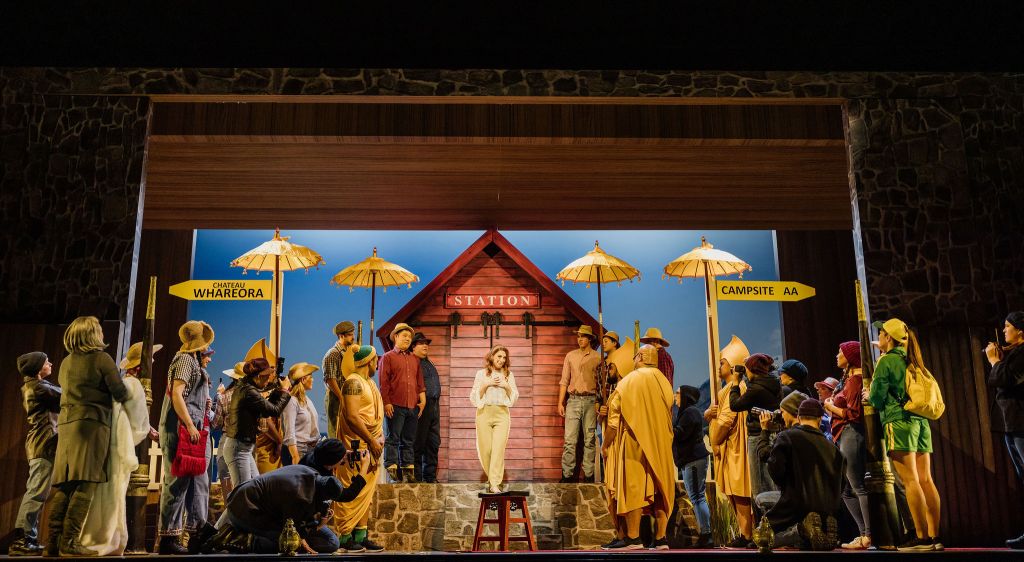
The setting for the opera is moved from medieval France to New Zealand, probably the Central Plateau where we find the wives of a rugby team who are off on an international tour staying at a wellness centre in the Chateau Whareora.

Adjacent to the wellness centre is a campsite where Ory and his rugby teammates have set themselves up with the dodgy intentions.

Ory uses this base to  establish himself as a guru / advisor on matters of the heart in an attempt to woo Adele, the sister of the owner of the centre who is away on tour .The team’s personal physiotherapist, Isolier is also in love with Adele and tries to thwart Orys undertakings.

This conflict between pure love and the profane is actually more about a form of selfishness and narcissism which Ory shows in both words and deeds.

The opera revolves around lots of deception, disguises and sexual intrigue where the only character, Count Ory, seems to be in control, yet he is the one who constantly fails ,

Manase Latu as Ory captures the characters inflated sense of self with a bravura performance, parading around the stage in his orange Buddhist robes, behaving like a faith healing tele evangelist.

His voice had the richness of the glib politician / priest with touches of both wit and seriousness, brilliantly captures the suave veneer. In the first act he was great as a Dalai Lama character. Partly his acting, partly the libretto but his character comes over as flawed and despite his belief in his charms and sexual prowess he is never in control of his endeavours.

Emma Pearson as Adele displayed a range of emotional responses with her iridescent voice which at time conveys a sense of rapture.

Hanna Hipp as Isolier played an ambivalent character in taking on  the traditional ‘trouser role’ of female playing male as well as that of a bi-sexual woman in her relationship with Adele. Her duo with Ory was riveting with its mixture of the comic, and sexual friction.

The various duos are performed superbly while the septet at the end of Act I was a great showing off of their voices as they slowly morphed into what sounded like a delightful barbershop singing group.

Andrea Creighton’s Ragonde fulsome voice was a quiet force. Moses Mackay as Raimbaud displayed a fine sense of the comic and Wade Kernot as the Team Manager had a genial style with a nice flexibility of tone.

The sets and costumes by Tracy Grant Lord worked well in defining place and character but some of the costumes worn by the locals in Act I seem to have been borrowed from an amateur production of Oklahoma.

For a little-known opera this production offers originality, riotous performances  with  some of the country’s best voices. The APO conducted by  Brad Cohen brought Rossini’s sparkling music to life, particularly the two overtures.

St James Theatre, Wellington June 13 & 15

Isaac Theatre Royal, Christchurch June 27 & 29

To subscribe or follow New Zealand Arts Review site – www.nzartsreview.org.

The “Follow button” at the bottom right will appear and clicking on that button  will allow you to follow that blog and all future posts will arrive on your email.

Or go to https://nzartsreview.org/blog/, Scroll down and click “Subscribe”

Categories
Reviews, News and Commentary

My Brilliant Divorce

Reviewed by Malcolm Calder

Jackie Clarke in My Brilliant Divorce                     Photo: Darren Meredith

My Brilliant Divorce

By Geraldine Aron

Dir Janice Finn

With Jackie Clarke

Tadpole Productions

Pumphouse Theatre, Takapuna

to 25 May

Review by Malcolm Calder

16 May 2024

As a mere male, I feel something of a fraud attempting to review something that tackles its subject entirely from a woman’s perspective.  But, rest assured, I have sought the opinions of female friends, so plough on (in truth ARE thoughts for menfolk in the work too).

Geraldine Aron’s play tracks one woman’s three-year path through a pending divorce after 20 or so years of marriage.  It is ripe for many emotional, social and potentially dangerous situations and that’s no bad thing.  In fact Aron’s script largely treats them as a self-deprecatingly comedic and the twinkling sparkle and dry self-observations of Jackie Clarke helps ensure this is the case – although not without some truly heart-rending moments along the way.

There is occasional recognition of Aron’s truths, but the laughter flows, there are giggles galore and  it is these spoonfuls of sugar that help ease the shock, the pain, the anxiety and the self-doubt – embarrassingly so at times. 

While Aron’s stereotypically deserted wife reflects with shredded self-esteem, loneliness and self-induced neuroses, she finds little support around her.  Older family members prefer to look to their own future with generational glee, children don’t look back too hard because they are focussed on other things, while men wish to pursue their new path clearly preferring glitz and glam (and youth of course, now THERE’S a stereotype).  And when the loyalty of her hitherto best friend the delightful Dexter wavers, she hits rock bottom.

In sum, My Brilliant Divorce portrays a women who has thought of herself as ‘provided for’ until she isn’t.  And then discovers her own future right in front of her.

Initially Jackie Clarke’s Angela Kennedy Lipsky came across as a little tense and a tad overly-quick with her delivery on Opening Night, but she soon grew into the character, quickly found her comic timing and really started to make the most of some of Aron’s delicious lines.  In fact, the way her girl-koala demolished her boy-koala (both longtime gifts from her ex), there was real venom behind it and even Dexter looked startled.  Even the audience lapped it up when she crawled off-stage looking for the bits.

Self-doubt is at the core of this play.  In one or two places it seemed a little dated and some of the localisations didn’t quite work, but that didn’t matter.  The audience intuitively knew it would all work out for the best in the long run.  Far be it for me provide a spoiler alert though.

Finally, congratulations once again to Tadpole, a company that knows and understands its audience rather well, and keeps coming up with productions to which they can relate.  That’s not to suggest the opening night audience for My Brilliant Career was stacked with divorcees.  Far from it.  In fact I have a feeling that many were there largely because of Jackie Clarke’s presence on stage.

Categories
Reviews, News and Commentary

A warm endearing night out

The Best Exotic Marigold Hotel

By Deborah Moggach
Director, Lucy Waterhouse
Producers, Stewart and Tricia Macpherson, Ben MacDonald
With
Rula Lenska, Harmage Singh Kalirai, Shaan Kesha, Sudeepta Vyas, Dhiya Redding, Georgina Monro,
Helen Moulder, Edward Newborn, Cathy Downes, Annie Ruth, Paul Barrett, Ravi Gurunathan, Alvin Maharaj, Tiahli Martyn, Kate Jasonsmith

Civic Theatre, Auckland until 5 May
then St James, Wellington and James Hay, Christchurch


Review by Malcolm Calder

I simply cannot remember when I last saw a large-scale commercial theatre production in this country. Music theatre and countless concerts yes, but not a straight play. In fact hardly ever!
Marigold Hotel is a huge commercial undertaking fraught with risk and a mammoth achievement.


So, first off, congratulations to the Macphersons and to Ben McDonald.

There’s always something about entering a big theatre that takes me back. Viscerally. Especially for something like this. Maybe it’s the deliciously faux theatrical decor, perhaps that unique smell or even just the sense of occasion that can never be replicated in smaller, newer venues. As such, I cannot even suggest a more apt stage for this production than Auckland’s Civic and its Wellington counterpart – I can only presume Christchurch’s Royal is unavailable.

Although she did not write the screenplay for the movie, Marigold Hotel is Deborah Moggach’s stage adaptation and is largely based on her original novel These Foolish Things. It was first produced in the UK a couple of years back and toured extensively before a run on the West End.

This New Zealand production brings in only the revered Harmage Singh Kalirai and the popular Rula Lenska from London to reprise the roles they created in the UK, and surrounds with a local cast overseen by Lucy Waterhouse to ensure consistency.

Put briefly, Marigold Hotel is hardly a serious drama. Rather it is a comedy that is endearing and loveable tale about a group of English retirees who, for diverse reasons, find themselves in a rundown
hotel in India. While not just a retread of the film, it presumes some familiarity with that source.


Miss Lenska’s Madge is a central role, and she is rightly billed as the star, Marigold Hotel is essentially an ensemble piece (supported with some backup) and provides ample opportunity for
each of the key characters to deliver from their immense experience. Many are recognisable, even for non-theatre afficionados, and it is a joy to see such on-point timing, situational awareness and
even improvisation around a couple of minor technical hitches with nary a blink.

There is not a weak link amongst them and some will remain memorable – Cathy Downes’ Dorothy being but one example.
Conversely, Moggach’s script provides only two-dimensional roles for most of the Indian characters. Harmage Singh Kalirai is a standout as the omnipresent Jimmy, but it was the near line-less Tikal
(Ravi Gurunathan) who captures with a rivetting on-stage presence, along with Sudeepta Vyas who wheedles and manipulates her Mrs Kapoor as only some mothers can.

However, it is also true to concede that Moggach’s first act might have benefitted more from tighter editing and the opposite in the second where the final denouement is a bit brisk.

On balance though, The Best Exotic Marigold Hotel is a warm and heartfelt story with a joyous finale that assures audiences of a good night out. It is an undertaking that is far from small for its
producers, and a welcome opportunity for some of our finest character actors. All are to be congratulated.

I wallowed.