Categories
Reviews, News and Commentary

What on at Auckland Arts Festival 2026

John Daly-Peoples

hi. Wehi. Mana

Auckland Arts Festival

5–22 March 2026

John Daly-Peoples

Next year’s Auckland Arts Festival brings together an inspiring collection of works from New Zealand’s major performing arts organizations as well as an impressive lineup of Māori and Pacific individuals and international performers from Australia, China and America.

The festival opens with a free, all ages celebration in Aotea Square Sau Fiafia! Boogie Down!, brings together the infectious rhythms of nine-piece Pacific funk collective Island Vibes.
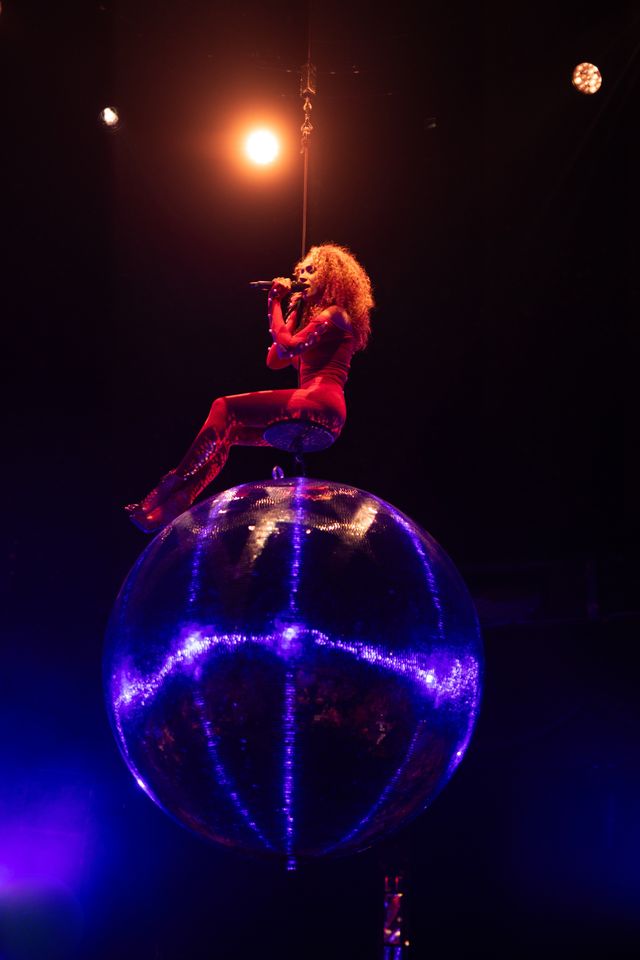
La Ronde

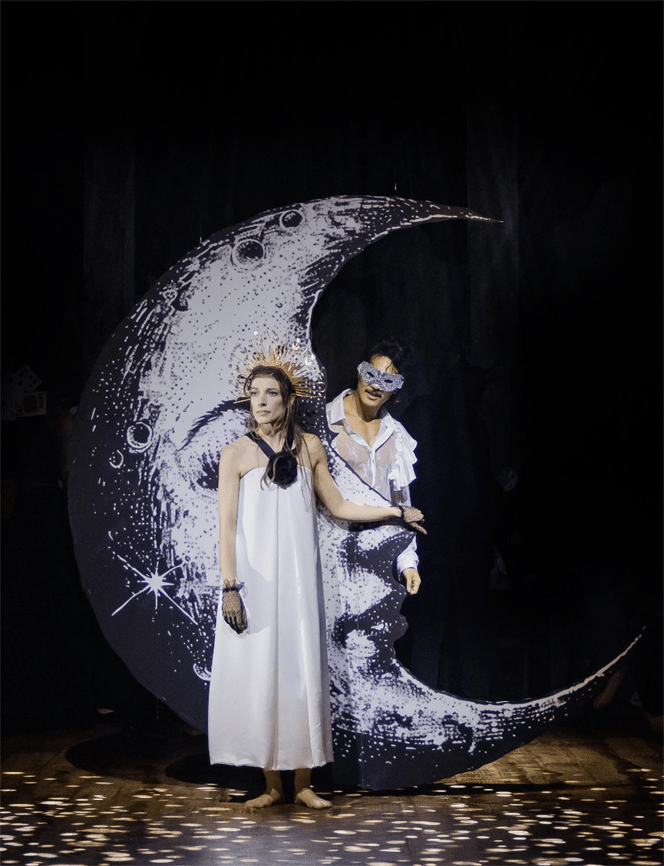
The intoxicating, lavish and seductive La Ronde will take over The Spiegeltent for 21 performances, with a mixture of circus, live music and comedy. From the creators of Blanc de Blanc and Limbo, La Ronde exclusively premieres in New Zealand after a sell-out season in Australia.

The Samoan musician Fonoti Pati Umaga will present an honest and unapologetic humourous story, Music Portrait of a Humble Disabled Samoan​. Created with Oscar Kightley, Nathaniel Lees, Neil Ieremia and Sasha Gibb, this is a world premiere production of powerful and unfiltered reflection on resilience, identity and transformation.

Auckland Theatre Company and Tawata Productions, will premiere Waiora Te Ūkaipō  The Homeland​, a powerful story of family, culture and belonging. Written and directed by Hone Kouka, with waiata and haka composed by Hone Hurihanganui.

From acclaimed collective Binge Culture comes Werewolf, a thrilling, darkly funny horror-comedy exploring how we respond to crises. Theatre Scotland gave it a positive review “Werewolf does very well in setting the scene early and vividly. The audience truly feel a part of the experience and like we are trapped in a “safe house”. Impeccable performances from our three “wardens”, brilliant lighting and some incredible sound design create a perfect hour of interactive and immersive theatre. 

For one night only, internationally acclaimed American soprano Julia Bullock will be performing with the Auckland Philharmonia conducted by Christian Reif showcasing a repertoire blending classical masterworks, jazz and The Great American Songbook. A recent review noted “Bullock’s meditative mixtape ends in safe haven, with Odetta’s bluesy arrangement of “Going Home,” a song rooted in Dvorak’s “New World” Symphony. Bullock reaches into her burgundy lower register, and pianist Christian Reif depresses the soft pedal, to achieve maximum comfort.”

“These songs refract love in various colours and further illustrate why Bullock is one of today’s most discerning and expressive singers. Contemporary composers are particularly enamoured, including John Adam’s new opera Antony and Cleopatra.”

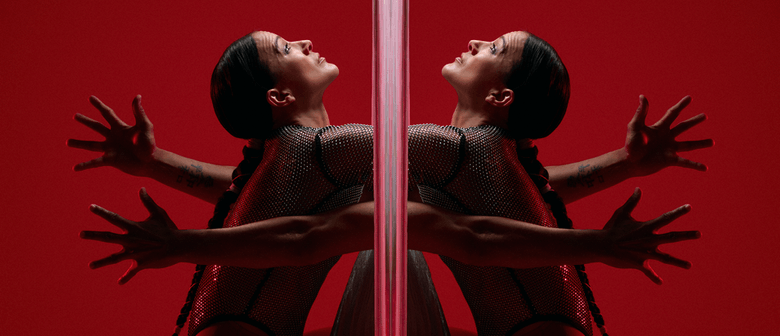
In celebration of International Women’s Day, Moana & The Tribe present ONO, a powerful live performance and video work honouring six Indigenous women worldwide – a stirring journey of hope and unity through te reo Māori, kapa haka and electronic-dub beats.

A flagship free event, Whānau Day brings together music, performance, kai and hands-on arts experiences in a vibrant celebration of community.

Duck Pond

Circa’s production of Duck Pond, reimagines Swan Lake as a spectacular circus, full of physicality and cheeky humour. In A Place in the Sultan’s Kitchen, theatre-maker and musician Joshua Hinton weaves song, memory and mouth-watering aromas as he recreates his grandmother’s curry live on stage. Fresh off mesmerising Australian audiences and completing a 23-show season in Edinburgh, is The Butterfly Who Flew ​into the Rave, this award-laden crowd favourite returns home for a triumphant encore.

The Butterfly Who Flew ​into the Rave,

The Australian company Gravity & Other Myths, will present Ten Thousand Hours, with eight acrobats and one musician paying homage to the discipline and the joy of movement. 27 Club delivers a blistering rock concert celebrating the legends lost too soon – Janis Joplin, Amy Winehouse, Jimi Hendrix, Kurt Cobain, Jim Morrison and Robert Johnson.
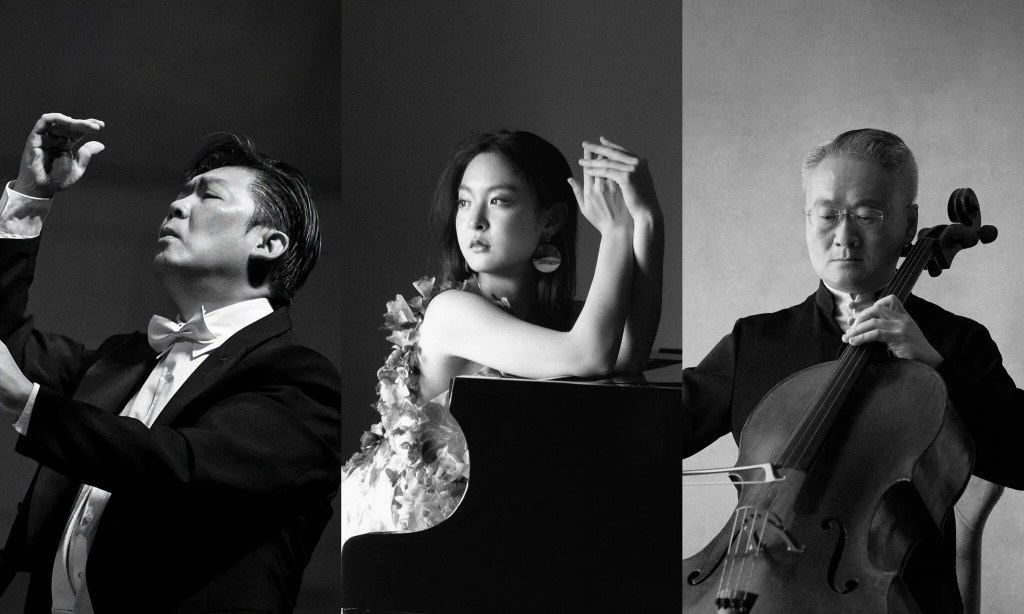
Long Yu, Serena Wand and Jian Wang

The Shanghai Symphony Orchestra, under the baton of its renowned Music Director, Long Yu, comes to New Zealand from China in an extraordinary cross-cultural celebration of Eastern and Western symphonic traditions featuring celebrated soloists Jian Wang (cello) and Serena Wang (piano). Across two evenings, the orchestra performs classical works by Tchaikovsky and Rachmaninov alongside selections from Elliot Leung’s Chinese Kitchen: A Feast of Flavours.

Jane Harrison’s multi-award-winning play The Visitors reimagines the arrival of the First Fleet through the eyes of seven First Nations Elders. Directed by Wesley Enoch, this Sydney Theatre Company and Moogahlin Performing Arts production is a sharply written, deeply resonant piece of speculative historical theatre that challenges and educates​.

Built from the world’s apologies – famous, absurd and deeply personal – Sincere Apologies is a funny, awkward and unexpectedly moving participatory performance exploring how we say sorry and what we really mean.

Ihi. Wehi. Mana. reunites past and present members of Te Waka Huia with esteemed choral musician Karen Grylls and a bespoke invitational choir, for a stirring, celebratory event combining kapa haka, waiata and vocal talent.​

Additionally featured in the festival is a double bill of bold new writing, He Kākano showcases Becoming Jeff Bezos by Kai Tahu playwright Alex Medlan, a razor-sharp satire on capitalism and chaos, and Marmite & Honey by Rainton Oneroa (Te Aupōuri), a moving family drama unfolding over 24 hours at a tangi. Both works will be developed with Jason Te Kare.

Ten Thousand Hours,

The acclaimed Australian company Gravity & Other Myths, will perform Ten Thousand Hours, with eight acrobats and one musician pay homage to the discipline of mastery and the joy of movement. 27 Club delivers a blistering rock concert celebrating the legends lost too soon – Janis Joplin, Amy Winehouse, Jimi Hendrix, Kurt Cobain, Jim Morrison and Robert Johnson.

Closing the Festival with pure brass swagger, Big Horns is a high-octane, homegrown funk collective redefining the modern big band, led by guitarist Dixon Nacey. Featuring Jordyn with a Why, MOHI and Muroki, He Manu Tīoriori gathers the next generation of soulful voices for an uplifting evening of waiata in the Spiegeltent. Inspired by Dame Hinewehi Mohi’s Waiata Anthems project, this showcase of original te reo Māori compositions celebrates the beauty, depth and contemporary vitality of Aotearoa’s music.


2026’s programme also includes Bluebeard’s Castle which sees New Zealand Opera and Auckland Philharmonia reimagine Bartók’s haunting masterpiece as an intimate portrait of a couple confronting dementia. Royal New Zealand Ballet’s Macbeth, choreographed by Alice Topp, transforms Shakespeare’s tragedy into a gripping modern study of ambition and power.

Set in the heart of the Festival Garden, Rova Sound Stage offers a relaxed, social space to discover fresh talent and genre-crossing performances from neo-soul and alt-pop to hip hop, jazz and electronic music. Audiences can grab a beanbag and a drink, soak up the summer sun, and dance into the night with the resident Festival DJ.

Categories
Reviews, News and Commentary

Peter James Smith’s Zealandia

Reviewed by John Daly-Peoples

Peter James Smith, Zealandia

Orexart

Until 27 September

Reviewed by John Daly-Peoples

Peter James Smith in speaking about the impetus behind his landscape paintings has noted his debt to T S Eliot’s “Four Quartets” and in particular “Burnt Norton” with its notion of transcending time to achieve a sense of timelessness.

Time before and time after
In a dim light: neither daylight
Investing form with lucid stillness
Turning shadow into transient beauty

This can be seen in his latest exhibition “Zealandia” where the artist examines Zealandia, the earth’s largely submerged continent beneath the waters of the Southwest Pacific Ocean with only a few islands like New Zealand and New Caledonia breaking the surface to reveal parts of the super continent of Gondwana. 

These islands, historical remnants of an ancient time and still revealing themselves, link past and present through a process of discovery both scientific and historical.

With many of his paintings the landscape forms are often shrouded in this dim light and their shadowy forms seem to take on a substantial form, transporting them from the eighteenth century and the voyages of Capt Cook as well as later voyagers.

With “Zealandia” ($8500) there is sense that the artist is describing the underlying landscape of rocks, islands and headlands beneath the water’s surface, as though these forms are thrusting their way upwards.

Smith like many other artists with a Romantic approach to landscape see his subjects as a powerful, emotional forces, depicting the raw, uncontrollable aspects of nature such as storms, mountains, and wild, untamed places. The landscapes used to express subjective feelings and the sublime, highlighting nature’s grandeur.

Unlike many Romantic artist Smith does not include human figures to emphasis the grandeur of nature but rather includes ideas about man’s measurement of the forces of nature.

In his paintings he employs diagrammatic symbols and marks which indicate of natural forces and aspects of scientific enquiry such as concepts of the angle of sunlight, speed of tide or ocean currents.

The marks he often applies to his paintings can be cartographic indicating the outlines of landscape or the passages into harbours, they can also be the recording of rainfall or the forces of nature.

Then there are the written descriptions of the landscape giving the location, the dates of original or important events as well as a references to Plato’s concept of perception which is noted in “Rain Shadow (Lake Tekapo”) ($8,500).

With his “The Passage of History” ($15,500) the artist includes a short summary of Captain John Grono’s adventures in Doubtful sounds in 1813 where he rescued several marooned sealers. He also includes a map of the area as well as a distance indicator in sea miles.

A similar work “Wind Across Dusky Bay” ($15,500) features a map of the Dusky Bay area with a text about Capt.  Cook’s arrival in 1773 which includes the route taken by his ship “Resolution”. He has also included wispy shapes of the water being driven across the surface of the bay.

The view in this work is frames as though being seen through an observation window, emphasizing the notion of historical distance and that this was the area where Cook established an observatory so enable him to accurately fix his position in New Zealand.

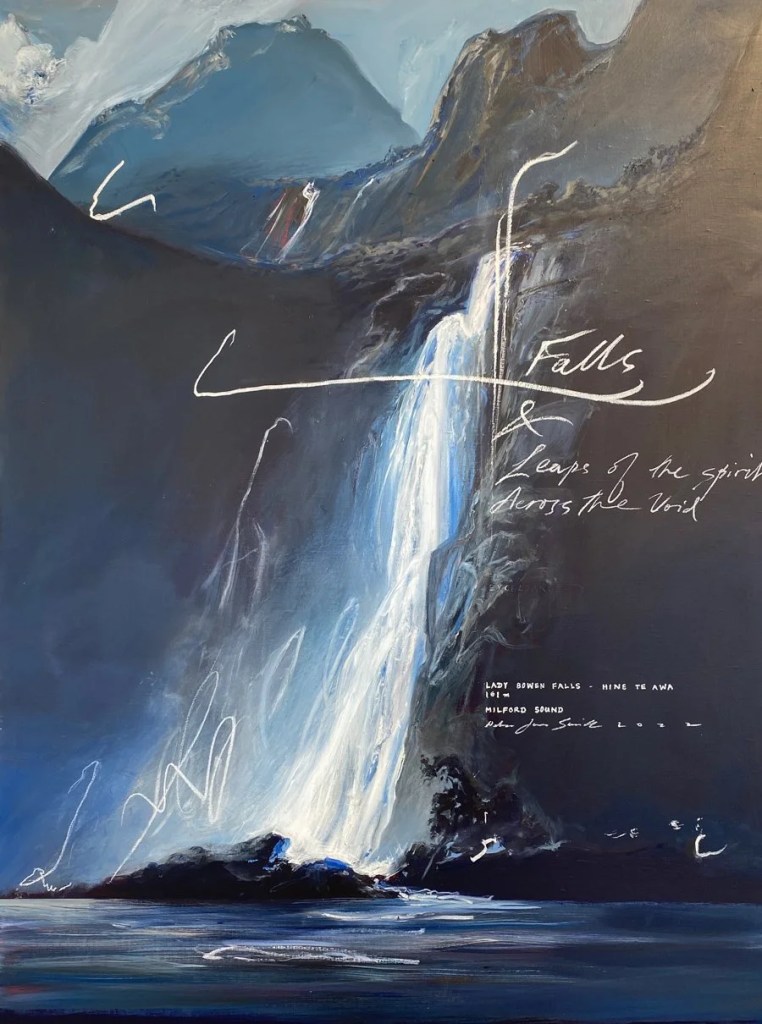
The work “Leaps of the Spirit” ($10,500) which depicts the Lady Bowen Falls combines Romantic landscapes with gestural marks exploring themes of artistic intervention, history, time, and perception. 

The works full title “Leaps of the Spirit Across the Void” has something of a Miltonian flavour and reflects the artists notion of the interconnectedness of science and spirituality, where mathematical certainty meets artistic vision to create a holistic understanding of the world. 

To subscribe or follow New Zealand Arts Review site – www.nzartsreview.org.

The “Follow button” at the bottom right will appear and clicking on that button  will allow you to follow that blog and all future posts will arrive on your email.

Or go to https://nzartsreview.org/blog/, Scroll down and click “Subscribe”

Categories
Reviews, News and Commentary

Shakespearean Disappointment

Phoebe McKellar (Juliet) and Theo Dāvid (Romeo) Photo: Andi Crown

Review by Malcolm Calder

Romeo and Juliet

By William Shakespeare

Auckland Theatre Company

Director – Benjamin Kilby-Henson

Design – Dan Williams

Lighting – Filament Eleven 11

Costumes – Daniella Salazar

Sound – Robin Kelly

With Ryan Carter, Liam Coleman, Theo Dāvid, Courteney Eggleton, Jesme Faa’auuga, Isla Mayo, Miriama McDowell, Phoebe McKellar, Jordan Mooney, Meramanji Odedra, Beatriz Romilly and Amanda Tito

Waterfront Theatre – until 9 August

Review by Malcolm Calder

This is a brave attempt by ATC to broaden its audience base and provide a path for younger performers.  And when you’re doing that, a good Shakespeare is a fairly safe bet as it can probably do quite well with younger audiences, meet the needs of traditional adherents and will no doubt fare well with a schools audience.  And ATC is to be acknowledged for that.

Unfortunately, when one looks at the larger theatrical picture, this Romeo and Juliet doesn’t really fare very well.  Especially as a major production by one of this country’s more significant professional companies.  However ATC’s production standards remain fairly high and are arguably this production’s saving grace. 

This Romeo and Juliet is set in a 1960s Verona and I get that – not such a silly idea.  The the overall design is consistent and sometimes works very well indeed with the themes Director Benjamin Kilby-Henson is articulating – youth, love and lyricism.  Chapeaus are due to the entire creative team and his production looks and feels quite stunning.

Dan Williams has generated a well-executed, three-dimensional set, largely articulated with reductive arches, derived some mobility from a well-used billiard table and unusually introduced what looks like a painter’s scaffold that trucks about a Veronian ballroom that is ‘under renovation’ and elsewhere too.  It makes for a splendidly unusual balcony scene.

I wasn’t in Verona in the 1960s, however I did own a pair of vertically-striped trousers a decade later, so I give costumier Daniella Salazar’s costumes a big thumbs up too.  Her use of colour is at times subtle and nuanced and the differences she has drawn between Montague and Capulet families are finely drawn.  Of particular note is the ballroom scene.

But it was the lighting and the soundscape that were the standouts for me.   The Filament 11 designers have introduced some dramatic and highly effective lighting that echoes the sentiments of Shakespeare’s words and the emotions highlighted by the director.  It is also pleasing to see ATC using effective sound reinforcement for actors who often spend more time in front of cameras and on more intimate venues these days than on the comparatively largish Waterfront’s stage.

However, Miriama McDowell aside, the cast struggled with Shakepeare’s words, couplet-ridden though they are

In fact, the whole casting process seemed somehow –  odd.  Generational differences were blurred, there was a rather strange mix of accents, some characters seemed to fit the context while others didn’t, and I’m still trying to work out why there were so many varied approaches.

Music may be the food of love but, as the director has noted, poetic verse is its very life force. Romeo only addresses Juliet in verse and she does likewise.  But sustaining this is very difficult indeed.

Apart from occasional flashes, especially with some of the longer speeches, the net result was one where authority and credibility were just – missing.   At one point it seemed like I was watching a youth company of younger kiwis imagining a Verona they had never visited.   

Miriama McDowell (Whaea Lawrence), however, was very much the exception, actually speaking Shakespeare’s words rather than matching the prevalent declamations of others. Theo Dāvid (Romeo) matched her to some extent leading one to wonder whether their work with the now-long-gone Popup Globe had anything to do with this.

There were a number of unanswered quibbles too: why, for example, did Friar Lawrence became a ‘Whaea’ in this production.  If this really were set in 1960s Tauranga and there two gangs at war with each other it could make sense.  But it is a term never uttered in in Verona in the 1960s.  And perhaps a bit of undersheet nudity was a way of  the simpering unreality of Paris, but that didn’t work for me either.

So thanks for the effort ATC.  But Romeo and Juliet was a disappointment for me.

Categories
Reviews, News and Commentary

Peter Cleverly: The artist revealed

Reviewed by John Daly-Peoples

Peter Cleverly: Between Transience and Eternity

Alistair Fox

Quentin Wilson Publishing

RRP $60

Reviewed by  John Daly-Peoples

Peter Cleverly has rarely shown his work in Auckland galleries apart from a few times the early 1990’s, so for many his work is unknown apart from images in publications.

However, a new book, “Peter Cleverly: Between Transience and Eternity” by Alistair Fox will correct this.

The heavily illustrated book traces the artists career from the 1980’s to the present with images of his work across more than four decades.

These four decades of art practice have seen him developing a personal style partly influenced by other New Zealand artists as well as his personal, response to his environment –  physical, social and political.

His early work was predominantly figurative but from the 1990’s these were replaced with landscapes, often with texts and then. more recently the  inclusion of figurative elements again.

His work, particularly early on was influenced in different ways by Toss Woollaston, and McCahon.

McCahon probably influenced his palette and his use of text but he may have also gained an understanding of McCahon’s approach. Unlike many artists influenced by McCahon he referenced A C Cotton’s book “Geomorphology” which was a prime source for both artists and Cleverly uses Cottons illustrations and shapes. He also used objects such as the pitcher as symbols in his work.

Other influences include New Zealand artists Bill Sutton and Tony Fomison while the importance of several international artists  such as George Baselitz, Mimmo Paladino and David Salle and appears to  have adapted their thinking about art.

His early landscapes owe much to McCahon shapes in “Six Days in Nelson and Canterbury while interiors such as “Still life kitchen Oamaru” are Post Impressionist distilled though Woollaston.

Peter Cleverly, All twenty-nine

His figurative work often dwells on mortality and death. “All Twenty-nine” his response to the death of 29 miners at Pike River. Here and in many other works the artist has a personal and visceral approach to his subject.

This is also seen in “Couriers” featuring two distorted hanging figures – is reaction to the incarceration of drug couriers Lorraine and Aaron Cohen. Often his figures are something  between flayed corpses and angels.

Peter Cleverly, Seadog

Cleverly has developed his own distinctive iconography including a dog shape/face which serves a range of emotional and symbolic purposes as in “Seadog”. 

The book is a very readable account of the artists varied life which has had an impact on the way he sees the world and the influences on his practice as well as an understanding of the artists thoughts and motivations.

Categories
Reviews, News and Commentary

Groundwork: The Art and Writing of Emily Cumming Harris

Reviewed by John Daly-Peoples

Groundwork: The Art and Writing of Emily Cumming Harris

By Michele Leggott and Catherine Field-Dodgson

Te Papa Press

RRP $60

Reviewed by John Daly-Peoples

Botanical painters have been an integral part of the botanical and artistic history of New Zealand since Joseph Banks accompanied Cook on his voyage to New Zealand and his publication of detailed illustrations of the exotic plant species he found here.

Since the time of Banks there have been many other artists who have devoted themselves to depicting the flora of New Zealand .A new book “Groundwork” by Michele Leggott and Catherine Field-Dodgson reveals one of the first women botanical artists in New Zealand. Emily Cumming Harris who was born in England in 1837 spent most of her life in New Zealand, mainly in the Taranaki and Nelson areas.

During this time, she painted numerous examples of plant life as well as landscapes, a number of which were exhibited locally and internationally.

Her works were exhibited at the Sydney International Exhibition in 1879, the 1880–81 Melbourne International Exhibition and the Colonial and Indian Exhibition in London in 1886. At the New Zealand Industrial Exhibition held in Wellington in 1885 she won first prize and a silver medal for a painted screen.

Emily Cumming Harris, Kiekie (Freycinetia banksii), nikau (Rhopalostylis sapida), five finger (Pseudopanax arboreum) and karaka (Corynocarpus laevigata) in fruit, 1879, watercolour, 389 x 506mm. Reproduced as a Turnbull Library print in 1980. Alexander Turnbull Library,

Throughout her life she also had solo exhibitions, selling a number of works, the sales of which provided useful financial assistance to her and her family.

The book documents her career as an artist and even though this was never to be a full-time career she amassed a large collection of images many of which are in public collections. Leggott and Catherine Field-Dodgson’s research, along with other individuals reveal a woman whose work lies between the scientific, botanical illustration and artistic.

The book has been the result of a lot of detective work, research in various museums and some family history. Michelle Leggott ‘s interest came about when she was researching about Emily’s father, Edwin who had painted several views of New Plymouth at the time of the Land Wars in Taranaki. His paintings are also included in the book.

Emily Cumming Harris, Hector’s tree daisy Brachyglottis hectorii, oil on straw board, 690 x 470mm. Galpin collection, Pauanui

The authors also discovered a number of paintings Emily had done of astronomical subjects – The Total Eclipse of the Sun in1885 and a double tailed comet in 1901.

The book includes a number of her poems which range in quality but the occasional one shows some literary skills and keen observation.

Her “The mountain looks down on the river” contains some lines which indicate an awareness of the situation of Māori.

But the forest which grew by the river,

And the flowers on the mountain that bloomed

Will they gladden our hearts for ever

Or pass like a race that is doomed?

In 1890, she published three books, New Zealand flowers, New Zealand ferns, and New Zealand berries. Each contained twelve lithographs with descriptive text, and some copies were hand-coloured by Harris herself.

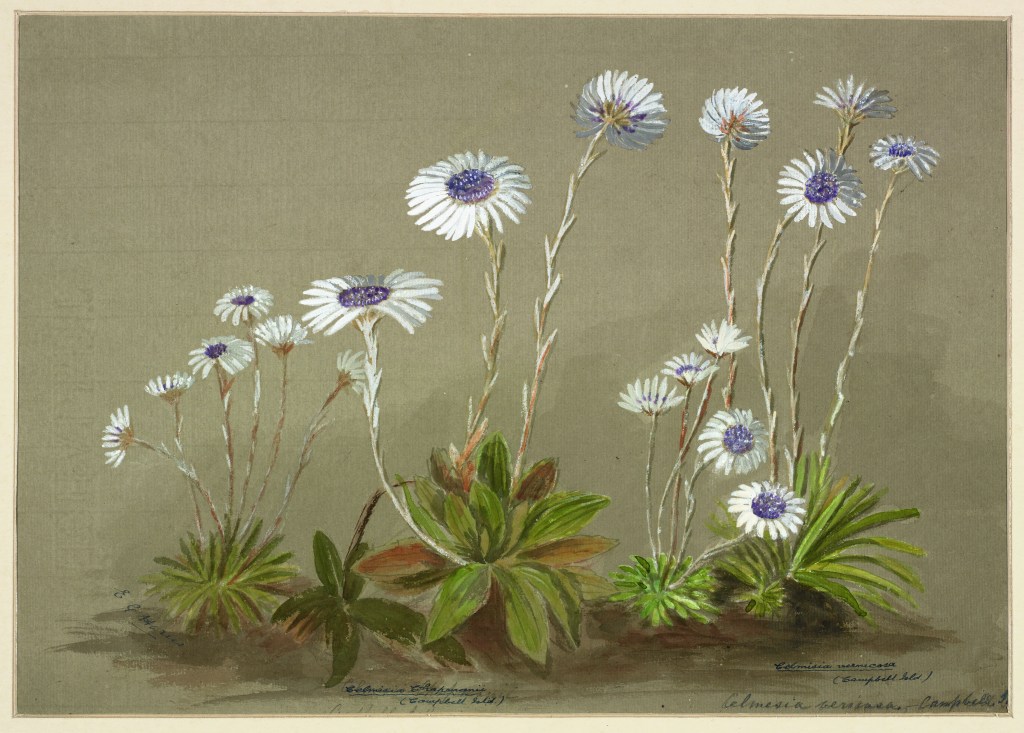
Emily Cumming Harris, Celmisia chapmanii – Campbell Island; Celmisia vernicosa – Campbell Island, 1890s, watercolour, 310 x 440mm. Alexander Turnbull Library

All her paintings as well as her writings and poems provide a portrait of a woman of great talent and enterprise but social convention prevented her developing an independent career and she was viewed merely as a gifted illustrator.”

This has meant she has not been well served by history but this book will do much to correct that.

Categories
Reviews, News and Commentary

You are Here: linking language, memories and landscape

Reviewed by John Daly-Peoples

You Are Here

Whiti Hereaka and Peata Larkin

Massey University Press

RRP $45.00

Reviewed by John Daly-Peoples

Most stories have a beginning, a middle  and an end. Most stories have a central idea, a kernel from which the tale expands like a sinuous river which follows a plot or a life. Other books can have a very different structure as with the new book “You Are Here”.

“You Are Here” which is the  sixth book in the “kōrero series”, edited by Lloyd Jones, features Jann Medlicott Acorn Fiction Prize winner Whiti Hereaka and artist Peata Larkin, cousins who share the same whakapapa. in a collaboration. Unlike the previous stories in the collection Larkin’s images are not merely illustrations of the text but rather complementary representations of similar ideas.

Here the story line is cyclical, expanding and contracting. Like James Joyce’s  “Finnegans Wake” the work begins and ends at the same point but with an elaborate structure in between  

The poem  starts with the line “You are here” and ends with the line – “Return to where you belong”, seemingly following the mathematical notions of the Fibonacci number sequence.

In tracing out the narrative the  narrator recalls their youth and their experiences of life. Threaded through this personal journey are images of water and the stones of a lake as well as  images of birds and journeys. like the  symbolic use of the Piwakawaka by Colin McCahon.

Language, memories and landscape are seen as linked in the development of the narrator, their memories of school and the shaping of the person through language and experiences. the physical and the metaphorically linked in this journey.

Parallel to Hereaka’s storyline are Peata Larkin’s multi-layered visual images in which ideas inherent in the structure of the story are the linked to her exploration of the DNA structure as well as images of Māori design. Drawings of tāniko and whakairo on gridded shapes are linked to European notions of embroidery and mathematical structures.

Peata Larkin says of the work “Working on this project has been very special to me …Being cut from the same cloth enables the threads of the fabric to shine through and hopefully we achieved that.

Hereaka says. ‘It is my hope that by the time you have walked that path that you are now a different reader and will read those words in a new way,’

To subscribe or follow New Zealand Arts Review site – www.nzartsreview.org.

The “Follow button” at the bottom right will appear and clicking on that button  will allow you to follow that blog and all future posts will arrive on your email.

Or go to https://nzartsreview.org/blog/, Scroll down and click “Subscribe”

Categories
Reviews, News and Commentary

Ka Mua Ka Muri: Backwards to the Future

Reviewed by Malcolm Calder

Ka Mua Ka Muri Image, Andi Crown

Ka Mua Ka Muri

Choreographers: Bianca Hyslop and Eddie Elliott

Sound composition: Eden Mulholland

Set and costume design: Rona Ngahuia Osborne

Lighting design: Owen McCarthy

Projection Design: Owen McCarthy (Remain), Dan Mace (Whakamaheahea)

With Abbie Rogers, Caleb Heke, Madi Tumataroa, Matiu Hamuera, Oli Mathiesen, Tai Taranui Hemana, Toalei Roycroft,

An Atamira Dance Company production

Q Theatre, Rangitira

Until 27 July

Then Clarence Street Theatre, Hamilton 29 July.

Review by Malcolm Calder

25 July 2024

This significant work comprises two collaborative creations without an interval – Eddie Elliott’s Remain followed by Bianca Hyslop’s Whakamaheahea.  Although each could easily stand alone, they are not really a double bill.  There is no interval, simply a pause, or perhaps a lengthy segue between the two, and each reflects the other.  Hence the title which loosely translates into Before and After.

Elliott’s Remain does far more than simply relate the past and provide a context for today however.  It helps to explain that past and how the intertwining of traditions with their origins, social practice and evolution delivers a whakapapa that is as rich with meaning and significance in contemporary Aotearoa as it has been since Ranginui and Papatūānuku.

Elliott has mined the humour and playfulness of everyday life, pride in achievement and evolutionary contributions to making Aotearoa what it is today.  And, no, it is far from a sugar-coating.  There are brief flashes of anger, resentment and disagreement and, after all, that’s life.

Conversely, Hyslop’s Whakamaheahea takes all this as a given or starting point and looks to the world we live in today while providing a basis for navigating the path ahead.  A future that shimmers one moment and then cowers the next.  As Hyslop has noted, cultural identity is a continuum and the place of māoritanga is clearly identified and deeplyembedded in the social context of our country.

The dancers provide a strong ensemble quality with individual characters allowed to emerge and some of the solo work is of a high quality indeed.

Of special mention is the creative team who handled the production aspects of this work admirably.  It is slick, extremely contemporary and entirely captivating.

Importantly, this work acknowledges and further develops the legacy that is Altamira Dance Company.  Yes, there may be some ‘fooling about’ along the way but there is also a strong sense of empowerment, transformation, and resilience that underpins Ka Mua Ka Muri.  It has the potential to inspire a bright collective future.

Categories
Reviews, News and Commentary

(Gen)-X rated Satire

Zoe Triggs, Mika Austin, and Lizzie Buckton in HR The Musical
Photo: Jinki Cambronero (she/they)

HR The Musical

A Performance Revue

Created and directed by Amy Mansfield

Artsense Productions

Part of the 2024 NZ Comedy Festival

With Mika Austin, Zoe Triggs, Lizzie Buckton & Amy Mansfield

SM Simon Todd

Rangatira, Q Theatre

Review by Malcolm Calder

14 May 2024

This delightful little show had an outstanding run in the summer series at Q.  So much so that it has popped up again on the national 2024 Comedy Festival circuit.  HR The Musical has some very, very funny lines and lyrics and confirms Amy Mansfield as genuine talent in the field.  It has now finished its return run at Q in Auckland but Wellington and Christchurch audiences still have something to look forward to.

So if you are in either city, don’t miss it.

Despite the principal title, the subtitle is far more appropriate (and barely hides a satire on itself) –  HR is very much a contemporary and wickedly comedic Performance Revue.  And a good one too.  But you’re looking for a plot or story, then forget it.  This is a series of sketches …and it works.

Set in amorphously non-specific workplaces, the cast of four have a lot of fun with some delightful lyrics, at times bitingly so.  Mansfield has a genuine skill at finding rhymes and rhythms and then delivering them with a scattergun regularity.  Standout for me was undoubtedly the ‘Mansplaining’ scene, but only narrowly losing out to the ‘Coalition of Chaos’.

She takes aim at the meaninglessness that enshrouds many of today’s workplace practices.  Y’know … the term for ‘personnel’ (which used to be about employment) soon became ‘people operations’ in the cyborg workplaces that seem to have flowered in our endemic post neo-liberal economic era.  The audience got it, and got it well, as the term was morphed into ‘human resources’, ‘recruitment and selection’, ‘performance management’, ‘learning and development’, ‘succession planning’, ‘onboarding’ and a myriad of other clichaic terms – don’t get me started on teams and team-building.  Each is instantly recognisable to its target audience.  Couple that with a close familiarity with the attitudes and processes that underpin employment and you have an audience that relates to many of the painfully recognisable and satirically drawn characters, and they get it even more. And therein lies the principal reason for this production’s success.   Audiences relate.

In keeping with this, Mansfield’s music covers a range of styles, necessarily scattergun at times, but none are inappropriate.  It is held together by a keyboard supported by a couple of guitars and even a plastic flute or two.

It would seem to me that the southern venues for HR The Musical may be a tad on the small side.  In Wellington particularly !

However, it also struck me that HR The Musical is something of a work in progress.  Its final scene starts to hint at querying why the workplace is the way it is.  It would be fascinating to see Mansfield explore this further.

Christchurch 16-18 May, Little Andromeda

Wellington 21-22 May, Te Auaha

Categories
Reviews, News and Commentary

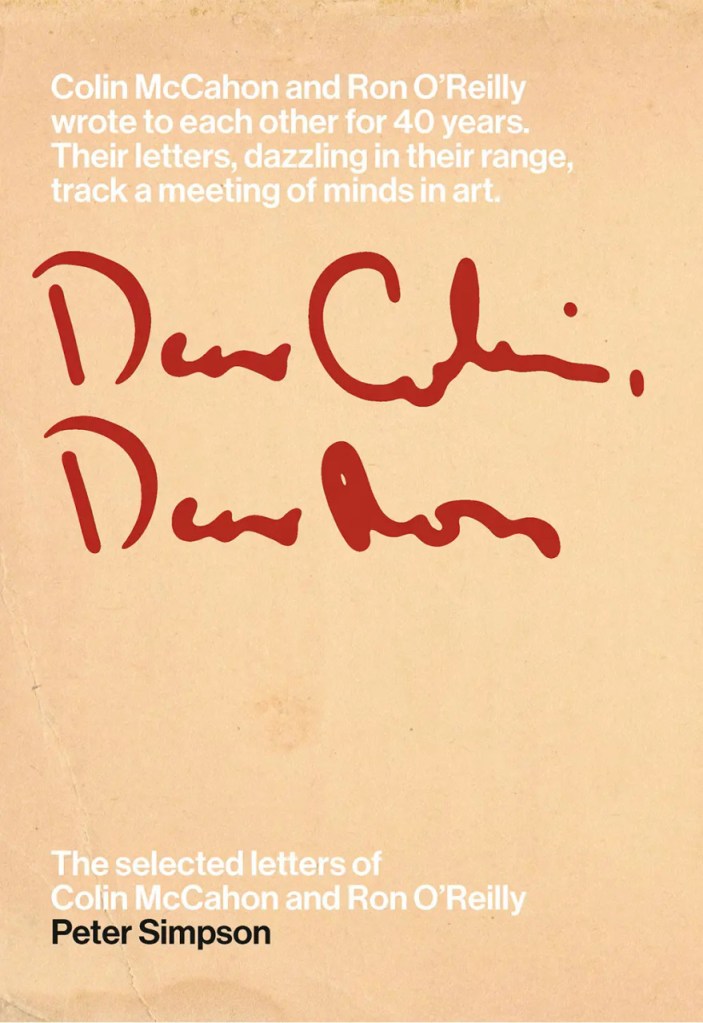
Dear Colin, Dear Ron

Reviewed by John Daly-Peoples

Dear Colin, Dear Ron

By Peter Simpson

Te Papa Press

RRP $65.00

Reviewed by John Daly-Peoples

“I feel very strongly that where I’m going is where paintings must go.”

So wrote Colin McCahon in his  final letter to his friend Ron O’Reilly. The two of them had been writing to each other for thirty-seven years and in many ways their letters chart the history of McCahon to the point that he was justified in making such as statement.

This statement and other observations about his own art and the development of art in New Zealand over four decades are revealed in new book “Dear Colin, Dear Ron” by Peter Simpson. It adds new dimensions to our knowledge of the life of Colin McCahon as well as exploring the art scene of the 1940’ through to the 1980’s.

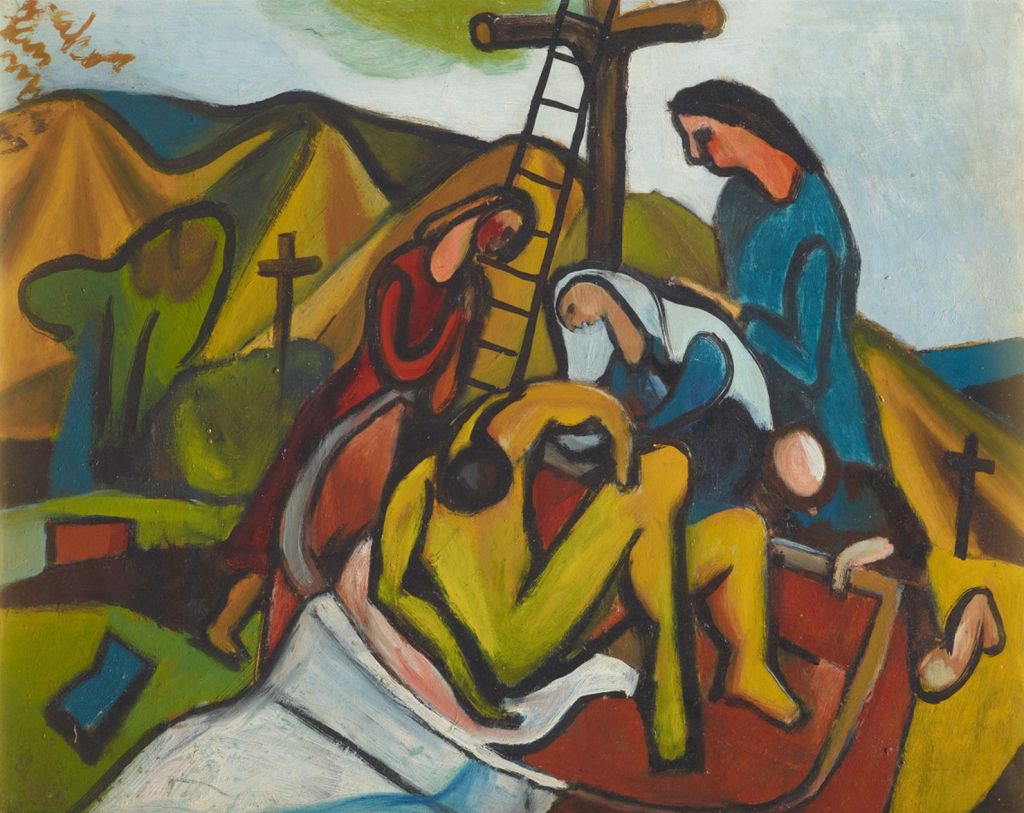
“Entombment (after Titian”), oil on cardboard on hardboard, 1947

Simpson has brought together the correspondence of Colin McCahon and O’Reilly who first met in 1938, in Dunedin when McCahon was 19 and O’Reilly 24. They remained close, writing regularly to each other until 1981, when McCahon became too unwell to write.

Their 380 letters, more than 165,000 words covers McCahon’s art practice, the contemporary art scene, ideas, philosophy and the spiritual life. Their letters deal with a wide range of interests and reveal two men deeply committed to the notion that art can make  a difference to society ..

O’Reilly was a philosophy graduate who for many years worked for the Canterbury Public Library where he was influential in showing and collecting the work of McCahon. He subsequently became the director of the Govett Brewster Art Gallery.

This regard for each other can be seen when McCahon applied for job at Elam . O’Reilly wrote: ‘After years of viewing, as I know from the works of his that I possess, one is still discovering more in them, is still more and more impressed by the acuteness of the perception, the fineness of the thought and the breadth of the compassion revealed in their artistry. There is no other artist in New Zealand of whom I would say this. It should be clear that I regard Mr McCahon as the foremost painter in New Zealand and a very great man.’

Reilly’s respect for McCahon can be seen throughout the letters along with his intense interest in getting the rest of New Zealand to see the value of the artist’s work and he worked tirelessly to organise exhibitions of the artist’s work.  

Their friendship and correspondence brought out the best in each other – intelligence, empathy, compassion, loyalty, trust: these qualities are obvious  through the letters as though the two men appreciated that the issues the y were addressing were important to themselves as well as for posterity.

The book is illustrated with 64 images of McCahon’s work along with some of the drawings which the artist included in some of his letters to illustrate idea about composition.

The letters reveal O’Reilly to be a more intellectual and focussed thinker with carefully considered pieces of writing  while McCahon’s responses  seems to be more urgent but there are many passages of serious reflection.

The book is sprinkled with snippets of information about other artists, exhibitions and the art world  generally   which provides a sense of the emerging art scene.

There is Ron O’Reilly’s reports on talks by the visiting British critic Herbert read in 1963  and the American critic  Clement Greenberg in 1968 where the notions of international versus the local and the local were addressed.

There is also references to the arts politics of various arts institutions, art events and artists. In a couple of letters Ron O’Reilly (at the time the director of the Govett Brewster Art Gallery) writes about Billy Apple who was going to have a show at the gallery. He notes that ”Billy is a good man and a serious and dedicated artist. He is also touchy and won’t play when people want to use him or assume ever so bigheartedly that he is an entertainer cum pervert or treat him as a bum”.

The letters are full of such perceptive observations about artists and institutions. They also provide a fascinating insight into a relationship which is both personal as well as verging on the philosophical and spiritual as they both try to understand  their own and each other’s motivations and ideas.

Simpson says there are many interesting comments  about the nature of the paintings in the letters. In 1950 “Colin spoke of making changes to Easter Morning, a painting Ron especially liked. Ron wrote: ‘I am sorry you felt the Easter Morning needed altering: no doubt there are things one is trying for which are not achieved to satisfaction: however I wonder if one ever does achieve them by long labour on the same work. That picture had a magnificent feeling: the quiet movement of the women, the expectancy the fulfilment, the lovely early morning light . . . What you do is so good, so good, it doesn’t seem to me to matter much if you leave a painting which is not quite what you want: the development goes on so richly’. Colin replied: ‘About repainting, I don’t know, but I think Picasso is right that nothing is lost the destroyed discovery reappears in a new and better form. The Easter Morning is certainly better. The three women [in The Marys at the Tomb] remain – the alterations are to the angel[;] he has been enlarged & the landscape, lowered & the colour gone from blue to red[;] there is now a warmth as well as early morning coolness & a less cramped appearance to the whole picture.’

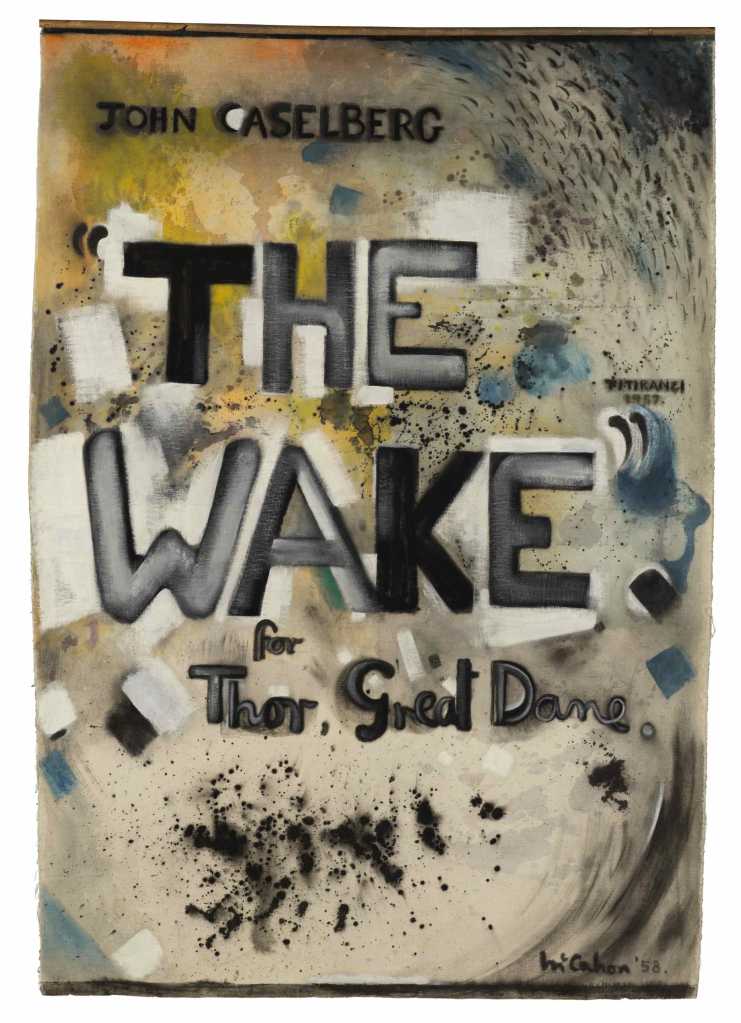
McCahon makes many comments about his own work. At one point in 1958  when he was working on the panels for “The Wake” which was based on the  John Caselberg poem he write to O Reilly saying

“The Wake” (panel one) ink and oil on unstretched canvas on sixteen panels, 1956

“I don’t understand the poem with any thoroughness at all either before I started work on it or when I finished. The feelings of what was being expressed comes over strongly – all builds into one feeling & builds this very largely by piling up of word on word in just such a relentless fashion”. Then in reference to the opening line of the poem,

“Your going maims God: God”

He writes “It is a line where bitterness is so strong that all the other feelings seem cancelled  & is I feel foreign to the quality of a wake.”

But just a few lines later he writes “I think I’m wrong in what I say of the first line. I can’t work out what I do feel about it…No doubt this bitterness is right as a start.”

The book is  a masterpiece of academic scholarship and shows a daunting level of  hard work with Simpson transcribing the letters as well as researching and writing 1500 explanatory notes to make the contents of the letters fully accessible to contemporary readers.

O’Reilly’s son Matthew O’Reilly and McCahon’s grandson Finn McCahon-Jones contribute insightful essays that round out the unique perspective the letters afford.

Categories
Reviews, News and Commentary

Demanding Play is a Festival Highlight

Reviewed by Malcolm Calder

Auckland Arts Festival

The Sun and the Wind

Taurima Vibes

Loft, Q Theatre

Writer and Set Design, Tainui Tukiwaho

Director, Edward Peni

With Taungaroa Emile, Julie Edwards, Joe Dekkers-Reihana, Tuakoi Okia

Lighting, Katrina Chandra

Sound, Eve Gordon

Until 24 March

Review by Malcolm Calder

Conceived during lockdown, Tainui Tukiwaho’s The Sun and the Wind is demanding for an audience. At times it mixes the real and the surreal, throws in a pinch of the tender and the touching, and then explodes with emotion, truth becomes blurred and we start unravelling things all over again. It is a highlight of this year’s Festival.

Set at a birthday party for an ageing couple, heartrendingly comfortable and practised in each other’s company,  Hūkerikeri seems like a kind and gentle kuia caring for her Rangi in his dotage.  I initially wondered if I had accidentally strayed into some kind of social commentary on contemporary aged care.

But the sudden and noisy arrival of a younger couple crashing into their home intent on robbing them quickly put that thought to bed. 

The newcomers soon become mistaken for a long-deceased son and his pregnant wife – in the mind of the birthday couple anyway.  From there The Sun and the Wind quickly becomes an emotional rollercoaster.  Factual memory blurs with confused recollection, two levels of whanau intermingle and become one or maybe not, and quiet introspection gives way to sudden violence.

How much of it is real ?  Perhaps that is summed up by the presence of a gun – which may or may not be real.

The Sun and the Wind owes something Aesop’s fable The North Wind and the Sun, a moral allegory which sees persuasion triumph over force.  The way Tukiwaho spins it though, things are never quite that simple.   That is why this play demands a lot from its audience.

Nevertheless, I occasionally wondered if Tukiwaho had over-written in patches, but he quickly jolted me back to the main course with more sudden and unexpected twists, turns and confusions.

Edward Peni directed with aplomb – an extremely demanding task on a play if this type.

Julie Edwards makes an enchanting Hūkerikeri, endearingly loveable but with sudden vituperative barks of fury.  She is so, so on point. Taungaroa Emile gives us a Rangi, whose mind wanders with vivid clarity, his love of whanau omnipresent.

I felt quite sorry for poor Hihi (Joe Dekkers-Reihana) who is flung from doorpost to doormat as he struggles to make sense of everything.  It is left to his heavily pregnant partner Kate (Tuakoi Okia) to slide the occasionally grounded, and often humourous, comment in from time to time.

Although it generates the occasional laugh, this play is not a comedy.  It marks a big step forward for Tainui  and demands a lot from its audience.  So, if you are one of those who lament the  plethora of highly subjective immature frivolity seen today on many of Aotearoa’s stages, you should certainly not miss this one.