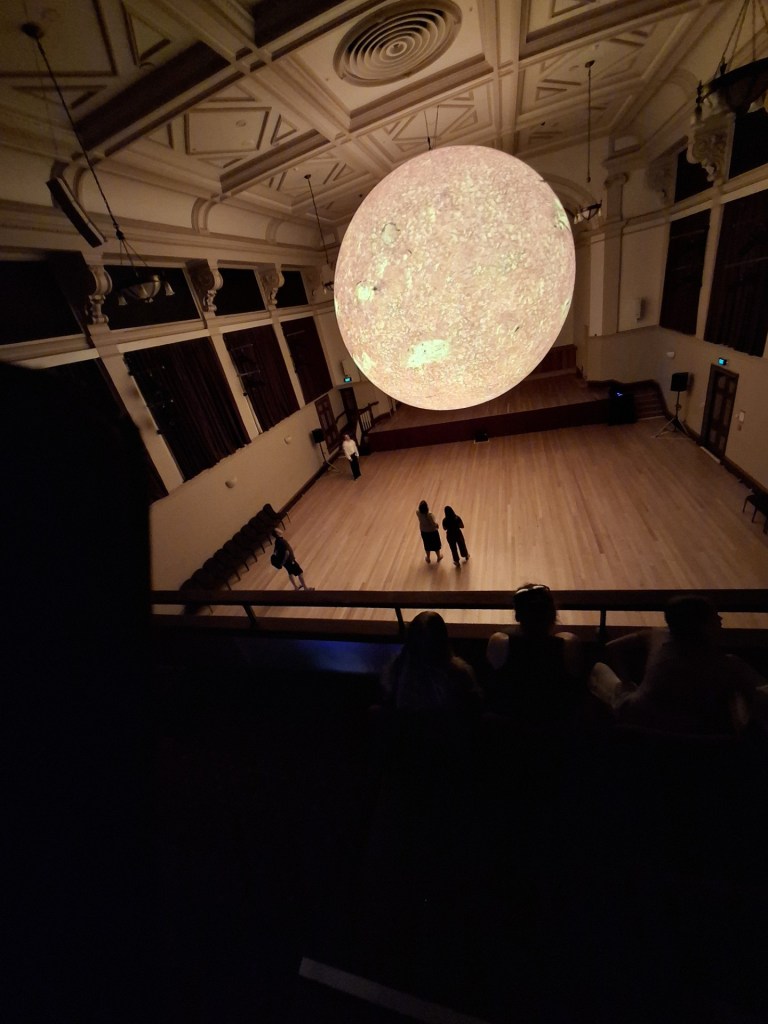
This week you can experience Helios, a breathtaking, larger-than-life artwork created by renowned UK artist Luke Jerram. Arriving in New Zealand for the first time, Helios is both a scientific wonder and a multi-sensory artwork, offering a rare opportunity to visualise the beauty and complexity of our closest star.
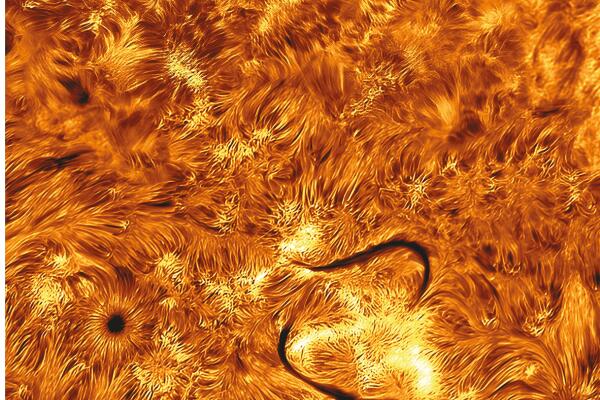
The globe measures six metres in diameter and was created at a scale of 1:230 million, it is constructed from approximately 400,000 images of the Sun’s surface. These images combine photography by astrophotographer Dr Stuart Green with data from NASA solar observations. Internally lit, this spherical installation allows for a safe yet awe-inspiring examination of the Sun’s extraordinarily detailed surface, revealing features such as sunspots, spicules, and filaments.
Named after the ancient Greek and Roman sun god – symbolic of time and life. Helios blends real solar imagery with animated lighting accompanied with an immersive surround-sound composition by Duncan Speakman and Sarah Anderson, creating a powerful and unforgettable experience.
Luke Jerram’s multidisciplinary arts practice involves the creation of sculptures, installations and live artworks. Living in the UK, but working internationally, Jerram creates art projects which excite and inspire people around the world.
One of his recent projects Echo Wood is a collaboration between the artist and charity Avon Needs Trees It is an extensive new artwork made from 365 living trees.
The native trees will slowly grow into a vast 110-metre-wide design. Blossoming at different times of year, pathways and avenues will be created to guide visitors on a journey through the forest towards a central circular gathering space, formed from 12 English oak trees. Echo Wood will take a century to fully emerge – but will endure for generations.
Co-commissioned by National Trust, Cork Midsummer Festival, Liverpool Cathedral, Old Royal Naval College and University College London.
Brazilian born Roberta Queiroga’s training as an architect appears to inform her art practice, bringing a nuanced understanding of space, rhythm, and materiality. Her architectural sensibility links gesture, energy, and spatial awareness.
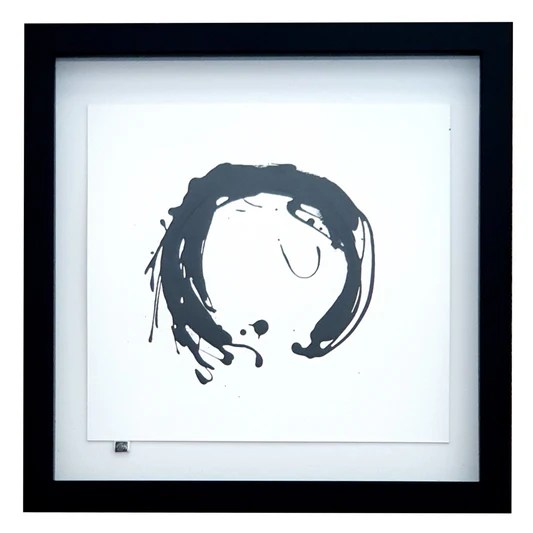
Her works are connected to Eastern artists such as Sengai Gibon the nineteenth Japanese Zen artist known for his simple, and profound ink paintings which employed minimal brushstrokes to convey deep spiritual truths. There are a couple of Queiroga’s small gestural work on paper such as “Today 1” ($480) which are reminiscent of the Japanese artist.
Roberta Queiroga. Today 1
The paintings also connect with the work of Max Gimblett, entwining Eastern spirituality and modernism. Like Gimblett’s work Queiroga’s has a sense of capturing the instant, when emotion is realised and intuition is revealed.
“Tidal Composition – Ripple” ($4800) is a simple gestural work with a single sweeping stroke with small ink splatters, capturing the instance of creation. Like the title of the work several of the paintings are derived from the tides, their motion, their drama, their moments of calm and their intricate patterns of movement.
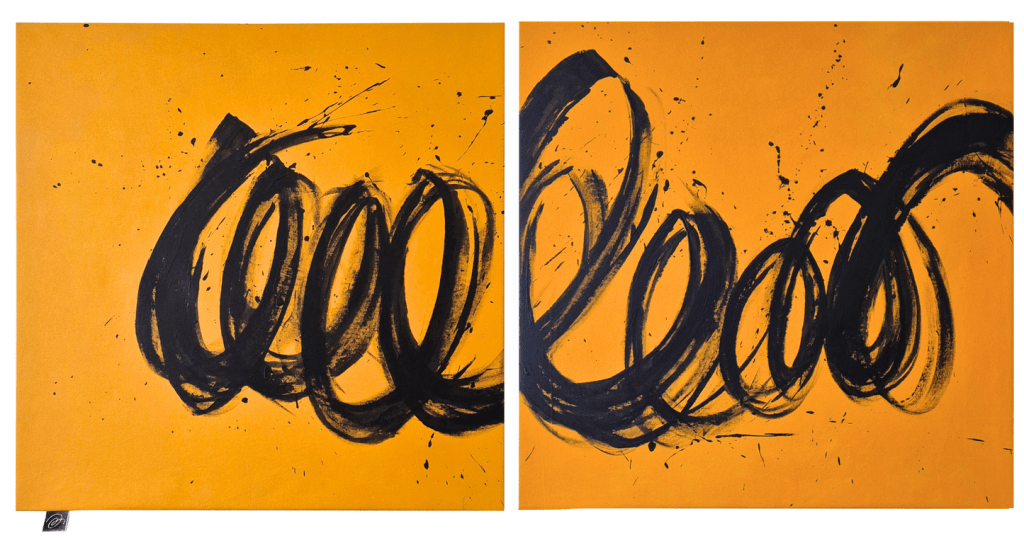
The two panel “Tidal Composition – Pulse” ($8000) extends the notion of surf and tides with a suggestion of curling breakers, the energy of the waves pulsing along a shoreline.
Roberta Queiroga. Tidal Composition: Pulse
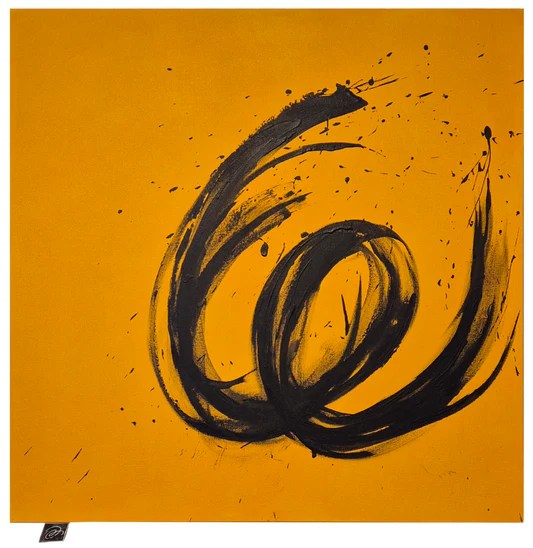
Some of the works have titles related to another energy, that of fire with some titled ”Brasa” which is Portuguese for embers while others are titled “Charcoal and Fire” and “Glow of Embers”. In “Charcoal and Fire” a small slash of red enlivens the work like a bloody mark.
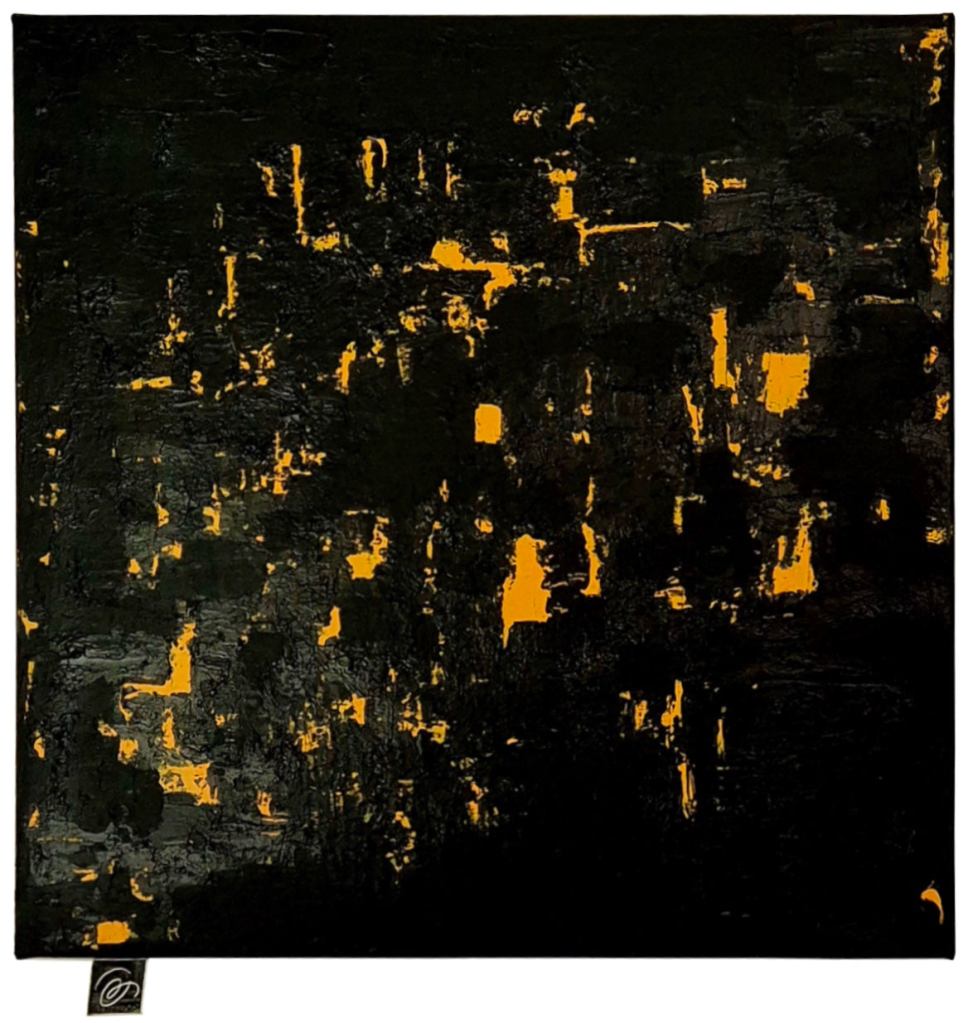
The predominant colour for these works is a bold orange which provides a sense of energy, heat and light. With “Charcoal and Fire” ($3800) there are also traces of red which adds a sense of danger. With the “Glow of Embers” ($3800) where black encroaches on the orange it is like the colours of a dying fire.
Roberta Queiroga, Glow of Embers 1
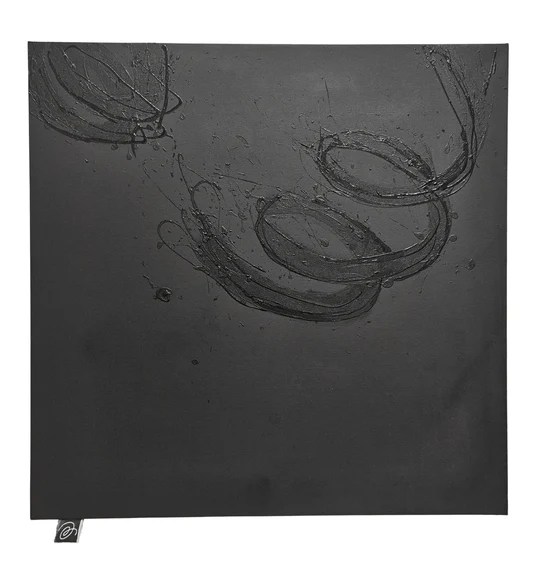
There are some more subtle, gestural works in the show among them “Midnight” ($4800) where the black gestural strokes are laid over a black background giving a sense of the shapes emerging from the velvety darkness of the night.
Roberta Queiroga, Midnight
There is also a display of her” Kaleidoscope Series”, twelve small panels ($150 each, 3 for $300) where black painterly gestures are made on a black background, the various marks seeming like a secret form of calligraphy.
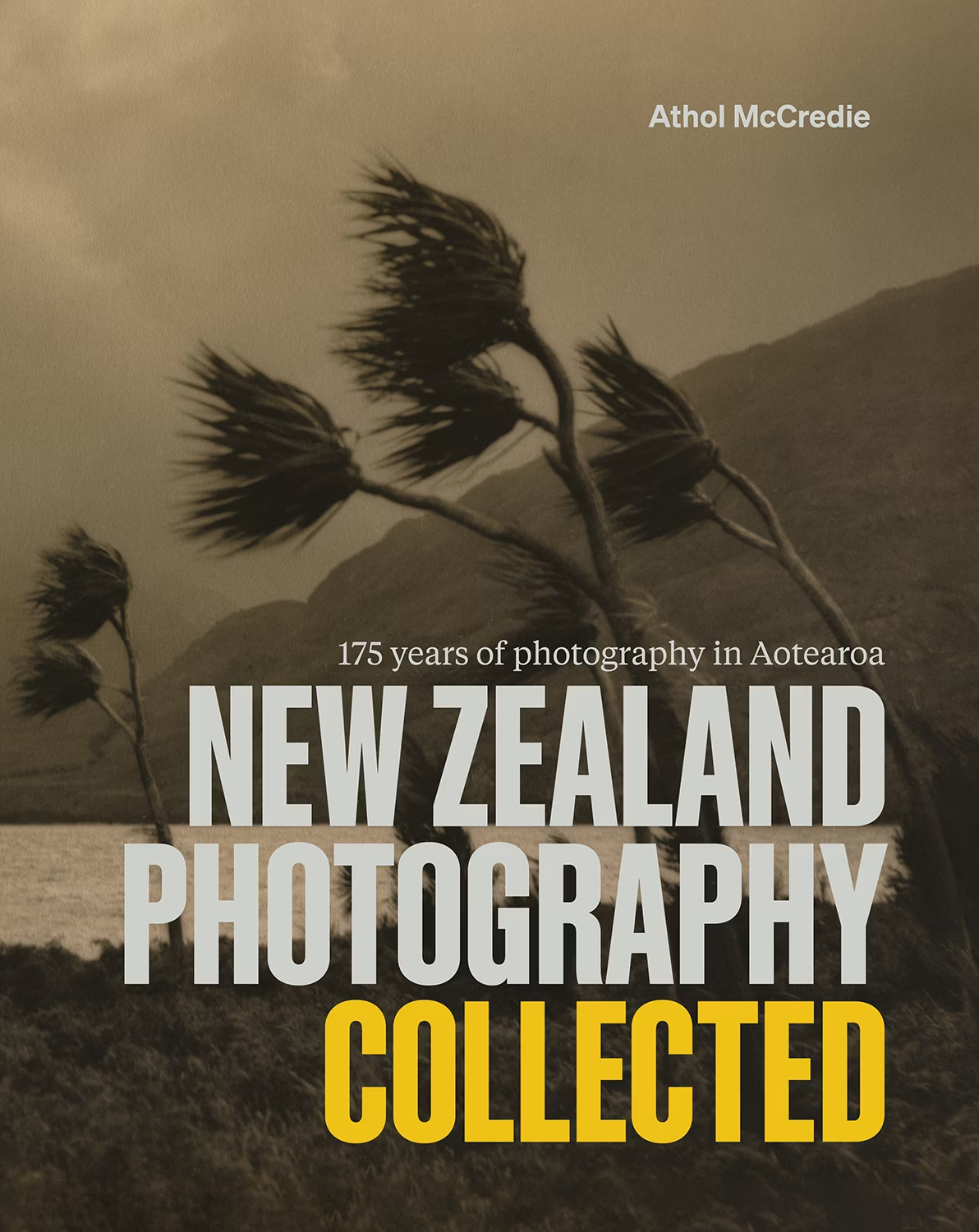
Cover image, George Chance – The Storm, Wanaka (c1940)
New Zealand Photography Collected
175 Years of Photography in Aotearoa
Te Papa Press
Written by Athol McCredie
RRP $90.00
Reviewed by John Daly-Peoples
New Zealand Photography Collected illuminates New Zealand’s photographic history, from the earliest nineteenth-century portraits of Māori and local ‘scenic views’ to the latest contemporary art photography. The previous edition of the book published in 2015 went into two editions and this expanded version featuring 400 images from Te Papa’s collection of 400,000 works.
From the iconic to the previously unpublished, the selection includes outstanding photographs by the Burton Brothers, Leslie Adkin, Spencer Digby, John Pascoe, Brian Brake, Frank Hofmann, Ans Westra, Eric Lee-Johnson, Marti Friedlander, Laurence Aberhart, Ann Shelton, Glenn Jowitt, Anne Noble, Yvonne Todd – and many more.
The book not only provides a wide selection of images, it also introduces the reader to the photographic artists who have used photography to explore our history and environment. The photographs of the nineteenth century makes us realise that these images are often our only reference point for how the country, its people and events looked in the past.
Author and curator Athol McCredie provides a wide-ranging selection of images across portraiture, landscape, science, documentary photography and art with informative notes.
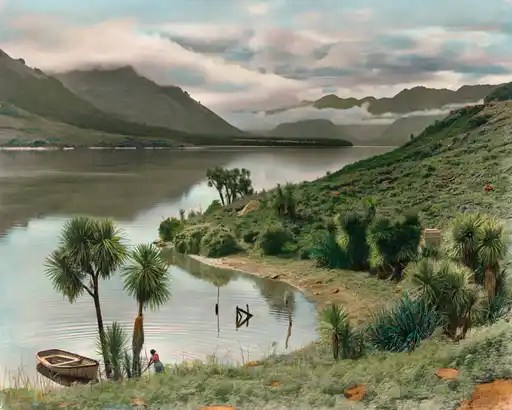
Ellis Dudgeon Lake Hawea, c.1947 Hand-coloured gelatin silver print, coloured by Elaine Watson, 1962, 404 × 500 mm Purchased 2023, O.051365 It is almost unknown for a hand-colourist to be identified on a photograph, but this one has a handwritten label on the back reading ‘Hand painted photograph by Elaine Watson, July 1962.’ This records that Watson hand-coloured it, not that she took it, for we know from a 1947 book in which it was reproduced in black and white that it was taken by Ellis Dudgeon, a photographer who ran a studio in Nelson from 1930 to 1970. Dudgeon’s scenic hand-coloured photographs were widely seen. Indeed, this image appears in colour on the cover of the upmarket magazine Mirror: New Zealand’s national home journal in 1955. In that version, the colouring is quite different: there is much more yellow in the tī kouka (cabbage trees), there are red flowers on the bushes by the lakeside, and it is much brighter and sunnier throughout. It is a more upbeat, holiday image than Watson’s subdued and uniformly toned version, showing just how much interpretive room there was for colourists, who were rarely present when the photograph was taken.
Together these photographs tell stories about life in this country from almost the earliest days of European colonisation and about how the practice of photography has evolved here, reflecting the dynamic and increasingly diverse nature of the collection, allowing for previously unseen treasures, and enabling familiar works to be recontextualised with fresh insights.
In making the selection, McCredie, says “I looked for photographs that were evocative, resonant, ambiguous, entertaining, and most especially, that might say something about the nature of photography itself.”
Whie no collection of photographs can be comprehensive the book offers many threads which weave together a sense of the nation’s history and culture. It is more than a history of photography tracing out our responses to the landscape, the built environment, events and people.
Through the book we see the taming and changing of the landscape, the changing domestic and commercial architecture, the way we dress and there are images of the citizens we valued for their contribution to our civic and cultural life.
There are portraits of Māori such as Tomika Te Mutu, as well as other history makers such as Peter Fraser, Ed Hillary and Mike Moore along with artists such as Kiri Te Kanawa, Tony Fomison and Yuki Kihara.
We also can see the way in which the photograph has changed from the need to simply record the landscape and people through to experimentation as well as viewing photography as a means of social and political change.
While there no comparative before and after images the book does have images of the changing face of the land as well as images of the major cities and the built environment from the nineteenth century and the twentieth which show the development of the urban areas. We are also able to see the changing nature of clothes, particularly those worn by females.
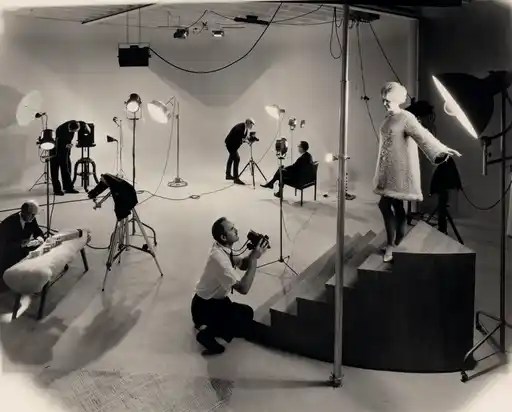
The inclusion of Frank Hofmann, one of the major modernist photographers is an example of the multi-talented artist who worked across the media providing many of the important modernist photographs as well as portraits. A photograph of the Christopher Bede Studio, which he founded also shows his ability to work across the commercial as well as experimental genres.
Frank Hofmann Christopher Bede Studios, 1967 Gelatin silver print, 418 × 578 mm Purchased 2016, O.044647 Christopher Bede Studios was formed by Frank Hofmann and Bill Doherty around 1950. It focused on home portraiture but also operated a studio, and this photograph was probably taken to promote its new premises being opened in Auckland in 1967. The image clearly sets out to demonstrate the varieties of photography the studio could undertake, from fashion and product photography to portraiture. It is pure advertising though, for it would be fanciful to imagine four photographers actually working simultaneously in the same studio space. The studio had branches in other centres, and in 1970 it claimed to be New Zealand’s largest photographic organisation. In 1975 it became Bede Photography.
There are number of images of individual Māori and Māori society which changes over the course of time from initially being of an ethnographic nature with images by John Nicol Crombuie and Alfred Burton through to seeing Māori as an integral part of society with photos by Ans Westra as well as seeing the inclusion of Māori photographers such as Tia Ranginui and Fiona Pardinton.
There are several small suites of work such as Eric Lee-Johnson images of Opo taken at Opononi in 1956, Gordon Burt’s commercial works mainly of automobiles and the Burton Brothers for their extensive images of the country.
Then there are individual images such as Frede Brockett’s dramatic image of the wreck of La Bella, Theo Schoon’s Geothermal studies or Eric Lee Johnson’s image of a bike wheel and shadow which predate similar work by Bill Culbert who, surprisingly, has no images in the book.
The landscape work in the book range from the nineteenth century images of the Burton Brothers through the NZ Tourism images, the myth-like work “Peter Pan on Mt Eden” by J. W. Chapman-Taylor through to the revisionist work of Mark Adams.
Les Wallace Napier after Hawke’s Bay earthquake, 1931 Gelatin silver print, 158 × 386 mm Gift of Holden New Zealand Limited, 1998, O.005635 The Hawke’s Bay earthquake of 3 February 1931 remains New Zealand’s deadliest natural disaster: 256 lost their lives, and the region was devastated. With limited water to fight the fires that ignited after the quake, eleven blocks of central Napier were completely gutted. According to an eyewitness, by evening the town ‘looked as if it had been subjected to a severe bombardment’: The centre of it for over a mile was a mass of flames. Every concrete and brick building had collapsed. It was like an upheaval and there was a terrible number of deaths . . . A number of people were lying in the streets and buried under the debris. Some were terribly injured and some were dead. The town was all in darkness and that added to the horror of the situation.
While there are not a lot of photographs of dramatic historical events like Les Wallace’s “Napier after the earthquake” there are a few, like Paul Simei Barton’s images of the demonstrations about the Springbok 1982 tour as well as the Covid 19 demonstration in Wellington by Adrian Lambert.
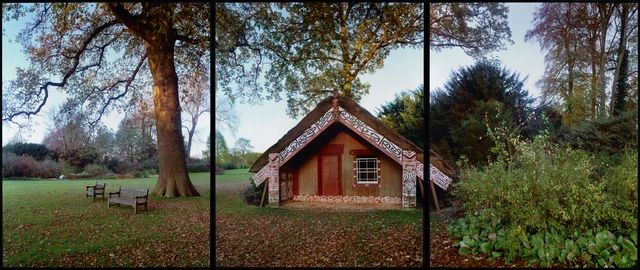
Mark Adams 13.11.2000 Hinemihi, ClandonPark, Surrey, England. Nga Tohunga:Wero Taroi, Tene Waitere, 2000 Chromogenic prints, 1200 × 3200 mm Purchased 2020, O.049055/A-C to C-C Mark Adams has often highlighted cultural incongruities in his photographs, and nowhere more so than in this triptych of the meeting house Hinemihi o te Ao Tawhito standing in a corner of an English country estate. The 1881 house was originally situated at Te Wairoa, the gateway village to the Pink and White Terraces. When Mount Tarawera erupted in 1886, the house was partially buried and subsequently abandoned. In 1891, the Earl of Onslow and Governor of New Zealand purchased Hinemihi and had it dismantled and reinstalled on his English estate as a sort of folly — something he probably didn’t see as incongruous himself, as he bought it as a reminder of his affection for New Zealand. Adams took another equally dissonant triptych that pairs with this photograph. It shows the site where Hinemihi originally stood — now just a forlorn patch of empty land covered in long grass and thistles. Hinemihi will be returned to New Zealand (though probably not to this site), placing Adams’s photograph in dialogue with the future as well as the past.
The “Follow button” at the bottom right will appear and clicking on that button will allow you to follow that blog and all future posts will arrive on your email.
Writing about Hiria Anderson-Mita a couple of years ago I noted that she “has never had to look far for subject matter. She only has to look around the room, out the window or down the road. Her paintings are essentially documentation of her daily life, painting what she sees, the people she encounters and her immediate experiences.”
Her domestic interiors or local views of her local environment were both mundane and intriguing.
This incongruity in many of her works give the images both a simplicity and sophistication. One could compare her paintings to the simple French Impressionist paintings as well as the recent landscape paintings of David Hockney, in creating timeless views.
In her latest exhibition the paintings and view points have been extended, broadening out from the local to the wider area of hers and her ancestors land so the exhibition becomes for her “a return to the ancestral landscapes that have shaped who I am.”
In the catalogue notes she writes “The tracts of farmland in these artworks hold the DNA and stories of my ancestors. Their ridges and valleys are layered with the pā sites of my tūpuna; connections that survey pegs and ownership papers can never sever.
In fact those pegs and papers are reference points for rediscovery.
Through researching Māori Land Court records and field books made by 19th Century Government Surveyor William Cussen – alongside maps, archaeological files, photographs, oral histories and the living landscape itself – I am tracing the footprints of my tūpuna.
Each painting in this exhibition describes and locates a site of history and connection within the rohe of Ōtewa, Rangitoto Tuhua and the surrounding pā of Ngāti Maniapoto and Rereahu.
The pā tuna, the kohatu, the maunga, and the awa I paint were once sources of sustenance for entire communities. I want to make them visible once more; to bring them into the light. And to reinsert our knowledge and our presence into the whenua from which we have been separated by pen and politics.
I have been guided by ancestors who still reside within me. My paintings are my journey home.”
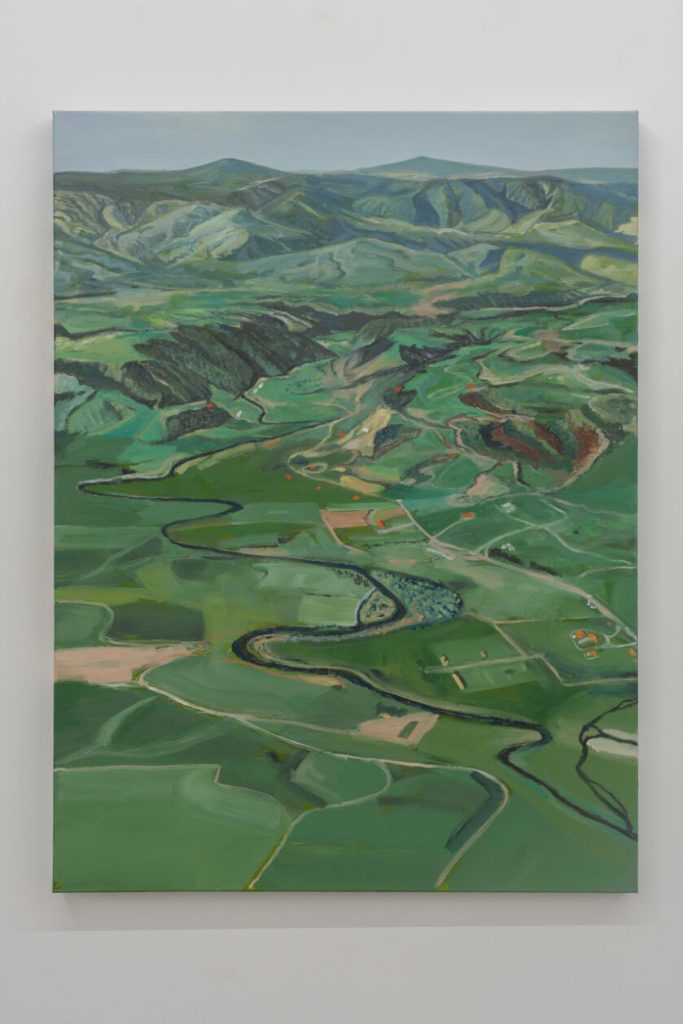
Central to the works is the large “Ōtuaoroa” ($11,500) which is the original name for the area. The artist calls the painting “A map”, so the image is like the chart of a mythical land or a treasure map found in a children’s book with each road, farm, bend in the river all bearing a history. Many of these places are then seen in a larger format in other paintings such as “Puketarata Rd No2” ($3500) which is the view from her childhood home or “Hikurangi Pa” ($3250) a bend in the river where her ancestors had been born and which sustained the local population with food.
There are also links to the geomorphological qualities of the land which had intrigued Colin McCahon and his study of the landforms and their history.
Puketarata Pā
This idea of discovering the history and formation of the land is seen in Puketarata Pā ($7500) where the landscape is inscribed with other information such a pre-European name, survey number, the indication of tracks or landforms as well as the Google Earth Coordinates.
Turamoe Pa Otuaoroa (Te Kooti’s Lookout)
Most of the works have personal connection to the artist and their importance and significance is made clear from their titles of the catalogue notes. So, there is the obvious “Otewa – My Mothers Ancestral Home ($3500) as well as “Turamoe Pa Otuaoroa (Te Kooti’s Lookout)” ($3250) featuring the hill site where Te Kooti spent the last years of the Land Wars.
Otwea Pa – Into the Future
Most of the works in the exhibition are landscapes but there are a few are more emblematic. One “Otewa Pa – Into the Future ($5750), a portrait of a niece where the artist envisions the future and there is the more abstract “Hinaki a Rautawhiri / Te Awa a Tane Pa Tuns” ($4750) which looks to the past with a design featuring netting used to trap fish and fowl.
The paintings in the exhibition paintings along with a poem she has written, “her return Home” as well as many of her previous paintings build a visual biography of her personal connections with the land, a history which is both personal, tribal and mythological.
Dick Frizzell’s latest show “Weight of the World,” at Gow Langsford could well be a reference to Ringo Starr’s 1998 comeback single of the same name which uses the phrase to describe the struggle of letting go of the past and embracing the future.
The exhibition is ambivalent in terms of the artist’s own life and work, linking the past with his history of breaking new ground. At times his work has seemed to be conservative, borrowing art of the past and outdated advertising images. But this reworking or appropriating images of the past can also be a way of charting new directions for his art.
The exhibition also alludes to his recently published autobiography “Hastings” with its references to growing up in small town New Zealand and the rural landscapes of Central North Island in which the young Frizzell’s encounters with the world of Hastings provide an almost heroic account of his life.
As the artist says “My landscapes occupy a special place in my affections because they define, more than any other of my endeavours, the most solid manifestation of my philosophy. Both the subjects and their manner of representation are chosen to emphasise my eternally optimistic faith in the physical universe that I believe we are ultimately destined to define. I hope… through my piles of hills, stumps, trees and land… to literally convey ‘the gravity of the situation’.”
While his paintings can be seen as simple descriptive works there is a complexity to their construction as well as their context and history. creating dense works about observation, contemplation and significance.
Dick Frizzell, Dirt Road
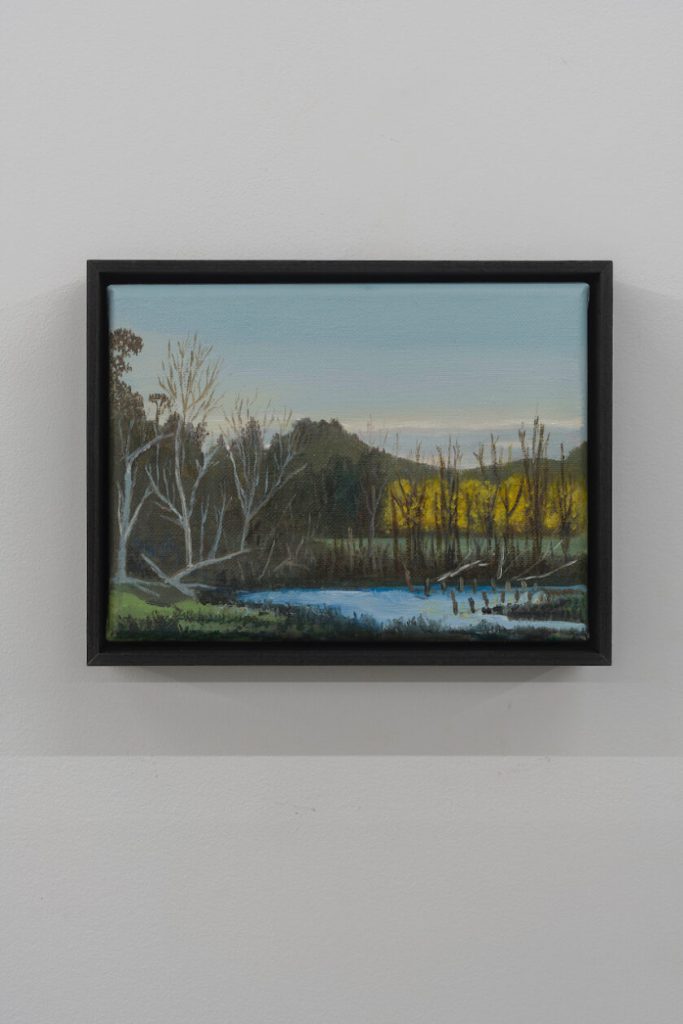
Several of the landscape images from the exhibition could have been illustrations to his autobiography such as “Dirt Road” ($27,500) and “Backtrack” ($45,000), images that are quintessential New Zealand scenes which link past and present with images which are both descriptive and metaphoric.
There is one work with the same title of the exhibition, “The Weight of the World” ($163,000). It depicts a large tree stump, a reference both to his own tree stump works of the 1980’s as well as those by artists such as Mervyn Taylor and Eric Lee-Johnson. These dead trees were both a symbol of modernism and change as well as an emblematic of the past and loss of identity.
Much of the artist’s work is imbued with this sense of nostalgia and Frizzell has regularly depicted aspects of New Zealand – a series of local businesses, the huts at Scott base and the controversial series of hei tiki works which all helped define the nature of New Zealand culture.
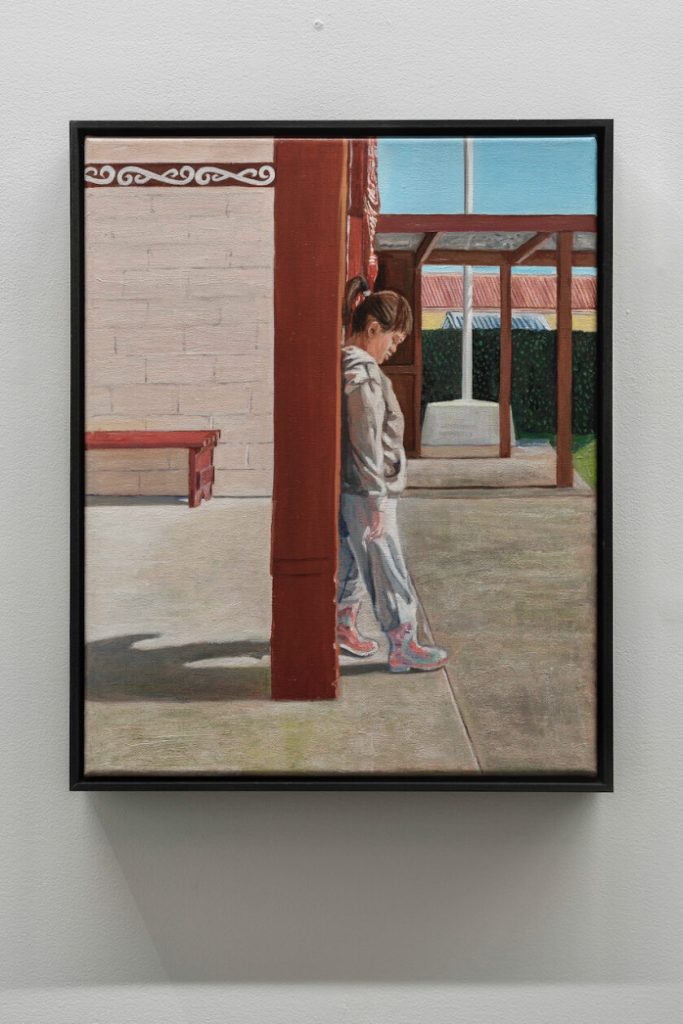
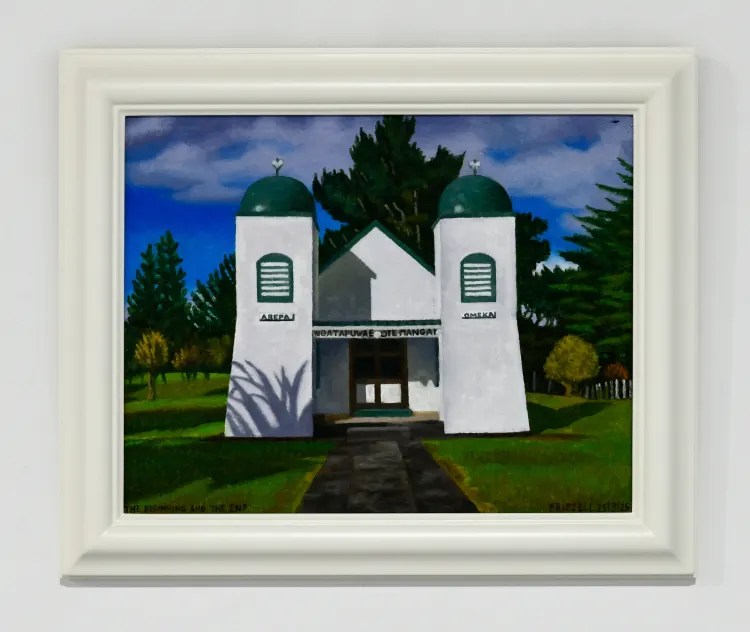
There are a few signs of habitation or figures in his works mainly small insignificant buildings, “Whitebaiter’s Huts” ($27,500) and “Leaning Toilet” ($27,500) but there is also a painting of a Ratana Chapel “The Beginning and the End” $27,500) displaying the words ārepa (alpha) ōmeka (omega), and the large panoramic “Autumn Morning Alexandra” $185,000).
Dick Frizzell, The Beginning and the End
The only paintings of a settlement in the exhibition are “Autumn Morning Alexandra, 2023 “($185,000) and “Alexandra Morning 2019” ($65,000) where the emphasis is on the natural aspects of the view, the distant hills, the colours of the sky and Autumn leaves as well as the surrounding vegetation. The largest work in the exhibition is “Milling Whakaangiangi” ($225,000), a celebration and recognition of the ever-changing face of the land.
As well as taking inspiration from the New Zealand artists of the early twentieth century there are acknowledgment of other artists – such as his Monet-like “Winter, Earnscleugh Road” ($55,000) and a nod to Winslow Homer’s lighthouse with his “Castlepoint”.
Dick Frizzell, Winter, Earnscleugh Road
As with much of the artist’s work there is a wry humour in many of the paintings both in terms of the subject and the titles. A small painting of a pie is titled 27/3/2025” where English and mathematics merge, similar to his Greek / English word play in “The Beginning and the End”.
The exhibition reveals an artist addressing conflicted personal and national histories around land, seeing the land as both a record of our history and a metaphor for our changing identity, seeing the future looming out of the past.
Auckland Art Gallery Toi o Tāmaki will present the first solo exhibition in Aotearoa New Zealand of Louise Bourgeois (1911–2010), one of the most intriguing and influential artists of the last century.
Opening 27 September, Louise Bourgeois: In Private View brings together a selection of works from an international private collection, exhibited publicly for the first time. The exhibition spans over six decades of Bourgeois’s career, from early paintings made in 1945 to a fabric work from the final year of her life
Auckland Art Gallery Senior Curator, Global Contemporary Art, Natasha Conland, says, “Bourgeois remains a defining figure in late twentieth-century art with the ripples of her influence still being felt today. She is known for her highly personal and idiosyncratic sculptural practice which has lent her a special place in the history of art.” “The works in the exhibition are from a private collection lived with over many years, reflecting a deep and personal appreciation of her practice.”
Widely celebrated for her psychologically charged and bold sculptural practice, Bourgeois explored themes of memory, family, the body and the subconscious, often drawing from personal experiences.
She is best known for her series of large spider sculptures, which have been installed in many major international cities.
Highlights include paintings and her first series of sculptures, the Personages, from the 1940s and early ‘50s; Lair sculptures from the early 1960s; and significant later works, such as textile-based sculptures and sculptural enclosures.
Louise Bourgeois. Spider VI
Spider VI (2002) is a wall-mounted example of her internationally acclaimed series of spider sculptures, which she began in the mid-1990s. Also featured is her extraordinary hanging sculpture, The Couple, and late outdoor piece, Eyes.
A series of curator tours and talks, open lates, as well as family-friendly activities has been programmed with the exhibition. The Gallery Shop has also launched a new range of Bourgeois inspired products which includes socks, brooches, books and more.
Pop to Present: American Art from the Virginia Museum of Fine Arts
Auckland Art Gallery
November 8th 2025–March 15 2026
John Daly-Peoples
This year the Auckland Art Gallery scored a great success with their “A century of Modern Art” exhibition sourced from the Toledo Museum of Art. Not only was it an extensive look at the art of the twentieth century but also included some significant works.
Later this year the gallery will be looking to repeat the success of that exhibition with “Pop to Present” a major show highlighting the diverse artistic voices from the United States, spanning from1945 to the present day.
Opening in November, “Pop to Present:” will be showing American Art from the Virginia Museum of Fine Arts, 52 works reflecting eight decades of extraordinary artistic experimentation and cultural transformation in the United States. The exhibition includes abstract paintings, vibrant Pop canvases and hyper-detailed photorealist compositions along with Minimalist sculptures, richly textured pieces inspired by craft and domestic traditions, and contemporary figurative works that explore questions of identity, power and representation.
Showcasing 28 works by women and African American and Indigenous artists, the exhibition places well-known names in conversation with artists from diverse backgrounds to offer a broad and inclusive overview of recent American art. Artists featured in this comprehensive survey include Benny Andrews, Thornton Dial, Roslyn Drexler, Elaine de Kooning, Willem de Kooning, Helen Frankenthaler, Sam Gilliam, Philip Guston, Barkley L. Hendricks, Norman Lewis, Virgil Ortiz, Howardena Pindell, Jackson Pollock, Martin Puryear, Jaune Quick-to-See Smith, Mark Rothko, Kiki Smith, Clyfford Still and Andy Warhol.
“Experimenting with new materials while responding to the cultural and technological shifts of their time, the artists featured in Pop to Present challenged America’s social and artistic norms in ways that are still meaningful today,” says Kenneth Brummel, Curator, International Art, Auckland Art Gallery. “The exhibition also presents a large number of works by artists rarely seen in this part of the world”
Alma Thomas. Forsythia and Pussy Willows Begin Spring
Standouts in the exhibition include” Forsythia and Pussy Willows Begin Spring” a vibrant colour-field abstraction by Alma Thomas, an iconic Pop landscape by Roy Lichtenstein, and Andy Warhol’s Triple Elvis (1963).
Warhol’s “Triple Elvis” was based on the singer-turned-gunslinger portrait of Elvis Presley on a publicity photograph for the 1960 western Flaming Star. This public persona was ideally suited to Warhol’s aim to focus on surface appearance rather than psychological interpretation. The overlapping multiple figures suggest individual film frames and cinematic motion, while the work’s metallic background evokes Hollywood’s silver screen.
Barkley Hendricks. Sisters (Susan and Toni)
Barkley Hendricks was an American painter and photographer who revolutionized portraiture through his realist and post-modern paintings of Black Americans living in urban areas in the 1960s and 1970s. “Sisters (Susan and Toni)” is a painting of two stylish women Hendricks met in Boston belongs to a series of works with dark backgrounds, against which the bright shirts and jewellery stands out.
This work and others in the exhibition are an indication of the strength of the museum’s holdings of art by black American artists of the American South.
The museum is among the largest art museum in North America for area of exhibition space and its comprehensive art collection includes ancient art, African art and American art, British sporting art, and Himalayan art. As part of their exhibit of decorative arts the museum has the largest public display of Faberge eggs outside of Russia, owning five. It is one of the first museums in the American South to be operated by state funds.
“We are proud to share the overall breadth of the VMFA collection, and in particular the importance of the Sydney and Frances Lewis collection that anchors it” says exhibition curators Sarah Powers and Alexis Assam the Regenia A. Perry Assistant Curator of Global and Contemporary Art at the Virginia Museum of Fine Arts.
The “Follow button” at the bottom right will appear and clicking on that button will allow you to follow that blog and all future posts will arrive on your email.
The paintings in Aroha Gossage’s new exhibition “Into the Light” are grounded in her connection to the whenua of Pakiri, north of Auckland where she lives.
They continue Gossage’s exploration of land, light, and ancestry, the paintings serving as links between observation of her environment and reflections on her connections to the land and to her ancestors.
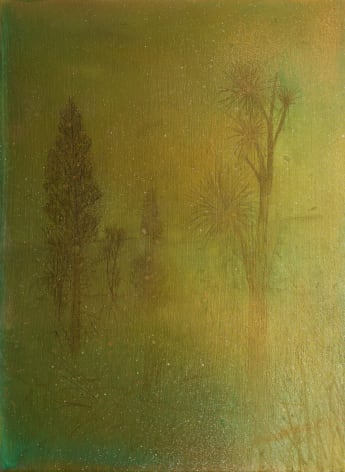
Several of the works are titled after their subject matter, simple renderings of native trees – Nikau, Macrocarpa and Manuka. These works follow in the tradition of botanical artists such as Sir Joseph Banks who identified Manuka in 1769 during his time with Captain Cook on his first voyage aboard the Endeavour and many artists have depicted trees and their flowers since then notably Emily Cumming Harris and Shane Cotton.
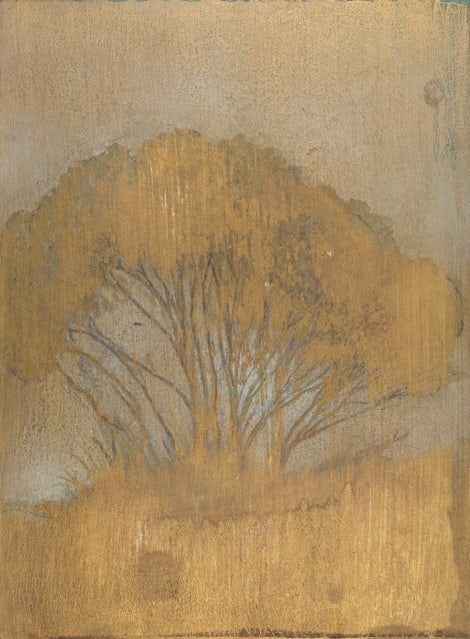
Aroha Gossage, Manuka
Gossage’s “Manuka” ($2700) is painted in golden tones giving it an enigmatic quality where earth and foliage are connected, creating an image which transcends the physical. ”Manuka” is part of group of four small works which have distinctive colouring, due to the earth pigments the artist has collected from sites around her local environment.
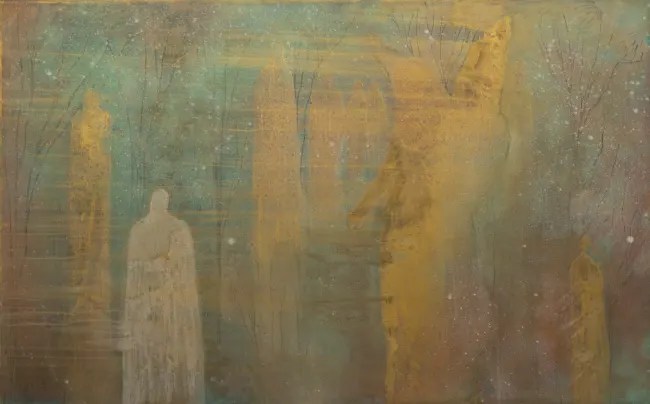
While most of her works are of botanical subjects there are a few which include figures, or at least the spirits or manifestations of figures. Rather than earthly figures they suggest ancestral presence. As the title of the show suggest these figures are journeying towards the light of a new place or a new understanding.
In the large ”Anahera” ($9800) a caped / shrouded figure inhabits an abstract environment with traces of foligare snaking through the work. There is a sense of another world in which ancestors dwell, the paintings connecting the physicality of this world with the spirituality of the other-world .
Aroha Gossage, Light
This can also be seen in “Light” ($2700) with one indistinct form and “Tupuna” ($9800) with several shapes inhabiting a forest of trees. With the works that include figures it is noticeable that while the trees are painted with distinctive realism the figures are indistinct and ethereal.
Some of her works such as “Witi” ($4750) have a quiet drama to them like Rita Angus’ “Tree”. ”Witi” is also impressive because of its deep red earth pigment which seems to it refer to bush fires, destruction and renewal.
Works such as “Hine” ($2700) and “Macrocarpa” with their dark tones seem to be ghost-like images of the trees rather than mere depictions, as though inhabiting another dimension.
The suggestion of another world is created in many of these painting by veils of overlapping colour where the air around the foliage and figures in infused with earthy tones.
There are a couple of works which are pure landscape “Pakiri Dunes” ($9800) and “Kaitaki” ($9800).These do not have the same density or richness as the others works being descriptive with fewer allusions to another dimension.
The Art of Banksy, is a major exhibition of the artist’s work which has now been seen by 1.5 million visitors in 18 cities around the world.
The collection of 150 original and authenticated works features more than 150 pieces, including prints, canvases, unique works, and ephemera.
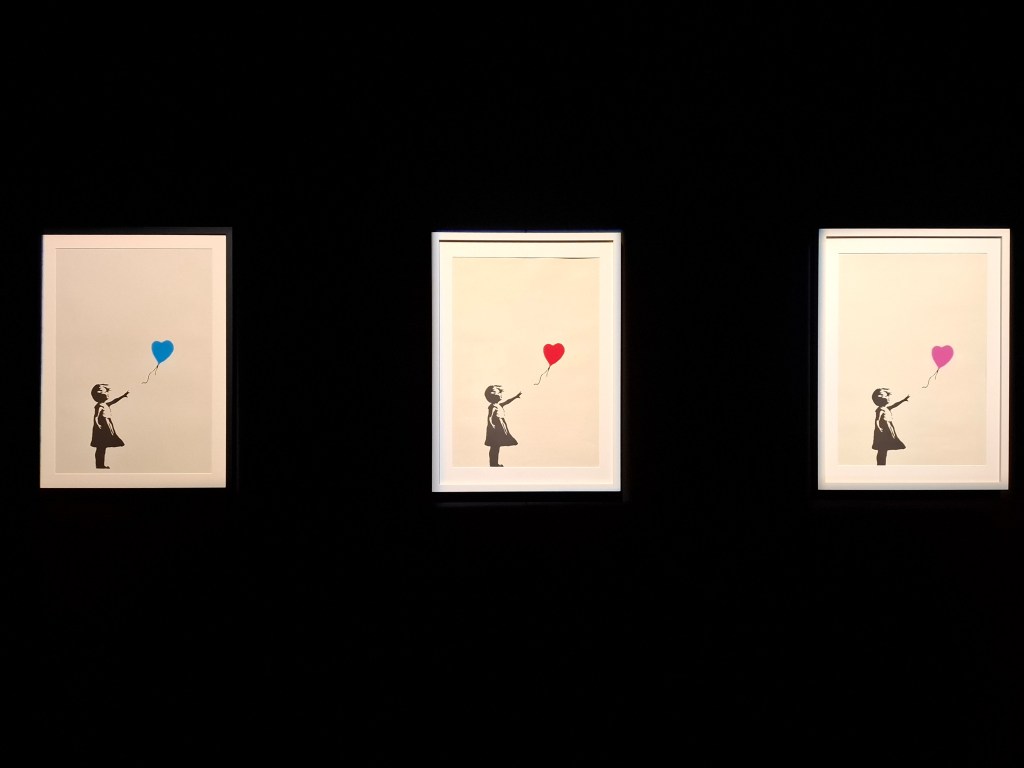
There are several versions of his well-known pieces such as the “Girl with a balloon” and “Flower Thrower,” also known as “Love is in the Air,”
As with many of his works Banky borrows from other sources, changing the original intention, subverting the original meaning as well as trawling the world for the symbols and highlights in other artworks.
So, there are references, adaptations and reworkings of Christian iconography, news photographs, Disney images along with the work of Andy Warhol, Keith Harring and even Degas.
Banksy, Ballerina with Action Man parts
It is the clever borrowing of images which appeals to adult audiences as well as well as children and his images which undermine capitalism will bring a smile to both to the conservative as well as the revolutionary.
The exhibition spans his output from the 1990’s to the present-day showing examples of his satirical and subversive output often appearing in public places around the world.
His iconic artwork depicting a masked figure or rioter, about to throw a bunch of flowers is taken for a newspaper image of a rioter throwing a projectile. This substitution is an obvious message advocating for love and peace over conflict and war.
Banksy, Trolley Hunters
There are other works like “Trolley Hunters” that satirize consumerism by depicting cavemen hunting shopping trolleys instead of wild animals. As well as being a clever juxtaposition of elements it is also a commentary on how modern society has become overly reliant on mass-produced goods and detached from nature.
Banksy, Souvenirs
Some of his work has more immediacy such as the several works related to his Walledoff Hotel in Bethlehem including some hand painted souvenirs. There are also images of his “Dismaland”, his take on Disney World ,creating a dystopian “bemusement park” located at the Tropicana in Weston-Super-Mare in 2015.
The exhibition also helps expand our understanding of the artist with numerous quotes by the artist about his history and approach to his work along with commentary by some of his collaboratives.
While here are many of his famous work there are also some of his original pencil sketches for the finished works
The works in the exhibition show that Banksy can be viewed from various perspectives – a cartoonist, a comic, a satirist, an agent provocateur or an advertising guru,
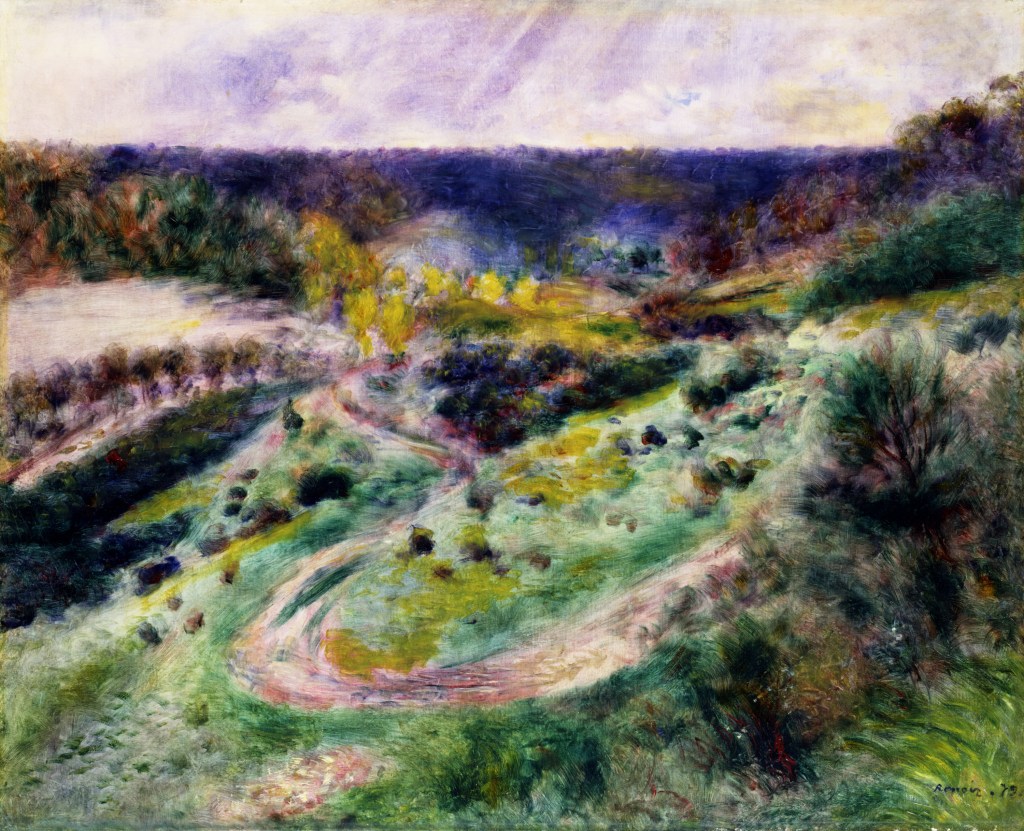
Auguste Renoir, Road at Wargemont, 1879, Toledo Museum of Art, Purchased with funds from the Libbey Endowment, Gift of Edward Drummond Libbey
A Century of Modern Art
Auckland Art Gallery
June 7 – September 28
John Daly-Peoples
A Century of Modern Art which has just opened at the Auckland Art Gallery is one of the most significant exhibitions mounted by the gallery in the last few years. It is on loan from the Toledo Museum of Art, Ohio, and provides a survey of the major artists who transformed modern art from the mid nineteenth century to the mid twentieth century.
The exhibition features 57 works by 53 artists, including Paul Cezanne, Edgar Degas, Helen Frankenthaler, Édouard Manet, William Merritt Chase, Amedeo Modigliani, Berthe Morisot, Claude Monet, Pablo Picasso, Camille Pissarro, Robert Rauschenberg, Pierre-Auguste Renoir, Vincent van Gogh, James McNeill Whistler, among others.
The Toledo Art Museum was established and funded by Edward Drummond Libby and still has a substantial Endowment Trust in his name . The endowment has some $330 million and a budget of more than $20 million a year,. Many of the works in the exhibition were gifted by Libby or acquired through the Libbey Endowment.
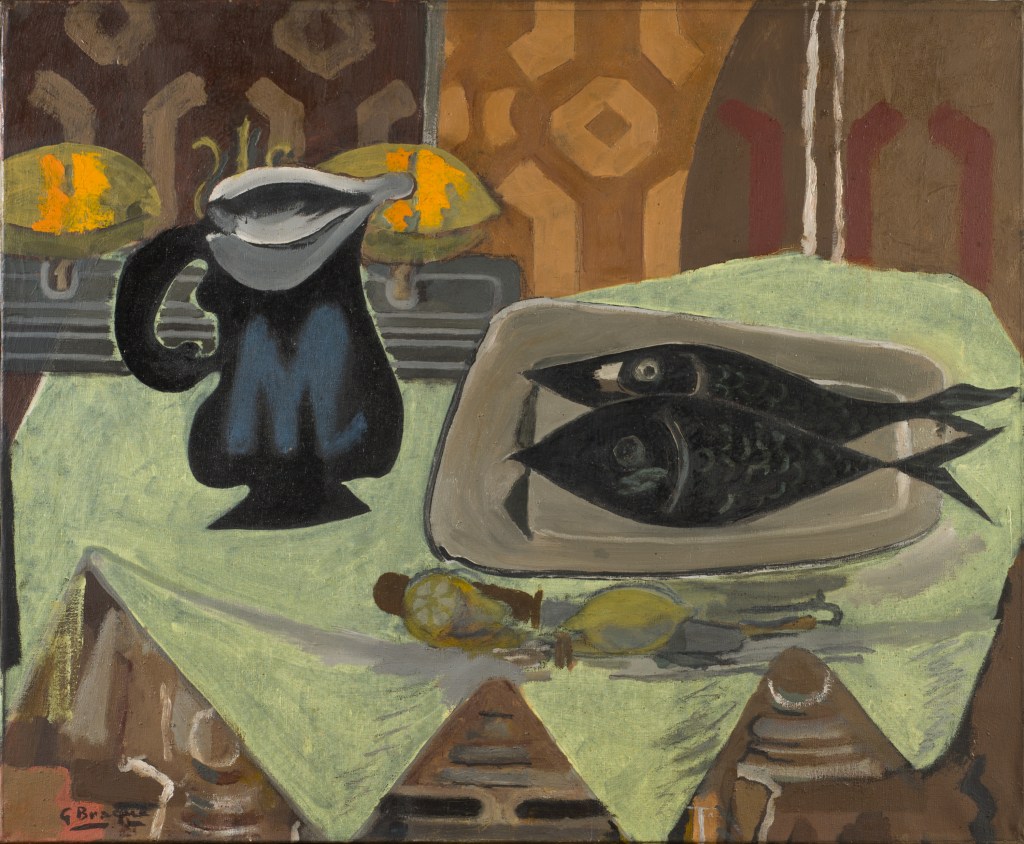
Georges Braque, Still Life with Fish, 1941, Toledo Museum of Art, Purchased with funds from the Libbey Endowment, Gift of Edward Drummond Libbey
Some of the Impressionist / Post Impressionist works by artists such as Renoir, van Gogh, Morisot and Gauguin are major works whle some of them are of unfamiliar subjects such as Renoir’s ”Road at Wargemont”
Several of the works are excellent examples of their work such as van Gogh’s “Wheat Fields with Reaper, Auvers” and Monet’s Water Lilies of 1922, one of the many images of the flower he created in his later years.
The show also features some unfamiliar names of American artists such as Luther Emerson van Gorder whose “Flower Market, Paris” (late 19ht century) could be mistaken for a Pissarro.
Flower Market, PLuther Emerson, Van Gorder, Flower Market, Paris, late 19th century- early 20th century. Toledo Museum of Art, Gift of the artist
The small Whistler work ”Crepuscule in Opal, Trouville” of 1865 is an interesting inclusion in the show, the landscape with its slash of colour is an almost abstract work
Among the more contemporary work is Helen Frankenthaler “Blue Jay” painted at a transition time between paintings of organic forms and colour field paintings. There is also a Morris Louis whose work has not been seen in Auckland since his large exhibition at the gallery in 1971
Helen Frankenthaler, Blue Jay,1963, Toledo Museum of Art, Gift of The Woodward Foundation
There are also works by artists who we rarely see but whose work shows high level of sophistication such as Piet Mondrian’s Composition with Red, Blue, Yellow, Black, and Gray”, László Moholy-Nagy’s ”Am2”, and Max Beckmann’s “The Trapeze”.
Max Beckmann, German, 1884-1950; The Trapeze; 1923; oil on canvas;H: 77 3/8 in. (196.5 cm); W: 33 1/8 in. (84 cm);Toledo Museum of Art; 1983.20;
There are a few important American artists as Stanton Macdonald-Wright who was one of the early American abstract artists and his “Synchromy, Blue-Green”, of 1916 is an example of the abstraction which developed in America in the early twentieth century.
Other American artists in the show include Gertrude Glass Green who was an important constructivist artist and Grace Hartigan who was a member of the New York School in the 1950’s and 60’s.
The “Follow button” at the bottom right will appear and clicking on that button will allow you to follow that blog and all future posts will arrive on your email.





 27/3/2025” where English and mathematics merge, similar to his Greek / English word play in “The Beginning and the End”.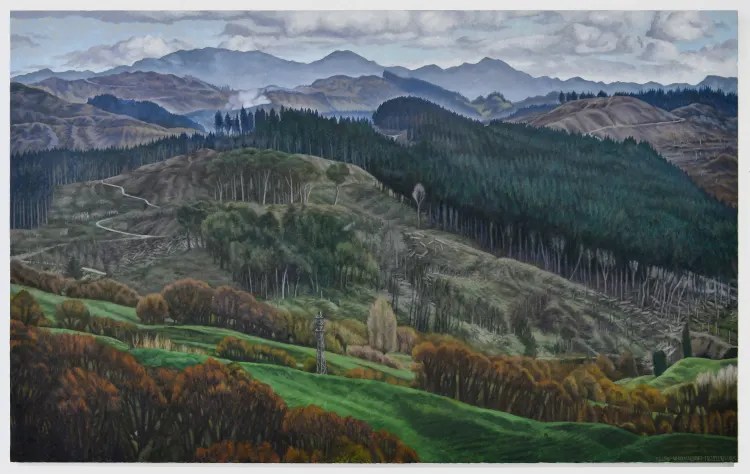






 New Zealand Arts Review