Categories
Reviews, News and Commentary

The Hanly House Residency. Preserving the legacy of Gil and Pat Hanly

John Daly-Peoples

The Hanly House Residency

A visionary plan to preserve, establish and maintain the home of Gil and Pat Hanly as an artist’s residency and museum at 7 Walters Road, Mt Eden was recently announced at the artist’s former home.

The house and extensive tropical garden located in the heart of Mt Eden, would operate as a social hub, gallery and museum as well as an education and research space for New Zealand art history, and a unique supported urban artists’ residency and studio for emerging contemporary artists locally and from across the world.

Iconic New Zealand artists Pat, a painter and Gil, a documentary photographer, contributed significantly to the social, political and cultural landscape of Aotearoa. Through the Hanly House project the family wish to celebrate Pat and Gil’s contributions to the cultural landscape of Aotearoa, and for visitors and researchers to enjoy and be inspired by it.

The Artist Residency Programme would support artist at a critical point in their career development by providing the house rent free for up to five years.

The residency would work with key stakeholders including Te Papa, AAG, ELAM and ILAM to achieve that goal.

Initial aims of the Hanly House would be to raise capital to purchase the house and garden from the Family. Once established it is intended that house would host regular arts focused functions and support public access to events at the house, support public access to the  garden and raise operational funds through events, endowment fund, and edition sales.

ARTIST RESIDENCY DETAILS

  • Long term (3 -5-year residency programme)
  • Open to national and international artists through an arts partner organisation.
  • Selection Process and Programme in Partnership with Te Papa, AAG, ELAM, ILAM
    • Artist to be between 30 and 40 years old
    • Artist’s family welcome to reside with artist
    • On acceptance of the residency, The Artist will be expected to reside and work at the address for the duration of the period, with standard holiday breaks.
    • The residing Artist participation and outcome expectations would include
      • Attend the Annual Garden Party Functions at the house.
      • Speak at quarterly In Conversation programmes at the house or another arts organisation.
      • Deliver a body of work or installation that responses to the region.
      • Produce and gift to the Trust a series of limited edition to the value of $20,000 for fundraising purposes.

The Hanly Family Trust is currently supporting the development of the Hanly House proposal and is calling on individuals for support. Supporters can make immediate donations of $5 or more and can pledge donations which will help offset the establishment costs and enable the commissioning of further development plans.

Supporters can register at various tiers:

  • Heart 1M+
  • Kowhai 500K+
  • Dove 100K+
  • Hope 5K+
  • Activist 1K+
  • Benefactors will be acknowledged, onsite, in print material and at functions.

To subscribe or follow New Zealand Arts Review site – www.nzartsreview.org.

The “Follow button” at the bottom right will appear and clicking on that button  will allow you to follow that blog and all future posts will arrive on your email.

Or go to https://nzartsreview.org/blog/, Scroll down and click “Subscribe”

For more information – hanlyhouse.nz

Contact diane.blomfield@icloud.com to discuss your pledge.

To subscribe or follow New Zealand Arts Review site – www.nzartsreview.org.

The “Follow button” at the bottom right will appear and clicking on that button  will allow you to follow that blog and all future posts will arrive on your email.

Or go to https://nzartsreview.org/blog/, Scroll down and click “Subscribe”

Categories
Reviews, News and Commentary

A celebration of Shostakovich

Reviewed by John Daly-Peoples
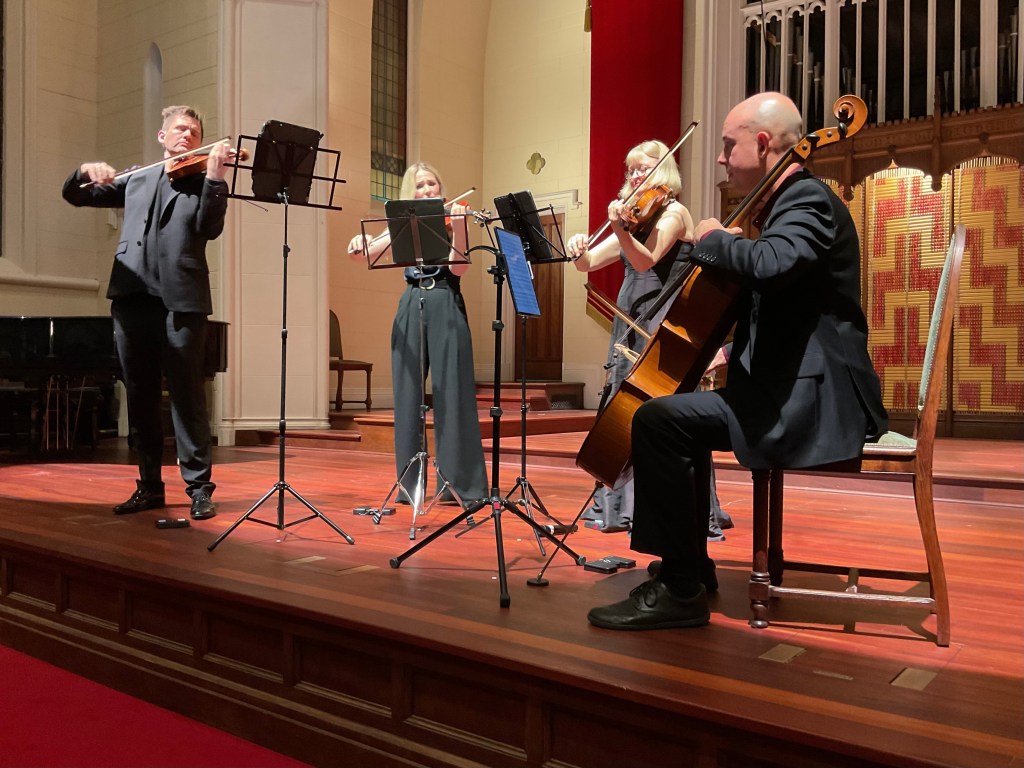
Peter Clark, Arna Morton, Gillian Ansell and Callum Hall Photo: Kāhui St David’s

Shostakovich: Unpacked

New Zealand String Quartet with Ghost Trio

Kāhui St David’s

September 24

Reviewed by John Daly-Peoples

For their latest concert “Shostakovich Unpacked” the New Zealand String quartet joined with the Ghost Trio to perform three works by the composer acknowledging the fiftieth anniversary of the composer’s death.

They performed in the recently renovated Kāhui St David’s church which has become a valuable addition to the music performing spaces in Auckland.

The concert featured his “Five Pieces for Two Violins and Piano” which consisted of early works which had been arranged by Lev Atovmian, a student of the composers.

The Five Pieces are relatively easy to play works which were originally written as film background music which are Romantic dance like works including a gavotte, waltz and polka.

Throughout the work violinists Monique Lapins and Peter Clark responded to the lively music engaging in their own dance moves, notably in the last piece, a gypsy style polka.

The concert opened with the composers “String Quartet No. 4” which was composed in 1949 and premiered in 1953 after the death of Stalin. Before that Soviet composers could only write proletarian music for the Russian masses. With Stalin’s death Shostakovich’s music was more accepted and his reputation restored and he could express himself more freely

The work was written for his friend Pyotr Williams the artist and scene painter and in a sense a requiem.

Violinist Peter Clark playing was animated, his sinuous playing matched by his sinuous, vigorous movements.

The sounds of his violin were at times mournful with some ecstatic moments like the voice of a Jewish cantor.

Where his voice might be seen as that of a souring angel the two other violinists Arna Morton and Gillian Ansell provided more human responses with sounds representing human grief.

In the third movement there was lively a conversation between the violists and Callum Hall’s cello with some abrupt sounds and ricochet bowing creating a tense atmosphere which morphed into more whimsical but soulful sequence.

There was some effervescent playing as the strings seems to compete with each other, the cello providing a solid base in a headlong race. There were passages filled with pizzicato playing representing Jewish folk melodies along with some strangled voice and jazz sounds.

At times the group sounded like a choir full of disparate voices with the plucking of strings and the clashing of bows against strings. Between these harsh attacks which had an intense physicality there were sections of reverie with the work ended with an almost whispered sequence of light pizzicato.

Ken Ichinose, Gabriele Glapska and Monique Lapins Photo: Kāhui St David’s

The final, work on the programme played by the Ghost Trio was the composers “Piano Trio No 2” which was written in the middle of the Great Patriotic War and is the composer’s response to the drama and destruction of the time. It opened with the high-pitched sounds of the cello played by Ken Ichinose, a sole voice in a deserted landscape followed by the mournful piano. The insistent cello and repeated phrases of the piano suggested the harsh sounds of battles followed by victory followed by defeat and retreat.

The subversive use of the ‘forbidden’ Jewish folk themes which Shostakovich often used as a subversive element can be heard, especially in the third and fourth movements.

Throughout the work there are massive sequences in which piano violin and cello seem to compete with each other but in the end merge. There were parts where the piano performed a death march and the three instruments provided a tapestry of dispiriting sounds as the instruments wove an intricate pattern of some elaborate game, the violinist and cello in a futile dance of death. One of the final themes, possibly a Jewish dance turns into a militaristic theme before ending in a whisper.

The concert also featured the New Zealand composer Robert Burch’s “An essay to the Memory of Dmitri Shostakovich for cello and piano composed in 1975 featuring the cello of Callum Hall and pianist Gabriela Glapska. The work was evocative of Shostakovich’s work with the meticulous cello of Hall interspersed with violent interruptions from the piano.

To subscribe or follow New Zealand Arts Review site – www.nzartsreview.org.

The “Follow button” at the bottom right will appear and clicking on that button  will allow you to follow that blog and all future posts will arrive on your email.

Or go to https://nzartsreview.org/blog/, Scroll down and click “Subscribe”

Categories
Reviews, News and Commentary

Mark Adams: Photographs across time and cultures

Reviewed by John Daly-Peoples

Mark Adams A survey — He kohinga whakaahua

Mark Adams and Sarah Farrar

Massey University Press

80.00

Mark Adams: A Survey | He Kohinga Whakaahua

Auckland Art Gallery

Until August 17

Reviewed by John Daly-Peoples

The current exhibition “Mark Adams: A Survey | He Kohinga Whakaahua” is the artists first comprehensive exhibition of his work and features more than 65 works spanning his 50-years as a photographer. documenting the land, the people and its history. These photographs are of places across the Pacific, the United Kingdom and Europe.

Much of his practice documenting sites of significance across the country, include places where Captain James Cook and his crew came ashore on their visits in 1769 and the 1770s, as well as locations where Te Tiriti o Waitangi was signed in 1840.

Over the decades, Adams has sustained a deep and ongoing engagement with subjects of interest. He has photographed whakairo Māori (Māori carving) both here and overseas and the work of, Samoan master tattoo artists, Māori–Pākehā interactions in Rotorua, carved meeting houses, locations of significance for Ngāi Tahu in Te Waipounamu and  the place of museums and photography in the area of cross-cultural exchange.


It includes photographs taken across the Pacific, the United Kingdom and Europe that explore the migration of artistic and cultural practices across the globe, and examine the role of museums, and photography itself, in the ongoing area of cross-cultural exchange.

The various sections of the book show Adams’ range of work from his early works, his focus on Rotorua, tatau, Treaty Signing Sites, Museums, Cooks Sites Māori meeting house in overseas locations, Te Waipounamu and his more recent interest in Photograms.

Several of his multi-image work are fascinating in their scope and production but the book does not do them credit, even when spread across several pages. With these works the exhibition at the Auckland Art Gallery make an impression in some cases filling an entire wall of the gallery. “0 degrees” is such  a work, a  panoramic 360-degree set of images taken at Greenwich Park which includes the Royal Observatory, the home of Greenwich Mean Time and Prime Meridian.

Other works on a grand scale  include  his “Nine Fathoms Passage”, the photographers view replicating William Hodges view of Dusky Sound, and his panorama of the  meeting house, Hinemihi in the grounds of Clandon Park in Surrey, England as well as the magnificent meeting house Rauru in the Museum am Rothenbaum in Hamburg.

Mark Adams, 13.11.2000. Hinemihi. Clandon Park. Surrey. England. Ngā tohunga whakairo: Wero Tāroi, Tene Waitere, 2000, colour inkjet prints, Auckland Art Gallery Toi o Tāmaki, gift of the Patrons of the Auckland Art Gallery, 2014.

Author of the book Sarah Farrar says “You could say that, in many respects, Mark has been ahead of his time as a Pākehā and Palagi artist. But what does that really mean — to be ‘early’ or ‘ahead of one’s time’? It’s all relative and I’m sure many people would view a respectful approach to tangata whenua and tangata o le moana as seriously overdue.”

Adams’ photographs are of exceptional quality and intriguing in their distinctive approach to subject matter. The viewer is challenged to interpret , question and reflect on them. One commentator, Damian Skinner has noted that Adams photographs “offer no resolution, only problems. They patiently track the material traces of various forces that coalesce in specific sites”.

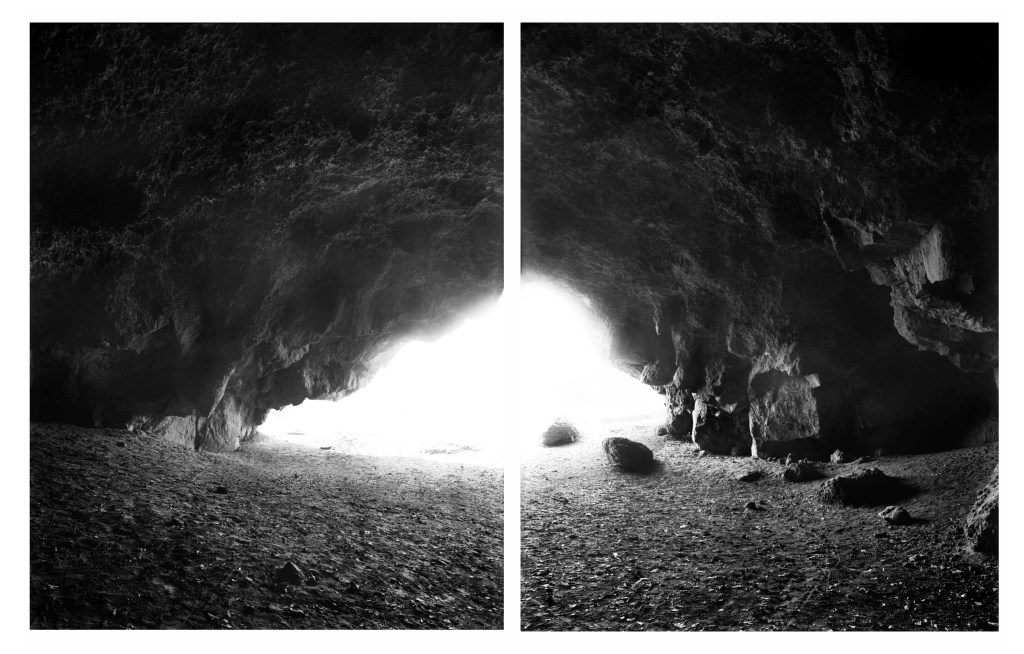
Mark Adams, 19.05.1989. Te Ana o Hineraki. Moa Bone Point Cave. Redcliffs. Ōtautahi Christchurch. Te Waipounamu South Island, 1989, gold-toned silver bromide fibre-based prints, Auckland Art Gallery Toi o Tāmaki, gift of the Patrons of the Auckland Art Gallery, 2014.

Generally, with photographs of important sites the photographer is essentially saying – “I was here – this is how it looks”. However, with many of Mark Adams photographs of historical sites, the land seems of little interest, often devoid of figures. With these the photographer seems to be saying “this is how it looked”. The photographs require the viewer to transport themselves back to that place but in another time.

Sarrah Farrar notes “His photographs of museums and art galleries remind me of the artifice and stagecraft that we are actively involved in as curators and museum professionals. Every decision we make communicates something to audiences. We construct meaning through the selection of objects (even those that are absent), their placement and their interpretation. Mark’s photographs remind me of the power dynamics and knowledge systems that are inscribed in museum, library and art gallery experiences — even embedded into the design of the buildings themselves. A great example of this is Mark’s panorama of the science-fiction-like modernist design of Berlin’s Staatsbibliothek, which feels so at odds with the fact that it’s the home of the journals of Georg Forster, the naturalist who travelled with James Cook on his second voyage.”

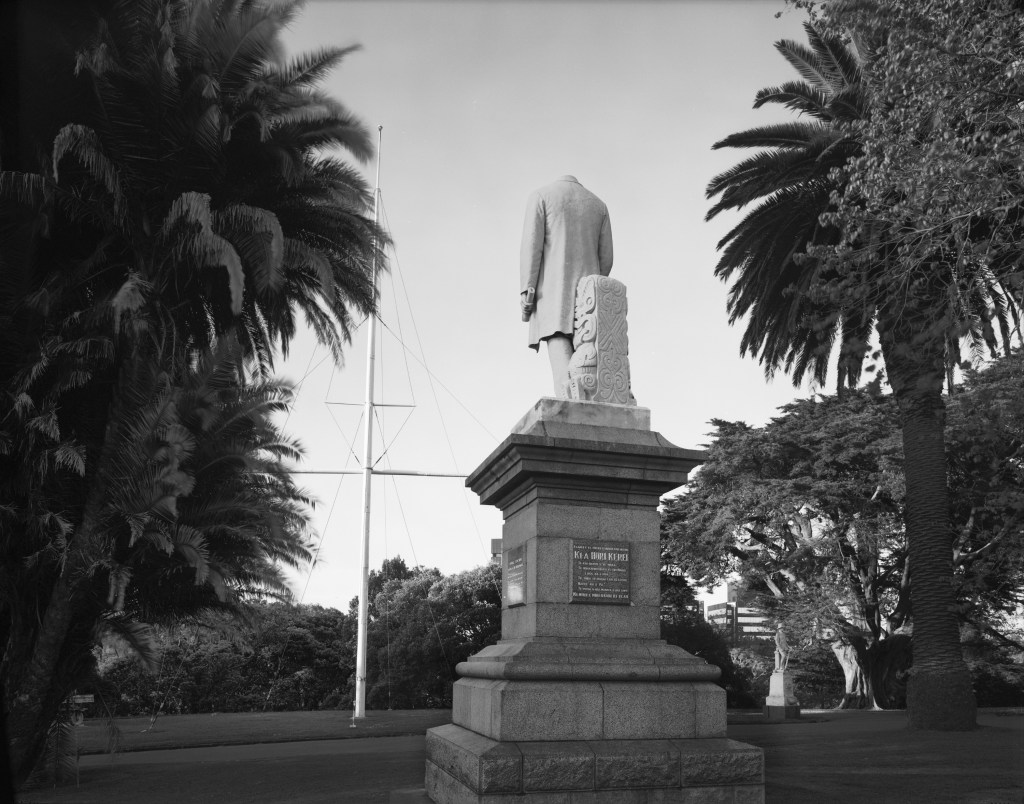
Mark Adams, 1988. Hori Korei. George Grey monument. Albert Park. Tāmaki Makaurau Auckland, 1988, silver bromide print, courtesy of the artist.

The book is a stylish, superbly-designed production with over 200 images, mainly black and white. It features  an excellent text by Sarah Farrar as well as a forward by Ngahuia te Awekotuku and afterword by Nichlos Thomas

Categories
Reviews, News and Commentary

Six The Musical: More Than Mere Glitz

Reviewed by Malcolm Calder

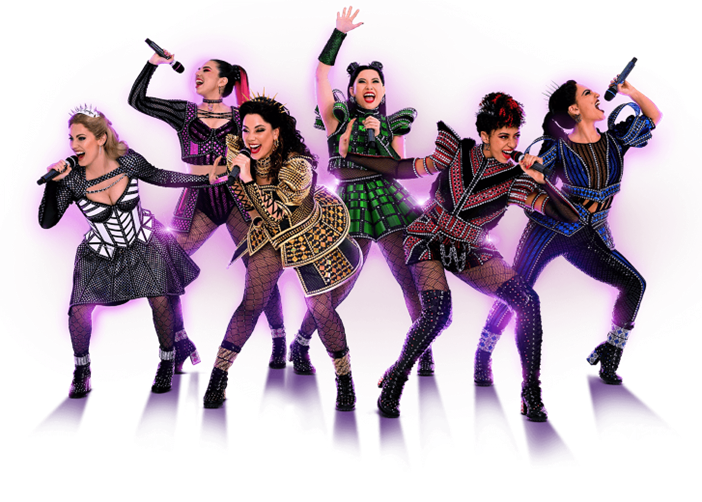
Photo : James D Morgan

SIX THE MUSICAL

by Toby Marlow and Lucy Moss

Directors Lucy Moss and Jamie Armitage

Choreography Carrie-Anne Ingrouille

Set Design Emma Bailey

Costume Design Gabriella Slade

Lighting Design Tim Deiling

Sound Design Paul Gatehouse

Orchestrator Tom Curran

Musical Director Beighton

Civic Theatre, Auckland (until 30 March)

Reviewed by Malcolm Calder

1 March 2025

It would be easy to pigeon-hole SIX as a high energy show with lots of froth and bubble, and aimed fairly and squarely at the tiktok generation.  But you would be wrong.  It is rather more.

All things must change and musical theatre is no different.  SIX is important enough to represent another of those significant change points in history – following in the footsteps trodden by Oklahoma or West Side Story or Cats or Hamilton.

On leaving, I overheard an audience member mutter something about SIX being really just a glossed up pub cabaret.  And, to a certain extent, it is.  Originally conceived by a couple of then relatively unknown Cambridge students in 2017, Moss and Marlow took it to the Edinburgh Fringe that year, was a huge success and soon wound up at the Arts Theatre in the West End before a Broadway opening almost immediately before Covid struck.  There was a sort of relaunch in 2021 and SIX now enjoys semi-permanent residence in both London and New York and has gone on to world-wide success with multiple productions all over the anglosphere, as well as Europe and in Asia.

So what has driven this success? A well-known Australian commentator once suggested it resembles a Spice Girls concert directed by Baz Luhrman – but one where the girls can actually sing.  Quite apt I thought at the time.  But this show is a lot more than that.  It is VERY much a significant part of the musical theatre tradition.  In fact there are so many references, acknowledgments and subtle nuances running through SIX that enumerating all of them becomes difficult.

First and foremost, this is a NOW show.  As such it reaches its target easily and then some. So, yes, to the tiktok generation.  But it is  bigger than that and, while it might help grow memberships of amateur music theatre organisations, that is rather simplistic view as it impact is considerably greater. Not to put too fine a point on it, the key fundamental of SIX is pure entertainment built around that old adage – a good story told well that enthrals its audience.  And good entertainment knows no age boundaries – the grandmother in front of me was up and out-boogying her two grandchildren at the end.  Underlying import counts too. 

The stories of the six queens are told in the language of the second decade of the 21st century – not by the archival or even slanted recollections of historians about the politics and intrigue surrounding the first Tudor king.  Most of whom were men, and of a fairly clearly-defined social class at that.  Further, it is told from a women’s perspective.  And remember, some of the queens were all exceptionally young when they married and the Royal Court revolved around power, politics and intrigue.  So we leap immediately to empowerment for women – a rallying cry for millions – and a clear audience profile for SIX.

Structurally, as the fairly comprehensive promotional campaign has pointed out, SIX is built around a history lesson and a competition.  OK.  Thank you.  Got that.  It puts the six queens up against each other each other – an Eisteddfod if you will – or is that merely a device for something bigger?

The six queens never leave the stage and their individual songs merge into six-voice choral arrangements, complimentarily and contrapuntally at times, with occasional snatches of spoken dialogue (but not very much at all).  The staging itself is outstandingly conceived by Emma Bailey and reflects a modern high-tech concert stage that integratesTim Deiling’s dynamic lighting and Paul Gastrehouses’s sound in a way that clearly works.  The stage is also peopled by an astonishingly well-rehearsed, syncopathic and complimentary all-girl band for the entire show.

This primarily Australian cast comes well credentialled.  Dancing skills are clearly in evidence with very tight routines throughout and, even if there were one or two very minor vocal wobbles, vocal strength was generally strong and led by the assurance of Loren Hunter (Jane Seymour).  But let’s face it, this show is presented more like an eisteddfod or a competition and it doesn’t really matter – one voice will always overlap another. The tenderness of Heart Of Stone and the hilarious rap of Haus of Holbein were both standouts for me.

The primary focus of attention however is largely rivetted on Gabriella Slade’s award-winning costumes. Little wonder that her outfits have a dash of Spice Girls about them as she devised Spice World back in the 1990s.  But now she has embellished some glittering and futuristic sequinned outfits in ways that not only catch the eye, but help tell each queen’s story.  The ‘beheadeds’ have chokers for example, Jane Seymour’s black and white bodice echoes the half-timbered houses of Tudor England, the green of Anne Boleyn’s outfit references the popular myth that this evergreen was composed by the much-wedded Henry VIII himself (that’s factually incorrect, but let’s stick with the myth). It’s interesting that one interpretation of this song concerns the promiscuity in young women, something Henry’s henchman Archbishop Cranmer used in arranging divorce and subsequent beheading.

The references go on.  In fact they are never ending.  There are the pop divas found in the songs : I think I heard echoes of Beyonce, Ariana Grande and Alicia Keys and probably missed a few more.

The sense of fun and campness is constant.  SIX takes neither itself, nor musical theatre in general, seriously and whimsy is everywhere.  Phones in the theatre, for example, were quite correctly asked to be turned off pre-show and then during the encore (or more correctly the ‘finale’), encouraged the audience to light them up again.  And they certainly did. It was another moment of sheer joy and made the audience a part of the show. I think that grandma in front of me got a pretty good video take.

Any good production simply tells a story.  SIX does so with succinctness and very, very well.  It is not a long show, but is pretty demanding on both voices and the attention-span of audiences.

I always relish a well written show that is objective and contemporary rather than one that delves into the introspective meanderings of L-plate writers.  SIX is mature writing and very clever staging.  

The filmed on-stage reunion of Six’s original West End queens will be released in cinemas next month and, rather ironically, Auckland’s Civic remains one of the larger in-theatre venues it has played.  After here, it’s off to complete its second lap of Australia at the Civic’s sister in Newcastle, while Asia awaits

To subscribe or follow New Zealand Arts Review site – www.nzartsreview.org.

The “Follow button” at the bottom right will appear and clicking on that button  will allow you to follow that blog and all future posts will arrive on your email.

Or go to https://nzartsreview.org/blog/, Scroll down and click “Subscribe”

Categories
Reviews, News and Commentary

ATC’s six plays for 2025

John Daly-Peoples

Murder on the Orient Express

AUCKLAND THEATRE COMPANY 2025 SEASON

John Daly-Peoples

Auckland Theatre Company have announced their 2025 Season of six plays ranging from Shakespeare’s 400-year-old Romeo and Juliet to Roger Halls latest.

These plays include two world premieres, an Auckland premiere, and a translation of a one of the classics. The productions will be directed by some of the country’s best talent including Shane Bosher, Oliver Driver, Benjamin, Alison Quigan QSM and Katie Wolfe,

The Plays

a mixtape for maladies
by Ahi Karunaharan
4 – 23 Mar
Ahi Karunaharan’s talesweeps from 1950s Sri Lanka to modern-day Aotearoa. Directed by Jane Yonge (Scenes from a Yellow Peril) this is both a love letter to Sri Lanka and a lament, the story plays out over 17 songs – ranging from Dusty Springfield to La Bamba to the hit single from a Tamil rom-com.

A collaboration between Agaram Productions, Auckland Theatre Company and Te Ahurei Toi o Tāmaki Auckland Arts Festival.

Agatha Christie’s Murder on the Orient Express
Adapted for the stage by Ken Ludwig
22 Apr – 10 May
The classic that birthed an entire genre comes to the stage with Cameron Rhodes (King Lear, North by Northwest) as the inscrutable Hercule Poirot, supported by Rima Te Wiata, Sophie Henderson, Ryan O’Kane and Mayen Mehta. This play was adapted for the stage by Tony-nominated playwright Ken Ludwig and is directed by Shane Bosher.

Roger Hall’s End of Summer Time
17 Jun – 5 Jul
New Zealand’s most successful playwright Sir Roger Hall brings back one of his most famous characters, Dickie Hart who made his first appearance almost 30 years ago in C’mon Black. This is an affectionate and hilarious skewering of an old grump who realises he still has a lot to learn about the world when he moves to Auckland to be closer to his grandkids. Directed by theatre stalwart Alison Quigan, the play sees Andrew Grainger (Peter Pan, North by Northwest) bringing his big-hearted comedic talent to this solo show that like, all of Hall’s plays, has more than a little bite to it.

William Shakespeare’s Romeo and Juliet
15 Jul – 9 Aug
William Shakespeare’s tale of passion and heartbreak is recast as a fast-paced thriller in this large-scale production of Romeo and Juliet, directed by the co-director of 2023’s runaway hit King Lear, Benjamin Kilby-Henson. Theo Dāvid (Shortland Street) and Phoebe McKellar (One Lane Bridge) make their Auckland Theatre Company debuts as the star-crossed lovers in a Missoni and Pucci-inspired take on 1960s’ Italy, supported by a stellar cast including Bronwyn Bradley, Miriama McDowell and Beatriz Romilly. As potent today as it was when written more than four centuries ago, this tragedy celebrates the triumph of love over hate.

Mary

MARY: The Birth of Frankenstein
by Jess Sayer
19 Aug – 7 Sep
A villa in Switzerland, in the dark winter of 1816. Mary Shelley stands over a bloodied corpse and knows her words are to blame. The script, written by award-winning playwright Jess Sayer in collaboration with Oliver Driver, builds on the bones of history to re-imagine the events of the infamous night that birthed one of the most famous novels of all time: Frankenstein. In Mary: The Birth of Frankenstein, co-created and directed by Oliver Driver (Amadeus), the production transforms from a parlour drama into an unsettling, drug-fueled, lust-drenched Gothic horror as Shelley, played by Olivia Tennet, casts off the men who seek to control her and steps from childhood into life.

Tiri: Te Araroa Woman Far Walking

TIRI: TE ARAROA WOMAN FAR WALKING
by Witi Ihimaera
4 – 23 Nov
The Season closes out with a history-making new adaptation of the epic tale of Tiri Mahana, a 185-year-old matriarch, from her birth at the signing of the Treaty of Waitangi to present day Aotearoa. For the first time, the play will be performed in two parts, English and te reo Māori, with both versions capturing the enduring spirit of Te Ao Māori. With the multi-award-winning team of The Haka Party Incident creator Katie Wolfe (Ngāti Mutunga, Ngāti Tama) and actor Miriama McDowell (Ngāti Hine, Ngāpuhi); Witi Ihimaera’s (Te Whanau a Kai and Ngāti Porou) extraordinary play will shine once again, re-imagined in te reo Māori by Maioha Allen and company.

Categories
Reviews, News and Commentary

Tempo Dance Festival: In Transit, Matter and Slip

Reviewed by John Daly-Peoples

In Transit

Te Rerenga o Tere | Tempo Dance Festival 2024

Rua, – In Transit & Matter

Q Theatre

October18

Slip , Rebecca Jensen

October 20

Reviewed by John Daly-Peoples

In Transit

Choreographer, Louise Pōtiki Bryant

Sound / Av, Paddy Free

Lighting, Jo Kilgour

Costumes , Kasia Pol

Slip, Rebecca Jensen

Louise Pōtiki Bryant’s In Transit imagines the links between Maori  myth, ritual and their notion of the ancestors observing the nutuarl  world and its cretasures. Here the shaping of the creation myths, are given narratuives and images which give meaning to the transition in human life  paralleling those of the spirit world.

The work appears to dwell on several aspects of Māori myth such as the creation story of Ranginui and Papatūānuku, whose, children exist for a time in  in the dark world until Tāne, separates their parents, bringing the children into light.

There is also reference to the evolution of the  taiaha which Tū, the god of war asks Rūrūtangiākau, the weapon maker of the gods to create a weapon.

The dance opens with a low droning sounds as the sole figure, representing Tū or Rūrūtangiākau who dances through shafts of light with a  branch balanced on his head., He moves from an underworld into light and is joined by five other dancers who perform with long sticks or the evolving taiaha. They dance to a soundscape which [provides a sense of the being under water along with bird sounds.

The dancers seemingly inspired by bird and reptile  movement, move with short sharp steps id birds, strutting, foraging and pecking. These  movements were accompanied by staccato like breath which add to the sense of existing n another dimension.

Some of the dancers entwine cresting manaia shapes suggesting the notion of messenger between the mortal and spirit worlds.

The slender taiaha are used to create a Papatūānuku womb-like shape out of which  a figure emerges.

The work is full of robust dancing, flickering shafts of light along with a mesmerizing soundtrack along with relentless beats. It blends together sound, music, visual and movement describing the transitions between the physical world and the spirit dimensions.

Matter

Matter

Choreographer & Sets, Ross McCormack

Composer, Jason Wright

Lighting, Jo Kilgour

Costumes , Vicki Slow

“Matter” choreographed by Ross McCormack opens with a lone figure seemingly transfixed by one of the five post erected on the stage. He was joined by another figure and from their fitful movements it appears that they are inhabiting a world where they are seeking, discovering or being activated by lines of force or energy, possibly emanating from the poles.

Then they are joined by a group of dancers who move to a cacophony of sound, inching forward, creating a reptilian-like form with a nod to the work of the German choreographer Pina Bausch. Their erratic shuffling moves, driven by an inner tension and massive roars of music is by turns orderly as though responding to laws of Nature or manipulated by an unseen hand.

Two of the dancers appear to respond to other sounds as though out of their control and they engage in movements which area mix of tussle and dance, their movements  hinting at forces which are attracting and repelling g them.

We get the sense that the poles are the xxx of these forces-  electromagnetic, natural rhythms or xx.  Other bodies separate and merge becoming alien creatures and the sounds and music we hear are the sound of  massed bodies  and the arms and legs becomes tentacles.

Throughout the work the dancers seemed to be either seduced or buffeted by the music and sounds, their movements at times urgent and  sharp while at other times graceful and submissive.

In the latter part of the dance the poles /  pou are moved taking on more symbolic meaning- the crucifixion, the triumphal Iwo Jima image  of WWII.

There is a surreal beauty to the dancing which is created with a subtle mix of  sound and lights while at one point the music takes on the rhythms of the Pacific with a hypnotic quality.

Another dramatic sequence involves first two dancers and ultimately all eight moving and dancing as mirror images of each other creating a dramatic frieze. This architectural aspect is also present in many of the other sequences, deriving from the five poles.

Much of the time the dancing could be likened to the movements of atoms and molecules in chemical and physical reactions, conforming to notions of particle physics and string theory.

Slip

Slip, Rebecca Jensen

We don’t often get to see true absurdist dance in the style of the absurdist dramatic works of the 1950s and ’60s. Nothing that suggest the human condition is essentially absurd and devoid of purpose.

Rebecca Jensen’s “The Slip” seemed to offer an absurdist dance which was set in a bizarre or surreal environment. The stage looked like an art installation  – a step ladder, bucket, watering can, a table cluttered with apparatus, a sole cup and a large, directional microphone.

The opening minutes of the work continued the absurdist premise as we watched a couple of stagehands pouring water into containers and splashing it over  the stage. It looked as though it was a work about sea level and climate change. This idea was reaffirmed throughout  the production with images and the sounds of water.

After that opening  sequence Rebecca Jensen appeared, dressed in a medieval gown, the first of her iterations. She sat, meditatively  on the stage, performing simple gestures which were  in marked contrast to her hectic movement in the latter part of the work.

“Slip” is a filled with precise  and deliberate movements, mixed with moments of humour and provocation. It is an experimental work where the  flaws and interventions that show up over the course of the performance add to its idiosyncratic quality.

It’s a work which can be interpreted as having  surreal narratives, the themes of which will occur to the individual viewer as they come to grips with  the many vignettes.

The focus of the work comes from the title, ”Slip”. There is a constant slippage between what we see and what we hear, between what is natural and what is fabricated between the  role of the performer and the place of the technician.

While Jensen is the dancer/actor in “Slip” she is aided by Aviva Endean who acts as sound technician, participant and  guide,  controlling a table full of noise producing devices both physical and electronic.

When Jensen first appears, she dives into her backpack extracting various items such as a key, a bag of chips a bottle of water and a newspaper. But when she handles these items, it is not their natural sound we hear, it is Endean – shaking her own newspaper and pouring her own bottle of water, the sounds picked up and enhanced by the large microphone. When Jensen eats a chip, the crunch we hear is from Endean’s microphone enhancing the sound of her biting on a stick of celery.

This dislocation and enhancement occurs throughout the work in different forms. When Jensen walks around the stage we hear the sounds of Endean’s feet crunching on shells. At other times when Jensen walks, we hear the sounds of her body creaking as though she is robotic.

Jensen explores a range of movements from small gestures though fluid and dramatic balletic moves to the volatile actions which see her almost out of control.

The soundscape produced by Endean is similar to the enigmatic sounds created by the experimental group From Scratch and like that group she uses unlikely items to create the sounds.

Categories
Reviews, News and Commentary

The Apprentice: Trump’s early days of learning the art of corruption

Reviewed by John Daly-Peoples

Jeremy Strong (Roy Cohn) and Sebastian Stan (Donald Trump)

THE APPRENTICE

Directed by: Ali Abbasi

Duration: 120min

In cinemas from October 10th

Reviewed by John Daly-Peoples

Some of the more interesting aspects of the Donald Trump biopic, “The Apprentice” are around its funding and distribution. Unlike most US films it was largely financed by Irish and Danish organisations and none of the major distributors would touch the film, fearing the wrath of the ex-president. To fund the distribution of the film in the US the producers initially had to launch a Kickstarter fund before it was eventually picked up.

The film is directed by  the award-winning Iranian-Danish filmmaker Ali Abbasi and looks at the life of Donald Trump in the 1970’s and 1980’s as he made his first moves into the New York real estate business.

It’s in two parts with the first set in the seventies when Trump is just starting out, working for his father as not much more than a rent collector as he embarks on his own career. The second part is set in the eighties when he is wielding more power and influence.

Along with Trump, the main protagonist is the influential attorney Roy Cohn  who gained prominence for  successfully prosecuting the American spies, Julius and Ethel  Rosenberg leading to their execution in the early 1950’s.

He  manipulated the legal system on behalf of powerful, conservative figures but lived as a closeted gay man, publicly denying his AIDS till the day he died.

Trump becomes the apprentice to Cohn as he assists him in his efforts to circumvent New York City planning restrictions to build Trump Tower and helps Trump amass wealth and power through deception, intimidation and media manipulation.

Cohn’s advice to Trump consisted  of three simple rules.

Rule 1. Attack. Attack. Attack. Rule 2. Admit nothing. Deny everything. Rule 3. Claim victory and never admit defeat.

We see how these become the foundations of Trump’s later ways of dealing with individuals, organisations and the media, as President and in his present-day speeches and interviews.

Abbasi depicts Trump as something of a loner, often in the presence of other people but with no close friends. Even his family relationships are fraught notably  with his “loser” brother Freddie who is only an international pilot and later a drug user who Trump won’t put up at his place.

The film does not completely vilify Trump and there are some sympathetic touches but it does show that he is a flawed character both from his upbringing as well as  his relationship with Cohn and these experiences do nothing to make him more sympathetic towards other people.

Sebastain Stan cleverly displays many of the characteristics of the later Trump and we see how he is progressively imbues Cohn’s cynical view of people and the world – there to be taken advantage of.

Jeremy Strong as Roy Cohn presents an almost totally amoral character who apart from his three rules of getting ahead also reveals a disdain for weakness in others and a savagery in getting his own way.

Maria Bakalova (Ivana Trump) and Sebastian Stan (Donald Trump)

Trump’s relationship with his first wife Ivana (Maria Bakalova) and his father Fred (Martin Donovan) are loosely sketched in but they could well have been fleshed out a bit more to add depth to the psychological study of Trump but they do suggest aspects of his personal relationships and the need to dominate .

Screenwriter Gabriel Sherman has skilfully crafted Trumps ascent with his actual recorded dialogue, written words  as well as some  well devised dialogue.

Categories
Reviews, News and Commentary

Resetting the Coordinates of Performance art in NZ

Reviewed by John Daly-Peoples

Resetting the Coordinates

An anthology of performance art in Aotearoa New Zealand

Edited by Christopher Braddock, Ioana Gordon-Smith, Layne Waerea and Victoria Wynne-Jones

Massey University Press

Published September 2024

RRP $65.00

Reviewed by John Daly-Peoples

In 2014 The Walters Prize  included a work by Kalisolaite ‘Uhila where the artist inhabited the Auckland Art Gallery precinct for several months, living as a homeless person – eating sleeping and communicating with visitors, staff and other destitute  people. The work  was intended to draw attention to the plight of the homeless.

However, going to the gallery to find the ”art” and the artist necessitated searching the art gallery, the nearby park and streets until I found him wedged into an overhang on the gallery’s roof.

This search seemed more like a game of hide and seek rather than being immersed in a social /political experience /experiment. At the time It seemed to only involve me and the artist, reflecting on an encounter.

That encounter is what can loosely be called an example of  post-object art or performance art which has been evolving in New Zealand since the 1970’s.

With that encounter and many others one can see that performance  art requires an audience as well as documentation as many of the events are transient.

Now an  anthology/reader of performance art in New Zealand, ”Resetting the Coordinateshas been published,providing an in-depth survey of the artists and artworks in the  performance area which have happened over the past fifty years.

At the core of performance art  is the audience and the performer/artist,  the works having a theatrical element to them in which artist often draw attention to time, space, and body,

The  goal of these actions is to generate a reaction with themes which are commonly linked to life experiences of the artist themselves along with social and political criticism.

Darcell Apelu:, New Zealand Axemens Association: Womens subcommittee president
2 August 2014, documentation of performance.
Courtesy Artspace, Auckland. Photo by Peter Jennings

The book records a number of the activities which occurred as described in the introduction by editor Christiopher Braddock,

“If, on 2 April 1971, you had journeyed out across the unsealed metal roads to the west coast of the Tāmaki Makaurau Auckland region of the North Island of Aotearoa New Zealand, venturing as far as the remote Karekare Beach, to the north of Whatipu Beach and the great Manukau Harbour and south of Piha Beach, you would have come across the mystifying scene of ten people arduously sweeping the beach with long-handled yard brooms. “

Organised by Phil Dadson and colleagues this was the first in a series of purposeless works of which Dadson said : ‘This was work for the sake of the work, no particular purpose, no rewards’ across a ‘pointless-to-sweep stretch of beach’ in ‘communion with the elements and the place’.

These activities often existed outside the confines of the mainstream contemporary art scene  and were often undocumented. Many of the names included in the anthology will be recognisable because of their wide-ranging practice, others however have had lower profiles.

Central figures have been Phil Dadson, Jim Allen, Annea Lockwood, Peter Roche & Linda Buis, Andrew Drummond, Daniel Malone, Shannon Te Ao and Lonnie Hutchinson. There have also been numerous other practitioners who are included in the book.

Christopher Braddock, one of the editors says “Mainstream art history tends to prioritise static forms of art that are more commodifiable and saleable such as painting and sculpture. Anthologies often prioritise these artforms, such as Michael Dunn’s “New Zealand Painting: A Concise History| published in 2004. Furthermore, large-scale anthologies can cement these institutional prejudices, such as Hamish Keith’s The Big Picture: The History of New Zealand Art from 1642 (2007) which largely ignores performance art.”

The book underlines the fact that performance art is a distinctive part of recent art history, with its activities presenting  social and political  approaches which  emphasises the  connections between artist, audience and art critic /  historian.

These events often combined elements of anarchy,  humour, spirituality, repetition, the unplanned and unexpected.

There are a several chapters which examine the  history and development of performance art, some which look at the aspects of woman’s art practice, the development of Māori and Pacific based works, queer performance art and performance art in post -quake Christchurch.

There are numerous photographs and records of the activities which only give a limited appreciation of the performances such as Annae Lockwood piano burning while the multiple images of Andrew Drummond’s projects give some sense of the scale of his work.

CardboardConfessional_
Audrey Baldwin, Oscar Bannan, Bridget Harris, NeilMacLeod, Annemieke Montagne, Pat Parkin, Jennifer. Katherine Shield
2016, documentation of performance for the Centre of Contemporary Art Toi Moroki programme,Ōtautahi Christchurch.
Courtesy Centre of Contemporary Art Toi Moroki. Photo by Janneth Gi

Among the other projects included are the documentation project of the Christchurch “Cardboard Confessional” (2016) developed by Audrey Baldwin et al, Louise Potiki Bryant’s dance work “Te Taki o te Ua / The Sound of Rain” (2001), Jeremy Leatinu’u’s Queen Victoria (2013) where the artist contemplated statues of the queen,  Juliet Batten’s Women’s Project of 1985 at Te Henga Beach and Bruce Barber’s “Mt Eden Crater Performance  (1973) which was a collaboration with Solar Plexus as part of the drumming event initiated by Phil Dadson..

It is a fascinating book with lots of performances which have been rarely written about, seemingly lost to history but which tell us much about the social, political and spiritual examinations and soundings which artists have made.

The writers include  Natasha Conland, Gregory Burke, Ioana Gordon-Smith, Khye Hitchcock, Audrey Baldwin, Bruce E Phillips and Heather Galbraith

To subscribe or follow New Zealand Arts Review site – www.nzartsreview.org.

The “Follow button” at the bottom right will appear and clicking on that button  will allow you to follow that blog and all future posts will arrive on your email.

Or go to https://nzartsreview.org/blog/, Scroll down and click “Subscribe”

Categories
Reviews, News and Commentary

Wall to Wall Māfana

Red White and Brass: The Play

Stage adaptation by Leki Jackson-Bourne

Directors, Anapela Polata’ivao, Vela Manusaute

Musical Director, Joanna Mika Toloa

Production Design, Sean Coyle

Costume Design, Chrissy Vaega

Sound Design, Matt Eller

Choreography, Mario Faumui

With Haannz Fa’avae-Jackson, Mikey Falesiu, John-Paul ‘JP’ Foliaki, Onetoto Ikavuka, Saala Ilaua, Diamond Langi, Lauren Jackson, ‘Aisea Latu, Jason Manumu’a, Rocky Manusaute, Michaela Te Awa Bird, Kasi Valu

Original screenplay by Halaifonua Finau and Damon Fepulea’i

Co-produced by Piki Films and Miss Conception Films

A World Premiere

ASB Waterfront Theatre

Until 7 July

Reviewed by Malcolm Calder

Last weekend I had a cold and spent most of it confined to quarters.  You know – a bit of this, a bit of that and an overly-heavy dosage of highly-predictable news, current affairs and media gossip monochromatically detailing financial woes, political faux pas, a couple of murders, the inevitable obsession with car crashes and countless opinion from a whole heap of ‘experts’ confidently predicting an imminent emigration across the ditch. I was miserable.

Then I went to the Auckland Theatre Company’s world premiere of a new stage production of Red, White and Brass: The Play!  And I wondered what I was being miserable about.

The basic plot is well publicised and closely follows the original screenplay of the same name by Halaifonua Finau and Damon Fepulea’I about sporting underdogs who over-achieve just as Eddie the Eagle and those Jamaican bobsledders did at the Olympics.  Hollywood loves a good sports story especially where the underdog comes out on top and this story has a unique local flavour.

But this stage production is more subtly nuanced, goes well beyond sport and is weighted more towards capturing hearts and minds in ways that both embrace and express the social psyche that is Tongan Māfana.

It is a thing that generates joy and, without being in the slightest bit didactic about all things Tongan,

it assumes a knowledge of many things in a long, long list.  These range from the place of religion to the place of rugby; from gently acknowledging the contrapuntal role of the matriarch in a purportedly patriarchal society; from an acknowledgement that achievement rests ultimately on aspiration; from generational clash to resolution and to an understanding that even addresses the subsets within the contemporary urban Tongan diaspora in Aotearoa.

As Leki Jackson-Bourne has noted… this production is loud, proud and unapologetically Tongan. It is a statement about community, heritage and sense of self.  But it is more than that.  It also says something very important about our increasingly multicultural society and as such provides a further plank in the evolution of New Zealand theatre history.  It does so with unashamed pride and joy, and celebrates both.

JP Foliaki reprises the movie role of Maka, arguably with more light and shade than the movie allowed, and his relationship with his ‘bit less Tongan’ cousin Veni (Saale Ilaua) is well handled.  Overall the cast is strong and well-balanced and their choral work mesmerizingly memorable.

Sean Coyle’s busy set morphs well in multiple directions, the costumes are a hoot and the dialogue a completely understandable mix of Lea Faka-Tonga and English. The finale is a triumph- but no spoiler alert from me other than to say the band grows on one.

Congratulations to Auckland Theatre Company and mālō Leki – the last vestiges of my cold vanished on the spot!

To subscribe or follow New Zealand Arts Review site – www.nzartsreview.org.

The “Follow button” at the bottom right will appear and clicking on that button  will allow you to follow that blog and all future posts will arrive on your email.

Or go to https://nzartsreview.org/blog/, Scroll down and click “Subscribe”

Categories
Reviews, News and Commentary

Swan Lake: A Warm Glow Inside

Image Stephen A’Court

Swan Lake

Royal New Zealand Ballet in association with AVIS

Choreography: Russell Kerr ONZM QSM after Marius Petipa and Lev Ivanov
Staging: Turid Revfeim

Set & Costume Design: Kristian Fredrikson

Lighting: Jon Buswell

Music: Pyotr Ilyich Tchaikovsky

Auckland Philharmonia, Conductor Hamish McKeich

Kiri Te Kanawa Theatre, Aotea Centre, Auckland until 12 May

Review by Malcolm Calder

Swan Lake is a classic. And rightly so.


This production, originally choreographed by the legendary late Russell Kerr, lives on and will continue to remain something of a benchmark for the company.


Swan Lake is a work of staggering beauty and power. The magic of the swans, the sumptuous costuming and the elaborately subtle set changes continue to captivate.


Mesmeric and somehow timeless, it truly suspends disbelief, draws on both imagination and
emotion and eventually ushers its audience homeward shrouded in an inner warmth and secure in the knowledge that tradition is something to be both valued and prized.


The work itself is as familiar as old boots, is far removed from the concept of a ‘hackneyed standby’ as occasionally perceived by some, and showcases the traditions, skills and techniques that are such an essential part of the artform.
Drawing on sets and costumes nearly 30 years old, this RNZB Swan Lake remains lush, vibrant and very, very satisfying. Assiduous attention to detail has resulted in a restoration job to be applauded,

giving Wardrobe a more than gentle workout and Staging with a restoration that is far from counterfeit.


Other commitments prevented this reviewer from attending Opening Night in Auckland, and I was delighted to be able to see the second night cast with the alternate principals and some shuffles in the corp.


Under maestro Hamish McKeich, the Auckland Philharmonia brought the much-loved and thoroughly familiar Tchaikovsky score to life establishing and maintaining the atmospheric and at times mesmeric tone that marries brilliantly well with Turid Revfeim’s staging. Special mention too to the work of harpist Ingrid Bauer.


I found Joshue Guillemot-Rodgerson to be rivettingly imperious as Prince Siegfried in Act 1 – outstanding control and very much a Prince among his subjects. Then I delighted further as he smoothly grew into the smitten and then the confused, before finally leaving us with a feeling of hope for the future. It was a remarkably well-conveyed journey of maturation and growth perhaps drawing from his own journey from the one I first saw in Romeo and Juliet a couple of years back.


However, I found Ana Gallardo Lobaina initially a little aloof, daunting and even ice-like at times as Odette. Her technique was flawlessly detailed and her control immaculate but her connection with
Siegfried only really flowered for me after she had slid seamlessly into her alter ego of Odile. However I soon stopped fretting as the two came breathtakingly together in their two pas de deux in Act 3.


Dane Head was delightfully cheeky as the athletic Jester and Zacharie Dun gave us a sleek and
demonically insidious Rothbart we all love to hate.
But Swan Lake is about swans after all. At a lake. And swans, being swans, are something of pack
animals. In turn it follows that they move in unison, think in unison and breathe in unison. And these swans did so with only the slightest of occasional nerves from newcomers, conjuring images
that personify Swan Lake.
My only disappointment was that, despite their three multi-cultural scenes and significant overall contribution, for some reason the boys did no final bow at the performance I attended. What a pity – I would have applauded them too.


This Swan Lake is a rather mammoth production and RNZB is to be congratulated. It has an enormous energy, is fabulously presented and attracted an audience representing pretty much every age-group. It presents few intellectual challenges, only aesthetic ones and has many, many talking points.


As more than one writer has suggested, this alone may be responsible for drawing more children into dance than any other. That this work will tour regionally will no doubt assist this process.

RNZB Touring to:

Napier, Municipal Theatre, May 17-18
Christchurch, Isaac Theatre Royal, May 23-26
Dunedin, Regent Theatre, May 30
Invercargill, Civic Theatre, June 2