Categories
Reviews, News and Commentary

Opera Australia’s memorable Brisbane Ring Cycle

Reviewed by John Daly-Peoples

Brunnhilde and Siegfried on her Walkure platform   Image – Wallis Media

The Ring Cycle

Opera Australia

Lyric Theatre, Brisbane

8 – 14  December 2023

Reviewed by John Daly-Peoples

Opera Australia’s  fully digital Ring Cycle opened in Brisbane last month to critical acclaim and huge audience responses. Three separate seasons of the four-work opera were presented at Brisbane’s Lyric Theatre. The production was originally scheduled for 2020, but postponed twice due to the COVID pandemic,

The scale and scope of the story is epic. It follows the struggles of gods, heroes and several mythical creatures over a magic ring which has been forged by the Nibelung dwarf Alberich from gold he stole from the Rhine maidens. It is a ring that grants domination over the entire world. The drama and intrigue continue through three generations of protagonists, until the final cataclysm at the end of the final opera, “Götterdämmerung”.

Director Chen Shi-Zheng drew on the best of the best talent from Australia, New Zealand and around the globe creating a futuristic version of the Norse mythology into which he wove weave Chinese mythology into the production.

Along with some of the sculptural design features the production will be remembered for the digital staging. Designed by, Leigh Sachwitz, it made use of LED screens with AI auto-generated graphics, audiovisual projections and 3D printed set pieces.

Throughout the operas  abstract patterns and colours were used as motifs for various characters as well as being used  to represent the emotions and the internal struggles of the main characters. 

These design elements were dramatically used in the opening scene of “Das Rheingold” featuring the three Rhine Maidens who were perched on a huge chunk of coral / gold.

The Rhine Maidens              Image – Wallis Media

Above and behind them were their three doubles, who swam and cavorted in the projected waters, waves and bubbles of the Rhine as though in a huge aquarium.

Later we entered the  underground Nibelung, home to the dwarves, with its digitally created atmospheric, dark cave with accompanying brooding music.

At the opening of “Die Walkure” the stage was dominated by a large icy white, bonsai tree which featured the sword Nothung embedded by Wotan in its trunk – the sword which Siegmund later  releases. This is one of Wagner’s many nods to other mythologies in this case Excalibur, the mythical sword of King Arthur which had magical powers related to  the rightful sovereignty of Britain.

Siegmund, Nothung and the tree   Image – Wallis Media

At the conclusion of “Die Walkure” Brunnhilde (Lisa Lindstrom) ascended  a platform/ fortress  which was supported on Walkure spears. At this point as she and her father Wotan (Daniel Sumegi)  engage in an emotive duet about their parting a huge metallic Chinese dragon encircles the  platform to protect Brunnhilde, erupting with flames  from its body.

In “Siegfried” when the hero forges the broken sword, Nothung  after the failure of Mime to do so the digital screens pulsed with giant images of the sword and  flashing flames all accompanied by dancers  rushing around stage trailing ribbons.

When Siegfried enters the forest, the labyrinth he encounters is one of dramatic images, puzzling shapes and symbols while his encounter with Fafner  has him slicing into the dragon-like figure as he progresses from one realm to another though a series of grotesque images.

The final scene of Gotterdammerung     Image – Wallis Media

The conclusion of “Götterdämmerung” featured a pyramidal shape representing  a sacrificial pyre for Siegfried as well as symbolising the ancient notions of life, death and rebirth.

In the final as moments as Brunnhilde mounted the pyramid it blazed with colour while various screen images came alive with bursts of colour and ring images. Then the images which had previously been used throughout the operas were displayed in reverse order as the memories of the gods were replayed in their final moments.

Here the Rhine maidens again appeared, swimming down to retrieve the  ring from Brunnhilde before she was consumed by fire.

There were several  stand out performers in this Ring. Lise Lindstrom was a remarkable Brunnhilde, investing the role with emotional clout. Her presence on stage showed a well-honed acting ability in her various encounters with her lover Siegfried, her husband Gunther as well as her father, Wotan. Throughout her voice was sharp and she conveyed the emotional relationships with both the notions of a  demigod as well as those of a passionate human.

As Wotan Daniel Sumegi was a powerful presence on stage conveying a real sense of a god with his strange godly flaws and weird relationship with wife and daughter.

Warwick Fyfe’s Alberich was a careful mixture of the malevolent and the comic, a menacing presence in the cave of the Nibelung contrasting with his bumbling tussle with the Rhine maidens.

Stefan Vinke as Siegfried had some huge passages to sing and he dealt with them brilliantly both with his macho duet with Luke Gabbedy (Gunther) and his passionate duet with Lise Lindstrom (Brunnhilde).

The Queensland Symphony Orchestra under Phillipe Augin was probably the most impressive part of the four operas, playing for  fifteen and a half hours and never once seeming to flag.

Opera Australia’s 2024 season offers some spectacular operas performances including.

Verdi, La Traviata

2 January – 14 March 2024

Glamour, riches and a tragic secret: La Traviata is the story of a courtesan falling in love. Classic opera with stunning costumes, outstanding music and a fresh perspective.

Gluck, Orpheus & Eurydice

12 – 31 January 2024

Journey to the underworld and back with the grieving Orpheus. Awe-inspiring acrobatics meet Gluck’s exquisite music in this genre-busting production.

Mozart, The Magic Flute

1 February – 16 March 2024, Sydney Opera House
9 – 16 November 2024, Geelong Arts Centre

Embark on an enchanting adventure and meet a host of wondrous characters in Mozart’s The Magic Flute. This production in sung in English.

Bernstein, West Side Story

22 March – 21 April 2024
Handa Opera on Sydney Harbour

A musical masterpiece returns to Handa Opera on Sydney Harbour in a thrilling, larger-than-life staging. Dynamic dance numbers along with fireworks above the harbour.

Puccini, Tosca

24 – 30 May 2024, Margaret Court Arena
25 June – 16 August 2024, Sydney Opera House

A thriller with sensational music, opera’s best villain and an unforgettable ending, Tosca will keep you on the edge of your seat.

To subscribe or follow New Zealand Arts Review site – www.nzartsreview.org.

The “Follow button” at the bottom right will appear and clicking on that button  will allow you to follow that blog and all future posts will arrive on your email.

Or go to https://nzartsreview.org/blog/, Scroll down and click “Subscribe”

Categories
Reviews, News and Commentary

Auckland Choral’s exhilarating performance of Handel’s Messiah

Reviewed by John Daly-Peoples

Auckland Choral and Pipers Sinfonia           Image Randy Weaver

Handel’s Messiah
Auckland Choral and Pipers Sinfonia
Auckland Town Hall
December 17

Reviewed by John Daly-Peoples

Auckland Choral has been singing the Messiah every year at Christmastime since 1856 but despite this long history, each year Auckland Choral manages to bring a fresh interpretation with new singers.

Although it is immensely popular, with great tunes the Messiah can be a challenge to make it a truly great experience.

The work has aspects of an opera but does not have an opera’s dramatic form.  There are no characters as such and no direct speech. Instead, the text provides insights into the spiritual, emotional and psychological dimensions of Christ’s life as well as the joys and struggles of mankind. Part I deals with prophecies by Isaiah and others, and moves to the annunciation and the shepherds, the only “scene” taken from the Gospels. Part II concentrates on the Passion of Jesus ending  with the Hallelujah Chorus. Part III   covers the resurrection and Christ’s glorification in Heaven. 

A great performance of the Messiah needs to have soloists who convey the various narrative lines and psychological nuances of the work, expressing aspects of the life of Christ as well as that of the common man. It also requires an orchestra of exceptional quality to provide the emotional content and drama of the work.

With this year’s Messiah Auckland Choral and Pipers Sinfonia conducted by Uve Grodd achieved all that was necessary with an exhilarating display along with the four soloists: Kristin Darragh (mezzo-soprano), Anna Leese (soprano), Simon O’Neill (tenor) and Wade Kernot (bass).

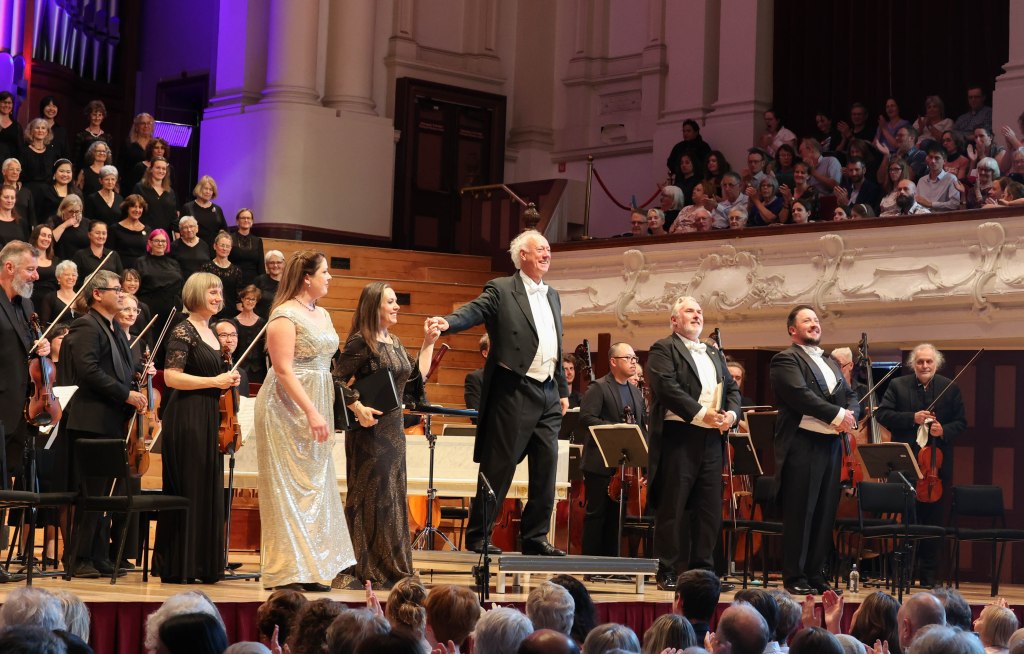
Conductor Uve Grodd with Anna Leese (soprano), Kristin Darragh (mezzo-soprano), Simon O’Neill (tenor) and Wade Kernot (bass).        Image Randy Weaver

The bass has some of best tunes to sing in the Messiah and Wade Kernot gave them a fresh interpretation making him the stand-out appearance of the concert. His singing of “The people that walked in darkness”, exposed the dark and eerie quality of the oratorio and his “Why do the nations” sounded like a powerful revolutionary call to arms.

Simon O’Neill’s “Comfort ye” was well modulated showing a superbly controlled voice making his opening recitative a moving description. His dynamism extended throughout his singing and his second half “Thou shalt break them” which was delivered with strength and precision was filled with a mix of anger and aggression.

Kristin Darragh lacked power in some of her early arias, but later on the richness of her voice allowed her to give an affecting performance notably with her anguished account of “He was despised and rejected of men” which she imbued with sorrow and despair. In the second part of the that Air she changed tempo and intensity brilliantly; Throughout she used her voice to effectively create an interplay with the orchestra which provided emotional refrains to her lines.

Anna Leese had a great stage presence with a bright, incisive voice full of drama  and feeling. She excelled in some of her singing notably in the duet “He Shall feed his His flock”, while her singing “I know my redeemer livith” showed her ability to project and to use her luxurious voice to create an intimacy with the audience,

Conductor Uwe Grodd proved himself to be a conductor who thinks through the music. There was a balance between the various parts of the orchestra and between choir and orchestra which brought out the best in the music and the singers. The choir as usual turned on a polished performance in which individual voices surfaced and merged providing an opulence and majesty to the work. The choir was electrifying in some of its choruses, producing sounds which ranged from the light and sweet to the vibrant and dark.

Their singing of the Hallelujah Chorus was a highlight while their singing of “All we like sheep” was particularly thrilling and expressive.

Trumpeter Josh Rogan gave a sensational performance in his “The trumpet will sound” ‘duet’ with Stephen Bemelman This section which ends with the words “we shall be changed” seemed to be a more appropriate ending to the whole oratorio given the power of the two performers.

Organist John Wells gave an inspiring accompaniment with some thrilling, burnished sounds which heightened the drama of many of the choruses. At times it seemed he created a cloud of sound which hovered above the choir  while at other times he produced tidal waves of sound which rolled into the audience.

To subscribe or follow New Zealand Arts Review site – www.nzartsreview.org.

The “Follow button” at the bottom right will appear and clicking on that button  will allow you to follow that blog and all future posts will arrive on your email.

Or go to https://nzartsreview.org/blog/, Scroll down and click “Subscribe”