Categories
Reviews, News and Commentary

Wellington Architecture: A Walking Guide

Reviewed by John Daly-Peoples

Wellington Architecture: A Walking Guide

John Walsh and Patrick Reynolds

Massey University Press

RRP $37.00

Reviewed by John Daly-Peoples

John Walsh and photographer Patrick Reynolds have just launched “Wellington Architecture, A Walking Guide” their third book in the series of architectural walking tours following on from their books on Auckland and Christchurch. It is a great addition to books which explore and explain our built environment.

 John Walsh in the introduction notes that he was born in Wellington which was as “compact and confined as a medieval city-state, intensely impressed itself on me, in the most impressionable part of my life. My mother had moved to Wellington where she met my father, and they were married in the church at St Gerard’s Monastery. I remember the Freyberg Pool, where I learned to swim; the summer lights strung on the Norfolk pines along Oriental Parade; and the council yard where my father worked, next to the Herd Street Post and Telegraph Building. My high school was near the old National Art Gallery and Dominion Museum; we’d be sent to mass at St Mary of the Angels and, in blazers and ties, despatched from Wellington Railway Station on rugby expeditions into the hinterlands of the Hutt Valley.”
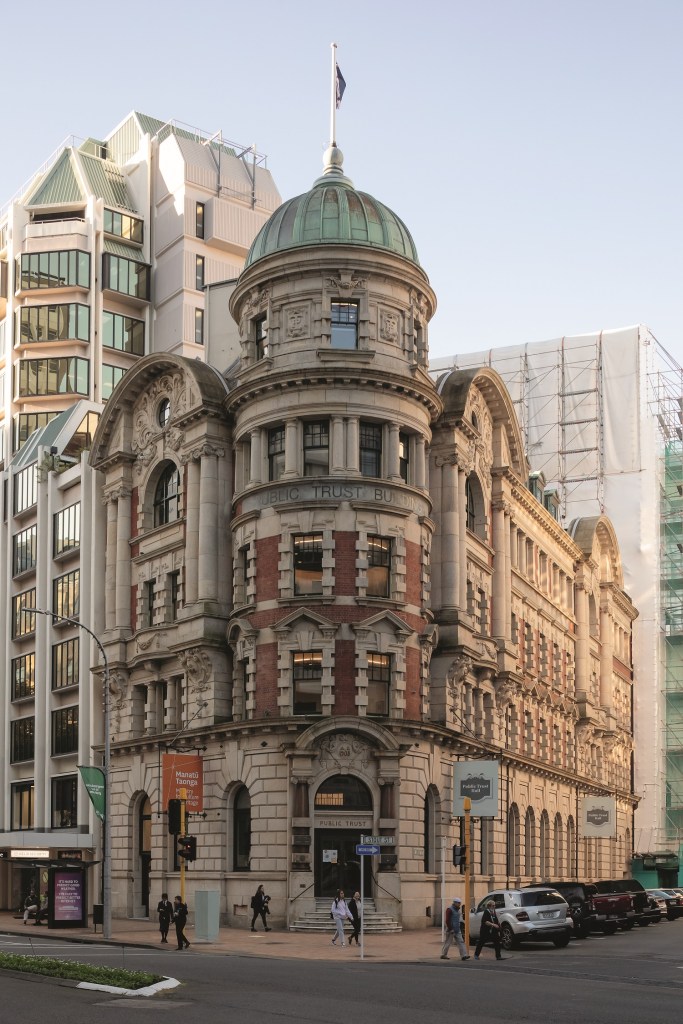
Public Trust Building

This reviewer also grew up in  Wellington, living in the National Hotel  across from  the corner of Stout St and  Lambton Quay. From our front room we had an impressive architectural vista including The Public Trust Building The Government Departmental Building and The State Insurance Building. Further down the street was the Wellington Railway Station  and the Seamans Mission Building.

On my way to school I passed  Ernst Plischke’s Massey House, The Old Supreme Court, The Old Government Building, The Beehive, Parliament building, the General Assembly Library, Turnbull House and the rather unfortunate Cathedral of St Paul. These were the background to my life at the time and it was only when I moved to suburban Karori that I noticed the difference in my daily environment.

Shed 7, Wellington Harbour Board

The place of architecture in our environment and in our personal and social history is important often more noticeable when we are in foreign cities. A city’s buildings are important in defining the nature of a place. When visiting a place for the first time the visitor will map a city through its buildings. The materials, the orientation, the colours, the decoration and the forms all help create the language of the way the city is perceived.

The buildings of Auckland Wellington and Christchurch have many similarities but the accumulation of the various periods of construction and styles in each of those places has created very individual environments.

“Wellington Architecture, A Walking Guide” features more than 120 significant buildings describing their purpose and history as well as  providing a background on  the architects who designed them. The buildings are grouped into five self-guided walking routes, each with a map together with itineraries which collectively create a portrait of the  city.
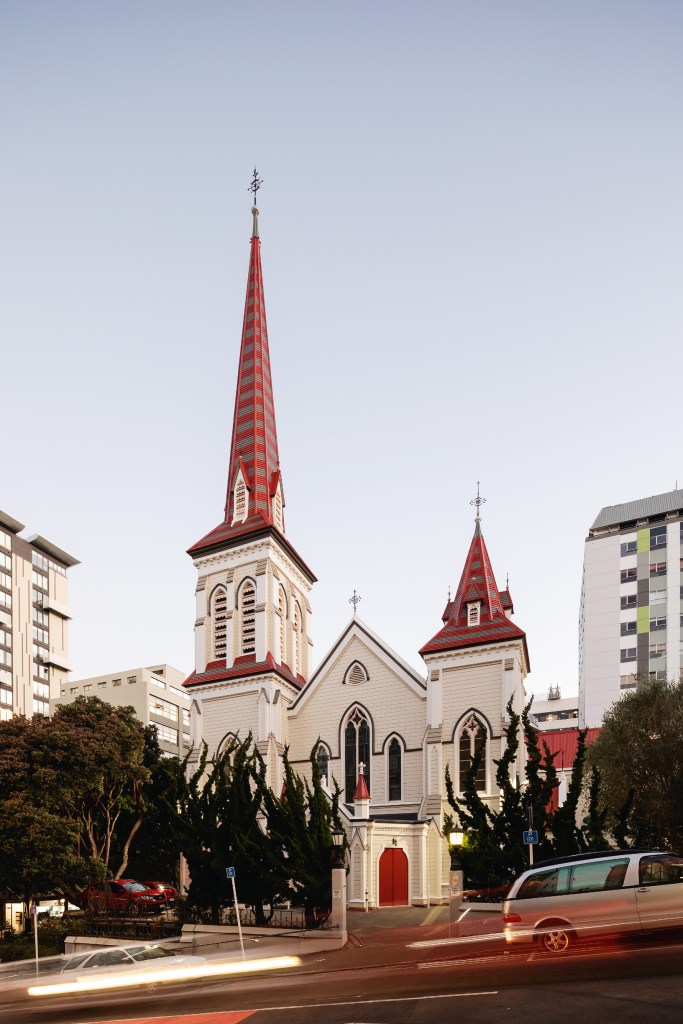
St John’s

The building are  a mix of colonial, nineteenth century Gothic, mid-century modernism and buildings of the last fifty years illustrating the changing nature of the architecture along with the changing nature of New Zealand and the city. The buildings are banks, businesses, government departments, churches, apartment buildings libraries, hotels, apartments, and a few  private houses.

One of the tours features several of the government institutions surrounding Parliament including the Old Government Building (now the Victoria University Law School) and one on the largest wooden buildings in the world, all those other buildings I passed on the way to school along with the more recent  brutalist National Library and the modernist Freyberg Building.

Several architects feature with a number of buildings such as Gummer & Ford, Thomas Turnbull and Ian Athfield who is represented by the Wellington Library (soon to be reopened) and his Oriental Parade flats as well as a few, often controversial,  additions he made to existing buildings

DeLoitte, 20 Customhouse Quay

While all the buildings are significant there are a number  scattered through the  walk which have importance beyond their architectural qualities. There are the Dixon Street Flats which were the first multi-story modernist block of flats created under the First Labour Government which show the influence of overseas trends introduced to New Zealand by Plischke.

There is also the remarkable Futuna Chapel designed by John Scott the Māori architect who managed to combine aspects of Māori and mainstream architecture. Walsh notes that Futuna is  one of the few buildings one could refer to as “iconic”.

Asked which building he regarded as the most interesting new building in Wellington he has stated that it is Heke Rua the new building for New Zealand’s Archive beside the National library, both for its architecture as well its signaling a commitment to preserving the nations documentary heritage.

Walsh writes in an informative style, providing wide ranging information to provide a context for the buildings so that while the book is an ideal complement to a walking tour of the city it is also provides a potted history of the social, political and aesthetics development over 150 years in the city as seen through the buildings.

The photography of Patrick Reynolds enhances the text with many of them showing an appreciation of the design elements of the buildings, 

Anscombe Flats
Categories
Reviews, News and Commentary

Ray Ching: the huia & our tears

reviewed by John Daly-Peoples

Ray Ching

the huia & our tears

ARTIS Gallery

RRP $80.00

Reviewed by John Daly-Peoples

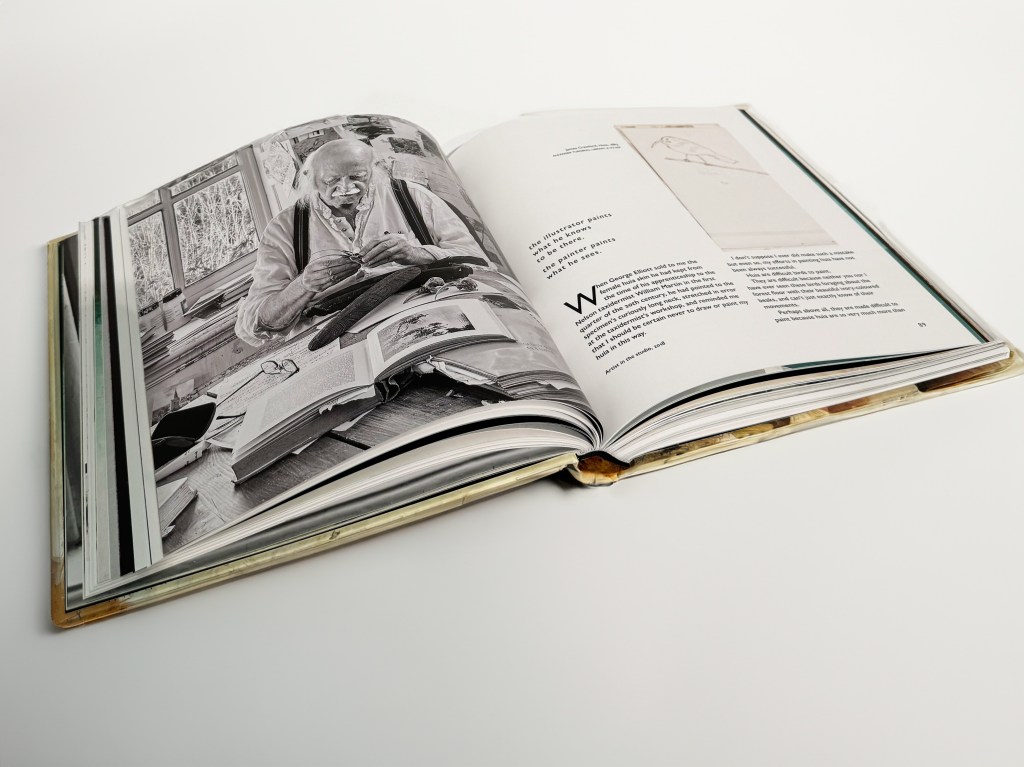
With his latest book “the huia & our tears” Ray Ching has shown once again that he is not just a great painter, he is also a clever storyteller and an expert ornithologist.

The large format book like all his previous publications is impressive with full colour reproduction, Illustrations spread over two pages, great typography and well researched text. It adds greatly to our understanding and appreciation of the huia which disappeared in the early years of the twentieth century.

The book is a remarkable collection of memories, observations, research and reflections on the huia and its place in New Zealand ornithological and national history.

Ching has had an interest bordering on obsession with the huia from an early age noting that he had always had the bird with him, connected by its image on the old New Zealand sixpence.

Included in the book are the artist’s encounters with taxidermists, ornithologists, writers artists and major figures in New Zealand’s history who provide fascinating insights into the history of the huia.

The Kite and the huia (detail)

In many of his previous books notably his Aesop’s Kiwi Fables  he has included moral tales featuring figures from the animal kingdom. In this  book he has included several examples of these including  “The huia and our tears as well as “The kite and the huia”

He includes early reports of the huia by Charles Heaphy, Edward Jerningham Wakefield and Ernest Dieffenbach as well as Walter Buller’s description of the huia where he wrote:

“The Huia never leaves the shade of the forest. It moves along the ground, or from tree to tree, with surprising celerity by a series of bounds or jumps. In its flight it never rises, like other birds, above the tree tops”.

There are a number of other mentions about the bird such as the poem “The Huia” included in Eileen Duggan’ s 1929 publication “New Zealand Bird Songs”  The final verse of this poem reads:

Where is it now that once was high?

Where is it now, where is its wing?

Where is the Prince of the leaves and sky?

Where is the King?

Ching notes that many of the illustrations of the huia are from examples held in museums but only few from recently killed birds which accounts for the lack of dramatic colouring as the plumage has faded.

Ray Ching, Huia (detail)

In this respect he notes that the work of Keulemans who produced the illustrations for Walter Bullers books on New Zealand birds may be the most accurate as he normally received his birds sent by Buller to Europe within a few weeks of their death.

There is a series of portraits of  Māori by Lindauer and Goldie in which the sitters have worn huia feathers in their hair with Ching referencing the use of the bird’s feathers by high-ranking Māori. Included in these portraits are images Pane Watene (Ngati Maru) and Tawhiao Matutaera Te Wherewhere (Ngāti Mahuta).

Gottfried Lindauer, Pane Watene (Ngati Maru)

As well as Chings account of his sixty-year interest in the huia he includes another important text.

The now out of print publication “The Book of the Huia” written by W.J. Phillipps and published in 1963 is reproduced in full providing additional information . In it the author included conversations and correspondence of early settlers and the place of the huia in the lives of Māori.

He also provides details of the bird’s life from birth through its use as a food and its feathers for decoration both for Māori and later Europeans and its wholesale slaughter in the late nineteenth century and inclusion in museums across the globe.

Ching also includes  details of all the huia held in the many New Zealand locations as well as the UK, America Germany

Categories
Reviews, News and Commentary

A Different Light: First Photographs of Aotearoa

Reviewed by John Daly-Peoples

A Different Light: First Photographs of Aotearoa

Auckland Museum

April 11 – September

A Different Light: First Photographs of Aotearoa

Auckland University Press

RRP $65.00

Reviewed by John Daly-Peoples

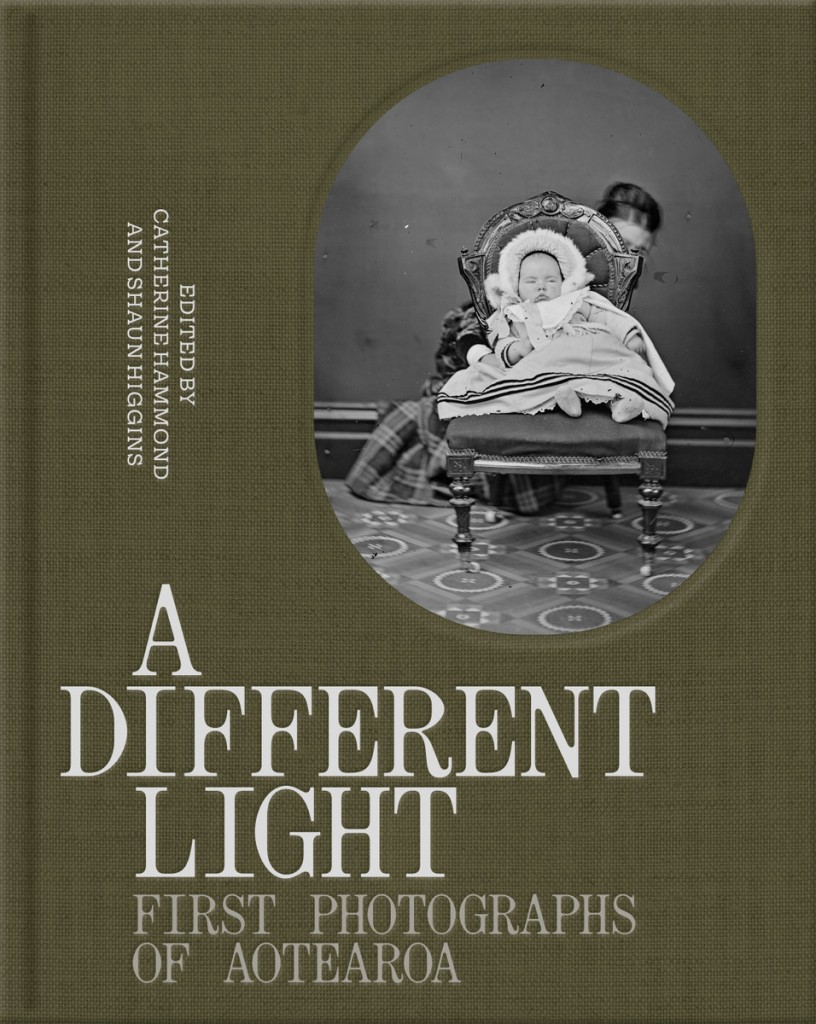
Opening at the Auckland Museum this month is the exhibition “A Different Light: First Photographs of Aotearoa” which will also see the launch of the book “A Different Light: First Photographs of Aotearoa” published by Auckland University Press.

The exhibition is groundbreaking in bringing together work from some of the most extensive photographic collections in the country – Auckland Museum, The Alexander Turnbull Library, The Hocken Collection and The National Library.

While early artists had recorded aspects of life in New Zealand through paintings, drawings and engravings it was the photograph which enabled them to record the full range of people, events, landscapes and the built environment.

The full range of such photographs can be seen in the exhibition and the accompanying new book  

The first recorded use of photography in Aotearoa was in 1848, less than a decade after it became commercially available in Europe. Over the second half of the 19th century, professionals and amateurs alike experimented with the new technology and set in motion an image revolution that changed the way our lives were recorded.

These first photographs reveal important individuals as well as ordinary people, imposing landscapes and the  New Zealand bush. There are example of Māori architecture and the fledgling townships. In those towns, there are examples of the most imposing of buildings which speak of government and wealth as well as the rudimentary dwellings of settlers.

Cold Water Baths White Terrace; circa 1880s; Charles Spencer; Auckland Museum Collection

The famous Pink and White terraces were photographed by numerous photographers including John Kinder, George Valentine  and Josiah Martin. In the book/exhibition there is one by Charles Spencer  “Cold Water Baths, White Terraces”. It has been printed as a cyanotype which gives the image a Prussian Blue colour. Another of Spencer’s cyanotypes is of Auckland Harbour which has an eerie appearance.

There are images which help give us an understanding of our past such as Francis Coxhead/ William Meluish’s photograph which shows Gabriels Gully in 1862 with its collection of tents dotted over the barren valley.

Maori King, Tukaroto Matutaera Potatau Te Wherowhero Tawhiao Auckland Museum Collection

There are a couple of images of Auckland by Hartley Webster including what is probably the earliest depiction of the town along with several other views of the town. There are also images of other towns in their infancy including Dunedin, Wellington, Hokitika and Lyttleton.

Two wāhine; circa 1887-1890 Harriet Cobb.  Alexander Turnbull Library

From the very first there were images of Māori such “Two Wahine” by Harriet Cobb and many images were printed commercially. One of the most widely distributed was of Wiremu Tamihana te Waharoa who was known as the “king maker”. At one point there was even court action over the plagiarised of images of him.

Other important figures represented in the exhibition include Sir George Grey,  Tamati Waka Nene and Gustav von Tempsky.

” The Native Earthworks at Rangiriri partially destroyed. ” Photo: M. Higginson, Auckland Museum

References are also found to the Land Wars  with Monatague Higginson’s “The Native earthworks at Rangariri” which was taken after the decisive battle for the Waikato fought in November 1863. There are aspects of cultural exchange to be seen in the dual portrait of Tom Adamson and Wiremu Mutu Mutu where styles of dress and fabrics are  merged.

The exhibition provides information on the development of the photographic processes from the  expensive, silver-coated daguerreotype portraits to the gelatine silver process, which when paired with a fast-shutter, could capture Victorian-era subjects in action for the first time.

Tom Adamson and Wiremu Mutumutu, Wanganui; circa 1867–1874; Batt & Richards; Hocken

With this growth in understanding of the technical aspects of the photograph came experimentation as can be seen in the double exposure image of John Buchanan, the noted botanist in “Spirit photograph of John Buchanan” by McGregor and Company.

David Reeves, Auckland Museum Tumu Whakarae Chief Executive, says,  “The advent of photography in the mid-19th century was a remarkable technological event which had significant impacts on society at the time. This exhibition gives us a chance to reflect on that and more recent changes in the way images are captured and shared and what that means for identity, privacy, and connection with each other.”

The exhibition travels to the Adam Art Gallery (Wellington) in  February 2025  and the Hocken Collections (Dunedin)  September 2025.

To subscribe or follow New Zealand Arts Review site – www.nzartsreview.org.

The “Follow button” at the bottom right will appear and clicking on that button  will allow you to follow that blog and all future posts will arrive on your email.

Or go to https://nzartsreview.org/blog/, Scroll down and click “Subscribe”