Reviewed by John Daly-Peoples
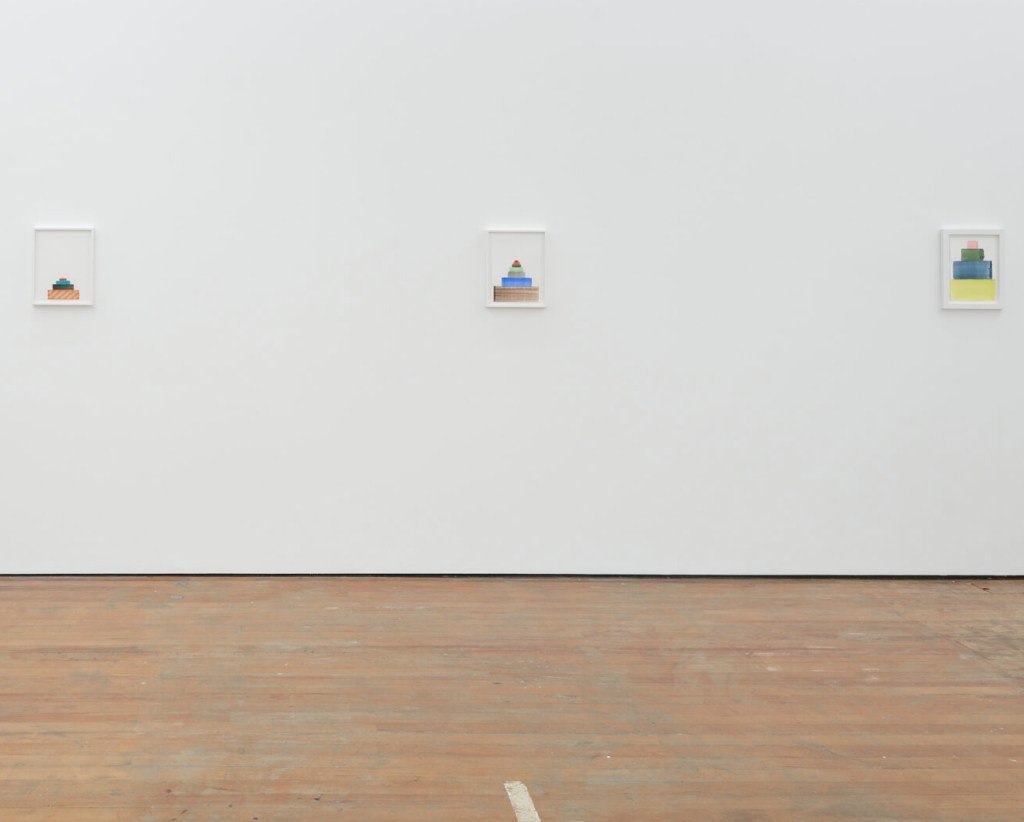
Three exhibitions K Rd – Palmer, Creed, Parekōwhai.
Stanley Palmer, New Work
Melanie Roger Gallery
Until February 22
Martin Creed, Like Favourite Socks in a Drawer
Michael Lett
Until March 1
Michael Parekōwhai, The Indefinite Article
Artspace Aotearoa
Until April 17
Reviewed by John Daly-Peoples
Current exhibitions along Karangahape Rd offers a range of art works from the realist depictions of the landscape to abstract paintings and conceptual construction.
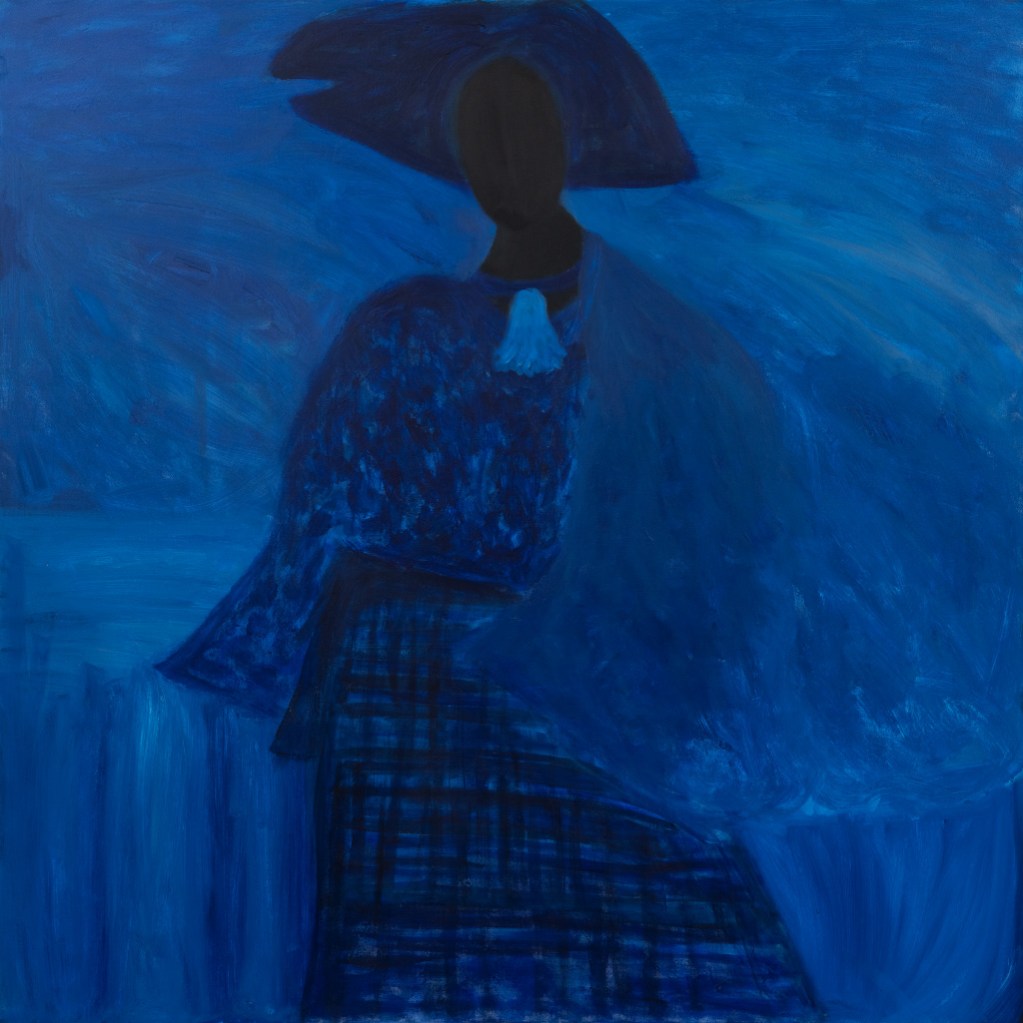
With his latest exhibition at Melanie Roger Gallery Stanley Palmer continues his depictions of the New Zealand landscape. Like many of his previous exhibition he has painted views of the New Zealand coastline featuring dramatic vistas of headlands and offshore islands.
With this new series of works he has revisited many of his previous subjects including depictions of Karamea, Great Barrier Island, Chathams, Great Mercury Island and Matauiri. While these are mainly landscape there are a few which also feature other element in the landscape which add a visual drama as in “Akiaki – Chathams” ($30,000) where he has included windswept trees and grazing sheep.

These paintings seem to be less detailed than some of his previous work and there is a simplicity which gives these works an added drama. Part of this drama comes from the artists shrewd use of paint, so that in “Awana- Aotea Great Barrier” ($22,000) the eroded cliffs are highlighted by the gash of earthy colours and in “Mataurui” ($28,000) the red line of a track is like an abstract slash through the landscape.
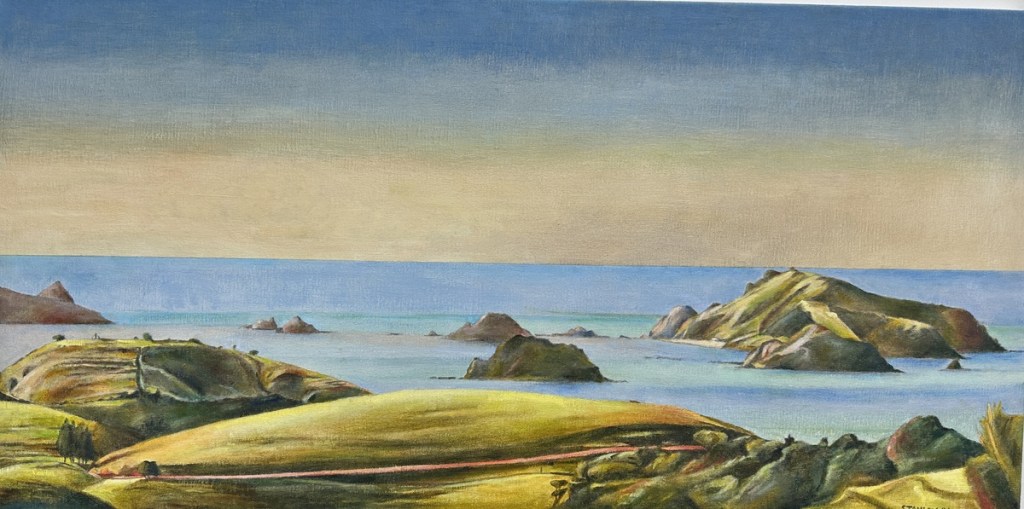
In most of the works the background of sea meeting sky shows a clever juxtaposition of shimmering abstract blues with subtle variations between each of the paintings
Also included in the exhibition are some of the artist’s earlier bamboo prints of the early 1970’s including “Hillside Town Kohukohu” ($2250).

Martin Creed’s minimalist works have always played with the definition of art and art making starting with his Turner winning installation “Work No. 227: The lights going on and off: an empty room” in which the gallery lights switched on and off at 5-second intervals.
His work is a mixture of the witty, poetic and philosophical, making use of a range of everyday materials and approaches which challenge traditional views of art.
His current show “Like Favourite Socks in a Drawer” brings together elements of chance, time and structure with a series of ziggurat shaped works. The works started with his decision to buy an ordinary multi pack of commercial paint brushes.
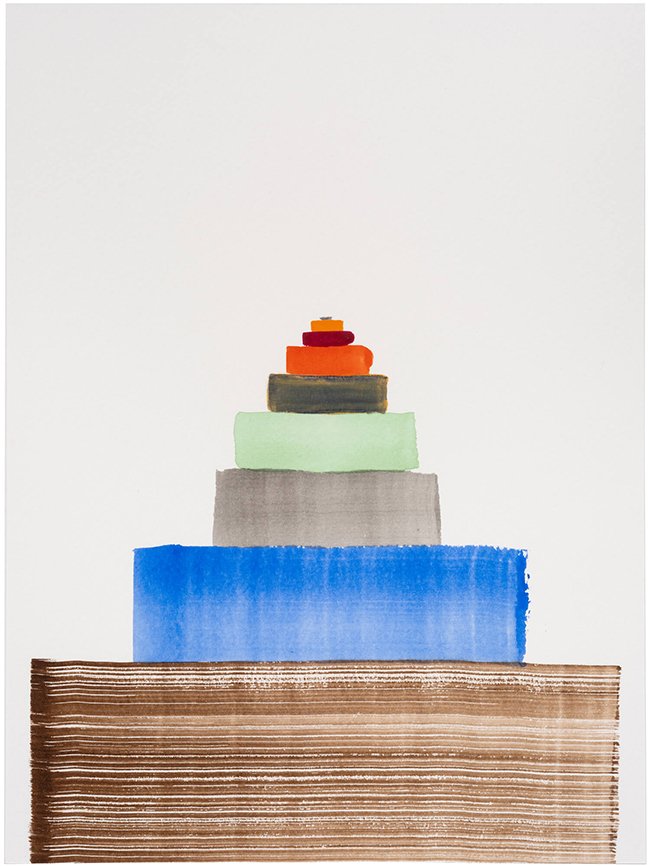
With these he applied paint in different colours with the varying brush sizes, stacking the colours one above the other to create stepped, random bands of colour.
The paintings/designs can be seen as referencing the ziggurat forms of ancient Mesopotamia and Mexico as well as more recent brutalist constructions and has connections with Rewi Thompson’s block-like house in Kohimarama. There are also hints of Frank Stella, Donald Judd and Cuisenaire rods.
Creed says of the works “A step pyramid is solid and easy to understand. It is a safe structure that is not going to fall down. It is trustworthy. You can see how it is built. The steps are hopefully leading to the top, and you can enjoy the colours on the way up. In a blobby, soupy, ill-defined world it can be helpful to put your ducks in a row.”
The works have a sense of the structure to them with their build-up of coloured shapes and in works such as “Work No 3764” (USD $22,000 plus GST) there is sense of the artist gestural involvement where the striations of the brown / sepia are visible as a single calligraphic stroke. With others there is the notion of time with the various strokes of colour measuring out the time taken to complete each work

Some of the work display additions to the quick gesture with Creed scumbling the yellow band in “Work No 3766” (USD $22,000 plus GST). This work like some other has a humorous element with the painting looking like a celebratory, multi-layered birthday cake.
The works all convey Creed’s minimalism of means, notions of time along with the structuring and ordering of objects shapes and colours.
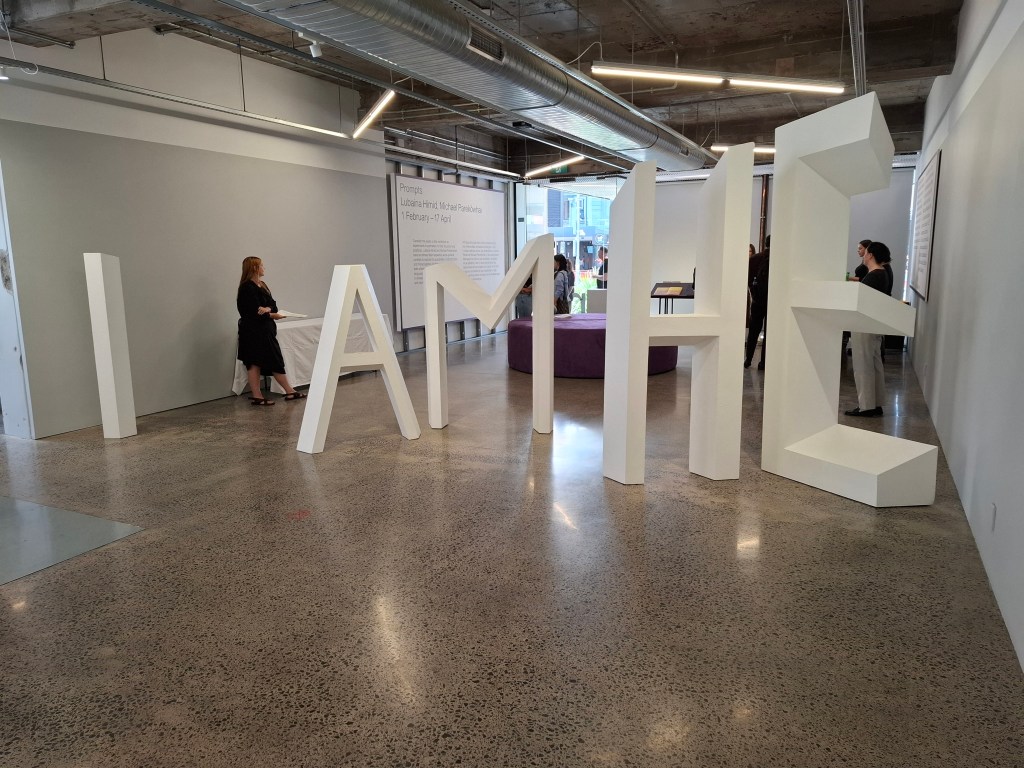
Artspace is exhibiting Michael Parekōwhai’s sculptural object, “The Indefinite Article (1990) which had previously been shown at Artspace in 1990 in the show “Choice” curated by George Hubbard
The large letters based on McCahon’s cubist stylised letters constructed of MDF spell out the words “I AM HE”. Which references some of the McCahon paintings featuring the words “I Am”.
While borrowing from McCahon the work can also be seen as creating a bilingual pun linking the words to te reo where “HE” can be read as the indefinite article where the word can be defined as -a, an, some – or it can also mean something is wrong, mistaken or incorrect.
Other linguistic variations can be identified with the words. During the ”Cultural Safety” exhibition in Frankfort in 1995 where the work was shown this reviewer noted at the time – “His large word sculpture using the words of the Colin McCahon painting I AM HE was quickly identified by one perceptive German journalist as coming from the pen of John Lennon in “I Am the Walrus” [I am he as you are he, as you are me and we are all together] rather than the Bible or McCahon.
To subscribe or follow New Zealand Arts Review site – www.nzartsreview.org.
The “Follow button” at the bottom right will appear and clicking on that button will allow you to follow that blog and all future posts will arrive on your email.
Or go to https://nzartsreview.org/blog/, Scroll down and click “Subscribe”










 New Zealand Arts Review