Categories
Reviews, News and Commentary

Dick Frizzell’s picaresque memoir of the artist as a young man

Reviewed by John Daly-Peoples

Hastings. A boy’s own adventure

Dick Frizzell

Massey University Press

RRP $37.00

Reviewed by John Daly-Peoples

Many geniuses are recognized early on in their lives. Mozart had written 10 symphonies by the time he was 14, Pablo Picasso was turning out some skilful nudes when he was 14 and  Dick Frizzell did a drawing of Christopher Lee as Frankenstein’s monster at the same age.

However, neither Mozart nor Picasso wrote a decent autobiography about growing up which is where Frizzell has the edge over the other two.

His new book recounting his early years, “Hastings, A boy’s own adventure” is an entertaining set of stories which probably mirrors the life and times of many young men growing up in provincial New Zealand in the 1950’s and 60’s. It was a time of complete freedom when young men like Frizzell were learning the first of life’s lessons and enjoying life’s experiences.

In thirty chapters Frizzell recounts his adventures which provide  portraits of his family, descriptions of Hastings and sketches of his encounters with the day-to-day activities he was immersed in. Through these he  manages to provide an insight into his growing awareness and understanding of the world around him, conjuring up the experience of most young boys of his age, encountering the world of adults – aunts, uncles, family friends and  teachers.

We also get a sense of how he became Dick Frizzell the artist  with a mother who had been to art school  and taught him some artistic skills and a father who was well read and a technically accomplished engineer with his own enquiring and adventurous nature.  There are also his experiences of the landscape – Te Mata Peak and the farms of relatives where he worked or holidayed  There is also his love of  comics and movies, his interest in working environments and workmen It’s what we see in his artwork – a celebration of landscape and culture, history and everyday objects.

Frizzell says of these early years “I felt that I had the town covered: our Parkvale kingdom, Uncle George’s market gardens, Aunty Molly’s frock shop, Dad’s freezing works, my high school . . . the town was pretty much ring fenced by Frizzell’s! And I was there growing up with it. Rock ’n’ roll came along, the town became a city, Fantasyland was built, hoodlums trashed the Blossom festival, I learnt the Twist in the Labour and Trades Hall . . . everything I took within me towards adulthood came from Hastings.”

‘If I’d been asked to vote on it I would’ve said I’d landed at the centre of the universe. Standing on our corner of Sylvan Road and Victoria Street, with Te Mata Peak, the Tukituki River and the mad wilderness of Windsor Park to the back of me and the distinctly non-wilderness of Cornwall Park and the misty vista of the Ruahines in front of me, I was the master of all I could barely survey.”

We learn about his jobs, the same that probably every youth got living in Hastings – spells at the Tomoana Freezing Works (where his father worked) and at the Wattie’s canning factory.

But while his portraits of his mother and father and the likes  of his aunts Molly and Nora the figure which we most appreciate is the author with his achievements, blunders, successes and failures.

While the artist may have gained the image as the suave man about town. his early encounters with the opposite sex by his own accounts were less prepossessing. He recounts his inauspicious attempt at the seduction of Bunny as well as his fleeing from the amorous advances of the older Trixie.

It’s a coming-of-age book which will resonate with many older readers with its half-remembered tales of family life, friendships  and growing awareness of one’s place in the world.

To subscribe or follow New Zealand Arts Review site – www.nzartsreview.org.

The “Follow button” at the bottom right will appear and clicking on that button  will allow you to follow that blog and all future posts will arrive on your email.

Or go to https://nzartsreview.org/blog/, Scroll down and click “Subscribe”

Categories
Reviews, News and Commentary

You are Here: linking language, memories and landscape

Reviewed by John Daly-Peoples

You Are Here

Whiti Hereaka and Peata Larkin

Massey University Press

RRP $45.00

Reviewed by John Daly-Peoples

Most stories have a beginning, a middle  and an end. Most stories have a central idea, a kernel from which the tale expands like a sinuous river which follows a plot or a life. Other books can have a very different structure as with the new book “You Are Here”.

“You Are Here” which is the  sixth book in the “kōrero series”, edited by Lloyd Jones, features Jann Medlicott Acorn Fiction Prize winner Whiti Hereaka and artist Peata Larkin, cousins who share the same whakapapa. in a collaboration. Unlike the previous stories in the collection Larkin’s images are not merely illustrations of the text but rather complementary representations of similar ideas.

Here the story line is cyclical, expanding and contracting. Like James Joyce’s  “Finnegans Wake” the work begins and ends at the same point but with an elaborate structure in between  

The poem  starts with the line “You are here” and ends with the line – “Return to where you belong”, seemingly following the mathematical notions of the Fibonacci number sequence.

In tracing out the narrative the  narrator recalls their youth and their experiences of life. Threaded through this personal journey are images of water and the stones of a lake as well as  images of birds and journeys. like the  symbolic use of the Piwakawaka by Colin McCahon.

Language, memories and landscape are seen as linked in the development of the narrator, their memories of school and the shaping of the person through language and experiences. the physical and the metaphorically linked in this journey.

Parallel to Hereaka’s storyline are Peata Larkin’s multi-layered visual images in which ideas inherent in the structure of the story are the linked to her exploration of the DNA structure as well as images of Māori design. Drawings of tāniko and whakairo on gridded shapes are linked to European notions of embroidery and mathematical structures.

Peata Larkin says of the work “Working on this project has been very special to me …Being cut from the same cloth enables the threads of the fabric to shine through and hopefully we achieved that.

Hereaka says. ‘It is my hope that by the time you have walked that path that you are now a different reader and will read those words in a new way,’

To subscribe or follow New Zealand Arts Review site – www.nzartsreview.org.

The “Follow button” at the bottom right will appear and clicking on that button  will allow you to follow that blog and all future posts will arrive on your email.

Or go to https://nzartsreview.org/blog/, Scroll down and click “Subscribe”

Categories
Reviews, News and Commentary

This Doll’s House Sizzles

Reviewed by Malcolm Calder

Laura Hill (credit Tatiana Harper)

A Doll’s House Part 2

By Lucas Hnath

Directed by Paul Gittins

Design John Parker

Costumes Elizabeth Whiting

Lighting Jane Hakaraia

Production/SM Teresa Sokolich

With Laura Hill, Stephen Butterworth, Danyelle Mealings, Maya Dalziel

Herald Theatre, Aotea Centre, Auckland

14 Nov to 1 Dec 2024

Reviewed by Malcolm Calder

A Doll’s House, Part 2 runs about 90 minutes with no interval and is a bit like a well-cooked, multi-course series of tastes – or tapas if you will.  It is a meal that sizzles and left me feeling delightfully sated.

Each taste is marvelously well-prepared and each is impeccably presented.  Chef Hnath’s initial offerings covered ground prepared by others although he put an individual tweak to each and ensured they were delightfully delivered in ways that addressed time-proven issues of women’s independence, choice and self-fulfillment. 

His chief protagonist Nora Helmer arrives through the same door through which Ibsen had exited her 15 years previously.  But now she bears the scars, world-weariness and hard-won wisdom of a woman who has emphatically found and secured her place in the world as a clearly successful writer.  She is confronted by the worldly-wise Ann-Marie , Nanny to her abandoned children, an older woman who has looked, listened and learned much.  Ann-Marie is able to match Nora when it comes to verbal sparring and their discussion, debate, and general discourse delves into independence, freedom, patriarchies and the expectations of society.  And what that means.  But up to this point Hnath’s menu largely provides tastes with which we are familiar – albeit extremely well done with lashings of aspiration and confidence and some magical energy exchange between the two women.

Humour is never far away, arguments are sophisticated and standpoints and circumstances are outlined one after the other.

However well-presented these standpoints are and just as I was thinking I had heard most of their supporting arguments previously and had mistakenly arrived at a law moot, Hnath introduces Nora’s perhaps-former husband and not quite-ex Torvald.  His arrival is somewhat unexpected to the two women and now the meal and its courses becomes successively tastier.  New garnishes are added – subtly at first as incomprehension, resentment and self-doubt became apparent between all three.  But liberal sprinklings of emotion that initially bubble to the surface and then burst forth as spicy aromas that grow as they are savoured.

And that is the crux of Hnath’s play.  I sat enthralled as each new dish was served raising questions about family, marriage and responsibility.   Again, hardly new arguments, but assembled in dramatic combinations.

The dialogue is fast and vibrant – some of it using very modern vernacular. There is confusion and disagreement and miscomprehension that is sharp and pointed.

Director Paul Gittins is the interpreter of Hnath’s dishes and adds depth and nuance to each.  Designer John Parker enhances them with a simple set that is little more than a platform containing three or four chairs, a small table and an omni-present door frame that acknowledges where Ibsen left off.  Its very simplicity allows Gittins’ cast to better explore and extract light and shade.  Elizabeth’ Whiting’s costumes hint at Ibsen’s period, but nor are they of the present.  Timeless and script-driven are terms that spring to mind.

Rightly so, Laura Hill is billed as the ‘star’ and makes a compelling Nora as the chemistry between her and others is abundantly clear.  Her initial interactions with a remarkably strong Maya Dalziel as Nanny Anne-Marie and then with Torvald reveal the maelstrom that lurks beneath the surface of their worlds.

From being initially nervous and confused Torvald’s emotions soon take over and A Doll’s House 2 really starts to sizzle.  His Torvald is achingly sympathetic one moment, a blustering tyrant the next and ultimately a confused soul.

Their calm and rationale daughter Emmy (Danyelle Mealings) attempts to metaphorically and literally patch up the father-she-never-has-known as a voice of balanced reason but her voice is largely ignored, becoming almost that of a rather more dispassionate audience.

In conclusion one can only applaud.  This is an actor’s play that provokes its audience to empathise with different perspectives and director Gittins allows his universally strong and highly experienced cast to do so.

It is rather like that tapas meal where each course sizzles making A Doll’s House Part 2 a delight and, for me, one of the standouts of Auckland theatre in 2024.

As advised in all the pre-promotional material, familiarity with Ibsen’s 1879 original is not essential, but there are direct and indirect references and clues to it are strewn liberally throughout Hnath’s 21st century sequel. One might think of them as yet another layer of satisfaction – or a hidden dessert if you prefer.

Categories
Reviews, News and Commentary

ATC’s Girls and Boys: comic, dramatic, unexpected and gut wrenching.

Reviewed by John Daly-Peoples

Beatriz Romilly

Girls & Boys by Dennis Kelly

Directed by Eleanor Bishop

Auckland Theatre Company

ASB Waterfront  Theatre

Until September 22

Reviewed by John Daly-Peoples

Boys & Girls starts of as a very simple play with a clear narrative, some well-honed quips and some nicely sketched characters. All this is deftly presented by Beatriz Romilly as the sole unnamed central character who we meet standing in a queue at Naples airport where she tells of her misspent youth and her  as drunk / druggy / slaggy phase imbibing  drinks, drugs and a bit of cocaine. She gives us her youthful world-weary evaluation of a few European hot spots – Paris is a dump – Leeds with wider streets. Italians are fucked up but great.

Its also in this queue she meets her husband who endears himself to her by putting two wanna-be models in their place.  He is something of an entrepreneur, buying up old French and Italian furniture to sell in the UK.

Then its fast forward to her and the  children, who do have names – Leanne and Danny. And she gets a new job. She gets to be a PA in a TV company. She is good at her job, rises through the ranks to the point she is getting Baftas.

The first half of the play is pretty bright, the sex is terrific, the children predictable, she manages to thwart a potential rival, it’s a good life.

The latter part of the play is a bit darker. His business starts to falter, she suspects another woman, they are drifting apart. Its at this point she addresses the audience, as she has done a few times before _ “I am if course, just giving you one side”. While she doesn’t tell us what the other side is she comes to the realisation that he is jealous of her rising star while his is waning. The conclusion is devastating and echoes some of the remarks she makes earlier in the play about male violence and she muses in her final lines about the way the world has been made for men should be to stop men.

As well as giving life lessons to the children the woman also imparts them to the audience in her complex role of mother, shrink and life coach.

In charting the trajectory of her marriage she has to confront the puzzle of the man she loves and Romilly is able to convey her changing emotional states from the early,  witty observation to the visceral responeses she has to the final  tragedy. Romilly also manages to transform the physical nature of the woman herself from a statuesque figure at the beginning to a crumpled form at the conclusion.

Romilly gives a brilliantly textured performance as she builds a portrait of the woman, transitioning from her early  phase of her life to maturity with some clever vignettes as she takes on the voices of  other characters.

The simple set designed by Tracy Grant Lord was a masterpiece of design – at times just a small flat wall, then a doorway, then a dark box -and  was able  to change the dynamins of the action while the lighting of Filament 11 added to the atmosphere.

The soundscape created by Te Aihe Butler with its sounds of the outside world as well the music of Victoria Kelly all helped create intense  moods which were  generally, extremely effective but occasionally it becomes unnecessarily obvious and masked the dialogue.

The monologue at close to two hours is a remarkable display of acting – subtle, comic, dramatic, unexpected and gut wrenching.

The play is acutely relevant in telling of the tragedy of lives and families ripped apart by male violence and its debilitating aftereffects on individuals and society.

To subscribe or follow New Zealand Arts Review site – www.nzartsreview.org.

The “Follow button” at the bottom right will appear and clicking on that button  will allow you to follow that blog and all future posts will arrive on your email.

Or go to https://nzartsreview.org/blog/, Scroll down and click “Subscribe”

Categories
Reviews, News and Commentary

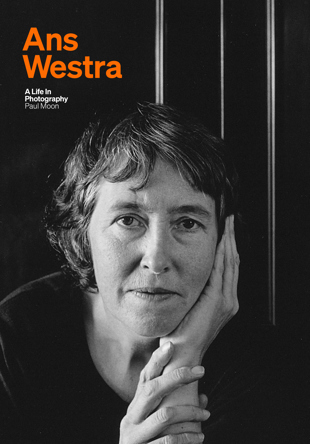
Ans Westra: A life in photography

Reviewed by John Daly-Peoples

Ans Westra: A life in photography

By Paul Moon

Massey University Press

Published May 2024

RRP $49,99

Reviewed by John Daly-Peoples

Ans Westra, who died in 2023 was probably the  most prolific contemporary photographer  who focussed on  recording the life and times of New Zealanders.

With a career spanning over sixty years, she took hundreds of thousands of photographs of people, places and events.

Now a new book “Ans Westra: A life in photography” by cultural historian  Paul Moon documents her life and her contribution to the cultural life of the country.

The book charts her photographic career  from her early involvement with the Wellington Camera Club in the 1960’s and her first sale  of a work to the quarterly journal Te Ao Hou, a publication she would continue to provide images for,

She also gained early recognition in 1961 winning a prize in a photographic competition run by Arts Committee of the Festival of  Wellington.

Much of her work was commissioned for publications originated with the Department of Education and several of her books were for educational publishers as well. One of her earliest publications was ”Viliami of the Friendly Isles” based on her travels to Tonga, Fiji and Samoa in 1962. As well as taking the pictures she wrote the text which describes the dramas, tragedies and excitement of the various locations and events she encountered.

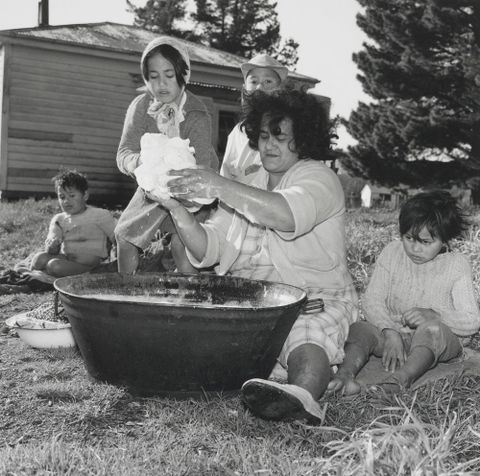
Then there was the controversial booklet “Washday at the Pa”  which was a school bulletin published in 1964 by the Education Department’s School Publications section. Ans Westra wrote the text and took the photographs during a visit to Ruatōria.

Ans Westra, Ruatoria, 1963 (from ‘Washday at the Pa’), courtesy of {Suite} Gallery

The bulletin followed a day in the life of a rural Māori family with nine children. Her images of the family’s living conditions caused enormous controversy, notably from The Māori Women’s Welfare League and the work was subsequently removed from schools and destroyed. Only latterly was the work republished by her Wellington gallery Suite.

Her more substantial publication “Māori” was published by Alistair Taylor in 1967 which was co-produced with James Ritchie and designed by Gordon Walters.

Her motive for participating  in the project was the misguided notion, held by many pakeha writers that Māori were likely to become extinct at some time in the future and their culture needed to be recorded.

She was also involved with another controversial publication “Down Under the Plumtree” published by Alistair Taylor. Published in 1972, the book openly discussed sex, sexuality and drugs at a time when there was very little reliable information on these issues for young people. 

Moon writes about all her major bodies of work such as “Notes on the Country I live in”  and “We Live by a lake” which was written by Noel Hilliard.

He also outlines the rational and impetus for the various projects, the political and social climate at the time and the reactions to them.

The 84 images used to illustrate the book show the various aspect of her photographic  approach which changes over the years. One is conscious of her ability to frame an image, capture the sense of a person or place and find the drama of the moment.

Ans Westra, Wellington, 1974 courtesy of {Suite} Gallery

This ability to capture the sense of place can be seen in her “Wellington” of 1974 with the wet streets of the capital by the cenotaph.

She also shows an understanding  of architectural space with an image of the dam structure in “We Live by a Lake” and she is aware of the possibilities of contrast through light and shade as well as means of creating drama and movement as shown in her image of a policeman and dog confronting a protestor during the anti-Springboks tour campaign.

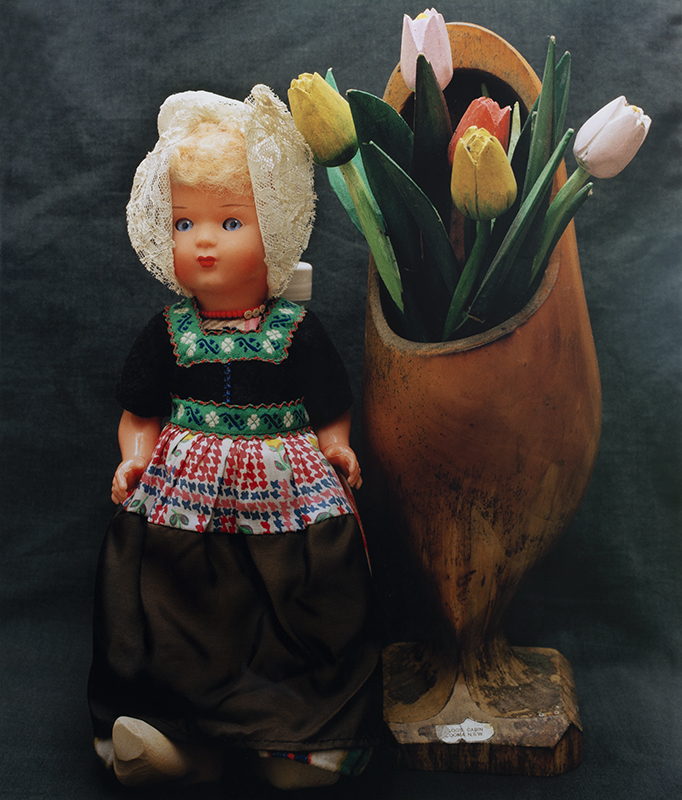
While she did not photograph all that much in colour, when she did, she was able to use colour to great effect as in her image of a Dutch doll from her Toyland series.

Ans Westra, Dutch Doll, 2004, courtesy of {Suite} Gallery

The book not only documents Westra’s immense contribution to our history in documenting social change but also reveals an enthusiastic and  dedicated  artist.

The book deals with several of the important events in her own life from her move from Holland in her youth, the brief  return to Holland in the late 1960’s and her short-lived affair with the writer Barry Crump  and the resulting son, Erik.

Dr Paul Moon ONZM is professor of history at Auckland University of Technology’s Te Ara Poutama, the Faculty of Māori Development, where he has taught since 1993. He is the prolific author of many books, including biographies of William Hobson, Robert FitzRoy, and the Ngāpuhi rangatira Hone Heke and Hone Heke Ngapua. He is a Fellow of both the Royal Historical Society at University College London and of the Royal Society of Arts.

All Images extracted from Ans Westra: A Life In Photography by Paul Moon, published by Massey University Press,

Categories
Reviews, News and Commentary

My Brilliant Divorce

Reviewed by Malcolm Calder

Jackie Clarke in My Brilliant Divorce                     Photo: Darren Meredith

My Brilliant Divorce

By Geraldine Aron

Dir Janice Finn

With Jackie Clarke

Tadpole Productions

Pumphouse Theatre, Takapuna

to 25 May

Review by Malcolm Calder

16 May 2024

As a mere male, I feel something of a fraud attempting to review something that tackles its subject entirely from a woman’s perspective.  But, rest assured, I have sought the opinions of female friends, so plough on (in truth ARE thoughts for menfolk in the work too).

Geraldine Aron’s play tracks one woman’s three-year path through a pending divorce after 20 or so years of marriage.  It is ripe for many emotional, social and potentially dangerous situations and that’s no bad thing.  In fact Aron’s script largely treats them as a self-deprecatingly comedic and the twinkling sparkle and dry self-observations of Jackie Clarke helps ensure this is the case – although not without some truly heart-rending moments along the way.

There is occasional recognition of Aron’s truths, but the laughter flows, there are giggles galore and  it is these spoonfuls of sugar that help ease the shock, the pain, the anxiety and the self-doubt – embarrassingly so at times. 

While Aron’s stereotypically deserted wife reflects with shredded self-esteem, loneliness and self-induced neuroses, she finds little support around her.  Older family members prefer to look to their own future with generational glee, children don’t look back too hard because they are focussed on other things, while men wish to pursue their new path clearly preferring glitz and glam (and youth of course, now THERE’S a stereotype).  And when the loyalty of her hitherto best friend the delightful Dexter wavers, she hits rock bottom.

In sum, My Brilliant Divorce portrays a women who has thought of herself as ‘provided for’ until she isn’t.  And then discovers her own future right in front of her.

Initially Jackie Clarke’s Angela Kennedy Lipsky came across as a little tense and a tad overly-quick with her delivery on Opening Night, but she soon grew into the character, quickly found her comic timing and really started to make the most of some of Aron’s delicious lines.  In fact, the way her girl-koala demolished her boy-koala (both longtime gifts from her ex), there was real venom behind it and even Dexter looked startled.  Even the audience lapped it up when she crawled off-stage looking for the bits.

Self-doubt is at the core of this play.  In one or two places it seemed a little dated and some of the localisations didn’t quite work, but that didn’t matter.  The audience intuitively knew it would all work out for the best in the long run.  Far be it for me provide a spoiler alert though.

Finally, congratulations once again to Tadpole, a company that knows and understands its audience rather well, and keeps coming up with productions to which they can relate.  That’s not to suggest the opening night audience for My Brilliant Career was stacked with divorcees.  Far from it.  In fact I have a feeling that many were there largely because of Jackie Clarke’s presence on stage.

Categories
Reviews, News and Commentary

An immersive Tales of an Urban Indian experience

Reviewed by Malcolm Calder

Nolan Moberly (Simon) in Tales of an Urban Indian

Tales of an Urban Indian

An immersive TIFT experience

By Darrell Dennis

Director Herbie Barnes

With Nolan Moberly (Simon) and Dean Deffett (Stage Manager)

Jan 11 to 14 2024

The Bus Stop, Corbans Estate Art Centre

Review by Malcolm Calder

11 January 2024

I went for a 90 minute ride today.  With others.  On an AT bus.  In and around some of Auckland’s western suburbs.  And an actor called Nolan Moberley told us a story. 

I’m glad I did.  Because it left me drained.  Exhausted.  And not a lot of theatre does that to me.

Moberley gave us bus passengers a character named Simon Douglas, an indigenous Canadian born on an Indian reservation in British Columbia perhaps 50 years ago.  He is a product of the Canadian Indian Residential School system. Tales of an Urban Indian focusses on his struggles with self, on family and heritage and on the world in which he lives during childhood, adolescence and early adulthood, moving into an ever-increasingly urban lifestyle. 

His issues are shared by a cohort that is international.  But the context of each is unique.

This story is moving and painful at times.  It tells of segregation, alienation and rejection.  It tells of aspiration and maybe even – hope.  As Simon says, “it’s a story I need to tell, not because it’s extraordinary, but because it’s common. Too common, and it’s not told enough. It’s a story about my people …”.

In this country we have some awareness of our own socio-historical context and, to some extent, we like to think we comprehend something of the Australian terrain too.  Or perhaps we only think we do. 

For some reason however, Canada is not imprinted on our national consciousness in the same way.  Hardly at all in fact.  And that is what made this performance so strikingly different for me.  The issues may not be dissimilar.  But the context certainly is.

Nolan Moberley gives a bravura performance, somehow keeping his footing as our big blue bus as it lurched over traffic humps and narrow turnarounds.  I’m not sure if the itinerary was random or carefully programmed but there was something deliciously ironic as we passed smashed up deserted and graffitied houses that somehow echoed the words of the script.  Or how Simon’s vain attempts to get work in films, fancying himself to be James Bond, came just as we passed some of the giant sound stages that encircle this part of Auckland.

Accolades to our driver who found his way into and through some impossibly teensy streets and to stage manager Dean Deffett who revealed stage management skills delivered by sign-language.

After 90 minutes I was starting to wonder how director Herbie Barnes would round it all off – or get Simon off the bus, to coin a phrase.  He did.  But no spoiler alerts from me.  You will just have to take your own ride to discover how.  It is fitting, apt.

First Nations theatre has developed an ever-increasing international voice over the last few decades and Talk Is Free Theatre (TIFT) is to be congratulated for sharing thus Canadian story with other parts of the world, for finding commonality there and for such a breathtakingly exhaustive bus ride.