Categories
Reviews, News and Commentary

Mozart’s Jupiter: Musical foothills and a mighty mountain

Reviewed by Peter Simpson

Genevieve Lacey Photo. Pia Johnson

Mozart’s Jupiter

Auckland Philharmonia Orchestra

Auckland Town Hall

May 1

Reviewed by Peter Simpson

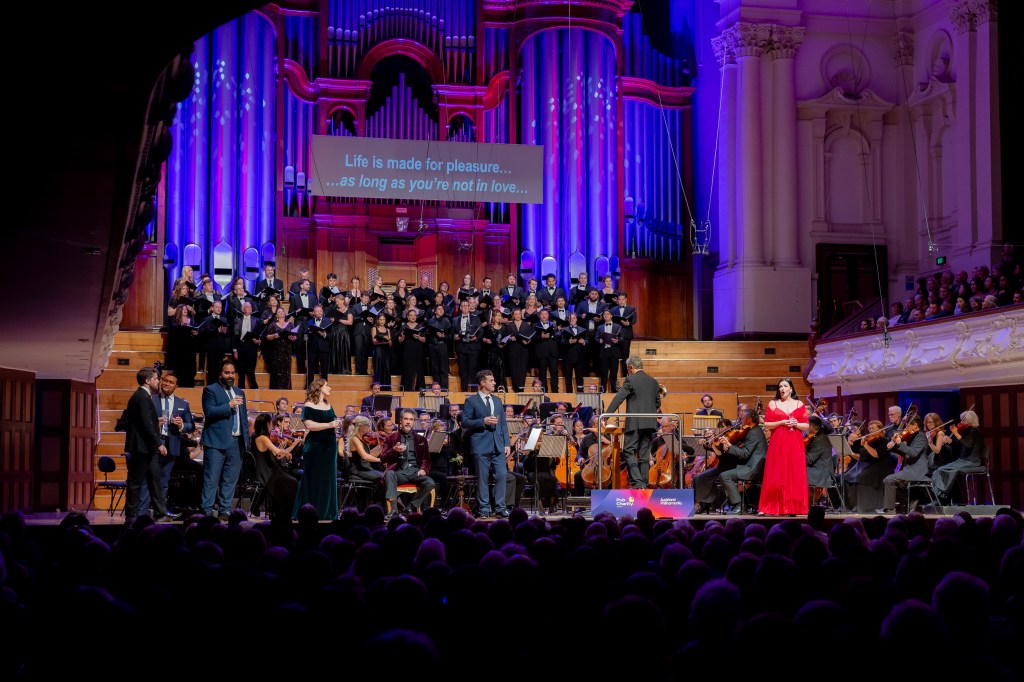
Thursday’s Mayday concert by the Auckland Philharmonia Orchestra consisted of some pleasant foothills leading to a mighty mountain. The foothills were all acts of homage by different composers to a major predecessor: Tchaikovsky honouring Mozart; Australian composer Elena Kats-Cherwin (born 1957) honouring Bach, and British composer George Benjamin (born 1960) honouring Purcell. The mighty mountain was Mozart’s sublime ‘Jupiter Symphony’, No. 41.

The conductor, Leo Hussain (born 1978), is British and is currently Principal Guest Conductor of the George Enescu Philharmonic in Bucharest; he also worked with Simon Rattle at the Berlin Philharmonic and is probably He is best known as a conductor of opera. In Auckland he began the concert informally with a brief verbal introduction emphasising the linking theme of homage and describing the Mozart symphony as the summation not only of Mozart’s career but of the whole Classical period in music. His control of the orchestra was impeccable throughout and the whole concert was warmly received.

Tchaikovsky’s ‘Mozartiana’, dating from 1887, orchestrated what the composer called ‘gems of musical art, unpretentious in form, but containing incomparable beauties’. The first three movements are tasty miniatures; the final movement, a set of variations, based on Mozart after a theme by Gluck, is more extensive and includes some effects a million miles from Mozart; the variations fully explore the large orchestra’s resources, one being entirely for strings, another entirely for woodwind, and including solo turns by clarinet, flute, violin and glockenspiel. The performance was spirited.

Elena Kats-Chernin describes her six-part work as ‘Re-inventions (after Bach)’; they are based on some of the great composer’s inventions for keyboard. Scored for small string orchestra and solo recorders the performance featured entertaining solos on four different recorders (discount, tenor, bass, sopranino) by Australian virtuoso Genevieve Lacey who impressed the audience (especially in her bird-song imitation encore) with her skill and vivacity.

Composer George Benjamin was a pupil of Messiaen; his ‘Three Consorts’ responds particularly to the ‘mesmerising intersection of line and harmony’ in Henry Purcell’s 1680 Fantasias. The middle piece was especially sonorous and pleasing.

Mozart’s Jupiter symphony is an astonishing work which the composer himself probably never heard performed; it certainly owes its name to somebody else. One scholar described it as ‘the greatest orchestral work of the world which preceded the French Revolution’ and the APO played the work as if they agreed with that dizzy estimation. The way the symphony combines both clarity and complexity, especially in the last movement, was apparent throughout the orchestra’s sparkling rendition. Glorious music!

Categories
Reviews, News and Commentary

Murder on the Orient Express: Unadulterated Entertainment

Reviewed by Malcolm Calder

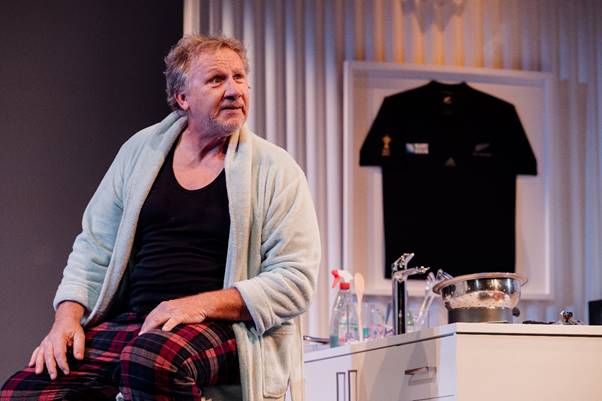
Cameron Rhodes (Hercule Poirot), Edwin Wright (M Bouc) Photo Andi Crown

Agatha Christie’s Murder on the Orient Express

Adapted for the stage by Ken Ludwig

Auckland Theatre Company

Dir: Shane Bosher

Set: John Verryt

Lighting: Sean Lynch

Costumes: Elizabeth Whiting

Composition and Sound: Paul McLaney

Motion: Harley Campbell

Dialect: Kirstie O’Sullivan

Intimacy: Todd Emerson

Engine Room Assistant Director: Nī Dekkers-Reihana

With Bronwen Ensor (Greta Ohlsson), Sophie Henderson (Countess Andreyi), Jennifer Ludlam (Princess Dragomiroff), Mayen Mehta (Hector McQueen), Ryan O’Kane Col Arbuthnot/Samuel Ratchett), Mirabai Pease (Mary Debenham), Cameron Rhodes (Hercule Poirot), Jordan Selwyn (Michael/Head Waiter), Rima Te Wiata (Helen Hubbard), Edwin Wright (Monsieur Bouc)

ASB Waterfront Theatre

Until 10 May

Reviewer Malcolm Calder

Photo: Andi Crown

I’ve had a busy time of it lately.  What with school holidays, two successive long weekends and a seemingly endless round of rather long and demanding days, I had half a mind to settle for a quiet glass of red, a good book and an early bedtime blithely avoiding any additional responsibilities that might involve going out to the theatre. Had to rush to make the 7pm start too!

Thank goodness I didn’t.

With this re-vamp of the original classic, Director Shane Bosher has turned in a blinder for Auckland Theatre Company and come up with something that is pure, unadulterated entertainment. 

Adaptor Ken Ludwig’s cull of the original murder mystery, after having been approached by Agatha Christie’s grandson for the Christie Estate, was first performed in 2017.  So if you are a Christie devotee looking for a simply stage-adaptation of her original go no further.

Ludwig adamantly insists that he is a writer of plays and not simply a ‘murder-mystery guy’.  As a result he has redrawn, reduced and compacted the number of characters, enhanced the comedy and come up with a tightly-scripted and genuine ensemble piece that adds to the already enormous output that has made him arguably the most produced playwright of his generation.

It is sometimes suggested that more serious undertones may have underpinned aspects of Christie’s original but few are evident here.  Bosher may have drawn some slight allusions to contemporary geo-political issues that underpin the entire structure but this may or may not be the case.  What he has done however, is generate something that entertains big time. 

The result is an actor’s piece to die for.  And this cast do more than just deliver.   Just as Auckland Theatre Company, CEO Jonathan Bielski has urged audiences to avoid spoilers about resolution of the murder, mystery and mayhem of the play itself, it would be churlish to single out any one cast member.  The entire cast is let loose, projecting archetypes rather than convincing portrayals of real people.  Each character is distinct, their backgrounds are as varied as their accents and the ensemble functions as a singular unit predominantly by using that essence of great comedy – precision timing and the credibility of relationships between them.

ATC is to be congratulated too on once again continuing to develop pathways for increasing numbers of younger actors and production people who we are seeing as first-time performers with ATC.

This is a consummate, professional ensemble and even a tiny glitch with a prop on opening night was more than successfully ad-libbed around, the comedy was sustained and the professionalism acknowledged by an audience who got it.

I am advised that ticket sales for MOTORE are already strong and ATC is to be congratulated on both the production itself and for hopefully hitting a jackpot.

The 7pm start time may have been a bit of a scramble but it had the bonus of my being home and abed well before 10pm.  No book though – my head was still laughing inside itself.

Categories
Reviews, News and Commentary

The Art of Banksy coming to Auckland

John Daly-Peoples

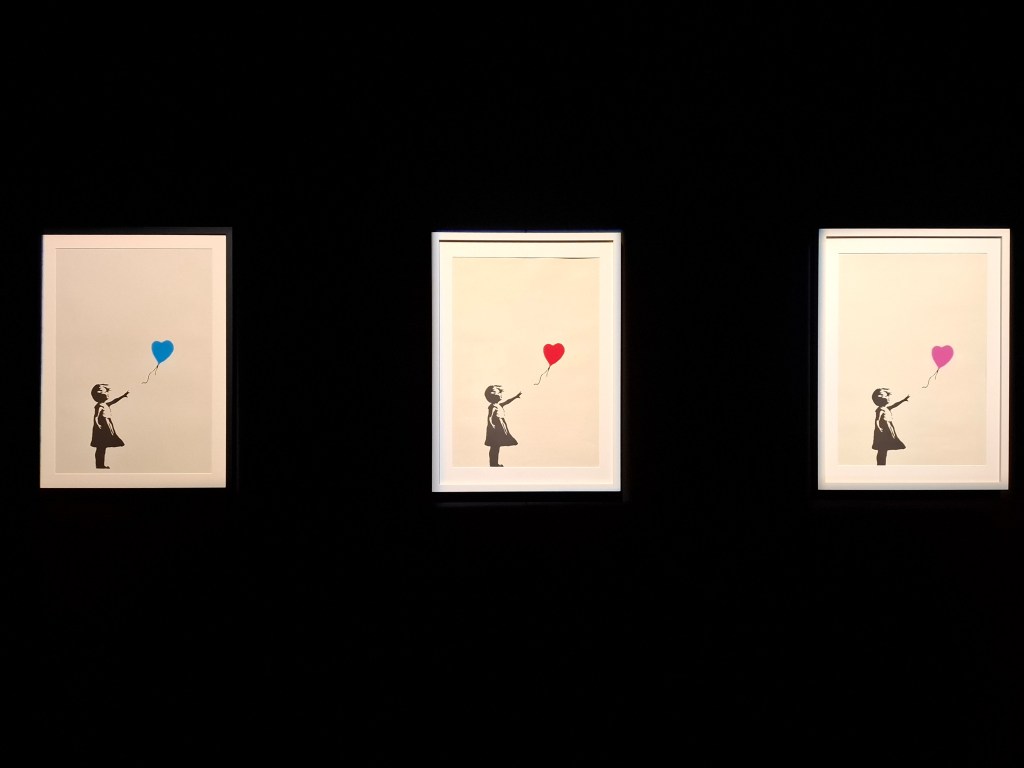
Girl With Balloon
The Art of Banksy – the major exhibition which has brought Banksy’s era defining works to over 1.5 million visitors in 19 cities across the globe will visit Auckland for a final and strictly limited New Zealand season. The exhibition will be hosted at Tāmaki Makaurau Auckland’s Aotea Centre (Hunua Rooms) from Monday 7 July through Sunday 3 August 2025.

The Art of Banksy is the world’s largest collection of original and authenticated Banksy art showcasing more than 150 pieces including prints, canvases and unique works. The collection wowed thousands of Wellingtonians in 2024 and now it’s Auckland’s turn.

Michel Boersma, curator and producer of the exhibition says: “Following a hugely successful 19 city global tour and 2 years in London, UK, we’re very excited to bring this larger-than-ever collection to Auckland, bigger and better! The last 9 years we have been working with collectors in expanding the collection which we are able to display, from 70 in Auckland in 2018 to over 150 authenticated and genuine works, no replicas – the real deal. I am particularly proud that trusted associates of Banksy, for example Ben Eine, have been willing to contribute to the exhibit with their privately held works, gifts and hand drawn sketches and video testimonials. This way The Art of Banksy is able to lift the veil on how some of the iconic Banksy works were created and reveals some of the secret stunts they got up to.” 

Daniel Clarke, Tātaki Auckland Unlimited Director of Performing Arts, leading Auckland Live adds: “We’re delighted to be working with GTP Exhibitions to bring The Art of Banksy to Tāmaki Makaurau Auckland. As one of the world’s most successful contemporary artists Banksy’s work consistently captures the public’s attention and imagination – over a million people worldwide have seen the exhibition – so to have this number of works on show is a hugely exciting addition to our winter events season.”

Visitors at The Art of Banksy can expect to see the seminal artworks that brought the infamously anonymous artist international notoriety such as Girl With Balloon in four different colour variations, including the rare Gold Edition. Banksy fans can also see unique personalised gift prints created for friends, associates and lovers. The exhibition also focuses on Banksy’s Dismaland and recent artworks acknowledging the ongoing war in Ukraine.


Many of Banksy’s iconic works are also featured in the exhibition including a very rare collection of ‘thank you prints which Banksy created as gifts to staff and team members who worked with him at Dismaland and other Banksy stunts. The exhibition also features a series of unique hand drawn sketches by Banksy. The fragile pieces of paper are one-of-a-kind depicting Banksy’s working on versions of his famous rat images.

The Art of Banksy is an unmissable show for anyone who wants to learn more about one of the world’s most important current artists and what their work reveals today; the power of art to affect social change, inspire the public and lay bare the undercurrents of social issues.

The Art of Banksy is not curated or authorised by the artist and only displays authenticated art sold or gifted by the Artist, no replicas or art removed from the street.
Banksy’s Dismaland
ART OF BANKSY
 
Monday 7 July – Sunday 3 August 2025
Mon – Wed: 10am – 6pm
Thu – Sun: 10am – 9pm
 
Tickets start from $39.50. Service fees apply
 
Tickets on sale from Wednesday 7 May
Categories
Reviews, News and Commentary

Delicacy and grandeur in nineteenth century masterworks

Inon Barnatan. Image. Sav Schulman

Romantic Brahms

Auckland Philharmonia

Auckland Town Hall

April 10

Reviewed by Peter Simpson

The April 10 concert of the Auckland Philharmonia headed ‘Romantic Brahms’, placed the audience squarely in the nineteenth century (where most audiences most like to be), with an overture from 1834, a concerto from 1881 and a symphony from 1888. The conductor was the Swiss-Australian Elena Schwarz who is currently with Klangforum, a chamber orchestra specialising in contemporary music based in Vienna; she is also a guest conductor with leading orchestras in Europe, America and Australia.  Elegant and agile in her dark trouser suit she seemed completely in command of these complex scores.

Louise Farrenc (1804-1975) was famous in her time (and is now undergoing recuperation) as a pianist, teacher and composer in Paris, earning the respect of Schumann and Berlioz for her compositions which included symphonies and chamber works as well as two orchestral overtures in 1834, the second of which played in Auckland demonstrates her confident control of the post-Beethoven orchestra and musical idioms.

Brahms’ Piano Concerto No. 2 is possibly his greatest orchestral work, at least I have thought so since the early 1960s when I first heard Sviatoslav Richter’s famous recording with the Chicago Symphony under Erich Leinsdorf made during Richter’s first tour of America. Israeli-pianist Inon Barnatan was well up to the demands of this heroic score ranging as it does from  extreme delicacy – as in the opening exchanges between piano and horn (the beginning slightly fluffed by APO’s horn soloist) – to full orchestral grandeur in the many climactic passages. For his encore the pianist unusually chose a graceful duet by Rachmaninov with a cellist instead of a solo piece, perhaps in recognition of the lovely ‘cello solo at the start of the third movement of the concerto.

According to Heath Lees’ programme notes, César Franck’s Symphony in D has somewhat lost favour with modern audiences compared to its earlier fame, but it still comes across as a noble and majestic piece, especially in its swelling major theme which recurs throughout the circular structure The texture of the work can sometimes seem a bit muddy but not in Elena Schwarz’s expert separating out of the separate layers of sound. It was a fitting conclusion to a stirring and satisfying evening of Romantic music.

Categories
Reviews, News and Commentary

High Couture meets High Country

Reviewed by John Daly-Peoples

Central Otago Couture: The Eden Hore Collection

By Jane Malthus and Claire Regnault, photographs by Derek Henderson

Te Papa Press

RRP $70.00

Reviewed by John Daly-Peoples

We know who all the great names in New Zealand fashion of last century  are  -Karen Walker, Kate Sylvester, Trelise Cooper, the list goes on. There are even some key male figures – Gus Fisher, Adrian Hailwood and Francis Hooper.

One name though  has been missing from that list for many years. Eden Hore. A merino farmet from the Maniototo of Central Otago, he epitomises the “Southern Man” having been one of the first farmers to introduce cattle to the normally sheep running areas of Central Otago.

But his main claim to fame is his collection of high couture garments which he has amassed since the 1970’s and is considered to be one of the most impressive collections of garments in the Southern hemisphere.

Barbara McKain strapless dress with tulip hemline, early 1980s.
Flannel-blend fabric and sequins, EH79.
Photographed at Two Paddocks Vineyard, Earnscleugh, 2024
Model:Alannah Kwant
Image supplied by Te Papa Press/Eden Hore Central Otago
Image/s © Derek Henderson

A new book “Central Otago Couture: The Eden Hore Collection” by Jane Malthus and Claire Regnault with photographs by Derek Henderson is a remarkable publication documenting the life and times of Eden Hore, his collection and the development of the high fashion industry in New Zealand  

Along with the release of the book there will be exhibitions at Toitū Otago Settlers Museum and Art Gallery, Alexandra, celebrating Hore’s remarkable history of collecting and his unique museum which held his collection for many years – a converted shed on his farm.

Vinka Lucas evening dress and cape, early 1970s.
Taffeta, synthetic voile, feathers and swansdown, EH48.
Photographed at Lake Dunstan, 2024
Model:Alannah Kwant
Image supplied by Te Papa Press/Eden Hore Central Otago
Image/s © Derek Henderson

The designers of many of the clothes featured in the book  were all well-known in fashion circles in the 1970s and 1980s – Kevin Berkahn, Vinka Lucas, John West, Rosalie Gwilliam, Jo Dunlap, Wapiti Handcrafts, Annie Bonza and James Jaye Leathers.

The photographs of the garments in the book were taken by Derek Henderson during two photoshoots in Central Otago in 2024 and 2019 with models Ngahuia Williams, Alannah Kwant and Hannah Clark.

The dozens of designs which he has photographed are set in the stunning landscapes of Central Otago. There are the tussock lands, vineyards, orchards, lakes, rugged hills and  old stone buildings.

In many of the photographs the striking garments contrast with the lands  and building while others blend in with the landscape. Colours and textures of some seem to have grown out of the landscape and there are some shown with iconic images of the area such as the photospread with the Wedderburn goods sheds made famous by Grahame Sydney.

Kevin Berkahn evening dress, 1973.
Pleated taffeta ruffles on nylon net, EH23.
Photographed at Little Valley Road, Alexandra, 2024
Model:Ngahuia Williams
Image supplied by Te Papa Press/Eden Hore Central Otago
Image/s © Derek Henderson
 

Jane Malthus is a dress historian and honorary curator for the dress collection at Tūhura Otago Museum, and has an academic background in textiles, clothing and fashion, history and fine arts. She has been Involved with Eden Hore’s collection since the 1980s.

Claire Regnault is Senior Curator New Zealand Histories & Cultures at Te Papa and is the author of Dressed: Fashionable Dress in Aotearoa New Zealand from 1840 to 1910 (2021), and co-author of The Dress Circle: New Zealand Fashion Design Since 1940 (2010). She is the President of Costume & Textiles Aotearoa New Zealand, and a member of the Eden Hore Central Otago steering committee.

Categories
Reviews, News and Commentary

Groundwork: The Art and Writing of Emily Cumming Harris

Reviewed by John Daly-Peoples

Groundwork: The Art and Writing of Emily Cumming Harris

By Michele Leggott and Catherine Field-Dodgson

Te Papa Press

RRP $60

Reviewed by John Daly-Peoples

Botanical painters have been an integral part of the botanical and artistic history of New Zealand since Joseph Banks accompanied Cook on his voyage to New Zealand and his publication of detailed illustrations of the exotic plant species he found here.

Since the time of Banks there have been many other artists who have devoted themselves to depicting the flora of New Zealand .A new book “Groundwork” by Michele Leggott and Catherine Field-Dodgson reveals one of the first women botanical artists in New Zealand. Emily Cumming Harris who was born in England in 1837 spent most of her life in New Zealand, mainly in the Taranaki and Nelson areas.

During this time, she painted numerous examples of plant life as well as landscapes, a number of which were exhibited locally and internationally.

Her works were exhibited at the Sydney International Exhibition in 1879, the 1880–81 Melbourne International Exhibition and the Colonial and Indian Exhibition in London in 1886. At the New Zealand Industrial Exhibition held in Wellington in 1885 she won first prize and a silver medal for a painted screen.

Emily Cumming Harris, Kiekie (Freycinetia banksii), nikau (Rhopalostylis sapida), five finger (Pseudopanax arboreum) and karaka (Corynocarpus laevigata) in fruit, 1879, watercolour, 389 x 506mm. Reproduced as a Turnbull Library print in 1980. Alexander Turnbull Library,

Throughout her life she also had solo exhibitions, selling a number of works, the sales of which provided useful financial assistance to her and her family.

The book documents her career as an artist and even though this was never to be a full-time career she amassed a large collection of images many of which are in public collections. Leggott and Catherine Field-Dodgson’s research, along with other individuals reveal a woman whose work lies between the scientific, botanical illustration and artistic.

The book has been the result of a lot of detective work, research in various museums and some family history. Michelle Leggott ‘s interest came about when she was researching about Emily’s father, Edwin who had painted several views of New Plymouth at the time of the Land Wars in Taranaki. His paintings are also included in the book.

Emily Cumming Harris, Hector’s tree daisy Brachyglottis hectorii, oil on straw board, 690 x 470mm. Galpin collection, Pauanui

The authors also discovered a number of paintings Emily had done of astronomical subjects – The Total Eclipse of the Sun in1885 and a double tailed comet in 1901.

The book includes a number of her poems which range in quality but the occasional one shows some literary skills and keen observation.

Her “The mountain looks down on the river” contains some lines which indicate an awareness of the situation of Māori.

But the forest which grew by the river,

And the flowers on the mountain that bloomed

Will they gladden our hearts for ever

Or pass like a race that is doomed?

In 1890, she published three books, New Zealand flowers, New Zealand ferns, and New Zealand berries. Each contained twelve lithographs with descriptive text, and some copies were hand-coloured by Harris herself.

Emily Cumming Harris, Celmisia chapmanii – Campbell Island; Celmisia vernicosa – Campbell Island, 1890s, watercolour, 310 x 440mm. Alexander Turnbull Library

All her paintings as well as her writings and poems provide a portrait of a woman of great talent and enterprise but social convention prevented her developing an independent career and she was viewed merely as a gifted illustrator.”

This has meant she has not been well served by history but this book will do much to correct that.

Categories
Reviews, News and Commentary

Auckland Philharmonia’s Enigma

Reviewed by John Daly-Peoples

Enigma

Auckland Philharmonia

Auckland Town Hall

March 27

Conductor Karl-Heinz Steffens

Grieg, Norwegian Dances
James MacMillan, Concerto for Orchestra ‘Ghosts’ (NZ premiere)
Elgar, Enigma Variations

On the programme for the Auckland Philharmonia’ s “Enigma” concert was a newly commissioned  work by the Scottish composer James MacMillan. His “Concerto for Orchestra” was subtitled “Ghosts” and had an enigmatic quality to it.

As the composer says of the work, “The music seems to be haunted by other, earlier musical spirits and memories,” These musical memories which creep into the composition can be seen in the reference to Beethoven’s “Ghost”  trio along with other musical references – Debussy, Scottish traditional music and an eastern musical hymn.

These musical references emerge from the composition like ghostly figures, sometimes gradually appearing, sometimes unexpectedly while some of the themes overlap.  The music is full of juxtapositions and surprises as various instruments and combinations of instruments introduce new themes and spiritedly amplify them.

The lively spirits of the opening were created by dramatic percussion and piercing brass which led to a great chattering of sounds with some eerie conversations between the strings and brass.

Throughout the work there is a sense of the instruments floating around, trying to discover and capture themes which have been lost. This floating, colliding and capturing of elusive themes creates a tension within the piece. The dramatic flourishes of percussion, the sinuous sounds of the strings as well as some jazzy sequences all add to the works restlessness and urgency.

The sounds all helped create a dreamscape of remembered, and reimagined sounds and like some ghostly figures were continually slipping and finally the wispy sounds disappear.

The piece recalls the Shakespeare line from the Tempest

The isle is full of noises,
Sounds, and sweet airs, that give delight and hurt not.
Sometimes a thousand twangling instruments
Will hum about mine ears, and sometime voices

Many of the same musical ideas appear in Elgars “Enigma Variations” where various musical instruments are used to convey impression of people that were close to the composer. The one theme that is probably never heard is the one that represents the composer himself. The variations feature the composer’s own ideas about his friends and close contacts conveying their physical, psychological and spiritual personalities.

The variations with their delightful impressions include variation I said to be of his wife, has a wistful quality and  an anthem overflowing with joy but also with s hint of sadness, Variation IX Nimrod with its heavenly sounds and the violas solo in Variation VI – Ysobel

Conductor Karl-Heinz Steffens was able to ensure that each of the portraits was interpreted with the appropriate mood, pace and colour and he seemed to relish both the music and the narratives of the work and his sharp, sensitive gestures had him performing like some grand puppet master manipulating the  dozen characters of Elgar’s world.

The opening work on the programme was Grieg’s “Norwegian Dances” and Steffens was able to lead the orchestra through the spirited dances with its changing portraits of the people, the history  and landscape effortlessly, taking the orchestra from lethargic to happy and ebullient.

Categories
Reviews, News and Commentary

Animal: The great little show in the farmyard

Reviewed by John Daly-Peoples

Animal

Cirque Alfonse

Q Theatre

March 19 – 23

Reviewed by John Daly-Peoples

It was not much of an act, chucking an egg in the air, have it land on your back and keep it there while you jiggle around. Anyone could do it , except one of the performers in the Quebec based group “Animal” had to have three goes at it. One of the eggs splatting on his back and head and two more landing on the stage. He got more applause for the broken eggs than did his two fellow perfomers for their safely caught eggs.

It’s always great to see performers achieving pulling off acts , but it’s more amusing when they fail – fail, recover and get on with the show. It often reveals the skill and dexterity of the performer and shows up our own lack of skill. In another of their acts one of the females spins a bucket full of seeds which is supposed to keep the seeds inside  . She misjudges and we get a stage strewn with seeds and she doesn’t miss a beat – it almost seems as if she meant that to happen. I think the little children may have learned one of their basic science lessons about centripetal force.

Theres a lot of basic science in” Animal” along with basic acrobatics as the group perform basic balancing, juggling and springboard work. They take the audience on a slightly surreal  journey through their weird farm of outlandish animal  and wacky activities – tossing pitch forks, balancing on milk churns, riding bucking cows.

As well as being skilled acrobats and contortionists the group are also skilled musicians playing guitar, trumpets, a range of percussion instruments, flute and keyboard – and they can sing too, belting out their own French compositions which are probably very witty if you are up on your French.

The Canadian Cirque Du Soliel group has shown us  how to put on a high-powered performance with cool moves and dazzling costumes but “Animal” is more down to earth, using all the contraptions from the farm, – wheelbarrows. milk churns and  hay forks, along with a jumble of clothes and hats which they must have found around the barn. Their routines are all clever and entertaining, bringing together circus, song, dance and theatre with some  quirky live music.

It may be designed for children but it has a universal appeal  with their displays of strength  agility and balance in their boutique version of the grander Cirque displays.

To subscribe or follow New Zealand Arts Review site – www.nzartsreview.org.

The “Follow button” at the bottom right will appear and clicking on that button  will allow you to follow that blog and all future posts will arrive on your email.

Or go to https://nzartsreview.org/blog/, Scroll down and click “Subscribe”

Categories
Reviews, News and Commentary

Party Time at the Town Hall with Neil Ieremia

Reviewed by Malcolm Calder

Neil Ieremia and the cast Image Jinki Cambronero

Not A Retrospective

Black Grace

By Neil Ieremia MNZM

Dir Neil Ieremia
With Che Fu, Tha Feelstyle, Buckwheat, the NZ Trio, DJ Manuel Bundy, multiple dancers and the Town Hall Staff

Great Hall,

Auckland Town Hall

Saturday, 20 March 2025

Reviewed by Malcolm Calder

There was actually a bit of dance at this Black Grace extravaganza. But there was an awful lot more as well.

Billed as a celebration – and rightly so – this was really a 30th birthday party for Neil Ieremia’s now iconic NZ company.  Yes, definitely a party and a great big thank you to Neil and his crew.  The Town Hall rocked to its foundations. 

Configured more as a rock venue-cum-nightclub, the setting featured a large catwalk (or perhaps showcase-platform-up-the-centre-of-the-floor might be a more apt description), some video-screens on stage towering over DJ Manuel Bundy, with gantries and creative lighting overhead and Anonymouz’s creative soundscape emanating artfully from every corner of the room.  The audience was split between those constantly moving excitedly on the floor around the catwalk and those seated upstairs – didn’t see too much jewellery being rattled though.

Auckland Town Hall catwalk Image Jinki Cambronero

Things started slowly (well relatively anyway) acknowledging some of the company’s early work, its strong links to Pasifika and its dance heritage.  But then hip hop artist Tha Feelstyle, and drag phenomenon Buckwheat arrived and things moved swiftly into the now and it was all on.  The entire venue became partly a concert venue, partly a nightclub and partly a showcase.  Even the NZ Trio, the mighty Town Hall organ and the staff became part of the show. 

It was therefore highly appropriate that Ieremia took the final bow himself, decked out in a rather splendid white frock-coat.

Auckland was treated to a contemporaneous expression of something of which all our performing arts can be proud. of and this delirious audience of the faithful, the believers and the acknowledgers participated in something that could readily grace any stage in the world.   One might say – as one of New Zealand’s finest tariff-free exports. 

So Neil, thank you for the thank you.  Even this rather hoary old correspondent was definitely up and bopping at the end.

To subscribe or follow New Zealand Arts Review site – www.nzartsreview.org.

The “Follow button” at the bottom right will appear and clicking on that button  will allow you to follow that blog and all future posts will arrive on your email.

Or go to https://nzartsreview.org/blog/, Scroll down and click “Subscribe”

Categories
Reviews, News and Commentary

An achingly Sublime Streetcar finessed to Perfection

Reviewed by Malcolm Calder

A Streetcar Named Desire

Based on the play by Tennesee Williams

Scottish National Ballet

Dir: Nancy Meckler

Chor: Annabelle Lopez Ochoa

Scenario: Nancy Meckler and Annabelle Lopez Ochoa

Music & Sound Des: Peter Salem

Orch: Robert Baxter, Auckland Phimharmonia

Des: Nicola Turner

LX Des: Tim Mitchel

Kiri Te Kanawa Theatre, Aotea Centre

Until 23 March

Reviewed by Malcolm Calder

Founder Peter Darrell relocated his Bristol-based company to Glasgow in 1957 promising to entertain the widest possible public and to introduce both contemporary themes and the influence of other theatrical skills to dance as the Scottish Ballet.

With A Streetcar Named Desire and fifty years later The Scottish Ballet continues to do so.  In spades.

Streetcar draws many facets together.  Firstly, it takes a well-known stage drama, fiddles a bit with Williams’s original opening scenes on the demise of the Du Bois family and Blanche’s descent from pure white chiffon to her arrival in a comparatively down-market New Orleans.  And then it takes off – becoming the Tragedy of Blanche Du Bois.

Nicola Turner’s set combines cinematic suggestions mixed with minimalist theatrical staging, costumes and snatches of dialogue as well as music straight from the 1940s, Streetcar uses simple beer crates to evolve magically into a streetcar, a brothel, a market, a bedroom or a bowling alley.  Scenes slide into other scenes, then unfold, merge and reverse.  I suspect Williams would have been quietly smiling – wholeheartedly and very contentedly.

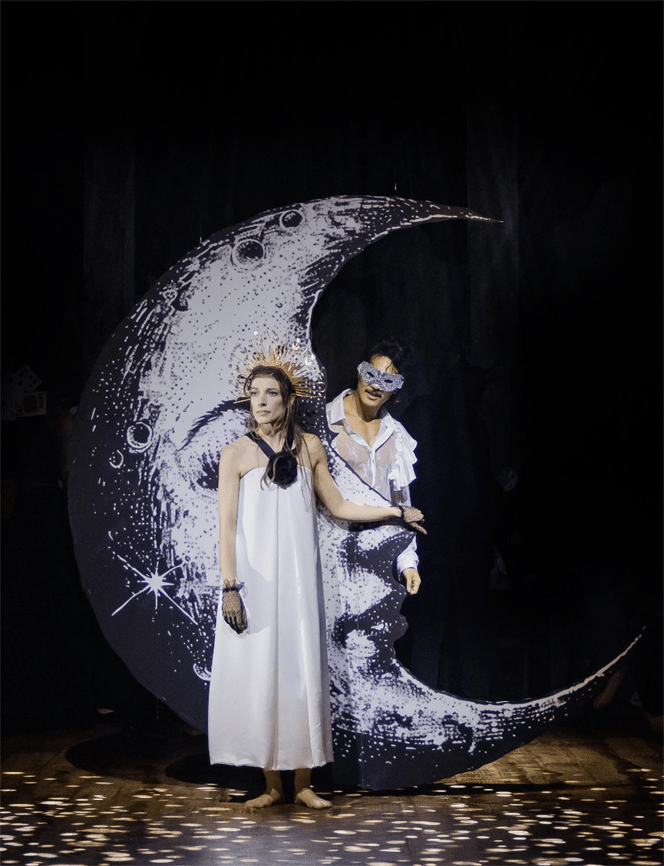
His is the tale of a Blanche who denies her past, who is dismissive of well-meaning sister Stella, and who is irresistibly drawn to both alcohol and to men – Stella’s husband Stanley  in particular – as she tries to gain attention to make herself feel better about herself.  And all the while she clutches for that unattainable paper moon. 

Today Blanche would quite probably be diagnosed with severe depression and even mental illness.  But Streetcar is set 80 years ago and even prozac did not exist.  A gradual descent into severe depression is the inevitable result.

Underpinning everything are the symbols around which the story unfolds.  The outsized splotch of blood on Alan’s shirt whenever he re-enters Blanche’s both conscious and unconscious minds, the redness of flowers suggesting death and that omnipresent paper moon hovering –  a forever an unattainable dream.

Tim Mitchell’s lighting sets moods, isolates space and reflects Blanche’s descent while Peter Salem’s cinematic score is sympathetically handled by a mix of touring principals and the Auckland Philharmonia under Robert Baxter.  Intriguingly, it is a smooth and remarkably strong mix of pre-recorded sounds — trains, church bells, malicious whispers — and a wide ranging fusion from wedding waltzes to the brassy world of 1940s New Orleans jazz.

Roseanna Leney gives us a remarkably multi-faceted Blanche, her pas de deux with Evan Loudon (the would-be macho strong-man Stanley) a study in character development.  Yes, he does rape her, but it is Blanche who appears very much in control.  In contrast, her passive and even dismissive handling of the earnest Mitch reveals further dimension to her Blanche.  And, even though a minor role, I enjoyed Bruno Micchiardi’s bumbling and almost Chaplinesque creation of Mitch. However, as her eventual spiral and demise grow and take hold, so does her strength dissipate and Stanley is allowed revealed to be the cad that he is during the final sickening showdown.

The corp are busy throughout with pair work prevalent, quite possibly echoing Blanche’s predilections about others.

This Streetcar can only be described as finessed to fluidic perfection.

Wellington audiences enjoy two different works and it is great to see RNZB featuring cooperatively on this program as well.